ISSM 2010      NiPt SALICIDE Process
                      Optimization for
                 28nm CMOS Manufacturing


                        James M.M. Chu (Speaker)
                        Application Dept. Manager
                        SE Asia/Greater China Region
                        FSI International

                        James.chu@fsi-intl.com

            ISSM 2010                                  1   G-Number
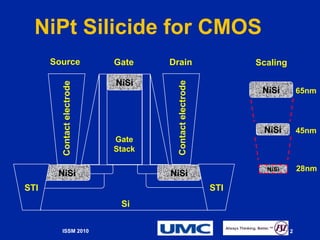
NiPt Silicide for CMOS
      Source                Gate    Drain                      Scaling

                            NiSi


                                     Contact electrode
        Contact electrode

                                                                NiSi         65nm


                                                                NiSi         45nm
                            Gate
                            Stack

                                                                 NiSi        28nm
       NiSi                         NiSi
STI                                                      STI
                             Si

         ISSM 2010                                                       2    G-Number
NiSi Encroachment Defects

 Spiking


  Piping


65nm node and beyond : Ni(Pt 5-10%) replace Ni for defect control.
But … residual surface Pt removal become a challenge !!!

         ISSM 2010                                            3   G-Number
Motivations
 Tostay with current material (NiPt) and
 chemistry (SPM) for SALICIDE formation

 To   scale NiSi into 28nm CMOS device

 To   optimize wet selective etch process
  – Support the residual NiPt removal on the film
    thickness and Pt% proposed
  – Reduce the process cycle time


       ISSM 2010                                    4   G-Number
NiPt Salicide Process
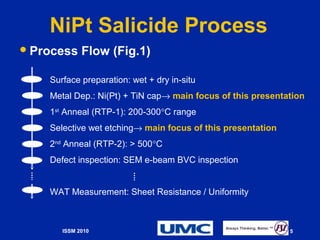
 Process    Flow (Fig.1)

    Surface preparation: wet + dry in-situ
    Metal Dep.: Ni(Pt) + TiN cap→ main focus of this presentation
    1st Anneal (RTP-1): 200-300°C range
    Selective wet etching→ main focus of this presentation
    2nd Anneal (RTP-2): > 500°C
    Defect inspection: SEM e-beam BVC inspection


    WAT Measurement: Sheet Resistance / Uniformity


       ISSM 2010                                             5   G-Number
Pt Reaction Model
 Common        Pt reaction model
  - Aqua regia base :
      Pt + 4NO3- + 8H +  Pt(4+) + NO2 + 4H2O                 Silicide
     Pt(4+) + 6Cl - + 2H +  H2PtCl6                         Attacked !

  - Hydrochloric acid base :
      Pt + 2H2O2 + 4H +  Pt(4+) + 4H2O
           Pt(4+) + 6Cl - + 2H +  H2PtCl6

  Sulfuric          Acid Peroxide Pt reaction model
  - Sulfuric acid base (main focus of this presentation)      Take place
      Pt + H2SO4 + H2O2  Pt(OH)2++ + PtO++ + H2SO3               On
                                                           high temperature


         ISSM 2010                                                 6   G-Number
Batch/SW
Processor Comparison
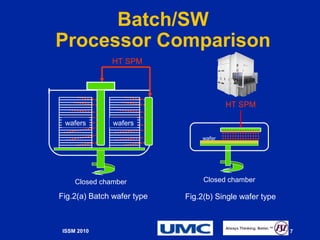
               HT SPM


                                         HT SPM

 wafers        wafers

                                 wafer


     Closed chamber              Closed chamber

Fig.2(a) Batch wafer type   Fig.2(b) Single wafer type


 ISSM 2010                                               7   G-Number
Pt% / NiPt Film Optimization
         on Rs/BVC
                                                                         increasing film thickness
 BVC Count (a.u.)


                                                      BVC Count (a.u.)
                                      x15


                    Low Pt %
                      5% Pt
                               NiPt Film  High Pt %
                                            10% Pt                          A                        B         C
                      Same NiPt film thickness                                          NiPt Thickness
                                                                              NiPt film thickness (same Pt%)


Fig.3(a) Pt additive on BVC performance               Fig. 3(b) NiPt thickness vs. BVC


                         ISSM 2010                                                                                 8   G-Number
Pt% / NiPt Film Optimization
         on Rs/BVC


                                                                                                           Sheet Resistance (a.u.)
                                         BVC Count (a.u.)
                                                                                         BVC - - -
                                                                                         Rs - - - Ο
                                                                  A              B              C

        NiPt film thickness (same Pt%)                      Linear ProgramNiPt Thickness thickness / Pt%
                                                                           for NiPt film

Fig.3(c) Ni thickness vs. Rs             Fig.3(d) Linear program for Pt Additive
                                         to NiPt film thickness for BVC and Rs


             ISSM 2010                                                                                 9                             G-Number
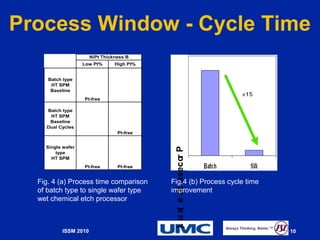
Process Window - Cycle Time
                      NiPt Thickness B
                   Low Pt%      High Pt%


     Batch type
      HT SPM
      Baseline
                   Pt-free

    Batch type
     HT SPM
     Baseline
    Dual Cycles
                                 Pt-free


    Single wafer


                                            ). u a e m ssec o P
        type


                                                             r
      HT SPM
                   Pt-free       Pt-free


  Fig. 4 (a) Process time comparison       Fig.4 (b) Process cycle time
  of batch type to single wafer type       improvement
                                                     it

  wet chemical etch processor
                                               . (


          ISSM 2010                                                       10   G-Number
Process Window – SW Time

                   SPM
                 Process      90       120       150       180       210
                 time (s)

                     A      Pt-free   Pt-free   Pt-free      -         -
   High Pt%
NiPt Thickness       B         -      Pt-free   Pt-free   Pt-free      -
      (Å)
                     C         -         -      Pt-free   Pt-free   Pt-free

 Table 1 Process window of single wafer wet etch processor over various
 Pt additive and NiPt film thickness


         ISSM 2010                                                            11   G-Number
Process Selectivity
Rs Uniformity Variation Range
a               N_Diff                   b         P_Diff


              NU variation range 0.45%           NU variation range 0.35%

             Process Time                        Process Time
c              N_Poly                    d         P_Poly


              NU variation range 0.49%           NU variation range 0.35%

             Process Time                        Process Time

Fig. 5 Rs Uniformity variation range by different wet etch process times


        ISSM 2010                                                           12   G-Number
Summary
28nm NiPt Salicide process with co-optimization
of NiPt film thickness, Pt additive and the
complementary wet selective etch processor

Results
•   Satisfactory Rs/ Rs uniformity performance
•   15x Improvement on NiSi encroachment through BVC count
•   15x Improvement in cycle time with single wafer system


       ISSM 2010                                             13   G-Number

Issm 2010-po-o-102 ppt-for_cdrom_final_revised

  • 1.
    ISSM 2010 NiPt SALICIDE Process Optimization for 28nm CMOS Manufacturing James M.M. Chu (Speaker) Application Dept. Manager SE Asia/Greater China Region FSI International James.chu@fsi-intl.com ISSM 2010 1 G-Number
  • 2.
    NiPt Silicide forCMOS Source Gate Drain Scaling NiSi Contact electrode Contact electrode NiSi 65nm NiSi 45nm Gate Stack NiSi 28nm NiSi NiSi STI STI Si ISSM 2010 2 G-Number
  • 3.
    NiSi Encroachment Defects Spiking Piping 65nm node and beyond : Ni(Pt 5-10%) replace Ni for defect control. But … residual surface Pt removal become a challenge !!! ISSM 2010 3 G-Number
  • 4.
    Motivations  Tostay withcurrent material (NiPt) and chemistry (SPM) for SALICIDE formation  To scale NiSi into 28nm CMOS device  To optimize wet selective etch process – Support the residual NiPt removal on the film thickness and Pt% proposed – Reduce the process cycle time ISSM 2010 4 G-Number
  • 5.
    NiPt Salicide Process Process Flow (Fig.1) Surface preparation: wet + dry in-situ Metal Dep.: Ni(Pt) + TiN cap→ main focus of this presentation 1st Anneal (RTP-1): 200-300°C range Selective wet etching→ main focus of this presentation 2nd Anneal (RTP-2): > 500°C Defect inspection: SEM e-beam BVC inspection WAT Measurement: Sheet Resistance / Uniformity ISSM 2010 5 G-Number
  • 6.
    Pt Reaction Model Common Pt reaction model - Aqua regia base : Pt + 4NO3- + 8H +  Pt(4+) + NO2 + 4H2O Silicide Pt(4+) + 6Cl - + 2H +  H2PtCl6 Attacked ! - Hydrochloric acid base : Pt + 2H2O2 + 4H +  Pt(4+) + 4H2O Pt(4+) + 6Cl - + 2H +  H2PtCl6  Sulfuric Acid Peroxide Pt reaction model - Sulfuric acid base (main focus of this presentation) Take place Pt + H2SO4 + H2O2  Pt(OH)2++ + PtO++ + H2SO3 On high temperature ISSM 2010 6 G-Number
  • 7.
    Batch/SW Processor Comparison HT SPM HT SPM wafers wafers wafer Closed chamber Closed chamber Fig.2(a) Batch wafer type Fig.2(b) Single wafer type ISSM 2010 7 G-Number
  • 8.
    Pt% / NiPtFilm Optimization on Rs/BVC increasing film thickness BVC Count (a.u.) BVC Count (a.u.) x15 Low Pt % 5% Pt NiPt Film High Pt % 10% Pt A B C Same NiPt film thickness NiPt Thickness NiPt film thickness (same Pt%) Fig.3(a) Pt additive on BVC performance Fig. 3(b) NiPt thickness vs. BVC ISSM 2010 8 G-Number
  • 9.
    Pt% / NiPtFilm Optimization on Rs/BVC Sheet Resistance (a.u.) BVC Count (a.u.) BVC - - - Rs - - - Ο A B C NiPt film thickness (same Pt%) Linear ProgramNiPt Thickness thickness / Pt% for NiPt film Fig.3(c) Ni thickness vs. Rs Fig.3(d) Linear program for Pt Additive to NiPt film thickness for BVC and Rs ISSM 2010 9 G-Number
  • 10.
    Process Window -Cycle Time NiPt Thickness B Low Pt% High Pt% Batch type HT SPM Baseline Pt-free Batch type HT SPM Baseline Dual Cycles Pt-free Single wafer ). u a e m ssec o P type r HT SPM Pt-free Pt-free Fig. 4 (a) Process time comparison Fig.4 (b) Process cycle time of batch type to single wafer type improvement it wet chemical etch processor . ( ISSM 2010 10 G-Number
  • 11.
    Process Window –SW Time SPM Process 90 120 150 180 210 time (s) A Pt-free Pt-free Pt-free - - High Pt% NiPt Thickness B - Pt-free Pt-free Pt-free - (Å) C - - Pt-free Pt-free Pt-free Table 1 Process window of single wafer wet etch processor over various Pt additive and NiPt film thickness ISSM 2010 11 G-Number
  • 12.
    Process Selectivity Rs UniformityVariation Range a N_Diff b P_Diff NU variation range 0.45% NU variation range 0.35% Process Time Process Time c N_Poly d P_Poly NU variation range 0.49% NU variation range 0.35% Process Time Process Time Fig. 5 Rs Uniformity variation range by different wet etch process times ISSM 2010 12 G-Number
  • 13.
    Summary 28nm NiPt Salicideprocess with co-optimization of NiPt film thickness, Pt additive and the complementary wet selective etch processor Results • Satisfactory Rs/ Rs uniformity performance • 15x Improvement on NiSi encroachment through BVC count • 15x Improvement in cycle time with single wafer system ISSM 2010 13 G-Number

Editor's Notes

  • #2 Title Slide If your Presentation Title is very long you may need to use plain text instead of bold or modify the font size to fit.
  • #7 From the known chemistry to react with Platinum, mainly the chlorine play the key role as major reactant. It is known that two major approaches to generate chlorine in acidic environment, One approach is to use Aqua Regia, the relevant reaction model is in formula (1) The other approach is to use Hydrocloric Acid Peroxide Mixture (or so called HPM), the relevant reaction model is in formula (2) Through the survey from original material corrosion research, it was reported that Sulfuric acid Peroxide Mixture (SPM) will react with Platinum when temperature is high. This newly discovered application has the hypothesis reaction model as formula (3), Basically, it utilize the OH- radical which exist in high temperature SPM to react with Platinum.
  • #14 This template should only be used for on-screen presentations. Using the other templates for on-screen or PC projected presentations may result colors that appear too dark when projected and an image area that does not fill the screen. Conversely, this template should not be used for 35mm slides as it is not set up to the correct aspect ratio for that application. This template may also be used for overheads, with some modifications: Change the background to clear and text color to bright or dark colors for better visibility.