SURGERY IN BLEEDING
DIATHESIS
Dr.B.Selvaraj MS;Mch;FICS;
Professor of Surgery
Melaka Manipal Medical College
Melaka 75150 Malaysia
SURGERY IN BLEEDING
DIATHESIS
 Introduction
 Physiology Of Hemostasis
 Pre-op Evaluation
 Cases Managed
 Common Bleeding Disorders
 Surgery In Hemophiliacs
 Clinical vignettes
PLAN
SURGERY IN BLEEDING
DIATHESIS
 A challenging & fascinating problem
 Pre-existing hemostatic defects can be detected
with proper H&P and screening lab tests
 Occasionally the first sign of the defect would be
excessive intra-op bleeding
 Nightmare to any surgeon
SURGERY IN BLEEDING
DIATHESIS
PHYSIOLOGY OF
HEMOSTASIS
FOUR COMPONENTS:
 VESSEL WALL RESPONSE
 PLATELET ACTIVITIES
 COAGULATION CASCADE
 FIBRINOLYTIC SYSTEM
PHYSIOLOGY OF
HEMOSTASIS
 VESSEL WALL RESPONSE
- Intact endothelium maintain fluidity of blood
- Endothelial disruption initiates hemostasis
 PLATELET ACTIVITIES
- Adhesion to denuded endothelium by VWBF
- Aggregation into an unstable mass by
fibrinogen&Thromboxane A2
PHYSIOLOGY OF
HEMOSTASIS
PLATELET
ACTIVITIES
COAGULATION FACTORS
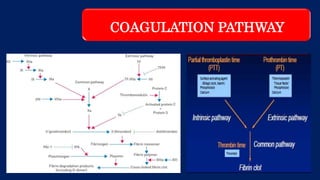
COAGULATION PATHWAY
FIBRINOLYTIC SYSTEM
PRE-OPERATIVE
EVALUATION
 Thorough personal medical history, family history& drug
ingestion history
 Physical Exam:
 Skin: Petechiae Thrombocytopenia
Ecchymosis & Hematomas Platelet dysfunction
 Joints: Hemarthrosis severe coagulation defect
 Organomegaly: Hepatomegaly Coagulopathy of Cirrhosis
Spleenomegaly Possible thrombocytopenia
PRE-OPERATIVE
EVALUATION
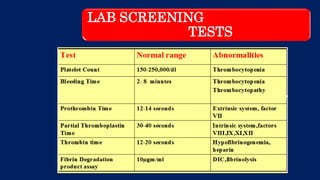
LAB SCREENING
TESTS
CASE NO: 1
 2 Yrs old 1st born male child was brought with obstructed RIH
 H/O Epistaxis & easy bruisability
 Ear boring ceremony resulted in prolonged bleeding
 Emergency, so extensive workup was not done
 Emergency herniotomy was done
CASE NO: 1
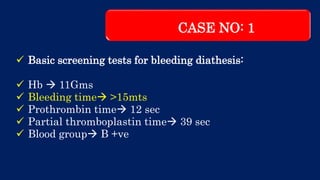
 Basic screening tests for bleeding diathesis:
 Hb  11Gms
 Bleeding time >15mts
 Prothrombin time 12 sec
 Partial thromboplastin time 39 sec
 Blood group B +ve
CASE NO: 1
 Only B.T. was prolonged
 Provisional Diagnosis: Functional Platelet problem
-Thrombocytopathy
 Emergency Herniotomy with 200 ml of fresh whole blood
 Readmitted after 10 days for prolonged bleeding from a small
cut to upper lip
 Managed by multiple WB transfusions
CASE NO: 1
 Hematological workup:
 Hb 11.5 GMs
 PCV 36%
 TC 12000/Cmm
 DC P33,L43,E18, M4
 Platlets200,000/
 Bleeding time > 15 mts
Clotting time13 mts
 Clot retraction Nil
 Clot lysis Nil
 PT 12 sec
 PTT 40 sec
 Plasma fibrinogen 280 mgms
 Factor xiii activity normal
CASE NO: 1
 PLATELET FUNCTION TESTS:
-Invivo Platelet Adhesion10.8%
-ADP Aggregation Absent
Aggregometer Studies
-ADP No Aggregation
-Collagen No Aggregation
 Thrombin Time 8sec
 Blood group B+ve
CASE NO: 1
 Normal Platelet count&morphology
 Normal Clotting tests
 Prolonged Bleeding Time
 Absent Platelet Aggregation with ADP and Collagen
 Absent Clot Retraction
 GLANZMAN`S THROMBASTHENIA
CASE NO: 2
 11 yrs old boy with no known H/O any bleeding diathesis
underwent emergency appendicectomy
 He started oozing from the operated site in immediate post-
operative period
 In subsequent interrogation parents came out with the H/O
ingestion of aspirin tablet by the boy
 Labs: BT- prolonged; PT, PTT- Normal; Platelet count- Normal
 Since this is a functional disorder of Platelets(Thrombocytopathy)
the boy was treated with Platelet concentrate
CASE NO: 3
 4 yrs old boy was brought with pain abdomen and fever for 1 day
 O/E: Abdomen- diffuse tenderness with rigidity
 AXR- erect revealed free gas under diaphragm
 Boy is a known Hemophiliac
 Laparotomy and ileal perforation closure was done with Anti
hemophilic factor
 On 2nd POD boy was oozing from the surgical site. So factor8
assay was done in hematology lab and dose of AHF was adjusted.
CASE NO: 4
 5 yrs old boy with a H/O fall over cycle bar presented with
retention of urine
 O/E: Drop of blood at uretheral meatus, perineal hematoma and
extravasation of urine were present
 Emergency SPC was done after confirming rupture urethra with
Retrograde urethrogram
 The next day the boy started bleeding from SPC site
 On subsequent interrogation parents told the boy is a known
Hemophiliac
 He was managed with AHF
Hematological Disorders Commonly
Encounter by surgeons
 Thrombocytopenia
 Thrombocytopathy
 Hemophilia- A
 Hemophilia- B- Christmas disease
 Von Willebrand Disease
 Disseminated Intravascular Coagulation
 Liver Disease– Factor vii & x deficiency
THROMBOCYTOPENIA
 Low Platelet Count
 Acquired or Inherited
 Purpura & Ecchymosis superficial bleeding
 Labs: BT- prolonged, PC- decreased, PT, PTT- Normal
 Treatment: Platelet concentrates
THROMBOCYTOPATHY
 Functional Platelet Abnormality
 Acquired due to drugs like Aspirin and Uremia
 Inherited Defective Platelet adhesion Bernard Soulier
Syndrome
Defective Platelet aggregation Glanzman’s
Thrombasthenia
 Labs: BT- Prolonged; PC,PT,PTT Normal
 Ecchymosis & Epistaxis Superficial hemorrhage
 Treatment: Platelet concentrates
HEMOPHILIA- A
 Factor viii procoagulant deficiency
 Sex linked recessive inheritance
 Deep tissue bleed & hemarthrosis
 LABS: PTT- Prolonged; PC,PT,BT- Normal
Individual factor assay
 Treatment: AHF- 1U/Kg raises the level by 2%
For 5 Kg baby 250U for 100% raise
Cryoprecipitate & FFP
HEMOPHILIA- B
 Factor ix deficiency Christmas disease
 Sex linked recessive inheritance
 Deep tissue bleed&Hemarthrosis
 LABS: PTT- Prolonged; BT,PC,PT- Normal
Individual factor assay
 Treatment: Factor 9 concentrates or FFP
VON WILLEBRAND’S
DISEASE
 Factor viii vwf deficiency
 Autosomal Dominant Inheritance
 Epistaxis, easy bruising and prolonged bleeding from
dental extraction
 LABS: BT & PTT- Prolonged; PC,PT- Normal
Individual factor assay
 Treatment: Cryoprecipitate or FFP or DDAVP
Disseminated Intravascular
Coagulation
 Thrombohemorrhagic disorder
 Acquired: Abruptio placenta, septic abortion, toxemia,
Gram-ve sepsis, massive tissue injury, snake bite Etc
 Activation of coagulation cascade Microthrombi
throughout the micro circulation
 Consumption of coagulation factors, platelets and
fibrin
 Activation of fibrinolytic system
Disseminated Intravascular
Coagulation
 Mucosal bleeding, oozing from wound sites and
ecchymosis
 LABS: BT,PC,PT,PTT,TT- all prolonged; FDP- increased
 Treat the underlying causes
 FFP & Platelete concentrates
Advanced Liver Disease
 Acquired
 Factor vii & x deficiency
 Epistaxis, Menorrhagia and Hemarthrosis
 LABS: BT,PC- normal; Factor x  PT,PTT both elevated
Factor vii PT- Prolonged; PTT- Normal;
Specific factor assays
 Treatment: FFP & Vitk
Treatment Algorithm
Surgery in Hemophiliacs
 Give Factor viii, dose calculated to bring patient’s plasma level to
100% 1 hour prior to surgery(50 units/kg q12h); Assay daily prior to
dose
 For Minor Surgery: Maintain plasma level > 60% for 1st 4days
Maintain plasma level > 20% for next 4days
 For Major Surgery: Maintain plasma level > 60% for 1st 4days
Maintain plasma level > 40% for next 4 days
 For Orthopedic Surgery: Maintain plasma level > 80% for 1st 4days
Maintain plasma level > 40% for next 4 days
Case Vignette 1
 40yrs old man c/o bleeding PR
 Colonoscopy revealed single polyp in descending colon
 Colonoscopic snare polypectomy was done
 Postop profuse bleeding+
 Labs: only B.T is prolonged; PC,PT,PTT- Normal
 Diagnosis& Treatment ?
 Answer: Diagnosis Thrombocytopathy due to aspirin ingestion
Treatment Platelet concentrates
Case Vignette 2
 3 months old congenital Biliary Atresia baby
 Was brought with purpuric skin lesions&oozing from gums
 Labs: PT&PTT- prolonged; BT,PC- Normal
 Diagnosis & Treatment ?
 Answer: Diagnosis Advanced liver disease
Treatment FFP & individual factors x & vii
Case Vignette 3
 3 days old baby was brought with H/O Hemetemesis & Melena
 O/E Well baby
 Labs: Hb –N; B.T,P.C,PT,PTT -Normal
 Diagnosis ?
 Answer: Normal baby- No pathology
Baby swallowed maternal blood during labour
and subsequently vomiting the same.
No need for any treatment
Case Vignette 4
 60 yrs old man a case of ESRD on chronic hemodialysis
 Called to see him for profuse oozing from puncture site @ AV fistula
 LABS: BT,PC,PT- normal; PTT, TT- prolonged
 Diagnosis and Treatment?
 Answer: Diagnosis: Heparin overdosage
Treatment: Protamine 1mgm counter 1 unit of heparin
Case Vignette 5
 12 yrs old girl on chronic hemodialysis for ESRD
 Uremia developed because of temporary interruption of dialysis
 Developed brisk epistaxis
 Labs:BUN-164 mgms, BT>20mts
 Diagnosis & Treatment?
 Answer: Diagnosis: Thrombocytopathy due to uremia
Treatment: Platelet concentrates
Case Vignette 6
 50 yrs old lady with severe burns injury became febrile & toxic
 Epistaxis, Hemetemesis & melena
 Wound Swab Gram –ve sepsis
 Labs: BT,PC,PT&PTT,TT- all are prolonged
 Diagnosis & Treatment?
 Answer: Diagnosis: DIC
Treatment: FFP
THANK
YOU
Subscribe to get notified
regarding my latest
uploads

Surgery in Bleeding Diathesis

  • 1.
    SURGERY IN BLEEDING DIATHESIS Dr.B.SelvarajMS;Mch;FICS; Professor of Surgery Melaka Manipal Medical College Melaka 75150 Malaysia
  • 2.
    SURGERY IN BLEEDING DIATHESIS Introduction  Physiology Of Hemostasis  Pre-op Evaluation  Cases Managed  Common Bleeding Disorders  Surgery In Hemophiliacs  Clinical vignettes PLAN
  • 3.
    SURGERY IN BLEEDING DIATHESIS A challenging & fascinating problem  Pre-existing hemostatic defects can be detected with proper H&P and screening lab tests  Occasionally the first sign of the defect would be excessive intra-op bleeding  Nightmare to any surgeon
  • 4.
  • 5.
    PHYSIOLOGY OF HEMOSTASIS FOUR COMPONENTS: VESSEL WALL RESPONSE  PLATELET ACTIVITIES  COAGULATION CASCADE  FIBRINOLYTIC SYSTEM
  • 6.
    PHYSIOLOGY OF HEMOSTASIS  VESSELWALL RESPONSE - Intact endothelium maintain fluidity of blood - Endothelial disruption initiates hemostasis  PLATELET ACTIVITIES - Adhesion to denuded endothelium by VWBF - Aggregation into an unstable mass by fibrinogen&Thromboxane A2
  • 7.
  • 8.
  • 9.
  • 10.
  • 11.
    PRE-OPERATIVE EVALUATION  Thorough personalmedical history, family history& drug ingestion history  Physical Exam:  Skin: Petechiae Thrombocytopenia Ecchymosis & Hematomas Platelet dysfunction  Joints: Hemarthrosis severe coagulation defect  Organomegaly: Hepatomegaly Coagulopathy of Cirrhosis Spleenomegaly Possible thrombocytopenia
  • 12.
  • 13.
  • 15.
    CASE NO: 1 2 Yrs old 1st born male child was brought with obstructed RIH  H/O Epistaxis & easy bruisability  Ear boring ceremony resulted in prolonged bleeding  Emergency, so extensive workup was not done  Emergency herniotomy was done
  • 16.
    CASE NO: 1 Basic screening tests for bleeding diathesis:  Hb  11Gms  Bleeding time >15mts  Prothrombin time 12 sec  Partial thromboplastin time 39 sec  Blood group B +ve
  • 17.
    CASE NO: 1 Only B.T. was prolonged  Provisional Diagnosis: Functional Platelet problem -Thrombocytopathy  Emergency Herniotomy with 200 ml of fresh whole blood  Readmitted after 10 days for prolonged bleeding from a small cut to upper lip  Managed by multiple WB transfusions
  • 18.
    CASE NO: 1 Hematological workup:  Hb 11.5 GMs  PCV 36%  TC 12000/Cmm  DC P33,L43,E18, M4  Platlets200,000/  Bleeding time > 15 mts Clotting time13 mts  Clot retraction Nil  Clot lysis Nil  PT 12 sec  PTT 40 sec  Plasma fibrinogen 280 mgms  Factor xiii activity normal
  • 19.
    CASE NO: 1 PLATELET FUNCTION TESTS: -Invivo Platelet Adhesion10.8% -ADP Aggregation Absent Aggregometer Studies -ADP No Aggregation -Collagen No Aggregation  Thrombin Time 8sec  Blood group B+ve
  • 20.
    CASE NO: 1 Normal Platelet count&morphology  Normal Clotting tests  Prolonged Bleeding Time  Absent Platelet Aggregation with ADP and Collagen  Absent Clot Retraction  GLANZMAN`S THROMBASTHENIA
  • 21.
    CASE NO: 2 11 yrs old boy with no known H/O any bleeding diathesis underwent emergency appendicectomy  He started oozing from the operated site in immediate post- operative period  In subsequent interrogation parents came out with the H/O ingestion of aspirin tablet by the boy  Labs: BT- prolonged; PT, PTT- Normal; Platelet count- Normal  Since this is a functional disorder of Platelets(Thrombocytopathy) the boy was treated with Platelet concentrate
  • 22.
    CASE NO: 3 4 yrs old boy was brought with pain abdomen and fever for 1 day  O/E: Abdomen- diffuse tenderness with rigidity  AXR- erect revealed free gas under diaphragm  Boy is a known Hemophiliac  Laparotomy and ileal perforation closure was done with Anti hemophilic factor  On 2nd POD boy was oozing from the surgical site. So factor8 assay was done in hematology lab and dose of AHF was adjusted.
  • 23.
    CASE NO: 4 5 yrs old boy with a H/O fall over cycle bar presented with retention of urine  O/E: Drop of blood at uretheral meatus, perineal hematoma and extravasation of urine were present  Emergency SPC was done after confirming rupture urethra with Retrograde urethrogram  The next day the boy started bleeding from SPC site  On subsequent interrogation parents told the boy is a known Hemophiliac  He was managed with AHF
  • 24.
    Hematological Disorders Commonly Encounterby surgeons  Thrombocytopenia  Thrombocytopathy  Hemophilia- A  Hemophilia- B- Christmas disease  Von Willebrand Disease  Disseminated Intravascular Coagulation  Liver Disease– Factor vii & x deficiency
  • 25.
    THROMBOCYTOPENIA  Low PlateletCount  Acquired or Inherited  Purpura & Ecchymosis superficial bleeding  Labs: BT- prolonged, PC- decreased, PT, PTT- Normal  Treatment: Platelet concentrates
  • 26.
    THROMBOCYTOPATHY  Functional PlateletAbnormality  Acquired due to drugs like Aspirin and Uremia  Inherited Defective Platelet adhesion Bernard Soulier Syndrome Defective Platelet aggregation Glanzman’s Thrombasthenia  Labs: BT- Prolonged; PC,PT,PTT Normal  Ecchymosis & Epistaxis Superficial hemorrhage  Treatment: Platelet concentrates
  • 27.
    HEMOPHILIA- A  Factorviii procoagulant deficiency  Sex linked recessive inheritance  Deep tissue bleed & hemarthrosis  LABS: PTT- Prolonged; PC,PT,BT- Normal Individual factor assay  Treatment: AHF- 1U/Kg raises the level by 2% For 5 Kg baby 250U for 100% raise Cryoprecipitate & FFP
  • 28.
    HEMOPHILIA- B  Factorix deficiency Christmas disease  Sex linked recessive inheritance  Deep tissue bleed&Hemarthrosis  LABS: PTT- Prolonged; BT,PC,PT- Normal Individual factor assay  Treatment: Factor 9 concentrates or FFP
  • 29.
    VON WILLEBRAND’S DISEASE  Factorviii vwf deficiency  Autosomal Dominant Inheritance  Epistaxis, easy bruising and prolonged bleeding from dental extraction  LABS: BT & PTT- Prolonged; PC,PT- Normal Individual factor assay  Treatment: Cryoprecipitate or FFP or DDAVP
  • 30.
    Disseminated Intravascular Coagulation  Thrombohemorrhagicdisorder  Acquired: Abruptio placenta, septic abortion, toxemia, Gram-ve sepsis, massive tissue injury, snake bite Etc  Activation of coagulation cascade Microthrombi throughout the micro circulation  Consumption of coagulation factors, platelets and fibrin  Activation of fibrinolytic system
  • 31.
    Disseminated Intravascular Coagulation  Mucosalbleeding, oozing from wound sites and ecchymosis  LABS: BT,PC,PT,PTT,TT- all prolonged; FDP- increased  Treat the underlying causes  FFP & Platelete concentrates
  • 32.
    Advanced Liver Disease Acquired  Factor vii & x deficiency  Epistaxis, Menorrhagia and Hemarthrosis  LABS: BT,PC- normal; Factor x  PT,PTT both elevated Factor vii PT- Prolonged; PTT- Normal; Specific factor assays  Treatment: FFP & Vitk
  • 33.
  • 34.
    Surgery in Hemophiliacs Give Factor viii, dose calculated to bring patient’s plasma level to 100% 1 hour prior to surgery(50 units/kg q12h); Assay daily prior to dose  For Minor Surgery: Maintain plasma level > 60% for 1st 4days Maintain plasma level > 20% for next 4days  For Major Surgery: Maintain plasma level > 60% for 1st 4days Maintain plasma level > 40% for next 4 days  For Orthopedic Surgery: Maintain plasma level > 80% for 1st 4days Maintain plasma level > 40% for next 4 days
  • 35.
    Case Vignette 1 40yrs old man c/o bleeding PR  Colonoscopy revealed single polyp in descending colon  Colonoscopic snare polypectomy was done  Postop profuse bleeding+  Labs: only B.T is prolonged; PC,PT,PTT- Normal  Diagnosis& Treatment ?  Answer: Diagnosis Thrombocytopathy due to aspirin ingestion Treatment Platelet concentrates
  • 36.
    Case Vignette 2 3 months old congenital Biliary Atresia baby  Was brought with purpuric skin lesions&oozing from gums  Labs: PT&PTT- prolonged; BT,PC- Normal  Diagnosis & Treatment ?  Answer: Diagnosis Advanced liver disease Treatment FFP & individual factors x & vii
  • 37.
    Case Vignette 3 3 days old baby was brought with H/O Hemetemesis & Melena  O/E Well baby  Labs: Hb –N; B.T,P.C,PT,PTT -Normal  Diagnosis ?  Answer: Normal baby- No pathology Baby swallowed maternal blood during labour and subsequently vomiting the same. No need for any treatment
  • 38.
    Case Vignette 4 60 yrs old man a case of ESRD on chronic hemodialysis  Called to see him for profuse oozing from puncture site @ AV fistula  LABS: BT,PC,PT- normal; PTT, TT- prolonged  Diagnosis and Treatment?  Answer: Diagnosis: Heparin overdosage Treatment: Protamine 1mgm counter 1 unit of heparin
  • 39.
    Case Vignette 5 12 yrs old girl on chronic hemodialysis for ESRD  Uremia developed because of temporary interruption of dialysis  Developed brisk epistaxis  Labs:BUN-164 mgms, BT>20mts  Diagnosis & Treatment?  Answer: Diagnosis: Thrombocytopathy due to uremia Treatment: Platelet concentrates
  • 40.
    Case Vignette 6 50 yrs old lady with severe burns injury became febrile & toxic  Epistaxis, Hemetemesis & melena  Wound Swab Gram –ve sepsis  Labs: BT,PC,PT&PTT,TT- all are prolonged  Diagnosis & Treatment?  Answer: Diagnosis: DIC Treatment: FFP
  • 41.
    THANK YOU Subscribe to getnotified regarding my latest uploads