APPROACH TO A
BLEEDING CHILD
D R . S U R A B H I P E R I W A L
1 S T Y R P G T
S C B M C H
CONTENTS
1. PHYSIOLOGY OF HEMOSTASIS
2. CLINICAL & LABORATORY EVALUATION OF HEMOSTASIS
3. CASE SCENARIO I
4. HEREDITARY CLOTTING FACTOR DEFICIENCIES
5. CASE SCENARIO II
6. PLATELET DISORDERS
7. CASE SCENARIO III
8. BLOOD VESSEL DISORDERS
9. SUMMARY
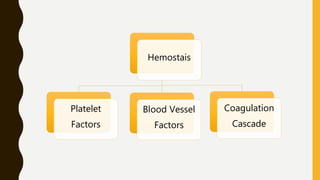
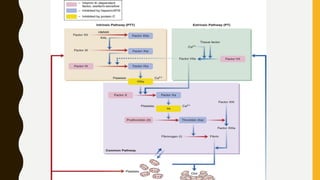
Hemostais
Coagulation
Cascade
Blood Vessel
Factors
Platelet
Factors
HEMOSTASIS
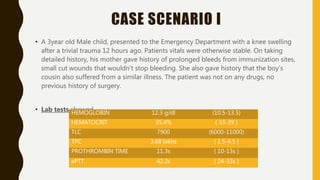
CASE SCENARIO I
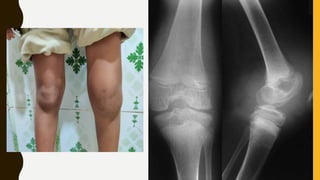
• A 3year old Male child, presented to the Emergency Department with a knee swelling
after a trivial trauma 12 hours ago. Patients vitals were otherwise stable. On taking
detailed history, his mother gave history of prolonged bleeds from immunization sites,
small cut wounds that wouldn’t stop bleeding. She also gave history that the boy’s
cousin also suffered from a similar illness. The patient was not on any drugs, no
previous history of surgery.
• Lab tests showed -HEMOGLOBIN 12.3 g/dl (10.5-13.5)
HEMATOCRIT 35.4% ( 33-39 )
TLC 7900 (6000-11000)
TPC 3.68 lakhs ( 1.5-4.5 )
PROTHROMBIN TIME 11.3s ( 10-13s )
aPTT 42.2s ( 24-33s )
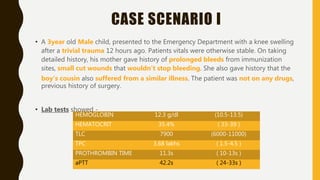
CASE SCENARIO I
• A 3year old Male child, presented to the Emergency Department with a knee swelling
after a trivial trauma 12 hours ago. Patients vitals were otherwise stable. On taking
detailed history, his mother gave history of prolonged bleeds from immunization
sites, small cut wounds that wouldn’t stop bleeding. She also gave history that the
boy’s cousin also suffered from a similar illness. The patient was not on any drugs,
previous history of surgery.
• Lab tests showed -
HEMOGLOBIN 12.3 g/dl (10.5-13.5)
HEMATOCRIT 35.4% ( 33-39 )
TLC 7900 (6000-11000)
TPC 3.68 lakhs ( 1.5-4.5 )
PROTHROMBIN TIME 11.3s ( 10-13s )
aPTT 42.2s ( 24-33s )
HEMOPHILIA A/B
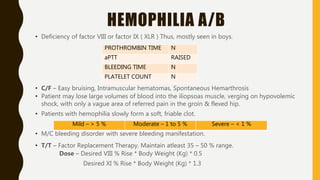
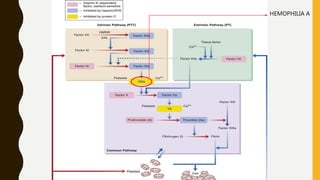
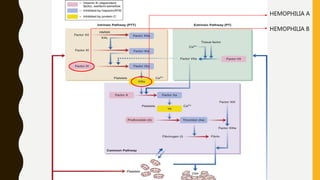
• Deficiency of factor VIII or factor IX ( XLR ) Thus, mostly seen in boys.
• C/F – Easy bruising, Intramuscular hematomas, Spontaneous Hemarthrosis
• Patient may lose large volumes of blood into the iliopsoas muscle, verging on hypovolemic
shock, with only a vague area of referred pain in the groin & flexed hip.
• Patients with hemophilia slowly form a soft, friable clot.
• M/C bleeding disorder with severe bleeding manifestation.
• T/T – Factor Replacement Therapy. Maintain atleast 35 – 50 % range.
Dose – Desired VIII % Rise * Body Weight (Kg) * 0.5
Desired XI % Rise * Body Weight (Kg) * 1.3
PROTHROMBIN TIME N
aPTT RAISED
BLEEDING TIME N
PLATELET COUNT N
Mild – > 5 % Moderate – 1 to 5 % Severe – < 1 %
HEMOSTASIS HEMOPHILIA A
HEMOPHILIA B
HEMOSTASIS HEMOPHILIA A
HEMOPHILIA B
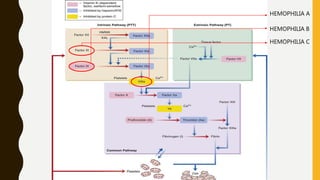
HEMOPHILIA C
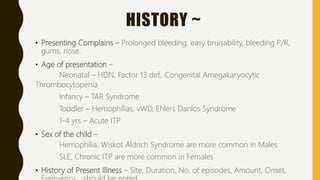
HISTORY ~
• Presenting Complains – Prolonged bleeding, easy bruisability, bleeding P/R,
gums, nose.
• Age of presentation –
Neonatal – HDN, Factor 13 def., Congenital Amegakaryocytic
Thrombocytopenia
Infancy – TAR Syndrome
Toddler – Hemophilias, vWD, Ehlers Danlos Syndrome
1-4 yrs – Acute ITP
• Sex of the child –
Hemophilia, Wiskot Aldrich Syndrome are more common in Males
SLE, Chronic ITP are more common in Females
• History of Present Illness – Site, Duration, No. of episodes, Amount, Onset,
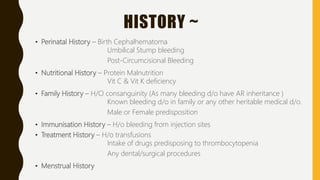
HISTORY ~
• Perinatal History – Birth Cephalhematoma
Umbilical Stump bleeding
Post-Circumcisional Bleeding
• Nutritional History – Protein Malnutrition
Vit C & Vit K deficiency
• Family History – H/O consanguinity (As many bleeding d/o have AR inheritance )
Known bleeding d/o in family or any other heritable medical d/o.
Male or Female predisposition
• Immunisation History – H/o bleeding from injection sites
• Treatment History – H/o transfusions
Intake of drugs predisposing to thrombocytopenia
Any dental/surgical procedures
• Menstrual History
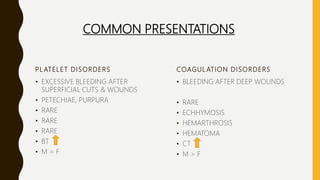
PL ATELET DISORDERS
• EXCESSIVE BLEEDING AFTER
SUPERFICIAL CUTS & WOUNDS
• PETECHIAE, PURPURA
• RARE
• RARE
• RARE
• BT
• M = F
COAGULATION DISORDERS
• BLEEDING AFTER DEEP WOUNDS
• RARE
• ECHHYMOSIS
• HEMARTHROSIS
• HEMATOMA
• CT
• M > F
COMMON PRESENTATIONS
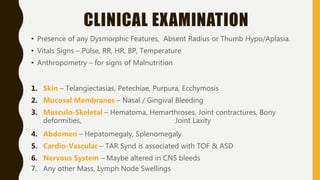
CLINICAL EXAMINATION
• Presence of any Dysmorphic Features, Absent Radius or Thumb Hypo/Aplasia.
• Vitals Signs – Pulse, RR, HR, BP, Temperature
• Anthropometry – for signs of Malnutrition
1. Skin – Telangiectasias, Petechiae, Purpura, Ecchymosis
2. Mucosal Membranes – Nasal / Gingival Bleeding
3. Musculo-Skeletal – Hematoma, Hemarthroses, Joint contractures, Bony
deformities, Joint Laxity
4. Abdomen – Hepatomegaly, Splenomegaly
5. Cardio-Vascular – TAR Synd is associated with TOF & ASD
6. Nervous System – Maybe altered in CNS bleeds
7. Any other Mass, Lymph Node Swellings
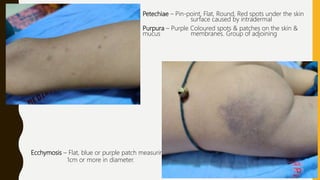
Petechiae – Pin-point, Flat, Round, Red spots under the skin
surface caused by intradermal
Purpura – Purple Coloured spots & patches on the skin &
mucus membranes. Group of adjoining
Ecchymosis – Flat, blue or purple patch measuring
1cm or more in diameter.
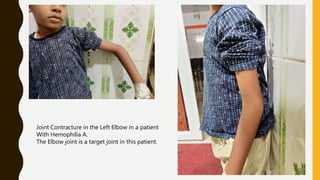
Joint Contracture in the Left Elbow in a patient
With Hemophilia A.
The Elbow joint is a target joint in this patient.
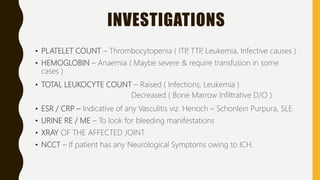
INVESTIGATIONS
• PLATELET COUNT – Thrombocytopenia ( ITP, TTP, Leukemia, Infective causes )
• HEMOGLOBIN – Anaemia ( Maybe severe & require transfusion in some
cases )
• TOTAL LEUKOCYTE COUNT – Raised ( Infections, Leukemia )
Decreased ( Bone Marrow Infiltrative D/O )
• ESR / CRP – Indicative of any Vasculitis viz. Henoch – Schonlein Purpura, SLE
• URINE RE / ME – To look for bleeding manifestations
• XRAY OF THE AFFECTED JOINT
• NCCT – If patient has any Neurological Symptoms owing to ICH.
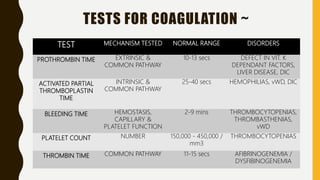
TESTS FOR COAGULATION ~
TEST MECHANISM TESTED NORMAL RANGE DISORDERS
PROTHROMBIN TIME EXTRINSIC &
COMMON PATHWAY
10-13 secs DEFECT IN VIT. K
DEPENDANT FACTORS,
LIVER DISEASE, DIC
ACTIVATED PARTIAL
THROMBOPLASTIN
TIME
INTRINSIC &
COMMON PATHWAY
25-40 secs HEMOPHILIAS, vWD, DIC
BLEEDING TIME HEMOSTASIS,
CAPILLARY &
PLATELET FUNCTION
2-9 mins THROMBOCYTOPENIAS,
THROMBASTHENIAS,
vWD
PLATELET COUNT NUMBER 150,000 - 450,000 /
mm3
THROMBOCYTOPENIAS
THROMBIN TIME COMMON PATHWAY 11-15 secs AFIBRINOGENEMIA /
DYSFIBINOGENEMIA
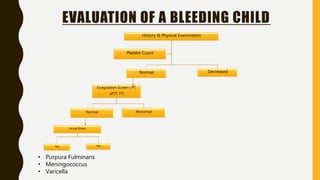
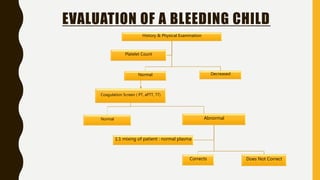
History & Physical Examination
Normal Decreased
Platelet Count
EVALUATION OF A BLEEDING CHILD
Coagulation Screen ( PT,
aPTT, TT)
Normal Abnormal
Acute Illness
Yes No
• Purpura Fulminans
• Meningococcus
• Varicella
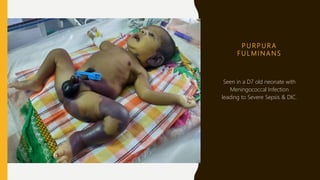
P U R P U R A
F U L M I N A N S
Seen in a D7 old neonate with
Meningococcal Infection
leading to Severe Sepsis & DIC.
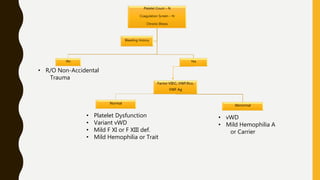
Platelet Count – N
Coagulation Screen – N
Chronic Illness
No Yes
Bleeding History
• R/O Non-Accidental
Trauma
Factor VIII:C, VWF:Rco,
VWF Ag
Normal
Abnormal
• Platelet Dysfunction
• Variant vWD
• Mild F XI or F XIII def.
• Mild Hemophilia or Trait
• vWD
• Mild Hemophilia A
or Carrier
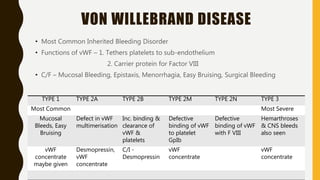
VON WILLEBRAND DISEASE
• Most Common Inherited Bleeding Disorder
• Functions of vWF – 1. Tethers platelets to sub-endothelium
2. Carrier protein for Factor VIII
• C/F – Mucosal Bleeding, Epistaxis, Menorrhagia, Easy Bruising, Surgical Bleeding
TYPE 1 TYPE 2A TYPE 2B TYPE 2M TYPE 2N TYPE 3
Most Common Most Severe
Mucosal
Bleeds, Easy
Bruising
Defect in vWF
multimerisation
Inc. binding &
clearance of
vWF &
platelets
Defective
binding of vWF
to platelet
GpIb
Defective
binding of vWF
with F VIII
Hemarthroses
& CNS bleeds
also seen
vWF
concentrate
maybe given
Desmopressin,
vWF
concentrate
C/I -
Desmopressin
vWF
concentrate
vWF
concentrate
History & Physical Examination
Normal Decreased
Platelet Count
EVALUATION OF A BLEEDING CHILD
Coagulation Screen ( PT, aPTT, TT)
Normal
AbnormalAbnormal
Corrects Does Not Correct
1:1 mixing of patient : normal plasma
Platelet Count – N
Coagulation Screen – AbN
1:1 mixing CORRECTS screen
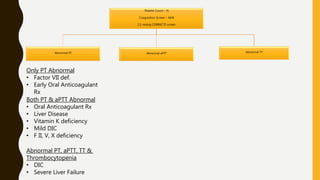
Abnormal PT Abnormal aPTT Abnormal TT
Only PT Abnormal
• Factor VII def.
• Early Oral Anticoagulant
Rx
Both PT & aPTT Abnormal
• Oral Anticoagulant Rx
• Liver Disease
• Vitamin K deficiency
• Mild DIC
• F II, V, X deficiency
Abnormal PT, aPTT, TT &
Thrombocytopenia
• DIC
• Severe Liver Failure
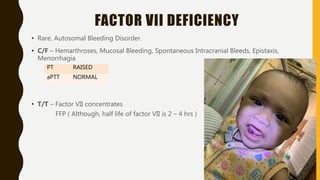
FACTOR VII DEFICIENCY
• Rare, Autosomal Bleeding Disorder.
• C/F – Hemarthroses, Mucosal Bleeding, Spontaneous Intracranial Bleeds, Epistaxis,
Menorrhagia
• T/T – Factor VII concentrates
FFP ( Although, half life of factor VII is 2 – 4 hrs )
PT RAISED
aPTT NORMAL
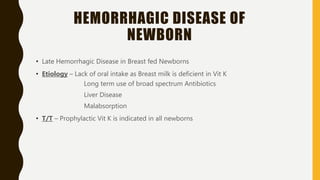
HEMORRHAGIC DISEASE OF
NEWBORN
• Late Hemorrhagic Disease in Breast fed Newborns
• Etiology – Lack of oral intake as Breast milk is deficient in Vit K
Long term use of broad spectrum Antibiotics
Liver Disease
Malabsorption
• T/T – Prophylactic Vit K is indicated in all newborns
LIVER DISEASE
• All clotting factors are exclusively produced in the liver, except F VIII
• But, bleeding episodes occur in only 15% of patients d/t concomitant reduction in anti-
coagulant proteins.
• T/T of coagulopathy is reserved for cases with clinical bleeding.
• T/T – Vitamin K therapy
Fresh Frozen Plasma
Cryoprecipitate
Desmopressin ( to augment hemostasis before Liver Biopsy )
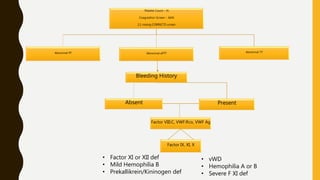
Platelet Count – N
Coagulation Screen – AbN
1:1 mixing CORRECTS screen
Abnormal PT Abnormal aPTT Abnormal TT
Bleeding History
Absent Present
Factor VIII:C, VWF:Rco, VWF Ag
Factor IX, XI, X
• Factor XI or XII def
• Mild Hemophilia B
• Prekallikrein/Kininogen def
• vWD
• Hemophilia A or B
• Severe F XI def
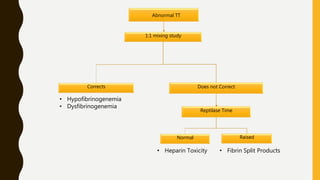
1:1 mixing study
Corrects Does not Correct
Abnormal TT
• Hypofibrinogenemia
• Dysfibrinogenemia
• Heparin Toxicity
Reptilase Time
Normal Raised
• Fibrin Split Products
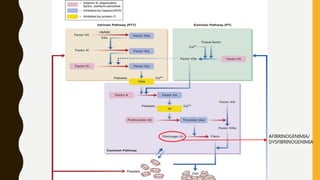
AFIBRINOGENEMIA / DYSFIBRINOGENEMIA
• Rare, Autosomal Recessive disorder
• Patients present in Neonatal period with GI bleeding, Umbilical Stump Bleeding,
Hematomas due to minor birth trauma
• Dysfibrinogenemia can present with Thrombosis.
• T/T – Human Fibrinogen Concentrate
Fresh Frozen Plasma
Cryoprecipitate
PT RAISED
aPTT RAISED
TT RAISED
HEMOSTASIS
AFIBRINOGENIMIA/
DYSFIBRINOGENIMIA
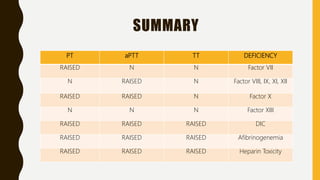
SUMMARY
PT aPTT TT DEFICIENCY
RAISED N N Factor VII
N RAISED N Factor VIII, IX, XI, XII
RAISED RAISED N Factor X
N N N Factor XIII
RAISED RAISED RAISED DIC
RAISED RAISED RAISED Afibrinogenemia
RAISED RAISED RAISED Heparin Toxicity
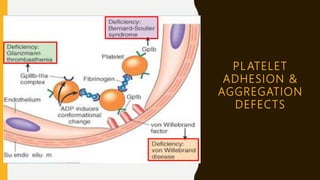
PLATELET
ADHESION &
AGGREGATION
DEFECTS
PLATELETS
• Produced by Megakaryocytes under the control of Thrombopoetin
• Life Span – 8 to 10 days
• Normal Range – 1.5 to 4.5 lakhs.
• THROMBOCYTOPENIA – Less than 1.5 lakh.
Causes : Premature destruction
Decreased production
Splenic Trapping
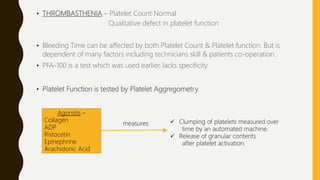
• THROMBASTHENIA – Platelet Count Normal
Qualitative defect in platelet function
• Bleeding Time can be affected by both Platelet Count & Platelet function. But is
dependent of many factors including technicians skill & patients co-operation.
• PFA-100 is a test which was used earlier, lacks specificity
• Platelet Function is tested by Platelet Aggregometry.
Agonists –
Collagen
ADP
Ristocetin
Epinephrine
Arachidonic Acid
 Clumping of platelets measured over
time by an automated machine.
 Release of granular contents
after platelet activation.
measures
BERNARD SOULIER SYNDROME
Severe Congenital platelet function disorder
Absence / Severe Def. of receptor for vWF on the platelets [ Gp Ib-IX ]
C/F – Thrombocytopenia
Giant platelets
Greatly prolonged Bleeding Time / PFA-100 Closure Time
Significant mucosal & GI bleeding
Inv – Absent Ristocetin Aggregation. Normal Aggregation with other agonists.
vWF – Normal
Confirmation by – Flow Cytometry of platelet Glycoproteins
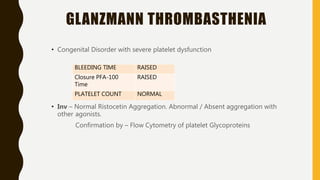
GLANZMANN THROMBASTHENIA
• Congenital Disorder with severe platelet dysfunction
• Inv – Normal Ristocetin Aggregation. Abnormal / Absent aggregation with
other agonists.
Confirmation by – Flow Cytometry of platelet Glycoproteins
BLEEDING TIME RAISED
Closure PFA-100
Time
RAISED
PLATELET COUNT NORMAL
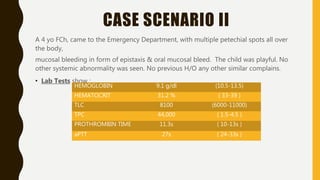
CASE SCENARIO II
A 4 yo FCh, came to the Emergency Department, with multiple petechial spots all over
the body,
mucosal bleeding in form of epistaxis & oral mucosal bleed. The child was playful. No
other systemic abnormality was seen. No previous H/O any other similar complains.
• Lab Tests show :
HEMOGLOBIN 9.1 g/dl (10.5-13.5)
HEMATOCRIT 31.2 % ( 33-39 )
TLC 8100 (6000-11000)
TPC 44,000 ( 1.5-4.5 )
PROTHROMBIN TIME 11.3s ( 10-13s )
aPTT 27s ( 24-33s )
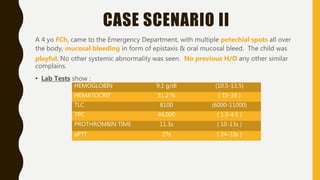
CASE SCENARIO II
A 4 yo FCh, came to the Emergency Department, with multiple petechial spots all over
the body, mucosal bleeding in form of epistaxis & oral mucosal bleed. The child was
playful. No other systemic abnormality was seen. No previous H/O any other similar
complains.
• Lab Tests show :
HEMOGLOBIN 9.1 g/dl (10.5-13.5)
HEMATOCRIT 31.2 % ( 33-39 )
TLC 8100 (6000-11000)
TPC 44,000 ( 1.5-4.5 )
PROTHROMBIN TIME 11.3s ( 10-13s )
aPTT 27s ( 24-33s )
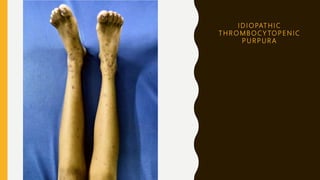
I D I O PAT H I C
T H R O M B O C Y TO P E N I C
P U R P U R A
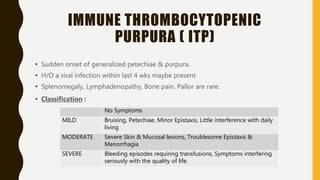
IMMUNE THROMBOCYTOPENIC
PURPURA ( ITP)
• Sudden onset of generalized petechiae & purpura.
• H/O a viral infection within last 4 wks maybe present
• Splenomegaly, Lymphadenopathy, Bone pain, Pallor are rare.
• Classification :
No Symptoms
MILD Bruising, Petechiae, Minor Epistaxis, Little interference with daily
living
MODERATE Severe Skin & Mucosal lesions, Troublesome Epistaxis &
Menorrhagia
SEVERE Bleeding episodes requiring transfusions, Symptoms interfering
seriously with the quality of life.
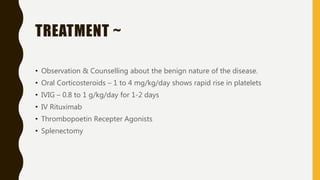
TREATMENT ~
• Observation & Counselling about the benign nature of the disease.
• Oral Corticosteroids – 1 to 4 mg/kg/day shows rapid rise in platelets
• IVIG – 0.8 to 1 g/kg/day for 1-2 days
• IV Rituximab
• Thrombopoetin Recepter Agonists
• Splenectomy
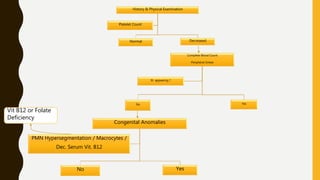
Congenital Anomalies
No Yes
PMN Hypersegmentation / Macrocytes /
Dec. Serum Vit. B12
History & Physical Examination
Normal Decreased
Platelet Count
Complete Blood Count
Peripheral Smear
No Yes
Ill- appearing ?
Vit B12 or Folate
Deficiency
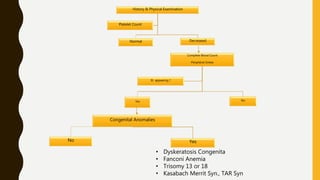
Congenital Anomalies
No Yes
History & Physical Examination
Normal Decreased
Platelet Count
Complete Blood Count
Peripheral Smear
Yes No
Ill- appearing ?
• Dyskeratosis Congenita
• Fanconi Anemia
• Trisomy 13 or 18
• Kasabach Merrit Syn., TAR Syn
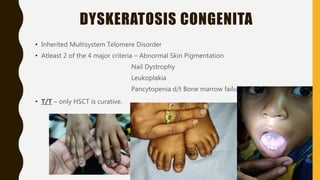
DYSKERATOSIS CONGENITA
• Inherited Multisystem Telomere Disorder
• Atleast 2 of the 4 major criteria – Abnormal Skin Pigmentation
Nail Dystrophy
Leukoplakia
Pancytopenia d/t Bone marrow failure.
• T/T – only HSCT is curative.
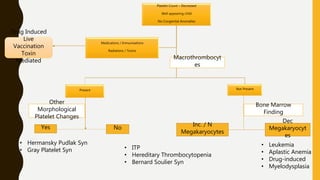
Platelet Count – Decreased
Well appearing child
No Congenital Anomalies
Present Not Present
Medications / Immunisations
Radiations / Toxins
Drug Induced
Live
Vaccination
Toxin
Mediated
Macrothrombocyt
es
Other
Morphological
Platelet Changes
Yes No
• Hermansky Pudlak Syn
• Gray Platelet Syn • ITP
• Hereditary Thrombocytopenia
• Bernard Soulier Syn
Bone Marrow
Finding
Inc. / N
Megakaryocytes
Dec
Megakaryocyt
es
• Leukemia
• Aplastic Anemia
• Drug-induced
• Myelodysplasia
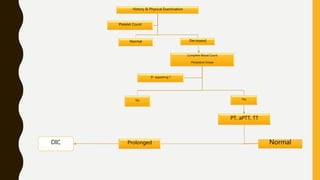
History & Physical Examination
Normal Decreased
Platelet Count
Complete Blood Count
Peripheral Smear
No Yes
Ill- appearing ?
PT, aPTT, TT
ProlongedDIC Normal
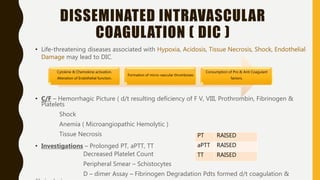
DISSEMINATED INTRAVASCULAR
COAGULATION ( DIC )
• Life-threatening diseases associated with Hypoxia, Acidosis, Tissue Necrosis, Shock, Endothelial
Damage may lead to DIC.
• C/F – Hemorrhagic Picture ( d/t resulting deficiency of F V, VIII, Prothrombin, Fibrinogen &
Platelets
Shock
Anemia ( Microangiopathic Hemolytic )
Tissue Necrosis
• Investigations – Prolonged PT, aPTT, TT
Decreased Platelet Count
Peripheral Smear – Schistocytes
D – dimer Assay – Fibrinogen Degradation Pdts formed d/t coagulation &
Cytokine & Chemokine activation.
Alteration of Endothelial function.
Formation of micro-vascular thromboses
Consumption of Pro & Anti Coagulant
factors.
PT RAISED
aPTT RAISED
TT RAISED
DIC..
• Treatment – Treat the Trigger
Correct Shock, Hypoxia, Acidosis
• Blood Components used as Replacement Therapy in cases of hemorrahage.
1. Fresh Frozen Plasma
2. Cryoprecipitate
3. Platelet Infusions
• Prognosis depends upon outcome of primary disease & prevention of end-organ
damage
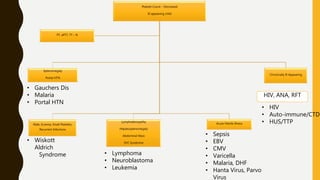
Platelet Count – Decreased
Ill appearing child
Splenomegaly
Portal HTN
Male, Eczema, Small Platelets,
Recurrent Infections
Lymphadenopathy
Hepatosplenomegaly
Abdominal Mass
SVC Syndrome
Acute Febrile Illness
Chronically Ill Appearing
PT, aPTT, TT – N
• Gauchers Dis
• Malaria
• Portal HTN
• Wiskott
Aldrich
Syndrome • Lymphoma
• Neuroblastoma
• Leukemia
• HIV
• Auto-immune/CTD
• HUS/TTP
HIV, ANA, RFT
• Sepsis
• EBV
• CMV
• Varicella
• Malaria, DHF
• Hanta Virus, Parvo
Virus
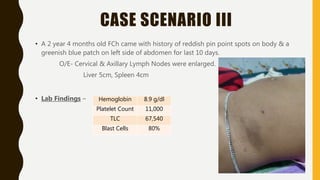
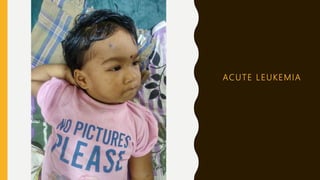
CASE SCENARIO III
• A 2 year 4 months old FCh came with history of reddish pin point spots on body & a
greenish blue patch on left side of abdomen for last 10 days.
O/E- Cervical & Axillary Lymph Nodes were enlarged.
Liver 5cm, Spleen 4cm
• Lab Findings – Hemoglobin 8.9 g/dl
Platelet Count 11,000
TLC 67,540
Blast Cells 80%
ACUTE LEUKEMIA
BLOOD VESSEL DISORDERS
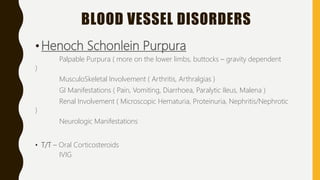
•Henoch Schonlein Purpura
Palpable Purpura ( more on the lower limbs, buttocks – gravity dependent
)
MusculoSkeletal Involvement ( Arthritis, Arthralgias )
GI Manifestations ( Pain, Vomiting, Diarrhoea, Paralytic Ileus, Malena )
Renal Involvement ( Microscopic Hematuria, Proteinuria, Nephritis/Nephrotic
)
Neurologic Manifestations
• T/T – Oral Corticosteroids
IVIG
•Ehler Danlos Syndrome
Connective tissue disorder at the level of Collagen structure & function.
Bleeding manifestations more common in Type VI (VASCULAR TYPE)
Tissue fragility & arterial rupture is seen
Majority suffer from a major vascular event within 20yrs of age.
Rupture of great vessels, Dissecting Aortic aneurysm common
Associated with high morbidity & mortality.
REFERENCES
1. NELSON TEXTBOOK OF PAEDIATRICS
2. CLINICAL PAEDIATRICS, ARUCHAMY
3. PRACTICAL ALGORITHMS IN PAEDIATRIC HEMATOLOGY & ONCOLOGY, R. H. SILLS
THANK YOU.

Approach To A Bleeding Child

  • 1.
    APPROACH TO A BLEEDINGCHILD D R . S U R A B H I P E R I W A L 1 S T Y R P G T S C B M C H
  • 2.
    CONTENTS 1. PHYSIOLOGY OFHEMOSTASIS 2. CLINICAL & LABORATORY EVALUATION OF HEMOSTASIS 3. CASE SCENARIO I 4. HEREDITARY CLOTTING FACTOR DEFICIENCIES 5. CASE SCENARIO II 6. PLATELET DISORDERS 7. CASE SCENARIO III 8. BLOOD VESSEL DISORDERS 9. SUMMARY
  • 3.
  • 5.
  • 6.
    CASE SCENARIO I •A 3year old Male child, presented to the Emergency Department with a knee swelling after a trivial trauma 12 hours ago. Patients vitals were otherwise stable. On taking detailed history, his mother gave history of prolonged bleeds from immunization sites, small cut wounds that wouldn’t stop bleeding. She also gave history that the boy’s cousin also suffered from a similar illness. The patient was not on any drugs, no previous history of surgery. • Lab tests showed -HEMOGLOBIN 12.3 g/dl (10.5-13.5) HEMATOCRIT 35.4% ( 33-39 ) TLC 7900 (6000-11000) TPC 3.68 lakhs ( 1.5-4.5 ) PROTHROMBIN TIME 11.3s ( 10-13s ) aPTT 42.2s ( 24-33s )
  • 7.
    CASE SCENARIO I •A 3year old Male child, presented to the Emergency Department with a knee swelling after a trivial trauma 12 hours ago. Patients vitals were otherwise stable. On taking detailed history, his mother gave history of prolonged bleeds from immunization sites, small cut wounds that wouldn’t stop bleeding. She also gave history that the boy’s cousin also suffered from a similar illness. The patient was not on any drugs, previous history of surgery. • Lab tests showed - HEMOGLOBIN 12.3 g/dl (10.5-13.5) HEMATOCRIT 35.4% ( 33-39 ) TLC 7900 (6000-11000) TPC 3.68 lakhs ( 1.5-4.5 ) PROTHROMBIN TIME 11.3s ( 10-13s ) aPTT 42.2s ( 24-33s )
  • 9.
    HEMOPHILIA A/B • Deficiencyof factor VIII or factor IX ( XLR ) Thus, mostly seen in boys. • C/F – Easy bruising, Intramuscular hematomas, Spontaneous Hemarthrosis • Patient may lose large volumes of blood into the iliopsoas muscle, verging on hypovolemic shock, with only a vague area of referred pain in the groin & flexed hip. • Patients with hemophilia slowly form a soft, friable clot. • M/C bleeding disorder with severe bleeding manifestation. • T/T – Factor Replacement Therapy. Maintain atleast 35 – 50 % range. Dose – Desired VIII % Rise * Body Weight (Kg) * 0.5 Desired XI % Rise * Body Weight (Kg) * 1.3 PROTHROMBIN TIME N aPTT RAISED BLEEDING TIME N PLATELET COUNT N Mild – > 5 % Moderate – 1 to 5 % Severe – < 1 %
  • 10.
  • 11.
  • 12.
  • 13.
    HISTORY ~ • PresentingComplains – Prolonged bleeding, easy bruisability, bleeding P/R, gums, nose. • Age of presentation – Neonatal – HDN, Factor 13 def., Congenital Amegakaryocytic Thrombocytopenia Infancy – TAR Syndrome Toddler – Hemophilias, vWD, Ehlers Danlos Syndrome 1-4 yrs – Acute ITP • Sex of the child – Hemophilia, Wiskot Aldrich Syndrome are more common in Males SLE, Chronic ITP are more common in Females • History of Present Illness – Site, Duration, No. of episodes, Amount, Onset,
  • 14.
    HISTORY ~ • PerinatalHistory – Birth Cephalhematoma Umbilical Stump bleeding Post-Circumcisional Bleeding • Nutritional History – Protein Malnutrition Vit C & Vit K deficiency • Family History – H/O consanguinity (As many bleeding d/o have AR inheritance ) Known bleeding d/o in family or any other heritable medical d/o. Male or Female predisposition • Immunisation History – H/o bleeding from injection sites • Treatment History – H/o transfusions Intake of drugs predisposing to thrombocytopenia Any dental/surgical procedures • Menstrual History
  • 15.
    PL ATELET DISORDERS •EXCESSIVE BLEEDING AFTER SUPERFICIAL CUTS & WOUNDS • PETECHIAE, PURPURA • RARE • RARE • RARE • BT • M = F COAGULATION DISORDERS • BLEEDING AFTER DEEP WOUNDS • RARE • ECHHYMOSIS • HEMARTHROSIS • HEMATOMA • CT • M > F COMMON PRESENTATIONS
  • 16.
    CLINICAL EXAMINATION • Presenceof any Dysmorphic Features, Absent Radius or Thumb Hypo/Aplasia. • Vitals Signs – Pulse, RR, HR, BP, Temperature • Anthropometry – for signs of Malnutrition 1. Skin – Telangiectasias, Petechiae, Purpura, Ecchymosis 2. Mucosal Membranes – Nasal / Gingival Bleeding 3. Musculo-Skeletal – Hematoma, Hemarthroses, Joint contractures, Bony deformities, Joint Laxity 4. Abdomen – Hepatomegaly, Splenomegaly 5. Cardio-Vascular – TAR Synd is associated with TOF & ASD 6. Nervous System – Maybe altered in CNS bleeds 7. Any other Mass, Lymph Node Swellings
  • 17.
    Petechiae – Pin-point,Flat, Round, Red spots under the skin surface caused by intradermal Purpura – Purple Coloured spots & patches on the skin & mucus membranes. Group of adjoining Ecchymosis – Flat, blue or purple patch measuring 1cm or more in diameter.
  • 18.
    Joint Contracture inthe Left Elbow in a patient With Hemophilia A. The Elbow joint is a target joint in this patient.
  • 19.
    INVESTIGATIONS • PLATELET COUNT– Thrombocytopenia ( ITP, TTP, Leukemia, Infective causes ) • HEMOGLOBIN – Anaemia ( Maybe severe & require transfusion in some cases ) • TOTAL LEUKOCYTE COUNT – Raised ( Infections, Leukemia ) Decreased ( Bone Marrow Infiltrative D/O ) • ESR / CRP – Indicative of any Vasculitis viz. Henoch – Schonlein Purpura, SLE • URINE RE / ME – To look for bleeding manifestations • XRAY OF THE AFFECTED JOINT • NCCT – If patient has any Neurological Symptoms owing to ICH.
  • 20.
    TESTS FOR COAGULATION~ TEST MECHANISM TESTED NORMAL RANGE DISORDERS PROTHROMBIN TIME EXTRINSIC & COMMON PATHWAY 10-13 secs DEFECT IN VIT. K DEPENDANT FACTORS, LIVER DISEASE, DIC ACTIVATED PARTIAL THROMBOPLASTIN TIME INTRINSIC & COMMON PATHWAY 25-40 secs HEMOPHILIAS, vWD, DIC BLEEDING TIME HEMOSTASIS, CAPILLARY & PLATELET FUNCTION 2-9 mins THROMBOCYTOPENIAS, THROMBASTHENIAS, vWD PLATELET COUNT NUMBER 150,000 - 450,000 / mm3 THROMBOCYTOPENIAS THROMBIN TIME COMMON PATHWAY 11-15 secs AFIBRINOGENEMIA / DYSFIBINOGENEMIA
  • 21.
    History & PhysicalExamination Normal Decreased Platelet Count EVALUATION OF A BLEEDING CHILD Coagulation Screen ( PT, aPTT, TT) Normal Abnormal Acute Illness Yes No • Purpura Fulminans • Meningococcus • Varicella
  • 22.
    P U RP U R A F U L M I N A N S Seen in a D7 old neonate with Meningococcal Infection leading to Severe Sepsis & DIC.
  • 23.
    Platelet Count –N Coagulation Screen – N Chronic Illness No Yes Bleeding History • R/O Non-Accidental Trauma Factor VIII:C, VWF:Rco, VWF Ag Normal Abnormal • Platelet Dysfunction • Variant vWD • Mild F XI or F XIII def. • Mild Hemophilia or Trait • vWD • Mild Hemophilia A or Carrier
  • 24.
    VON WILLEBRAND DISEASE •Most Common Inherited Bleeding Disorder • Functions of vWF – 1. Tethers platelets to sub-endothelium 2. Carrier protein for Factor VIII • C/F – Mucosal Bleeding, Epistaxis, Menorrhagia, Easy Bruising, Surgical Bleeding TYPE 1 TYPE 2A TYPE 2B TYPE 2M TYPE 2N TYPE 3 Most Common Most Severe Mucosal Bleeds, Easy Bruising Defect in vWF multimerisation Inc. binding & clearance of vWF & platelets Defective binding of vWF to platelet GpIb Defective binding of vWF with F VIII Hemarthroses & CNS bleeds also seen vWF concentrate maybe given Desmopressin, vWF concentrate C/I - Desmopressin vWF concentrate vWF concentrate
  • 25.
    History & PhysicalExamination Normal Decreased Platelet Count EVALUATION OF A BLEEDING CHILD Coagulation Screen ( PT, aPTT, TT) Normal AbnormalAbnormal Corrects Does Not Correct 1:1 mixing of patient : normal plasma
  • 26.
    Platelet Count –N Coagulation Screen – AbN 1:1 mixing CORRECTS screen Abnormal PT Abnormal aPTT Abnormal TT Only PT Abnormal • Factor VII def. • Early Oral Anticoagulant Rx Both PT & aPTT Abnormal • Oral Anticoagulant Rx • Liver Disease • Vitamin K deficiency • Mild DIC • F II, V, X deficiency Abnormal PT, aPTT, TT & Thrombocytopenia • DIC • Severe Liver Failure
  • 27.
    FACTOR VII DEFICIENCY •Rare, Autosomal Bleeding Disorder. • C/F – Hemarthroses, Mucosal Bleeding, Spontaneous Intracranial Bleeds, Epistaxis, Menorrhagia • T/T – Factor VII concentrates FFP ( Although, half life of factor VII is 2 – 4 hrs ) PT RAISED aPTT NORMAL
  • 28.
    HEMORRHAGIC DISEASE OF NEWBORN •Late Hemorrhagic Disease in Breast fed Newborns • Etiology – Lack of oral intake as Breast milk is deficient in Vit K Long term use of broad spectrum Antibiotics Liver Disease Malabsorption • T/T – Prophylactic Vit K is indicated in all newborns
  • 29.
    LIVER DISEASE • Allclotting factors are exclusively produced in the liver, except F VIII • But, bleeding episodes occur in only 15% of patients d/t concomitant reduction in anti- coagulant proteins. • T/T of coagulopathy is reserved for cases with clinical bleeding. • T/T – Vitamin K therapy Fresh Frozen Plasma Cryoprecipitate Desmopressin ( to augment hemostasis before Liver Biopsy )
  • 30.
    Platelet Count –N Coagulation Screen – AbN 1:1 mixing CORRECTS screen Abnormal PT Abnormal aPTT Abnormal TT Bleeding History Absent Present Factor VIII:C, VWF:Rco, VWF Ag Factor IX, XI, X • Factor XI or XII def • Mild Hemophilia B • Prekallikrein/Kininogen def • vWD • Hemophilia A or B • Severe F XI def
  • 31.
    1:1 mixing study CorrectsDoes not Correct Abnormal TT • Hypofibrinogenemia • Dysfibrinogenemia • Heparin Toxicity Reptilase Time Normal Raised • Fibrin Split Products
  • 32.
    AFIBRINOGENEMIA / DYSFIBRINOGENEMIA •Rare, Autosomal Recessive disorder • Patients present in Neonatal period with GI bleeding, Umbilical Stump Bleeding, Hematomas due to minor birth trauma • Dysfibrinogenemia can present with Thrombosis. • T/T – Human Fibrinogen Concentrate Fresh Frozen Plasma Cryoprecipitate PT RAISED aPTT RAISED TT RAISED
  • 33.
  • 34.
    SUMMARY PT aPTT TTDEFICIENCY RAISED N N Factor VII N RAISED N Factor VIII, IX, XI, XII RAISED RAISED N Factor X N N N Factor XIII RAISED RAISED RAISED DIC RAISED RAISED RAISED Afibrinogenemia RAISED RAISED RAISED Heparin Toxicity
  • 35.
  • 36.
    PLATELETS • Produced byMegakaryocytes under the control of Thrombopoetin • Life Span – 8 to 10 days • Normal Range – 1.5 to 4.5 lakhs. • THROMBOCYTOPENIA – Less than 1.5 lakh. Causes : Premature destruction Decreased production Splenic Trapping
  • 37.
    • THROMBASTHENIA –Platelet Count Normal Qualitative defect in platelet function • Bleeding Time can be affected by both Platelet Count & Platelet function. But is dependent of many factors including technicians skill & patients co-operation. • PFA-100 is a test which was used earlier, lacks specificity • Platelet Function is tested by Platelet Aggregometry. Agonists – Collagen ADP Ristocetin Epinephrine Arachidonic Acid  Clumping of platelets measured over time by an automated machine.  Release of granular contents after platelet activation. measures
  • 38.
    BERNARD SOULIER SYNDROME SevereCongenital platelet function disorder Absence / Severe Def. of receptor for vWF on the platelets [ Gp Ib-IX ] C/F – Thrombocytopenia Giant platelets Greatly prolonged Bleeding Time / PFA-100 Closure Time Significant mucosal & GI bleeding Inv – Absent Ristocetin Aggregation. Normal Aggregation with other agonists. vWF – Normal Confirmation by – Flow Cytometry of platelet Glycoproteins
  • 39.
    GLANZMANN THROMBASTHENIA • CongenitalDisorder with severe platelet dysfunction • Inv – Normal Ristocetin Aggregation. Abnormal / Absent aggregation with other agonists. Confirmation by – Flow Cytometry of platelet Glycoproteins BLEEDING TIME RAISED Closure PFA-100 Time RAISED PLATELET COUNT NORMAL
  • 40.
    CASE SCENARIO II A4 yo FCh, came to the Emergency Department, with multiple petechial spots all over the body, mucosal bleeding in form of epistaxis & oral mucosal bleed. The child was playful. No other systemic abnormality was seen. No previous H/O any other similar complains. • Lab Tests show : HEMOGLOBIN 9.1 g/dl (10.5-13.5) HEMATOCRIT 31.2 % ( 33-39 ) TLC 8100 (6000-11000) TPC 44,000 ( 1.5-4.5 ) PROTHROMBIN TIME 11.3s ( 10-13s ) aPTT 27s ( 24-33s )
  • 41.
    CASE SCENARIO II A4 yo FCh, came to the Emergency Department, with multiple petechial spots all over the body, mucosal bleeding in form of epistaxis & oral mucosal bleed. The child was playful. No other systemic abnormality was seen. No previous H/O any other similar complains. • Lab Tests show : HEMOGLOBIN 9.1 g/dl (10.5-13.5) HEMATOCRIT 31.2 % ( 33-39 ) TLC 8100 (6000-11000) TPC 44,000 ( 1.5-4.5 ) PROTHROMBIN TIME 11.3s ( 10-13s ) aPTT 27s ( 24-33s )
  • 42.
    I D IO PAT H I C T H R O M B O C Y TO P E N I C P U R P U R A
  • 43.
    IMMUNE THROMBOCYTOPENIC PURPURA (ITP) • Sudden onset of generalized petechiae & purpura. • H/O a viral infection within last 4 wks maybe present • Splenomegaly, Lymphadenopathy, Bone pain, Pallor are rare. • Classification : No Symptoms MILD Bruising, Petechiae, Minor Epistaxis, Little interference with daily living MODERATE Severe Skin & Mucosal lesions, Troublesome Epistaxis & Menorrhagia SEVERE Bleeding episodes requiring transfusions, Symptoms interfering seriously with the quality of life.
  • 44.
    TREATMENT ~ • Observation& Counselling about the benign nature of the disease. • Oral Corticosteroids – 1 to 4 mg/kg/day shows rapid rise in platelets • IVIG – 0.8 to 1 g/kg/day for 1-2 days • IV Rituximab • Thrombopoetin Recepter Agonists • Splenectomy
  • 45.
    Congenital Anomalies No Yes PMNHypersegmentation / Macrocytes / Dec. Serum Vit. B12 History & Physical Examination Normal Decreased Platelet Count Complete Blood Count Peripheral Smear No Yes Ill- appearing ? Vit B12 or Folate Deficiency
  • 46.
    Congenital Anomalies No Yes History& Physical Examination Normal Decreased Platelet Count Complete Blood Count Peripheral Smear Yes No Ill- appearing ? • Dyskeratosis Congenita • Fanconi Anemia • Trisomy 13 or 18 • Kasabach Merrit Syn., TAR Syn
  • 47.
    DYSKERATOSIS CONGENITA • InheritedMultisystem Telomere Disorder • Atleast 2 of the 4 major criteria – Abnormal Skin Pigmentation Nail Dystrophy Leukoplakia Pancytopenia d/t Bone marrow failure. • T/T – only HSCT is curative.
  • 48.
    Platelet Count –Decreased Well appearing child No Congenital Anomalies Present Not Present Medications / Immunisations Radiations / Toxins Drug Induced Live Vaccination Toxin Mediated Macrothrombocyt es Other Morphological Platelet Changes Yes No • Hermansky Pudlak Syn • Gray Platelet Syn • ITP • Hereditary Thrombocytopenia • Bernard Soulier Syn Bone Marrow Finding Inc. / N Megakaryocytes Dec Megakaryocyt es • Leukemia • Aplastic Anemia • Drug-induced • Myelodysplasia
  • 49.
    History & PhysicalExamination Normal Decreased Platelet Count Complete Blood Count Peripheral Smear No Yes Ill- appearing ? PT, aPTT, TT ProlongedDIC Normal
  • 50.
    DISSEMINATED INTRAVASCULAR COAGULATION (DIC ) • Life-threatening diseases associated with Hypoxia, Acidosis, Tissue Necrosis, Shock, Endothelial Damage may lead to DIC. • C/F – Hemorrhagic Picture ( d/t resulting deficiency of F V, VIII, Prothrombin, Fibrinogen & Platelets Shock Anemia ( Microangiopathic Hemolytic ) Tissue Necrosis • Investigations – Prolonged PT, aPTT, TT Decreased Platelet Count Peripheral Smear – Schistocytes D – dimer Assay – Fibrinogen Degradation Pdts formed d/t coagulation & Cytokine & Chemokine activation. Alteration of Endothelial function. Formation of micro-vascular thromboses Consumption of Pro & Anti Coagulant factors. PT RAISED aPTT RAISED TT RAISED
  • 51.
    DIC.. • Treatment –Treat the Trigger Correct Shock, Hypoxia, Acidosis • Blood Components used as Replacement Therapy in cases of hemorrahage. 1. Fresh Frozen Plasma 2. Cryoprecipitate 3. Platelet Infusions • Prognosis depends upon outcome of primary disease & prevention of end-organ damage
  • 52.
    Platelet Count –Decreased Ill appearing child Splenomegaly Portal HTN Male, Eczema, Small Platelets, Recurrent Infections Lymphadenopathy Hepatosplenomegaly Abdominal Mass SVC Syndrome Acute Febrile Illness Chronically Ill Appearing PT, aPTT, TT – N • Gauchers Dis • Malaria • Portal HTN • Wiskott Aldrich Syndrome • Lymphoma • Neuroblastoma • Leukemia • HIV • Auto-immune/CTD • HUS/TTP HIV, ANA, RFT • Sepsis • EBV • CMV • Varicella • Malaria, DHF • Hanta Virus, Parvo Virus
  • 53.
    CASE SCENARIO III •A 2 year 4 months old FCh came with history of reddish pin point spots on body & a greenish blue patch on left side of abdomen for last 10 days. O/E- Cervical & Axillary Lymph Nodes were enlarged. Liver 5cm, Spleen 4cm • Lab Findings – Hemoglobin 8.9 g/dl Platelet Count 11,000 TLC 67,540 Blast Cells 80%
  • 54.
  • 55.
    BLOOD VESSEL DISORDERS •HenochSchonlein Purpura Palpable Purpura ( more on the lower limbs, buttocks – gravity dependent ) MusculoSkeletal Involvement ( Arthritis, Arthralgias ) GI Manifestations ( Pain, Vomiting, Diarrhoea, Paralytic Ileus, Malena ) Renal Involvement ( Microscopic Hematuria, Proteinuria, Nephritis/Nephrotic ) Neurologic Manifestations • T/T – Oral Corticosteroids IVIG
  • 56.
    •Ehler Danlos Syndrome Connectivetissue disorder at the level of Collagen structure & function. Bleeding manifestations more common in Type VI (VASCULAR TYPE) Tissue fragility & arterial rupture is seen Majority suffer from a major vascular event within 20yrs of age. Rupture of great vessels, Dissecting Aortic aneurysm common Associated with high morbidity & mortality.
  • 57.
    REFERENCES 1. NELSON TEXTBOOKOF PAEDIATRICS 2. CLINICAL PAEDIATRICS, ARUCHAMY 3. PRACTICAL ALGORITHMS IN PAEDIATRIC HEMATOLOGY & ONCOLOGY, R. H. SILLS
  • 58.