Instruments
Surgery
TONY SCARIA 2010 MBBS
Retractor
TONY 2010 MBBS
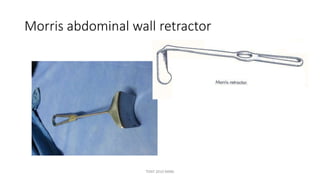
Morris abdominal wall retractor
TONY 2010 MBBS
Morris abdominal wall retractor
• In laparotomy
•
•
Retract
Retract
abdominal wall for better visualization
intraabdominal viscus coils of intestine
TONY 2010 MBBS
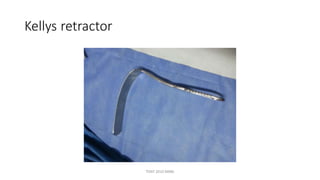
Kellys retractor
TONY 2010 MBBS
Kellys
•
retractor
Retract liver bladder uterus
TONY 2010 MBBS
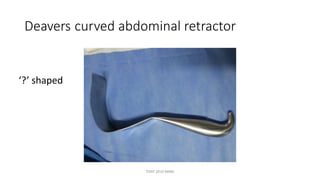
Deavers curved abdominal retractor
‘?’ shaped
TONY 2010 MBBS
Deavers curved abdominal retractor
• retract solid organs like
Retract abdominal wall
Atraumatic
liver spleen kidney
•
•
• Adequate exposure
TONY 2010 MBBS
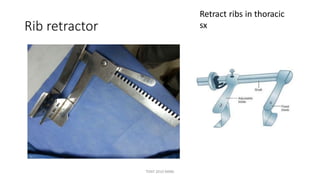
Retract
sx
ribs in thoracic
Rib retractor
TONY 2010 MBBS
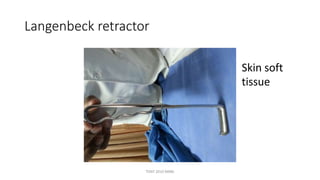
Langenbeck retractor
Skin soft
tissue
TONY 2010 MBBS
Langenbeck retractor
• Used in superficial surgeries & hernia surgeries
• retract skin superficial fascia
TONY 2010 MBBS
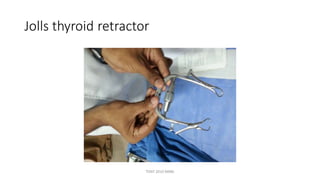
Jolls thyroid retractor
TONY 2010 MBBS
Jolls thyroid
•
retractor
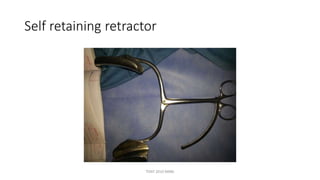
Self retaining
• To hold & tetract upper & lower skin flaps
TONY 2010 MBBS
Self retaining retractor
TONY 2010 MBBS
Forceps
TONY 2010 MBBS
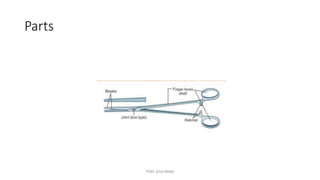
Parts
TONY 2010 MBBS
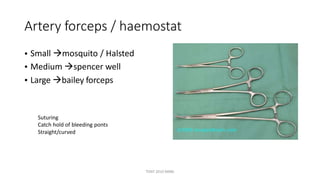
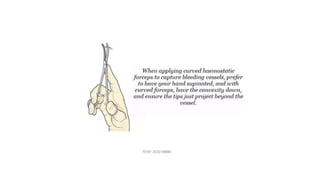
Artery forceps / haemostat
•
•
•
Small mosquito / Halsted
Medium spencer well
Large bailey forceps
Suturing
Catch hold of bleeding ponts
Straight/curved
TONY 2010 MBBS
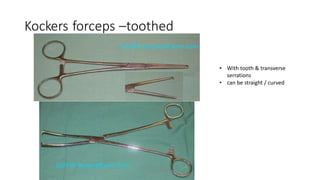
Kockers forceps –toothed
• With tooth & transverse
serrations
can be straight / curved•
TONY 2010 MBBS
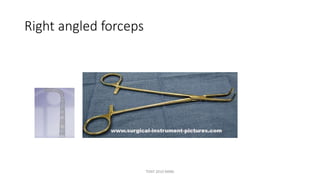
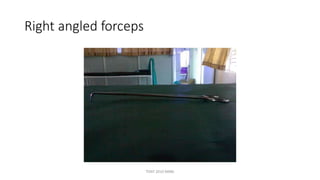
Right angled forceps
TONY 2010 MBBS
Right angled forceps
TONY 2010 MBBS
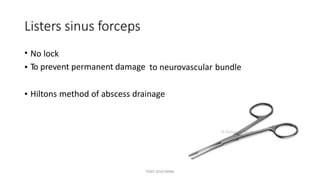
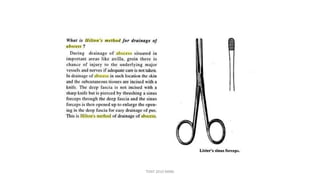
Listers sinus forceps
• No lock
To prevent permanent damage• to neurovascular bundle
• Hiltons method of abscess drainage
TONY 2010 MBBS
TONY 2010 MBBS
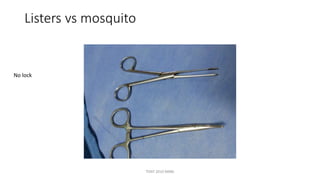
Listers vs mosquito
No lock
TONY 2010 MBBS
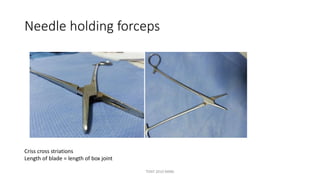
Needle holding forceps
Criss cross striations
Length of blade = length of box joint
TONY 2010 MBBS
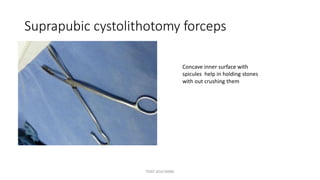
Suprapubic cystolithotomy forceps
Concave inner surface with
spicules help in holding stones
with out crushing them
TONY 2010 MBBS
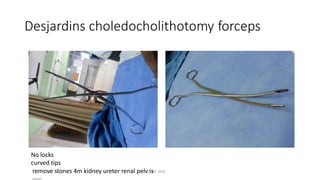
Desjardins choledocholithotomy forceps
No locks
curved tips
remove stones 4m kidney ureter renal pelvTOisNY 2010
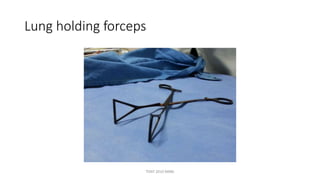
Lung holding forceps
TONY 2010 MBBS
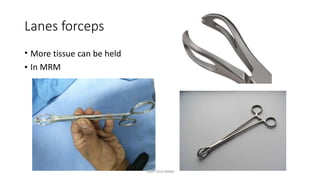
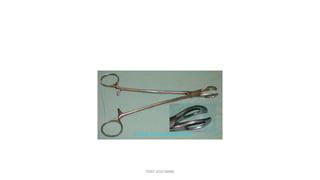
Lanes forceps
• More tissue can be held
• In MRM
TONY 2010 MBBS
TONY 2010 MBBS
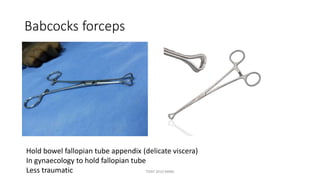
Babcocks forceps
Hold bowel fallopian tube appendix (delicate viscera)
In gynaecology to hold fallopian tube
Less traumatic TONY 2010 MBBS
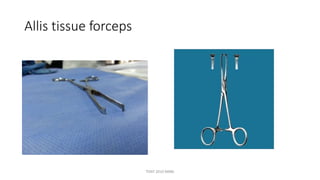
Allis tissue forceps
TONY 2010 MBBS
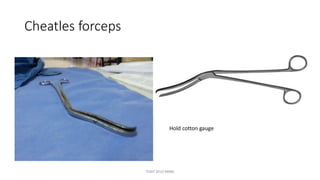
Cheatles forceps
Hold cotton gauge
TONY 2010 MBBS
Cheatles forceps
• No lock
•
•
Heavy metallic with curved
uses
blades
• Used to pick sterilized instruments & drapes to avoid touching
• Transfering from one tray to another
• Kept in savlon
TONY 2010 MBBS
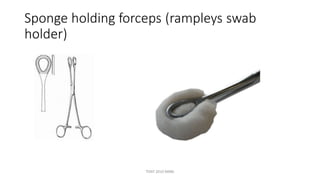
Sponge
holder)
holding forceps (rampleys swab
TONY 2010 MBBS
Sponge holding
•
forceps
Draping
Holding
Hydatid
skin
gall bladder in•
•
cholecystectomy
cyst removal
TONY 2010 MBBS
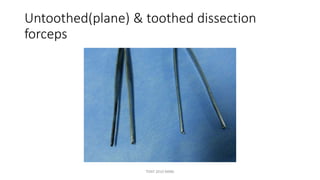
Untoothed(plane)
forceps
& toothed dissection
TONY 2010 MBBS
Plane(noon toothed) dissecting forceps
• To hold delicate viscera ,hernial sac ,bleeding vessels & nerves
TONY 2010 MBBS
Toothed
•
forceps
Hold tough structures like skin scalp rectus sheath while suturing
TONY 2010 MBBS
Clamps
TONY 2010 MBBS
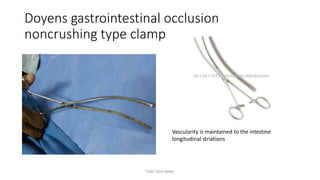
Doyens gastrointestinal occlusion
noncrushing type clamp
Vascularity is maintained to the intestine
longitudinal striations
TONY 2010 MBBS
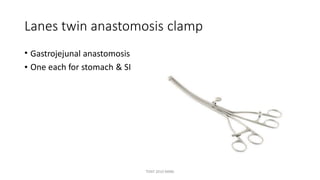
Lanes twin anastomosis
•
clamp
Gastrojejunal anastomosis
• One each for stomach & SI
TONY 2010 MBBS
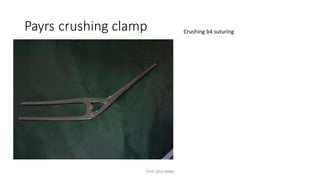
Payrs crushing clamp Crushing b4 suturing
TONY 2010 MBBS
Tubes
TONY 2010 MBBS
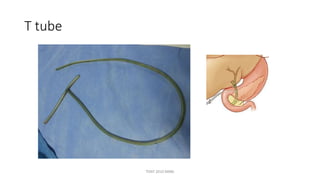
T tube
TONY 2010 MBBS
TONY 2010 MBBS
T tube use
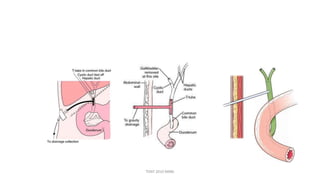
• After exploration of the common bile duct, a T-tube may be inserted
into the duct which allows bile to drain
•
•
while the sphincter of Oddi
Once the sphincter relaxes,
and into the duodenum. To
is in spasm postoperatively.
bile drains normally down the bile duct
assist choleresis, it is often advisable
which•
•
to convert the
also facilitates
lumen of
removal
the limb of the T into a gutter,
TONY 2010 MBBS
Removal
• Kept for 7-10 days
Cholangiogram b4 removal•
• To see there is free
retained stones
flow of bile into the duodenum and that there are no
• Just pull to remove .
TONY 2010 MBBS
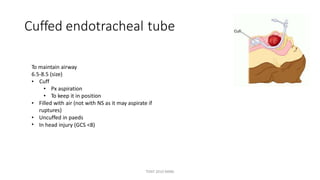
Cuffed endotracheal tube
To maintain airway
6.5-8.5 (size)
• Cuff
•
•
Px aspiration
To keep it in position
• Filled with air (not with NS as it may aspirate if
ruptures)
Uncuffed in paeds
In head injury (GCS <8)
•
•
TONY 2010 MBBS
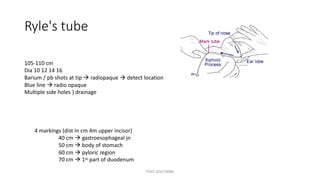
Ryle's tube
105-110 cm
Dia 10 12 14 16
Barium / pb shots at tip  radiopaque  detect location
Blue line  radio opaque
Multiple side holes } drainage
4 markings (dist in cm 4m upper incisor)
40 cm  gastroesophageal jn
50 cm  body of stomach
60 cm  pyloric region
70 cm  1st part of duodenum
TONY 2010 MBBS
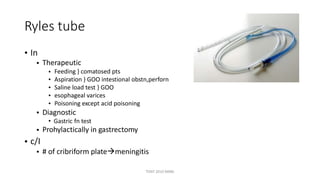
Ryles tube
• In
• Therapeutic
•
•
•
•
•
Feeding } comatosed pts
Aspiration } GOO intestional obstn,perforn
Saline load test } GOO
esophageal varices
Poisoning except acid poisoning
• Diagnostic
• Gastric fn test
Prohylactically in gastrectomy•
c/I
•
•
# of cribriform platemeningitis
TONY 2010 MBBS
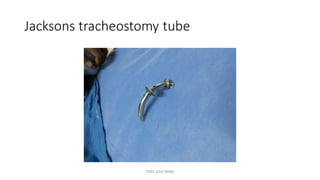
Jacksons tracheostomy tube
TONY 2010 MBBS
Catheter
TONY 2010 MBBS
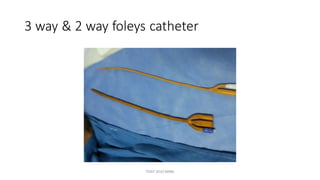
3 way & 2 way foleys catheter
TONY 2010 MBBS
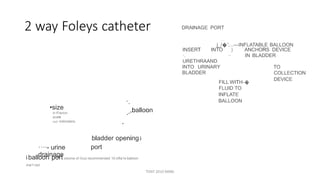
2 way Foleys catheter DRAINAGE PORT
.r::/
j_/�':...---INFLATABLE BALLOON
INSERT INTO
·.
URETHRAAND
INTO URINARY
BLADDER
) ANCHORS DEVICE
IN BLADDER··
TO
COLLECTION
DEVICE
FILL WITH-�
FLUID TO
INFLATE
BALLOON..
..,balloon•size
in French
scale
and milimeters .
bladder opening i
port····- urine
drainagei balloon portvolume of fluid recommended 10 infla1e balloon
mai1<ed
TONY 2010 MBBS
• Use 5 ml distilled water (NS will crystallise) for inflating balloon
TONY 2010 MBBS
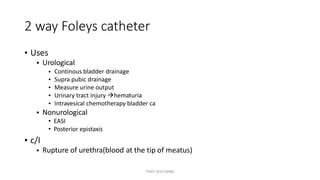
2 way Foleys catheter
• Uses
• Urological
•
•
•
•
•
Continous bladder drainage
Supra pubic drainage
Measure urine output
Urinary tract injury hematuria
Intravesical chemotherapy bladder ca
• Nonurological
• EASI
• Posterior epistaxis
• c/I
• Rupture of urethra(blood at the tip of meatus)
TONY 2010 MBBS
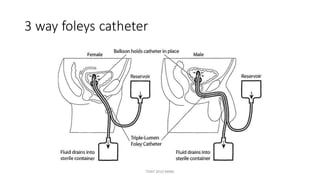
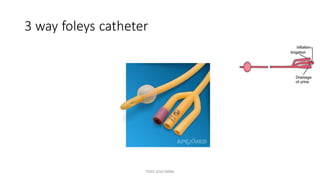
3 way foleys catheter
• In hematuria
• Continous bladder irrigation to prevent
of urine
formation of clots blocking drainage
• Postoperative irrigation of bladder as In
•
•
TURP
Prostactic Sx
TONY 2010 MBBS
3 way foleys catheter
TONY 2010 MBBS
3 way foleys catheter
TONY 2010 MBBS
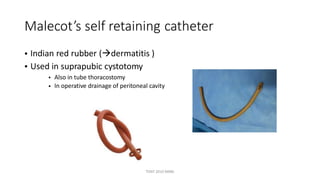
Malecot’s self retaining catheter
•
•
Indian red rubber (dermatitis )
Used in suprapubic cystotomy
•
•
Also in tube thoracostomy
In operative drainage of peritoneal cavity
TONY 2010 MBBS
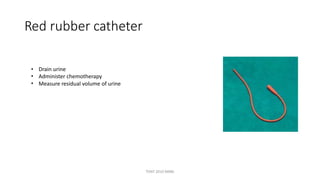
Red rubber catheter
•
•
•
Drain urine
Administer chemotherapy
Measure residual volume of urine
TONY 2010 MBBS
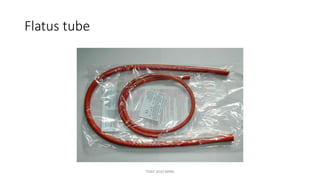
Flatus tube
TONY 2010 MBBS
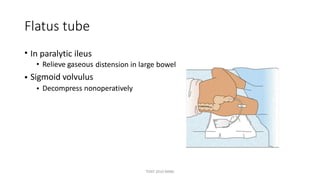
Flatus tube
• In paralytic ileus
• Relieve gaseous
Sigmoid volvulus
distension in large bowel
•
• Decompress nonoperatively
TONY 2010 MBBS
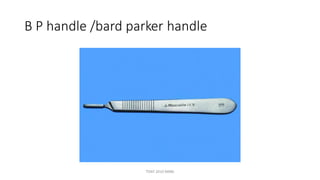
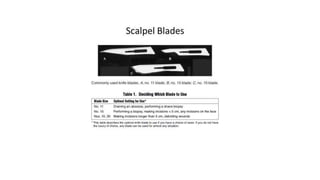
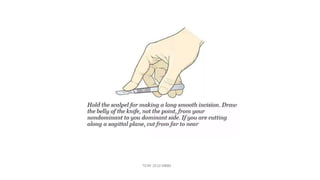
B P handle /bard parker handle
TONY 2010 MBBS
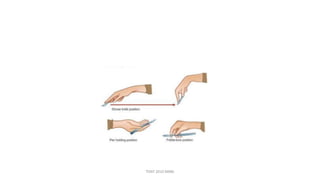
Bp
•
•
handle
Pen holding
Dinner knife holding
TONY 2010 MBBS
TONY 2010 MBBS
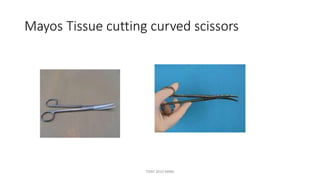
Mayos Tissue cutting curved scissors
TONY 2010 MBBS
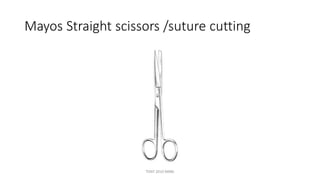
Mayos Straight scissors /suture cutting
TONY 2010 MBBS
Suturing
TONY 2010 MBBS
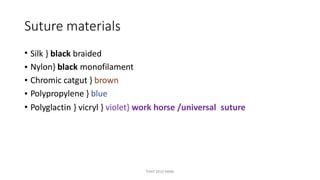
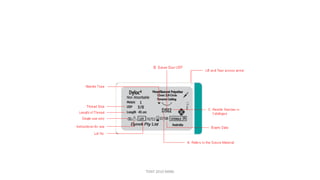
Suture materials
• Silk } black braided
Nylon} black monofilament
Chromic catgut } brown
Polypropylene } blue
•
•
•
• Polyglactin } vicryl } violet} work horse /universal suture
TONY 2010 MBBS
TONY 2010 MBBS
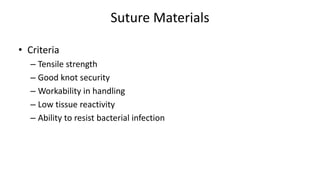
Suture Materials
• Criteria
– Tensile strength
– Good knot security
– Workability in handling
– Low tissue reactivity
– Ability to resist bacterial infection
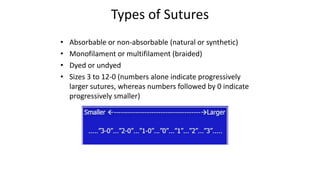
Types of Sutures
• Absorbable or non-absorbable (natural or synthetic)
• Monofilament or multifilament (braided)
• Dyed or undyed
• Sizes 3 to 12-0 (numbers alone indicate progressively
larger sutures, whereas numbers followed by 0 indicate
progressively smaller)
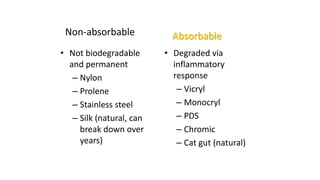
Non-absorbable
• Not biodegradable
and permanent
– Nylon
– Prolene
– Stainless steel
– Silk (natural, can
break down over
years)
• Degraded via
inflammatory
response
– Vicryl
– Monocryl
– PDS
– Chromic
– Cat gut (natural)
Absorbable
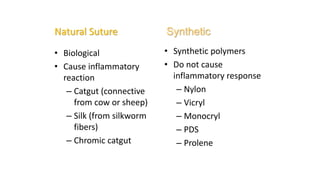
Natural Suture
• Biological
• Cause inflammatory
reaction
– Catgut (connective
from cow or sheep)
– Silk (from silkworm
fibers)
– Chromic catgut
Synthetic
• Synthetic polymers
• Do not cause
inflammatory response
– Nylon
– Vicryl
– Monocryl
– PDS
– Prolene
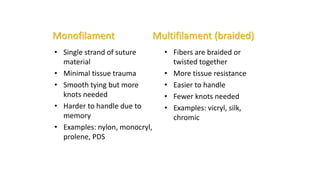
Monofilament
• Single strand of suture
material
• Minimal tissue trauma
• Smooth tying but more
knots needed
• Harder to handle due to
memory
• Examples: nylon, monocryl,
prolene, PDS
Multifilament (braided)
• Fibers are braided or
twisted together
• More tissue resistance
• Easier to handle
• Fewer knots needed
• Examples: vicryl, silk,
chromic
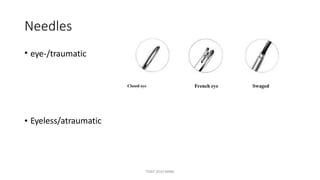
Needles
• eye-/traumatic
• Eyeless/atraumatic
TONY 2010 MBBS
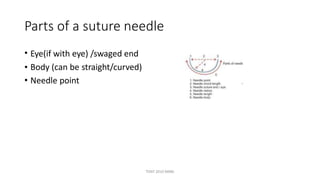
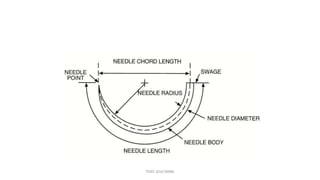
Parts of a suture needle
• Eye(if with eye) /swaged end
•
•
Body (can be straight/curved)
Needle point
TONY 2010 MBBS
TONY 2010 MBBS
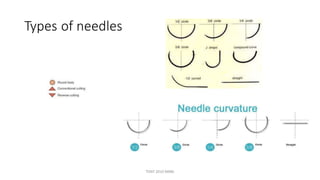
Types of needles
TONY 2010 MBBS
• Round-bodied needles
• gradually taper to a point, while triangular needles have
all three sides.
intestinal and cardiovascular surgery
Separate not to cut
cutting edges along
•
•
• Conventional cutting
• cutting edge facing the inside of the needle’s curvature,
• tough or dense tissue needs to be sutured, such as skin and fascia
reversed cutting
• cutting edge is on the outside
•
TONY 2010 MBBS
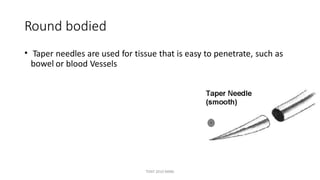
Round bodied
• Taper
bowel
needles are used for tissue that is easy to penetrate, such as
or blood Vessels
TONY 2010 MBBS
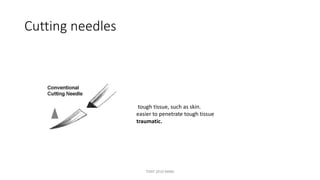
Cutting needles
tough tissue, such as skin.
easier to penetrate tough tissue
traumatic.
TONY 2010 MBBS
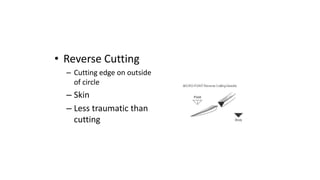
• Reverse Cutting
– Cutting edge on outside
of circle
– Skin
– Less traumatic than
cutting
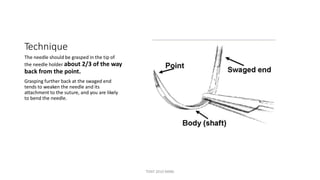
Technique
The needle should be grasped in the tip of
the needle holder about 2/3 of the way
back from the point.
Grasping further back at the swaged end
tends to weaken the needle and its
attachment to the suture, and you are likely
to bend the needle.
TONY 2010 MBBS
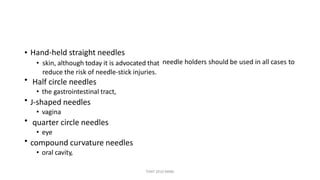
• Hand-held straight needles
• skin, although today it is advocated that
reduce the risk of needle-stick injuries.
Half circle needles
• the gastrointestinal tract,
J-shaped needles
• vagina
quarter circle needles
• eye
compound curvature needles
• oral cavity,
needle holders should be used in all cases to
•
•
•
•
TONY 2010 MBBS
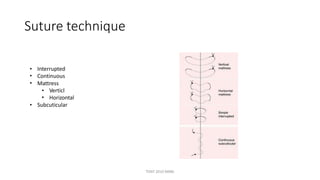
Suture technique
•
•
•
Interrupted
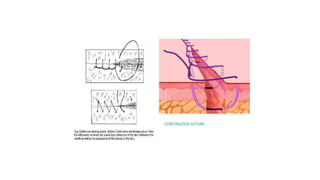
Continuous
Mattress
•
•
Verticl
Horizontal
• Subcuticular
TONY 2010 MBBS
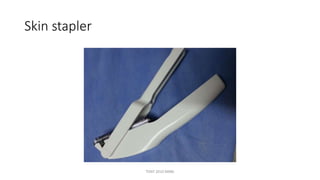
Skin stapler
TONY 2010 MBBS
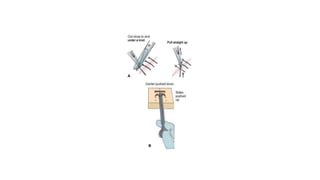
Suture removal
Varicose vein
TONY 2010 MBBS
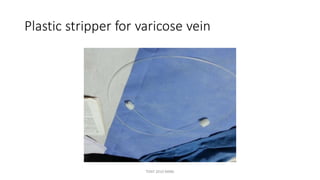
Plastic stripper for varicose vein
TONY 2010 MBBS
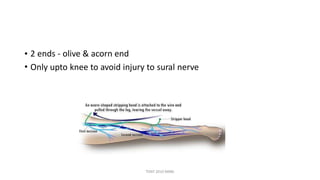
•
•
2 ends - olive & acorn end
Only upto knee to avoid injury to sural nerve
TONY 2010 MBBS
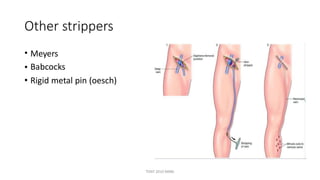
Other strippers
• Meyers
Babcocks•
• Rigid metal pin (oesch)
TONY 2010 MBBS
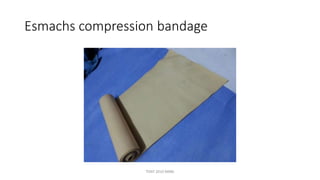
Esmachs compression bandage
TONY 2010 MBBS
Esmarch s
•
•
Transparent vein
Uses
can be seen
•
•
•
•
Perthes test
Pratts test
Tourniquet in ortho
After stripping to prevent hematoma
TONY 2010 MBBS
others
TONY 2010 MBBS
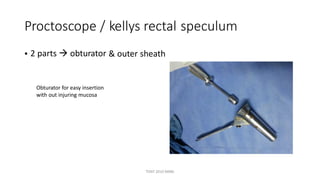
Proctoscope / kellys rectal speculum
• 2 parts  obturator & outer sheath
Obturator for easy insertion
with out injuring mucosa
TONY 2010 MBBS
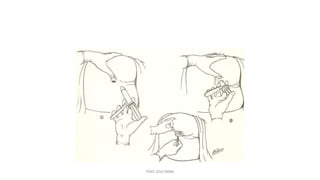
Proctoscope / kellys rectal speculum
•
•
3rdUsed to Visualise anal canal
Procedure
& lower of rectum
• Left lateral / sims position
• Directed 2ward umbilicus
• PR examn b4 proctoscopy
TONY 2010 MBBS
TONY 2010 MBBS
Proctoscope / kellys rectal speculum
• In
• Diagnostic
•
•
•
Piles / haemorrhoids } bulge in to cavity on retraction
Polyp
Ca anal canal / lower rectum
• Therapeutic
•
•
•
Injn of sclerosant
Excision of polyp
Drainage of abscess
• C/I
• In a/c fissure in ano } severe pain
TONY 2010 MBBS
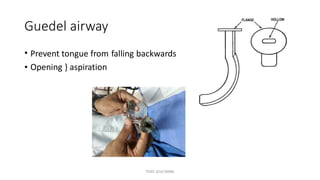
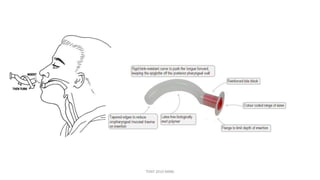
Guedel airway
• Prevent tongue from falling backwards
• Opening } aspiration
TONY 2010 MBBS
TONY 2010 MBBS
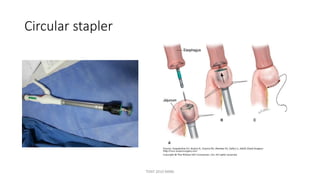
Circular stapler
TONY 2010 MBBS
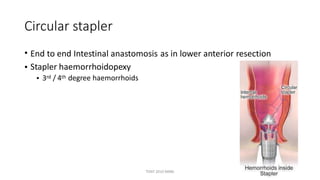
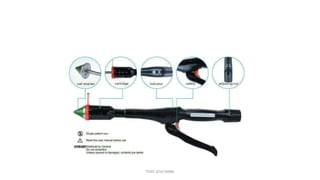
Circular stapler
• End to end Intestinal anastomosis
Stapler haemorrhoidopexy
as in lower anterior resection
•
• 3rd 4th/ degree haemorrhoids
TONY 2010 MBBS
TONY 2010 MBBS
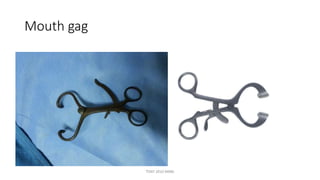
Mouth gag
TONY 2010 MBBS
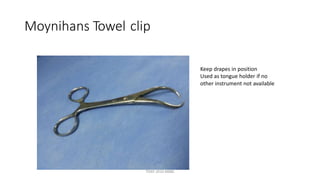
Moynihans Towel clip
Keep drapes in position
Used as tongue holder if no
other instrument not available
TONY 2010 MBBS
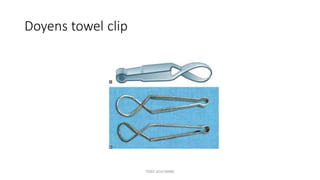
Doyens towel clip
TONY 2010 MBBS
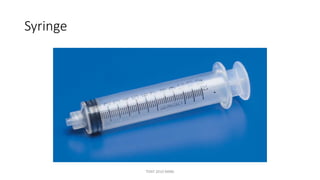
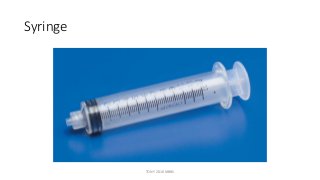
Syringe
TONY 2010 MBBS

Instruments SURGERY updated PPT