MINIMAL ACCESS
SURGERY
DR. AJAY KUMAR
2ND YEAR PG
MKCG, MCH
AIM OF THE TOPIC
 INTRODUCTION
 HISTORY
 EXTENT OF MAS
 ADVANTAGES AND DISADVANTAGES
 PREPARATION OF PATIENTS FOR MAS
 VARIOUS PROCEDURES
 COMPLICATIONS
INTRODUCTION
Defined as the application of modern technology to minimize
the trauma of surgical access without compromising the
exposure to surgical site, or the safety of patients.
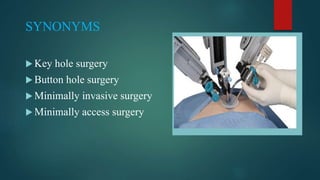
SYNONYMS
 Key hole surgery
 Button hole surgery
 Minimally invasive surgery
 Minimally access surgery
HISTORY
 1901 :- Von Ott – First inspection of abdominal cavity
 1983 :- Semm (German Gynaecologist) – First Lap. Appendicectomy.
 1985 :- Erich Muhe (German surgeon) – First Lap. Cholecystectomy.
 1987 :- Ger. – First laparoscopy hernia repair
 1989 :- Reich et al. – First Lap. Hysterectomy
 1990 :- Wickman & Fitzpatrick – MIS
 1992 :- Cuschieri - MAS
Cont…
 1993 :- Dan Stoianovici – First Robotic Laparoscopic surgery
 1994 :- Gies – First Colorectal surgery
 2001 :- NOTES (Natural Orifice Transluminal Endoscopy Surgery)
 2005 :- POEM (Per Oral Endoscopic Myotomy)
EXTENT OF MAS
 Laparoscopy
 Endoscopy
- Endoluminal
- Peri visceral
 Catheter based surgery
 Minimally invasive Robotic surgery
MOST COMMONLY DONE MAS
 Lap. Appendicectomy
 Lap. Cholecystectomy
 Diagnostic Laparoscopy
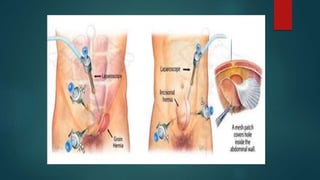
 Repair of all types of hernia
 Per oral endoscopic Myotomy
 Repair of D1 perforation
 Splenectomy
ADVANTAGES OF MAS
 Decrease in wound size
 Decrease in post operative pain
 Decrease wound infection
 Decreased risk of hernia & adhesive bowel disease
 Decrease recovery period
 Improved mobility
LIMITATIONS OF MAS
 Reliance on remote vision and operating
 Loss of tactile feedback
 Dependence on hand eye co-ordination
 Difficulty with haemostasis
 Reliance on new techniques.
 Extraction of large specimen
PREPARATION OF PATIENTS FOR MAS
 Routine investigation
 ICTC, HbSAg, HCV
 Coagulation profile
 Other blood & serum according to disease
 CXR, USG, CT Scan, MRI
 Cardiology fitness.
 Informed consent
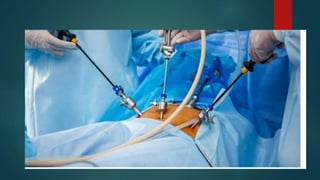
LAPAROSCOPIC SURGEY
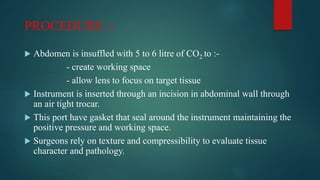
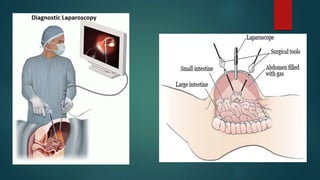
 It involves the placement of small telescope into the body cavity.
 Scope provide illumination of target tissue & convey a bright,
magnified, high definition image through attached camera system.
 These images can be attached to medical record and stored with
Radiological Picture Archiving & Communication System.
 So, images are available to :-
- Radiologist
- Pathologist
- Consultant
Cont….
 Closer the scope to target better is the
- illumination
- magnification
- image details
LIMITATION:-
 It is a monocular and provides two dimensional view of the body
displayed on a video monitor
 Limited field of vision.
Cont….
 Laparoscopic images gives the surgeon a view of surface of tissue.
 So, surgeon must adopt other methods to evaluate the tissue beneath
the surface.
 This can be done by accessing patients with cross sectional studies:-
- USG
- CT Scan
- MRI
PROCEDURE :-
 Abdomen is insuffled with 5 to 6 litre of CO2 to :-
- create working space
- allow lens to focus on target tissue
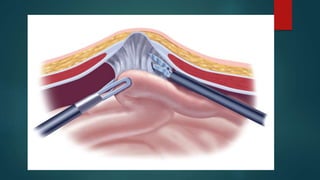
 Instrument is inserted through an incision in abdominal wall through
an air tight trocar.
 This port have gasket that seal around the instrument maintaining the
positive pressure and working space.
 Surgeons rely on texture and compressibility to evaluate tissue
character and pathology.
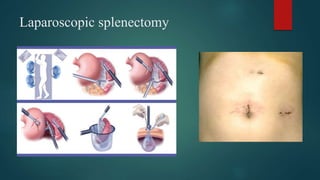
Laparoscopic splenectomy
Optimization in laparoscopy :-
 Miniaturization of diameter of surgical instrument & telescope.
 Initially 10mm telescope was used.
 At present 5mm telescope is used
 Provide same image quality and sufficient light to perform surgery
 In Mini-laparoscope : 2mm scope is used.
Have limited curvature.
SINGLE INCISION LAPAROSCOPIC
SURGERY
In SILS the entire surgical procedure is accomplished through
one incision instead of the multiple incision required in traditional
laparoscopic surgery.
There are two broad approaches to SILS
 Single-incision multi-port approach
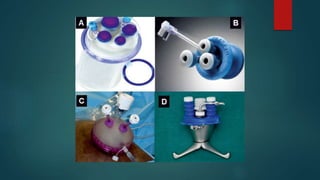
 Use of a single access device.
SINGLE INCISION MULTIPORT
APPROACH
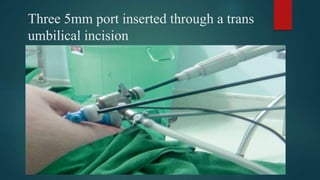
 One skin incision (commonly trans umbilical) 1.5cm-2.5cm in length
is utilized.
 After development of skin flaps the fascia is cleared over a wide area
all around.
 Either three 5mm or one 10mm and two 5mm trocars are introduced
through the incision which allow the laparoscope and operating
instruments to be introduced for carrying out the procedure.
Three 5mm port inserted through a trans
umbilical incision
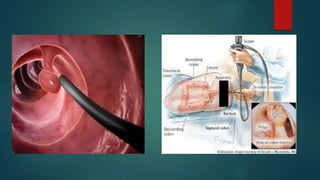
ENDOSCOPE
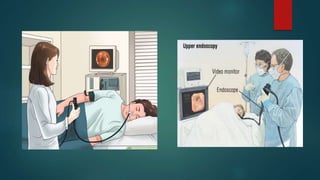
 Flexible endoscope is the instrument which passed through :
Mouth – upper GIT
Nose – respiratory tract
Rectum ( COLONOSCOPE )
 Scope is advanced by deflecting the tip of endoscope using wheels
at the handle, guided by image on monitor.
 Channel in scope provide access for instruments and lens can be
irrigated and field suctioned through the scope.
Instrument that can be used with flexible endoscope are
 Instrument for punch biopsy
 Needles for injections
 Knives for incision
 Snares to remove polyp/ FB
 Balloon to stretch stricture
 Clips to occlude bleeding vessels/ seal perforation.
SURGICAL USE OF ENDOSCOPY
 Resection of oesophageal, gastric, colonic mucosal tumours.
 Per Oral Endoscopic Myotomy (POEM)
 Gastrostomy tube insertion
 CBD Stone extraction
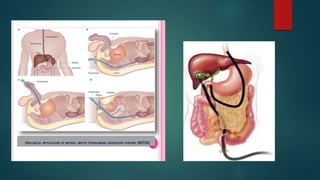
 Natural Orifice Transluminal Endoscopic Surgery (NOTES)
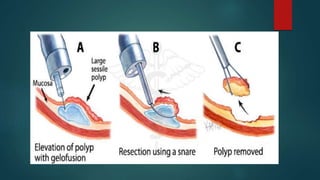
 Endoscopic Mucosal Resection (EMR)
 Endoscopic Submucosal Dissection (ESD)
NOTES
 Access to body cavity is achieved without an incision in body wall.
 Truly scar less surgery
 Access the target organ through a natural orifice
- Mouth
- Rectum
- Vagina
 For this, very long instruments are required.
Cont….
 After placing a flexible or rigid endoscope through a natural orifice,
an organ (oesophagus, stomach, colon, vagina) are perforated
intentionally.
 Endoscope is then advanced directly to target tissue.
 After the procedure is completed, opening is closed.
COMPLICATION :-
Any failure in healing results in peritonitis.
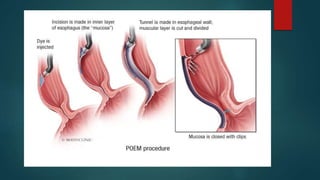
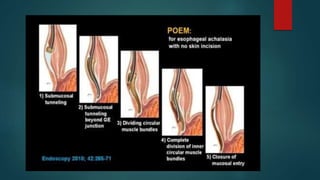
POEM
 Used for the treatment of Achalasia cardia.
 It is a natural orifice technique.
 Involves creation of long oesophageal Myotomy using a flexible
Endoscope.
STEPS:-
 Oesophageal mucosa is incised
 Tunnel is created in oesophageal wall
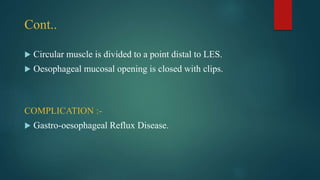
Cont..
 Circular muscle is divided to a point distal to LES.
 Oesophageal mucosal opening is closed with clips.
COMPLICATION :-
 Gastro-oesophageal Reflux Disease.
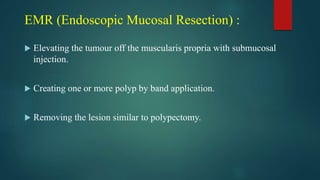
EMR (Endoscopic Mucosal Resection) :
 Elevating the tumour off the muscularis propria with submucosal
injection.
 Creating one or more polyp by band application.
 Removing the lesion similar to polypectomy.
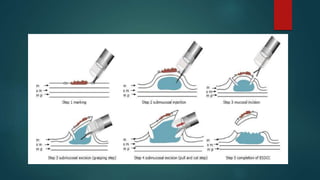
ESD (Endoscopic Submucosal Dissection)
 Elevating the tumour off the muscularis propria with submucosal
injection.
 Dissecting beneath the tumour in the submucosal plane.
 Remove the tumour en-block.
ADVANCEMENT IN ENDOSCOPY
 Combination of Flexible Endoscopy & Ultrasound transducer at
distal end.
 GIT :- Endoscopy Ultrasound (EUS).
 Bronchial tree :- Endobronchial Ultrasound.
 It describes the:
- complete thickness of wall (for staging of tumour)
- adjacent lymph nodes (for biopsy)
- adjacent structures
Cont….
 Combined with Doppler imaging, nearby vessels can be evaluated.
 Surgical procedure can be done using EUS Guidance such as pancreatic
pseudocyst drainage in stomach.
 Permits precise targeting for delivering medication directly into the
pancreas, liver and other organs.
CATHETER BASED SURGERY
 Endovascular procedure is used to treat occluded or aneurysmal
vessels.
 Imaging is provided by Fluoroscopy.
 Contrast is injected to outline the vascular anatomy.
 Instrument can be threaded along the vessel.
 Narrow vessels can be dilated with balloon and intraluminal stent can
be threaded into position guided by real time Fluoroscopy.
BENEFITS :-
 Excellent result
 Hastened recovery
 Reduced ICU stay and hospitalisation.
USES :-
 Treat coronary artery disease
 Closes septal defects
 Dilates stenotic valves
 Replaces cardiac valve.
MINIMAL INVASSIVE ROBOTIC
SURGERY
 Robotic surgery(robot assisted surgery) is the use of computer
technologies working in conjunction with robot systems to
perform surgical procedures.
 Term robot comes from Czech word “ROBOTA “ which means
forced labour.
 It was first introduced by the Czech play writer Karel Capek in
his fiction play “Rossum’s Universal Robots”.
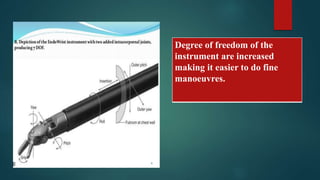
Degree of freedom of the
instrument are increased
making it easier to do fine
manoeuvres.
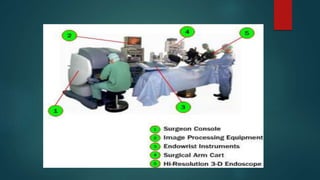
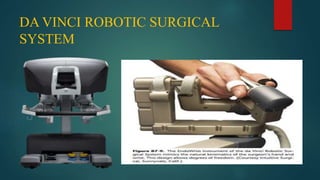
 Robot does not work autonomously but act as an interface between
operating surgeon and patients.
 Surgeons sits at a console in an ergonomic and comfortable position
and uses movement of hand and feet to control movement of
instrument and laparoscope in the patients.
 Surgeon can work from within Operating Room or remotely, as there is
no direct contact between surgeon and instrument.
 Surgical instruments are wristed near distal tip, so, the movement of
surgeon’s hand can be reproduced by the instrument without the usual
limitation of Fulcrum effect seen with traditional laparoscope
instrument.
 Longer the distance, greater the latent delay.
 Delay of > 250msec. Can have significant impact on the quality of the
surgery
Cont….
Theoretically, the surgeon can operate on patients at great distance; however,
trained personnel would still be required onsite to :
prepare the patient,
insert the ports,
dock the robot,
change instruments, and
intervene to treat complications or unexpected findings that
cannot be controlled robotically.
 Very useful for support of :-
- injured soldier
- hostile environment (outer space. Deep sea)
 Recently Robotic surgery is carried out in conjunction with Robotic
assisted anaesthesia.
 It involves an automated platform where anaesthetic agents are controlled
using computer assisted device that calculate moment to moment
anaesthesia doses in a closed loop system.
 DRAWBACK :-
- No tactile sense of tissue
- High cost
- Bulkiness & setup time
- Absence of data compelling
 USES :-
- Urology (prostatectomy)
- Cardiac (heart surgery)
- Gynecology (hysterectomy)
- ENT
- Gen. surgery
DA VINCI ROBOTIC SURGICAL
SYSTEM
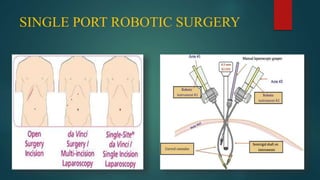
SINGLE PORT ROBOTIC SURGERY
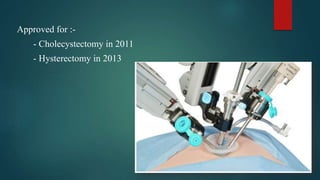
Approved for :-
- Cholecystectomy in 2011
- Hysterectomy in 2013
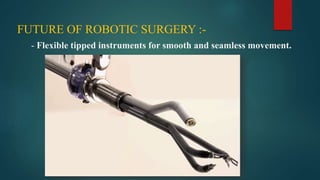
FUTURE OF ROBOTIC SURGERY :-
- Flexible tipped instruments for smooth and seamless movement.
COMPLICATIONS OF MAS
 Vascular injury.
 Visceral injury – stomach, colon, bladder.
 Thermal injury with cautery/laser
 Complications of Pneumoperitoneum :
- acidosis
- arrhythmias
- pneumothorax
- air embolism
THANK YOU

Minimal access surgery

  • 1.
    MINIMAL ACCESS SURGERY DR. AJAYKUMAR 2ND YEAR PG MKCG, MCH
  • 2.
    AIM OF THETOPIC  INTRODUCTION  HISTORY  EXTENT OF MAS  ADVANTAGES AND DISADVANTAGES  PREPARATION OF PATIENTS FOR MAS  VARIOUS PROCEDURES  COMPLICATIONS
  • 3.
    INTRODUCTION Defined as theapplication of modern technology to minimize the trauma of surgical access without compromising the exposure to surgical site, or the safety of patients.
  • 4.
    SYNONYMS  Key holesurgery  Button hole surgery  Minimally invasive surgery  Minimally access surgery
  • 5.
    HISTORY  1901 :-Von Ott – First inspection of abdominal cavity  1983 :- Semm (German Gynaecologist) – First Lap. Appendicectomy.  1985 :- Erich Muhe (German surgeon) – First Lap. Cholecystectomy.  1987 :- Ger. – First laparoscopy hernia repair  1989 :- Reich et al. – First Lap. Hysterectomy  1990 :- Wickman & Fitzpatrick – MIS  1992 :- Cuschieri - MAS
  • 6.
    Cont…  1993 :-Dan Stoianovici – First Robotic Laparoscopic surgery  1994 :- Gies – First Colorectal surgery  2001 :- NOTES (Natural Orifice Transluminal Endoscopy Surgery)  2005 :- POEM (Per Oral Endoscopic Myotomy)
  • 7.
    EXTENT OF MAS Laparoscopy  Endoscopy - Endoluminal - Peri visceral  Catheter based surgery  Minimally invasive Robotic surgery
  • 8.
    MOST COMMONLY DONEMAS  Lap. Appendicectomy  Lap. Cholecystectomy  Diagnostic Laparoscopy  Repair of all types of hernia  Per oral endoscopic Myotomy  Repair of D1 perforation  Splenectomy
  • 9.
    ADVANTAGES OF MAS Decrease in wound size  Decrease in post operative pain  Decrease wound infection  Decreased risk of hernia & adhesive bowel disease  Decrease recovery period  Improved mobility
  • 10.
    LIMITATIONS OF MAS Reliance on remote vision and operating  Loss of tactile feedback  Dependence on hand eye co-ordination  Difficulty with haemostasis  Reliance on new techniques.  Extraction of large specimen
  • 11.
    PREPARATION OF PATIENTSFOR MAS  Routine investigation  ICTC, HbSAg, HCV  Coagulation profile  Other blood & serum according to disease  CXR, USG, CT Scan, MRI  Cardiology fitness.  Informed consent
  • 12.
    LAPAROSCOPIC SURGEY  Itinvolves the placement of small telescope into the body cavity.  Scope provide illumination of target tissue & convey a bright, magnified, high definition image through attached camera system.  These images can be attached to medical record and stored with Radiological Picture Archiving & Communication System.  So, images are available to :- - Radiologist - Pathologist - Consultant
  • 14.
    Cont….  Closer thescope to target better is the - illumination - magnification - image details LIMITATION:-  It is a monocular and provides two dimensional view of the body displayed on a video monitor  Limited field of vision.
  • 15.
    Cont….  Laparoscopic imagesgives the surgeon a view of surface of tissue.  So, surgeon must adopt other methods to evaluate the tissue beneath the surface.  This can be done by accessing patients with cross sectional studies:- - USG - CT Scan - MRI
  • 16.
    PROCEDURE :-  Abdomenis insuffled with 5 to 6 litre of CO2 to :- - create working space - allow lens to focus on target tissue  Instrument is inserted through an incision in abdominal wall through an air tight trocar.  This port have gasket that seal around the instrument maintaining the positive pressure and working space.  Surgeons rely on texture and compressibility to evaluate tissue character and pathology.
  • 19.
  • 21.
    Optimization in laparoscopy:-  Miniaturization of diameter of surgical instrument & telescope.  Initially 10mm telescope was used.  At present 5mm telescope is used  Provide same image quality and sufficient light to perform surgery  In Mini-laparoscope : 2mm scope is used. Have limited curvature.
  • 22.
    SINGLE INCISION LAPAROSCOPIC SURGERY InSILS the entire surgical procedure is accomplished through one incision instead of the multiple incision required in traditional laparoscopic surgery. There are two broad approaches to SILS  Single-incision multi-port approach  Use of a single access device.
  • 23.
    SINGLE INCISION MULTIPORT APPROACH One skin incision (commonly trans umbilical) 1.5cm-2.5cm in length is utilized.  After development of skin flaps the fascia is cleared over a wide area all around.  Either three 5mm or one 10mm and two 5mm trocars are introduced through the incision which allow the laparoscope and operating instruments to be introduced for carrying out the procedure.
  • 24.
    Three 5mm portinserted through a trans umbilical incision
  • 26.
    ENDOSCOPE  Flexible endoscopeis the instrument which passed through : Mouth – upper GIT Nose – respiratory tract Rectum ( COLONOSCOPE )  Scope is advanced by deflecting the tip of endoscope using wheels at the handle, guided by image on monitor.  Channel in scope provide access for instruments and lens can be irrigated and field suctioned through the scope.
  • 29.
    Instrument that canbe used with flexible endoscope are  Instrument for punch biopsy  Needles for injections  Knives for incision  Snares to remove polyp/ FB  Balloon to stretch stricture  Clips to occlude bleeding vessels/ seal perforation.
  • 30.
    SURGICAL USE OFENDOSCOPY  Resection of oesophageal, gastric, colonic mucosal tumours.  Per Oral Endoscopic Myotomy (POEM)  Gastrostomy tube insertion  CBD Stone extraction  Natural Orifice Transluminal Endoscopic Surgery (NOTES)  Endoscopic Mucosal Resection (EMR)  Endoscopic Submucosal Dissection (ESD)
  • 31.
    NOTES  Access tobody cavity is achieved without an incision in body wall.  Truly scar less surgery  Access the target organ through a natural orifice - Mouth - Rectum - Vagina  For this, very long instruments are required.
  • 33.
    Cont….  After placinga flexible or rigid endoscope through a natural orifice, an organ (oesophagus, stomach, colon, vagina) are perforated intentionally.  Endoscope is then advanced directly to target tissue.  After the procedure is completed, opening is closed. COMPLICATION :- Any failure in healing results in peritonitis.
  • 34.
    POEM  Used forthe treatment of Achalasia cardia.  It is a natural orifice technique.  Involves creation of long oesophageal Myotomy using a flexible Endoscope. STEPS:-  Oesophageal mucosa is incised  Tunnel is created in oesophageal wall
  • 37.
    Cont..  Circular muscleis divided to a point distal to LES.  Oesophageal mucosal opening is closed with clips. COMPLICATION :-  Gastro-oesophageal Reflux Disease.
  • 38.
    EMR (Endoscopic MucosalResection) :  Elevating the tumour off the muscularis propria with submucosal injection.  Creating one or more polyp by band application.  Removing the lesion similar to polypectomy.
  • 40.
    ESD (Endoscopic SubmucosalDissection)  Elevating the tumour off the muscularis propria with submucosal injection.  Dissecting beneath the tumour in the submucosal plane.  Remove the tumour en-block.
  • 42.
    ADVANCEMENT IN ENDOSCOPY Combination of Flexible Endoscopy & Ultrasound transducer at distal end.  GIT :- Endoscopy Ultrasound (EUS).  Bronchial tree :- Endobronchial Ultrasound.  It describes the: - complete thickness of wall (for staging of tumour) - adjacent lymph nodes (for biopsy) - adjacent structures
  • 43.
    Cont….  Combined withDoppler imaging, nearby vessels can be evaluated.  Surgical procedure can be done using EUS Guidance such as pancreatic pseudocyst drainage in stomach.  Permits precise targeting for delivering medication directly into the pancreas, liver and other organs.
  • 44.
    CATHETER BASED SURGERY Endovascular procedure is used to treat occluded or aneurysmal vessels.  Imaging is provided by Fluoroscopy.  Contrast is injected to outline the vascular anatomy.  Instrument can be threaded along the vessel.  Narrow vessels can be dilated with balloon and intraluminal stent can be threaded into position guided by real time Fluoroscopy.
  • 45.
    BENEFITS :-  Excellentresult  Hastened recovery  Reduced ICU stay and hospitalisation. USES :-  Treat coronary artery disease  Closes septal defects  Dilates stenotic valves  Replaces cardiac valve.
  • 46.
    MINIMAL INVASSIVE ROBOTIC SURGERY Robotic surgery(robot assisted surgery) is the use of computer technologies working in conjunction with robot systems to perform surgical procedures.  Term robot comes from Czech word “ROBOTA “ which means forced labour.  It was first introduced by the Czech play writer Karel Capek in his fiction play “Rossum’s Universal Robots”.
  • 48.
    Degree of freedomof the instrument are increased making it easier to do fine manoeuvres.
  • 49.
     Robot doesnot work autonomously but act as an interface between operating surgeon and patients.  Surgeons sits at a console in an ergonomic and comfortable position and uses movement of hand and feet to control movement of instrument and laparoscope in the patients.  Surgeon can work from within Operating Room or remotely, as there is no direct contact between surgeon and instrument.
  • 50.
     Surgical instrumentsare wristed near distal tip, so, the movement of surgeon’s hand can be reproduced by the instrument without the usual limitation of Fulcrum effect seen with traditional laparoscope instrument.  Longer the distance, greater the latent delay.  Delay of > 250msec. Can have significant impact on the quality of the surgery
  • 51.
    Cont…. Theoretically, the surgeoncan operate on patients at great distance; however, trained personnel would still be required onsite to : prepare the patient, insert the ports, dock the robot, change instruments, and intervene to treat complications or unexpected findings that cannot be controlled robotically.
  • 52.
     Very usefulfor support of :- - injured soldier - hostile environment (outer space. Deep sea)  Recently Robotic surgery is carried out in conjunction with Robotic assisted anaesthesia.  It involves an automated platform where anaesthetic agents are controlled using computer assisted device that calculate moment to moment anaesthesia doses in a closed loop system.
  • 53.
     DRAWBACK :- -No tactile sense of tissue - High cost - Bulkiness & setup time - Absence of data compelling  USES :- - Urology (prostatectomy) - Cardiac (heart surgery) - Gynecology (hysterectomy) - ENT - Gen. surgery
  • 54.
    DA VINCI ROBOTICSURGICAL SYSTEM
  • 55.
  • 56.
    Approved for :- -Cholecystectomy in 2011 - Hysterectomy in 2013
  • 57.
    FUTURE OF ROBOTICSURGERY :- - Flexible tipped instruments for smooth and seamless movement.
  • 58.
    COMPLICATIONS OF MAS Vascular injury.  Visceral injury – stomach, colon, bladder.  Thermal injury with cautery/laser  Complications of Pneumoperitoneum : - acidosis - arrhythmias - pneumothorax - air embolism
  • 59.