CASE BASED
LEARNING
POST-OPERATIVE FEVER
POD#6= Walking
Dr.B.Selvaraj MS;Mch;FICS;
Professor of Surgery
Melaka Manipal Medical College
Melaka 75150 Malaysia
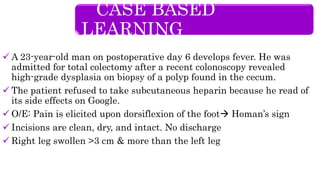
 A 23-year-old man on postoperative day 6 develops fever. He was
admitted for total colectomy after a recent colonoscopy revealed
high-grade dysplasia on biopsy of a polyp found in the cecum.
 The patient refused to take subcutaneous heparin because he read of
its side effects on Google.
 O/E: Pain is elicited upon dorsiflexion of the foot Homan’s sign
 Incisions are clean, dry, and intact. No discharge
 Right leg swollen >3 cm & more than the left leg
CASE BASED
LEARNING
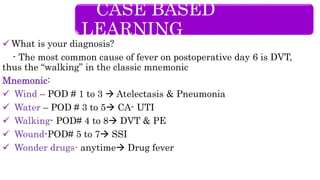
 What is your diagnosis?
- The most common cause of fever on postoperative day 6 is DVT,
thus the “walking” in the classic mnemonic
Mnemonic:
 Wind – POD # 1 to 3  Atelectasis & Pneumonia
 Water – POD # 3 to 5 CA- UTI
 Walking- POD# 4 to 8 DVT & PE
 Wound-POD# 5 to 7 SSI
 Wonder drugs- anytime Drug fever
CASE BASED
LEARNING
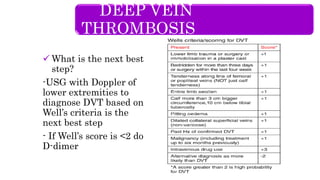
 What is the next best
step?
-USG with Doppler of
lower extremities to
diagnose DVT based on
Well’s criteria is the
next best step
- If Well’s score is <2 do
D-dimer
DEEP VEIN
THROMBOSIS
 Etiopathogenesis:
- DVT is often related to venous stasis from immobility in the
perioperative period. The deep veins of the lower limbs and
pelvis are the most commonly affected.
- Thrombotic risk is greatly increased during surgery, particularly
orthopedic, major vascular, abdominal or pelvic, neurosurgery, and cancer
surgery. Sign of a DVT are unilateral swelling and edema in the lower
extremity. In many patients, a palpable indurated, cordlike subcutaneous
venous segment can be felt Superficial thrombophelebitis
DEEP VEIN
THROMBOSIS
 Typical presentation:
- The most common sign is limb swelling. Other clues are tenderness,
pain, and erythema. Homan’s sign (pain in the calf upon dorsiflexion of
the ankle) tends to be an inconsistent finding.
 Diagnosis:
- The key to dx is to pay attention to risk factors: prior hx of DVT,
obesity, immobility, pelvic and orthopedic procedures, cancer,
hypercoagulable state, and peripheral venous disease. Doppler
ultrasonography is the best test for diagnosis.
CASE BASED
LEARNING
 Treatment:
- FH(LMWH) like fondaparinux and UFH(Heparin) should be given
for 5 days and then should be followed by oral anticoagulation with
warfarin.
-Patients with recurrent PEs and lower extremity DVT already on
prophylaxis or those with contraindications to anticoagulation need an
IVC filter like Greenfield filter.
-Thrombolytic therapy is reserved for Phlegmasia cerulea dolens who
are not amenable to thrombectomy.
- Prevention of DVT is performed by combined pharmacologic and
mechanical methods such as pneumatic compression devices and low-
dose unfractionated heparin (UFH) or FH(LMWH)
CASE BASED
LEARNING
THANK YOU
Subscribe to get notified
regarding
my latest uploads

Post op fever- pod#6- dvt

  • 1.
    CASE BASED LEARNING POST-OPERATIVE FEVER POD#6=Walking Dr.B.Selvaraj MS;Mch;FICS; Professor of Surgery Melaka Manipal Medical College Melaka 75150 Malaysia
  • 2.
     A 23-year-oldman on postoperative day 6 develops fever. He was admitted for total colectomy after a recent colonoscopy revealed high-grade dysplasia on biopsy of a polyp found in the cecum.  The patient refused to take subcutaneous heparin because he read of its side effects on Google.  O/E: Pain is elicited upon dorsiflexion of the foot Homan’s sign  Incisions are clean, dry, and intact. No discharge  Right leg swollen >3 cm & more than the left leg CASE BASED LEARNING
  • 3.
     What isyour diagnosis? - The most common cause of fever on postoperative day 6 is DVT, thus the “walking” in the classic mnemonic Mnemonic:  Wind – POD # 1 to 3  Atelectasis & Pneumonia  Water – POD # 3 to 5 CA- UTI  Walking- POD# 4 to 8 DVT & PE  Wound-POD# 5 to 7 SSI  Wonder drugs- anytime Drug fever CASE BASED LEARNING
  • 4.
     What isthe next best step? -USG with Doppler of lower extremities to diagnose DVT based on Well’s criteria is the next best step - If Well’s score is <2 do D-dimer DEEP VEIN THROMBOSIS
  • 5.
     Etiopathogenesis: - DVTis often related to venous stasis from immobility in the perioperative period. The deep veins of the lower limbs and pelvis are the most commonly affected. - Thrombotic risk is greatly increased during surgery, particularly orthopedic, major vascular, abdominal or pelvic, neurosurgery, and cancer surgery. Sign of a DVT are unilateral swelling and edema in the lower extremity. In many patients, a palpable indurated, cordlike subcutaneous venous segment can be felt Superficial thrombophelebitis DEEP VEIN THROMBOSIS
  • 6.
     Typical presentation: -The most common sign is limb swelling. Other clues are tenderness, pain, and erythema. Homan’s sign (pain in the calf upon dorsiflexion of the ankle) tends to be an inconsistent finding.  Diagnosis: - The key to dx is to pay attention to risk factors: prior hx of DVT, obesity, immobility, pelvic and orthopedic procedures, cancer, hypercoagulable state, and peripheral venous disease. Doppler ultrasonography is the best test for diagnosis. CASE BASED LEARNING
  • 7.
     Treatment: - FH(LMWH)like fondaparinux and UFH(Heparin) should be given for 5 days and then should be followed by oral anticoagulation with warfarin. -Patients with recurrent PEs and lower extremity DVT already on prophylaxis or those with contraindications to anticoagulation need an IVC filter like Greenfield filter. -Thrombolytic therapy is reserved for Phlegmasia cerulea dolens who are not amenable to thrombectomy. - Prevention of DVT is performed by combined pharmacologic and mechanical methods such as pneumatic compression devices and low- dose unfractionated heparin (UFH) or FH(LMWH) CASE BASED LEARNING
  • 8.
    THANK YOU Subscribe toget notified regarding my latest uploads