LAP ANTERIOR
RESECTION
DR.B.Selvaraj MS; Mch; FICS;
“ Surgical Educator”
Malaysia
OPERATIVE SURGERY
LAP ANTERIOR RESECTION
• INDICATIONS:
 Carcinoma of the rectum, where sphincter preservation is possible,
high anterior resection is done for tumours of rectosigmoid junction
and upper rectum which includes partial mesorectal excision.
The anastomosis is made in the region of the junction of the mid and
lower third of the rectum.
Low anterior resection is done for mid-rectal tumors which includes a
total mesorectal excision. The anastomosis is made at the level of the
pelvic floor.
For low anterior resections defunctioning stoma is made- loop
ileostomy
LAP ANTERIOR RESECTION
• INDICATIONS:
Carcinoma of rectum- High anterior
resection for rectosigmoid and upper rectal
tumors. Low anterior resection for mid
rectal tumors.
• CONTRAINDICATIONS:
• Big tumors- T4
• Narrow pelvis
• ANESTHESIA:
 GA/ETT
• POSITION:
 Lloyd– Davies- Lithotomy in padded Allen
stirrups
• Diagnosis
 Confirmed by biopsy
 Staging by CECT
• Pre-op preparation
Preoperative chemoradiation treatment is indicated
for patients with T3, T4 lesions or tumors with
enlarged pelvic lymph nodes found on pelvic
computed tomography (CT) scan or endorectal
ultrasound
 Adequate mechanical bowel preparation the day
before surgery with orthograde enema
 Prophylactic IV broad spectrum antibiotics
 VTE prophylaxis with LMWH and pneumatic
stockings
Bladder catheterization
The stoma nurse marks the ileostomy site for
defunctioning.
Intraoperative rigid proctoscopy is performed to
determine the distal extent of the cancer.
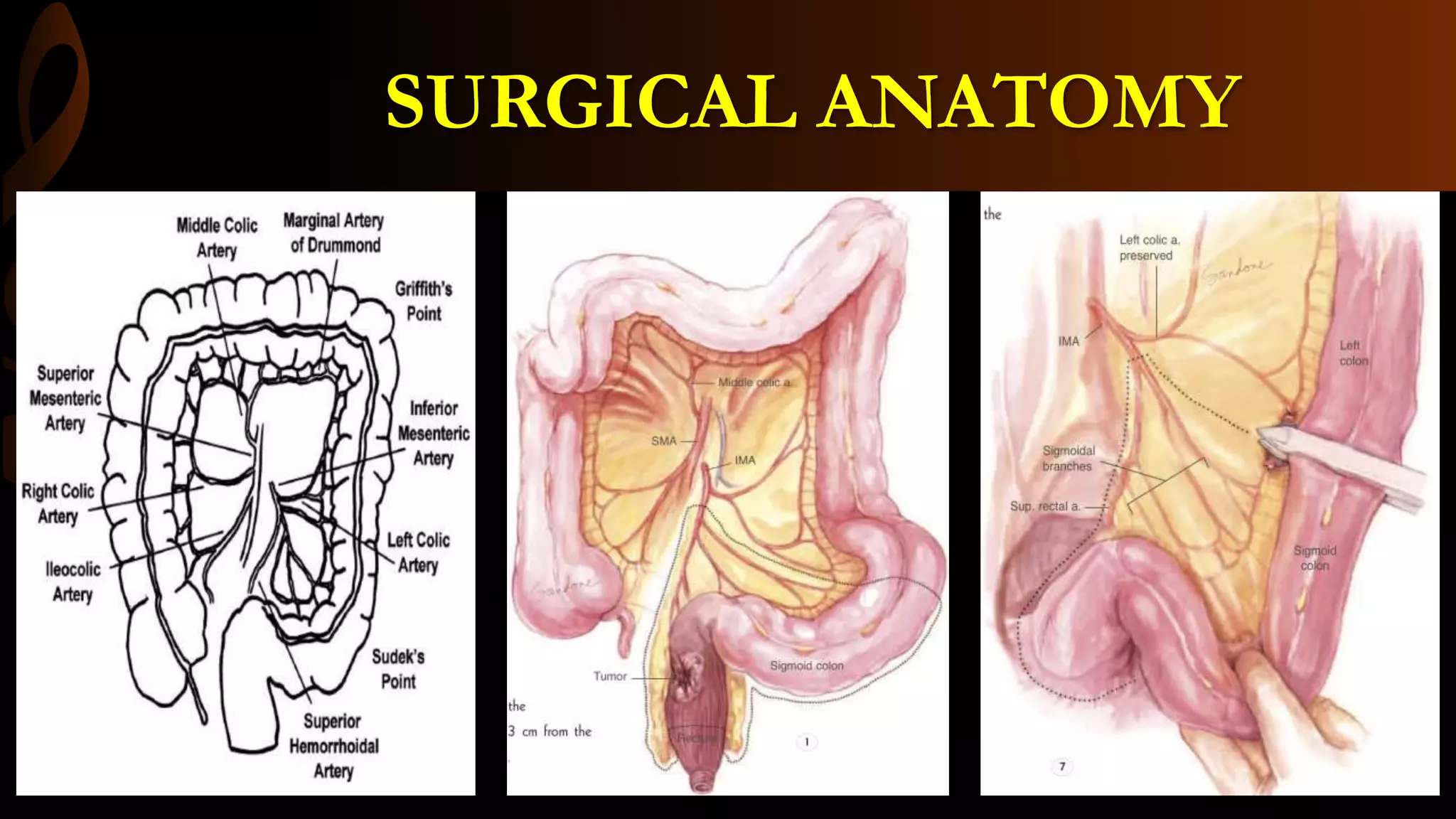
SURGICAL ANATOMY
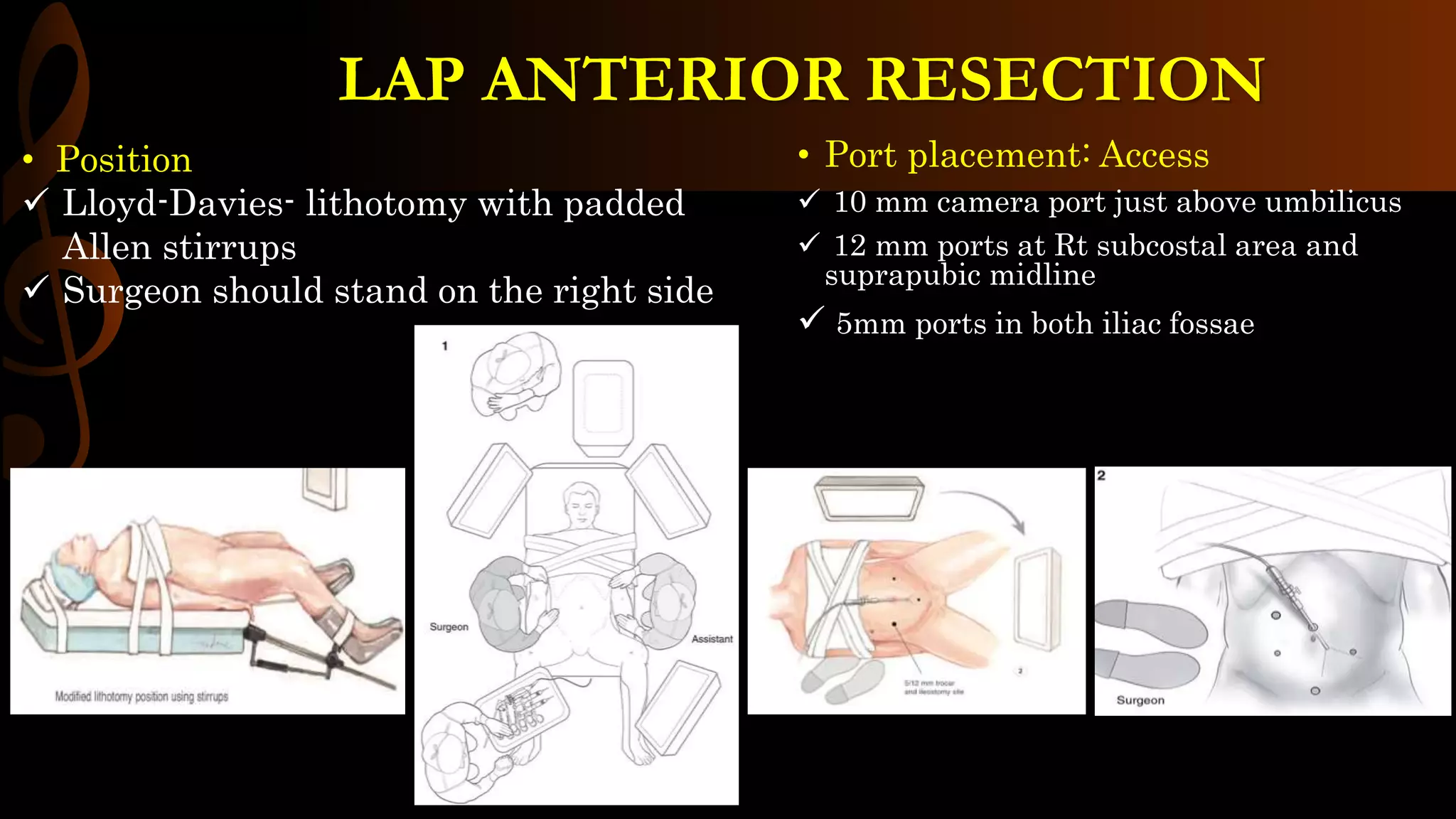
• Port placement: Access
 10 mm camera port just above umbilicus
 12 mm ports at Rt subcostal area and
suprapubic midline
 5mm ports in both iliac fossae
• Position
 Lloyd-Davies- lithotomy with padded
Allen stirrups
 Surgeon should stand on the right side
LAP ANTERIOR RESECTION
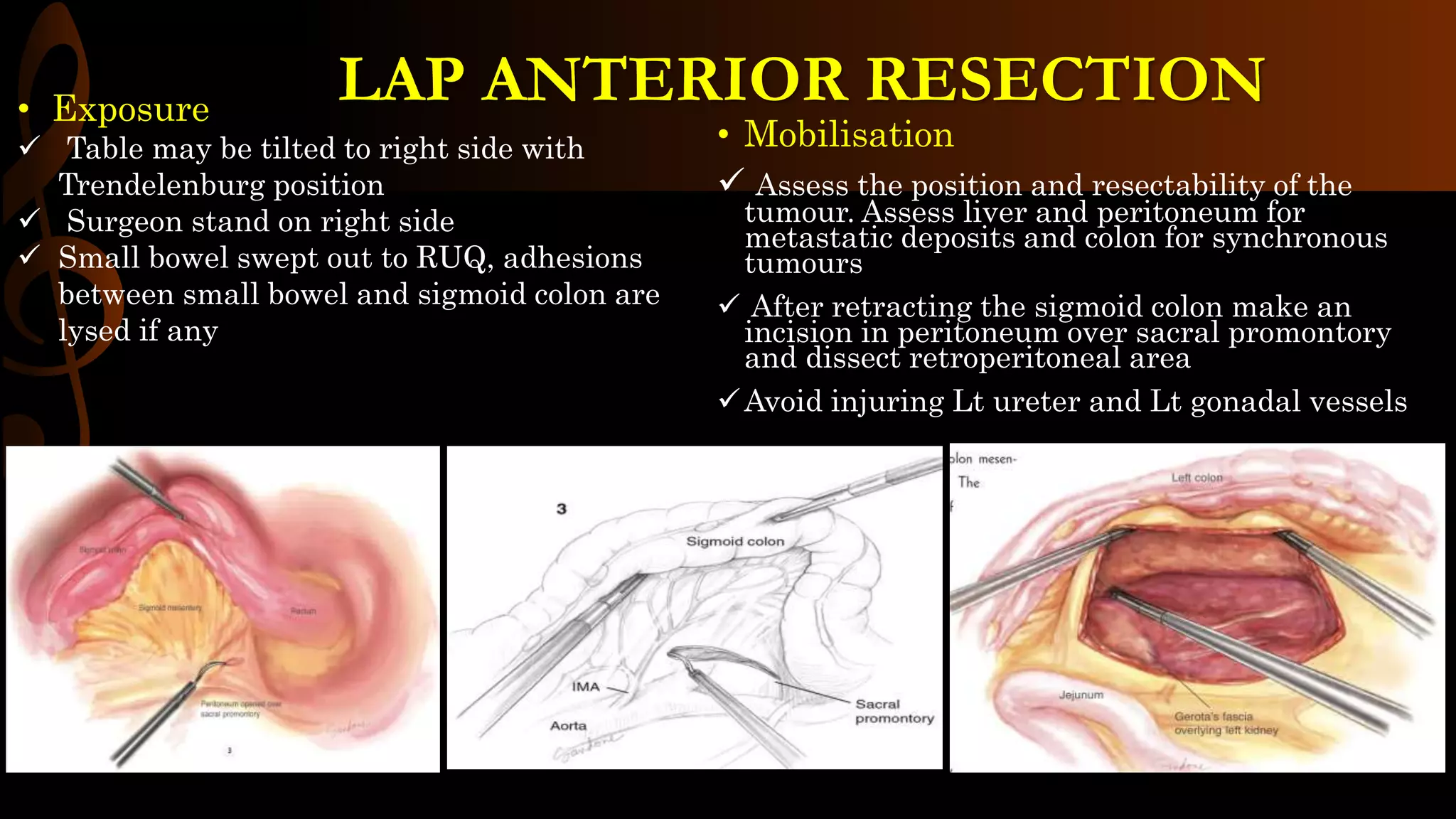
• Mobilisation
 Assess the position and resectability of the
tumour. Assess liver and peritoneum for
metastatic deposits and colon for synchronous
tumours
 After retracting the sigmoid colon make an
incision in peritoneum over sacral promontory
and dissect retroperitoneal area
Avoid injuring Lt ureter and Lt gonadal vessels
• Exposure
 Table may be tilted to right side with
Trendelenburg position
 Surgeon stand on right side
 Small bowel swept out to RUQ, adhesions
between small bowel and sigmoid colon are
lysed if any
LAP ANTERIOR RESECTION
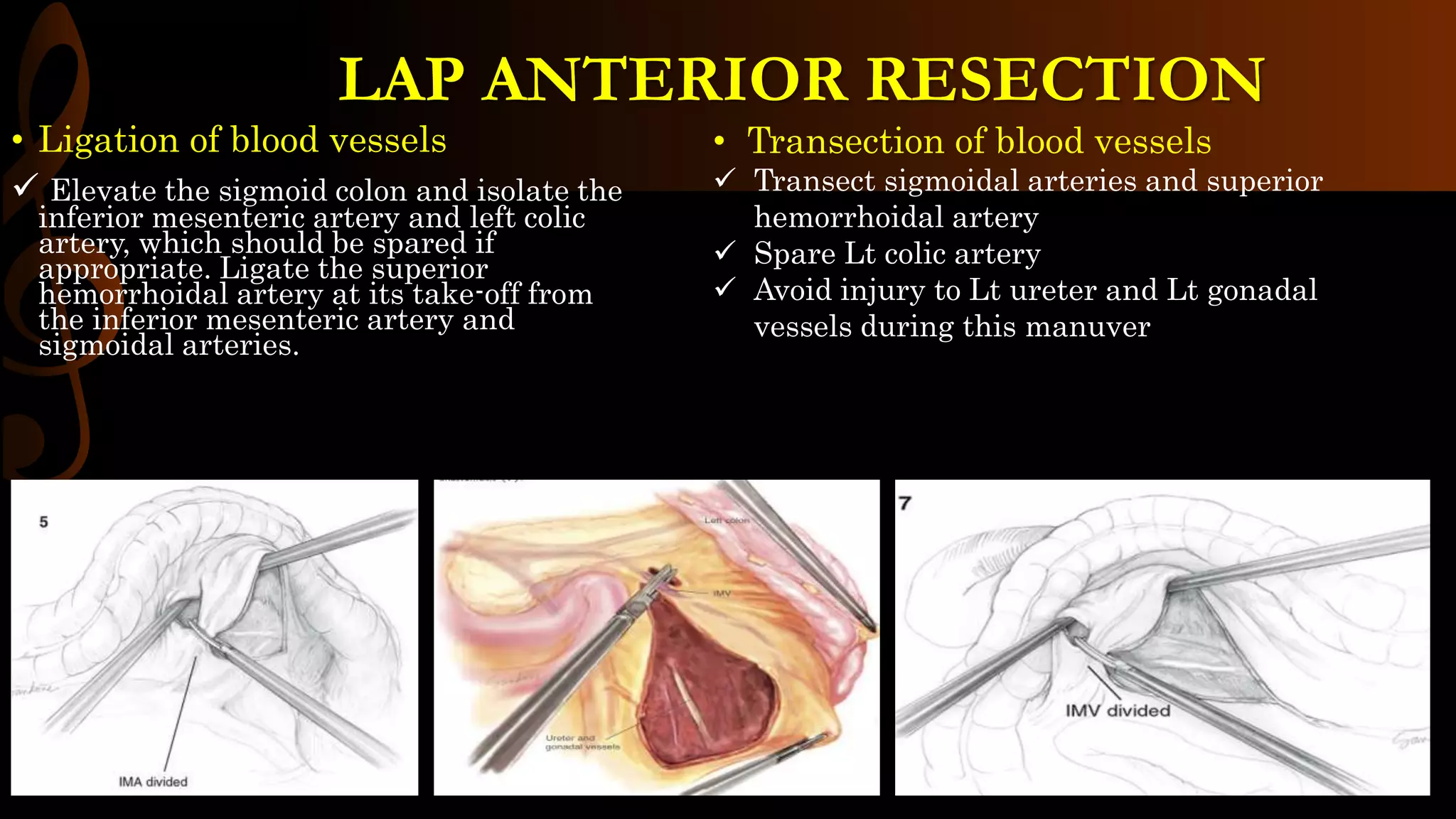
• Ligation of blood vessels
 Elevate the sigmoid colon and isolate the
inferior mesenteric artery and left colic
artery, which should be spared if
appropriate. Ligate the superior
hemorrhoidal artery at its take-off from
the inferior mesenteric artery and
sigmoidal arteries.
• Transection of blood vessels
 Transect sigmoidal arteries and superior
hemorrhoidal artery
 Spare Lt colic artery
 Avoid injury to Lt ureter and Lt gonadal
vessels during this manuver
LAP ANTERIOR RESECTION
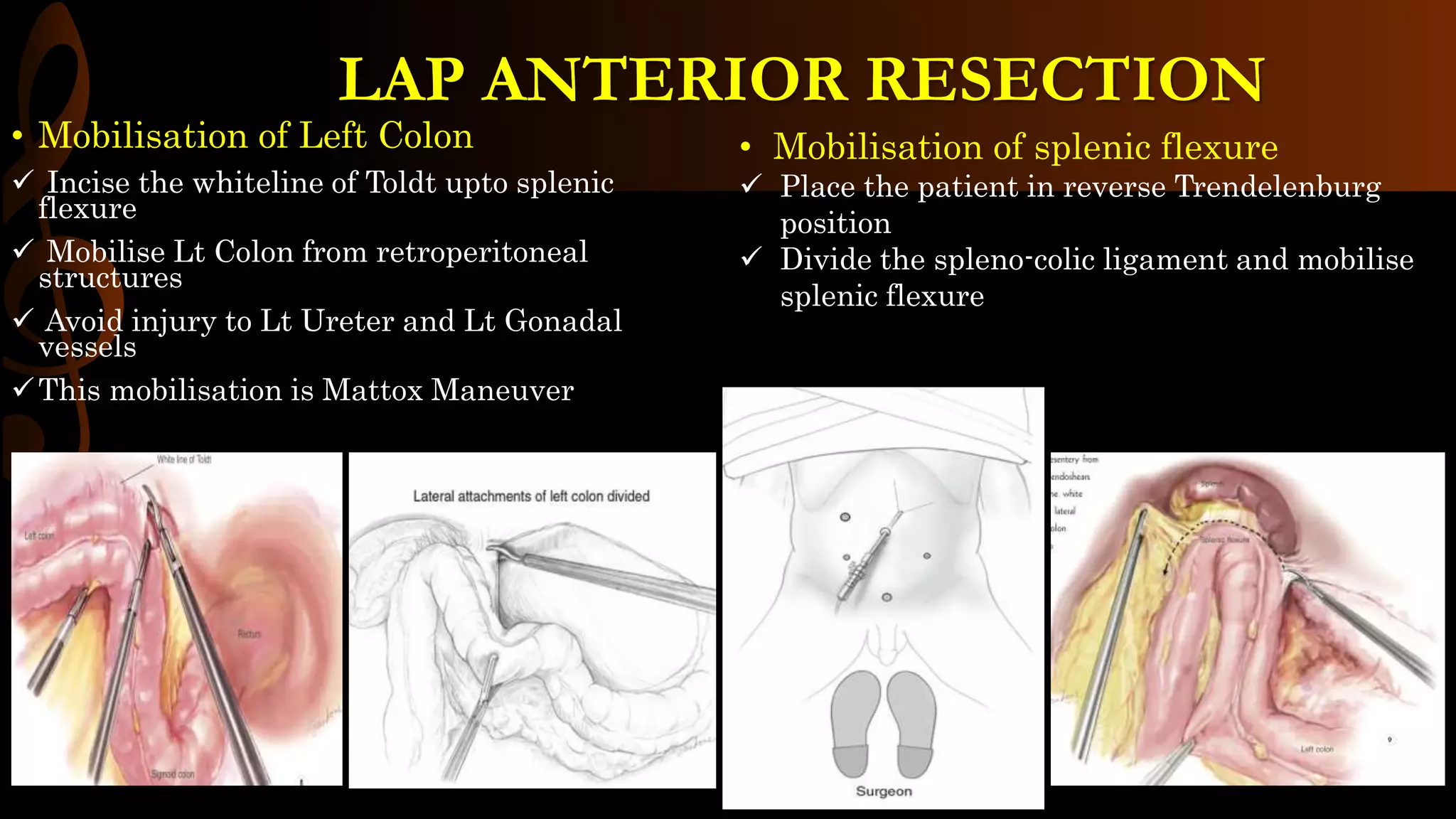
• Mobilisation of Left Colon
 Incise the whiteline of Toldt upto splenic
flexure
 Mobilise Lt Colon from retroperitoneal
structures
 Avoid injury to Lt Ureter and Lt Gonadal
vessels
This mobilisation is Mattox Maneuver
• Mobilisation of splenic flexure
 Place the patient in reverse Trendelenburg
position
 Divide the spleno-colic ligament and mobilise
splenic flexure
LAP ANTERIOR RESECTION
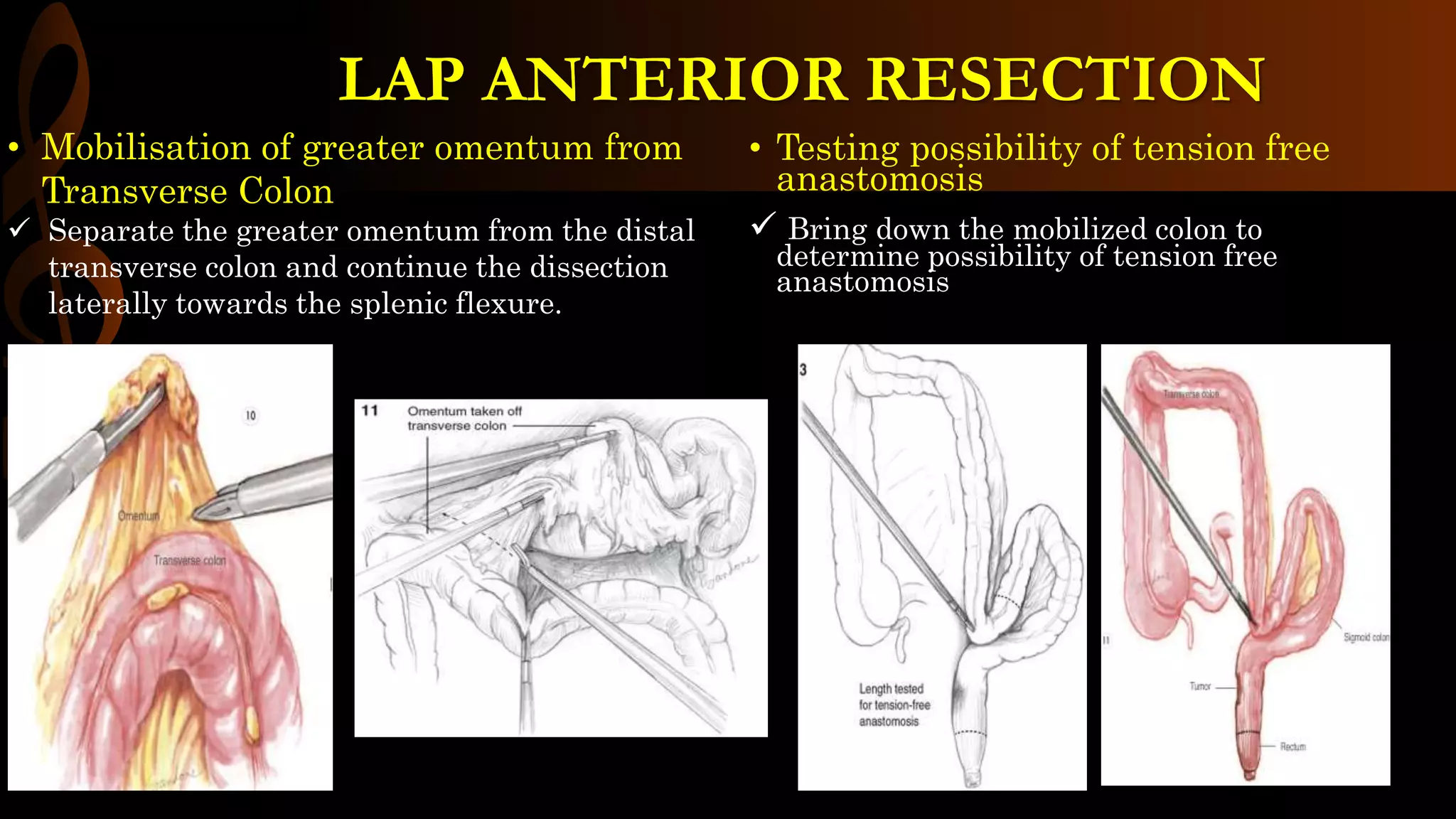
• Testing possibility of tension free
anastomosis
 Bring down the mobilized colon to
determine possibility of tension free
anastomosis
• Mobilisation of greater omentum from
Transverse Colon
 Separate the greater omentum from the distal
transverse colon and continue the dissection
laterally towards the splenic flexure.
LAP ANTERIOR RESECTION
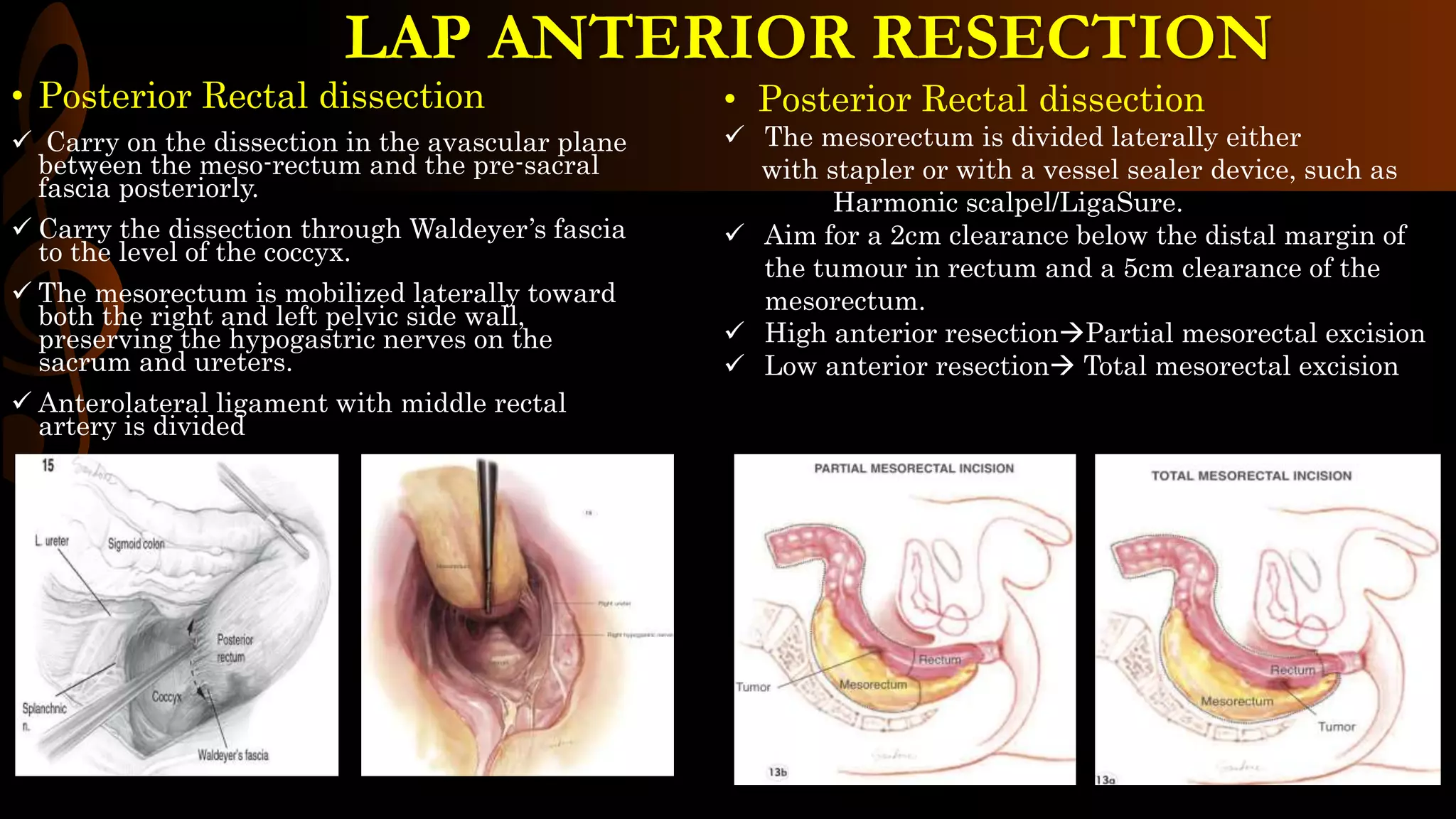
• Posterior Rectal dissection
 Carry on the dissection in the avascular plane
between the meso-rectum and the pre-sacral
fascia posteriorly.
 Carry the dissection through Waldeyer’s fascia
to the level of the coccyx.
 The mesorectum is mobilized laterally toward
both the right and left pelvic side wall,
preserving the hypogastric nerves on the
sacrum and ureters.
 Anterolateral ligament with middle rectal
artery is divided
• Posterior Rectal dissection
 The mesorectum is divided laterally either
with stapler or with a vessel sealer device, such as
Harmonic scalpel/LigaSure.
 Aim for a 2cm clearance below the distal margin of
the tumour in rectum and a 5cm clearance of the
mesorectum.
 High anterior resectionPartial mesorectal excision
 Low anterior resection Total mesorectal excision
LAP ANTERIOR RESECTION
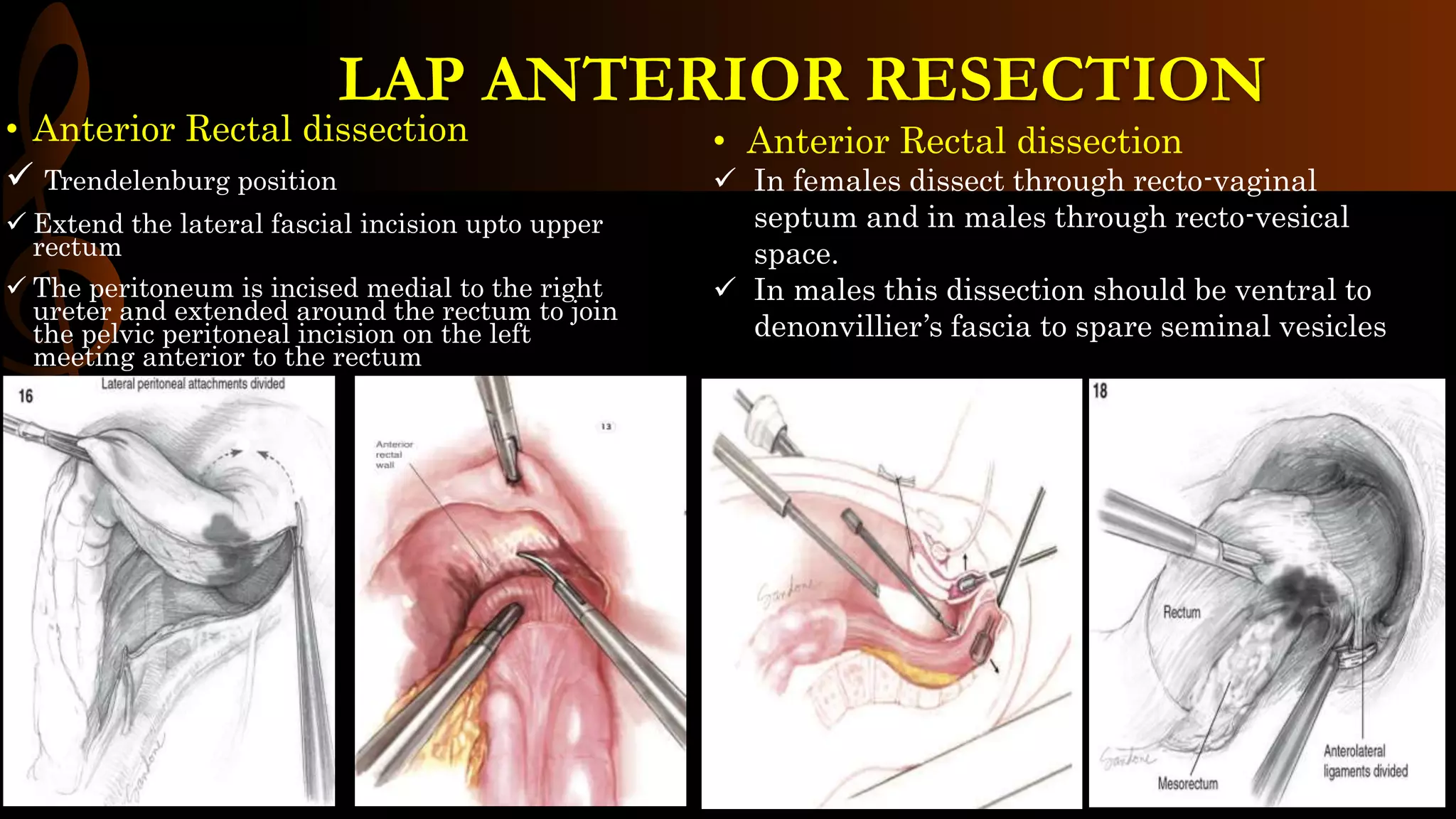
• Anterior Rectal dissection
 Trendelenburg position
 Extend the lateral fascial incision upto upper
rectum
 The peritoneum is incised medial to the right
ureter and extended around the rectum to join
the pelvic peritoneal incision on the left
meeting anterior to the rectum
• Anterior Rectal dissection
 In females dissect through recto-vaginal
septum and in males through recto-vesical
space.
 In males this dissection should be ventral to
denonvillier’s fascia to spare seminal vesicles
LAP ANTERIOR RESECTION
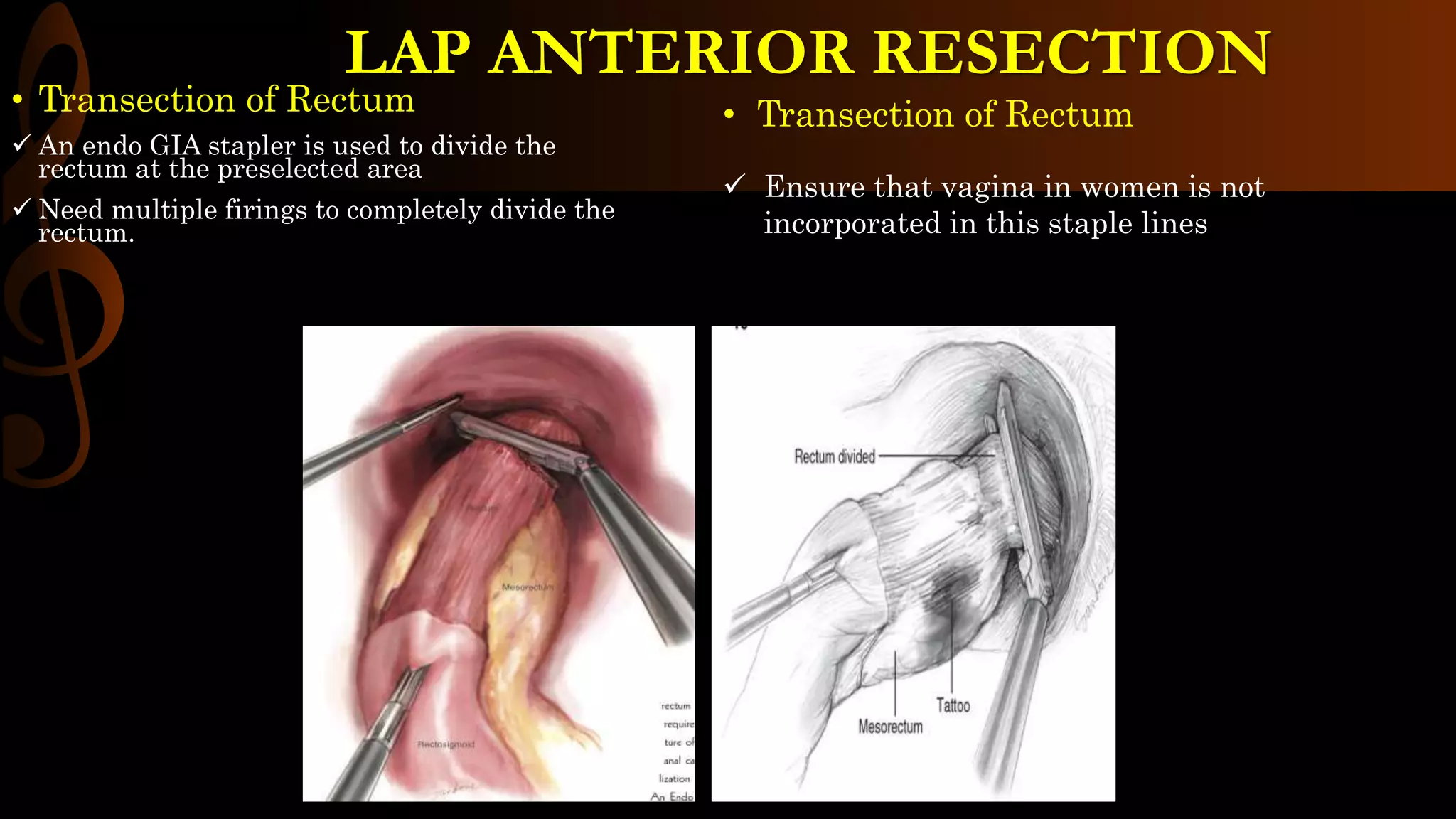
• Transection of Rectum
 An endo GIA stapler is used to divide the
rectum at the preselected area
 Need multiple firings to completely divide the
rectum.
• Transection of Rectum
 Ensure that vagina in women is not
incorporated in this staple lines
LAP ANTERIOR RESECTION
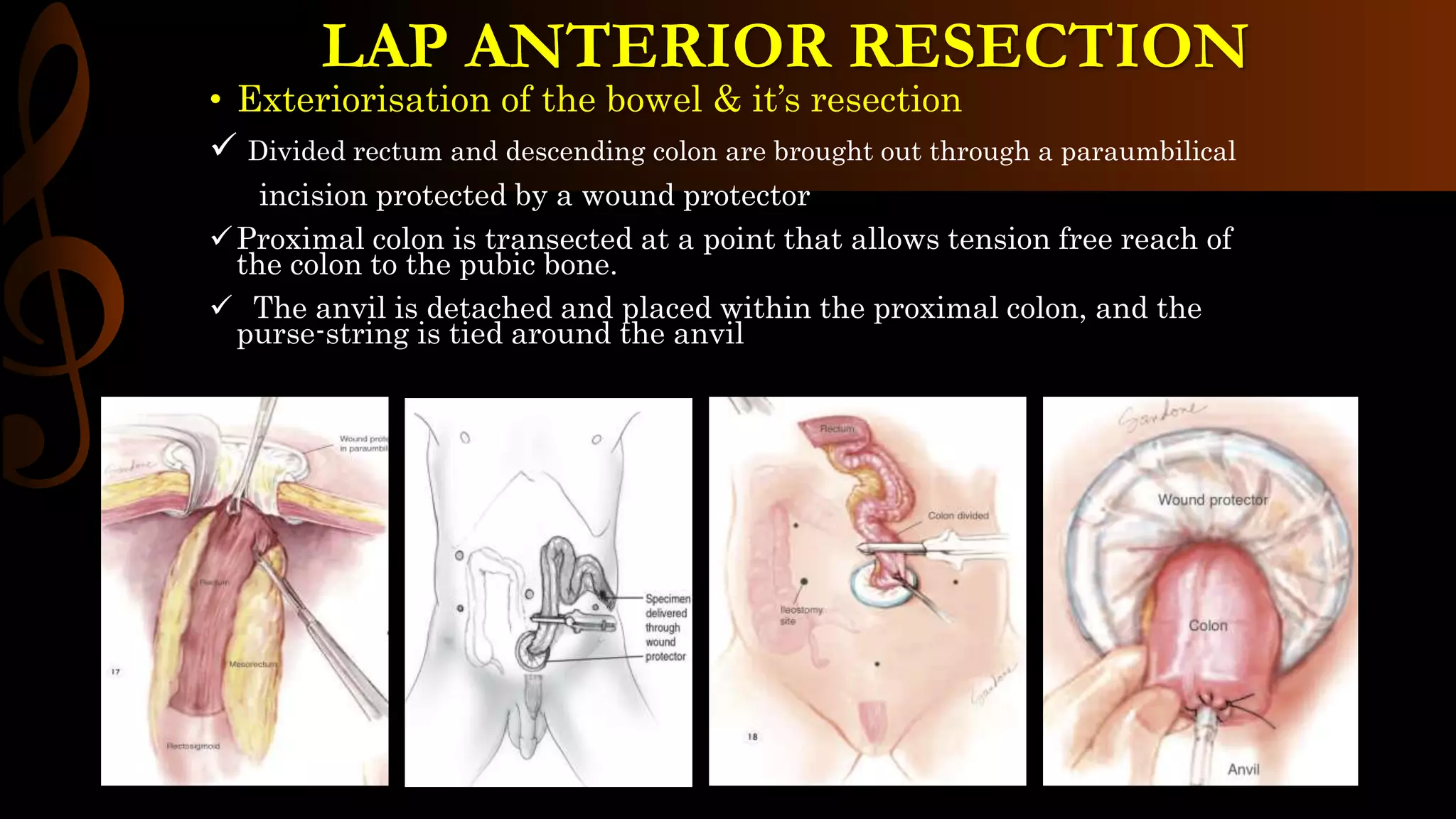
• Exteriorisation of the bowel & it’s resection
 Divided rectum and descending colon are brought out through a paraumbilical
incision protected by a wound protector
Proximal colon is transected at a point that allows tension free reach of
the colon to the pubic bone.
 The anvil is detached and placed within the proximal colon, and the
purse-string is tied around the anvil
LAP ANTERIOR RESECTION
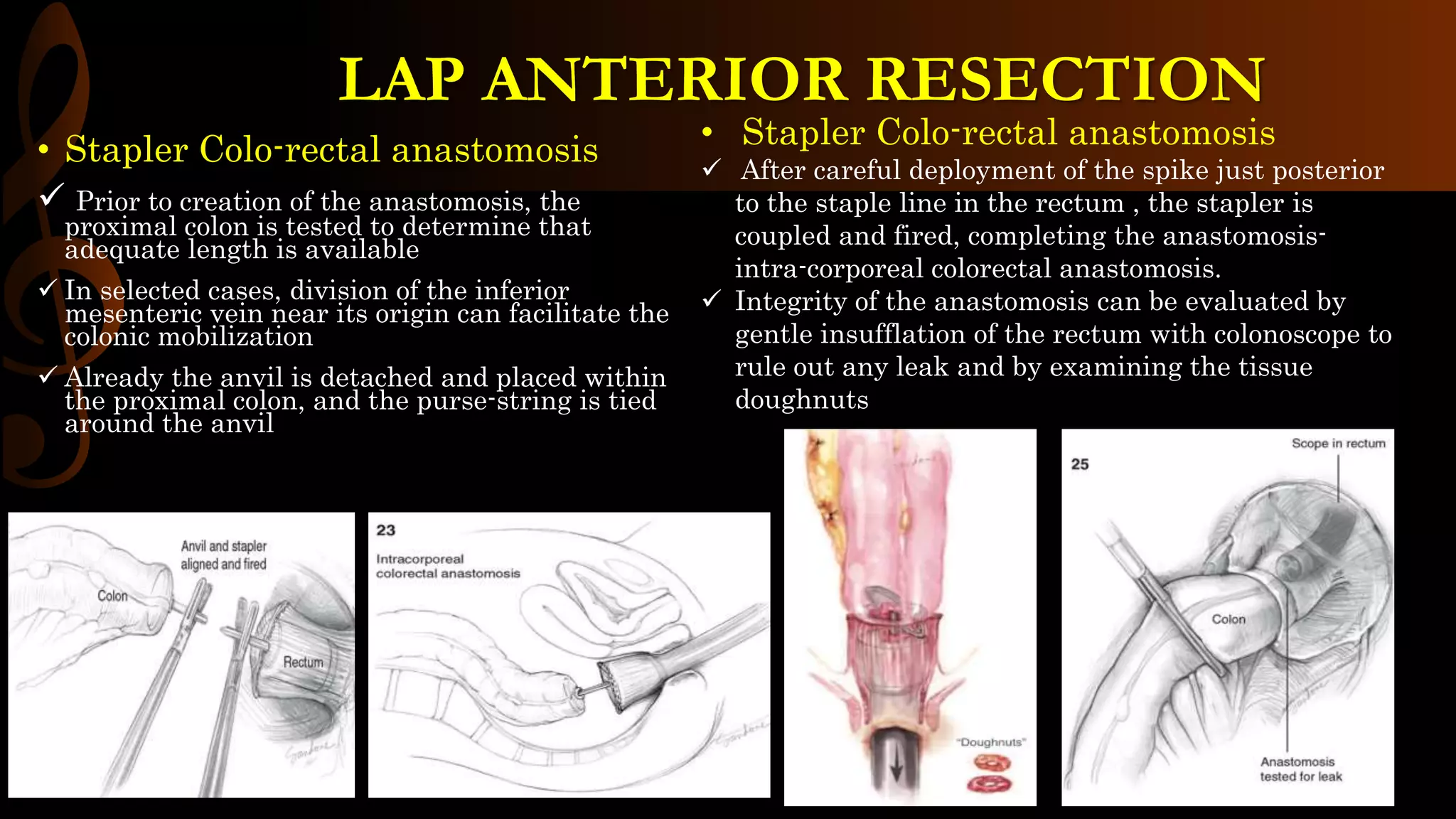
• Stapler Colo-rectal anastomosis
 Prior to creation of the anastomosis, the
proximal colon is tested to determine that
adequate length is available
 In selected cases, division of the inferior
mesenteric vein near its origin can facilitate the
colonic mobilization
 Already the anvil is detached and placed within
the proximal colon, and the purse-string is tied
around the anvil
LAP ANTERIOR RESECTION
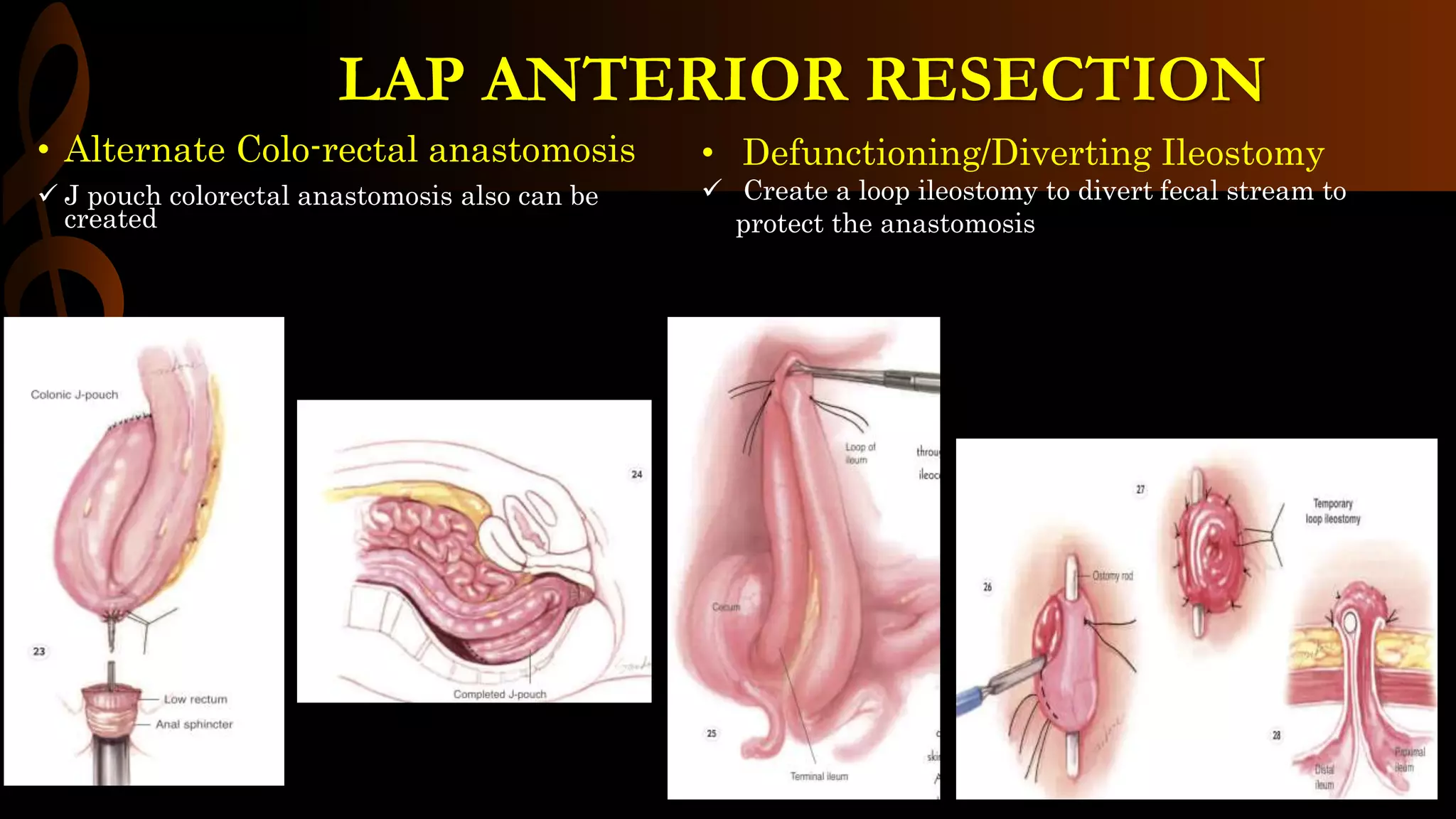
• Stapler Colo-rectal anastomosis
 After careful deployment of the spike just posterior
to the staple line in the rectum , the stapler is
coupled and fired, completing the anastomosis-
intra-corporeal colorectal anastomosis.
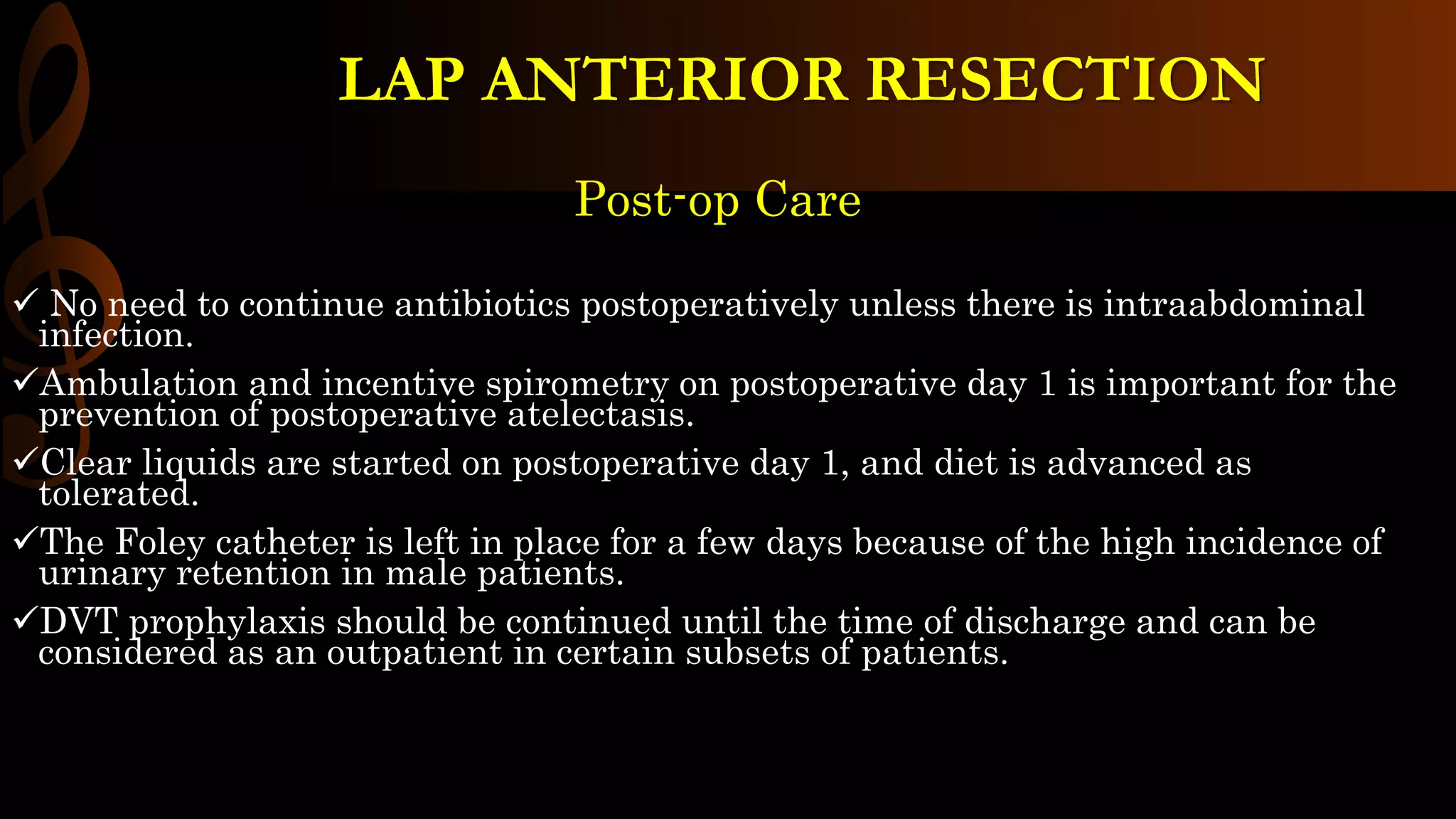
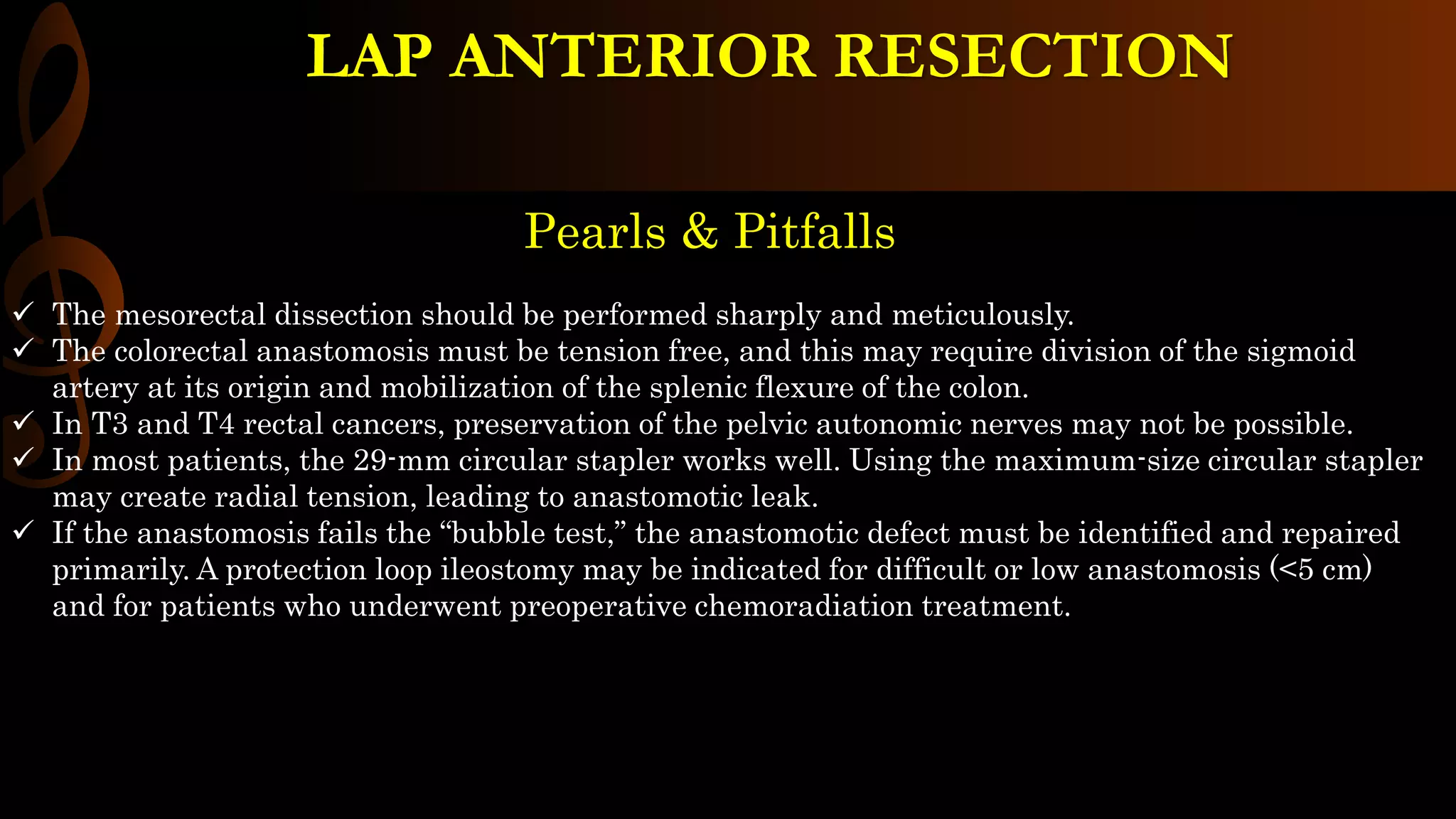
 Integrity of the anastomosis can be evaluated by
gentle insufflation of the rectum with colonoscope to
rule out any leak and by examining the tissue
doughnuts
• Alternate Colo-rectal anastomosis
 J pouch colorectal anastomosis also can be
created
LAP ANTERIOR RESECTION
• Defunctioning/Diverting Ileostomy
 Create a loop ileostomy to divert fecal stream to
protect the anastomosis
Post-op Care
 No need to continue antibiotics postoperatively unless there is intraabdominal
infection.
Ambulation and incentive spirometry on postoperative day 1 is important for the
prevention of postoperative atelectasis.
Clear liquids are started on postoperative day 1, and diet is advanced as
tolerated.
The Foley catheter is left in place for a few days because of the high incidence of
urinary retention in male patients.
DVT prophylaxis should be continued until the time of discharge and can be
considered as an outpatient in certain subsets of patients.
LAP ANTERIOR RESECTION
Pearls & Pitfalls
 The mesorectal dissection should be performed sharply and meticulously.
 The colorectal anastomosis must be tension free, and this may require division of the sigmoid
artery at its origin and mobilization of the splenic flexure of the colon.
 In T3 and T4 rectal cancers, preservation of the pelvic autonomic nerves may not be possible.
 In most patients, the 29-mm circular stapler works well. Using the maximum-size circular stapler
may create radial tension, leading to anastomotic leak.
 If the anastomosis fails the “bubble test,” the anastomotic defect must be identified and repaired
primarily. A protection loop ileostomy may be indicated for difficult or low anastomosis (<5 cm)
and for patients who underwent preoperative chemoradiation treatment.
LAP ANTERIOR RESECTION
THANK YOU

LAP ANTERIOR RESECTION-STEP BY STEP Operative Surgery.pptx

  • 1.
    LAP ANTERIOR RESECTION DR.B.Selvaraj MS;Mch; FICS; “ Surgical Educator” Malaysia OPERATIVE SURGERY
  • 2.
    LAP ANTERIOR RESECTION •INDICATIONS:  Carcinoma of the rectum, where sphincter preservation is possible, high anterior resection is done for tumours of rectosigmoid junction and upper rectum which includes partial mesorectal excision. The anastomosis is made in the region of the junction of the mid and lower third of the rectum. Low anterior resection is done for mid-rectal tumors which includes a total mesorectal excision. The anastomosis is made at the level of the pelvic floor. For low anterior resections defunctioning stoma is made- loop ileostomy
  • 3.
    LAP ANTERIOR RESECTION •INDICATIONS: Carcinoma of rectum- High anterior resection for rectosigmoid and upper rectal tumors. Low anterior resection for mid rectal tumors. • CONTRAINDICATIONS: • Big tumors- T4 • Narrow pelvis • ANESTHESIA:  GA/ETT • POSITION:  Lloyd– Davies- Lithotomy in padded Allen stirrups • Diagnosis  Confirmed by biopsy  Staging by CECT • Pre-op preparation Preoperative chemoradiation treatment is indicated for patients with T3, T4 lesions or tumors with enlarged pelvic lymph nodes found on pelvic computed tomography (CT) scan or endorectal ultrasound  Adequate mechanical bowel preparation the day before surgery with orthograde enema  Prophylactic IV broad spectrum antibiotics  VTE prophylaxis with LMWH and pneumatic stockings Bladder catheterization The stoma nurse marks the ileostomy site for defunctioning. Intraoperative rigid proctoscopy is performed to determine the distal extent of the cancer.
  • 4.
  • 5.
    • Port placement:Access  10 mm camera port just above umbilicus  12 mm ports at Rt subcostal area and suprapubic midline  5mm ports in both iliac fossae • Position  Lloyd-Davies- lithotomy with padded Allen stirrups  Surgeon should stand on the right side LAP ANTERIOR RESECTION
  • 6.
    • Mobilisation  Assessthe position and resectability of the tumour. Assess liver and peritoneum for metastatic deposits and colon for synchronous tumours  After retracting the sigmoid colon make an incision in peritoneum over sacral promontory and dissect retroperitoneal area Avoid injuring Lt ureter and Lt gonadal vessels • Exposure  Table may be tilted to right side with Trendelenburg position  Surgeon stand on right side  Small bowel swept out to RUQ, adhesions between small bowel and sigmoid colon are lysed if any LAP ANTERIOR RESECTION
  • 7.
    • Ligation ofblood vessels  Elevate the sigmoid colon and isolate the inferior mesenteric artery and left colic artery, which should be spared if appropriate. Ligate the superior hemorrhoidal artery at its take-off from the inferior mesenteric artery and sigmoidal arteries. • Transection of blood vessels  Transect sigmoidal arteries and superior hemorrhoidal artery  Spare Lt colic artery  Avoid injury to Lt ureter and Lt gonadal vessels during this manuver LAP ANTERIOR RESECTION
  • 8.
    • Mobilisation ofLeft Colon  Incise the whiteline of Toldt upto splenic flexure  Mobilise Lt Colon from retroperitoneal structures  Avoid injury to Lt Ureter and Lt Gonadal vessels This mobilisation is Mattox Maneuver • Mobilisation of splenic flexure  Place the patient in reverse Trendelenburg position  Divide the spleno-colic ligament and mobilise splenic flexure LAP ANTERIOR RESECTION
  • 9.
    • Testing possibilityof tension free anastomosis  Bring down the mobilized colon to determine possibility of tension free anastomosis • Mobilisation of greater omentum from Transverse Colon  Separate the greater omentum from the distal transverse colon and continue the dissection laterally towards the splenic flexure. LAP ANTERIOR RESECTION
  • 10.
    • Posterior Rectaldissection  Carry on the dissection in the avascular plane between the meso-rectum and the pre-sacral fascia posteriorly.  Carry the dissection through Waldeyer’s fascia to the level of the coccyx.  The mesorectum is mobilized laterally toward both the right and left pelvic side wall, preserving the hypogastric nerves on the sacrum and ureters.  Anterolateral ligament with middle rectal artery is divided • Posterior Rectal dissection  The mesorectum is divided laterally either with stapler or with a vessel sealer device, such as Harmonic scalpel/LigaSure.  Aim for a 2cm clearance below the distal margin of the tumour in rectum and a 5cm clearance of the mesorectum.  High anterior resectionPartial mesorectal excision  Low anterior resection Total mesorectal excision LAP ANTERIOR RESECTION
  • 11.
    • Anterior Rectaldissection  Trendelenburg position  Extend the lateral fascial incision upto upper rectum  The peritoneum is incised medial to the right ureter and extended around the rectum to join the pelvic peritoneal incision on the left meeting anterior to the rectum • Anterior Rectal dissection  In females dissect through recto-vaginal septum and in males through recto-vesical space.  In males this dissection should be ventral to denonvillier’s fascia to spare seminal vesicles LAP ANTERIOR RESECTION
  • 12.
    • Transection ofRectum  An endo GIA stapler is used to divide the rectum at the preselected area  Need multiple firings to completely divide the rectum. • Transection of Rectum  Ensure that vagina in women is not incorporated in this staple lines LAP ANTERIOR RESECTION
  • 13.
    • Exteriorisation ofthe bowel & it’s resection  Divided rectum and descending colon are brought out through a paraumbilical incision protected by a wound protector Proximal colon is transected at a point that allows tension free reach of the colon to the pubic bone.  The anvil is detached and placed within the proximal colon, and the purse-string is tied around the anvil LAP ANTERIOR RESECTION
  • 14.
    • Stapler Colo-rectalanastomosis  Prior to creation of the anastomosis, the proximal colon is tested to determine that adequate length is available  In selected cases, division of the inferior mesenteric vein near its origin can facilitate the colonic mobilization  Already the anvil is detached and placed within the proximal colon, and the purse-string is tied around the anvil LAP ANTERIOR RESECTION • Stapler Colo-rectal anastomosis  After careful deployment of the spike just posterior to the staple line in the rectum , the stapler is coupled and fired, completing the anastomosis- intra-corporeal colorectal anastomosis.  Integrity of the anastomosis can be evaluated by gentle insufflation of the rectum with colonoscope to rule out any leak and by examining the tissue doughnuts
  • 15.
    • Alternate Colo-rectalanastomosis  J pouch colorectal anastomosis also can be created LAP ANTERIOR RESECTION • Defunctioning/Diverting Ileostomy  Create a loop ileostomy to divert fecal stream to protect the anastomosis
  • 16.
    Post-op Care  Noneed to continue antibiotics postoperatively unless there is intraabdominal infection. Ambulation and incentive spirometry on postoperative day 1 is important for the prevention of postoperative atelectasis. Clear liquids are started on postoperative day 1, and diet is advanced as tolerated. The Foley catheter is left in place for a few days because of the high incidence of urinary retention in male patients. DVT prophylaxis should be continued until the time of discharge and can be considered as an outpatient in certain subsets of patients. LAP ANTERIOR RESECTION
  • 17.
    Pearls & Pitfalls The mesorectal dissection should be performed sharply and meticulously.  The colorectal anastomosis must be tension free, and this may require division of the sigmoid artery at its origin and mobilization of the splenic flexure of the colon.  In T3 and T4 rectal cancers, preservation of the pelvic autonomic nerves may not be possible.  In most patients, the 29-mm circular stapler works well. Using the maximum-size circular stapler may create radial tension, leading to anastomotic leak.  If the anastomosis fails the “bubble test,” the anastomotic defect must be identified and repaired primarily. A protection loop ileostomy may be indicated for difficult or low anastomosis (<5 cm) and for patients who underwent preoperative chemoradiation treatment. LAP ANTERIOR RESECTION
  • 18.