CASE BASED LEARNING
ABDOMINAL PAIN
INTRODUCTION
Dr.B.Selvaraj MS;Mch;FICS;
Professor of Surgery
Melaka Manipal Medical College
Melaka 75150 Malaysia
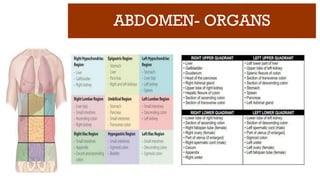
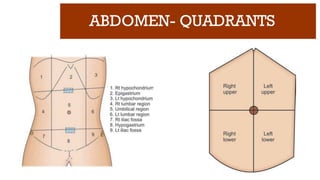
ABDOMEN- QUADRANTS
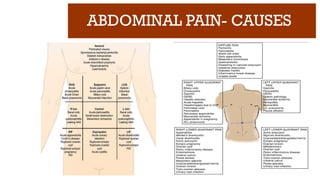
ABDOMEN- ORGANS
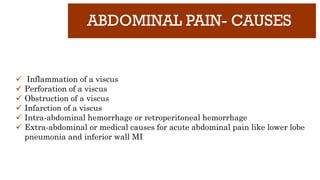
ABDOMINAL PAIN- CAUSES
✓ Inflammation of a viscus
✓ Perforation of a viscus
✓ Obstruction of a viscus
✓ Infarction of a viscus
✓ Intra-abdominal hemorrhage or retroperitoneal hemorrhage
✓ Extra-abdominal or medical causes for acute abdominal pain like lower lobe
pneumonia and inferior wall MI
ABDOMINAL PAIN- HISTORY
SOCRATES = Nemonic
S - site
O - onset
C - characteristics
R - radiation
A – associated symptoms &
signs
T - timing
E - exacerbating/
alleviating
S - severity
✓ “S” stands for “site”. Which region/quadrant? Is
it a general sense of overall discomfort? The site
of pain helps you fine tune your subsequent
physical exam and diagnostic decision making.
✓ “O” stands for “onset”. When did the pain start?
Acute or insidious?
✓ “C” stands for “characteristics”. The pain may
be sharp, dull, heavy, etc. or a combination of
descriptions.
ABDOMINAL PAIN- HISTORY
SOCRATES = Nemonic
S - site
O - onset
C - characteristics
R - radiation
A – associated symptoms &
signs
T - timing
E - exacerbating/
alleviating
S - severity
✓ “R”, which represents “radiation”. Ask if the
pain stays at the site they are describing or if it
travels somewhere else in the body. Ex:Ureteric
colic
✓ A” stands for associated symptoms. What other
symptoms are present and associated with the
pain? Ask do they also have nausea and/or
vomiting?
✓ "T" stands for timing. When does the pain
occur? Does it happen at specific times of the
day, or is it constant?
ABDOMINAL PAIN- HISTORY
SOCRATES = Nemonic
S - site
O - onset
C - characteristics
R - radiation
A – associated symptoms &
signs
T - timing
E - exacerbating/
alleviating
S - severity
✓ “E” represents “exacerbating” factors; grouped
within this is also alleviating factors. The
patient should be probed as to what makes their
pain better or worse. Certain physical positions,
medications, etc. These factors can all provide
historical clues about the root cause.
✓ “S” stands for “severity”. In most hospitals this
is formulated on a 1 to 10 scale with 10 being
the most severe pain they’ve ever experienced.
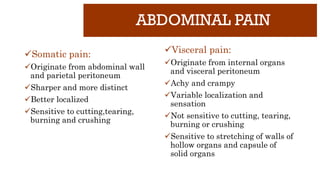
ABDOMINAL PAIN
✓Somatic pain:
✓Originate from abdominal wall
and parietal peritoneum
✓Sharper and more distinct
✓Better localized
✓Sensitive to cutting,tearing,
burning and crushing
✓Visceral pain:
✓Originate from internal organs
and visceral peritoneum
✓Achy and crampy
✓Variable localization and
sensation
✓Not sensitive to cutting, tearing,
burning or crushing
✓Sensitive to stretching of walls of
hollow organs and capsule of
solid organs
ABDOMINAL PAIN
✓Shifting pain: Ex: Periumbilical pain shifting to RLQ in
Ac.appendicitis
✓Radiating pain: Ex: Pain radiating from loin to groin in ureteric
colic
✓Reffered pain: Ex: Pain felt at Lt shoulder in case of splenic
rupture
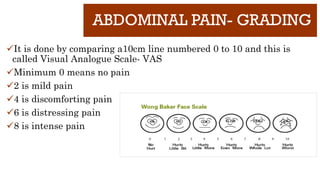
ABDOMINAL PAIN- GRADING
✓It is done by comparing a10cm line numbered 0 to 10 and this is
called Visual Analogue Scale- VAS
✓Minimum 0 means no pain
✓2 is mild pain
✓4 is discomforting pain
✓6 is distressing pain
✓8 is intense pain
AN OVRVIEW
Dr.B.Selvaraj MS;Mch;FICS;
“Surgical Educator”
Malaysia
ACUTE APPENDICITIS
RLQ PAIN
ACUTE APPENDICITIS
Objectives
ü Causes of RLQ Pain
ü Etiology
ü Pathology
ü Clinical features- Symptoms & Signs
ü Investigations
ü Scoring System
ü Treatment
ü Complications
ü Mindmap
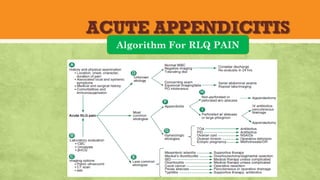
ü Algorithm for RLQ Pain
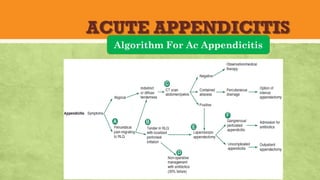
ü Treatment Algorithm for Ac Appendicitis
ACUTE APPENDICITIS
Causes of RLQ Pain
üAcute Appendicitis
üEctopic Pregnancy
üTwisted Ovarian Cyst
üPelvic Inflammatory
Disease- PID
üEndometriosis
üTubo-Ovarian
Pathology
üMittlesmerz
In Females
üAcute Appendicitis
üRt Ureteric Calculus
üPerforated DU-
Valentino Appendicitis
üAc Cholecystitis
üAc Pancreatitis
üCrohn’s Disease
üCecal Diverticulitis
üInferior Wall MI
üLower Lobe Pneumonia
In Males In Children
üAcute Appendicitis
üIntussusception
üMeckel’s Diverticulitis
üMesenteric Lymphadenitis
ACUTE APPENDICITIS
ETIOLOGY
üObstructive:
1. Fecolith
2. Worms- Enterobious Vermicularis
3. Lymphoid Hyperplasia in Children
ü Non-Obstructive:
1. Catarrhal- infection
ACUTE APPENDICITIS
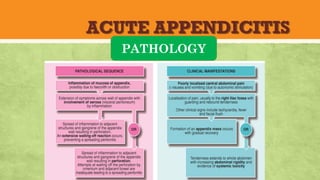
PATHOLOGY
ACUTE APPENDICITIS
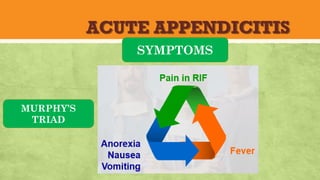
SYMPTOMS
MURPHY’S
TRIAD
ACUTE APPENDICITIS
SIGNS
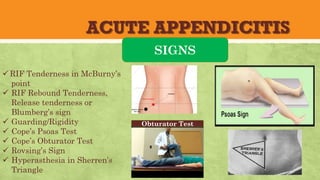
üRIF Tenderness in McBurny’s
point
ü RIF Rebound Tenderness,
Release tenderness or
Blumberg’s sign
ü Guarding/Rigidity
ü Cope’s Psoas Test
ü Cope’s Obturator Test
ü Rovsing’s Sign
ü Hyperasthesia in Sherren’s
Triangle
Obturator Test
ACUTE APPENDICITIS
SIGNS
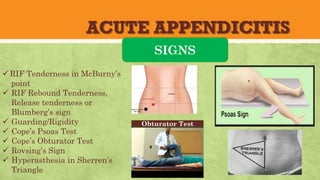
üRIF Tenderness in McBurny’s
point
ü RIF Rebound Tenderness,
Release tenderness or
Blumberg’s sign
ü Guarding/Rigidity
ü Cope’s Psoas Test
ü Cope’s Obturator Test
ü Rovsing’s Sign
ü Hyperasthesia in Sherren’s
Triangle
Obturator Test
ACUTE APPENDICITIS
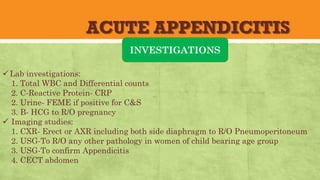
INVESTIGATIONS
üLab investigations:
1. Total WBC and Differential counts
2. C-Reactive Protein- CRP
2. Urine- FEME if positive for C&S
3. B- HCG to R/O pregnancy
ü Imaging studies:
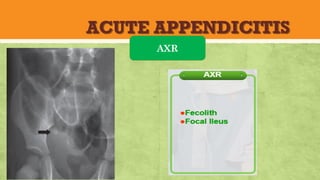
1. CXR- Erect or AXR including both side diaphragm to R/O Pneumoperitoneum
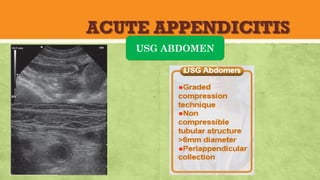
2. USG-To R/O any other pathology in women of child bearing age group
3. USG-To confirm Appendicitis
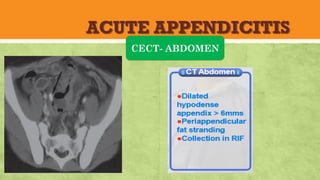
4. CECT abdomen
ACUTE APPENDICITIS
AXR
ACUTE APPENDICITIS
USG ABDOMEN
ACUTE APPENDICITIS
CECT- ABDOMEN
ACUTE APPENDICITIS
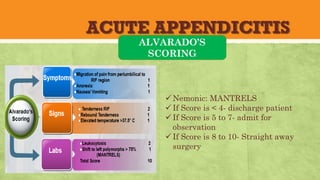
ALVARADO’S
SCORING
üNemonic: MANTRELS
üIf Score is < 4- discharge patient
üIf Score is 5 to 7- admit for
observation
üIf Score is 8 to 10- Straight away
surgery
ACUTE APPENDICITIS
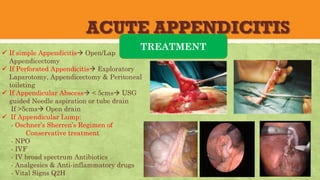
TREATMENT
ü If simple Appendicitis Open/Lap
Appendicectomy
ü If Perforated Appendicitis Exploratory
Laparotomy, Appendicectomy & Peritoneal
toileting
ü If Appendicular Abscess < 5cms USG
guided Needle aspiration or tube drain
If >5cms Open drain
ü If Appendicular Lump:
- Oschner’s Sherren’s Regimen of
Conservative treatment
- NPO
- IVF
- IV broad spectrum Antibiotics
- Analgesics & Anti-inflammatory drugs
- Vital Signs Q2H
ACUTE APPENDICITIS
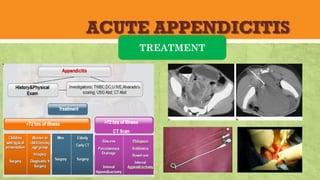
TREATMENT
ACUTE APPENDICITIS
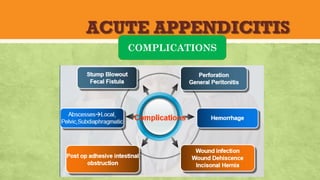
COMPLICATIONS
ACUTE APPENDICITIS
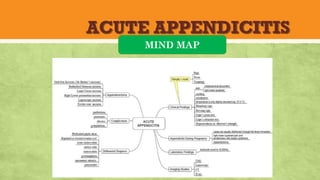
MIND MAP
ACUTE APPENDICITIS
Algorithm For RLQ PAIN
ACUTE APPENDICITIS
Algorithm For Ac Appendicitis
Peripheral Arterial Diseases(PAD)
ACUTE
CHOLECYSTITIS
RUQ PAIN
AN OVRVIEW
Dr.B.Selvaraj MS;Mch;FICS;
“Surgical Educator”
Malaysia
ACUTE CHOLECYSTITIS
 Causes for RUQ pain
 Epidemiology
 Etiology
 Pathology
 Clinical features
 Investigations
 Complications
 Treatment
 Mindmap
 Diagnostic Algorithm
 Treatment Algorithm
CASUES FOR RUQ PAIN
ACUTE CHOLECYSTITIS
-Epidemiology
 Cholecystitis is inflammation of the
gallbladder most commonly due to an
obstruction of the cystic duct by gallstones
arising from the gallbladder (cholelithiasis).
 Uncomplicated cholecystitis has an excellent
prognosis; the development of complications
such as perforation or gangrene renders a bad
prognosis.
 10%-20% of Americans have gallstones, and as
many as one third of these people develop
acute cholecystitis
 AGE: The incidence of cholecystitis increases
with age. Explanation for this is unclear.
 Sex distribution: Gallstones are 2-3 times
more frequent in females than in males,
resulting in a higher incidence of calculous
cholecystitis in females. Elevated progesterone
levels during pregnancy is the cause.
Acalculous cholecystitis is observed more often
in elderly men.
 Prevalence by race and ethinicity: More
common in people of Scandinavian descent,
Pima Indians, and Hispanic populations. In
the United States, white people have a higher
prevalence than black people.
ACUTE CHOLECYSTITIS
-ETIOLOGY
 Risk factors for Calculus Cholecystitis: 90%
- Female
- Fat- obese
- Fertile- Multigravida
- Forty- elderly
- Certain ethnic groups
- Certain drugs like HRT in females
 Risk factors for Acalculus Cholecystitis:
10%
- Critically ill patients
- Those who underwent major
surgery/trauma/Burns
- Severe Sepsis
- Prolonged fasting
- Long term TPN
- Sickle cell disease
- Immunocompromised patients- Diabetes & HIV
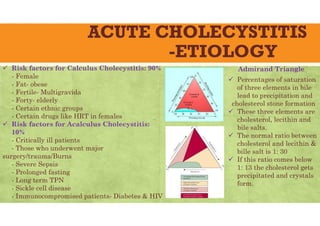
Admirand Triangle
 Percentages of saturation
of three elements in bile
lead to precipitation and
cholesterol stone formation
 These three elements are
cholesterol, lecithin and
bile salts.
 The normal ratio between
cholesterol and lecithin &
bille salt is 1: 30
 If this ratio comes below
1: 13 the cholesterol gets
precipitated and crystals
form.
ACUTE CHOLECYSTITIS
-PATHOLOGY
 90% of cases of cholecystitis involve
calculous cholecystitis, with the other
10% of cases representing acalculous
cholecystitis.
 Acute calculous cholecystitis is caused
by an obstruction of the cystic duct,
leading to distention of the gallbladder.
As the gallbladder becomes distended,
blood flow and lymphatic drainage are
compromised, leading to mucosal
ischemia and necrosis.
 Acalculous cholecystitis- exact
mechanism is unclear. Injury may be
the result of retained concentrated bile.
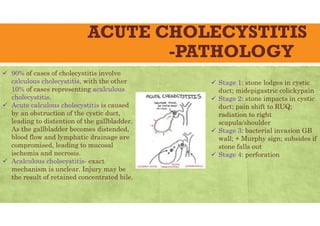
 Stage 1: stone lodges in cystic
duct; midepigastric colickypain
 Stage 2: stone impacts in cystic
duct; pain shift to RUQ;
radiation to right
scapula/shoulder
 Stage 3: bacterial invasion GB
wall; + Murphy sign; subsides if
stone falls out
 Stage 4: perforation
ACUTE CHOLECYSTITIS
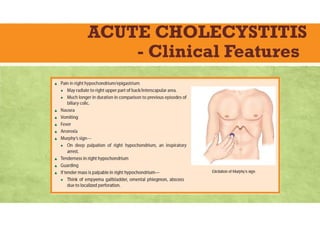
- Clinical Features
ACUTE CHOLECYSTITIS
- INVESTIGATIONS
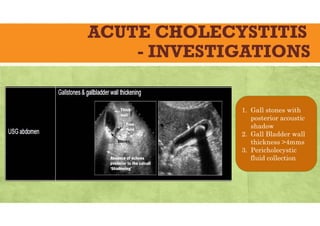
1. Gall stones with
posterior acoustic
shadow
2. Gall Bladder wall
thickness >4mms
3. Pericholecystic
fluid collection
ACUTE CHOLECYSTITIS
- INVESTIGATIONS
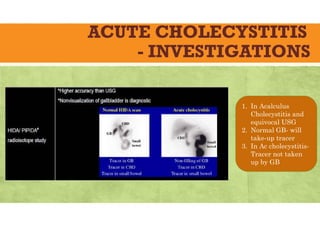
1. In Acalculus
Cholecystitis and
equivocal USG
2. Normal GB- will
take-up tracer
3. In Ac cholecystitis-
Tracer not taken
up by GB
ACUTE CHOLECYSTITIS
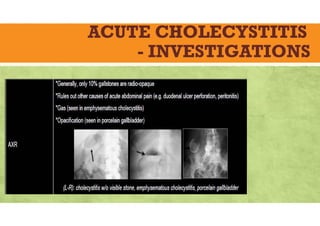
- INVESTIGATIONS
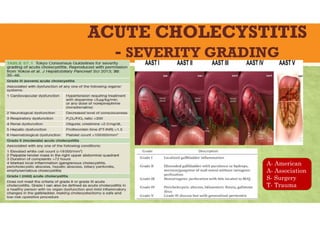
ACUTE CHOLECYSTITIS
- SEVERITY GRADING
A- American
A- Association
S- Surgery
T- Trauma
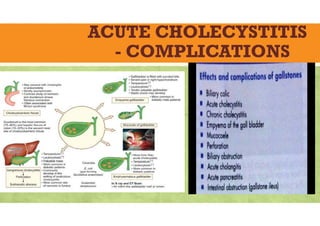
ACUTE CHOLECYSTITIS
- COMPLICATIONS
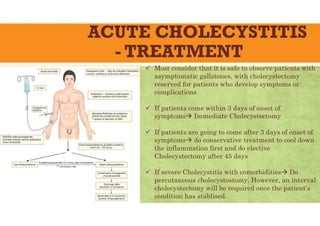
ACUTE CHOLECYSTITIS
- TREATMENT
 Most consider that it is safe to observe patients with
asymptomatic gallstones, with cholecystectomy
reserved for patients who develop symptoms or
complications
 If patients come within 3 days of onset of
symptoms Immediate Cholecystectomy
 If patients are going to come after 3 days of onset of
symptoms do conservative treatment to cool down
the inflammation first and do elective
Cholecystectomy after 45 days
 If severe Cholecystitis with comorbidities Do
percutaneous cholecystostomy. However, an interval
cholecystectomy will be required once the patient’s
condition has stablised.
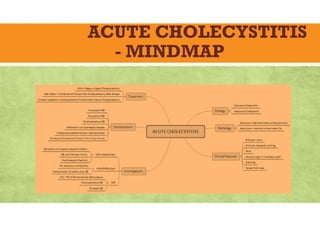
ACUTE CHOLECYSTITIS
- MINDMAP
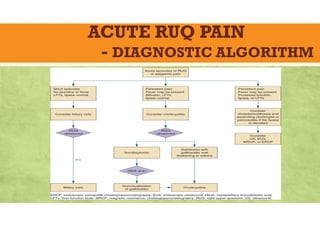
ACUTE RUQ PAIN
- DIAGNOSTIC ALGORITHM
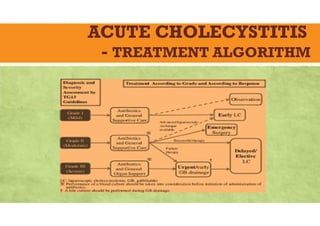
ACUTE CHOLECYSTITIS
- TREATMENT ALGORITHM
Peripheral Arterial Diseases(PAD)
ACUTE
PANCREATITIS
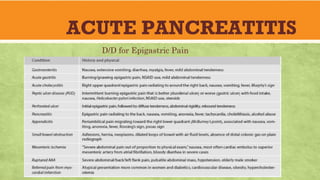
EPIGASTRIC PAIN
AN OVRVIEW
Dr.B.Selvaraj MS;Mch;FICS;
“Surgical Educator”
Malaysia
ACUTE PANCREATITIS
ü Different causes for epigastric pain
ü Epidemiology
ü Classifications and definitions
ü Etiology
ü Pathology
ü Clinical features
ü Investigations
ü Assessment of severity
ü Treatment
ü Complications
ü Mindmap
ü Treatment Algorithm
ACUTE PANCREATITIS
D/D for Epigastric Pain
ACUTE PANCREATITIS
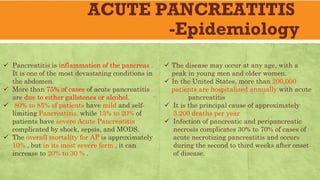
-Epidemiology
ü Pancreatitis is inflammation of the pancreas .
It is one of the most devastating conditions in
the abdomen.
ü More than 75% of cases of acute pancreatitis
are due to either gallstones or alcohol.
ü 80% to 85% of patients have mild and self-
limiting Pancreatitis, while 15% to 20% of
patients have severe Acute Pancreatitis
complicated by shock, sepsis, and MODS.
ü The overall mortality for AP is approximately
10% , but in its most severe form , it can
increase to 20% to 30 % .
ü The disease may occur at any age, with a
peak in young men and older women.
ü In the United States, more than 200,000
patients are hospitalized annually with acute
pancreatitis
ü It is the principal cause of approximately
3,200 deaths per year
ü Infection of pancreatic and peripancreatic
necrosis complicates 30% to 70% of cases of
acute necrotizing pancreatitis and occurs
during the second to third weeks after onset
of disease.
ACUTE PANCREATITIS
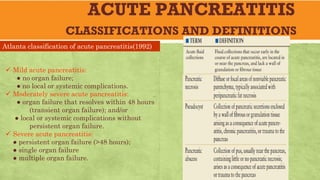
CLASSIFICATIONS AND DEFINITIONS
Atlanta classification of acute pancreatitis(1992)
ü Mild acute pancreatitis:
● no organ failure;
● no local or systemic complications.
ü Moderately severe acute pancreatitis:
● organ failure that resolves within 48 hours
(transient organ failure); and/or
● local or systemic complications without
persistent organ failure.
ü Severe acute pancreatitis:
● persistent organ failure (>48 hours);
● single organ failure
● multiple organ failure.
ACUTE PANCREATITIS
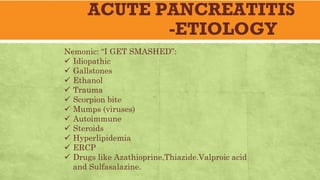
-ETIOLOGY
Nemonic: “I GET SMASHED”:
ü Idiopathic
ü Gallstones
ü Ethanol
ü Trauma
ü Scorpion bite
ü Mumps (viruses)
ü Autoimmune
ü Steroids
ü Hyperlipidemia
ü ERCP
ü Drugs like Azathioprine,Thiazide.Valproic acid
and Sulfasalazine.
ACUTE PANCREATITIS
-PATHOLOGY
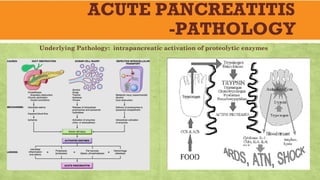
Underlying Pathology: intrapancreatic activation of proteolytic enzymes
ACUTE PANCREATITIS
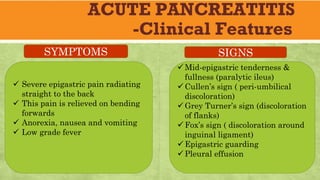
-Clinical Features
ü Severe epigastric pain radiating
straight to the back
ü This pain is relieved on bending
forwards
ü Anorexia, nausea and vomiting
ü Low grade fever
üMid-epigastric tenderness &
fullness (paralytic ileus)
üCullen’s sign ( peri-umbilical
discoloration)
üGrey Turner’s sign (discoloration
of flanks)
üFox’s sign ( discoloration around
inguinal ligament)
üEpigastric guarding
üPleural effusion
SYMPTOMS SIGNS
ACUTE PANCREATITIS
-INVESTIGATIONS
ü WBCs: ↑
ü Hct: ↑ (in dehydration)/ ↓ (in
hemorrhage)
ü ABG: metabolic & respiratory
acidosis + hypoxia
ü Urinary amylase: ↑
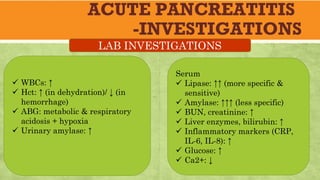
LAB INVESTIGATIONS
Serum
ü Lipase: ↑↑ (more specific &
sensitive)
ü Amylase: ↑↑↑ (less specific)
ü BUN, creatinine: ↑
ü Liver enzymes, bilirubin: ↑
ü Inflammatory markers (CRP,
IL-6, IL-8): ↑
ü Glucose: ↑
ü Ca2+: ↓
ACUTE PANCREATITIS
-INVESTIGATIONS
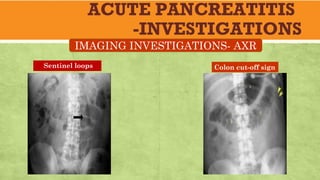
IMAGING INVESTIGATIONS- AXR
Sentinel loops Colon cut-off sign
ACUTE PANCREATITIS
-INVESTIGATIONS
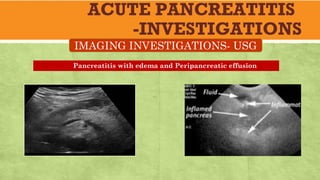
IMAGING INVESTIGATIONS- USG
Pancreatitis with edema and Peripancreatic effusion
ACUTE PANCREATITIS
-INVESTIGATIONS
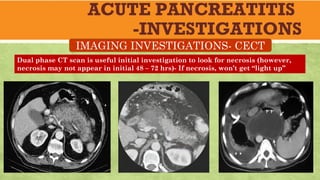
IMAGING INVESTIGATIONS- CECT
Dual phase CT scan is useful initial investigation to look for necrosis (however,
necrosis may not appear in initial 48 – 72 hrs)- If necrosis, won’t get “light up”
ACUTE PANCREATITIS
-INVESTIGATIONS
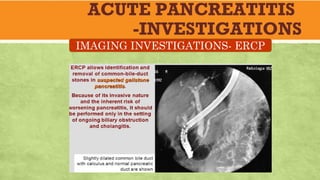
IMAGING INVESTIGATIONS- ERCP
ACUTE PANCREATITIS
ASSESSMENT OF SEVERITY
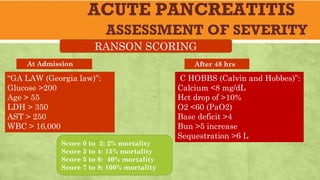
RANSON SCORING
At Admission
“GA LAW (Georgia law)”:
Glucose >200
Age > 55
LDH > 350
AST > 250
WBC > 16,000
After 48 hrs
“C HOBBS (Calvin and Hobbes)”:
Calcium <8 mg/dL
Hct drop of >10%
O2 <60 (PaO2)
Base deficit >4
Bun >5 increase
Sequestration >6 L
Score 0 to 2: 2% mortality
Score 3 to 4: 15% mortality
Score 5 to 6: 40% mortality
Score 7 to 8: 100% mortality
ACUTE PANCREATITIS
ASSESSMENT OF SEVERITY
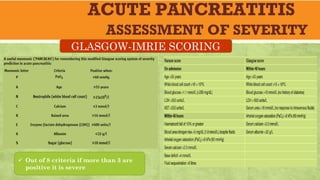
GLASGOW-IMRIE SCORING
ü Out of 8 criteria if more than 3 are
positive it is severe
ACUTE PANCREATITIS
ASSESSMENT OF SEVERITY
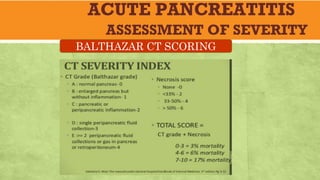
BALTHAZAR CT SCORING
ACUTE PANCREATITIS
ASSESSMENT OF SEVERITY
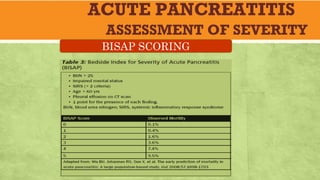
BISAP SCORING
ACUTE PANCREATITIS
TREATMENT
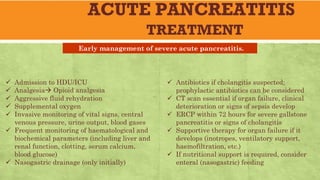
ü Admission to HDU/ICU
ü Analgesia Opioid analgesia
ü Aggressive fluid rehydration
ü Supplemental oxygen
ü Invasive monitoring of vital signs, central
venous pressure, urine output, blood gases
ü Frequent monitoring of haematological and
biochemical parameters (including liver and
renal function, clotting, serum calcium,
blood glucose)
ü Nasogastric drainage (only initially)
ü Antibiotics if cholangitis suspected;
prophylactic antibiotics can be considered
ü CT scan essential if organ failure, clinical
deterioration or signs of sepsis develop
ü ERCP within 72 hours for severe gallstone
pancreatitis or signs of cholangitis
ü Supportive therapy for organ failure if it
develops (inotropes, ventilatory support,
haemofiltration, etc.)
ü If nutritional support is required, consider
enteral (nasogastric) feeding
Early management of severe acute pancreatitis.
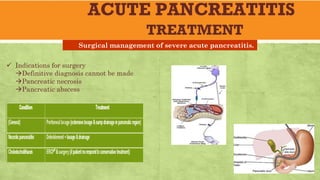
ACUTE PANCREATITIS
TREATMENT
ü Indications for surgery
Definitive diagnosis cannot be made
Pancreatic necrosis
Pancreatic abscess
Surgical management of severe acute pancreatitis.
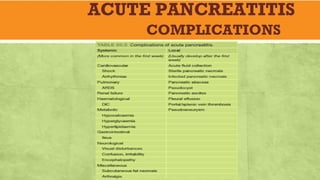
ACUTE PANCREATITIS
COMPLICATIONS
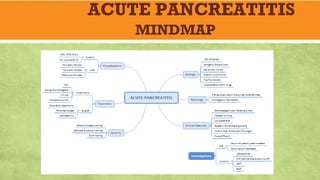
ACUTE PANCREATITIS
MINDMAP
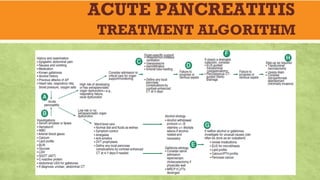
ACUTE PANCREATITIS
TREATMENT ALGORITHM
Peripheral Arterial Diseases(PAD)
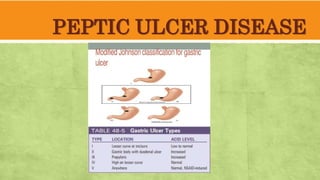
PEPTIC ULCER
DISEASE
EPIGASTRIC PAIN
AN OVRVIEW
Dr.B.Selvaraj MS;Mch;FICS;
“Surgical Educator”
Malaysia
PEPTIC ULCER DISEASE
Different causes for epigastric pain
Applied Basic Sciences
Etiopathogenesis
Epidemiology
Clinical features
Investigations
Complications
Treatment
Mindmap
Treatment Algorithm
PEPTIC ULCER DISEASE
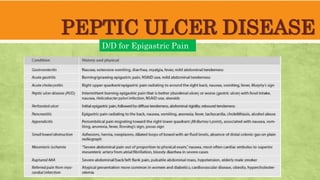
D/D for Epigastric Pain
PEPTIC ULCER DISEASE
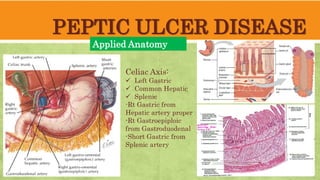
Applied Anatomy
Celiac Axis:
Left Gastric
Common Hepatic
Splenic
-Rt Gastric from
Hepatic artery proper
-Rt Gastroepiploic
from Gastroduodenal
-Short Gastric from
Splenic artery
PEPTIC ULCER DISEASE
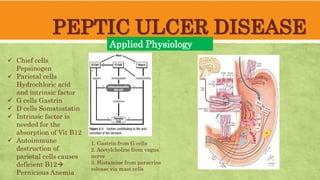
Applied Physiology
Chief cells
Pepsinogen
Parietal cells
Hydrochloric acid
and intrinsic factor
G cells Gastrin
D cells Somatostatin
Intrinsic factor is
needed for the
absorption of Vit B12
Autoimmune
destruction of
parietal cells causes
deficient B12
Pernicious Anemia
1. Gastrin from G cells
2. Acetylcholine from vagus
nerve
3. Histamine from paracrine
release via mast cells
PEPTIC ULCER DISEASE
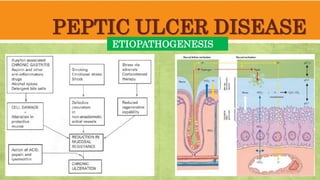
ETIOPATHOGENESIS
PEPTIC ULCER DISEASE
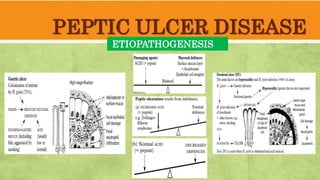
ETIOPATHOGENESIS
PEPTIC ULCER DISEASE
EPIDEMIOLOGY
A peptic ulcer is a break in the epithelial
surface of the stomach or duodenum caused
by the action of gastric secretions (acid and
pepsin) and infection with Helicobacter
pylori.
Mucosal infection with Helicobacter pylori is
a major cause for PUD
Patients with duodenal ulcers have an
increased capacity for gastric acid secretion
relative to normal people.
Hemorrhage is the leading cause of death
associated with peptic ulcer.
Each year, approximately 300,000 t o 500,000
new cases of PUD occur.
Three to four million patients are self-
medicating for symptoms of PUD
30,000 surgeries are performed annually for
PUD .
The incidence and prevalence of PUD varies
based upon the presence of Helicobacter pylori
(H. pylori). Higher rates are found in countries
where H. pylori infection is higher
DUs occur two decades earlier than GUs,
particularly in males .
PEPTIC ULCER DISEASE
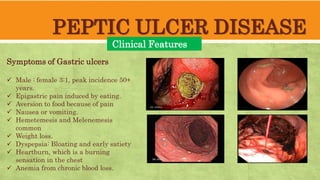
Clinical Features
Symptoms of Gastric ulcers
Male : female 3:1, peak incidence 50+
years.
Epigastric pain induced by eating.
Aversion to food because of pain
Nausea or vomiting.
Hemetemesis and Melenemesis
common
Weight loss.
Dyspepsia: Bloating and early satiety
Heartburn, which is a burning
sensation in the chest
Anemia from chronic blood loss.
PEPTIC ULCER DISEASE
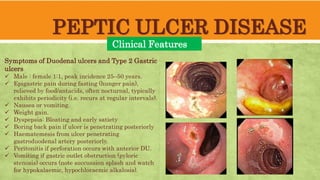
Clinical Features
Symptoms of Duodenal ulcers and Type 2 Gastric
ulcers
Male : female 1:1, peak incidence 25–50 years.
Epigastric pain during fasting (hunger pain),
relieved by food/antacids, often nocturnal, typically
exhibits periodicity (i.e. recurs at regular intervals).
Nausea or vomiting.
Weight gain.
Dyspepsia: Bloating and early satiety
Boring back pain if ulcer is penetrating posteriorly
Haematemesis from ulcer penetrating
gastroduodenal artery posteriorly.
Peritonitis if perforation occurs with anterior DU.
Vomiting if gastric outlet obstruction (pyloric
stenosis) occurs (note succussion splash and watch
for hypokalaemic, hypochloraemic alkalosis).
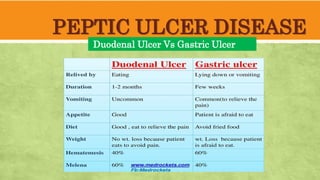
PEPTIC ULCER DISEASE
Duodenal Ulcer Vs Gastric Ulcer
PUD- INVESTIGATIONS
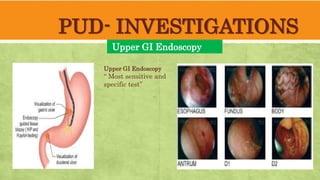
Upper GI Endoscopy
Upper GI Endoscopy
“ Most sensitive and
specific test”
PUD- INVESTIGATIONS
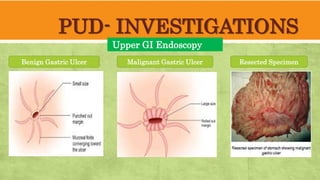
Upper GI Endoscopy
Benign Gastric Ulcer Malignant Gastric Ulcer Resected Specimen
PUD- INVESTIGATIONS
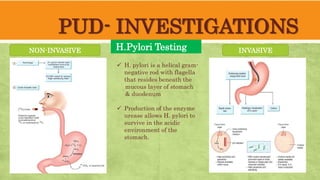
H.Pylori Testing
NON-INVASIVE INVASIVE
H. pylori is a helical gram-
negative rod with flagella
that resides beneath the
mucous layer of stomach
& duodenum
Production of the enzyme
urease allows H. pylori to
survive in the acidic
environment of the
stomach.
PUD- INVESTIGATIONS
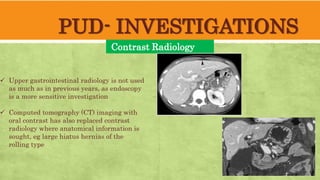
Contrast Radiology
Upper gastrointestinal radiology is not used
as much as in previous years, as endoscopy
is a more sensitive investigation
Computed tomography (CT) imaging with
oral contrast has also replaced contrast
radiology where anatomical information is
sought, eg large hiatus hernias of the
rolling type
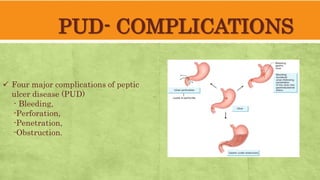
PUD- COMPLICATIONS
Four major complications of peptic
ulcer disease (PUD)
- Bleeding,
-Perforation,
-Penetration,
-Obstruction.
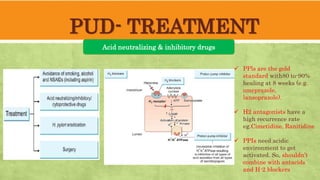
PUD- TREATMENT
PPls are the gold
standard with80 to-90%
healing at 8 weeks (e.g.
omeprazole,
lansoprazole).
H2 antagonists have a
high recurrence rate
eg.Cimetidine, Ranitidine
PPIs need acidic
environment to get
activated. So, shouldn’t
combine with antacids
and H-2 blockers
Acid neutralizing & inhibitory drugs
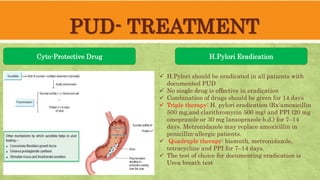
PUD- TREATMENT
Cyto-Protective Drug H.Pylori Eradication
H.Pylori should be eradicated in all patients with
documented PUD
No single drug is effective in eradication
Combination of drugs should be given for 14 days
Triple therapy: H. pylori eradication (Rx:amoxicillin
500 mg,and clarithromycin 500 mg) and PPI (20 mg
omeprazole or 30 mg lansoprazole b.d.) for 7–14
days. Metronidazole may replace amoxicillin in
penicillin-allergic patients.
Quadruple therapy: bismuth, metronidazole,
tetracycline and PPI for 7–14 days.
The test of choice for documenting eradication is
Urea breath test
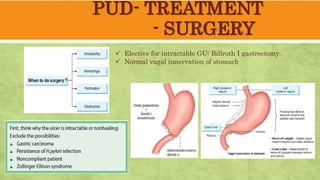
PUD- TREATMENT
- SURGERY
Elective for intractable GU: Billroth I gastrectomy.
Normal vagal innervation of stomach
PUD- TREATMENT
- SURGERY
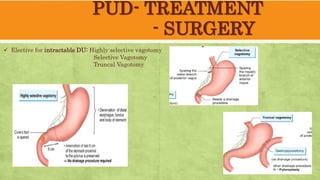
Elective for intractable DU: Highly selective vagotomy
Selective Vagotomy
Truncal Vagotomy
PUD- TREATMENT
- SURGERY
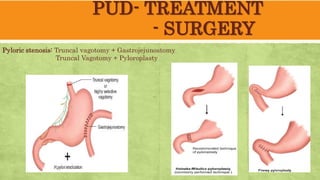
Pyloric stenosis: Truncal vagotomy + Gastrojejunostomy
Truncal Vagotomy + Pyloroplasty
PUD- TREATMENT
- SURGERY
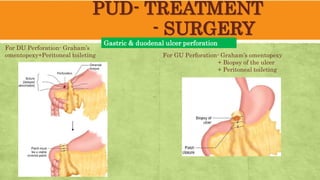
Gastric & duodenal ulcer perforation
For DU Perforation- Graham’s
omentopexy+Peritoneal toileting For GU Perforation- Graham’s omentopexy
+ Biopsy of the ulcer
+ Peritoneal toileting
PUD- TREATMENT
- SURGERY
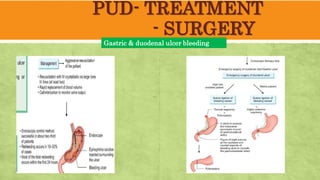
Gastric & duodenal ulcer bleeding
PEPTIC ULCER DISEASE
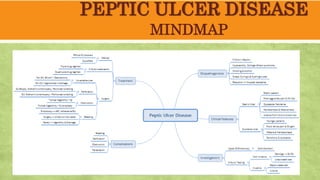
MINDMAP
PEPTIC ULCER DISEASE
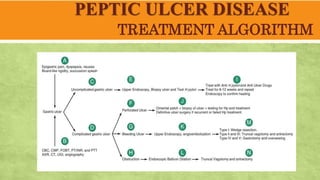
TREATMENT ALGORITHM
PEPTIC ULCER DISEASE
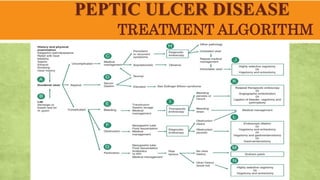
TREATMENT ALGORITHM
Peripheral Arterial Diseases(PAD)
SMALL BOWEL
OBSTRUCTION
GENERALISED ABDOMINAL PAIN
AN OVRVIEW
Dr.B.Selvaraj MS;Mch;FICS;
“Surgical Educator”
Malaysia
SMALL BOWEL OBSTRUCTION
✓ Different causes for generalized abdominal pain
✓ Epidemiology
✓ Etiology
✓ Pathology
✓ Clinical features
✓ Investigations
✓ Complications
✓ Treatment
✓ Mindmap
✓ Treatment Algorithm
SMALL BOWEL OBSTRUCTION
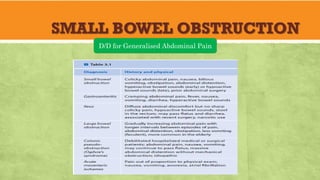
D/D for Generalised Abdominal Pain
SMALL BOWEL OBSTRUCTION
Epidemiology
✓ Stoppage of cranio- caudal propulsion of bowel
contents due to narrowing or complete
blockage of bowel lumen.
✓ Common surgical emergency, serious in nature
and demands early diagnosis and intervention
✓ SBO is more common and more severe than
LBO
✓ Post-op adhesion and obstructed inguinal
hernia are the two common causes
✓ The prevalence of small bowel obstruction is
approximately 100 - 500 per 100,000 - who
have not undergone previous abdominal
surgery.
✓ The prevalence of small bowel obstruction is
approximately 600 per 100,000 in patients who
have undergone previous abdominal surgery
SMALL BOWEL OBSTRUCTION
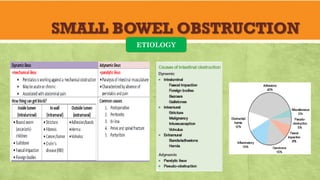
ETIOLOGY
SMALL BOWEL OBSTRUCTION
PATHOLOGY
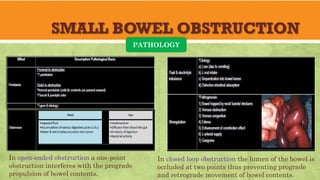
In open-ended obstruction a one-point
obstruction interferes with the prograde
propulsion of bowel contents.
In closed loop obstruction the lumen of the bowel is
occluded at two points thus preventing prograde
and retrograde movement of bowel contents.
SMALL BOWEL OBSTRUCTION
Clinical Features- Symptoms
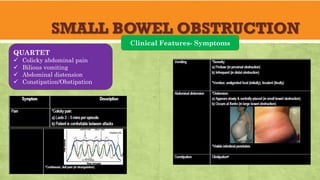
QUARTET
✓ Colicky abdominal pain
✓ Bilious vomiting
✓ Abdominal distension
✓ Constipation/Obstipation
SMALL BOWEL OBSTRUCTION
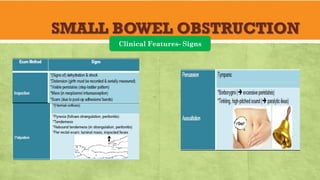
Clinical Features- Signs
SMALL BOWEL OBSTRUCTION
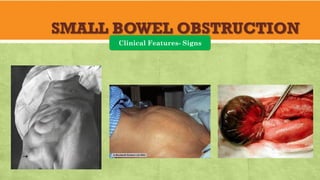
Clinical Features- Signs
SMALL BOWEL OBSTRUCTION
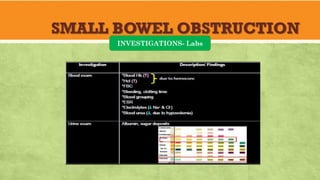
INVESTIGATIONS- Labs
SMALL BOWEL OBSTRUCTION
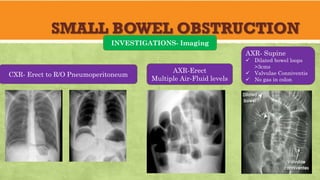
INVESTIGATIONS- Imaging
CXR- Erect to R/O Pneumoperitoneum
AXR-Erect
Multiple Air-Fluid levels
AXR- Supine
✓ Dilated bowel loops
>3cms
✓ Valvulae Conniventis
✓ No gas in colon
SMALL BOWEL OBSTRUCTION
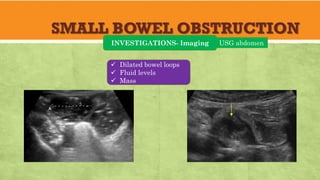
INVESTIGATIONS- Imaging USG abdomen
✓ Dilated bowel loops
✓ Fluid levels
✓ Mass
SMALL BOWEL OBSTRUCTION
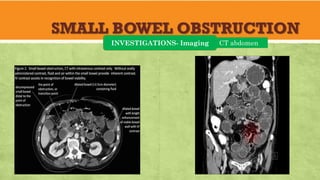
INVESTIGATIONS- Imaging CT abdomen
SMALL BOWEL OBSTRUCTION
TREATMENT
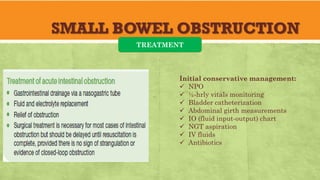
Initial conservative management:
✓ NPO
✓ ½-hrly vitals monitoring
✓ Bladder catheterization
✓ Abdominal girth measurements
✓ IO (fluid input-output) chart
✓ NGT aspiration
✓ IV fluids
✓ Antibiotics
SMALL BOWEL OBSTRUCTION
TREATMENT
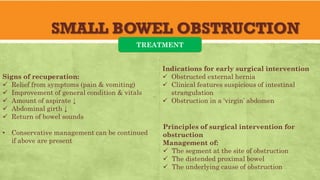
Signs of recuperation:
✓ Relief from symptoms (pain & vomiting)
✓ Improvement of general condition & vitals
✓ Amount of aspirate ↓
✓ Abdominal girth ↓
✓ Return of bowel sounds
• Conservative management can be continued
if above are present
Indications for early surgical intervention
✓ Obstructed external hernia
✓ Clinical features suspicious of intestinal
strangulation
✓ Obstruction in a ‘virgin’ abdomen
Principles of surgical intervention for
obstruction
Management of:
✓ The segment at the site of obstruction
✓ The distended proximal bowel
✓ The underlying cause of obstruction
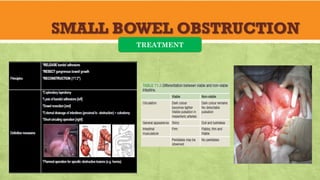
SMALL BOWEL OBSTRUCTION
TREATMENT
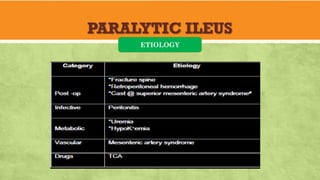
PARALYTIC ILEUS
ETIOLOGY
PARALYTIC ILEUS
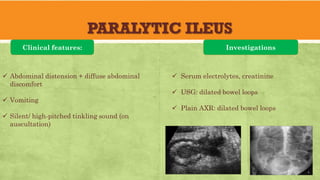
Clinical features:
✓ Abdominal distension + diffuse abdominal
discomfort
✓ Vomiting
✓ Silent/ high-pitched tinkling sound (on
auscultation)
Investigations
✓ Serum electrolytes, creatinine
✓ USG: dilated bowel loops
✓ Plain AXR: dilated bowel loops
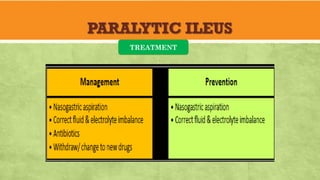
PARALYTIC ILEUS
TREATMENT
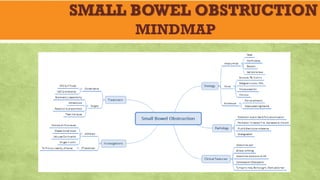
SMALL BOWEL OBSTRUCTION
MINDMAP
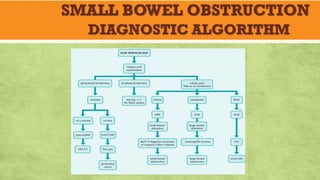
SMALL BOWEL OBSTRUCTION
DIAGNOSTIC ALGORITHM
SMALL BOWEL OBSTRUCTION
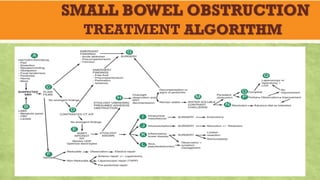
TREATMENT ALGORITHM
Peripheral Arterial Diseases(PAD)
MESENTERIC
ISCHEMIA
GENERALISED ABDOMINAL PAIN
AN OVRVIEW
Dr.B.Selvaraj MS;Mch;FICS;
“Surgical Educator”
Malaysia
MESENTERIC ISCHEMIA
 Different causes for generalized abdominal pain
 Etiology
 Pathology
 Epidemiology
 Clinical features
 Investigations
 Treatment
 Take home message
 Mindmap
 Treatment Algorithm
MESENTERIC ISCHEMIA
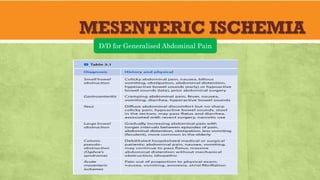
D/D for Generalised Abdominal Pain
MESENTERIC ISCHEMIA
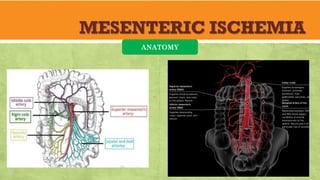
ANATOMY
MESENTERIC ISCHEMIA
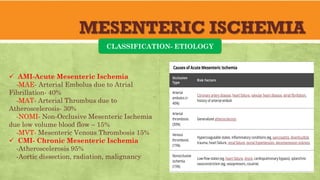
CLASSIFICATION- ETIOLOGY
 AMI-Acute Mesenteric Ischemia
-MAE- Arterial Embolus due to Atrial
Fibrillation- 40%
-MAT- Arterial Thrombus due to
Atheroscelerosis- 30%
-NOMI- Non-Occlusive Mesenteric Ischemia
due low volume blood flow – 15%
-MVT- Mesenteric Venous Thrombosis 15%
 CMI- Chronic Mesenteric Ischemia
-Atheroscelerosis 95%
-Aortic dissection, radiation, malignancy
MESENTERIC ISCHEMIA
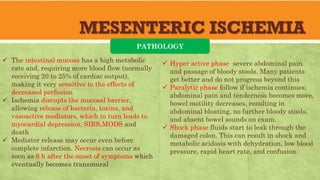
PATHOLOGY
 The intestinal mucosa has a high metabolic
rate and, requiring more blood flow (normally
receiving 20 to 25% of cardiac output),
making it very sensitive to the effects of
decreased perfusion
 Ischemia disrupts the mucosal barrier,
allowing release of bacteria, toxins, and
vasoactive mediators, which in turn leads to
myocardial depression, SIRS,MODS and
death
 Mediator release may occur even before
complete infarction. Necrosis can occur as
soon as 6 h after the onset of symptoms which
eventually becomes transmural
 Hyper active phase severe abdominal pain
and passage of bloody stools. Many patients
get better and do not progress beyond this
 Paralytic phase follow if ischemia continues;
abdominal pain and tenderness becomes more,
bowel motility decreases, resulting in
abdominal bloating, no further bloody stools,
and absent bowel sounds on exam.
 Shock phase fluids start to leak through the
damaged colon. This can result in shock and
metabolic acidosis with dehydration, low blood
pressure, rapid heart rate, and confusion.
MESENTERIC ISCHEMIA
EPIDEMIOLOOGY
 Mesenteric ischemia is insufficient perfusion
of the mesentery to meet the metabolic
demands of the splanchnic system.
 Prompt diagnosis and treatment of this life-
threatening condition, with mortality rates
from 24% to 94% is important
 Despite the best efforts of modern medicine
mortality still exceeds 50%
 Acute mesenteric ischemia is different from
ischemic colitis, which involves only small
vessels and causes mainly mucosal necrosis
and bleeding.
 The overall incidence for Mesenteric Ischemia
is estimated at 12.9/100,000 person/year
 Incidence of Acute superior mesenteric artery
(SMA) occlusion (embolus/thrombus ratio =
1.4) is 70%
 Incidence of Mesenteric venous thrombosis
(MVT) is 15%
 Nonocclusive mesenteric ischemia (NOMI)
were found in 15%
MESENTERIC ISCHEMIA
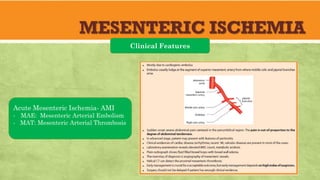
Clinical Features
Acute Mesenteric Ischemia- AMI
- MAE: Mesenteric Arterial Embolism
- MAT: Mesenteric Arterial Thrombosis
MESENTERIC ISCHEMIA
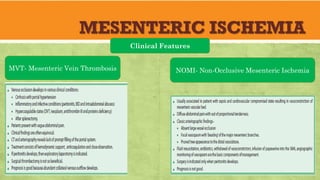
Clinical Features
MVT- Mesenteric Vein Thrombosis NOMI- Non-Occlusive Mesenteric Ischemia
MESENTERIC ISCHEMIA
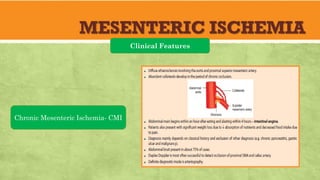
Clinical Features
Chronic Mesenteric Ischemia- CMI
MESENTERIC ISCHEMIA
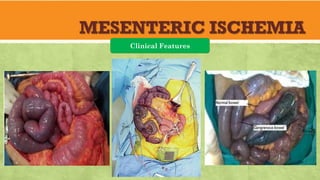
Clinical Features
MESENTERIC ISCHEMIA
INESTIGATIONS- LABS
 White blood cell count >10.5 in 98%
 Lactic acid elevated 91%
 In very early stage these two may not be elevated
 However, in late cases both are elevated
MESENTERIC ISCHEMIA
INESTIGATIONS- CT Abdomen
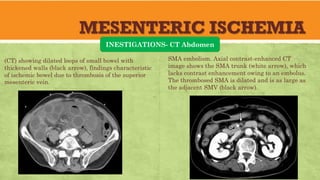
SMA embolism. Axial contrast-enhanced CT
image shows the SMA trunk (white arrow), which
lacks contrast enhancement owing to an embolus.
The thrombosed SMA is dilated and is as large as
the adjacent SMV (black arrow).
(CT) showing dilated loops of small bowel with
thickened walls (black arrow), findings characteristic
of ischemic bowel due to thrombosis of the superior
mesenteric vein.
MESENTERIC ISCHEMIA
INESTIGATIONS- CT Angiography
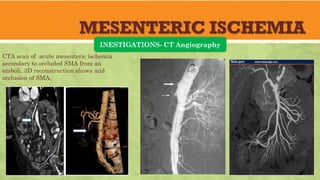
CTA scan of acute mesenteric ischemia
secondary to occluded SMA from an
emboli. 3D reconstruction shows mid
occlusion of SMA.
MESENTERIC ISCHEMIA
TREATMENT
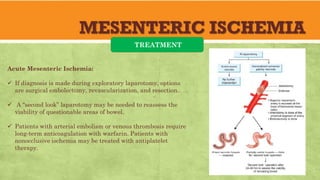
Acute Mesenteric Ischemia:
 If diagnosis is made during exploratory laparotomy, options
are surgical embolectomy, revascularization, and resection.
 A “second look” laparotomy may be needed to reassess the
viability of questionable areas of bowel.
 Patients with arterial embolism or venous thrombosis require
long-term anticoagulation with warfarin. Patients with
nonocclusive ischemia may be treated with antiplatelet
therapy.
MESENTERIC ISCHEMIA
TREATMENT
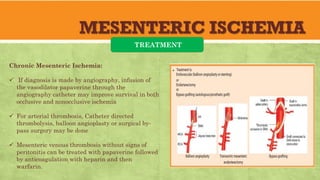
Chronic Mesenteric Ischemia:
 If diagnosis is made by angiography, infusion of
the vasodilator papaverine through the
angiography catheter may improve survival in both
occlusive and nonocclusive ischemia
 For arterial thrombosis, Catheter directed
thrombolysis, balloon angioplasty or surgical by-
pass surgery may be done
 Mesenteric venous thrombosis without signs of
peritonitis can be treated with papaverine followed
by anticoagulation with heparin and then
warfarin.
MESENTERIC ISCHEMIA
TAKE HOME MESSAGE
 Early diagnosis is critical because mortality increases significantly once
intestinal infarction has occurred.
 Initially, pain is severe but physical findings are minimal- Pain out of
proportion to physical findings
 Surgical exploration is often the best diagnostic measure for patients with
definite peritoneal signs.
 For other patients, mesenteric angiography or CT angiography is done.
 For AMI embolectomy, revascularization, and resection.
 For CMI thrombolysis, angioplasty or by-pass surgery
MESENTERIC ISCHEMIA
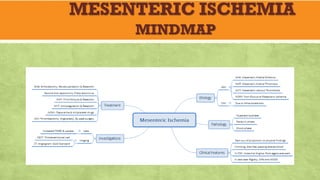
MINDMAP
MESENTERIC ISCHEMIA
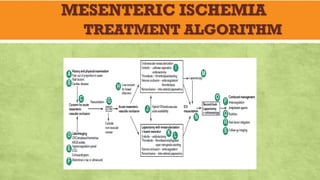
TREATMENT ALGORITHM
Peripheral Arterial Diseases(PAD)
SIGMOIDVOLVULUS
GENERALISED ABDOMINAL PAIN
AN OVRVIEW
Dr.B.Selvaraj MS;Mch;FICS;
“Surgical Educator”
Malaysia
SIGMOIDVOLVULUS
✓ Different causes for generalized abdominal pain
✓ Epidemiology
✓ Etiology- Risk Factors
✓ Pathology
✓ Clinical features- Symptoms & Signs
✓ Differential diagnosis
✓ Investigations
✓ Treatment
✓ Mindmap
✓ Diagnostic Algorithm
✓ Treatment Algorithm
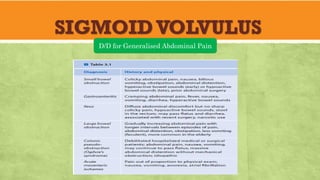
SIGMOID VOLVULUS
D/D for Generalised Abdominal Pain
SIGMOIDVOLVULUS
Epidemiology
✓ Volvulus occurs when a segment of colon
undergoes twisting along its own mesentery
(mesenterio-axial) resulting in obstruction.
✓ Twisting of 180 degrees results in clinical
obstruction, and further twisting to 360
degrees causes strangulation with venous
gangrene, ischemia, and eventual perforation.
✓ It is a closed loop obstruction
✓ Common in elderly and those who are taking
neuro-psychiatric drugs
✓ Sigmoid volvulus accounts for 5% of large
bowel obstruction in developed countries. and
10% to 50% in developing countries
✓ This is because of intake of high-fibre diet in
these countries
✓ Patients are often institutionalized and
debilitated due to underlying neurologic or
psychiatric disease and have a history of
constipation
SIGMOIDVOLVULUS
ETIOLOGY-Risk Factors
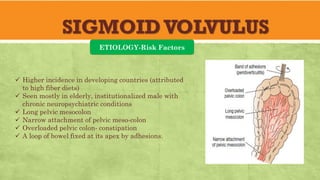
✓ Higher incidence in developing countries (attributed
to high fiber diets)
✓ Seen mostly in elderly, institutionalized male with
chronic neuropsychiatric conditions
✓ Long pelvic mesocolon
✓ Narrow attachment of pelvic meso-colon
✓ Overloaded pelvic colon- constipation
✓ A loop of bowel fixed at its apex by adhesions.
SIGMOIDVOLVULUS
PATHOLOGY
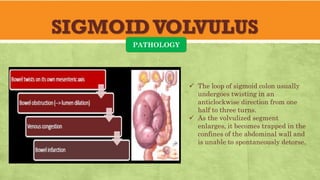
✓ The loop of sigmoid colon usually
undergoes twisting in an
anticlockwise direction from one
half to three turns.
✓ As the volvulized segment
enlarges, it becomes trapped in the
confines of the abdominal wall and
is unable to spontaneously detorse.
SIGMOIDVOLVULUS
Clinical Features- Symptoms & Signs
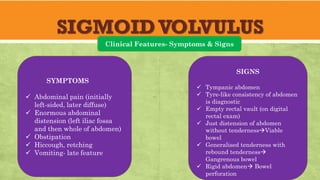
SYMPTOMS
✓ Abdominal pain (initially
left-sided, later diffuse)
✓ Enormous abdominal
distension (left iliac fossa
and then whole of abdomen)
✓ Obstipation
✓ Hiccough, retching
✓ Vomiting- late feature
SIGNS
✓ Tympanic abdomen
✓ Tyre-like consistency of abdomen
is diagnostic
✓ Empty rectal vault (on digital
rectal exam)
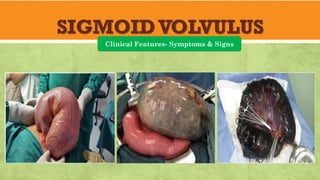
✓ Just distension of abdomen
without tenderness→Viable
bowel
✓ Generalised tenderness with
rebound tenderness→
Gangrenous bowel
✓ Rigid abdomen→ Bowel
perforation
SIGMOIDVOLVULUS
Clinical Features- Symptoms & Signs
SIGMOIDVOLVULUS
DIFFERENTIAL DIAGNOSIS
✓ Colorectal carcinoma causing
obstruction
✓ Toxic megacolon
✓ Colorectal strictures
✓ Hirschsprung's disease
✓ Caecal volvulus
✓ Paralytic ileus
✓ Ileosigmoid knotting
✓ Ogilvie's disease (colonic pseudo-
obstruction)- Dysfunction of Sacral
para-sympathetic nerves
✓ Acquired megacolon
✓ Giant colonic diverticulum
SIGMOIDVOLVULUS
INVESTIGATIONS
✓ Blood tests : FBC, Serum
Electrolytes
✓ RFT: Blood urea&Creatinine
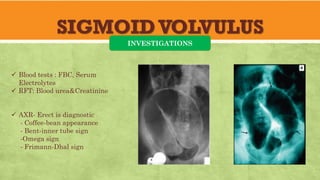
✓ AXR- Erect is diagnostic
- Coffee-bean appearance
- Bent-inner tube sign
-Omega sign
- Frimann-Dhal sign
SIGMOIDVOLVULUS
INVESTIGATIONS
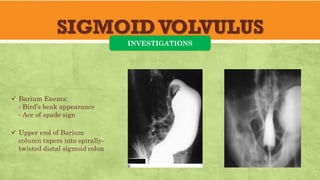
✓ Barium Enema:
- Bird’s beak appearance
- Ace of spade sign
✓ Upper end of Barium
column tapers into spirally-
twisted distal sigmoid colon
SIGMOIDVOLVULUS
INVESTIGATIONS
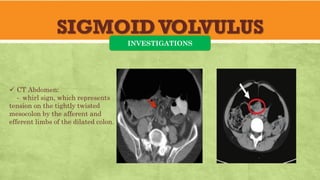
✓ CT Abdomen:
- whirl sign, which represents
tension on the tightly twisted
mesocolon by the afferent and
efferent limbs of the dilated colon.
SIGMOIDVOLVULUS
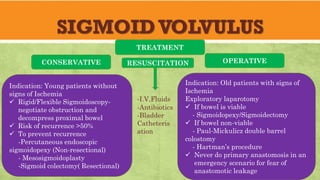
TREATMENT
Indication: Young patients without
signs of Ischemia
✓ Rigid/Flexible Sigmoidoscopy-
negotiate obstruction and
decompress proximal bowel
✓ Risk of recurrence >50%
✓ To prevent recurrence
-Percutaneous endoscopic
sigmoidopexy (Non-resectional)
- Mesosigmoidoplasty
-Sigmoid colectomy( Resectional)
Indication: Old patients with signs of
Ischemia
Exploratory laparotomy
✓ If bowel is viable
- Sigmoidopexy/Sigmoidectomy
✓ If bowel non-viable
- Paul-Mickulicz double barrel
colostomy
- Hartman’s procedure
✓ Never do primary anastomosis in an
emergency scenario for fear of
anastomotic leakage
CONSERVATIVE OPERATIVE
RESUSCITATION
-I.V.Fluids
-Antibiotics
-Bladder
Catheteris
ation
SIGMOIDVOLVULUS
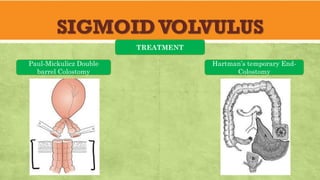
TREATMENT
Paul-Mickulicz Double
barrel Colostomy
Hartman’s temporary End-
Colostomy
SIGMOIDVOLVULUS
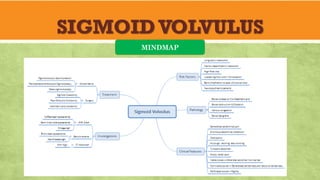
MINDMAP
SIGMOIDVOLVULUS
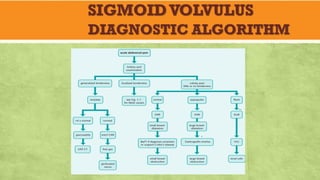
DIAGNOSTIC ALGORITHM
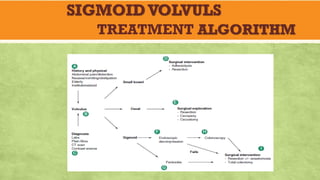
SIGMOIDVOLVULS
TREATMENT ALGORITHM
Peripheral Arterial Diseases(PAD)

ABDOMINAL PAIN- Didactic Lectures- PPTs.pdf

  • 1.
    CASE BASED LEARNING ABDOMINALPAIN INTRODUCTION Dr.B.Selvaraj MS;Mch;FICS; Professor of Surgery Melaka Manipal Medical College Melaka 75150 Malaysia
  • 2.
  • 3.
  • 4.
  • 5.
    ABDOMINAL PAIN- CAUSES ✓Inflammation of a viscus ✓ Perforation of a viscus ✓ Obstruction of a viscus ✓ Infarction of a viscus ✓ Intra-abdominal hemorrhage or retroperitoneal hemorrhage ✓ Extra-abdominal or medical causes for acute abdominal pain like lower lobe pneumonia and inferior wall MI
  • 6.
    ABDOMINAL PAIN- HISTORY SOCRATES= Nemonic S - site O - onset C - characteristics R - radiation A – associated symptoms & signs T - timing E - exacerbating/ alleviating S - severity ✓ “S” stands for “site”. Which region/quadrant? Is it a general sense of overall discomfort? The site of pain helps you fine tune your subsequent physical exam and diagnostic decision making. ✓ “O” stands for “onset”. When did the pain start? Acute or insidious? ✓ “C” stands for “characteristics”. The pain may be sharp, dull, heavy, etc. or a combination of descriptions.
  • 7.
    ABDOMINAL PAIN- HISTORY SOCRATES= Nemonic S - site O - onset C - characteristics R - radiation A – associated symptoms & signs T - timing E - exacerbating/ alleviating S - severity ✓ “R”, which represents “radiation”. Ask if the pain stays at the site they are describing or if it travels somewhere else in the body. Ex:Ureteric colic ✓ A” stands for associated symptoms. What other symptoms are present and associated with the pain? Ask do they also have nausea and/or vomiting? ✓ "T" stands for timing. When does the pain occur? Does it happen at specific times of the day, or is it constant?
  • 8.
    ABDOMINAL PAIN- HISTORY SOCRATES= Nemonic S - site O - onset C - characteristics R - radiation A – associated symptoms & signs T - timing E - exacerbating/ alleviating S - severity ✓ “E” represents “exacerbating” factors; grouped within this is also alleviating factors. The patient should be probed as to what makes their pain better or worse. Certain physical positions, medications, etc. These factors can all provide historical clues about the root cause. ✓ “S” stands for “severity”. In most hospitals this is formulated on a 1 to 10 scale with 10 being the most severe pain they’ve ever experienced.
  • 9.
    ABDOMINAL PAIN ✓Somatic pain: ✓Originatefrom abdominal wall and parietal peritoneum ✓Sharper and more distinct ✓Better localized ✓Sensitive to cutting,tearing, burning and crushing ✓Visceral pain: ✓Originate from internal organs and visceral peritoneum ✓Achy and crampy ✓Variable localization and sensation ✓Not sensitive to cutting, tearing, burning or crushing ✓Sensitive to stretching of walls of hollow organs and capsule of solid organs
  • 10.
    ABDOMINAL PAIN ✓Shifting pain:Ex: Periumbilical pain shifting to RLQ in Ac.appendicitis ✓Radiating pain: Ex: Pain radiating from loin to groin in ureteric colic ✓Reffered pain: Ex: Pain felt at Lt shoulder in case of splenic rupture
  • 11.
    ABDOMINAL PAIN- GRADING ✓Itis done by comparing a10cm line numbered 0 to 10 and this is called Visual Analogue Scale- VAS ✓Minimum 0 means no pain ✓2 is mild pain ✓4 is discomforting pain ✓6 is distressing pain ✓8 is intense pain
  • 13.
    AN OVRVIEW Dr.B.Selvaraj MS;Mch;FICS; “SurgicalEducator” Malaysia ACUTE APPENDICITIS RLQ PAIN
  • 14.
    ACUTE APPENDICITIS Objectives ü Causesof RLQ Pain ü Etiology ü Pathology ü Clinical features- Symptoms & Signs ü Investigations ü Scoring System ü Treatment ü Complications ü Mindmap ü Algorithm for RLQ Pain ü Treatment Algorithm for Ac Appendicitis
  • 15.
    ACUTE APPENDICITIS Causes ofRLQ Pain üAcute Appendicitis üEctopic Pregnancy üTwisted Ovarian Cyst üPelvic Inflammatory Disease- PID üEndometriosis üTubo-Ovarian Pathology üMittlesmerz In Females üAcute Appendicitis üRt Ureteric Calculus üPerforated DU- Valentino Appendicitis üAc Cholecystitis üAc Pancreatitis üCrohn’s Disease üCecal Diverticulitis üInferior Wall MI üLower Lobe Pneumonia In Males In Children üAcute Appendicitis üIntussusception üMeckel’s Diverticulitis üMesenteric Lymphadenitis
  • 16.
    ACUTE APPENDICITIS ETIOLOGY üObstructive: 1. Fecolith 2.Worms- Enterobious Vermicularis 3. Lymphoid Hyperplasia in Children ü Non-Obstructive: 1. Catarrhal- infection
  • 17.
  • 18.
  • 19.
    ACUTE APPENDICITIS SIGNS üRIF Tendernessin McBurny’s point ü RIF Rebound Tenderness, Release tenderness or Blumberg’s sign ü Guarding/Rigidity ü Cope’s Psoas Test ü Cope’s Obturator Test ü Rovsing’s Sign ü Hyperasthesia in Sherren’s Triangle Obturator Test
  • 20.
    ACUTE APPENDICITIS SIGNS üRIF Tendernessin McBurny’s point ü RIF Rebound Tenderness, Release tenderness or Blumberg’s sign ü Guarding/Rigidity ü Cope’s Psoas Test ü Cope’s Obturator Test ü Rovsing’s Sign ü Hyperasthesia in Sherren’s Triangle Obturator Test
  • 21.
    ACUTE APPENDICITIS INVESTIGATIONS üLab investigations: 1.Total WBC and Differential counts 2. C-Reactive Protein- CRP 2. Urine- FEME if positive for C&S 3. B- HCG to R/O pregnancy ü Imaging studies: 1. CXR- Erect or AXR including both side diaphragm to R/O Pneumoperitoneum 2. USG-To R/O any other pathology in women of child bearing age group 3. USG-To confirm Appendicitis 4. CECT abdomen
  • 22.
  • 23.
  • 24.
  • 25.
    ACUTE APPENDICITIS ALVARADO’S SCORING üNemonic: MANTRELS üIfScore is < 4- discharge patient üIf Score is 5 to 7- admit for observation üIf Score is 8 to 10- Straight away surgery
  • 26.
    ACUTE APPENDICITIS TREATMENT ü Ifsimple Appendicitis Open/Lap Appendicectomy ü If Perforated Appendicitis Exploratory Laparotomy, Appendicectomy & Peritoneal toileting ü If Appendicular Abscess < 5cms USG guided Needle aspiration or tube drain If >5cms Open drain ü If Appendicular Lump: - Oschner’s Sherren’s Regimen of Conservative treatment - NPO - IVF - IV broad spectrum Antibiotics - Analgesics & Anti-inflammatory drugs - Vital Signs Q2H
  • 27.
  • 28.
  • 29.
  • 30.
  • 31.
  • 32.
  • 33.
    ACUTE CHOLECYSTITIS RUQ PAIN AN OVRVIEW Dr.B.SelvarajMS;Mch;FICS; “Surgical Educator” Malaysia
  • 34.
    ACUTE CHOLECYSTITIS  Causesfor RUQ pain  Epidemiology  Etiology  Pathology  Clinical features  Investigations  Complications  Treatment  Mindmap  Diagnostic Algorithm  Treatment Algorithm
  • 35.
  • 36.
    ACUTE CHOLECYSTITIS -Epidemiology  Cholecystitisis inflammation of the gallbladder most commonly due to an obstruction of the cystic duct by gallstones arising from the gallbladder (cholelithiasis).  Uncomplicated cholecystitis has an excellent prognosis; the development of complications such as perforation or gangrene renders a bad prognosis.  10%-20% of Americans have gallstones, and as many as one third of these people develop acute cholecystitis  AGE: The incidence of cholecystitis increases with age. Explanation for this is unclear.  Sex distribution: Gallstones are 2-3 times more frequent in females than in males, resulting in a higher incidence of calculous cholecystitis in females. Elevated progesterone levels during pregnancy is the cause. Acalculous cholecystitis is observed more often in elderly men.  Prevalence by race and ethinicity: More common in people of Scandinavian descent, Pima Indians, and Hispanic populations. In the United States, white people have a higher prevalence than black people.
  • 37.
    ACUTE CHOLECYSTITIS -ETIOLOGY  Riskfactors for Calculus Cholecystitis: 90% - Female - Fat- obese - Fertile- Multigravida - Forty- elderly - Certain ethnic groups - Certain drugs like HRT in females  Risk factors for Acalculus Cholecystitis: 10% - Critically ill patients - Those who underwent major surgery/trauma/Burns - Severe Sepsis - Prolonged fasting - Long term TPN - Sickle cell disease - Immunocompromised patients- Diabetes & HIV Admirand Triangle  Percentages of saturation of three elements in bile lead to precipitation and cholesterol stone formation  These three elements are cholesterol, lecithin and bile salts.  The normal ratio between cholesterol and lecithin & bille salt is 1: 30  If this ratio comes below 1: 13 the cholesterol gets precipitated and crystals form.
  • 38.
    ACUTE CHOLECYSTITIS -PATHOLOGY  90%of cases of cholecystitis involve calculous cholecystitis, with the other 10% of cases representing acalculous cholecystitis.  Acute calculous cholecystitis is caused by an obstruction of the cystic duct, leading to distention of the gallbladder. As the gallbladder becomes distended, blood flow and lymphatic drainage are compromised, leading to mucosal ischemia and necrosis.  Acalculous cholecystitis- exact mechanism is unclear. Injury may be the result of retained concentrated bile.  Stage 1: stone lodges in cystic duct; midepigastric colickypain  Stage 2: stone impacts in cystic duct; pain shift to RUQ; radiation to right scapula/shoulder  Stage 3: bacterial invasion GB wall; + Murphy sign; subsides if stone falls out  Stage 4: perforation
  • 39.
  • 40.
    ACUTE CHOLECYSTITIS - INVESTIGATIONS 1.Gall stones with posterior acoustic shadow 2. Gall Bladder wall thickness >4mms 3. Pericholecystic fluid collection
  • 41.
    ACUTE CHOLECYSTITIS - INVESTIGATIONS 1.In Acalculus Cholecystitis and equivocal USG 2. Normal GB- will take-up tracer 3. In Ac cholecystitis- Tracer not taken up by GB
  • 42.
  • 43.
    ACUTE CHOLECYSTITIS - SEVERITYGRADING A- American A- Association S- Surgery T- Trauma
  • 44.
  • 45.
    ACUTE CHOLECYSTITIS - TREATMENT Most consider that it is safe to observe patients with asymptomatic gallstones, with cholecystectomy reserved for patients who develop symptoms or complications  If patients come within 3 days of onset of symptoms Immediate Cholecystectomy  If patients are going to come after 3 days of onset of symptoms do conservative treatment to cool down the inflammation first and do elective Cholecystectomy after 45 days  If severe Cholecystitis with comorbidities Do percutaneous cholecystostomy. However, an interval cholecystectomy will be required once the patient’s condition has stablised.
  • 46.
  • 47.
    ACUTE RUQ PAIN -DIAGNOSTIC ALGORITHM
  • 48.
  • 49.
  • 50.
    ACUTE PANCREATITIS EPIGASTRIC PAIN AN OVRVIEW Dr.B.SelvarajMS;Mch;FICS; “Surgical Educator” Malaysia
  • 51.
    ACUTE PANCREATITIS ü Differentcauses for epigastric pain ü Epidemiology ü Classifications and definitions ü Etiology ü Pathology ü Clinical features ü Investigations ü Assessment of severity ü Treatment ü Complications ü Mindmap ü Treatment Algorithm
  • 52.
  • 53.
    ACUTE PANCREATITIS -Epidemiology ü Pancreatitisis inflammation of the pancreas . It is one of the most devastating conditions in the abdomen. ü More than 75% of cases of acute pancreatitis are due to either gallstones or alcohol. ü 80% to 85% of patients have mild and self- limiting Pancreatitis, while 15% to 20% of patients have severe Acute Pancreatitis complicated by shock, sepsis, and MODS. ü The overall mortality for AP is approximately 10% , but in its most severe form , it can increase to 20% to 30 % . ü The disease may occur at any age, with a peak in young men and older women. ü In the United States, more than 200,000 patients are hospitalized annually with acute pancreatitis ü It is the principal cause of approximately 3,200 deaths per year ü Infection of pancreatic and peripancreatic necrosis complicates 30% to 70% of cases of acute necrotizing pancreatitis and occurs during the second to third weeks after onset of disease.
  • 54.
    ACUTE PANCREATITIS CLASSIFICATIONS ANDDEFINITIONS Atlanta classification of acute pancreatitis(1992) ü Mild acute pancreatitis: ● no organ failure; ● no local or systemic complications. ü Moderately severe acute pancreatitis: ● organ failure that resolves within 48 hours (transient organ failure); and/or ● local or systemic complications without persistent organ failure. ü Severe acute pancreatitis: ● persistent organ failure (>48 hours); ● single organ failure ● multiple organ failure.
  • 55.
    ACUTE PANCREATITIS -ETIOLOGY Nemonic: “IGET SMASHED”: ü Idiopathic ü Gallstones ü Ethanol ü Trauma ü Scorpion bite ü Mumps (viruses) ü Autoimmune ü Steroids ü Hyperlipidemia ü ERCP ü Drugs like Azathioprine,Thiazide.Valproic acid and Sulfasalazine.
  • 56.
    ACUTE PANCREATITIS -PATHOLOGY Underlying Pathology:intrapancreatic activation of proteolytic enzymes
  • 57.
    ACUTE PANCREATITIS -Clinical Features üSevere epigastric pain radiating straight to the back ü This pain is relieved on bending forwards ü Anorexia, nausea and vomiting ü Low grade fever üMid-epigastric tenderness & fullness (paralytic ileus) üCullen’s sign ( peri-umbilical discoloration) üGrey Turner’s sign (discoloration of flanks) üFox’s sign ( discoloration around inguinal ligament) üEpigastric guarding üPleural effusion SYMPTOMS SIGNS
  • 58.
    ACUTE PANCREATITIS -INVESTIGATIONS ü WBCs:↑ ü Hct: ↑ (in dehydration)/ ↓ (in hemorrhage) ü ABG: metabolic & respiratory acidosis + hypoxia ü Urinary amylase: ↑ LAB INVESTIGATIONS Serum ü Lipase: ↑↑ (more specific & sensitive) ü Amylase: ↑↑↑ (less specific) ü BUN, creatinine: ↑ ü Liver enzymes, bilirubin: ↑ ü Inflammatory markers (CRP, IL-6, IL-8): ↑ ü Glucose: ↑ ü Ca2+: ↓
  • 59.
  • 60.
    ACUTE PANCREATITIS -INVESTIGATIONS IMAGING INVESTIGATIONS-USG Pancreatitis with edema and Peripancreatic effusion
  • 61.
    ACUTE PANCREATITIS -INVESTIGATIONS IMAGING INVESTIGATIONS-CECT Dual phase CT scan is useful initial investigation to look for necrosis (however, necrosis may not appear in initial 48 – 72 hrs)- If necrosis, won’t get “light up”
  • 62.
  • 63.
    ACUTE PANCREATITIS ASSESSMENT OFSEVERITY RANSON SCORING At Admission “GA LAW (Georgia law)”: Glucose >200 Age > 55 LDH > 350 AST > 250 WBC > 16,000 After 48 hrs “C HOBBS (Calvin and Hobbes)”: Calcium <8 mg/dL Hct drop of >10% O2 <60 (PaO2) Base deficit >4 Bun >5 increase Sequestration >6 L Score 0 to 2: 2% mortality Score 3 to 4: 15% mortality Score 5 to 6: 40% mortality Score 7 to 8: 100% mortality
  • 64.
    ACUTE PANCREATITIS ASSESSMENT OFSEVERITY GLASGOW-IMRIE SCORING ü Out of 8 criteria if more than 3 are positive it is severe
  • 65.
    ACUTE PANCREATITIS ASSESSMENT OFSEVERITY BALTHAZAR CT SCORING
  • 66.
    ACUTE PANCREATITIS ASSESSMENT OFSEVERITY BISAP SCORING
  • 67.
    ACUTE PANCREATITIS TREATMENT ü Admissionto HDU/ICU ü Analgesia Opioid analgesia ü Aggressive fluid rehydration ü Supplemental oxygen ü Invasive monitoring of vital signs, central venous pressure, urine output, blood gases ü Frequent monitoring of haematological and biochemical parameters (including liver and renal function, clotting, serum calcium, blood glucose) ü Nasogastric drainage (only initially) ü Antibiotics if cholangitis suspected; prophylactic antibiotics can be considered ü CT scan essential if organ failure, clinical deterioration or signs of sepsis develop ü ERCP within 72 hours for severe gallstone pancreatitis or signs of cholangitis ü Supportive therapy for organ failure if it develops (inotropes, ventilatory support, haemofiltration, etc.) ü If nutritional support is required, consider enteral (nasogastric) feeding Early management of severe acute pancreatitis.
  • 68.
    ACUTE PANCREATITIS TREATMENT ü Indicationsfor surgery Definitive diagnosis cannot be made Pancreatic necrosis Pancreatic abscess Surgical management of severe acute pancreatitis.
  • 69.
  • 70.
  • 71.
  • 72.
  • 73.
    PEPTIC ULCER DISEASE EPIGASTRIC PAIN ANOVRVIEW Dr.B.Selvaraj MS;Mch;FICS; “Surgical Educator” Malaysia
  • 74.
    PEPTIC ULCER DISEASE Differentcauses for epigastric pain Applied Basic Sciences Etiopathogenesis Epidemiology Clinical features Investigations Complications Treatment Mindmap Treatment Algorithm
  • 75.
    PEPTIC ULCER DISEASE D/Dfor Epigastric Pain
  • 76.
    PEPTIC ULCER DISEASE AppliedAnatomy Celiac Axis: Left Gastric Common Hepatic Splenic -Rt Gastric from Hepatic artery proper -Rt Gastroepiploic from Gastroduodenal -Short Gastric from Splenic artery
  • 77.
    PEPTIC ULCER DISEASE AppliedPhysiology Chief cells Pepsinogen Parietal cells Hydrochloric acid and intrinsic factor G cells Gastrin D cells Somatostatin Intrinsic factor is needed for the absorption of Vit B12 Autoimmune destruction of parietal cells causes deficient B12 Pernicious Anemia 1. Gastrin from G cells 2. Acetylcholine from vagus nerve 3. Histamine from paracrine release via mast cells
  • 78.
  • 79.
  • 80.
    PEPTIC ULCER DISEASE EPIDEMIOLOGY Apeptic ulcer is a break in the epithelial surface of the stomach or duodenum caused by the action of gastric secretions (acid and pepsin) and infection with Helicobacter pylori. Mucosal infection with Helicobacter pylori is a major cause for PUD Patients with duodenal ulcers have an increased capacity for gastric acid secretion relative to normal people. Hemorrhage is the leading cause of death associated with peptic ulcer. Each year, approximately 300,000 t o 500,000 new cases of PUD occur. Three to four million patients are self- medicating for symptoms of PUD 30,000 surgeries are performed annually for PUD . The incidence and prevalence of PUD varies based upon the presence of Helicobacter pylori (H. pylori). Higher rates are found in countries where H. pylori infection is higher DUs occur two decades earlier than GUs, particularly in males .
  • 81.
  • 82.
    PEPTIC ULCER DISEASE ClinicalFeatures Symptoms of Gastric ulcers Male : female 3:1, peak incidence 50+ years. Epigastric pain induced by eating. Aversion to food because of pain Nausea or vomiting. Hemetemesis and Melenemesis common Weight loss. Dyspepsia: Bloating and early satiety Heartburn, which is a burning sensation in the chest Anemia from chronic blood loss.
  • 83.
    PEPTIC ULCER DISEASE ClinicalFeatures Symptoms of Duodenal ulcers and Type 2 Gastric ulcers Male : female 1:1, peak incidence 25–50 years. Epigastric pain during fasting (hunger pain), relieved by food/antacids, often nocturnal, typically exhibits periodicity (i.e. recurs at regular intervals). Nausea or vomiting. Weight gain. Dyspepsia: Bloating and early satiety Boring back pain if ulcer is penetrating posteriorly Haematemesis from ulcer penetrating gastroduodenal artery posteriorly. Peritonitis if perforation occurs with anterior DU. Vomiting if gastric outlet obstruction (pyloric stenosis) occurs (note succussion splash and watch for hypokalaemic, hypochloraemic alkalosis).
  • 84.
    PEPTIC ULCER DISEASE DuodenalUlcer Vs Gastric Ulcer
  • 85.
    PUD- INVESTIGATIONS Upper GIEndoscopy Upper GI Endoscopy “ Most sensitive and specific test”
  • 86.
    PUD- INVESTIGATIONS Upper GIEndoscopy Benign Gastric Ulcer Malignant Gastric Ulcer Resected Specimen
  • 87.
    PUD- INVESTIGATIONS H.Pylori Testing NON-INVASIVEINVASIVE H. pylori is a helical gram- negative rod with flagella that resides beneath the mucous layer of stomach & duodenum Production of the enzyme urease allows H. pylori to survive in the acidic environment of the stomach.
  • 88.
    PUD- INVESTIGATIONS Contrast Radiology Uppergastrointestinal radiology is not used as much as in previous years, as endoscopy is a more sensitive investigation Computed tomography (CT) imaging with oral contrast has also replaced contrast radiology where anatomical information is sought, eg large hiatus hernias of the rolling type
  • 89.
    PUD- COMPLICATIONS Four majorcomplications of peptic ulcer disease (PUD) - Bleeding, -Perforation, -Penetration, -Obstruction.
  • 90.
    PUD- TREATMENT PPls arethe gold standard with80 to-90% healing at 8 weeks (e.g. omeprazole, lansoprazole). H2 antagonists have a high recurrence rate eg.Cimetidine, Ranitidine PPIs need acidic environment to get activated. So, shouldn’t combine with antacids and H-2 blockers Acid neutralizing & inhibitory drugs
  • 91.
    PUD- TREATMENT Cyto-Protective DrugH.Pylori Eradication H.Pylori should be eradicated in all patients with documented PUD No single drug is effective in eradication Combination of drugs should be given for 14 days Triple therapy: H. pylori eradication (Rx:amoxicillin 500 mg,and clarithromycin 500 mg) and PPI (20 mg omeprazole or 30 mg lansoprazole b.d.) for 7–14 days. Metronidazole may replace amoxicillin in penicillin-allergic patients. Quadruple therapy: bismuth, metronidazole, tetracycline and PPI for 7–14 days. The test of choice for documenting eradication is Urea breath test
  • 92.
    PUD- TREATMENT - SURGERY Electivefor intractable GU: Billroth I gastrectomy. Normal vagal innervation of stomach
  • 93.
    PUD- TREATMENT - SURGERY Electivefor intractable DU: Highly selective vagotomy Selective Vagotomy Truncal Vagotomy
  • 94.
    PUD- TREATMENT - SURGERY Pyloricstenosis: Truncal vagotomy + Gastrojejunostomy Truncal Vagotomy + Pyloroplasty
  • 95.
    PUD- TREATMENT - SURGERY Gastric& duodenal ulcer perforation For DU Perforation- Graham’s omentopexy+Peritoneal toileting For GU Perforation- Graham’s omentopexy + Biopsy of the ulcer + Peritoneal toileting
  • 96.
    PUD- TREATMENT - SURGERY Gastric& duodenal ulcer bleeding
  • 97.
  • 98.
  • 99.
  • 100.
  • 101.
    SMALL BOWEL OBSTRUCTION GENERALISED ABDOMINALPAIN AN OVRVIEW Dr.B.Selvaraj MS;Mch;FICS; “Surgical Educator” Malaysia
  • 102.
    SMALL BOWEL OBSTRUCTION ✓Different causes for generalized abdominal pain ✓ Epidemiology ✓ Etiology ✓ Pathology ✓ Clinical features ✓ Investigations ✓ Complications ✓ Treatment ✓ Mindmap ✓ Treatment Algorithm
  • 103.
    SMALL BOWEL OBSTRUCTION D/Dfor Generalised Abdominal Pain
  • 104.
    SMALL BOWEL OBSTRUCTION Epidemiology ✓Stoppage of cranio- caudal propulsion of bowel contents due to narrowing or complete blockage of bowel lumen. ✓ Common surgical emergency, serious in nature and demands early diagnosis and intervention ✓ SBO is more common and more severe than LBO ✓ Post-op adhesion and obstructed inguinal hernia are the two common causes ✓ The prevalence of small bowel obstruction is approximately 100 - 500 per 100,000 - who have not undergone previous abdominal surgery. ✓ The prevalence of small bowel obstruction is approximately 600 per 100,000 in patients who have undergone previous abdominal surgery
  • 105.
  • 106.
    SMALL BOWEL OBSTRUCTION PATHOLOGY Inopen-ended obstruction a one-point obstruction interferes with the prograde propulsion of bowel contents. In closed loop obstruction the lumen of the bowel is occluded at two points thus preventing prograde and retrograde movement of bowel contents.
  • 107.
    SMALL BOWEL OBSTRUCTION ClinicalFeatures- Symptoms QUARTET ✓ Colicky abdominal pain ✓ Bilious vomiting ✓ Abdominal distension ✓ Constipation/Obstipation
  • 108.
  • 109.
  • 110.
  • 111.
    SMALL BOWEL OBSTRUCTION INVESTIGATIONS-Imaging CXR- Erect to R/O Pneumoperitoneum AXR-Erect Multiple Air-Fluid levels AXR- Supine ✓ Dilated bowel loops >3cms ✓ Valvulae Conniventis ✓ No gas in colon
  • 112.
    SMALL BOWEL OBSTRUCTION INVESTIGATIONS-Imaging USG abdomen ✓ Dilated bowel loops ✓ Fluid levels ✓ Mass
  • 113.
  • 114.
    SMALL BOWEL OBSTRUCTION TREATMENT Initialconservative management: ✓ NPO ✓ ½-hrly vitals monitoring ✓ Bladder catheterization ✓ Abdominal girth measurements ✓ IO (fluid input-output) chart ✓ NGT aspiration ✓ IV fluids ✓ Antibiotics
  • 115.
    SMALL BOWEL OBSTRUCTION TREATMENT Signsof recuperation: ✓ Relief from symptoms (pain & vomiting) ✓ Improvement of general condition & vitals ✓ Amount of aspirate ↓ ✓ Abdominal girth ↓ ✓ Return of bowel sounds • Conservative management can be continued if above are present Indications for early surgical intervention ✓ Obstructed external hernia ✓ Clinical features suspicious of intestinal strangulation ✓ Obstruction in a ‘virgin’ abdomen Principles of surgical intervention for obstruction Management of: ✓ The segment at the site of obstruction ✓ The distended proximal bowel ✓ The underlying cause of obstruction
  • 116.
  • 117.
  • 118.
    PARALYTIC ILEUS Clinical features: ✓Abdominal distension + diffuse abdominal discomfort ✓ Vomiting ✓ Silent/ high-pitched tinkling sound (on auscultation) Investigations ✓ Serum electrolytes, creatinine ✓ USG: dilated bowel loops ✓ Plain AXR: dilated bowel loops
  • 119.
  • 120.
  • 121.
  • 122.
  • 123.
  • 124.
    MESENTERIC ISCHEMIA GENERALISED ABDOMINAL PAIN ANOVRVIEW Dr.B.Selvaraj MS;Mch;FICS; “Surgical Educator” Malaysia
  • 125.
    MESENTERIC ISCHEMIA  Differentcauses for generalized abdominal pain  Etiology  Pathology  Epidemiology  Clinical features  Investigations  Treatment  Take home message  Mindmap  Treatment Algorithm
  • 126.
    MESENTERIC ISCHEMIA D/D forGeneralised Abdominal Pain
  • 127.
  • 128.
    MESENTERIC ISCHEMIA CLASSIFICATION- ETIOLOGY AMI-Acute Mesenteric Ischemia -MAE- Arterial Embolus due to Atrial Fibrillation- 40% -MAT- Arterial Thrombus due to Atheroscelerosis- 30% -NOMI- Non-Occlusive Mesenteric Ischemia due low volume blood flow – 15% -MVT- Mesenteric Venous Thrombosis 15%  CMI- Chronic Mesenteric Ischemia -Atheroscelerosis 95% -Aortic dissection, radiation, malignancy
  • 129.
    MESENTERIC ISCHEMIA PATHOLOGY  Theintestinal mucosa has a high metabolic rate and, requiring more blood flow (normally receiving 20 to 25% of cardiac output), making it very sensitive to the effects of decreased perfusion  Ischemia disrupts the mucosal barrier, allowing release of bacteria, toxins, and vasoactive mediators, which in turn leads to myocardial depression, SIRS,MODS and death  Mediator release may occur even before complete infarction. Necrosis can occur as soon as 6 h after the onset of symptoms which eventually becomes transmural  Hyper active phase severe abdominal pain and passage of bloody stools. Many patients get better and do not progress beyond this  Paralytic phase follow if ischemia continues; abdominal pain and tenderness becomes more, bowel motility decreases, resulting in abdominal bloating, no further bloody stools, and absent bowel sounds on exam.  Shock phase fluids start to leak through the damaged colon. This can result in shock and metabolic acidosis with dehydration, low blood pressure, rapid heart rate, and confusion.
  • 130.
    MESENTERIC ISCHEMIA EPIDEMIOLOOGY  Mesentericischemia is insufficient perfusion of the mesentery to meet the metabolic demands of the splanchnic system.  Prompt diagnosis and treatment of this life- threatening condition, with mortality rates from 24% to 94% is important  Despite the best efforts of modern medicine mortality still exceeds 50%  Acute mesenteric ischemia is different from ischemic colitis, which involves only small vessels and causes mainly mucosal necrosis and bleeding.  The overall incidence for Mesenteric Ischemia is estimated at 12.9/100,000 person/year  Incidence of Acute superior mesenteric artery (SMA) occlusion (embolus/thrombus ratio = 1.4) is 70%  Incidence of Mesenteric venous thrombosis (MVT) is 15%  Nonocclusive mesenteric ischemia (NOMI) were found in 15%
  • 131.
    MESENTERIC ISCHEMIA Clinical Features AcuteMesenteric Ischemia- AMI - MAE: Mesenteric Arterial Embolism - MAT: Mesenteric Arterial Thrombosis
  • 132.
    MESENTERIC ISCHEMIA Clinical Features MVT-Mesenteric Vein Thrombosis NOMI- Non-Occlusive Mesenteric Ischemia
  • 133.
  • 134.
  • 135.
    MESENTERIC ISCHEMIA INESTIGATIONS- LABS White blood cell count >10.5 in 98%  Lactic acid elevated 91%  In very early stage these two may not be elevated  However, in late cases both are elevated
  • 136.
    MESENTERIC ISCHEMIA INESTIGATIONS- CTAbdomen SMA embolism. Axial contrast-enhanced CT image shows the SMA trunk (white arrow), which lacks contrast enhancement owing to an embolus. The thrombosed SMA is dilated and is as large as the adjacent SMV (black arrow). (CT) showing dilated loops of small bowel with thickened walls (black arrow), findings characteristic of ischemic bowel due to thrombosis of the superior mesenteric vein.
  • 137.
    MESENTERIC ISCHEMIA INESTIGATIONS- CTAngiography CTA scan of acute mesenteric ischemia secondary to occluded SMA from an emboli. 3D reconstruction shows mid occlusion of SMA.
  • 138.
    MESENTERIC ISCHEMIA TREATMENT Acute MesentericIschemia:  If diagnosis is made during exploratory laparotomy, options are surgical embolectomy, revascularization, and resection.  A “second look” laparotomy may be needed to reassess the viability of questionable areas of bowel.  Patients with arterial embolism or venous thrombosis require long-term anticoagulation with warfarin. Patients with nonocclusive ischemia may be treated with antiplatelet therapy.
  • 139.
    MESENTERIC ISCHEMIA TREATMENT Chronic MesentericIschemia:  If diagnosis is made by angiography, infusion of the vasodilator papaverine through the angiography catheter may improve survival in both occlusive and nonocclusive ischemia  For arterial thrombosis, Catheter directed thrombolysis, balloon angioplasty or surgical by- pass surgery may be done  Mesenteric venous thrombosis without signs of peritonitis can be treated with papaverine followed by anticoagulation with heparin and then warfarin.
  • 140.
    MESENTERIC ISCHEMIA TAKE HOMEMESSAGE  Early diagnosis is critical because mortality increases significantly once intestinal infarction has occurred.  Initially, pain is severe but physical findings are minimal- Pain out of proportion to physical findings  Surgical exploration is often the best diagnostic measure for patients with definite peritoneal signs.  For other patients, mesenteric angiography or CT angiography is done.  For AMI embolectomy, revascularization, and resection.  For CMI thrombolysis, angioplasty or by-pass surgery
  • 141.
  • 142.
  • 143.
  • 144.
    SIGMOIDVOLVULUS GENERALISED ABDOMINAL PAIN ANOVRVIEW Dr.B.Selvaraj MS;Mch;FICS; “Surgical Educator” Malaysia
  • 145.
    SIGMOIDVOLVULUS ✓ Different causesfor generalized abdominal pain ✓ Epidemiology ✓ Etiology- Risk Factors ✓ Pathology ✓ Clinical features- Symptoms & Signs ✓ Differential diagnosis ✓ Investigations ✓ Treatment ✓ Mindmap ✓ Diagnostic Algorithm ✓ Treatment Algorithm
  • 146.
    SIGMOID VOLVULUS D/D forGeneralised Abdominal Pain
  • 147.
    SIGMOIDVOLVULUS Epidemiology ✓ Volvulus occurswhen a segment of colon undergoes twisting along its own mesentery (mesenterio-axial) resulting in obstruction. ✓ Twisting of 180 degrees results in clinical obstruction, and further twisting to 360 degrees causes strangulation with venous gangrene, ischemia, and eventual perforation. ✓ It is a closed loop obstruction ✓ Common in elderly and those who are taking neuro-psychiatric drugs ✓ Sigmoid volvulus accounts for 5% of large bowel obstruction in developed countries. and 10% to 50% in developing countries ✓ This is because of intake of high-fibre diet in these countries ✓ Patients are often institutionalized and debilitated due to underlying neurologic or psychiatric disease and have a history of constipation
  • 148.
    SIGMOIDVOLVULUS ETIOLOGY-Risk Factors ✓ Higherincidence in developing countries (attributed to high fiber diets) ✓ Seen mostly in elderly, institutionalized male with chronic neuropsychiatric conditions ✓ Long pelvic mesocolon ✓ Narrow attachment of pelvic meso-colon ✓ Overloaded pelvic colon- constipation ✓ A loop of bowel fixed at its apex by adhesions.
  • 149.
    SIGMOIDVOLVULUS PATHOLOGY ✓ The loopof sigmoid colon usually undergoes twisting in an anticlockwise direction from one half to three turns. ✓ As the volvulized segment enlarges, it becomes trapped in the confines of the abdominal wall and is unable to spontaneously detorse.
  • 150.
    SIGMOIDVOLVULUS Clinical Features- Symptoms& Signs SYMPTOMS ✓ Abdominal pain (initially left-sided, later diffuse) ✓ Enormous abdominal distension (left iliac fossa and then whole of abdomen) ✓ Obstipation ✓ Hiccough, retching ✓ Vomiting- late feature SIGNS ✓ Tympanic abdomen ✓ Tyre-like consistency of abdomen is diagnostic ✓ Empty rectal vault (on digital rectal exam) ✓ Just distension of abdomen without tenderness→Viable bowel ✓ Generalised tenderness with rebound tenderness→ Gangrenous bowel ✓ Rigid abdomen→ Bowel perforation
  • 151.
  • 152.
    SIGMOIDVOLVULUS DIFFERENTIAL DIAGNOSIS ✓ Colorectalcarcinoma causing obstruction ✓ Toxic megacolon ✓ Colorectal strictures ✓ Hirschsprung's disease ✓ Caecal volvulus ✓ Paralytic ileus ✓ Ileosigmoid knotting ✓ Ogilvie's disease (colonic pseudo- obstruction)- Dysfunction of Sacral para-sympathetic nerves ✓ Acquired megacolon ✓ Giant colonic diverticulum
  • 153.
    SIGMOIDVOLVULUS INVESTIGATIONS ✓ Blood tests: FBC, Serum Electrolytes ✓ RFT: Blood urea&Creatinine ✓ AXR- Erect is diagnostic - Coffee-bean appearance - Bent-inner tube sign -Omega sign - Frimann-Dhal sign
  • 154.
    SIGMOIDVOLVULUS INVESTIGATIONS ✓ Barium Enema: -Bird’s beak appearance - Ace of spade sign ✓ Upper end of Barium column tapers into spirally- twisted distal sigmoid colon
  • 155.
    SIGMOIDVOLVULUS INVESTIGATIONS ✓ CT Abdomen: -whirl sign, which represents tension on the tightly twisted mesocolon by the afferent and efferent limbs of the dilated colon.
  • 156.
    SIGMOIDVOLVULUS TREATMENT Indication: Young patientswithout signs of Ischemia ✓ Rigid/Flexible Sigmoidoscopy- negotiate obstruction and decompress proximal bowel ✓ Risk of recurrence >50% ✓ To prevent recurrence -Percutaneous endoscopic sigmoidopexy (Non-resectional) - Mesosigmoidoplasty -Sigmoid colectomy( Resectional) Indication: Old patients with signs of Ischemia Exploratory laparotomy ✓ If bowel is viable - Sigmoidopexy/Sigmoidectomy ✓ If bowel non-viable - Paul-Mickulicz double barrel colostomy - Hartman’s procedure ✓ Never do primary anastomosis in an emergency scenario for fear of anastomotic leakage CONSERVATIVE OPERATIVE RESUSCITATION -I.V.Fluids -Antibiotics -Bladder Catheteris ation
  • 157.
  • 158.
  • 159.
  • 160.
  • 161.