BRIDGE THERAPYSohail Yasin
DEPT. OF ORAL AND MAXILLOFACIAL SURGERY
GURU NANAK INSTITUTE OF DENTAL SCIENCES AND RESEARCH
COAGULATION CASCADE
WARFARIN
MECHANISM OF ACTION:
Vitamin K dependent Clotting factors (Prothrombin, Factor VII, Factor IX, Factor
X) have glutamic acid residues in their N-termini.
A post transitional modification occurs and adds a carboxyl group to the γ-
carbon of the glutamic acid residues.(γ-carboxylation)
This transition is necessary for the expression of the clotting factors and their
calcium dependent binding to the negatively charged phospholipid surface.
γ-carboxylation process is catalyzed by a Vitamin K dependent enzyme called
carboxylase.
Vitamin K from the diet is reduced to Vitamin K hydroquinone by the enzyme
vitamin K reductase.
Vitamin K hydroquinone acts as a cofactor for carboxylase enzyme and in the
presence of CO2 replaces the hydrogen group in the glutamic acid residue with
the carboxyl group.
During this process, Vitamin K hydroquinone is oxidized to Vitamin K epoxide
CONT.
Warfarin inhibits Vitamin K epoxide reductase, preventing the formation of
Vitamin K and thereby blocking γ-carboxylation process.
This results in synthesis of Vitamin K dependent clotting factors that are
partially carboxylated.
Warfarin acts as anti coagulant as these γ-carboxylated factors have reduced
or absent biologic activity.
Onset of Warfarin is delayed until new synthesized CFs with reduced activity
replace the active counterparts.
WARFARIN
Levels of Warfarin in the blood peak about 90 minutes from the drug
administration.
It rapidly and completely gets absorbed from the GIT.
Half Life- Its has a half life of 36-42 hours
More than 97%of warfarin is bound to albumin, only a small fraction of
unbound warfarin is biologically active.
Dosage-It is usually started at a dose of 5-10mg. Dose may be triggered to
get the desired target INR.
HEPARIN
MECHANISM OF ACTION
It acts as an anti coagulant by
 activating anti thrombin,
 accelerating the rate at which anti thrombin inhibits clotting factors
particularly Factor Xa
Anti thrombin is an obligatory cofactor of heparin.
Anti thrombin is a member of serine protease inhibitor(Serpin) superfamily.
To activate anti thrombin, heparin binds to the serpin via pentasaccharide
sequence that is found on 1/3 of chains of commercial heparin.
Remainder of heparin chains that lack pentasaccharide have little or no anti
coagulant activity.
 Once bound to anti thrombin, heparin induces a conformational change.
This conformational change enhaces the rate at which anti thrombin inhibits
Factor Xa by atleast two orders of magnitude, but has little effect on thrombin
inhibition.
CONT.
Only pentasaccharide containing heparin composed of at 18
saccharide units are of sufficient length to bridge thrombin and
antithrombin.
With mean molecular weight of 1500 almost all chains are long
enough to effect the bridging function.
Heparin is used in high doses to treat thromboembolism-IV bolus of
5000U
Followed by infusion over 5-10 days period.
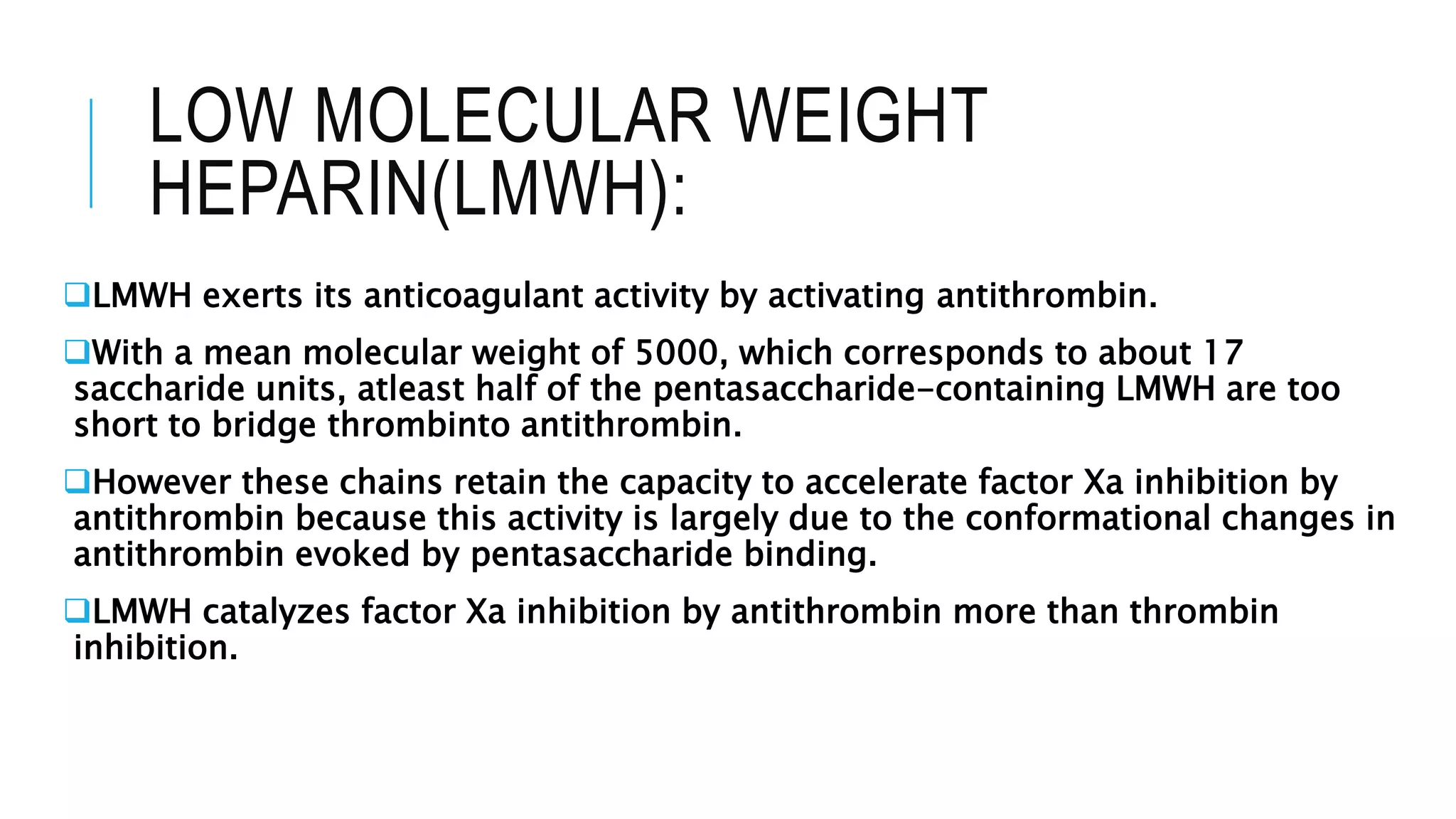
LOW MOLECULAR WEIGHT
HEPARIN(LMWH):
LMWH exerts its anticoagulant activity by activating antithrombin.
With a mean molecular weight of 5000, which corresponds to about 17
saccharide units, atleast half of the pentasaccharide-containing LMWH are too
short to bridge thrombinto antithrombin.
However these chains retain the capacity to accelerate factor Xa inhibition by
antithrombin because this activity is largely due to the conformational changes in
antithrombin evoked by pentasaccharide binding.
LMWH catalyzes factor Xa inhibition by antithrombin more than thrombin
inhibition.
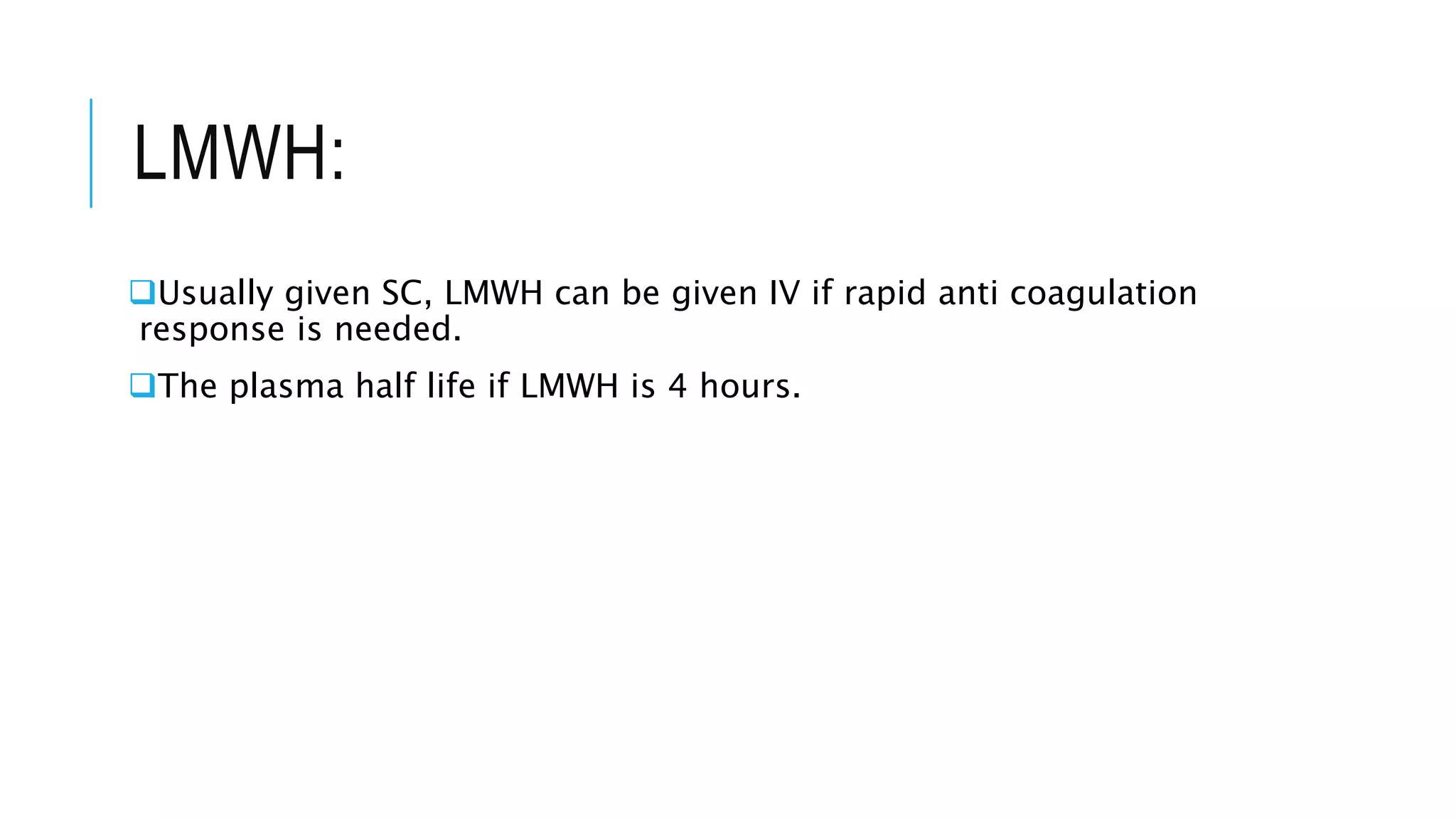
LMWH:
Usually given SC, LMWH can be given IV if rapid anti coagulation
response is needed.
The plasma half life if LMWH is 4 hours.
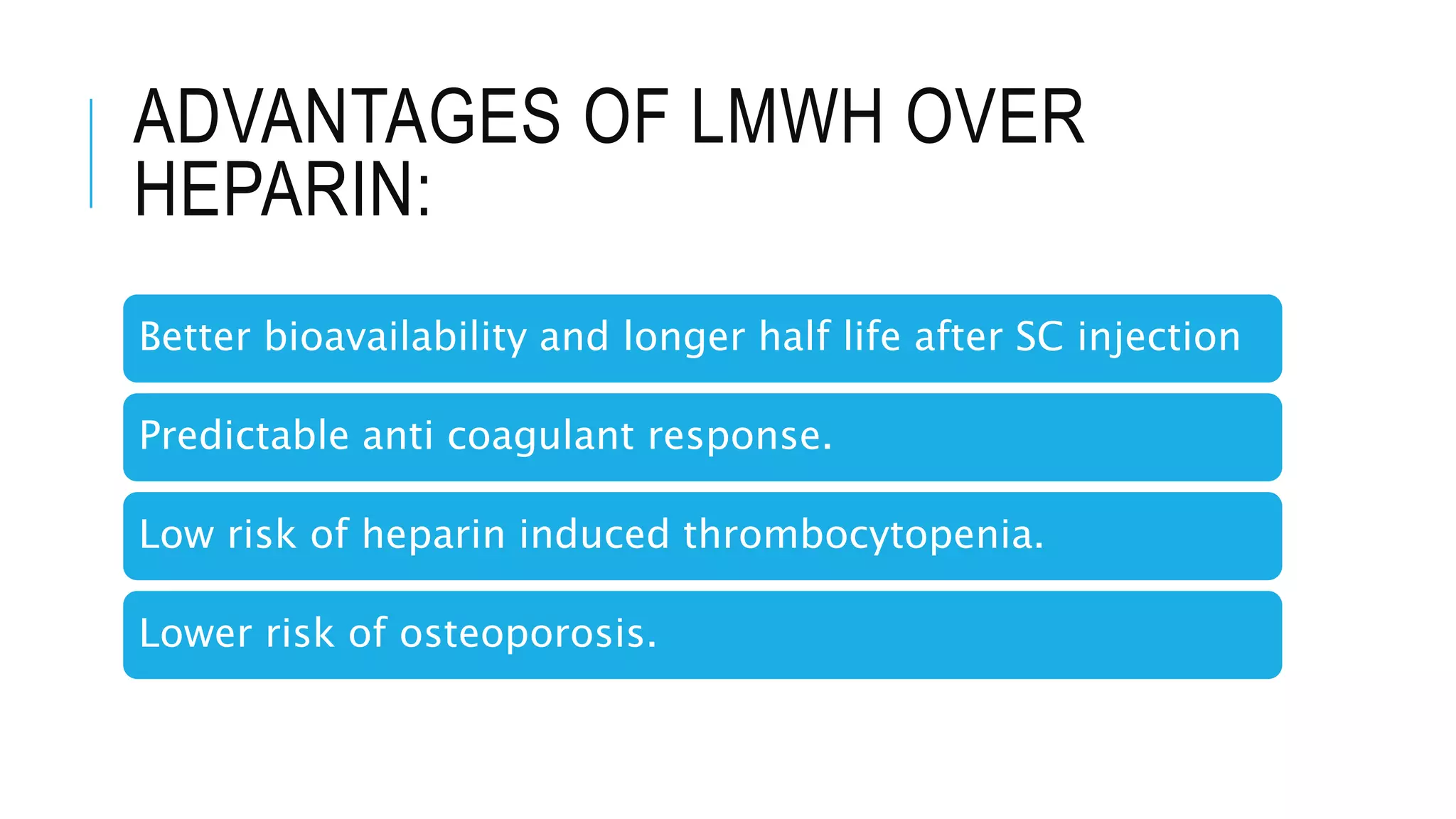
ADVANTAGES OF LMWH OVER
HEPARIN:
Better bioavailability and longer half life after SC injection
Predictable anti coagulant response.
Low risk of heparin induced thrombocytopenia.
Lower risk of osteoporosis.
INR(INTERNATIONAL NORMALISED
RATIO):
When Prothombin time test is used to evaluate levels of
anticoagulation with warfarin like drugs INR format is used.
INR ={
𝑃𝑎𝑡𝑖𝑒𝑛𝑡′ 𝑠𝑃𝑇
𝐶𝑜𝑛𝑡𝑟𝑜𝑙𝑃𝑇
} C ; C=international sensitivity index
Normal INR= 1
Procedures can be carried out till INR 3.
BRIDGE THERAPY:
Why do we need to do bridge therapy?
When a patient is on warfarin and needs to have a procedure done
and in order to make sure that the patient doesn’t bleed out during
the procedure, operators want the patient to be on a drug with a
short half life so that It can be stopped immediately before the
procedure, perform the procedure and then immediately get started
again to make sure that the INR doesn’t get too low.
An INR above 3 may need to be adjusted by the physician before the
procedure.
It takes around 3-5 days for any effective reduction of INR to occur.
The Option is to go for Warfarin and LMWH bridging.
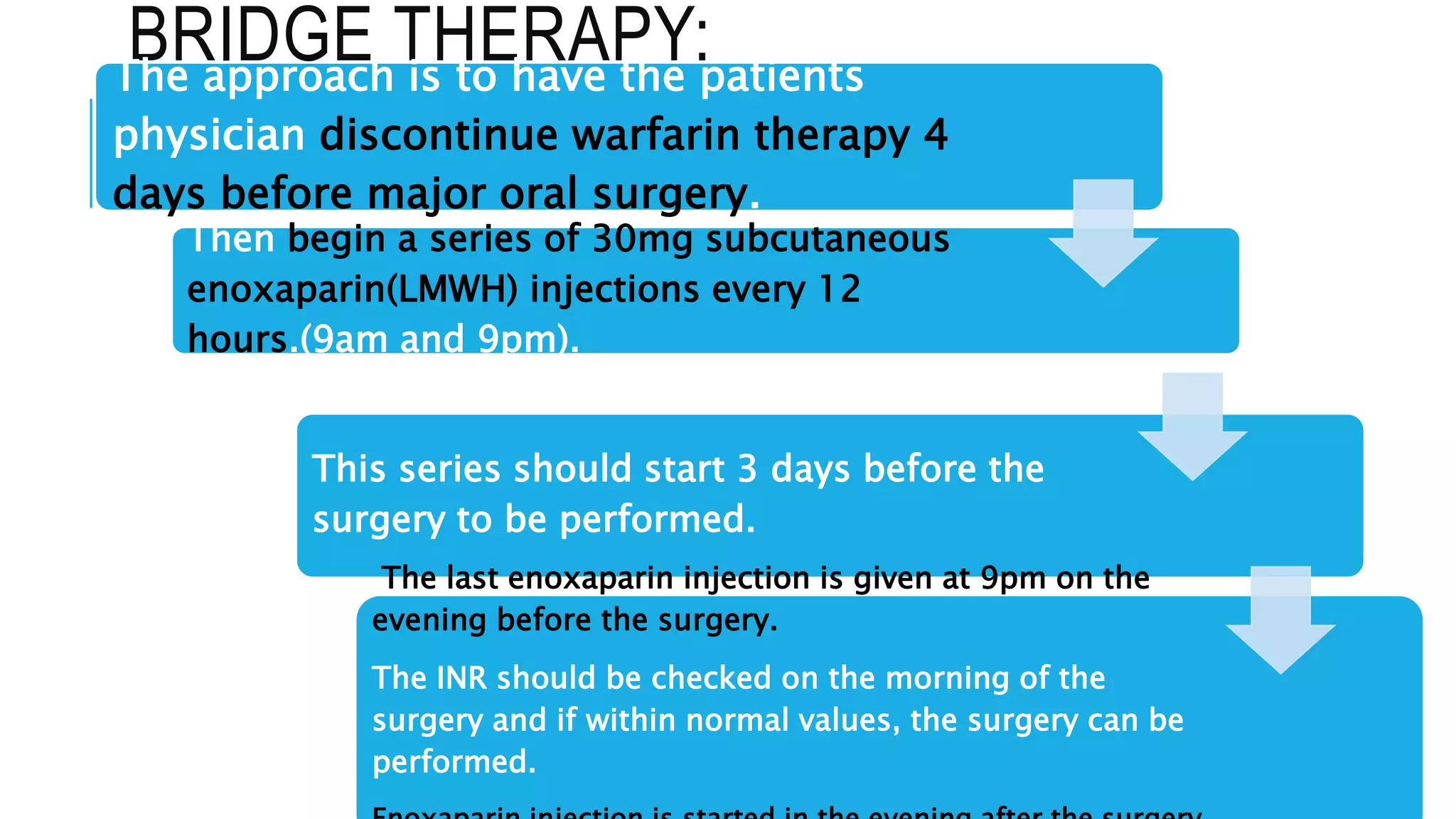
BRIDGE THERAPY:The approach is to have the patients
physician discontinue warfarin therapy 4
days before major oral surgery.
Then begin a series of 30mg subcutaneous
enoxaparin(LMWH) injections every 12
hours.(9am and 9pm).
This series should start 3 days before the
surgery to be performed.
The last enoxaparin injection is given at 9pm on the
evening before the surgery.
The INR should be checked on the morning of the
surgery and if within normal values, the surgery can be
performed.
BRIDGE THEPARY:
After 3 days post operatively, injectable
enoxaparin injections are stopped.
The potential problem with this
approach is that a temporary
hypercoagualtion state may occur
when warfarin therapy is stopped.
TO KNOW
If a patient on warfarin or any blood thinner meets with an accident with heavy
blood loss and bleeding cannot be controlled, what is the management?
-Discontinue warfarin
-Administration of Vitamin K( i.)IV-rapid response but risk of anaphylaxis
ii.)SC- response is unpredictable
iii.) Orally- predictable response,
effective,
convenient, safe, effect seen very early)
-Administration of Fresh Frozen Plasma
-Administration of Prothrombin concentrate
-Administration of Recombinant Factor VIIa
BIBLIOGRAPHY
HARRISON’S PRINCIPLES OF INTERNAL MEDICINE
LONGO,FAUCI,KASPER,HAUSER,JAMESON,LOSCALZO
LITTLE AND FALACE’s DENTAL MANAGEMENT of the Medically
Compromised Patient
James W.Little, Donald A.Falace, Craig S.Miller, Nelson L.Rhodus

Bridge therapy

  • 1.
    BRIDGE THERAPYSohail Yasin DEPT.OF ORAL AND MAXILLOFACIAL SURGERY GURU NANAK INSTITUTE OF DENTAL SCIENCES AND RESEARCH
  • 2.
  • 3.
    WARFARIN MECHANISM OF ACTION: VitaminK dependent Clotting factors (Prothrombin, Factor VII, Factor IX, Factor X) have glutamic acid residues in their N-termini. A post transitional modification occurs and adds a carboxyl group to the γ- carbon of the glutamic acid residues.(γ-carboxylation) This transition is necessary for the expression of the clotting factors and their calcium dependent binding to the negatively charged phospholipid surface. γ-carboxylation process is catalyzed by a Vitamin K dependent enzyme called carboxylase. Vitamin K from the diet is reduced to Vitamin K hydroquinone by the enzyme vitamin K reductase. Vitamin K hydroquinone acts as a cofactor for carboxylase enzyme and in the presence of CO2 replaces the hydrogen group in the glutamic acid residue with the carboxyl group. During this process, Vitamin K hydroquinone is oxidized to Vitamin K epoxide
  • 4.
    CONT. Warfarin inhibits VitaminK epoxide reductase, preventing the formation of Vitamin K and thereby blocking γ-carboxylation process. This results in synthesis of Vitamin K dependent clotting factors that are partially carboxylated. Warfarin acts as anti coagulant as these γ-carboxylated factors have reduced or absent biologic activity. Onset of Warfarin is delayed until new synthesized CFs with reduced activity replace the active counterparts.
  • 5.
    WARFARIN Levels of Warfarinin the blood peak about 90 minutes from the drug administration. It rapidly and completely gets absorbed from the GIT. Half Life- Its has a half life of 36-42 hours More than 97%of warfarin is bound to albumin, only a small fraction of unbound warfarin is biologically active. Dosage-It is usually started at a dose of 5-10mg. Dose may be triggered to get the desired target INR.
  • 6.
    HEPARIN MECHANISM OF ACTION Itacts as an anti coagulant by  activating anti thrombin,  accelerating the rate at which anti thrombin inhibits clotting factors particularly Factor Xa Anti thrombin is an obligatory cofactor of heparin. Anti thrombin is a member of serine protease inhibitor(Serpin) superfamily. To activate anti thrombin, heparin binds to the serpin via pentasaccharide sequence that is found on 1/3 of chains of commercial heparin. Remainder of heparin chains that lack pentasaccharide have little or no anti coagulant activity.  Once bound to anti thrombin, heparin induces a conformational change. This conformational change enhaces the rate at which anti thrombin inhibits Factor Xa by atleast two orders of magnitude, but has little effect on thrombin inhibition.
  • 7.
    CONT. Only pentasaccharide containingheparin composed of at 18 saccharide units are of sufficient length to bridge thrombin and antithrombin. With mean molecular weight of 1500 almost all chains are long enough to effect the bridging function. Heparin is used in high doses to treat thromboembolism-IV bolus of 5000U Followed by infusion over 5-10 days period.
  • 8.
    LOW MOLECULAR WEIGHT HEPARIN(LMWH): LMWHexerts its anticoagulant activity by activating antithrombin. With a mean molecular weight of 5000, which corresponds to about 17 saccharide units, atleast half of the pentasaccharide-containing LMWH are too short to bridge thrombinto antithrombin. However these chains retain the capacity to accelerate factor Xa inhibition by antithrombin because this activity is largely due to the conformational changes in antithrombin evoked by pentasaccharide binding. LMWH catalyzes factor Xa inhibition by antithrombin more than thrombin inhibition.
  • 9.
    LMWH: Usually given SC,LMWH can be given IV if rapid anti coagulation response is needed. The plasma half life if LMWH is 4 hours.
  • 11.
    ADVANTAGES OF LMWHOVER HEPARIN: Better bioavailability and longer half life after SC injection Predictable anti coagulant response. Low risk of heparin induced thrombocytopenia. Lower risk of osteoporosis.
  • 12.
    INR(INTERNATIONAL NORMALISED RATIO): When Prothombintime test is used to evaluate levels of anticoagulation with warfarin like drugs INR format is used. INR ={ 𝑃𝑎𝑡𝑖𝑒𝑛𝑡′ 𝑠𝑃𝑇 𝐶𝑜𝑛𝑡𝑟𝑜𝑙𝑃𝑇 } C ; C=international sensitivity index Normal INR= 1 Procedures can be carried out till INR 3.
  • 13.
    BRIDGE THERAPY: Why dowe need to do bridge therapy? When a patient is on warfarin and needs to have a procedure done and in order to make sure that the patient doesn’t bleed out during the procedure, operators want the patient to be on a drug with a short half life so that It can be stopped immediately before the procedure, perform the procedure and then immediately get started again to make sure that the INR doesn’t get too low. An INR above 3 may need to be adjusted by the physician before the procedure. It takes around 3-5 days for any effective reduction of INR to occur. The Option is to go for Warfarin and LMWH bridging.
  • 14.
    BRIDGE THERAPY:The approachis to have the patients physician discontinue warfarin therapy 4 days before major oral surgery. Then begin a series of 30mg subcutaneous enoxaparin(LMWH) injections every 12 hours.(9am and 9pm). This series should start 3 days before the surgery to be performed. The last enoxaparin injection is given at 9pm on the evening before the surgery. The INR should be checked on the morning of the surgery and if within normal values, the surgery can be performed.
  • 15.
    BRIDGE THEPARY: After 3days post operatively, injectable enoxaparin injections are stopped. The potential problem with this approach is that a temporary hypercoagualtion state may occur when warfarin therapy is stopped.
  • 16.
    TO KNOW If apatient on warfarin or any blood thinner meets with an accident with heavy blood loss and bleeding cannot be controlled, what is the management? -Discontinue warfarin -Administration of Vitamin K( i.)IV-rapid response but risk of anaphylaxis ii.)SC- response is unpredictable iii.) Orally- predictable response, effective, convenient, safe, effect seen very early) -Administration of Fresh Frozen Plasma -Administration of Prothrombin concentrate -Administration of Recombinant Factor VIIa
  • 17.
    BIBLIOGRAPHY HARRISON’S PRINCIPLES OFINTERNAL MEDICINE LONGO,FAUCI,KASPER,HAUSER,JAMESON,LOSCALZO LITTLE AND FALACE’s DENTAL MANAGEMENT of the Medically Compromised Patient James W.Little, Donald A.Falace, Craig S.Miller, Nelson L.Rhodus