LOWER GI HEMORRHAGE
HEMORRHOIDS
Dr.B.SELVARAJ MS;Mch;FICS:
PROFESSOR OF SURGERY
MELAKA MANIPAL MEDICAL COLLEGE
MELAKA 75150 MALAYSIA
HEMORRHOIDS
✓Causes of Lower GI Hemorrhage
✓Etiopathogenesis
✓Classification of Hemorrhoids
✓Clinical features
✓Investigations
✓Complications
✓Treatment
✓Mindmap
✓Diagnostic algorithm
✓Management Algorithm
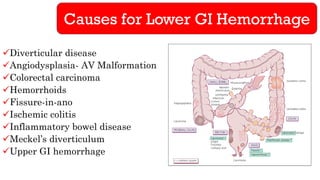
Causes for Lower GI Hemorrhage
✓Diverticular disease
✓Angiodysplasia- AV Malformation
✓Colorectal carcinoma
✓Hemorrhoids
✓Fissure-in-ano
✓Ischemic colitis
✓Inflammatory bowel disease
✓Meckel’s diverticulum
✓Upper GI hemorrhage
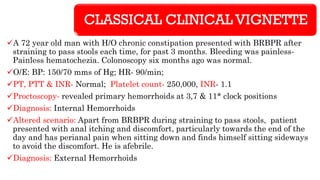
CLASSICAL CLINICAL VIGNETTE
✓A 72 year old man with H/O chronic constipation presented with BRBPR after
straining to pass stools each time, for past 3 months. Bleeding was painless-
Painless hematochezia. Colonoscopy six months ago was normal.
✓O/E: BP: 150/70 mms of Hg; HR- 90/min;
✓PT, PTT & INR- Normal; Platelet count- 250,000, INR- 1.1
✓Proctoscopy- revealed primary hemorrhoids at 3,7 & 11* clock positions
✓Diagnosis: Internal Hemorrhoids
✓Altered scenario: Apart from BRBPR during straining to pass stools, patient
presented with anal itching and discomfort, particularly towards the end of the
day and has perianal pain when sitting down and finds himself sitting sideways
to avoid the discomfort. He is afebrile.
✓Diagnosis: External Hemorrhoids
ETIOPATHOGENESIS
✓ Hemorrhoids are cushions of submucosal
tissue containing venules, arterioles,
smooth muscle fibers, and elastic
connective tissues.
✓Three hemorrhoidal cushions are there at
3, 7, 11 O’clock positions
✓ During defecation, they become engorged
with blood, cushion the anal canal, and
support the lining of canal.
✓Hemorrhoid is a condition, where there is
varicosity in the veins of anorectal region
which subsequently leads to hemorrhage.
ETIOPATHOGENESIS
✓ Idiopathic or primary—The
predisposing factors are pregnancy,
prolonged standing Etc
✓Secondary Causes:
✓Carcinoma of rectum—By blocking
the veins, produces back pressure
and manifest as piles.
✓Prolonged constipation
✓Persistent straining at micturition,
e.g. enlarged prostate
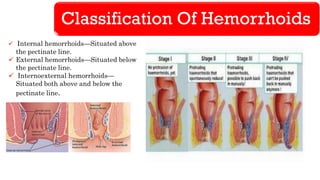
Classification Of Hemorrhoids
✓ Internal hemorrhoids—Situated above
the pectinate line.
✓ External hemorrhoids—Situated below
the pectinate line.
✓ Internoexternal hemorrhoids—
Situated both above and below the
pectinate line.
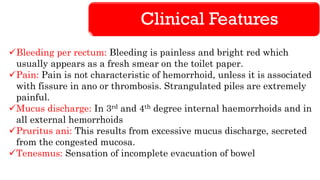
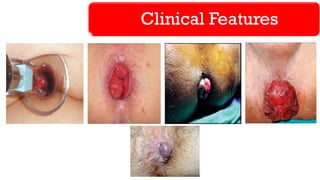
Clinical Features
✓Bleeding per rectum: Bleeding is painless and bright red which
usually appears as a fresh smear on the toilet paper.
✓Pain: Pain is not characteristic of hemorrhoid, unless it is associated
with fissure in ano or thrombosis. Strangulated piles are extremely
painful.
✓Mucus discharge: In 3rd and 4th degree internal haemorrhoids and in
all external hemorrhoids
✓Pruritus ani: This results from excessive mucus discharge, secreted
from the congested mucosa.
✓Tenesmus: Sensation of incomplete evacuation of bowel
Clinical Features
INVESTIGATIONS
✓Digital Rectal Examination(DRE): A digital examination should
always be done. A pile mass cannot be palpated, because it collapses
to digital pressure. It can be palpated only when it is thrombosed.
✓Proctoscopy(Anoscopy): As the proctoscope is removed, the piles
prolapses into the lumen of proctoscope as cherry red masses.
✓Sigmoidoscopy/Colonoscopy: Do Sigmoidoscopy and Colonoscopy to
R/O any colonic pathology
COMPLICATIONS
✓Anemia: Following severe or continued bleeding.
✓Strangulation: This occurs when the prolapsed hemorrhoids are
gripped by the internal sphincter and get irreducible.
✓Thrombosis: In strangulated piles, venous return is occluded and
thrombosis occurs. The thrombosis is accompanied by considerable
pain.
✓Suppuration or ulceration: may occur in a thrombosed hemorrhoids.
✓Fibrosis: After 2 to 3 weeks, thrombosed hemorrhoids become
fibrosed, often with spontaneous cure.
TREATMENT
✓Nonoperative
✓a. Sitz bath—The patient is asked to sit inwarm water with the anal
region and buttocks dipped in water for about 20 minutes,2 to 3 times
a day. This reduces pain edema and promotes healing.
✓b. Antibiotics, laxatives (stool softener) and antiinflammatory drugs
are beneficial.
✓c. Regulation of bowel habit with a high fiber diet.
✓d. Local application of astringent ointments.
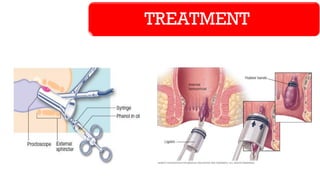
✓e. Injection of Sclerosant—The agent commonly used is 5 percent
phenol in almond oil. This is done in case of first and second degree
hemorrhoids.
TREATMENT
✓Operative Treatment:
✓First and second degree hemorrhoids are treated by Lord’s procedure,
Barron’s band application and cryosurgery.
✓Third and fourth degree haemorrhoids require hemorrhoidectomy
✓1. Lord’s procedure: Under general anesthesiathe internal sphincter
is widely stretched. It results is dilatation and disruption of the fibers
of internal sphincter. Thus venous congestion is relieved to improve
the hemorrhoids.
✓2. Barron’s Band Ligation: Bands are applied at the neck of
hemorrhoids which undergo healing by fibrosis.
TREATMENT
TREATMENT
✓Operative Treatment:
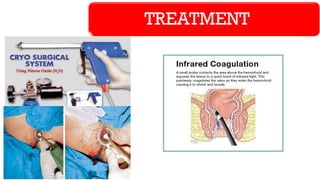
✓3. Cryosurgery: Liquid nitrogen at –196°C is applied to pile masses
which coagulate the tissues. The procedure is painless but there will
be continuous mucus discharge for 3 to 4 weeks.
✓4. Infrared photocoagulation coagulates tissue protein or evaporates
water in the cells. This technique can be used for first-degree and
second-degree haemorrhoids.
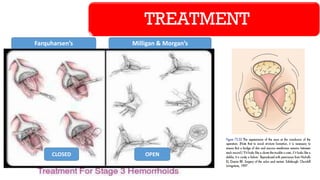
✓5. Hemorrhoidectomy—This is the ligation and excision of the
hemorrhoidal mass under spinal or general anesthesia.
-Milligan & Morgan’s Open Hemorrhoidectomy
-Farquharsan’s Closed Hemorrhoidectomy
TREATMENT
TREATMENT
Farquharsen’s Milligan & Morgan’s
CLOSED OPEN
TREATMENT
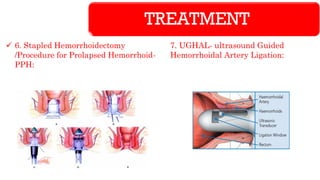
✓ 6. Stapled Hemorrhoidectomy
/Procedure for Prolapsed Hemorrhoid-
PPH:
7. UGHAL- ultrasound Guided
Hemorrhoidal Artery Ligation:
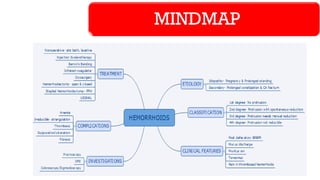
MINDMAP
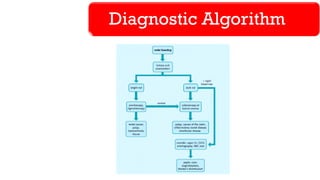
Diagnostic Algorithm
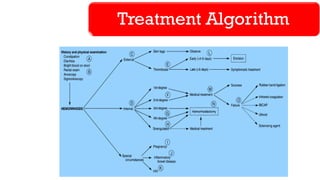
Treatment Algorithm
THANK YOU
LIKE
SHARE
SUBSCRIBE

Hemorrhoids - Lower GI Hemorrhage

  • 1.
    LOWER GI HEMORRHAGE HEMORRHOIDS Dr.B.SELVARAJMS;Mch;FICS: PROFESSOR OF SURGERY MELAKA MANIPAL MEDICAL COLLEGE MELAKA 75150 MALAYSIA
  • 2.
    HEMORRHOIDS ✓Causes of LowerGI Hemorrhage ✓Etiopathogenesis ✓Classification of Hemorrhoids ✓Clinical features ✓Investigations ✓Complications ✓Treatment ✓Mindmap ✓Diagnostic algorithm ✓Management Algorithm
  • 3.
    Causes for LowerGI Hemorrhage ✓Diverticular disease ✓Angiodysplasia- AV Malformation ✓Colorectal carcinoma ✓Hemorrhoids ✓Fissure-in-ano ✓Ischemic colitis ✓Inflammatory bowel disease ✓Meckel’s diverticulum ✓Upper GI hemorrhage
  • 4.
    CLASSICAL CLINICAL VIGNETTE ✓A72 year old man with H/O chronic constipation presented with BRBPR after straining to pass stools each time, for past 3 months. Bleeding was painless- Painless hematochezia. Colonoscopy six months ago was normal. ✓O/E: BP: 150/70 mms of Hg; HR- 90/min; ✓PT, PTT & INR- Normal; Platelet count- 250,000, INR- 1.1 ✓Proctoscopy- revealed primary hemorrhoids at 3,7 & 11* clock positions ✓Diagnosis: Internal Hemorrhoids ✓Altered scenario: Apart from BRBPR during straining to pass stools, patient presented with anal itching and discomfort, particularly towards the end of the day and has perianal pain when sitting down and finds himself sitting sideways to avoid the discomfort. He is afebrile. ✓Diagnosis: External Hemorrhoids
  • 5.
    ETIOPATHOGENESIS ✓ Hemorrhoids arecushions of submucosal tissue containing venules, arterioles, smooth muscle fibers, and elastic connective tissues. ✓Three hemorrhoidal cushions are there at 3, 7, 11 O’clock positions ✓ During defecation, they become engorged with blood, cushion the anal canal, and support the lining of canal. ✓Hemorrhoid is a condition, where there is varicosity in the veins of anorectal region which subsequently leads to hemorrhage.
  • 6.
    ETIOPATHOGENESIS ✓ Idiopathic orprimary—The predisposing factors are pregnancy, prolonged standing Etc ✓Secondary Causes: ✓Carcinoma of rectum—By blocking the veins, produces back pressure and manifest as piles. ✓Prolonged constipation ✓Persistent straining at micturition, e.g. enlarged prostate
  • 7.
    Classification Of Hemorrhoids ✓Internal hemorrhoids—Situated above the pectinate line. ✓ External hemorrhoids—Situated below the pectinate line. ✓ Internoexternal hemorrhoids— Situated both above and below the pectinate line.
  • 8.
    Clinical Features ✓Bleeding perrectum: Bleeding is painless and bright red which usually appears as a fresh smear on the toilet paper. ✓Pain: Pain is not characteristic of hemorrhoid, unless it is associated with fissure in ano or thrombosis. Strangulated piles are extremely painful. ✓Mucus discharge: In 3rd and 4th degree internal haemorrhoids and in all external hemorrhoids ✓Pruritus ani: This results from excessive mucus discharge, secreted from the congested mucosa. ✓Tenesmus: Sensation of incomplete evacuation of bowel
  • 9.
  • 10.
    INVESTIGATIONS ✓Digital Rectal Examination(DRE):A digital examination should always be done. A pile mass cannot be palpated, because it collapses to digital pressure. It can be palpated only when it is thrombosed. ✓Proctoscopy(Anoscopy): As the proctoscope is removed, the piles prolapses into the lumen of proctoscope as cherry red masses. ✓Sigmoidoscopy/Colonoscopy: Do Sigmoidoscopy and Colonoscopy to R/O any colonic pathology
  • 11.
    COMPLICATIONS ✓Anemia: Following severeor continued bleeding. ✓Strangulation: This occurs when the prolapsed hemorrhoids are gripped by the internal sphincter and get irreducible. ✓Thrombosis: In strangulated piles, venous return is occluded and thrombosis occurs. The thrombosis is accompanied by considerable pain. ✓Suppuration or ulceration: may occur in a thrombosed hemorrhoids. ✓Fibrosis: After 2 to 3 weeks, thrombosed hemorrhoids become fibrosed, often with spontaneous cure.
  • 12.
    TREATMENT ✓Nonoperative ✓a. Sitz bath—Thepatient is asked to sit inwarm water with the anal region and buttocks dipped in water for about 20 minutes,2 to 3 times a day. This reduces pain edema and promotes healing. ✓b. Antibiotics, laxatives (stool softener) and antiinflammatory drugs are beneficial. ✓c. Regulation of bowel habit with a high fiber diet. ✓d. Local application of astringent ointments. ✓e. Injection of Sclerosant—The agent commonly used is 5 percent phenol in almond oil. This is done in case of first and second degree hemorrhoids.
  • 13.
    TREATMENT ✓Operative Treatment: ✓First andsecond degree hemorrhoids are treated by Lord’s procedure, Barron’s band application and cryosurgery. ✓Third and fourth degree haemorrhoids require hemorrhoidectomy ✓1. Lord’s procedure: Under general anesthesiathe internal sphincter is widely stretched. It results is dilatation and disruption of the fibers of internal sphincter. Thus venous congestion is relieved to improve the hemorrhoids. ✓2. Barron’s Band Ligation: Bands are applied at the neck of hemorrhoids which undergo healing by fibrosis.
  • 14.
  • 15.
    TREATMENT ✓Operative Treatment: ✓3. Cryosurgery:Liquid nitrogen at –196°C is applied to pile masses which coagulate the tissues. The procedure is painless but there will be continuous mucus discharge for 3 to 4 weeks. ✓4. Infrared photocoagulation coagulates tissue protein or evaporates water in the cells. This technique can be used for first-degree and second-degree haemorrhoids. ✓5. Hemorrhoidectomy—This is the ligation and excision of the hemorrhoidal mass under spinal or general anesthesia. -Milligan & Morgan’s Open Hemorrhoidectomy -Farquharsan’s Closed Hemorrhoidectomy
  • 16.
  • 17.
  • 18.
    TREATMENT ✓ 6. StapledHemorrhoidectomy /Procedure for Prolapsed Hemorrhoid- PPH: 7. UGHAL- ultrasound Guided Hemorrhoidal Artery Ligation:
  • 19.
  • 20.
  • 21.
  • 22.