LOWER GI
HEMORRHAGE
DIVERTICULAR
DISEASE
Dr.B.SELVARAJ MS;Mch;FICS:
PROFESSOR OF SURGERY
MELAKA MANIPAL MEDICAL COLLEGE
MELAKA 75150 MALAYSIA
DIVERTICULAR
DISEASE
Causes of Lower GI Hemorrhage
 Clinical Types
A Classical Clinical vignette
Etiopathogenesis
Clinical features
Investigations
Complications
Management
Mindmap
Algorithm
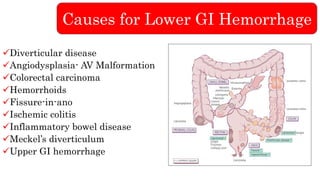
Causes for Lower GI Hemorrhage
Diverticular disease
Angiodysplasia- AV Malformation
Colorectal carcinoma
Hemorrhoids
Fissure-in-ano
Ischemic colitis
Inflammatory bowel disease
Meckel’s diverticulum
Upper GI hemorrhage
DIVERTICULAR
DISEASE
Two Clinical Types:
Diverticulosis:
-The initial primary stage of the disease, wherein there is hypertrophy,
muscular incoordination leading to increased segmentation and increased
intraluminal pressure- resulting false diverticulum
-At this stage they are asymptomatic, but often get severe spasmodic pain due
to colonic segmentation called as painful diverticular disease.
Diverticulitis:
-The second stage due to inflammation of one or more diverticula with
pericolitis. It presents with persistent pain, tenderness or occasionally mass in
LIF
CLASSICAL CLINICAL
VIGNETTE
A 72 year old man had three large painless bowel movements that he
describes as BRBPR. The last one was two hours ago. He is pale, but has
normal vital signs. A nasogastric tube returns clear, green fluid without blood.
BP: 150/70 mms of Hg; HR- 108/min; NS infusing at 200ml/hr
PT, PTT & INR- Normal; Platelet count- 224,000, INR- 1.1
Colonoscopy- revealed bleeding from sigmoid diverticulum
Diagnosis: Bleeding sigmoid diverticulum
Altered scenario: If Colonoscopy is negative do RBC tagged Tch99 scan which
may reveal bleeding from Angiodysplasia as little as 0.1 ml/min, If this is
positive do CT angiogram which can localize bleeding more than 0.5ml/min
and can do therapeutic embolization also
CLASSICAL CLINICAL
VIGNETTE
45 yrs old lady was admitted for her 3rd episode of LLQ pain and fever in 18
months. She was given oral Ciprofloxacin and Metronidazole during her first
episode. Second time she was admitted and given IV Ampicillin/Sulbactam
and this episode lasted 3 days.
 Temp: 102.4*F
 O/E: LLQ tenderness++
 Labs: Total WBC- 17,000; Pregnancy test- Negative
 Spiral CT abdomen: Thickened sigmoid colonic wall
Diagnosis: Diverticulitis
ETIOPATHOGENESIS
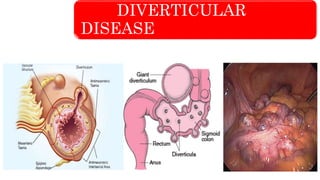
l .Colonic diverticula are mucosal out pouchings through the
submucosa and the muscular layer of the colon.
2 .They occur most commonly in the sigmoid colon, and in 10% of
patients, they involve the entire colon.
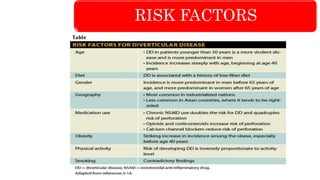
3.A disorder of modern civilization and is associated with
consumption of refined food products. It is rare in rural African and
Asian populations where dietary fiber is high.
4. Long standing constipation increases the stool transit time and
intraluminal pressure and causes diverticulosis.
5. They arise between antimesenteric taenia and the mesenteric
taenia at the site of entry of the blood vessels.
DIVERTICULAR
DISEASE
RISK FACTORS
CLINICAL FEATURES
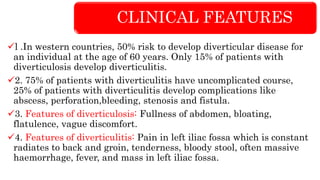
l .In western countries, 50% risk to develop diverticular disease for
an individual at the age of 60 years. Only 15% of patients with
diverticulosis develop diverticulitis.
2. 75% of patients with diverticulitis have uncomplicated course,
25% of patients with diverticulitis develop complications like
abscess, perforation,bleeding, stenosis and fistula.
3. Features of diverticulosis: Fullness of abdomen, bloating,
flatulence, vague discomfort.
4. Features of diverticulitis: Pain in left iliac fossa which is constant
radiates to back and groin, tenderness, bloody stool, often massive
haemorrhage, fever, and mass in left iliac fossa.
CLINICAL FEATURES
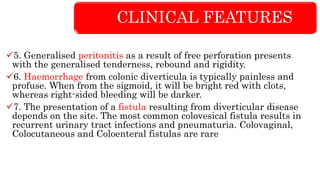
5. Generalised peritonitis as a result of free perforation presents
with the generalised tenderness, rebound and rigidity.
6. Haemorrhage from colonic diverticula is typically painless and
profuse. When from the sigmoid, it will be bright red with clots,
whereas right-sided bleeding will be darker.
7. The presentation of a fistula resulting from diverticular disease
depends on the site. The most common colovesical fistula results in
recurrent urinary tract infections and pneumaturia. Colovaginal,
Colocutaneous and Coloenteral fistulas are rare
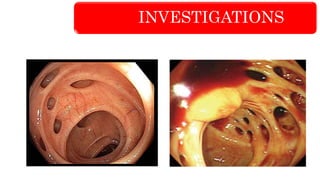
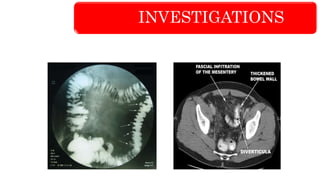
INVESTIGATIONS
1. Double Contrast Barium enema (best method to diagnose) shows
“sawteeth” appearance. Champagne glass sign: partial filling of
diverticula by barium with fecolith inside—seen in sigmoid diverticula.
2. Sigmoidoscopy is useful but should not be done in acute stage. Once
acute stage subsides, barium enema, sigmoidoscopy, Colonoscopy can be
done (To rule out associated malignancy).
3. Spiral CT scan in acute phase to see thickened colon and pericolic
abscess
4. RBC tagged Tch99 scan: Find out bleeding as low as 0.1ml/min
5. Mesenteric Angiogram: Find out bleeding > 0.5ml/min & therapeutic
embolisation
INVESTIGATIONS
INVESTIGATIONS
COMPLICATIONS
1. Acute diverticulitis : A diverticulum may become inflamed when a
fecalith obstructs its neck. Patients present with left lower quadrant
abdominal pain, fever, and leukocytosis.
2. Hemorrhage: Erosion of a peridiverticular vessel can lead to
significant bleeding.
3. Diverticular abscess: Acute diverticulitis may result in a
peridiverticular abscess. Patients experience severe pain, high fever,
and white blood cell (WBC) elevation . A CT scan can identify the
collection and guide percutaneous drainage.
4. Diverticular phlegmon: The local response to the diverticular
inflammation may lead to formation of an inflammatory mass or
phlegmon. Such patients need bowel rest and IV antibiotics .
COMPLICATIONS
5.Diverticular stricture: Recurrent episodes of inflammation may
lead to fibrosis ,resulting in luminal narrowing. Patients may
present with acute large bowel obstruction.
6.Fecal Peritonitis: Perforation of diverticula may lead to fecal
peritonitis ,which has a mortality rate of about 50% . Patients need
emergency exploratory laparotomy
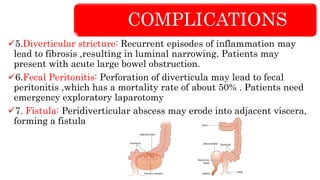
7. Fistula: Peridiverticular abscess may erode into adjacent viscera,
forming a fistula
DIVERTICULITIS
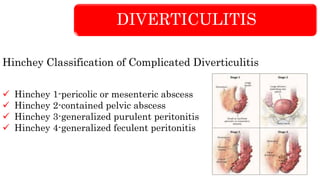
Hinchey Classification of Complicated Diverticulitis
 Hinchey 1-pericolic or mesenteric abscess
 Hinchey 2-contained pelvic abscess
 Hinchey 3-generalized purulent peritonitis
 Hinchey 4-generalized feculent peritonitis
MANAGEMENT
1. It is basically a benign condition, therefore the
prognosis is good. High fibre diet is advised.
2. In acute diverticulitis/phlegmon, intravenous (IV)
fluids, antibiotics, and bowel rest are necessary.
3. Abscesses should be drained, usually
percutaneously under CT guidance.
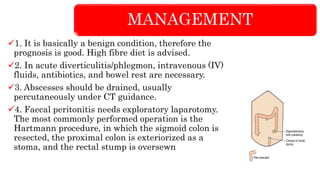
4. Faecal peritonitis needs exploratory laparotomy.
The most commonly performed operation is the
Hartmann procedure, in which the sigmoid colon is
resected, the proximal colon is exteriorized as a
stoma, and the rectal stump is oversewn
MANAGEMENT
5. Patients who develop strictures may need an elective sigmoid
colectomy and primary anastomosis .
6. Fistulae are a complex problem. The patient's nutrition should be
optimized, and infection should be controlled before surgical repair
or resection is attempted.
7. In certain cases of diverticulosis, a longitudinal incision through
the taenia and muscular layer without opening the mucosa is suffi
cient (like Heller’s/Ramstedt’s myotomy)—Reilly’s sigmoid myotomy.
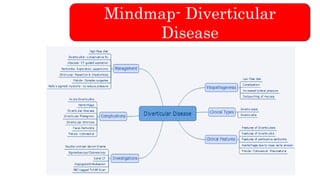
Mindmap- Diverticular
Disease
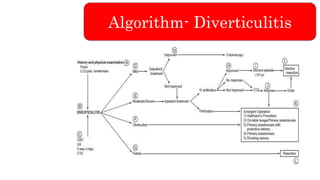
Algorithm- Diverticulitis
THANK YOU
LIKE
SHARE
SUBSCRIBE

Diverticular Disease-Lower GI Hemorrhage

  • 1.
    LOWER GI HEMORRHAGE DIVERTICULAR DISEASE Dr.B.SELVARAJ MS;Mch;FICS: PROFESSOROF SURGERY MELAKA MANIPAL MEDICAL COLLEGE MELAKA 75150 MALAYSIA
  • 2.
    DIVERTICULAR DISEASE Causes of LowerGI Hemorrhage  Clinical Types A Classical Clinical vignette Etiopathogenesis Clinical features Investigations Complications Management Mindmap Algorithm
  • 3.
    Causes for LowerGI Hemorrhage Diverticular disease Angiodysplasia- AV Malformation Colorectal carcinoma Hemorrhoids Fissure-in-ano Ischemic colitis Inflammatory bowel disease Meckel’s diverticulum Upper GI hemorrhage
  • 4.
    DIVERTICULAR DISEASE Two Clinical Types: Diverticulosis: -Theinitial primary stage of the disease, wherein there is hypertrophy, muscular incoordination leading to increased segmentation and increased intraluminal pressure- resulting false diverticulum -At this stage they are asymptomatic, but often get severe spasmodic pain due to colonic segmentation called as painful diverticular disease. Diverticulitis: -The second stage due to inflammation of one or more diverticula with pericolitis. It presents with persistent pain, tenderness or occasionally mass in LIF
  • 5.
    CLASSICAL CLINICAL VIGNETTE A 72year old man had three large painless bowel movements that he describes as BRBPR. The last one was two hours ago. He is pale, but has normal vital signs. A nasogastric tube returns clear, green fluid without blood. BP: 150/70 mms of Hg; HR- 108/min; NS infusing at 200ml/hr PT, PTT & INR- Normal; Platelet count- 224,000, INR- 1.1 Colonoscopy- revealed bleeding from sigmoid diverticulum Diagnosis: Bleeding sigmoid diverticulum Altered scenario: If Colonoscopy is negative do RBC tagged Tch99 scan which may reveal bleeding from Angiodysplasia as little as 0.1 ml/min, If this is positive do CT angiogram which can localize bleeding more than 0.5ml/min and can do therapeutic embolization also
  • 6.
    CLASSICAL CLINICAL VIGNETTE 45 yrsold lady was admitted for her 3rd episode of LLQ pain and fever in 18 months. She was given oral Ciprofloxacin and Metronidazole during her first episode. Second time she was admitted and given IV Ampicillin/Sulbactam and this episode lasted 3 days.  Temp: 102.4*F  O/E: LLQ tenderness++  Labs: Total WBC- 17,000; Pregnancy test- Negative  Spiral CT abdomen: Thickened sigmoid colonic wall Diagnosis: Diverticulitis
  • 7.
    ETIOPATHOGENESIS l .Colonic diverticulaare mucosal out pouchings through the submucosa and the muscular layer of the colon. 2 .They occur most commonly in the sigmoid colon, and in 10% of patients, they involve the entire colon. 3.A disorder of modern civilization and is associated with consumption of refined food products. It is rare in rural African and Asian populations where dietary fiber is high. 4. Long standing constipation increases the stool transit time and intraluminal pressure and causes diverticulosis. 5. They arise between antimesenteric taenia and the mesenteric taenia at the site of entry of the blood vessels.
  • 8.
  • 9.
  • 10.
    CLINICAL FEATURES l .Inwestern countries, 50% risk to develop diverticular disease for an individual at the age of 60 years. Only 15% of patients with diverticulosis develop diverticulitis. 2. 75% of patients with diverticulitis have uncomplicated course, 25% of patients with diverticulitis develop complications like abscess, perforation,bleeding, stenosis and fistula. 3. Features of diverticulosis: Fullness of abdomen, bloating, flatulence, vague discomfort. 4. Features of diverticulitis: Pain in left iliac fossa which is constant radiates to back and groin, tenderness, bloody stool, often massive haemorrhage, fever, and mass in left iliac fossa.
  • 11.
    CLINICAL FEATURES 5. Generalisedperitonitis as a result of free perforation presents with the generalised tenderness, rebound and rigidity. 6. Haemorrhage from colonic diverticula is typically painless and profuse. When from the sigmoid, it will be bright red with clots, whereas right-sided bleeding will be darker. 7. The presentation of a fistula resulting from diverticular disease depends on the site. The most common colovesical fistula results in recurrent urinary tract infections and pneumaturia. Colovaginal, Colocutaneous and Coloenteral fistulas are rare
  • 12.
    INVESTIGATIONS 1. Double ContrastBarium enema (best method to diagnose) shows “sawteeth” appearance. Champagne glass sign: partial filling of diverticula by barium with fecolith inside—seen in sigmoid diverticula. 2. Sigmoidoscopy is useful but should not be done in acute stage. Once acute stage subsides, barium enema, sigmoidoscopy, Colonoscopy can be done (To rule out associated malignancy). 3. Spiral CT scan in acute phase to see thickened colon and pericolic abscess 4. RBC tagged Tch99 scan: Find out bleeding as low as 0.1ml/min 5. Mesenteric Angiogram: Find out bleeding > 0.5ml/min & therapeutic embolisation
  • 13.
  • 14.
  • 15.
    COMPLICATIONS 1. Acute diverticulitis: A diverticulum may become inflamed when a fecalith obstructs its neck. Patients present with left lower quadrant abdominal pain, fever, and leukocytosis. 2. Hemorrhage: Erosion of a peridiverticular vessel can lead to significant bleeding. 3. Diverticular abscess: Acute diverticulitis may result in a peridiverticular abscess. Patients experience severe pain, high fever, and white blood cell (WBC) elevation . A CT scan can identify the collection and guide percutaneous drainage. 4. Diverticular phlegmon: The local response to the diverticular inflammation may lead to formation of an inflammatory mass or phlegmon. Such patients need bowel rest and IV antibiotics .
  • 16.
    COMPLICATIONS 5.Diverticular stricture: Recurrentepisodes of inflammation may lead to fibrosis ,resulting in luminal narrowing. Patients may present with acute large bowel obstruction. 6.Fecal Peritonitis: Perforation of diverticula may lead to fecal peritonitis ,which has a mortality rate of about 50% . Patients need emergency exploratory laparotomy 7. Fistula: Peridiverticular abscess may erode into adjacent viscera, forming a fistula
  • 17.
    DIVERTICULITIS Hinchey Classification ofComplicated Diverticulitis  Hinchey 1-pericolic or mesenteric abscess  Hinchey 2-contained pelvic abscess  Hinchey 3-generalized purulent peritonitis  Hinchey 4-generalized feculent peritonitis
  • 18.
    MANAGEMENT 1. It isbasically a benign condition, therefore the prognosis is good. High fibre diet is advised. 2. In acute diverticulitis/phlegmon, intravenous (IV) fluids, antibiotics, and bowel rest are necessary. 3. Abscesses should be drained, usually percutaneously under CT guidance. 4. Faecal peritonitis needs exploratory laparotomy. The most commonly performed operation is the Hartmann procedure, in which the sigmoid colon is resected, the proximal colon is exteriorized as a stoma, and the rectal stump is oversewn
  • 19.
    MANAGEMENT 5. Patients whodevelop strictures may need an elective sigmoid colectomy and primary anastomosis . 6. Fistulae are a complex problem. The patient's nutrition should be optimized, and infection should be controlled before surgical repair or resection is attempted. 7. In certain cases of diverticulosis, a longitudinal incision through the taenia and muscular layer without opening the mucosa is suffi cient (like Heller’s/Ramstedt’s myotomy)—Reilly’s sigmoid myotomy.
  • 20.
  • 21.
  • 22.