Dr. Sourabh Mandwariya
Pathologist & Nodal Officer Central Lab,
Indira Gandhi District Hospital, Mandsaur
 Bleeding disorders are very common
 Haemophilia A & vWD most common
 Bleeding patient can be a nightmare
 Proper evaluation & anticipation is needed
 Normal physiological mechanism for keeping
the blood in fluid state in vascular system
and for prevention of hemorrhage by
complex interaction of blood vessel walls,
platelets and plasma proteins.
 Primary Hemostasis (Platelet plug formation)
 Secondary Hemostasis (Stable fibrin clot)
 Three main components
 Blood Vessel Wall
 Constriction of blood vessel
 Endothelial cell –
 von Willebrand factor (vWF)
 Tissue Factor
 Platelet activating factor
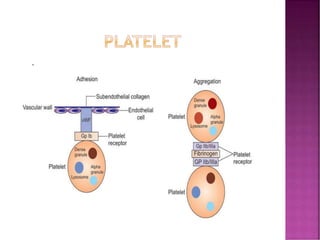
 Life span – 7 to 10 days
 Function
 Adhesion
 Release Reaction (ADP, TxA2, Serotonin)
 Aggregation
 Coagulation Factors
 Coagulation Inhibitors
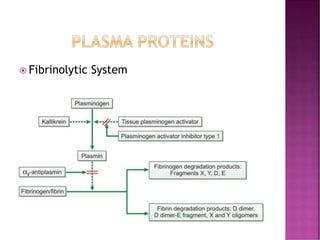
 Fibrinolytic Systems
 Coagulation Factors
I. Fibrinogen
II. Prothrombin
III. Tissue Factor, Thromboplastin
IV. Calcium
V. Labile Factor
VI. No Factor
VII. Stable Factor
VIII. Antihemophilic globulin; Antihemophilic factor
IX. Christmas Factor
X. Stuart-Prower Factor
XI. Plasma Thromboplastin Antecedent
XII. Hageman Factor
XIII. Fibrin Stabilizing Factor; Laki-Lorand Factor
Prekallikrein –Fletcher Factor
High Molecular Weight Kininogen – Fitzgerald Factor
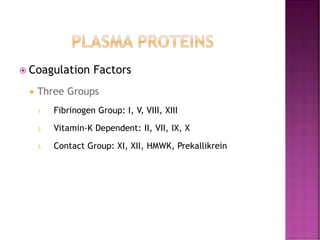
 Coagulation Factors
 Three Groups
1. Fibrinogen Group: I, V, VIII, XIII
2. Vitamin-K Dependent: II, VII, IX, X
3. Contact Group: XI, XII, HMWK, Prekallikrein
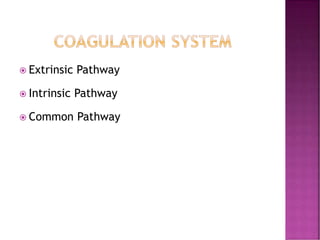
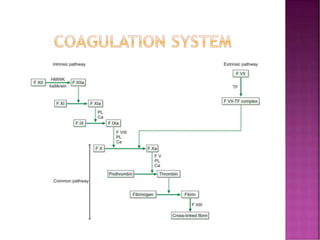
 Extrinsic Pathway
 Intrinsic Pathway
 Common Pathway
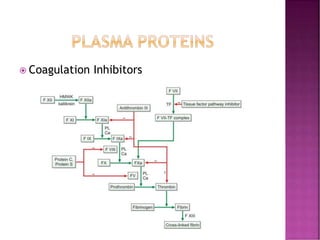
 Coagulation Inhibitors
 Fibrinolytic System
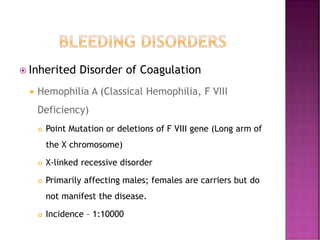
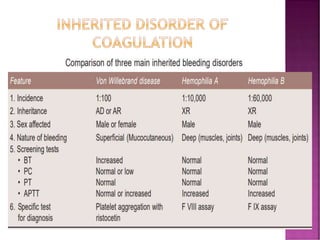
 Inherited Disorder of Coagulation
 Hemophilia A (Classical Hemophilia, F VIII
Deficiency)
 Point Mutation or deletions of F VIII gene (Long arm of
the X chromosome)
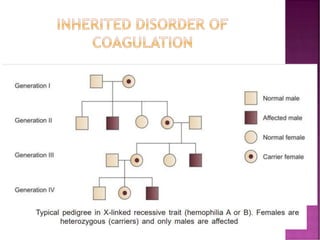
 X-linked recessive disorder
 Primarily affecting males; females are carriers but do
not manifest the disease.
 Incidence – 1:10000
 Inherited Disorder of Coagulation
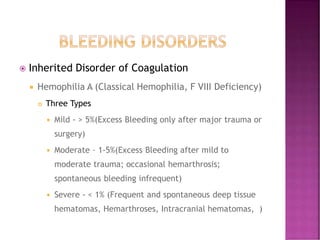
 Hemophilia A (Classical Hemophilia, F VIII Deficiency)
 Three Types
 Mild - > 5%(Excess Bleeding only after major trauma or
surgery)
 Moderate – 1-5%(Excess Bleeding after mild to
moderate trauma; occasional hemarthrosis;
spontaneous bleeding infrequent)
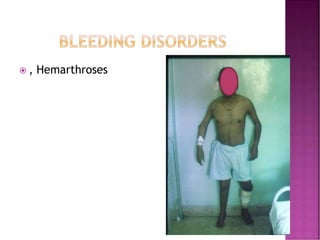
 Severe - < 1% (Frequent and spontaneous deep tissue
hematomas, Hemarthroses, Intracranial hematomas, )
 , Hemarthroses
 Acquired Inhibitors of Coagulation
1. Specific
 Against F VIII (Multi transfused patient, Old Age, RA,
Postpartum females)
2. Non-specific
 SLE, Neoplasia, HIV
 Is it a congenital or acquired bleeding
If congenital - Factor defi / Platelet / vWD
If Acquired - Surgical / Coagulopathy / Drugs
 Is bleed present at presentation
 Special situations - On drugs / Pregnancy /
Neonate
 Other Organ Involvement
 Clinical Evaluation
 Easy Bruising
 Spontaneous Bleeding
 Multiple Sites Bleeding
 Repeated Episodes of Excessive Bleeding
 Restart of bleeding hours or days following injury
 Similar past or family history
 Poor wound healing
 Bleeding is out of proportion to the degree of trauma.
 Clinical Evaluation
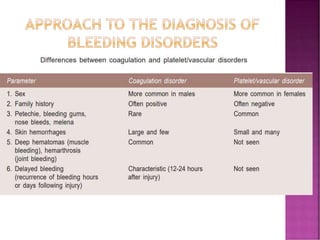
 Petechia - ≤2 mm in diameter
 Purpura - ≥3 mm but <1 cm in diameter
Both in Primary Hemostatic disorder
 Ecchymosis (Bruise) - >1 cm in diameter
(Defective hemostasis or trauma)
 Hematoma – Large area of hemorrhage
(Coagulation Disorder)
 Hemarthrosis – Coagulation Disorder Specially –
Hemophilia.
 Clinical Evaluation
 Muco-cutaneous bleeding (Purpiura, Petechia, Gums Bleeding,
Epistaxis, GI Bleeding, Menorrhagia)- Platelet Disorders, vWD
 Cephalhematomas, hemarthrosis, Intramuscular Hematoma, Intra
Cranial Bleeding, Retroperitoneal Haemorrhages – Hemophilia,
Afibrogenemia, vWD
 Umblical Stump Bleeding – Afibrogenemia, F XIII Defecicency
 Defective wound healing – F XIII Defeciency
 Recurrent Sever Epistaxis – Hereditary hemorrhagic Telangietasia
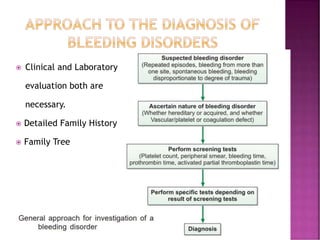
 Clinical and Laboratory
evaluation both are
necessary.
 Detailed Family History
 Family Tree
 Clinical Evaluation
 History of bleeding only in males and positive
family history on maternal side – X linked
Disorders (F VIII & F IX deficiency)
 Autosomal Recessive Disorders – Both males and
females are affected, History of consanguinity)
 Autosomal Dominant Disorders – Both sex, Older
generation, in one parent.
 Laboratory Evaluation
 CBC
 Peripheral Smear
 Bleeding time
 Clotting Time
 Prothrombin Time
 Activated Partial Thromboplastin Time
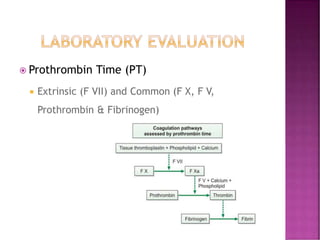
 Prothrombin Time (PT)
 Extrinsic (F VII) and Common (F X, F V,
Prothrombin & Fibrinogen)
 Prothrombin Time (PT)
 Sample Collection
 Should not use Glass Syrynge
 Trisodium Citrate (3.2%) Anticoagulant (1:9)
 Mix by gentle inversion 5 times
 Centrifuged 3000 RPM for 20 minutes
 Within 02 hrs of Blood collection test should be carried
out
 Prothrombin Time (PT)
 Method
 100 µl plasma + 100 µl Thromboplastin Reagent (TF
and Phospholipids)
 Incubate 37ºC for 1 minute
 Add 100 µl Calcium Chloride
 Record time for clot formation
Normal Range – 11 to 16 Seconds
 Prothrombin Time (PT)
 Prolongation of PT
1. Oral Anticoagulants
2. Liver Disease
3. Vit K Deficiency
4. DIC
5. Inherited Deficiency of factors of extrinsic and
common pathway
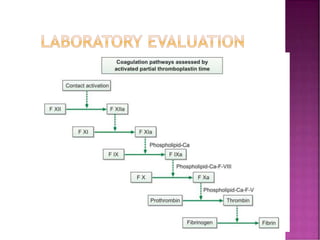
 Activated Partial Thromboplastin Time (aPTT)
 Intrinsic (F XII, F XI, HMWK, Prekallikrein, F IX &
F VIII) and Common Pathway
 Activated Partial Thromboplastin Time (aPTT)
 Method
 Phospholipid Reagent and Calcium chloride solution in
glass tube at 37ºC
 100 µl plasma and 100 µl Kaloin Solution at 37ºC for 10
minutes
 Add 200 µl Phospholipid and Calcium Chloride Mix.
Note the clotting time.
Normal Range – 30-40 seconds
 Activated Partial Thromboplastin Time (aPTT)
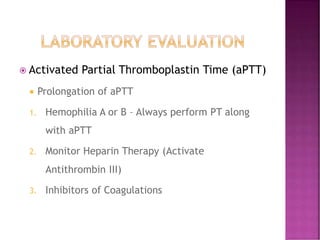
 Prolongation of aPTT
1. Hemophilia A or B – Always perform PT along
with aPTT
2. Monitor Heparin Therapy (Activate
Antithrombin III)
3. Inhibitors of Coagulations
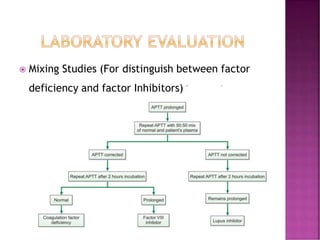
 Mixing Studies (For distinguish between factor
deficiency and factor Inhibitors)
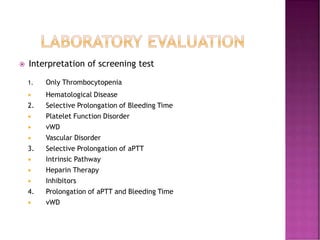
 Interpretation of screening test
1. Only Thrombocytopenia
 Hematological Disease
2. Selective Prolongation of Bleeding Time
 Platelet Function Disorder
 vWD
 Vascular Disorder
3. Selective Prolongation of aPTT
 Intrinsic Pathway
 Heparin Therapy
 Inhibitors
4. Prolongation of aPTT and Bleeding Time
 vWD
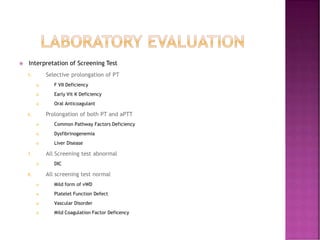
 Interpretation of Screening Test
5. Selective prolongation of PT
 F VII Deficiency
 Early Vit K Deficiency
 Oral Anticoagulant
6. Prolongation of both PT and aPTT
 Common Pathway Factors Deficiency
 Dysfibrinogenemia
 Liver Disease
7. All Screening test abnormal
 DIC
8. All screening test normal
 Mild form of vWD
 Platelet Function Defect
 Vascular Disorder
 Mild Coagulation Factor Deficency
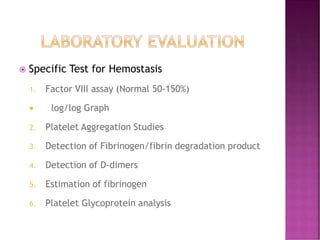
 Specific Test for Hemostasis
1. Factor VIII assay (Normal 50-150%)
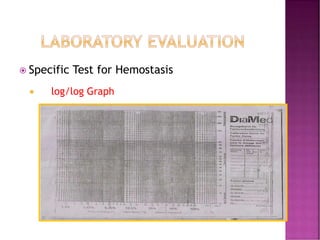
 log/log Graph
2. Platelet Aggregation Studies
3. Detection of Fibrinogen/fibrin degradation product
4. Detection of D-dimers
5. Estimation of fibrinogen
6. Platelet Glycoprotein analysis
 Specific Test for Hemostasis
 Normal Graph Paper
 Specific Test for Hemostasis
 log/log Graph
 Mild Congenital disorders can present late in life
 Every bleed in Pediatric age group is not Cong
 Combinations are possible
 History / General examination / Routine Inv
 Specialized investigations needed
 Repeat testing may be needed
 Obstetric bleeding to be tackled very aggressively
 Neonatal evaluation can be tricky
 Thank You

Hemophilia.pdf

  • 1.
    Dr. Sourabh Mandwariya Pathologist& Nodal Officer Central Lab, Indira Gandhi District Hospital, Mandsaur
  • 2.
     Bleeding disordersare very common  Haemophilia A & vWD most common  Bleeding patient can be a nightmare  Proper evaluation & anticipation is needed
  • 3.
     Normal physiologicalmechanism for keeping the blood in fluid state in vascular system and for prevention of hemorrhage by complex interaction of blood vessel walls, platelets and plasma proteins.  Primary Hemostasis (Platelet plug formation)  Secondary Hemostasis (Stable fibrin clot)
  • 4.
     Three maincomponents  Blood Vessel Wall  Constriction of blood vessel  Endothelial cell –  von Willebrand factor (vWF)  Tissue Factor  Platelet activating factor
  • 5.
     Life span– 7 to 10 days  Function  Adhesion  Release Reaction (ADP, TxA2, Serotonin)  Aggregation
  • 7.
     Coagulation Factors Coagulation Inhibitors  Fibrinolytic Systems
  • 8.
     Coagulation Factors I.Fibrinogen II. Prothrombin III. Tissue Factor, Thromboplastin IV. Calcium V. Labile Factor VI. No Factor VII. Stable Factor VIII. Antihemophilic globulin; Antihemophilic factor IX. Christmas Factor X. Stuart-Prower Factor XI. Plasma Thromboplastin Antecedent XII. Hageman Factor XIII. Fibrin Stabilizing Factor; Laki-Lorand Factor Prekallikrein –Fletcher Factor High Molecular Weight Kininogen – Fitzgerald Factor
  • 9.
     Coagulation Factors Three Groups 1. Fibrinogen Group: I, V, VIII, XIII 2. Vitamin-K Dependent: II, VII, IX, X 3. Contact Group: XI, XII, HMWK, Prekallikrein
  • 10.
     Extrinsic Pathway Intrinsic Pathway  Common Pathway
  • 12.
  • 13.
  • 16.
     Inherited Disorderof Coagulation  Hemophilia A (Classical Hemophilia, F VIII Deficiency)  Point Mutation or deletions of F VIII gene (Long arm of the X chromosome)  X-linked recessive disorder  Primarily affecting males; females are carriers but do not manifest the disease.  Incidence – 1:10000
  • 17.
     Inherited Disorderof Coagulation  Hemophilia A (Classical Hemophilia, F VIII Deficiency)  Three Types  Mild - > 5%(Excess Bleeding only after major trauma or surgery)  Moderate – 1-5%(Excess Bleeding after mild to moderate trauma; occasional hemarthrosis; spontaneous bleeding infrequent)  Severe - < 1% (Frequent and spontaneous deep tissue hematomas, Hemarthroses, Intracranial hematomas, )
  • 18.
  • 21.
     Acquired Inhibitorsof Coagulation 1. Specific  Against F VIII (Multi transfused patient, Old Age, RA, Postpartum females) 2. Non-specific  SLE, Neoplasia, HIV
  • 22.
     Is ita congenital or acquired bleeding If congenital - Factor defi / Platelet / vWD If Acquired - Surgical / Coagulopathy / Drugs  Is bleed present at presentation  Special situations - On drugs / Pregnancy / Neonate  Other Organ Involvement
  • 23.
     Clinical Evaluation Easy Bruising  Spontaneous Bleeding  Multiple Sites Bleeding  Repeated Episodes of Excessive Bleeding  Restart of bleeding hours or days following injury  Similar past or family history  Poor wound healing  Bleeding is out of proportion to the degree of trauma.
  • 24.
     Clinical Evaluation Petechia - ≤2 mm in diameter  Purpura - ≥3 mm but <1 cm in diameter Both in Primary Hemostatic disorder  Ecchymosis (Bruise) - >1 cm in diameter (Defective hemostasis or trauma)  Hematoma – Large area of hemorrhage (Coagulation Disorder)  Hemarthrosis – Coagulation Disorder Specially – Hemophilia.
  • 25.
     Clinical Evaluation Muco-cutaneous bleeding (Purpiura, Petechia, Gums Bleeding, Epistaxis, GI Bleeding, Menorrhagia)- Platelet Disorders, vWD  Cephalhematomas, hemarthrosis, Intramuscular Hematoma, Intra Cranial Bleeding, Retroperitoneal Haemorrhages – Hemophilia, Afibrogenemia, vWD  Umblical Stump Bleeding – Afibrogenemia, F XIII Defecicency  Defective wound healing – F XIII Defeciency  Recurrent Sever Epistaxis – Hereditary hemorrhagic Telangietasia
  • 26.
     Clinical andLaboratory evaluation both are necessary.  Detailed Family History  Family Tree
  • 27.
     Clinical Evaluation History of bleeding only in males and positive family history on maternal side – X linked Disorders (F VIII & F IX deficiency)  Autosomal Recessive Disorders – Both males and females are affected, History of consanguinity)  Autosomal Dominant Disorders – Both sex, Older generation, in one parent.
  • 29.
     Laboratory Evaluation CBC  Peripheral Smear  Bleeding time  Clotting Time  Prothrombin Time  Activated Partial Thromboplastin Time
  • 30.
     Prothrombin Time(PT)  Extrinsic (F VII) and Common (F X, F V, Prothrombin & Fibrinogen)
  • 31.
     Prothrombin Time(PT)  Sample Collection  Should not use Glass Syrynge  Trisodium Citrate (3.2%) Anticoagulant (1:9)  Mix by gentle inversion 5 times  Centrifuged 3000 RPM for 20 minutes  Within 02 hrs of Blood collection test should be carried out
  • 32.
     Prothrombin Time(PT)  Method  100 µl plasma + 100 µl Thromboplastin Reagent (TF and Phospholipids)  Incubate 37ºC for 1 minute  Add 100 µl Calcium Chloride  Record time for clot formation Normal Range – 11 to 16 Seconds
  • 33.
     Prothrombin Time(PT)  Prolongation of PT 1. Oral Anticoagulants 2. Liver Disease 3. Vit K Deficiency 4. DIC 5. Inherited Deficiency of factors of extrinsic and common pathway
  • 34.
     Activated PartialThromboplastin Time (aPTT)  Intrinsic (F XII, F XI, HMWK, Prekallikrein, F IX & F VIII) and Common Pathway
  • 36.
     Activated PartialThromboplastin Time (aPTT)  Method  Phospholipid Reagent and Calcium chloride solution in glass tube at 37ºC  100 µl plasma and 100 µl Kaloin Solution at 37ºC for 10 minutes  Add 200 µl Phospholipid and Calcium Chloride Mix. Note the clotting time. Normal Range – 30-40 seconds
  • 37.
     Activated PartialThromboplastin Time (aPTT)  Prolongation of aPTT 1. Hemophilia A or B – Always perform PT along with aPTT 2. Monitor Heparin Therapy (Activate Antithrombin III) 3. Inhibitors of Coagulations
  • 38.
     Mixing Studies(For distinguish between factor deficiency and factor Inhibitors)
  • 39.
     Interpretation ofscreening test 1. Only Thrombocytopenia  Hematological Disease 2. Selective Prolongation of Bleeding Time  Platelet Function Disorder  vWD  Vascular Disorder 3. Selective Prolongation of aPTT  Intrinsic Pathway  Heparin Therapy  Inhibitors 4. Prolongation of aPTT and Bleeding Time  vWD
  • 40.
     Interpretation ofScreening Test 5. Selective prolongation of PT  F VII Deficiency  Early Vit K Deficiency  Oral Anticoagulant 6. Prolongation of both PT and aPTT  Common Pathway Factors Deficiency  Dysfibrinogenemia  Liver Disease 7. All Screening test abnormal  DIC 8. All screening test normal  Mild form of vWD  Platelet Function Defect  Vascular Disorder  Mild Coagulation Factor Deficency
  • 41.
     Specific Testfor Hemostasis 1. Factor VIII assay (Normal 50-150%)  log/log Graph 2. Platelet Aggregation Studies 3. Detection of Fibrinogen/fibrin degradation product 4. Detection of D-dimers 5. Estimation of fibrinogen 6. Platelet Glycoprotein analysis
  • 42.
     Specific Testfor Hemostasis  Normal Graph Paper
  • 43.
     Specific Testfor Hemostasis  log/log Graph
  • 44.
     Mild Congenitaldisorders can present late in life  Every bleed in Pediatric age group is not Cong  Combinations are possible  History / General examination / Routine Inv  Specialized investigations needed  Repeat testing may be needed  Obstetric bleeding to be tackled very aggressively  Neonatal evaluation can be tricky
  • 45.