

LAP LEFT
HEMICOLECTOMY
DR.B.Selvaraj MS; Mch; FICS;
“ Surgical Educator”
Malaysia
OPERATIVE SURGERY
LAP LEFT HEMICOLECTOMY
• INDICATIONS:
 Malignant tumors in descending colon and splenic
flexure
 Diverticulitis, Polyps, Inflammatory bowel disease and
colonic hemorrhage
• ANESTHESIA:
 GA/ETT
• POSITION:
 Supine/modified lithotomy
• Diagnosis
 Confirmed by colonoscopic biopsy
 Staging by CECT
• Informed consent- risks of surgery:
 Anastomotic leak- 2%
 Hemorrhage- 1%
 Bowel obstruction- 2%
 Wound infection- 2 to 10%
 Splenic injury- < 5%
 Injury to ureter and gonadal vessels- 1%
• Pre-op preparation
 Adequate mechanical bowel preparation the day before surgery
with orthograde enema
 Prophylactic IV broad spectrum antibiotics
 VTE prophylaxis with LMWH and pneumatic stockings
 Tattooing of the tumor endoscopically or by localization on a barium
enema.
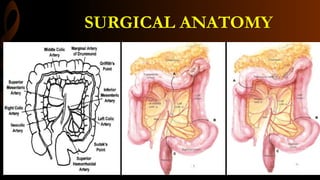
SURGICAL ANATOMY
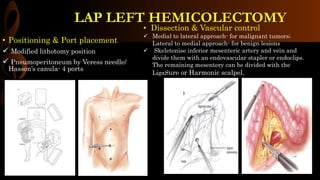
• Positioning & Port placement
 Modified lithotomy position
 Pneumoperitoneum by Veress needle/
Hasson’s canula- 4 ports
• Dissection & Vascular control
 Medial to lateral approach- for malignant tumors;
Lateral to medial approach- for benign lesions
 Skeletonise inferior mesenteric artery and vein and
divide them with an endovascular stapler or endoclips.
The remaining mesentery can be divided with the
LigaSure or Harmonic scalpel.
LAP LEFT HEMICOLECTOMY
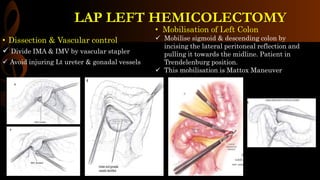
• Dissection & Vascular control
 Divide IMA & IMV by vascular stapler
 Avoid injuring Lt ureter & gonadal vessels
• Mobilisation of Left Colon
 Mobilise sigmoid & descending colon by
incising the lateral peritoneal reflection and
pulling it towards the midline. Patient in
Trendelenburg position.
 This mobilisation is Mattox Maneuver
LAP LEFT HEMICOLECTOMY
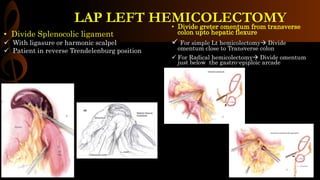
• Divide greter omentum from transverse
colon upto hepatic flexure
 For simple Lt hemicolectomy Divide
omentum close to Transverse colon
 For Radical hemicolectomy Divide omentum
just below the gastro-epiploic arcade
• Divide Splenocolic ligament
 With ligasure or harmonic scalpel
 Patient in reverse Trendelenburg position
LAP LEFT HEMICOLECTOMY
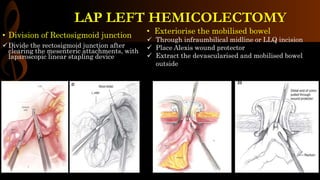
• Division of Rectosigmoid junction
Divide the rectosigmoid junction after
clearing the mesenteric attachments, with
laparoscopic linear stapling device
• Exteriorise the mobilised bowel
 Through infraumbilical midline or LLQ incision
 Place Alexis wound protector
 Extract the devascularised and mobilised bowel
outside
LAP LEFT HEMICOLECTOMY
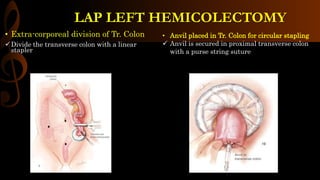
• Extra-corporeal division of Tr. Colon
Divide the transverse colon with a linear
stapler
LAP LEFT HEMICOLECTOMY
• Anvil placed in Tr. Colon for circular stapling
 Anvil is secured in proximal transverse colon
with a purse string suture
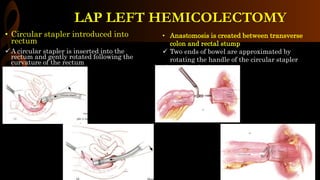
• Circular stapler introduced into
rectum
A circular stapler is inserted into the
rectum and gently rotated following the
curvature of the rectum
LAP LEFT HEMICOLECTOMY
• Anastomosis is created between transverse
colon and rectal stump
 Two ends of bowel are approximated by
rotating the handle of the circular stapler
 stapling device.
Post-op Care
Adherence to a postoperative colorectal clinical pathway ensures standardization of care and
facilitates timely discharge from the hospital.
Adequate pain control is achieved using patient-controlled analgesia, Inj Tramadol which can be
replaced with oral analgesics on 2 nd post-op day
Stress ulcer prophylaxis should be made for patients with symptoms or history of
gastroesophageal reflux disease (GERD) or peptic ulcer disease (PUD).
Prophylaxis for deep venous thrombosis, consisting of sequential compression devices while in
bed, and heparin 5000 U subcutaneously every 8 hours or enoxaparin 40 mg subcutaneously every
morning, starting within 24 hours after surgery.
Adequate IV fluid should be administered with monitoring of urine output. The Foley catheter
may be removed on postoperative day 1.
Clear liquid diet is started on postoperative day 1 and gradually advanced to normal diet
Early ambulation should be started on postoperative day 1.
LAP LEFT HEMICOLECTOMY
Pearls & Pitfalls
 Prophylactic antibiotic for colorectal surgery, ertapenem (Invanz) 1 g intravenously, before surgery, requires
only a single dose for 24-hour coverage. Furthermore, it lasts for the duration of the procedure and does not
require additional dosing
 Watch out for injury to the splenic capsule by traction on the colon during the entire dissection
 Smaller lesions in the colon should be marked with tattoo ink for confirmation of location, which will assist
in removal of the primary lesion with adequate 5-cm margin and areas of lymphatic drainage.
 Ensure the correct orientation of the bowel ends to be anastomosed- position proximal colon so that the
mesentery lies to the right of the anastomosis- “meso to meso”
 Placement of Sepra-film under the midline incision minimizes adhesions on re-entry for subsequent
operations. This should be considered, especially for indications such as Crohn’s disease and colon cancer.
LAP LEFT HEMICOLECTOMY
THANK YOU

LAP LEFT HEMICOLECTOMY-STEP BY STEP Operative Surgery.pptx

  • 1.
    LAP LEFT HEMICOLECTOMY DR.B.Selvaraj MS;Mch; FICS; “ Surgical Educator” Malaysia OPERATIVE SURGERY
  • 2.
    LAP LEFT HEMICOLECTOMY •INDICATIONS:  Malignant tumors in descending colon and splenic flexure  Diverticulitis, Polyps, Inflammatory bowel disease and colonic hemorrhage • ANESTHESIA:  GA/ETT • POSITION:  Supine/modified lithotomy • Diagnosis  Confirmed by colonoscopic biopsy  Staging by CECT • Informed consent- risks of surgery:  Anastomotic leak- 2%  Hemorrhage- 1%  Bowel obstruction- 2%  Wound infection- 2 to 10%  Splenic injury- < 5%  Injury to ureter and gonadal vessels- 1% • Pre-op preparation  Adequate mechanical bowel preparation the day before surgery with orthograde enema  Prophylactic IV broad spectrum antibiotics  VTE prophylaxis with LMWH and pneumatic stockings  Tattooing of the tumor endoscopically or by localization on a barium enema.
  • 3.
  • 4.
    • Positioning &Port placement  Modified lithotomy position  Pneumoperitoneum by Veress needle/ Hasson’s canula- 4 ports • Dissection & Vascular control  Medial to lateral approach- for malignant tumors; Lateral to medial approach- for benign lesions  Skeletonise inferior mesenteric artery and vein and divide them with an endovascular stapler or endoclips. The remaining mesentery can be divided with the LigaSure or Harmonic scalpel. LAP LEFT HEMICOLECTOMY
  • 5.
    • Dissection &Vascular control  Divide IMA & IMV by vascular stapler  Avoid injuring Lt ureter & gonadal vessels • Mobilisation of Left Colon  Mobilise sigmoid & descending colon by incising the lateral peritoneal reflection and pulling it towards the midline. Patient in Trendelenburg position.  This mobilisation is Mattox Maneuver LAP LEFT HEMICOLECTOMY
  • 6.
    • Divide greteromentum from transverse colon upto hepatic flexure  For simple Lt hemicolectomy Divide omentum close to Transverse colon  For Radical hemicolectomy Divide omentum just below the gastro-epiploic arcade • Divide Splenocolic ligament  With ligasure or harmonic scalpel  Patient in reverse Trendelenburg position LAP LEFT HEMICOLECTOMY
  • 7.
    • Division ofRectosigmoid junction Divide the rectosigmoid junction after clearing the mesenteric attachments, with laparoscopic linear stapling device • Exteriorise the mobilised bowel  Through infraumbilical midline or LLQ incision  Place Alexis wound protector  Extract the devascularised and mobilised bowel outside LAP LEFT HEMICOLECTOMY
  • 8.
    • Extra-corporeal divisionof Tr. Colon Divide the transverse colon with a linear stapler LAP LEFT HEMICOLECTOMY • Anvil placed in Tr. Colon for circular stapling  Anvil is secured in proximal transverse colon with a purse string suture
  • 9.
    • Circular staplerintroduced into rectum A circular stapler is inserted into the rectum and gently rotated following the curvature of the rectum LAP LEFT HEMICOLECTOMY • Anastomosis is created between transverse colon and rectal stump  Two ends of bowel are approximated by rotating the handle of the circular stapler  stapling device.
  • 10.
    Post-op Care Adherence toa postoperative colorectal clinical pathway ensures standardization of care and facilitates timely discharge from the hospital. Adequate pain control is achieved using patient-controlled analgesia, Inj Tramadol which can be replaced with oral analgesics on 2 nd post-op day Stress ulcer prophylaxis should be made for patients with symptoms or history of gastroesophageal reflux disease (GERD) or peptic ulcer disease (PUD). Prophylaxis for deep venous thrombosis, consisting of sequential compression devices while in bed, and heparin 5000 U subcutaneously every 8 hours or enoxaparin 40 mg subcutaneously every morning, starting within 24 hours after surgery. Adequate IV fluid should be administered with monitoring of urine output. The Foley catheter may be removed on postoperative day 1. Clear liquid diet is started on postoperative day 1 and gradually advanced to normal diet Early ambulation should be started on postoperative day 1. LAP LEFT HEMICOLECTOMY
  • 11.
    Pearls & Pitfalls Prophylactic antibiotic for colorectal surgery, ertapenem (Invanz) 1 g intravenously, before surgery, requires only a single dose for 24-hour coverage. Furthermore, it lasts for the duration of the procedure and does not require additional dosing  Watch out for injury to the splenic capsule by traction on the colon during the entire dissection  Smaller lesions in the colon should be marked with tattoo ink for confirmation of location, which will assist in removal of the primary lesion with adequate 5-cm margin and areas of lymphatic drainage.  Ensure the correct orientation of the bowel ends to be anastomosed- position proximal colon so that the mesentery lies to the right of the anastomosis- “meso to meso”  Placement of Sepra-film under the midline incision minimizes adhesions on re-entry for subsequent operations. This should be considered, especially for indications such as Crohn’s disease and colon cancer. LAP LEFT HEMICOLECTOMY
  • 12.