SPLENIC
RUPTURE
DR.B.SELVARAJ MS;Mch;FICS;
‘Surgical Educator’
MALAYSIA
BLUNT ABDOMINAL
TRAUMA
SPLENIC RUPTURE
• Etiology
• Pathology
• Clinical features
• Workup/Investigations
• Differential diagnosis
• Splenic CT injury grading
• Treatment
• Complications- OPSI
• Treatment algorithm for Splenic injury
LEARNING OBJECTIVES
SPLENIC RUPTURE
• H/O Blunt abdominal or lower thoracic trauma
• Penetrating trauma to Left Hypochondrium
• Iatrogenic
• Spontaneous rupture
- Malaria
- Leukemia
- Infectious mononucleosis
ETIOLOGY
• Injury types
• Laceration
• Hilar injury
• Subcapsular hematoma
• Injury associated with other organ
injuries
• Mechanism of injury
• Crushing
• Deceleration
• Sudden increase in intra abdominal
pressure
SPLENIC RUPTURE
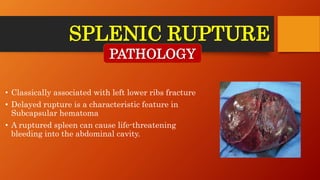
• Classically associated with left lower ribs fracture
• Delayed rupture is a characteristic feature in
Subcapsular hematoma
• A ruptured spleen can cause life-threatening
bleeding into the abdominal cavity.
PATHOLOGY
SPLENIC RUPTURE
• H/O Trauma
• Pain abdomen
• Occasional distension and vomiting
• In severe bleeding associated with shock, syncope or
dizziness
• Kher’s sign Pain over left shoulder joint
• Fixed dullness to percussion on the left, and shifting
dullness on the right (Ballance’s sign).
• Tenderness all over the abdomen with or without
guarding and rigidity
• Bowel sounds are absent
CLINICAL FEATURES
SPLENIC RUPTURE
• Other causes for hemoperitoneum
• Liver injury
• Ruptured ectopic pregnancy
• Ruptured abdominal aortic aneurysm
• Acute hemorrhagic pancreatitis
DIFFERENTIAL DIAGNOSIS
SPLENIC RUPTURE
INVESTIGATIONS
SPLENIC RUPTURE
INVESTIGATIONS- CECT
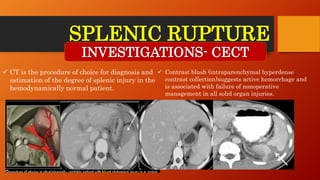
 CT is the procedure of choice for diagnosis and
estimation of the degree of splenic injury in the
hemodynamically normal patient.
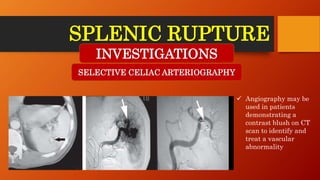
 Contrast blush (intraparenchymal hyperdense
contrast collection)suggests active hemorrhage and
is associated with failure of nonoperative
management in all solid organ injuries.
SPLENIC RUPTURE
INVESTIGATIONS
SELECTIVE CELIAC ARTERIOGRAPHY
 Angiography may be
used in patients
demonstrating a
contrast blush on CT
scan to identify and
treat a vascular
abnormality
SPLENIC RUPTURE
INVESTIGATIONS DPA/DPL
SPLENIC RUPTURE
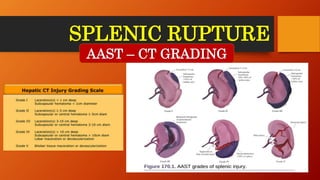
AAST – CT GRADING
SPLENIC RUPTURE
TREATMENT
Nonoperative management
 Requires ICU monitoring in a dedicated
trauma center and immediate ability to
convert to operative management should
that become necessary
Indications
 Hemodynamic stability
 Minimal evidence of blood loss, < 2 units
packed red blood cells as transfusion
requirement
 Absence of active contrast extravasation on
CT scan
 Absence of other indication for laparotomy
 Length of intensive care unit (ICU) monitoring is generally
24 to 48 hours initially, with serial hematocrit evaluation
and continuous hemodynamic monitoring
 Blood transfusion is limited to 2 units of packed red blood
cells. If the patient has an ongoing transfusion
requirement of more than 2 units, operative management
should be performed
 The majority of pediatric splenic trauma is successfully
managed nonoperatively.
 Recovery recommendations include restricted activity in
terms of contact sports, running, or similar stresses for 3
months following injury.
 Angiography is performed in patients who are
hemodynamically normal and have a blush on initial CT
scan.
SPLENIC RUPTURE
TREATMENT
Operative management
 Should be performed in those patients
demonstrating peritonitis or
hemodynamic instability, those failing
nonoperative therapy, and those with
gunshot wounds to the abdomen
 Splenectomy is indicated with
significant blood loss (>1000 mL),
significant associated injuries, hilar
involvement, coagulopathy, or massive
splenic disruption
 Splenic salvage includes splenorrhaphy
and partial splenectomy
 Splenorrhaphy can be performed with
absorbable mesh (Dexon)
 Other strategies include the use of topical hemostatic
agents, including Surgicel, Avitene, and topical thrombin,
as well as the application of mattress sutures to allow
tamponade of hemorrhage.
 Partial splenectomy may be performed for polar injuries. At
least 30% of the spleen must be preserved to maintain
function.
SPLENIC RUPTURE
TREATMENT
Operative management
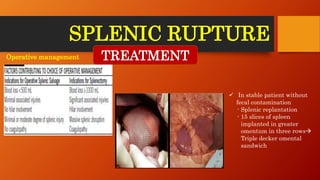
 In stable patient without
fecal contamination
- Splenic replantation
- 15 slices of spleen
implanted in greater
omentum in three rows
Triple decker omental
sandwich
SPLENIC RUPTURE
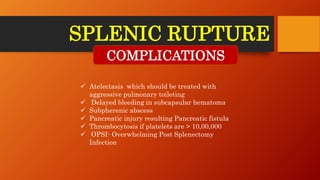
COMPLICATIONS
 Atelectasis which should be treated with
aggressive pulmonary toileting
 Delayed bleeding in subcapsular hematoma
 Subpherenic abscess
 Pancreatic injury resulting Pancreatic fistula
 Thrombocytosis if platelets are > 10,00,000
 OPSI- Overwhelming Post Splenectomy
Infection
SPLENIC RUPTURE
OPSI
 Syndrome consists of rapid development of
severe sepsis with hypotension, disseminated
intravascular coagulation, respiratory distress,
and coma within hours of presentation
 Incidence. This is a rare complication of
splenectomy. 50% to 70% of OPSI occurs less
than 2 years after splenectomy.
 Mortaltiy is 50% to 70% for patients
presenting with full-blown OPSI
 Organisms. S. pneumoniae is responsible for
50% to 90% of infections. Others include N.
meningitides, H. influenzae
 Treatment. Aggressive empiric antibiotic therapy
should be initiated awaiting pan-
culture/sensitivities.
 Prophylaxis. Presplenectomy immunization (2 weeks
before splenectomy) is optimal but most often
impossible for traumatic splenectomy.
 Immunization for Pneumococcus, Meningococcus,
and H. influenzae type B should be administered
prior to discharge Pneumovax. Pneumococcal
booster should be considered every 5 to 6 years for
high-risk patients.
SPLENIC RUPTURE
HAND-WRITTEN MINDMAP
SPLENIC INJURY.pptx

SPLENIC INJURY.pptx

  • 1.
  • 2.
    SPLENIC RUPTURE • Etiology •Pathology • Clinical features • Workup/Investigations • Differential diagnosis • Splenic CT injury grading • Treatment • Complications- OPSI • Treatment algorithm for Splenic injury LEARNING OBJECTIVES
  • 3.
    SPLENIC RUPTURE • H/OBlunt abdominal or lower thoracic trauma • Penetrating trauma to Left Hypochondrium • Iatrogenic • Spontaneous rupture - Malaria - Leukemia - Infectious mononucleosis ETIOLOGY • Injury types • Laceration • Hilar injury • Subcapsular hematoma • Injury associated with other organ injuries • Mechanism of injury • Crushing • Deceleration • Sudden increase in intra abdominal pressure
  • 4.
    SPLENIC RUPTURE • Classicallyassociated with left lower ribs fracture • Delayed rupture is a characteristic feature in Subcapsular hematoma • A ruptured spleen can cause life-threatening bleeding into the abdominal cavity. PATHOLOGY
  • 5.
    SPLENIC RUPTURE • H/OTrauma • Pain abdomen • Occasional distension and vomiting • In severe bleeding associated with shock, syncope or dizziness • Kher’s sign Pain over left shoulder joint • Fixed dullness to percussion on the left, and shifting dullness on the right (Ballance’s sign). • Tenderness all over the abdomen with or without guarding and rigidity • Bowel sounds are absent CLINICAL FEATURES
  • 6.
    SPLENIC RUPTURE • Othercauses for hemoperitoneum • Liver injury • Ruptured ectopic pregnancy • Ruptured abdominal aortic aneurysm • Acute hemorrhagic pancreatitis DIFFERENTIAL DIAGNOSIS
  • 7.
  • 8.
    SPLENIC RUPTURE INVESTIGATIONS- CECT CT is the procedure of choice for diagnosis and estimation of the degree of splenic injury in the hemodynamically normal patient.  Contrast blush (intraparenchymal hyperdense contrast collection)suggests active hemorrhage and is associated with failure of nonoperative management in all solid organ injuries.
  • 9.
    SPLENIC RUPTURE INVESTIGATIONS SELECTIVE CELIACARTERIOGRAPHY  Angiography may be used in patients demonstrating a contrast blush on CT scan to identify and treat a vascular abnormality
  • 10.
  • 11.
  • 12.
    SPLENIC RUPTURE TREATMENT Nonoperative management Requires ICU monitoring in a dedicated trauma center and immediate ability to convert to operative management should that become necessary Indications  Hemodynamic stability  Minimal evidence of blood loss, < 2 units packed red blood cells as transfusion requirement  Absence of active contrast extravasation on CT scan  Absence of other indication for laparotomy  Length of intensive care unit (ICU) monitoring is generally 24 to 48 hours initially, with serial hematocrit evaluation and continuous hemodynamic monitoring  Blood transfusion is limited to 2 units of packed red blood cells. If the patient has an ongoing transfusion requirement of more than 2 units, operative management should be performed  The majority of pediatric splenic trauma is successfully managed nonoperatively.  Recovery recommendations include restricted activity in terms of contact sports, running, or similar stresses for 3 months following injury.  Angiography is performed in patients who are hemodynamically normal and have a blush on initial CT scan.
  • 13.
    SPLENIC RUPTURE TREATMENT Operative management Should be performed in those patients demonstrating peritonitis or hemodynamic instability, those failing nonoperative therapy, and those with gunshot wounds to the abdomen  Splenectomy is indicated with significant blood loss (>1000 mL), significant associated injuries, hilar involvement, coagulopathy, or massive splenic disruption  Splenic salvage includes splenorrhaphy and partial splenectomy  Splenorrhaphy can be performed with absorbable mesh (Dexon)  Other strategies include the use of topical hemostatic agents, including Surgicel, Avitene, and topical thrombin, as well as the application of mattress sutures to allow tamponade of hemorrhage.  Partial splenectomy may be performed for polar injuries. At least 30% of the spleen must be preserved to maintain function.
  • 14.
    SPLENIC RUPTURE TREATMENT Operative management In stable patient without fecal contamination - Splenic replantation - 15 slices of spleen implanted in greater omentum in three rows Triple decker omental sandwich
  • 15.
    SPLENIC RUPTURE COMPLICATIONS  Atelectasiswhich should be treated with aggressive pulmonary toileting  Delayed bleeding in subcapsular hematoma  Subpherenic abscess  Pancreatic injury resulting Pancreatic fistula  Thrombocytosis if platelets are > 10,00,000  OPSI- Overwhelming Post Splenectomy Infection
  • 16.
    SPLENIC RUPTURE OPSI  Syndromeconsists of rapid development of severe sepsis with hypotension, disseminated intravascular coagulation, respiratory distress, and coma within hours of presentation  Incidence. This is a rare complication of splenectomy. 50% to 70% of OPSI occurs less than 2 years after splenectomy.  Mortaltiy is 50% to 70% for patients presenting with full-blown OPSI  Organisms. S. pneumoniae is responsible for 50% to 90% of infections. Others include N. meningitides, H. influenzae  Treatment. Aggressive empiric antibiotic therapy should be initiated awaiting pan- culture/sensitivities.  Prophylaxis. Presplenectomy immunization (2 weeks before splenectomy) is optimal but most often impossible for traumatic splenectomy.  Immunization for Pneumococcus, Meningococcus, and H. influenzae type B should be administered prior to discharge Pneumovax. Pneumococcal booster should be considered every 5 to 6 years for high-risk patients.
  • 17.
  • 18.