NATURAL ORIFICE TRANSLUMINAL
LAPAROSCOPIC SURGERY
By
Dr.Hisham Hussein Mohamed Ahmed
Assistant professor of General Surgery
Benha University
2016
INTRODUCTION
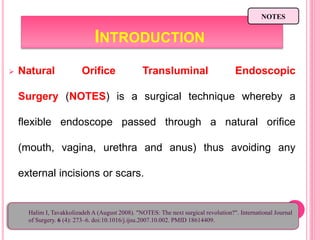
 Natural Orifice Transluminal Endoscopic
Surgery (NOTES) is a surgical technique whereby a
flexible endoscope passed through a natural orifice
(mouth, vagina, urethra and anus) thus avoiding any
external incisions or scars.
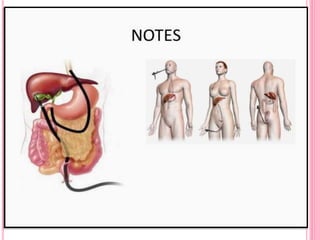
NOTES
Halim I, Tavakkolizadeh A (August 2008). "NOTES: The next surgical revolution?". International Journal
of Surgery. 6 (4): 273–6. doi:10.1016/j.ijsu.2007.10.002. PMID 18614409.
SURGERY THROUGH BODY’S NATURAL OPENINGS LIKE MOUTH, VAGINA,
 NOTES was originally described in animals by
researchers at Johns Hopkins University (Dr. Anthony
Kalloo et al.).
 The first NOTES transgastric appendectomy performed
by Rao and Reddy in 2004.
 The first transvaginal appendectomy performed by
Bernhardt in 2007.
NOTES
Introduction
Rolanda C, Lima E, Pêgo JM, et al. (January 2007). "Third-generation cholecystectomy by natural orifices:
transgastric and transvesical combined approach (with video)". Gastrointestinal Endoscopy. 65 (1): 111–
7. doi:10.1016/j.gie.2006.07.050. PMID 17185089.
 On June 25, 2007 Swanstrom and colleagues reported
the first human transgastric cholecystectomy.
 In late 2008 surgeons from Johns Hopkins School of
Medicine removed a healthy kidney from a woman donor
using NOTES.
NOTES
Introduction
"Surgeons Remove Healthy Kidney Through Vagina". InfoNIAC.com. Retrieved 2009-02- 03.
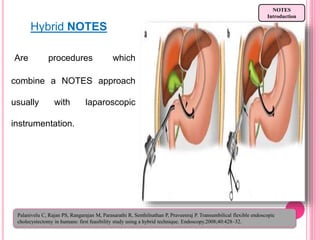
Hybrid NOTES
Are procedures which
combine a NOTES approach
usually with laparoscopic
instrumentation.
NOTES
Introduction
Palanivelu C, Rajan PS, Rangarajan M, Parasarathi R, Senthilnathan P, Praveenraj P. Transumbilical flexible endoscopic
cholecystectomy in humans: first feasibility study using a hybrid technique. Endoscopy.2008;40:428–32.
TIPS AND JUSTIFICATIONS
 Peritoneal access;
The principles of safe and reproducible NOTES are;
 Minimal tissue injury
 Good exposure
 Safety (avoiding vascular and visceral injury)
 Ability to maintain a seal and manipulate the
instrument.
Ryou M, Fong DG, Pai RD, Rattner DW, Thompson CC. Transluminal closure for NOTES: an ex vivostudy comparing leak
pressures of various gastrotomy and colostomy modalities. Endoscopy. 2008;40:432–7.
 Favoured routes for NOTES;
1. Transvaginal
2. Transgastric
3. Transcolonic
4. Transvesical
 All routes are under experimental usage.
 In clinical application Transvaginal access appears to be the safest,
most feasible and potentially less complications but only possible in
women.
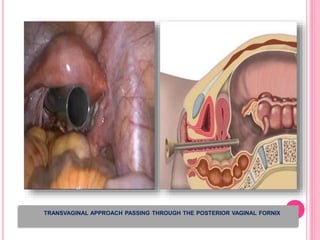
TRANSVAGINAL APPROACH PASSING THROUGH THE POSTERIOR VAGINAL FORNIX
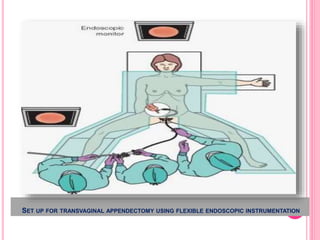
SET UP FOR TRANSVAGINAL APPENDECTOMY USING FLEXIBLE ENDOSCOPIC INSTRUMENTATION
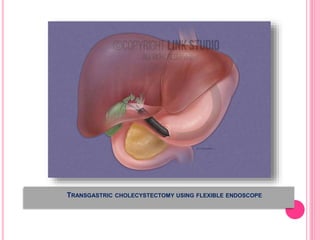
TRANSGASTRIC CHOLECYSTECTOMY USING FLEXIBLE ENDOSCOPE
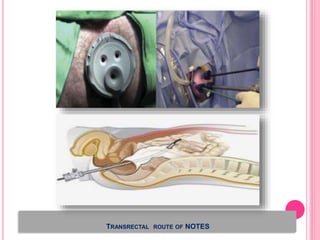
TRANSRECTAL ROUTE OF NOTES
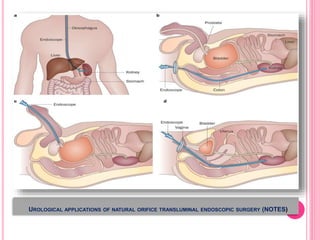
UROLOGICAL APPLICATIONS OF NATURAL ORIFICE TRANSLUMINAL ENDOSCOPIC SURGERY (NOTES)
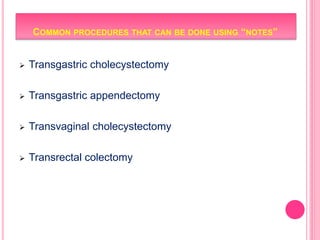
COMMON PROCEDURES THAT CAN BE DONE USING “NOTES”
 Transgastric cholecystectomy
 Transgastric appendectomy
 Transvaginal cholecystectomy
 Transrectal colectomy
SUTURING AND CLOSURE
Two issues of suturing during NOTES deserve special mention
 First “closure of the access site”
must ensure no anastomotic breakdown and subsequent leak
 Second “the need for suturing during the procedure”
to secure haemostasis or complete the operation
The instrumentation currently available is not consistently
capable of permitting safe suturing of tissues.
Voermans RP, Worm AM, Van Berge Henegouwen MI, Breeveld P, Bemelman WA, Fockens P. In vitrocomparison and
evaluation of seven gastric closure modalities for natural orifice transluminal endoscopic surgery
(NOTES) Endoscopy. 2008;40:595–602.
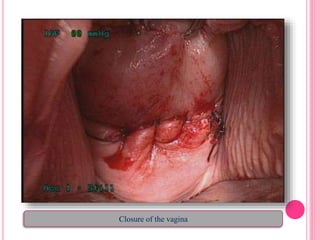
Closure of the vagina
COMPLICATIONS OF NOTES
 Visceral injury
 Vascular injury
 Infection
 Delayed anastomotic or entry site leaks
 Adhesion formation
 Dyspareunia
Vascular and visceral injuries can both passed unrecognized and
difficult to control due to the position and orientation of the endoscope
Pham BV, Morgan K, Romagnuolo J, Glenn J, Bazaz S, Lawrence C, Hawes R. Pilot study of adhesion formation following
colon perforation and repair in a pig model using transgastric, laparoscopic or open surgical repair. Endoscopy. 2008;40:664–
70.
NOTES INSTRUMENTATION TECHNOLOGY
 The ultimate goal remains the design and production of a flexible endoscope
or NOTES platform that is;
 Multichannelled,
 Can bend in more than two axes
 Can be stabilized once the correct operating position
has been reached.
Pham BV, Morgan K, Romagnuolo J, Glenn J, Bazaz S, Lawrence C, Hawes R. Pilot study of adhesion formation following
colon perforation and repair in a pig model using transgastric, laparoscopic or open surgical repair. Endoscopy. 2008;40:664–
70.
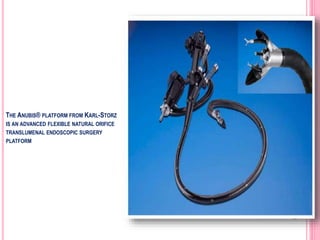
THE ANUBIS® PLATFORM FROM KARL-STORZ
IS AN ADVANCED FLEXIBLE NATURAL ORIFICE
TRANSLUMENAL ENDOSCOPIC SURGERY
PLATFORM
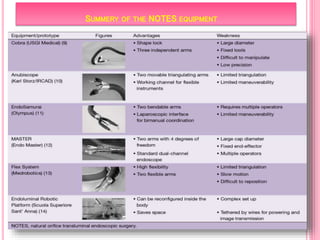
SUMMERY OF THE NOTES EQUIPMENT
ETHICS AND ACCEPTABILITY
 NOTES indications and techniques should be practiced in non-human
models followed by human research projects.
 Appropriate institutional and regional ethical committee approval before
its role in clinical practice.
 Close collaboration with industry partners is key to the future
development of NOTES.
Annals of The Royal College of Surgeons of England
RESEARCH
 Although there are now rapidly increasing publications on NOTES, it is
imperative to emphasize the importance of high-quality research
which is adequately funded.
 For the investigator starting NOTES, it is essential that further
knowledge on outcome in animal research is available before this
technique can be applied directly into human clinical studies.
Annals of The Royal College of Surgeons of England
TRAINING
 Training in NOTES will be a key issue in the future and
will improve the surgeon’s experience.
 Mandatory animal laboratory training would be a
prerequisite of any training course and accreditation
programme.
Annals of The Royal College of Surgeons of England
CONCLUSION
 NOTES is an entirely novel method of surgical therapy that
needs more research and training on animal models before
its application on human.
 Although there are many reasons for scepticism, there is
undoubted interest in this field from both the medical
profession and the general public.
Annals of The Royal College of Surgeons of England
Natural Orifice Transluminal Endoscopic Surgery"NOTES"

Natural Orifice Transluminal Endoscopic Surgery"NOTES"

  • 1.
    NATURAL ORIFICE TRANSLUMINAL LAPAROSCOPICSURGERY By Dr.Hisham Hussein Mohamed Ahmed Assistant professor of General Surgery Benha University 2016
  • 2.
    INTRODUCTION  Natural OrificeTransluminal Endoscopic Surgery (NOTES) is a surgical technique whereby a flexible endoscope passed through a natural orifice (mouth, vagina, urethra and anus) thus avoiding any external incisions or scars. NOTES Halim I, Tavakkolizadeh A (August 2008). "NOTES: The next surgical revolution?". International Journal of Surgery. 6 (4): 273–6. doi:10.1016/j.ijsu.2007.10.002. PMID 18614409.
  • 3.
    SURGERY THROUGH BODY’SNATURAL OPENINGS LIKE MOUTH, VAGINA,
  • 4.
     NOTES wasoriginally described in animals by researchers at Johns Hopkins University (Dr. Anthony Kalloo et al.).  The first NOTES transgastric appendectomy performed by Rao and Reddy in 2004.  The first transvaginal appendectomy performed by Bernhardt in 2007. NOTES Introduction Rolanda C, Lima E, Pêgo JM, et al. (January 2007). "Third-generation cholecystectomy by natural orifices: transgastric and transvesical combined approach (with video)". Gastrointestinal Endoscopy. 65 (1): 111– 7. doi:10.1016/j.gie.2006.07.050. PMID 17185089.
  • 5.
     On June25, 2007 Swanstrom and colleagues reported the first human transgastric cholecystectomy.  In late 2008 surgeons from Johns Hopkins School of Medicine removed a healthy kidney from a woman donor using NOTES. NOTES Introduction "Surgeons Remove Healthy Kidney Through Vagina". InfoNIAC.com. Retrieved 2009-02- 03.
  • 6.
    Hybrid NOTES Are procedureswhich combine a NOTES approach usually with laparoscopic instrumentation. NOTES Introduction Palanivelu C, Rajan PS, Rangarajan M, Parasarathi R, Senthilnathan P, Praveenraj P. Transumbilical flexible endoscopic cholecystectomy in humans: first feasibility study using a hybrid technique. Endoscopy.2008;40:428–32.
  • 7.
    TIPS AND JUSTIFICATIONS Peritoneal access; The principles of safe and reproducible NOTES are;  Minimal tissue injury  Good exposure  Safety (avoiding vascular and visceral injury)  Ability to maintain a seal and manipulate the instrument. Ryou M, Fong DG, Pai RD, Rattner DW, Thompson CC. Transluminal closure for NOTES: an ex vivostudy comparing leak pressures of various gastrotomy and colostomy modalities. Endoscopy. 2008;40:432–7.
  • 8.
     Favoured routesfor NOTES; 1. Transvaginal 2. Transgastric 3. Transcolonic 4. Transvesical  All routes are under experimental usage.  In clinical application Transvaginal access appears to be the safest, most feasible and potentially less complications but only possible in women.
  • 9.
    TRANSVAGINAL APPROACH PASSINGTHROUGH THE POSTERIOR VAGINAL FORNIX
  • 10.
    SET UP FORTRANSVAGINAL APPENDECTOMY USING FLEXIBLE ENDOSCOPIC INSTRUMENTATION
  • 11.
  • 12.
  • 13.
    UROLOGICAL APPLICATIONS OFNATURAL ORIFICE TRANSLUMINAL ENDOSCOPIC SURGERY (NOTES)
  • 14.
    COMMON PROCEDURES THATCAN BE DONE USING “NOTES”  Transgastric cholecystectomy  Transgastric appendectomy  Transvaginal cholecystectomy  Transrectal colectomy
  • 15.
    SUTURING AND CLOSURE Twoissues of suturing during NOTES deserve special mention  First “closure of the access site” must ensure no anastomotic breakdown and subsequent leak  Second “the need for suturing during the procedure” to secure haemostasis or complete the operation The instrumentation currently available is not consistently capable of permitting safe suturing of tissues. Voermans RP, Worm AM, Van Berge Henegouwen MI, Breeveld P, Bemelman WA, Fockens P. In vitrocomparison and evaluation of seven gastric closure modalities for natural orifice transluminal endoscopic surgery (NOTES) Endoscopy. 2008;40:595–602.
  • 16.
  • 17.
    COMPLICATIONS OF NOTES Visceral injury  Vascular injury  Infection  Delayed anastomotic or entry site leaks  Adhesion formation  Dyspareunia Vascular and visceral injuries can both passed unrecognized and difficult to control due to the position and orientation of the endoscope Pham BV, Morgan K, Romagnuolo J, Glenn J, Bazaz S, Lawrence C, Hawes R. Pilot study of adhesion formation following colon perforation and repair in a pig model using transgastric, laparoscopic or open surgical repair. Endoscopy. 2008;40:664– 70.
  • 18.
    NOTES INSTRUMENTATION TECHNOLOGY The ultimate goal remains the design and production of a flexible endoscope or NOTES platform that is;  Multichannelled,  Can bend in more than two axes  Can be stabilized once the correct operating position has been reached. Pham BV, Morgan K, Romagnuolo J, Glenn J, Bazaz S, Lawrence C, Hawes R. Pilot study of adhesion formation following colon perforation and repair in a pig model using transgastric, laparoscopic or open surgical repair. Endoscopy. 2008;40:664– 70.
  • 19.
    THE ANUBIS® PLATFORMFROM KARL-STORZ IS AN ADVANCED FLEXIBLE NATURAL ORIFICE TRANSLUMENAL ENDOSCOPIC SURGERY PLATFORM
  • 20.
    SUMMERY OF THENOTES EQUIPMENT
  • 21.
    ETHICS AND ACCEPTABILITY NOTES indications and techniques should be practiced in non-human models followed by human research projects.  Appropriate institutional and regional ethical committee approval before its role in clinical practice.  Close collaboration with industry partners is key to the future development of NOTES. Annals of The Royal College of Surgeons of England
  • 22.
    RESEARCH  Although thereare now rapidly increasing publications on NOTES, it is imperative to emphasize the importance of high-quality research which is adequately funded.  For the investigator starting NOTES, it is essential that further knowledge on outcome in animal research is available before this technique can be applied directly into human clinical studies. Annals of The Royal College of Surgeons of England
  • 23.
    TRAINING  Training inNOTES will be a key issue in the future and will improve the surgeon’s experience.  Mandatory animal laboratory training would be a prerequisite of any training course and accreditation programme. Annals of The Royal College of Surgeons of England
  • 24.
    CONCLUSION  NOTES isan entirely novel method of surgical therapy that needs more research and training on animal models before its application on human.  Although there are many reasons for scepticism, there is undoubted interest in this field from both the medical profession and the general public. Annals of The Royal College of Surgeons of England