OBSTRUCTIVE JAUNDICE
DR.B.SELVARAJ MS;Mch;FICS;
Professor of Surgery
Manipal University College Malaysia
Melaka 75150 Malaysia
JAUNDICE- Surgical Perspective
OBSTRUCTIVE JAUNDICE
Definition & Importance
Anatomy of Biliary system
Causes of obstructive jaundice
Choledocholithiasis
Biliary Atresia
Carcinoma Head of the Pancreas
Periampullary Carcinoma
Cholangio Carcinoma
Quick recap/Conclusion
LEARNING OBJECTIVES
OBSTRUCTIVE JAUNDICE
Definition: Obstructive jaundice is a medical
condition characterized by the obstruction of
normal bile flow from the liver to the small
intestine, leading to the accumulation of
bilirubin in the bloodstream. Bilirubin is a
yellow pigment formed during the breakdown
of red blood cells.
Implications of Untreated Obstructive
Jaundice: It can lead to progressive liver
damage with impaired bile secretion and
digestion
Definition & Importance
 Timely Diagnosis for Effective Intervention:
Early diagnosis allows for prompt intervention,
preventing potential complications and improving the
chances of successful treatment.
 Multidisciplinary Approach: The need for a
collaborative approach involving various healthcare
professionals, including gastroenterologists,
hepatologists, surgeons, and radiologists, to ensure
comprehensive care.
OBSTRUCTIVE JAUNDICE
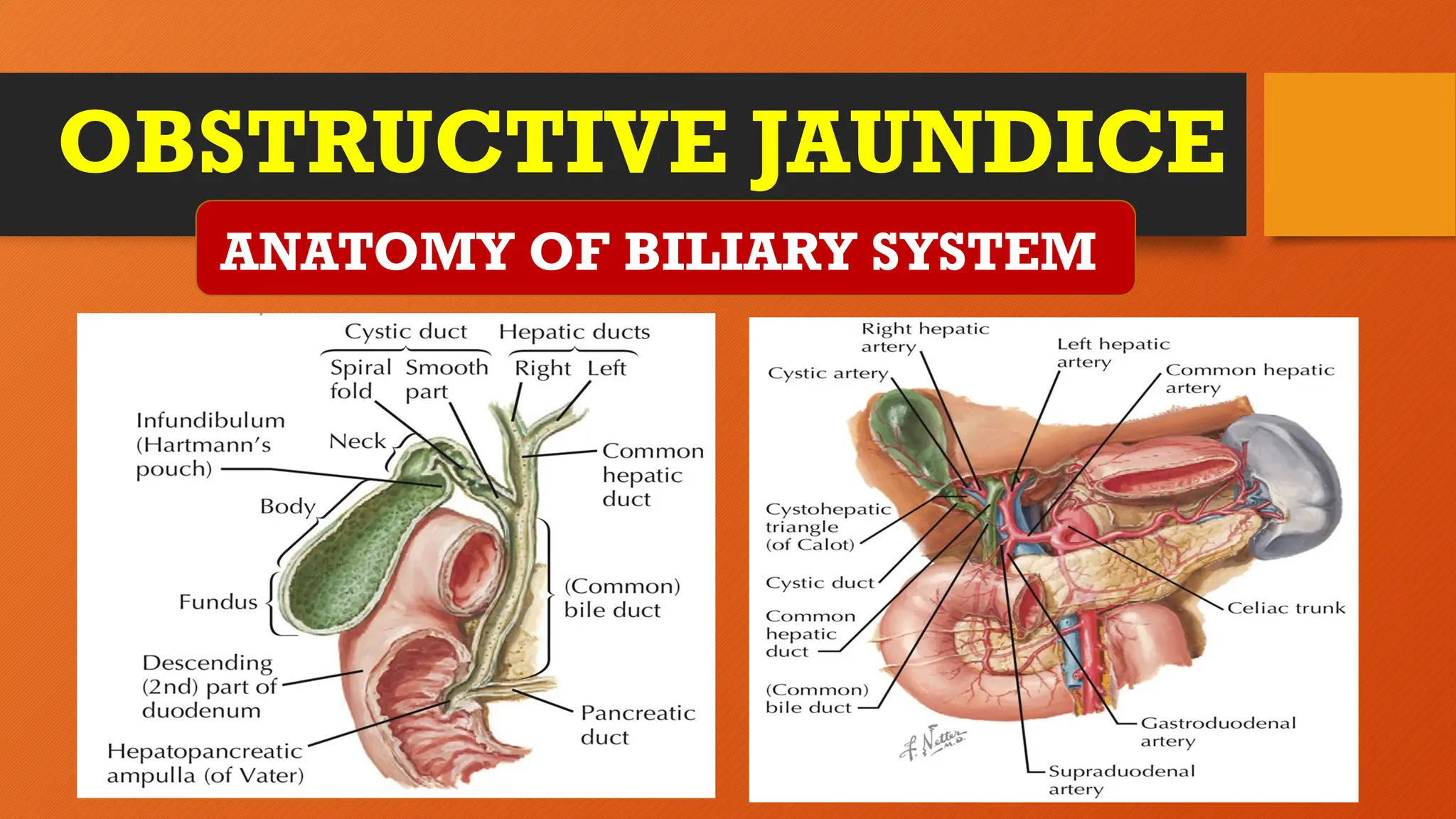
ANATOMY OF BILIARY SYSTEM
OBSTRUCTIVE JAUNDICE
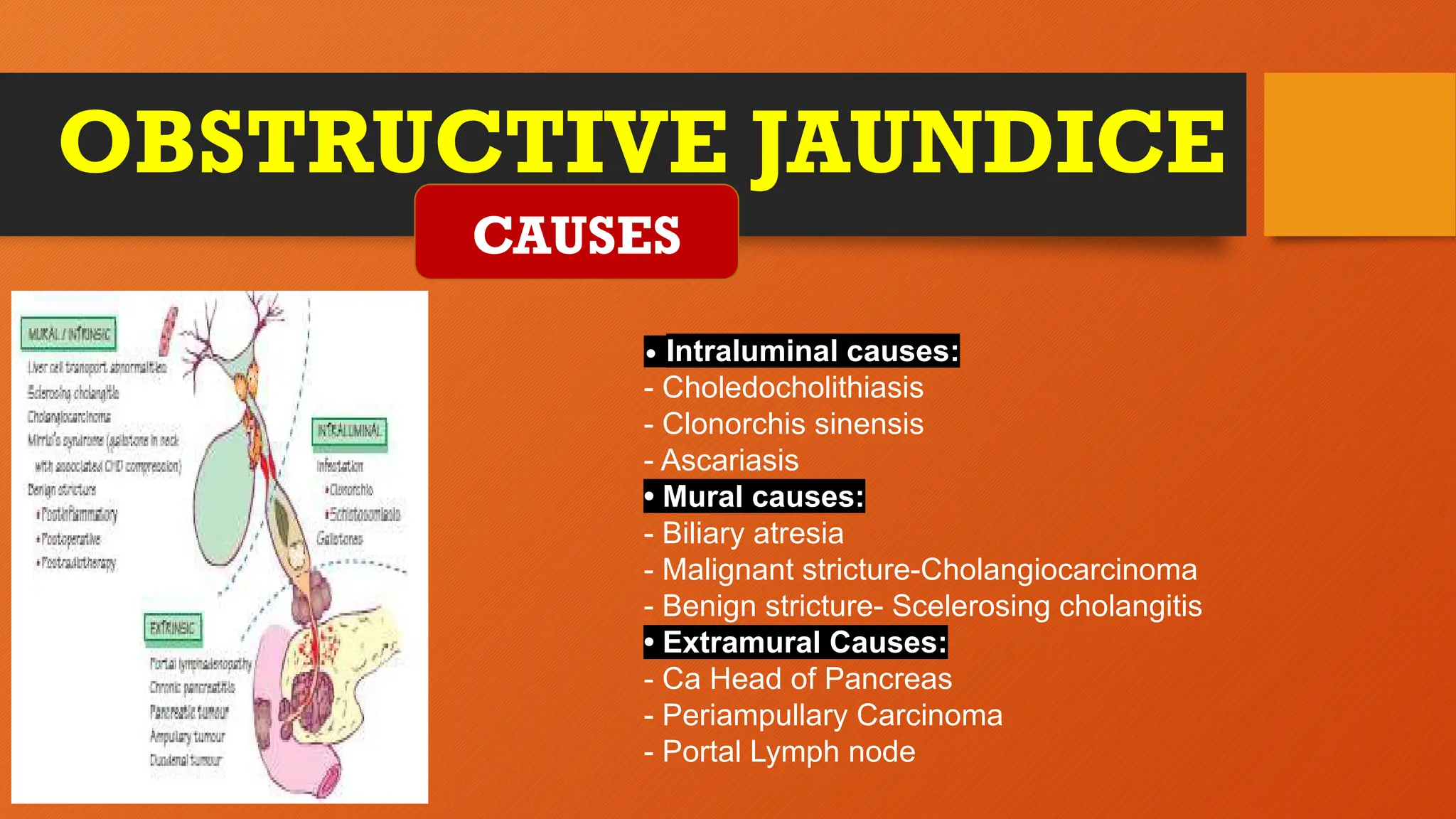
CAUSES
• Intraluminal causes:
- Choledocholithiasis
- Clonorchis sinensis
- Ascariasis
• Mural causes:
- Biliary atresia
- Malignant stricture-Cholangiocarcinoma
- Benign stricture- Scelerosing cholangitis
• Extramural Causes:
- Ca Head of Pancreas
- Periampullary Carcinoma
- Portal Lymph node
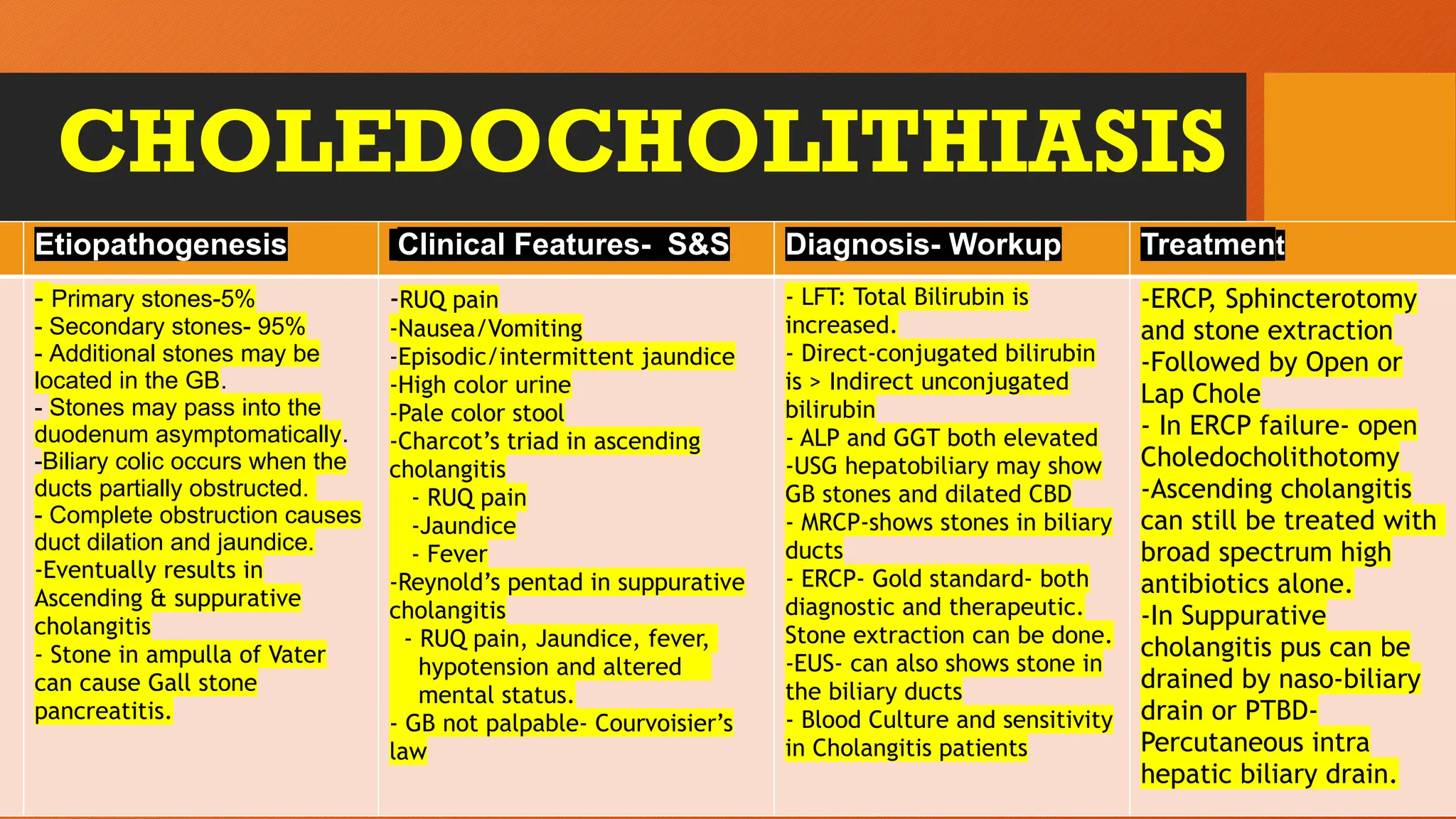
CHOLEDOCHOLITHIASIS
Etiopathogenesis Clinical Features- S&S Diagnosis- Workup Treatment
- Primary stones-5%
- Secondary stones- 95%
- Additional stones may be
located in the GB.
- Stones may pass into the
duodenum asymptomatically.
-Biliary colic occurs when the
ducts partially obstructed.
- Complete obstruction causes
duct dilation and jaundice.
-Eventually results in
Ascending & suppurative
cholangitis
- Stone in ampulla of Vater
can cause Gall stone
pancreatitis.
-RUQ pain
-Nausea/Vomiting
-Episodic/intermittent jaundice
-High color urine
-Pale color stool
-Charcot’s triad in ascending
cholangitis
- RUQ pain
-Jaundice
- Fever
-Reynold’s pentad in suppurative
cholangitis
- RUQ pain, Jaundice, fever,
hypotension and altered
mental status.
- GB not palpable- Courvoisier’s
law
- LFT: Total Bilirubin is
increased.
- Direct-conjugated bilirubin
is > Indirect unconjugated
bilirubin
- ALP and GGT both elevated
-USG hepatobiliary may show
GB stones and dilated CBD
- MRCP-shows stones in biliary
ducts
- ERCP- Gold standard- both
diagnostic and therapeutic.
Stone extraction can be done.
-EUS- can also shows stone in
the biliary ducts
- Blood Culture and sensitivity
in Cholangitis patients
-ERCP, Sphincterotomy
and stone extraction
-Followed by Open or
Lap Chole
- In ERCP failure- open
Choledocholithotomy
-Ascending cholangitis
can still be treated with
broad spectrum high
antibiotics alone.
-In Suppurative
cholangitis pus can be
drained by naso-biliary
drain or PTBD-
Percutaneous intra
hepatic biliary drain.
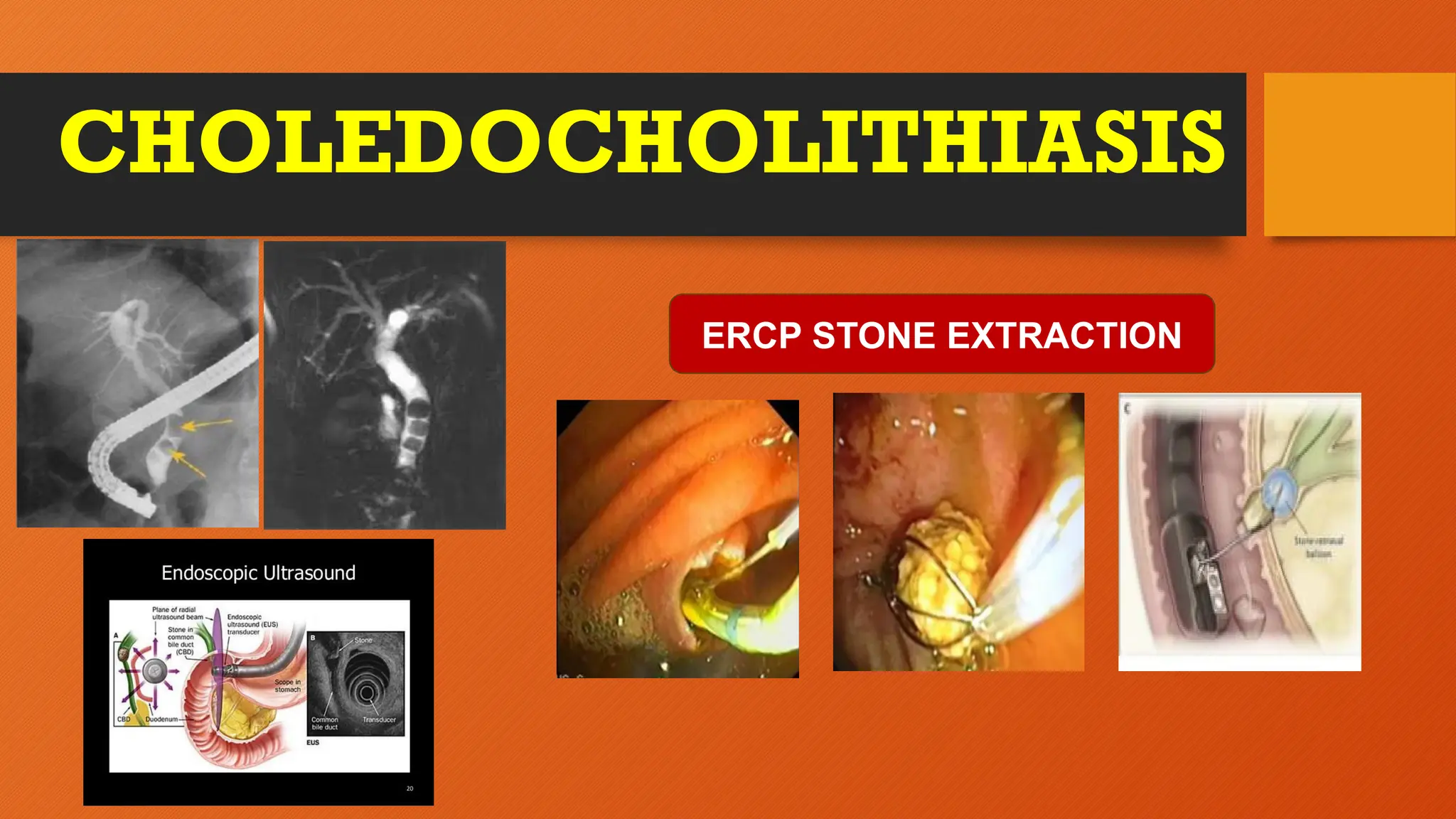
CHOLEDOCHOLITHIASIS
ERCP STONE EXTRACTION
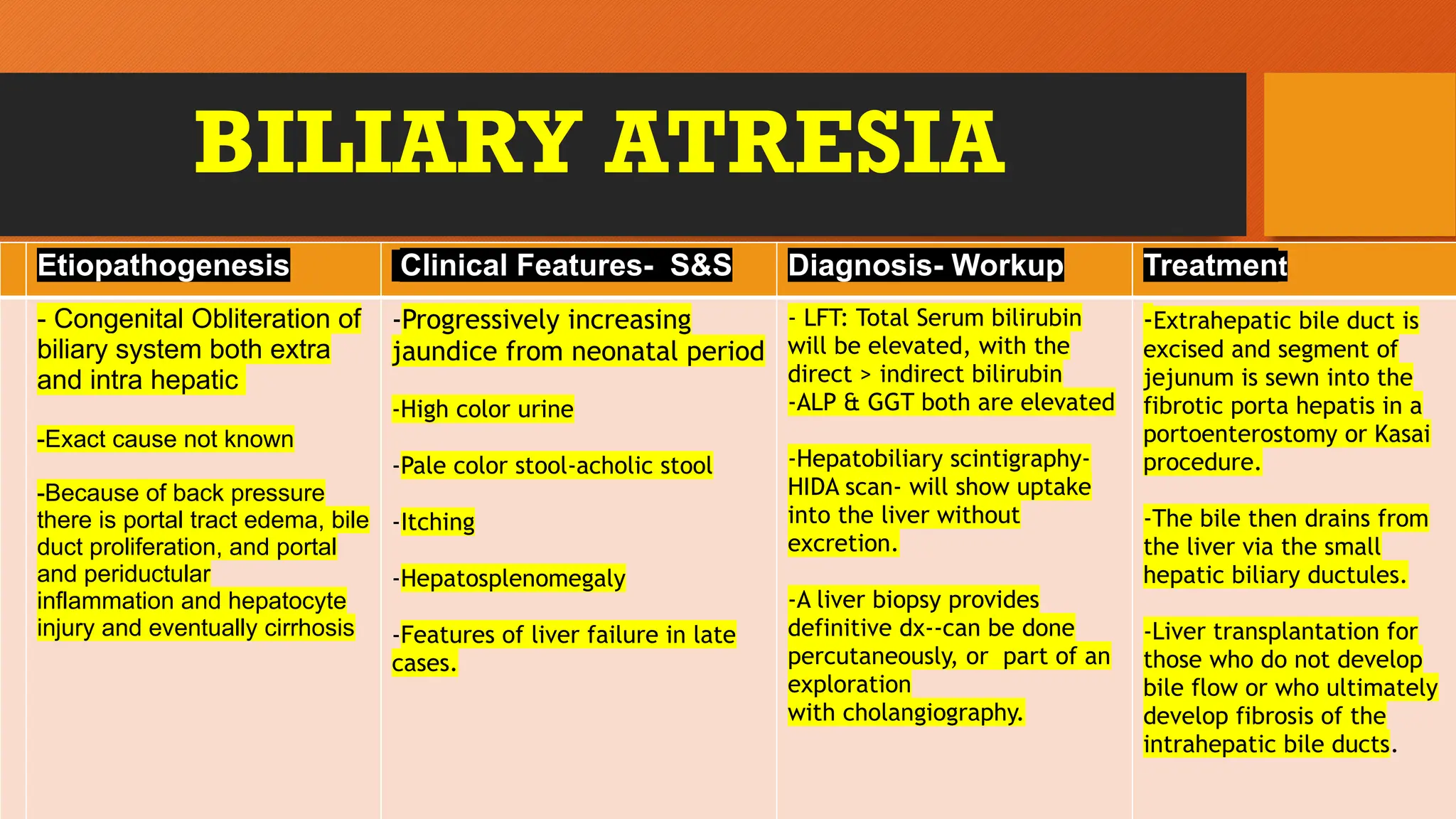
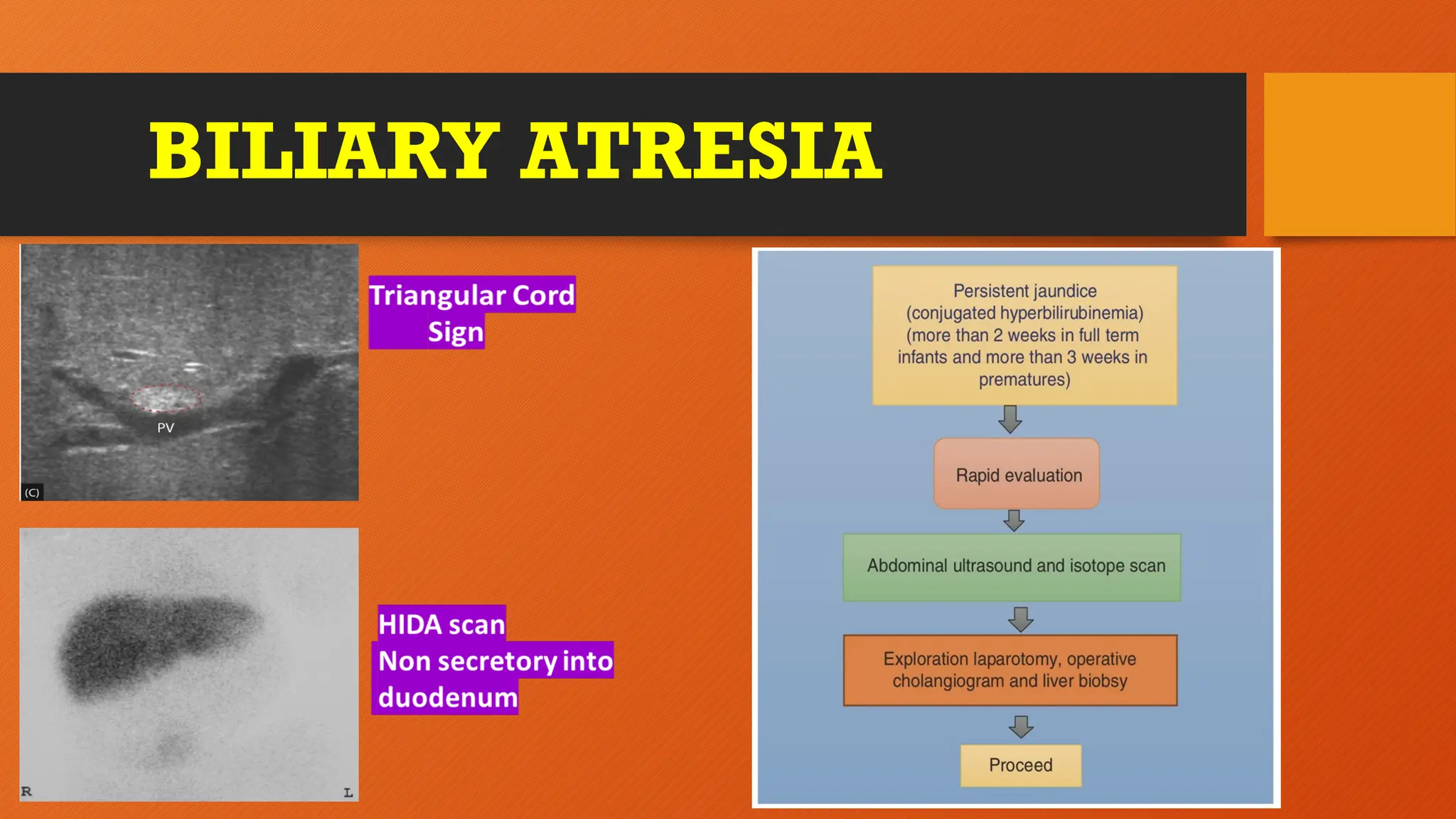
BILIARY ATRESIA
Etiopathogenesis Clinical Features- S&S Diagnosis- Workup Treatment
- Congenital Obliteration of
biliary system both extra
and intra hepatic
-Exact cause not known
-Because of back pressure
there is portal tract edema, bile
duct proliferation, and portal
and periductular
inflammation and hepatocyte
injury and eventually cirrhosis
-Progressively increasing
jaundice from neonatal period
-High color urine
-Pale color stool-acholic stool
-Itching
-Hepatosplenomegaly
-Features of liver failure in late
cases.
- LFT: Total Serum bilirubin
will be elevated, with the
direct > indirect bilirubin
-ALP & GGT both are elevated
-Hepatobiliary scintigraphy-
HIDA scan- will show uptake
into the liver without
excretion.
-A liver biopsy provides
definitive dx--can be done
percutaneously, or part of an
exploration
with cholangiography.
-Extrahepatic bile duct is
excised and segment of
jejunum is sewn into the
fibrotic porta hepatis in a
portoenterostomy or Kasai
procedure.
-The bile then drains from
the liver via the small
hepatic biliary ductules.
-Liver transplantation for
those who do not develop
bile flow or who ultimately
develop fibrosis of the
intrahepatic bile ducts.
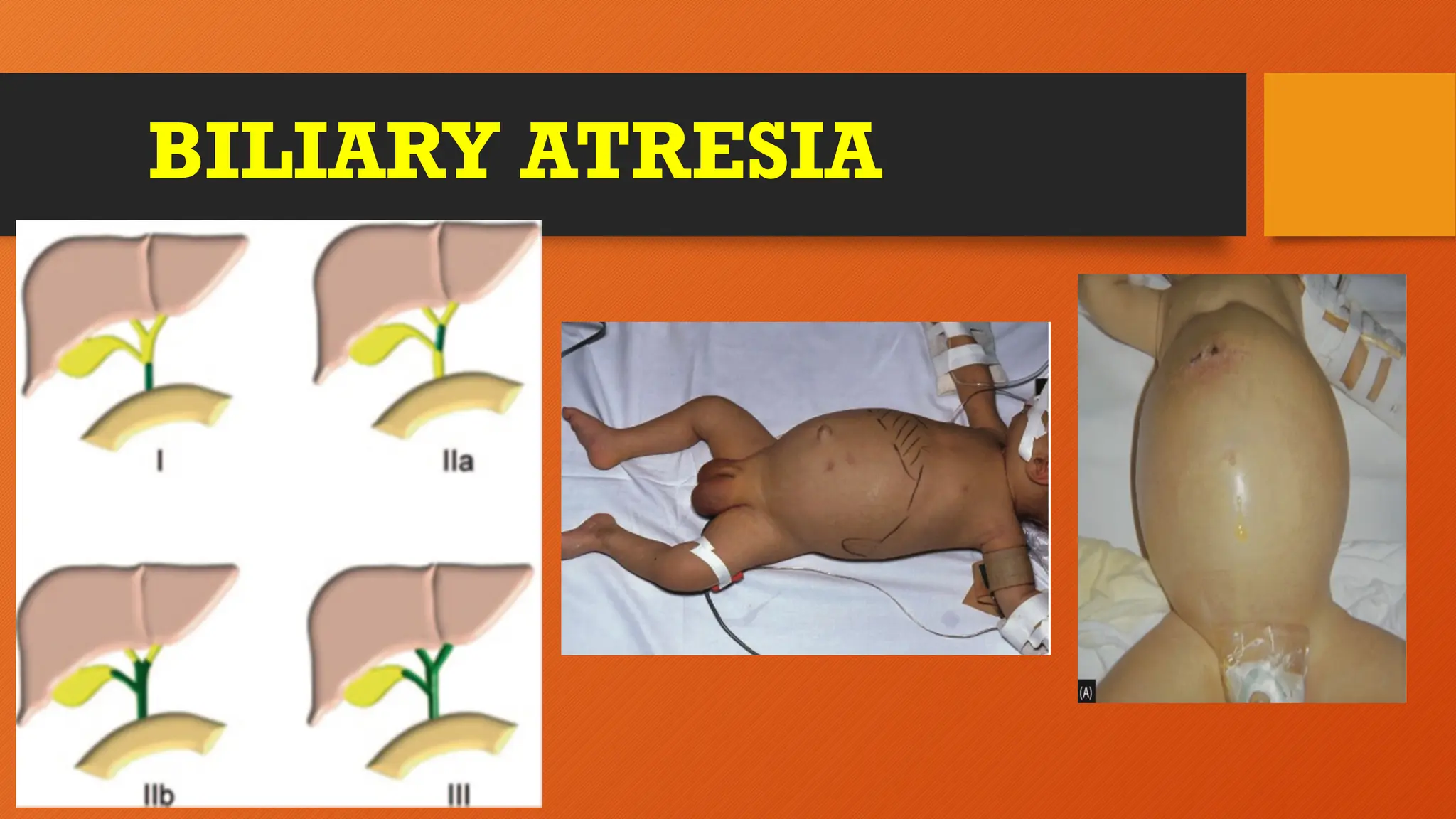
BILIARY ATRESIA
BILIARY ATRESIA
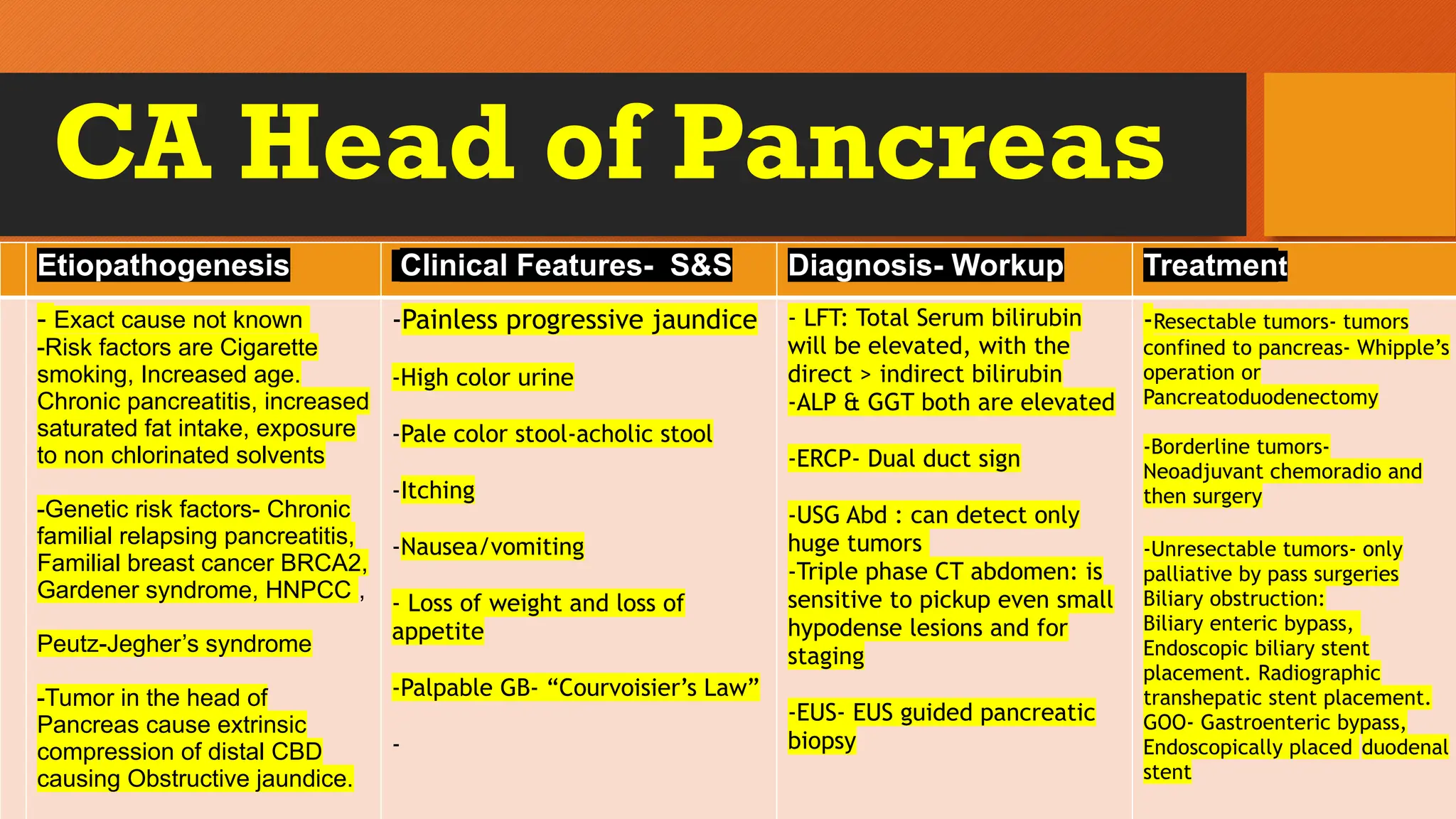
CA Head of Pancreas
Etiopathogenesis Clinical Features- S&S Diagnosis- Workup Treatment
- Exact cause not known
-Risk factors are Cigarette
smoking, Increased age.
Chronic pancreatitis, increased
saturated fat intake, exposure
to non chlorinated solvents
-Genetic risk factors- Chronic
familial relapsing pancreatitis,
Familial breast cancer BRCA2,
Gardener syndrome, HNPCC ,
Peutz-Jegher’s syndrome
-Tumor in the head of
Pancreas cause extrinsic
compression of distal CBD
causing Obstructive jaundice.
-Painless progressive jaundice
-High color urine
-Pale color stool-acholic stool
-Itching
-Nausea/vomiting
- Loss of weight and loss of
appetite
-Palpable GB- “Courvoisier’s Law”
-
- LFT: Total Serum bilirubin
will be elevated, with the
direct > indirect bilirubin
-ALP & GGT both are elevated
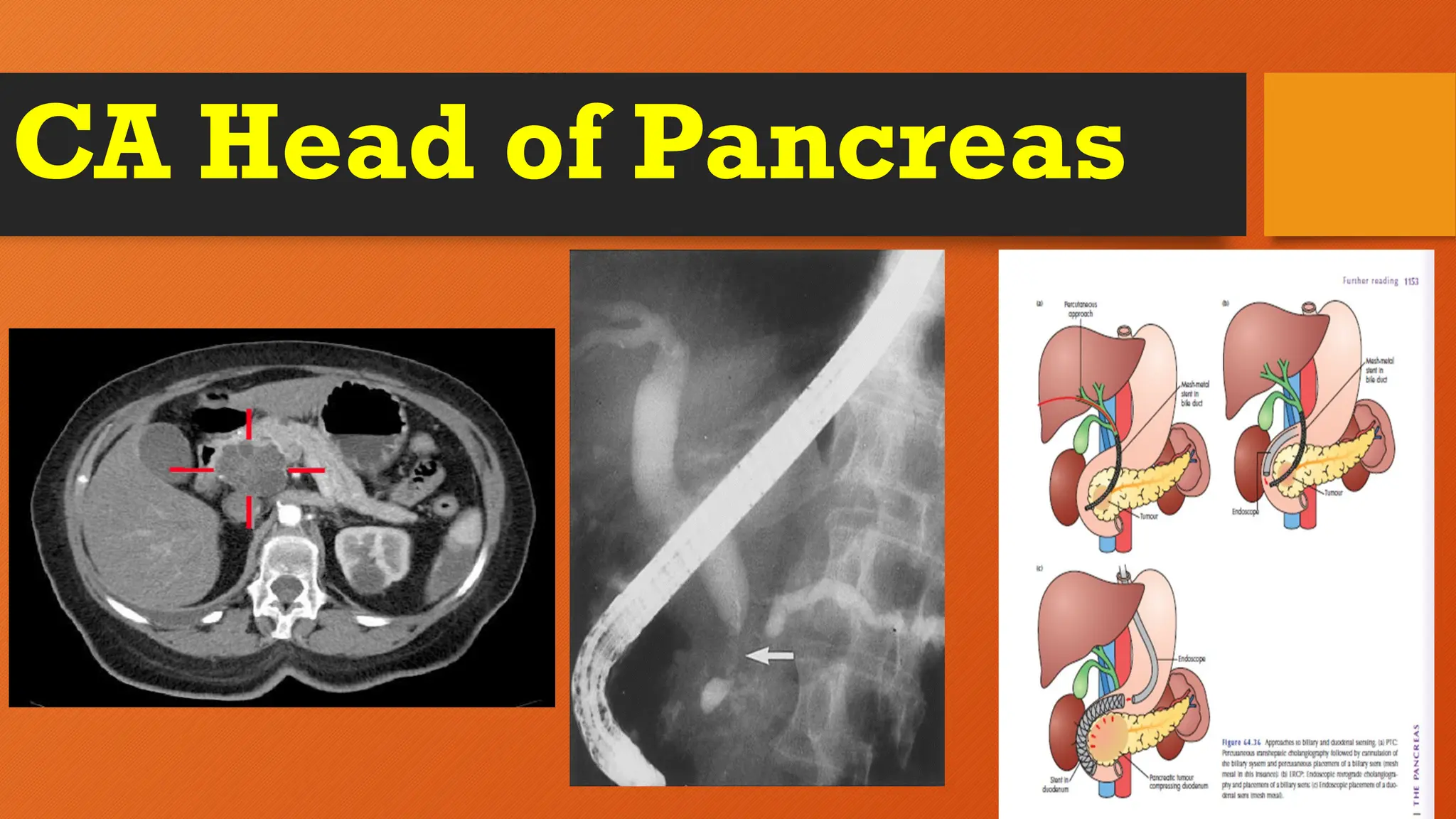
-ERCP- Dual duct sign
-USG Abd : can detect only
huge tumors
-Triple phase CT abdomen: is
sensitive to pickup even small
hypodense lesions and for
staging
-EUS- EUS guided pancreatic
biopsy
-Resectable tumors- tumors
confined to pancreas- Whipple’s
operation or
Pancreatoduodenectomy
-Borderline tumors-
Neoadjuvant chemoradio and
then surgery
-Unresectable tumors- only
palliative by pass surgeries
Biliary obstruction:
Biliary enteric bypass,
Endoscopic biliary stent
placement. Radiographic
transhepatic stent placement.
GOO- Gastroenteric bypass,
Endoscopically placed duodenal
stent
CA Head of Pancreas
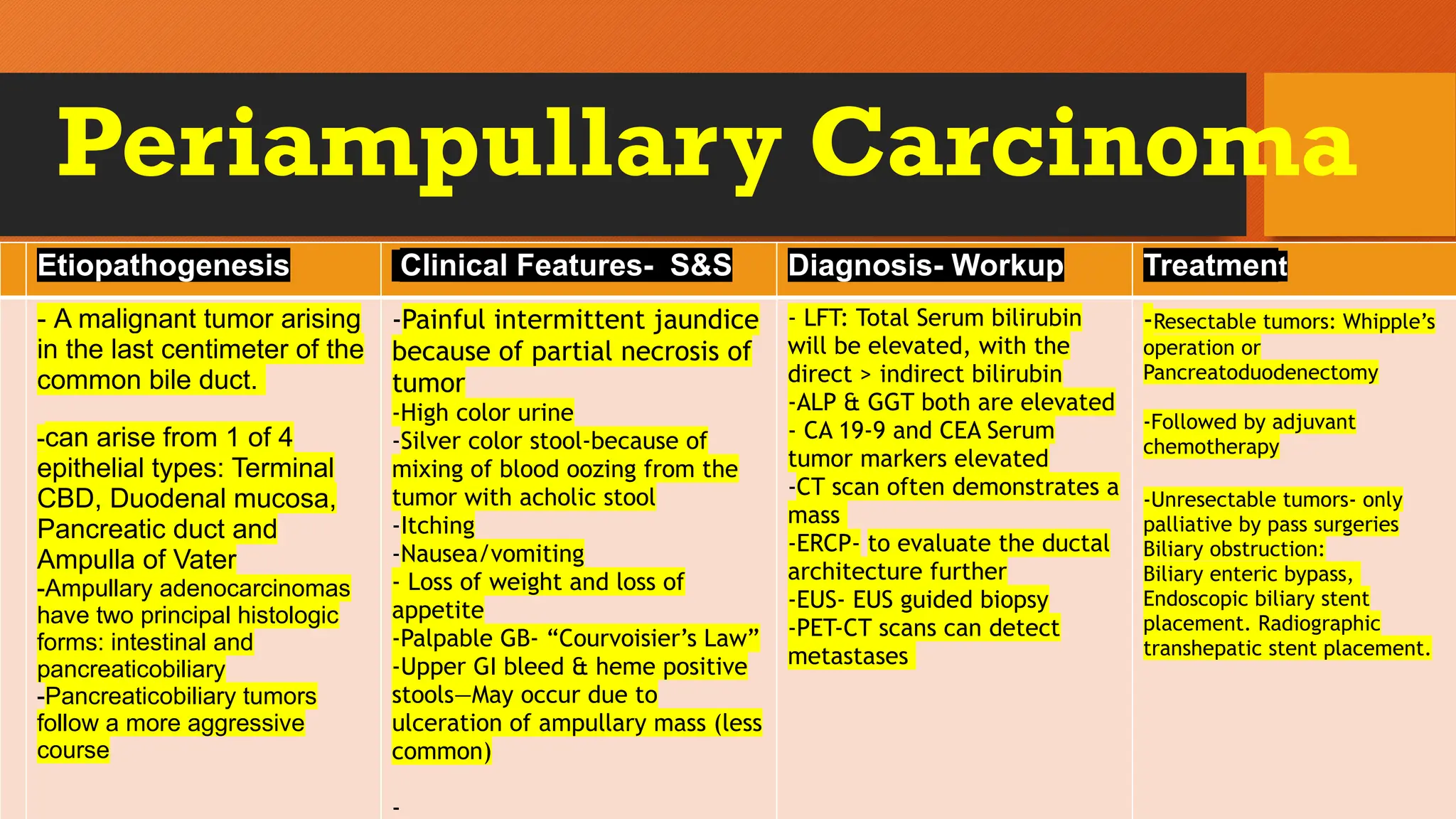
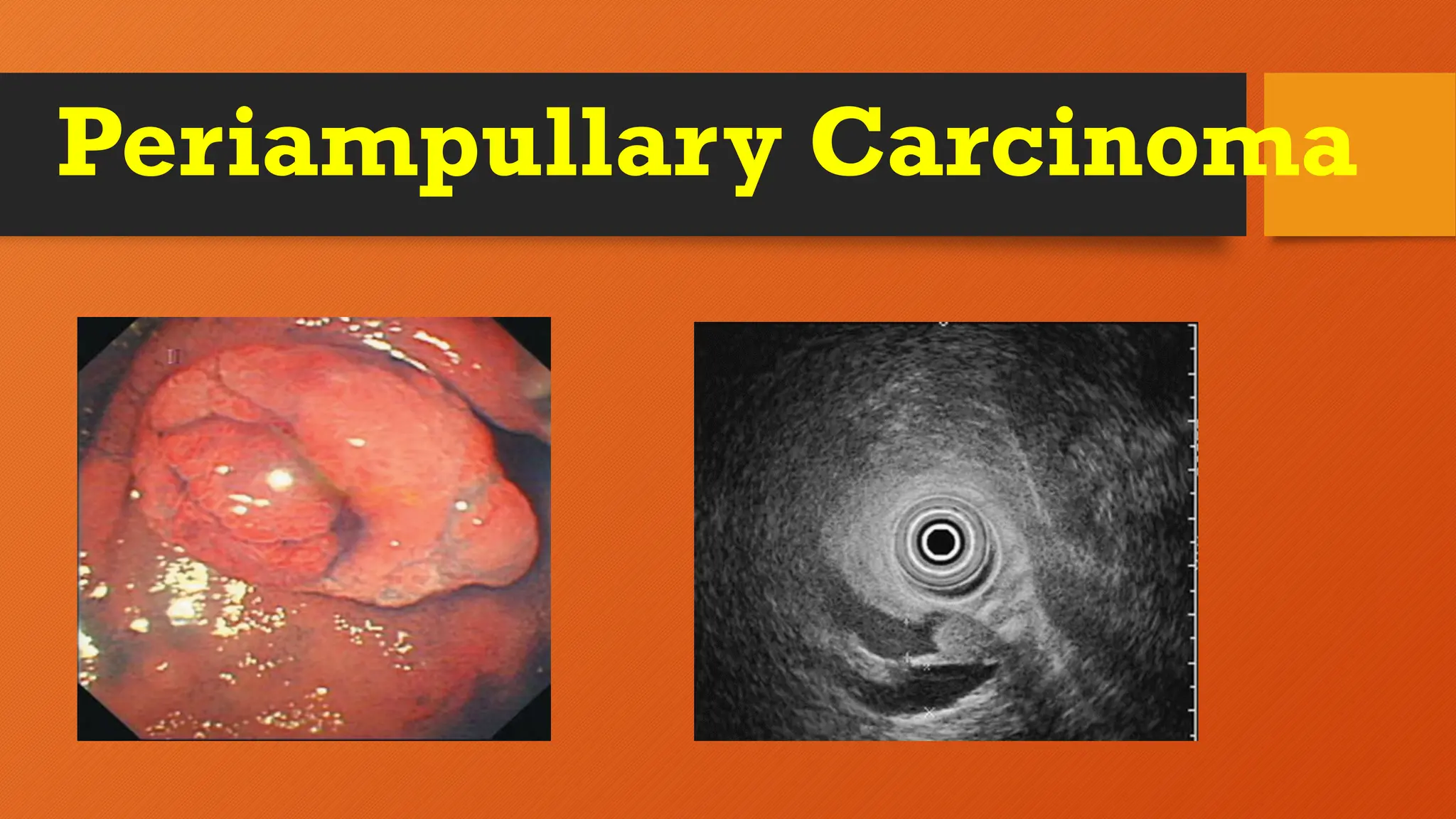
Periampullary Carcinoma
Etiopathogenesis Clinical Features- S&S Diagnosis- Workup Treatment
- A malignant tumor arising
in the last centimeter of the
common bile duct.
-can arise from 1 of 4
epithelial types: Terminal
CBD, Duodenal mucosa,
Pancreatic duct and
Ampulla of Vater
-Ampullary adenocarcinomas
have two principal histologic
forms: intestinal and
pancreaticobiliary
-Pancreaticobiliary tumors
follow a more aggressive
course
-Painful intermittent jaundice
because of partial necrosis of
tumor
-High color urine
-Silver color stool-because of
mixing of blood oozing from the
tumor with acholic stool
-Itching
-Nausea/vomiting
- Loss of weight and loss of
appetite
-Palpable GB- “Courvoisier’s Law”
-Upper GI bleed & heme positive
stools—May occur due to
ulceration of ampullary mass (less
common)
-
- LFT: Total Serum bilirubin
will be elevated, with the
direct > indirect bilirubin
-ALP & GGT both are elevated
- CA 19-9 and CEA Serum
tumor markers elevated
-CT scan often demonstrates a
mass
-ERCP- to evaluate the ductal
architecture further
-EUS- EUS guided biopsy
-PET-CT scans can detect
metastases
-Resectable tumors: Whipple’s
operation or
Pancreatoduodenectomy
-Followed by adjuvant
chemotherapy
-Unresectable tumors- only
palliative by pass surgeries
Biliary obstruction:
Biliary enteric bypass,
Endoscopic biliary stent
placement. Radiographic
transhepatic stent placement.
Periampullary Carcinoma
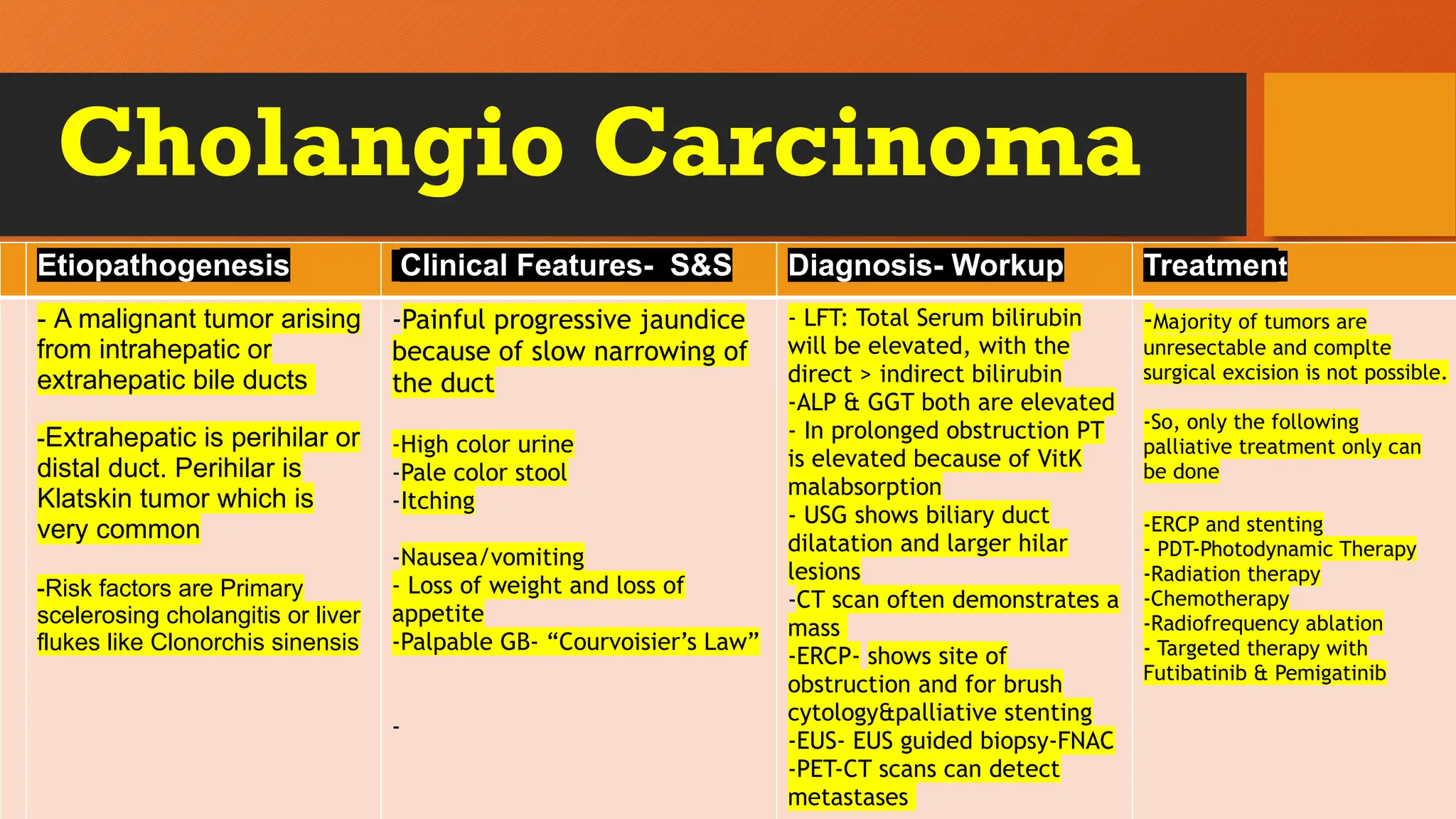
Cholangio Carcinoma
Etiopathogenesis Clinical Features- S&S Diagnosis- Workup Treatment
- A malignant tumor arising
from intrahepatic or
extrahepatic bile ducts
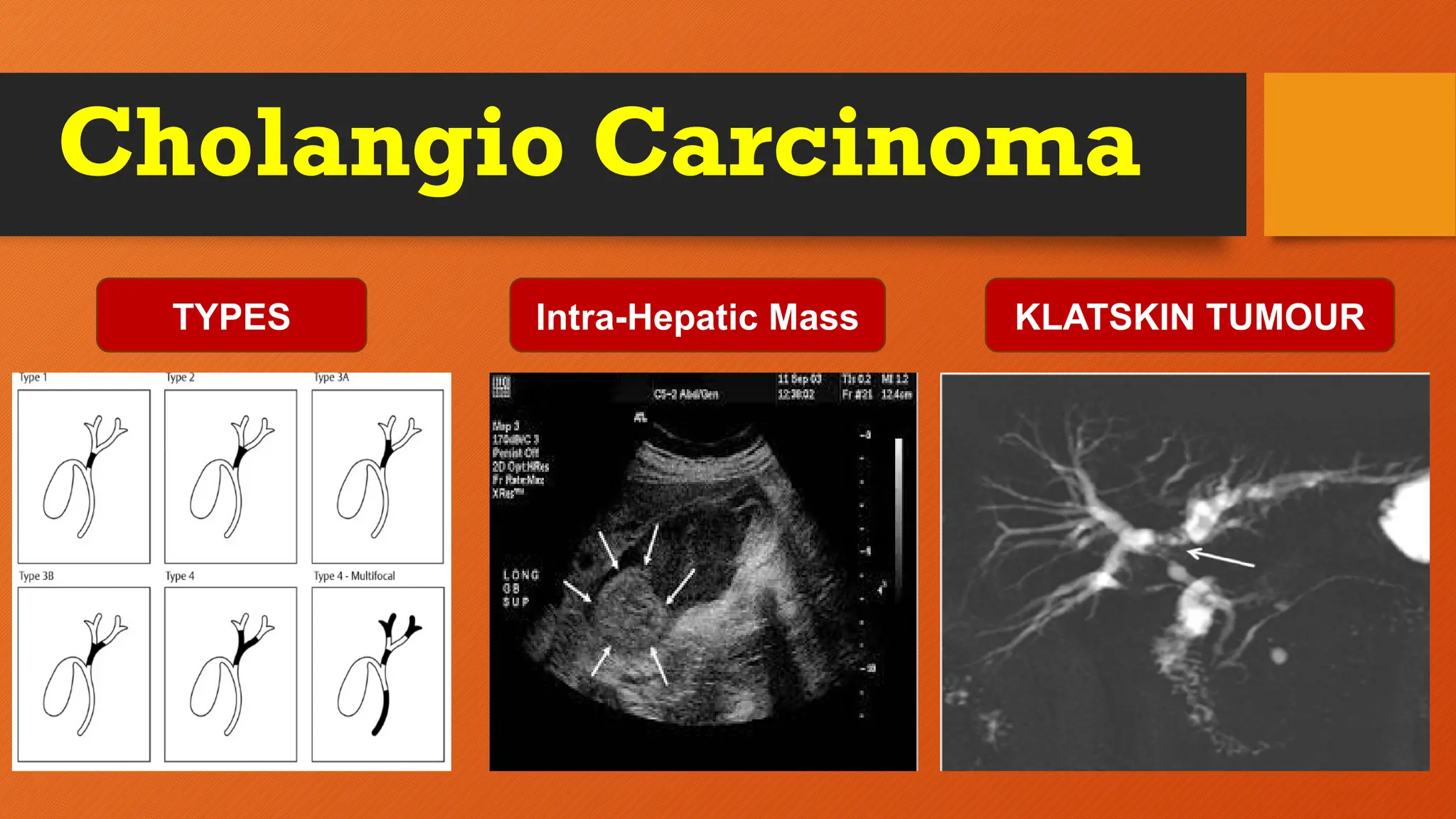
-Extrahepatic is perihilar or
distal duct. Perihilar is
Klatskin tumor which is
very common
-Risk factors are Primary
scelerosing cholangitis or liver
flukes like Clonorchis sinensis
-Painful progressive jaundice
because of slow narrowing of
the duct
-High color urine
-Pale color stool
-Itching
-Nausea/vomiting
- Loss of weight and loss of
appetite
-Palpable GB- “Courvoisier’s Law”
-
- LFT: Total Serum bilirubin
will be elevated, with the
direct > indirect bilirubin
-ALP & GGT both are elevated
- In prolonged obstruction PT
is elevated because of VitK
malabsorption
- USG shows biliary duct
dilatation and larger hilar
lesions
-CT scan often demonstrates a
mass
-ERCP- shows site of
obstruction and for brush
cytology&palliative stenting
-EUS- EUS guided biopsy-FNAC
-PET-CT scans can detect
metastases
-Majority of tumors are
unresectable and complte
surgical excision is not possible.
-So, only the following
palliative treatment only can
be done
-ERCP and stenting
- PDT-Photodynamic Therapy
-Radiation therapy
-Chemotherapy
-Radiofrequency ablation
- Targeted therapy with
Futibatinib & Pemigatinib
Cholangio Carcinoma
TYPES Intra-Hepatic Mass KLATSKIN TUMOUR
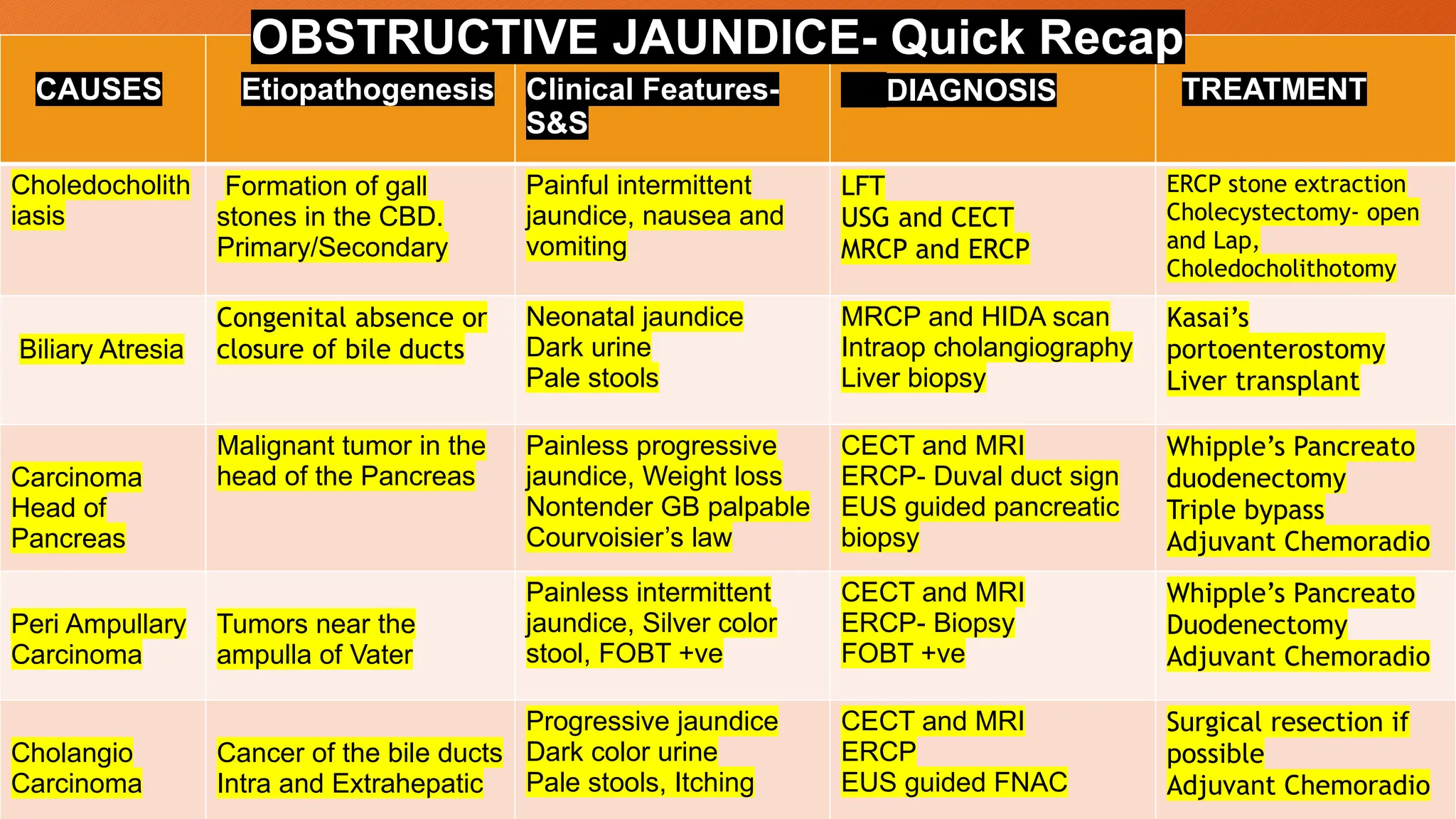
CAUSES Etiopathogenesis Clinical Features-
S&S
DIAGNOSIS TREATMENT
Choledocholith
iasis
Formation of gall
stones in the CBD.
Primary/Secondary
Painful intermittent
jaundice, nausea and
vomiting
LFT
USG and CECT
MRCP and ERCP
ERCP stone extraction
Cholecystectomy- open
and Lap,
Choledocholithotomy
Biliary Atresia
Congenital absence or
closure of bile ducts
Neonatal jaundice
Dark urine
Pale stools
MRCP and HIDA scan
Intraop cholangiography
Liver biopsy
Kasai’s
portoenterostomy
Liver transplant
Carcinoma
Head of
Pancreas
Malignant tumor in the
head of the Pancreas
Painless progressive
jaundice, Weight loss
Nontender GB palpable
Courvoisier’s law
CECT and MRI
ERCP- Duval duct sign
EUS guided pancreatic
biopsy
Whipple’s Pancreato
duodenectomy
Triple bypass
Adjuvant Chemoradio
Peri Ampullary
Carcinoma
Tumors near the
ampulla of Vater
Painless intermittent
jaundice, Silver color
stool, FOBT +ve
CECT and MRI
ERCP- Biopsy
FOBT +ve
Whipple’s Pancreato
Duodenectomy
Adjuvant Chemoradio
Cholangio
Carcinoma
Cancer of the bile ducts
Intra and Extrahepatic
Progressive jaundice
Dark color urine
Pale stools, Itching
CECT and MRI
ERCP
EUS guided FNAC
Surgical resection if
possible
Adjuvant Chemoradio
OBSTRUCTIVE JAUNDICE- Quick Recap
OBSTRUCTIVE JAUNDICE- Problem Oriented Approach.pptx

OBSTRUCTIVE JAUNDICE- Problem Oriented Approach.pptx

  • 1.
    OBSTRUCTIVE JAUNDICE DR.B.SELVARAJ MS;Mch;FICS; Professorof Surgery Manipal University College Malaysia Melaka 75150 Malaysia JAUNDICE- Surgical Perspective
  • 2.
    OBSTRUCTIVE JAUNDICE Definition &Importance Anatomy of Biliary system Causes of obstructive jaundice Choledocholithiasis Biliary Atresia Carcinoma Head of the Pancreas Periampullary Carcinoma Cholangio Carcinoma Quick recap/Conclusion LEARNING OBJECTIVES
  • 3.
    OBSTRUCTIVE JAUNDICE Definition: Obstructivejaundice is a medical condition characterized by the obstruction of normal bile flow from the liver to the small intestine, leading to the accumulation of bilirubin in the bloodstream. Bilirubin is a yellow pigment formed during the breakdown of red blood cells. Implications of Untreated Obstructive Jaundice: It can lead to progressive liver damage with impaired bile secretion and digestion Definition & Importance  Timely Diagnosis for Effective Intervention: Early diagnosis allows for prompt intervention, preventing potential complications and improving the chances of successful treatment.  Multidisciplinary Approach: The need for a collaborative approach involving various healthcare professionals, including gastroenterologists, hepatologists, surgeons, and radiologists, to ensure comprehensive care.
  • 4.
  • 5.
    OBSTRUCTIVE JAUNDICE CAUSES • Intraluminalcauses: - Choledocholithiasis - Clonorchis sinensis - Ascariasis • Mural causes: - Biliary atresia - Malignant stricture-Cholangiocarcinoma - Benign stricture- Scelerosing cholangitis • Extramural Causes: - Ca Head of Pancreas - Periampullary Carcinoma - Portal Lymph node
  • 6.
    CHOLEDOCHOLITHIASIS Etiopathogenesis Clinical Features-S&S Diagnosis- Workup Treatment - Primary stones-5% - Secondary stones- 95% - Additional stones may be located in the GB. - Stones may pass into the duodenum asymptomatically. -Biliary colic occurs when the ducts partially obstructed. - Complete obstruction causes duct dilation and jaundice. -Eventually results in Ascending & suppurative cholangitis - Stone in ampulla of Vater can cause Gall stone pancreatitis. -RUQ pain -Nausea/Vomiting -Episodic/intermittent jaundice -High color urine -Pale color stool -Charcot’s triad in ascending cholangitis - RUQ pain -Jaundice - Fever -Reynold’s pentad in suppurative cholangitis - RUQ pain, Jaundice, fever, hypotension and altered mental status. - GB not palpable- Courvoisier’s law - LFT: Total Bilirubin is increased. - Direct-conjugated bilirubin is > Indirect unconjugated bilirubin - ALP and GGT both elevated -USG hepatobiliary may show GB stones and dilated CBD - MRCP-shows stones in biliary ducts - ERCP- Gold standard- both diagnostic and therapeutic. Stone extraction can be done. -EUS- can also shows stone in the biliary ducts - Blood Culture and sensitivity in Cholangitis patients -ERCP, Sphincterotomy and stone extraction -Followed by Open or Lap Chole - In ERCP failure- open Choledocholithotomy -Ascending cholangitis can still be treated with broad spectrum high antibiotics alone. -In Suppurative cholangitis pus can be drained by naso-biliary drain or PTBD- Percutaneous intra hepatic biliary drain.
  • 7.
  • 8.
    BILIARY ATRESIA Etiopathogenesis ClinicalFeatures- S&S Diagnosis- Workup Treatment - Congenital Obliteration of biliary system both extra and intra hepatic -Exact cause not known -Because of back pressure there is portal tract edema, bile duct proliferation, and portal and periductular inflammation and hepatocyte injury and eventually cirrhosis -Progressively increasing jaundice from neonatal period -High color urine -Pale color stool-acholic stool -Itching -Hepatosplenomegaly -Features of liver failure in late cases. - LFT: Total Serum bilirubin will be elevated, with the direct > indirect bilirubin -ALP & GGT both are elevated -Hepatobiliary scintigraphy- HIDA scan- will show uptake into the liver without excretion. -A liver biopsy provides definitive dx--can be done percutaneously, or part of an exploration with cholangiography. -Extrahepatic bile duct is excised and segment of jejunum is sewn into the fibrotic porta hepatis in a portoenterostomy or Kasai procedure. -The bile then drains from the liver via the small hepatic biliary ductules. -Liver transplantation for those who do not develop bile flow or who ultimately develop fibrosis of the intrahepatic bile ducts.
  • 9.
  • 10.
  • 11.
    CA Head ofPancreas Etiopathogenesis Clinical Features- S&S Diagnosis- Workup Treatment - Exact cause not known -Risk factors are Cigarette smoking, Increased age. Chronic pancreatitis, increased saturated fat intake, exposure to non chlorinated solvents -Genetic risk factors- Chronic familial relapsing pancreatitis, Familial breast cancer BRCA2, Gardener syndrome, HNPCC , Peutz-Jegher’s syndrome -Tumor in the head of Pancreas cause extrinsic compression of distal CBD causing Obstructive jaundice. -Painless progressive jaundice -High color urine -Pale color stool-acholic stool -Itching -Nausea/vomiting - Loss of weight and loss of appetite -Palpable GB- “Courvoisier’s Law” - - LFT: Total Serum bilirubin will be elevated, with the direct > indirect bilirubin -ALP & GGT both are elevated -ERCP- Dual duct sign -USG Abd : can detect only huge tumors -Triple phase CT abdomen: is sensitive to pickup even small hypodense lesions and for staging -EUS- EUS guided pancreatic biopsy -Resectable tumors- tumors confined to pancreas- Whipple’s operation or Pancreatoduodenectomy -Borderline tumors- Neoadjuvant chemoradio and then surgery -Unresectable tumors- only palliative by pass surgeries Biliary obstruction: Biliary enteric bypass, Endoscopic biliary stent placement. Radiographic transhepatic stent placement. GOO- Gastroenteric bypass, Endoscopically placed duodenal stent
  • 12.
    CA Head ofPancreas
  • 13.
    Periampullary Carcinoma Etiopathogenesis ClinicalFeatures- S&S Diagnosis- Workup Treatment - A malignant tumor arising in the last centimeter of the common bile duct. -can arise from 1 of 4 epithelial types: Terminal CBD, Duodenal mucosa, Pancreatic duct and Ampulla of Vater -Ampullary adenocarcinomas have two principal histologic forms: intestinal and pancreaticobiliary -Pancreaticobiliary tumors follow a more aggressive course -Painful intermittent jaundice because of partial necrosis of tumor -High color urine -Silver color stool-because of mixing of blood oozing from the tumor with acholic stool -Itching -Nausea/vomiting - Loss of weight and loss of appetite -Palpable GB- “Courvoisier’s Law” -Upper GI bleed & heme positive stools—May occur due to ulceration of ampullary mass (less common) - - LFT: Total Serum bilirubin will be elevated, with the direct > indirect bilirubin -ALP & GGT both are elevated - CA 19-9 and CEA Serum tumor markers elevated -CT scan often demonstrates a mass -ERCP- to evaluate the ductal architecture further -EUS- EUS guided biopsy -PET-CT scans can detect metastases -Resectable tumors: Whipple’s operation or Pancreatoduodenectomy -Followed by adjuvant chemotherapy -Unresectable tumors- only palliative by pass surgeries Biliary obstruction: Biliary enteric bypass, Endoscopic biliary stent placement. Radiographic transhepatic stent placement.
  • 14.
  • 15.
    Cholangio Carcinoma Etiopathogenesis ClinicalFeatures- S&S Diagnosis- Workup Treatment - A malignant tumor arising from intrahepatic or extrahepatic bile ducts -Extrahepatic is perihilar or distal duct. Perihilar is Klatskin tumor which is very common -Risk factors are Primary scelerosing cholangitis or liver flukes like Clonorchis sinensis -Painful progressive jaundice because of slow narrowing of the duct -High color urine -Pale color stool -Itching -Nausea/vomiting - Loss of weight and loss of appetite -Palpable GB- “Courvoisier’s Law” - - LFT: Total Serum bilirubin will be elevated, with the direct > indirect bilirubin -ALP & GGT both are elevated - In prolonged obstruction PT is elevated because of VitK malabsorption - USG shows biliary duct dilatation and larger hilar lesions -CT scan often demonstrates a mass -ERCP- shows site of obstruction and for brush cytology&palliative stenting -EUS- EUS guided biopsy-FNAC -PET-CT scans can detect metastases -Majority of tumors are unresectable and complte surgical excision is not possible. -So, only the following palliative treatment only can be done -ERCP and stenting - PDT-Photodynamic Therapy -Radiation therapy -Chemotherapy -Radiofrequency ablation - Targeted therapy with Futibatinib & Pemigatinib
  • 16.
  • 17.
    CAUSES Etiopathogenesis ClinicalFeatures- S&S DIAGNOSIS TREATMENT Choledocholith iasis Formation of gall stones in the CBD. Primary/Secondary Painful intermittent jaundice, nausea and vomiting LFT USG and CECT MRCP and ERCP ERCP stone extraction Cholecystectomy- open and Lap, Choledocholithotomy Biliary Atresia Congenital absence or closure of bile ducts Neonatal jaundice Dark urine Pale stools MRCP and HIDA scan Intraop cholangiography Liver biopsy Kasai’s portoenterostomy Liver transplant Carcinoma Head of Pancreas Malignant tumor in the head of the Pancreas Painless progressive jaundice, Weight loss Nontender GB palpable Courvoisier’s law CECT and MRI ERCP- Duval duct sign EUS guided pancreatic biopsy Whipple’s Pancreato duodenectomy Triple bypass Adjuvant Chemoradio Peri Ampullary Carcinoma Tumors near the ampulla of Vater Painless intermittent jaundice, Silver color stool, FOBT +ve CECT and MRI ERCP- Biopsy FOBT +ve Whipple’s Pancreato Duodenectomy Adjuvant Chemoradio Cholangio Carcinoma Cancer of the bile ducts Intra and Extrahepatic Progressive jaundice Dark color urine Pale stools, Itching CECT and MRI ERCP EUS guided FNAC Surgical resection if possible Adjuvant Chemoradio OBSTRUCTIVE JAUNDICE- Quick Recap