The T-Test
- Independent Sample T-Test
- Paired Sample T-Test
- One Sample T-Test
- Test of Significance
The One-Way ANOVA
- Post Hoc Comparisons
- Contrasts
Descriptive Statistics
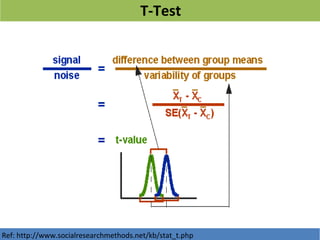
What is a T-Test
T-Test is a procedure used for comparing Sample
Means to see if there is sufficient evidence to infer that
the means of the corresponding population
distributions also differ. The important things are;
1. Two (t-test always compare two different means)
2. Some variable of interest
Ref: Statistics- A first course by John E Freund and Benjamin M.Perler, 7th
Edition
INDEPENDENT SAMPLE T-TEST
PAIRED SAMPLE T-TEST
ONE SAMPLE T-TEST
INDEPENDENT SAMPLE T-TEST
PAIRED SAMPLE T-TEST
ONE SAMPLE T-TEST
ONE TAIL TESTS
TWO TAIL TESTS
ONE TAIL TESTS
TWO TAIL TESTS
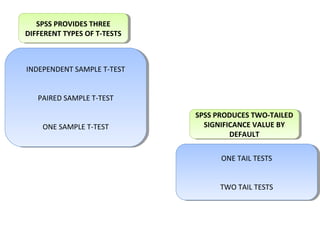
SPSS PROVIDES THREE
DIFFERENT TYPES OF T-TESTS
SPSS PROVIDES THREE
DIFFERENT TYPES OF T-TESTS
SPSS PRODUCES TWO-TAILED
SIGNIFICANCE VALUE BY
DEFAULT
SPSS PRODUCES TWO-TAILED
SIGNIFICANCE VALUE BY
DEFAULT
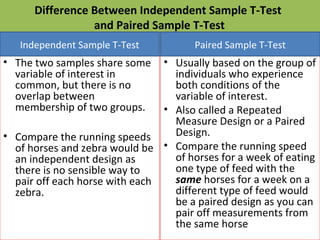
• The two samples share some
variable of interest in
common, but there is no
overlap between
membership of two groups.
• Compare the running speeds
of horses and zebra would be
an independent design as
there is no sensible way to
pair off each horse with each
zebra.
• Usually based on the group of
individuals who experience
both conditions of the
variable of interest.
• Also called a Repeated
Measure Design or a Paired
Design.
• Compare the running speed
of horses for a week of eating
one type of feed with the
same horses for a week on a
different type of feed would
be a paired design as you can
pair off measurements from
the same horse
Difference Between Independent Sample T-Test
and Paired Sample T-Test
Independent Sample T-Test Paired Sample T-Test
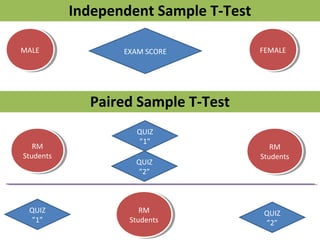
MALEMALE FEMALEFEMALEEXAM SCORE
Independent Sample T-Test
Paired Sample T-Test
RM
Students
RM
Students
RM
Students
RM
Students
QUIZ
”1”
QUIZ
”2”
QUIZ
”1”
QUIZ
”2”
RM
Students
RM
Students
One Sample T-Test
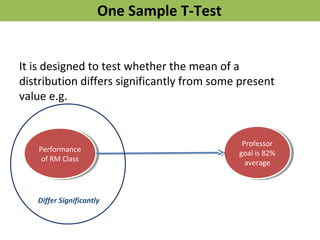
It is designed to test whether the mean of a
distribution differs significantly from some present
value e.g.
Performance
of RM Class
Performance
of RM Class
Professor
goal is 82%
average
Professor
goal is 82%
average
Differ Significantly
Textile
Mills
Textile
Mills
Steel
Mills
Steel
Mills
PRODUCTIVITY
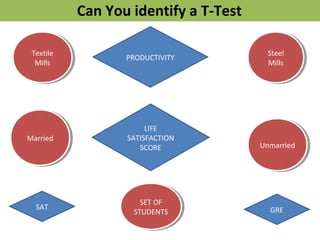
Can You identify a T-Test
MarriedMarried
UnmarriedUnmarried
LIFE
SATISFACTION
SCORE
SAT GRE
SET OF
STUDENTS
SET OF
STUDENTS
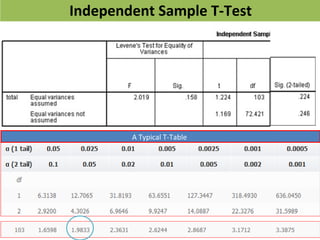
Independent Sample T-Test
A Typical T-Table
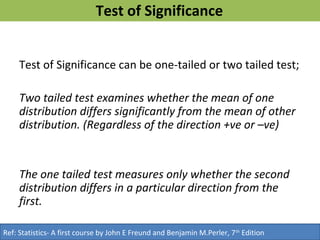
Test of Significance
Test of Significance can be one-tailed or two tailed test;
Two tailed test examines whether the mean of one
distribution differs significantly from the mean of other
distribution. (Regardless of the direction +ve or –ve)
The one tailed test measures only whether the second
distribution differs in a particular direction from the
first.
Ref: Statistics- A first course by John E Freund and Benjamin M.Perler, 7th
Edition
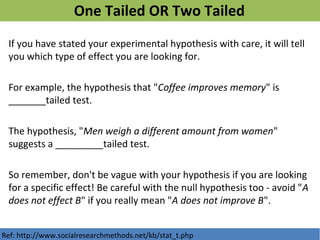
If you have stated your experimental hypothesis with care, it will tell
you which type of effect you are looking for.
For example, the hypothesis that "Coffee improves memory" is
_______tailed test.
The hypothesis, "Men weigh a different amount from women"
suggests a _________tailed test.
So remember, don't be vague with your hypothesis if you are looking
for a specific effect! Be careful with the null hypothesis too - avoid "A
does not effect B" if you really mean "A does not improve B".
One Tailed OR Two Tailed
Ref: http://www.socialresearchmethods.net/kb/stat_t.php
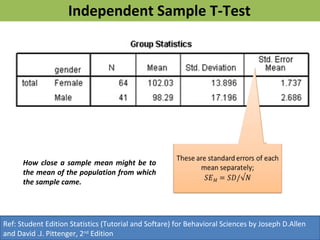
Independent Sample T-Test
How close a sample mean might be to
the mean of the population from which
the sample came.
Ref: Student Edition Statistics (Tutorial and Softare) for Behavioral Sciences by Joseph D.Allen
and David .J. Pittenger, 2nd
Edition
Independent Sample T-Test
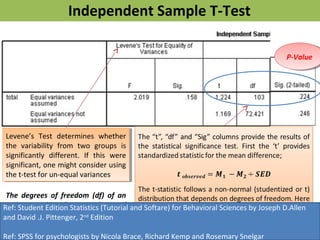
Levene’s Test determines whether
the variability from two groups is
significantly different. If this were
significant, one might consider using
the t-test for un-equal variances
Levene’s Test determines whether
the variability from two groups is
significantly different. If this were
significant, one might consider using
the t-test for un-equal variances
P-ValueP-Value
The degrees of freedom (df) of an
estimate is the number of
independent pieces of information
on which the estimate is based.
Ref: Student Edition Statistics (Tutorial and Softare) for Behavioral Sciences by Joseph D.Allen
and David .J. Pittenger, 2nd
Edition
Ref: SPSS for psychologists by Nicola Brace, Richard Kemp and Rosemary Snelgar
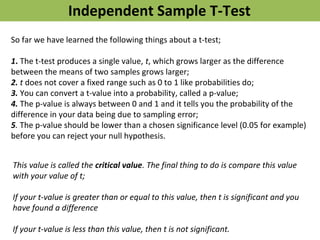
So far we have learned the following things about a t-test;
1. The t-test produces a single value, t, which grows larger as the difference
between the means of two samples grows larger;
2. t does not cover a fixed range such as 0 to 1 like probabilities do;
3. You can convert a t-value into a probability, called a p-value;
4. The p-value is always between 0 and 1 and it tells you the probability of the
difference in your data being due to sampling error;
5. The p-value should be lower than a chosen significance level (0.05 for example)
before you can reject your null hypothesis.
Independent Sample T-Test
This value is called the critical value. The final thing to do is compare this value
with your value of t;
If your t-value is greater than or equal to this value, then t is significant and you
have found a difference
If your t-value is less than this value, then t is not significant.
Independent Sample T-Test
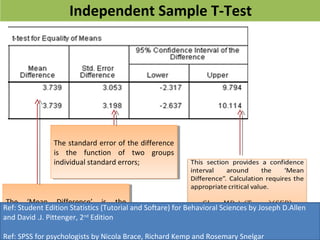
The ‘Mean Difference’ is the
difference between the two group
means.
The ‘Mean Difference’ is the
difference between the two group
means.
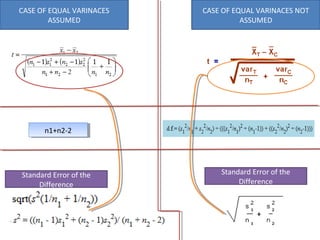
The standard error of the difference
is the function of two groups
individual standard errors;
The standard error of the difference
is the function of two groups
individual standard errors;
Ref: Student Edition Statistics (Tutorial and Softare) for Behavioral Sciences by Joseph D.Allen
and David .J. Pittenger, 2nd
Edition
Ref: SPSS for psychologists by Nicola Brace, Richard Kemp and Rosemary Snelgar
T-Test
Ref: http://www.socialresearchmethods.net/kb/stat_t.php
T-Test
Ref: http://www.socialresearchmethods.net/kb/stat_t.php
CASE OF EQUAL VARINACES
ASSUMED
CASE OF EQUAL VARINACES NOT
ASSUMED
n1+n2-2n1+n2-2
Standard Error of the
Difference
Standard Error of the
Difference
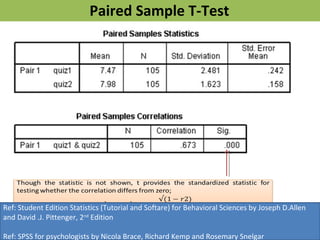
Paired Sample T-Test
Ref: Student Edition Statistics (Tutorial and Softare) for Behavioral Sciences by Joseph D.Allen
and David .J. Pittenger, 2nd
Edition
Ref: SPSS for psychologists by Nicola Brace, Richard Kemp and Rosemary Snelgar
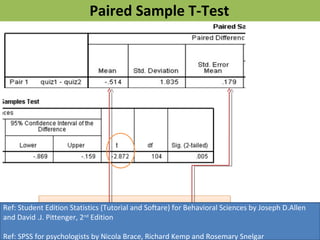
Paired Sample T-Test
Ref: Student Edition Statistics (Tutorial and Softare) for Behavioral Sciences by Joseph D.Allen
and David .J. Pittenger, 2nd
Edition
Ref: SPSS for psychologists by Nicola Brace, Richard Kemp and Rosemary Snelgar
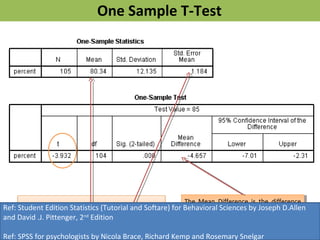
One Sample T-Test
The Mean Difference is the difference
between the sample mean and the
user-specified test value.
The Mean Difference is the difference
between the sample mean and the
user-specified test value.
Ref: Student Edition Statistics (Tutorial and Softare) for Behavioral Sciences by Joseph D.Allen
and David .J. Pittenger, 2nd
Edition
Ref: SPSS for psychologists by Nicola Brace, Richard Kemp and Rosemary Snelgar
ONE WAY ANALYSIS OF VARIANCE
(ONE WAY ANOVA)
• Analysis of variance is a procedure used for comparing
sample means to see if there is sufficient evidence to infer
that the means of the corresponding population
distributions also differ.
• Where t-test compare only two distributions, analysis of
variance is able to compare many.
• What does the one-way part mean? It is one dependent
variable (always continuous) and exactly one independent
variable (always categorical). A single independent variable
can have many levels.
ANOVA
Ref: Business Research Methods by Alan Bryman $ Emma Bell
ANOVA
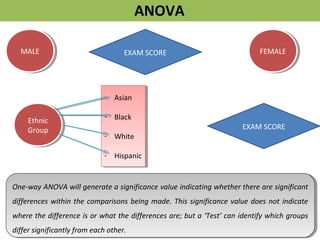
MALEMALE FEMALEFEMALEEXAM SCORE
Ethnic
Group
Ethnic
Group EXAM SCORE
- Asian
- Black
- White
- Hispanic
- Asian
- Black
- White
- Hispanic
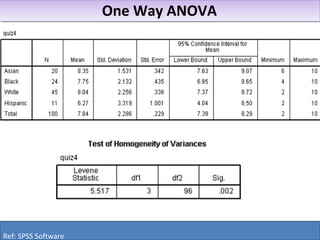
One-way ANOVA will generate a significance value indicating whether there are significant
differences within the comparisons being made. This significance value does not indicate
where the difference is or what the differences are; but a ‘Test’ can identify which groups
differ significantly from each other.
One-way ANOVA will generate a significance value indicating whether there are significant
differences within the comparisons being made. This significance value does not indicate
where the difference is or what the differences are; but a ‘Test’ can identify which groups
differ significantly from each other.
One Way ANOVAOne Way ANOVA
Ref: SPSS Software
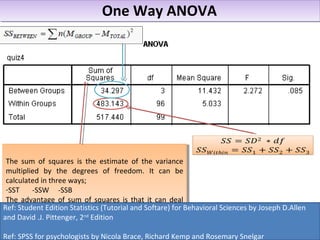
One Way ANOVAOne Way ANOVA
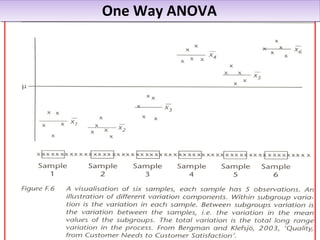
The sum of squares is the estimate of the variance
multiplied by the degrees of freedom. It can be
calculated in three ways;
-SST -SSW -SSB
The advantage of sum of squares is that it can deal
with unequal subgroup sizes and they add up like;
SST = SSB +SSW
The sum of squares is the estimate of the variance
multiplied by the degrees of freedom. It can be
calculated in three ways;
-SST -SSW -SSB
The advantage of sum of squares is that it can deal
with unequal subgroup sizes and they add up like;
SST = SSB +SSW
Ref: Student Edition Statistics (Tutorial and Softare) for Behavioral Sciences by Joseph D.Allen
and David .J. Pittenger, 2nd
Edition
Ref: SPSS for psychologists by Nicola Brace, Richard Kemp and Rosemary Snelgar
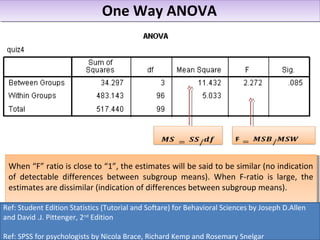
One Way ANOVAOne Way ANOVA
When “F” ratio is close to “1”, the estimates will be said to be similar (no indication
of detectable differences between subgroup means). When F-ratio is large, the
estimates are dissimilar (indication of differences between subgroup means).
SPSS calculated that an F with 3 and 96 df that equals 2.272 has a two tailed
probability of 0.085
When “F” ratio is close to “1”, the estimates will be said to be similar (no indication
of detectable differences between subgroup means). When F-ratio is large, the
estimates are dissimilar (indication of differences between subgroup means).
SPSS calculated that an F with 3 and 96 df that equals 2.272 has a two tailed
probability of 0.085
Ref: Student Edition Statistics (Tutorial and Softare) for Behavioral Sciences by Joseph D.Allen
and David .J. Pittenger, 2nd
Edition
Ref: SPSS for psychologists by Nicola Brace, Richard Kemp and Rosemary Snelgar
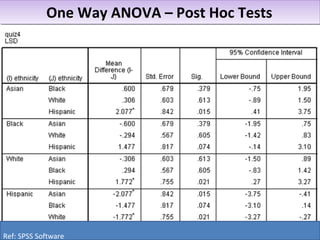
One Way ANOVA – Post Hoc TestsOne Way ANOVA – Post Hoc Tests
Ref: SPSS Software

Anova and T-Test

  • 2.
    The T-Test - IndependentSample T-Test - Paired Sample T-Test - One Sample T-Test - Test of Significance The One-Way ANOVA - Post Hoc Comparisons - Contrasts Descriptive Statistics
  • 3.
    What is aT-Test T-Test is a procedure used for comparing Sample Means to see if there is sufficient evidence to infer that the means of the corresponding population distributions also differ. The important things are; 1. Two (t-test always compare two different means) 2. Some variable of interest Ref: Statistics- A first course by John E Freund and Benjamin M.Perler, 7th Edition
  • 4.
    INDEPENDENT SAMPLE T-TEST PAIREDSAMPLE T-TEST ONE SAMPLE T-TEST INDEPENDENT SAMPLE T-TEST PAIRED SAMPLE T-TEST ONE SAMPLE T-TEST ONE TAIL TESTS TWO TAIL TESTS ONE TAIL TESTS TWO TAIL TESTS SPSS PROVIDES THREE DIFFERENT TYPES OF T-TESTS SPSS PROVIDES THREE DIFFERENT TYPES OF T-TESTS SPSS PRODUCES TWO-TAILED SIGNIFICANCE VALUE BY DEFAULT SPSS PRODUCES TWO-TAILED SIGNIFICANCE VALUE BY DEFAULT
  • 5.
    • The twosamples share some variable of interest in common, but there is no overlap between membership of two groups. • Compare the running speeds of horses and zebra would be an independent design as there is no sensible way to pair off each horse with each zebra. • Usually based on the group of individuals who experience both conditions of the variable of interest. • Also called a Repeated Measure Design or a Paired Design. • Compare the running speed of horses for a week of eating one type of feed with the same horses for a week on a different type of feed would be a paired design as you can pair off measurements from the same horse Difference Between Independent Sample T-Test and Paired Sample T-Test Independent Sample T-Test Paired Sample T-Test
  • 6.
    MALEMALE FEMALEFEMALEEXAM SCORE IndependentSample T-Test Paired Sample T-Test RM Students RM Students RM Students RM Students QUIZ ”1” QUIZ ”2” QUIZ ”1” QUIZ ”2” RM Students RM Students
  • 7.
    One Sample T-Test Itis designed to test whether the mean of a distribution differs significantly from some present value e.g. Performance of RM Class Performance of RM Class Professor goal is 82% average Professor goal is 82% average Differ Significantly
  • 8.
    Textile Mills Textile Mills Steel Mills Steel Mills PRODUCTIVITY Can You identifya T-Test MarriedMarried UnmarriedUnmarried LIFE SATISFACTION SCORE SAT GRE SET OF STUDENTS SET OF STUDENTS
  • 9.
  • 10.
    Test of Significance Testof Significance can be one-tailed or two tailed test; Two tailed test examines whether the mean of one distribution differs significantly from the mean of other distribution. (Regardless of the direction +ve or –ve) The one tailed test measures only whether the second distribution differs in a particular direction from the first. Ref: Statistics- A first course by John E Freund and Benjamin M.Perler, 7th Edition
  • 11.
    If you havestated your experimental hypothesis with care, it will tell you which type of effect you are looking for. For example, the hypothesis that "Coffee improves memory" is _______tailed test. The hypothesis, "Men weigh a different amount from women" suggests a _________tailed test. So remember, don't be vague with your hypothesis if you are looking for a specific effect! Be careful with the null hypothesis too - avoid "A does not effect B" if you really mean "A does not improve B". One Tailed OR Two Tailed Ref: http://www.socialresearchmethods.net/kb/stat_t.php
  • 12.
    Independent Sample T-Test Howclose a sample mean might be to the mean of the population from which the sample came. Ref: Student Edition Statistics (Tutorial and Softare) for Behavioral Sciences by Joseph D.Allen and David .J. Pittenger, 2nd Edition
  • 13.
    Independent Sample T-Test Levene’sTest determines whether the variability from two groups is significantly different. If this were significant, one might consider using the t-test for un-equal variances Levene’s Test determines whether the variability from two groups is significantly different. If this were significant, one might consider using the t-test for un-equal variances P-ValueP-Value The degrees of freedom (df) of an estimate is the number of independent pieces of information on which the estimate is based. Ref: Student Edition Statistics (Tutorial and Softare) for Behavioral Sciences by Joseph D.Allen and David .J. Pittenger, 2nd Edition Ref: SPSS for psychologists by Nicola Brace, Richard Kemp and Rosemary Snelgar
  • 14.
    So far wehave learned the following things about a t-test; 1. The t-test produces a single value, t, which grows larger as the difference between the means of two samples grows larger; 2. t does not cover a fixed range such as 0 to 1 like probabilities do; 3. You can convert a t-value into a probability, called a p-value; 4. The p-value is always between 0 and 1 and it tells you the probability of the difference in your data being due to sampling error; 5. The p-value should be lower than a chosen significance level (0.05 for example) before you can reject your null hypothesis. Independent Sample T-Test This value is called the critical value. The final thing to do is compare this value with your value of t; If your t-value is greater than or equal to this value, then t is significant and you have found a difference If your t-value is less than this value, then t is not significant.
  • 15.
    Independent Sample T-Test The‘Mean Difference’ is the difference between the two group means. The ‘Mean Difference’ is the difference between the two group means. The standard error of the difference is the function of two groups individual standard errors; The standard error of the difference is the function of two groups individual standard errors; Ref: Student Edition Statistics (Tutorial and Softare) for Behavioral Sciences by Joseph D.Allen and David .J. Pittenger, 2nd Edition Ref: SPSS for psychologists by Nicola Brace, Richard Kemp and Rosemary Snelgar
  • 16.
  • 17.
  • 18.
    CASE OF EQUALVARINACES ASSUMED CASE OF EQUAL VARINACES NOT ASSUMED n1+n2-2n1+n2-2 Standard Error of the Difference Standard Error of the Difference
  • 19.
    Paired Sample T-Test Ref:Student Edition Statistics (Tutorial and Softare) for Behavioral Sciences by Joseph D.Allen and David .J. Pittenger, 2nd Edition Ref: SPSS for psychologists by Nicola Brace, Richard Kemp and Rosemary Snelgar
  • 20.
    Paired Sample T-Test Ref:Student Edition Statistics (Tutorial and Softare) for Behavioral Sciences by Joseph D.Allen and David .J. Pittenger, 2nd Edition Ref: SPSS for psychologists by Nicola Brace, Richard Kemp and Rosemary Snelgar
  • 21.
    One Sample T-Test TheMean Difference is the difference between the sample mean and the user-specified test value. The Mean Difference is the difference between the sample mean and the user-specified test value. Ref: Student Edition Statistics (Tutorial and Softare) for Behavioral Sciences by Joseph D.Allen and David .J. Pittenger, 2nd Edition Ref: SPSS for psychologists by Nicola Brace, Richard Kemp and Rosemary Snelgar
  • 22.
    ONE WAY ANALYSISOF VARIANCE (ONE WAY ANOVA)
  • 23.
    • Analysis ofvariance is a procedure used for comparing sample means to see if there is sufficient evidence to infer that the means of the corresponding population distributions also differ. • Where t-test compare only two distributions, analysis of variance is able to compare many. • What does the one-way part mean? It is one dependent variable (always continuous) and exactly one independent variable (always categorical). A single independent variable can have many levels. ANOVA Ref: Business Research Methods by Alan Bryman $ Emma Bell
  • 24.
    ANOVA MALEMALE FEMALEFEMALEEXAM SCORE Ethnic Group Ethnic GroupEXAM SCORE - Asian - Black - White - Hispanic - Asian - Black - White - Hispanic One-way ANOVA will generate a significance value indicating whether there are significant differences within the comparisons being made. This significance value does not indicate where the difference is or what the differences are; but a ‘Test’ can identify which groups differ significantly from each other. One-way ANOVA will generate a significance value indicating whether there are significant differences within the comparisons being made. This significance value does not indicate where the difference is or what the differences are; but a ‘Test’ can identify which groups differ significantly from each other.
  • 25.
    One Way ANOVAOneWay ANOVA Ref: SPSS Software
  • 26.
    One Way ANOVAOneWay ANOVA The sum of squares is the estimate of the variance multiplied by the degrees of freedom. It can be calculated in three ways; -SST -SSW -SSB The advantage of sum of squares is that it can deal with unequal subgroup sizes and they add up like; SST = SSB +SSW The sum of squares is the estimate of the variance multiplied by the degrees of freedom. It can be calculated in three ways; -SST -SSW -SSB The advantage of sum of squares is that it can deal with unequal subgroup sizes and they add up like; SST = SSB +SSW Ref: Student Edition Statistics (Tutorial and Softare) for Behavioral Sciences by Joseph D.Allen and David .J. Pittenger, 2nd Edition Ref: SPSS for psychologists by Nicola Brace, Richard Kemp and Rosemary Snelgar
  • 27.
  • 28.
    One Way ANOVAOneWay ANOVA When “F” ratio is close to “1”, the estimates will be said to be similar (no indication of detectable differences between subgroup means). When F-ratio is large, the estimates are dissimilar (indication of differences between subgroup means). SPSS calculated that an F with 3 and 96 df that equals 2.272 has a two tailed probability of 0.085 When “F” ratio is close to “1”, the estimates will be said to be similar (no indication of detectable differences between subgroup means). When F-ratio is large, the estimates are dissimilar (indication of differences between subgroup means). SPSS calculated that an F with 3 and 96 df that equals 2.272 has a two tailed probability of 0.085 Ref: Student Edition Statistics (Tutorial and Softare) for Behavioral Sciences by Joseph D.Allen and David .J. Pittenger, 2nd Edition Ref: SPSS for psychologists by Nicola Brace, Richard Kemp and Rosemary Snelgar
  • 29.
    One Way ANOVA– Post Hoc TestsOne Way ANOVA – Post Hoc Tests Ref: SPSS Software