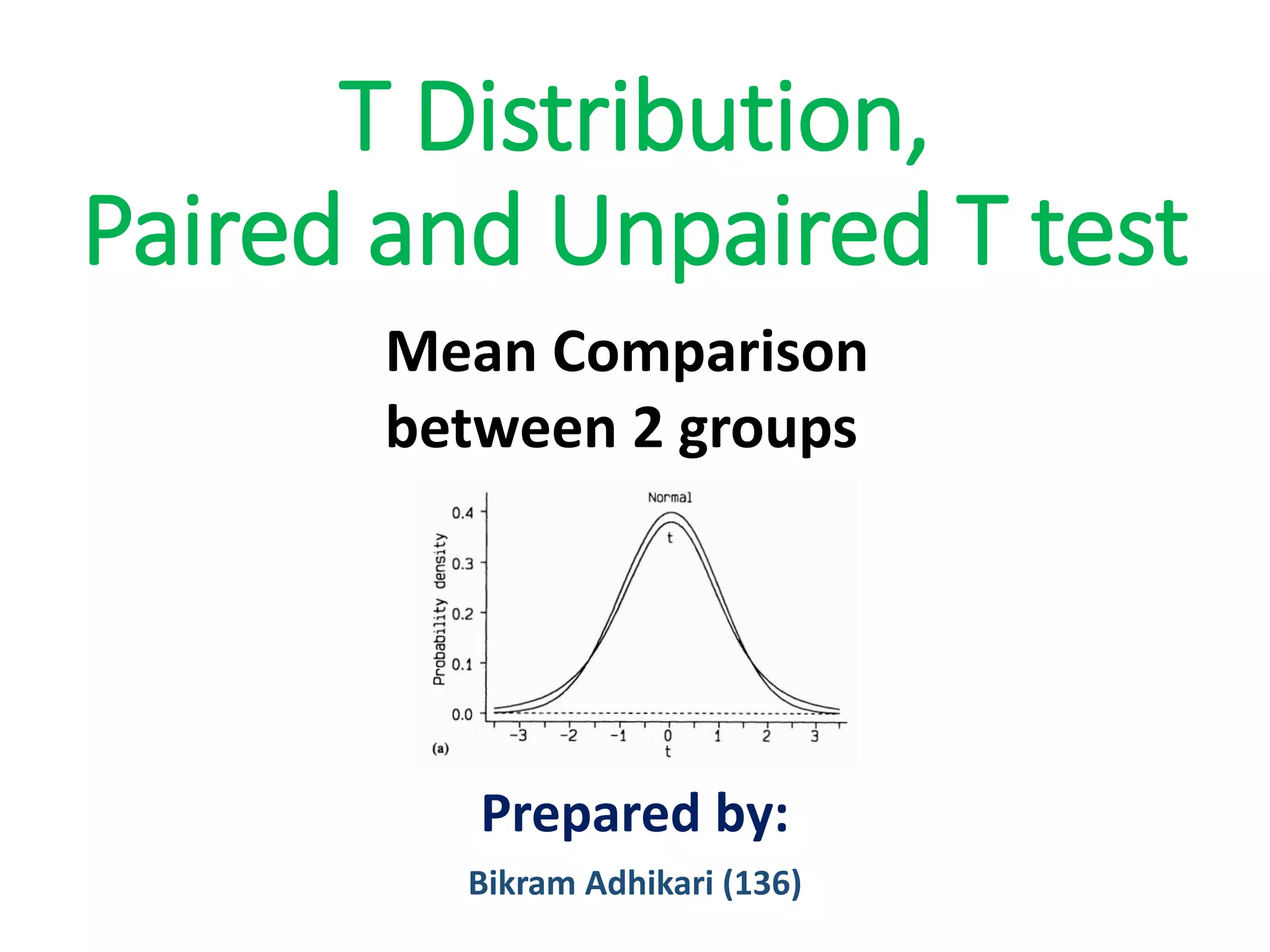
T Distribution,
Paired and Unpaired T test
Prepared by:
Bikram Adhikari (136)
Mean Comparison
between 2 groups
A bit of History
• W.A. Gassit (1905) first published a t-test.
• He worked at the Guiness Brewery in Dublin and
published under the name Student.
• The test was called Student Test later shortened
to t test
T Distribution
• Aka Student’s T distribution
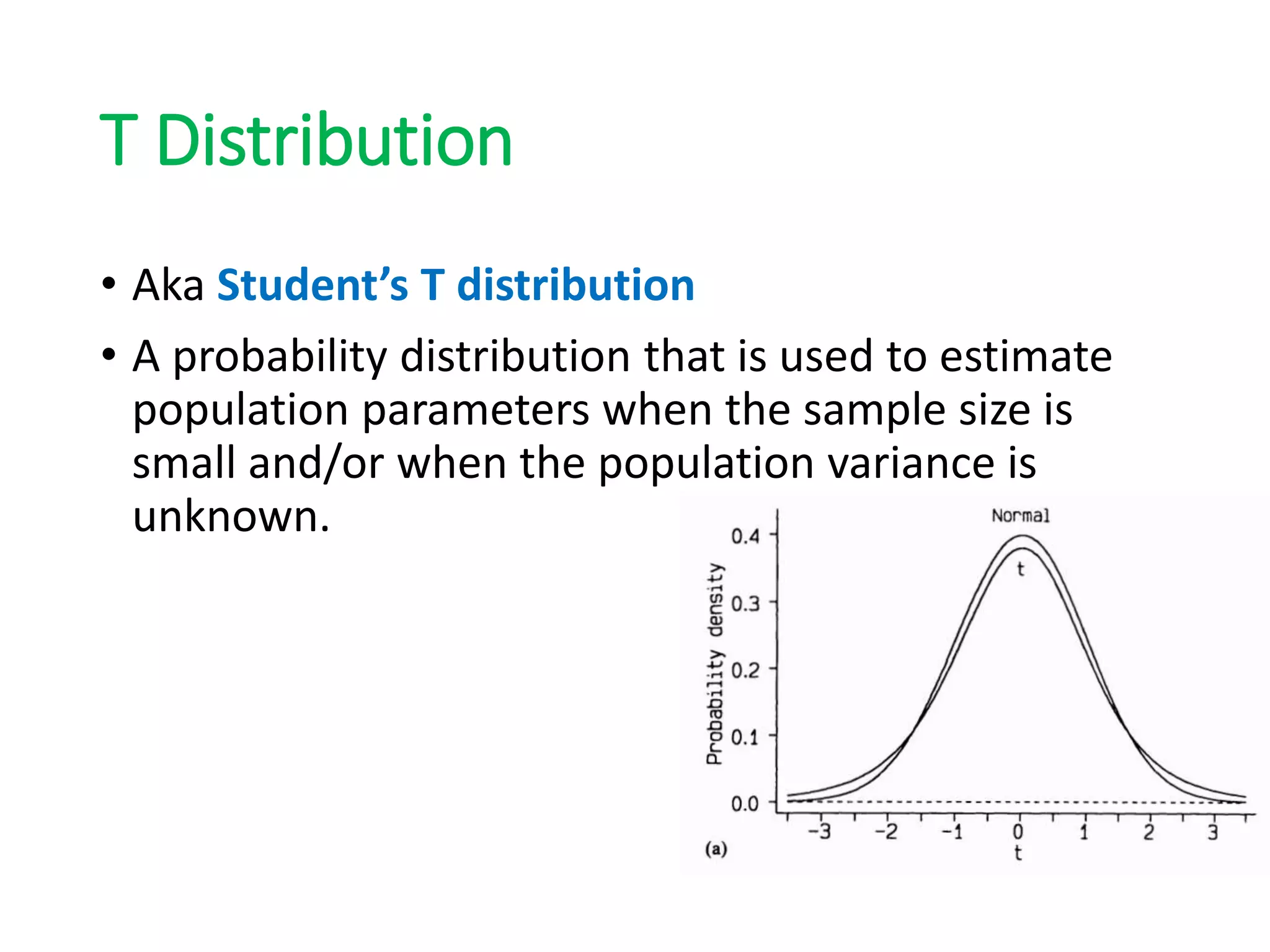
• A probability distribution that is used to estimate
population parameters when the sample size is
small and/or when the population variance is
unknown.
T Distribution
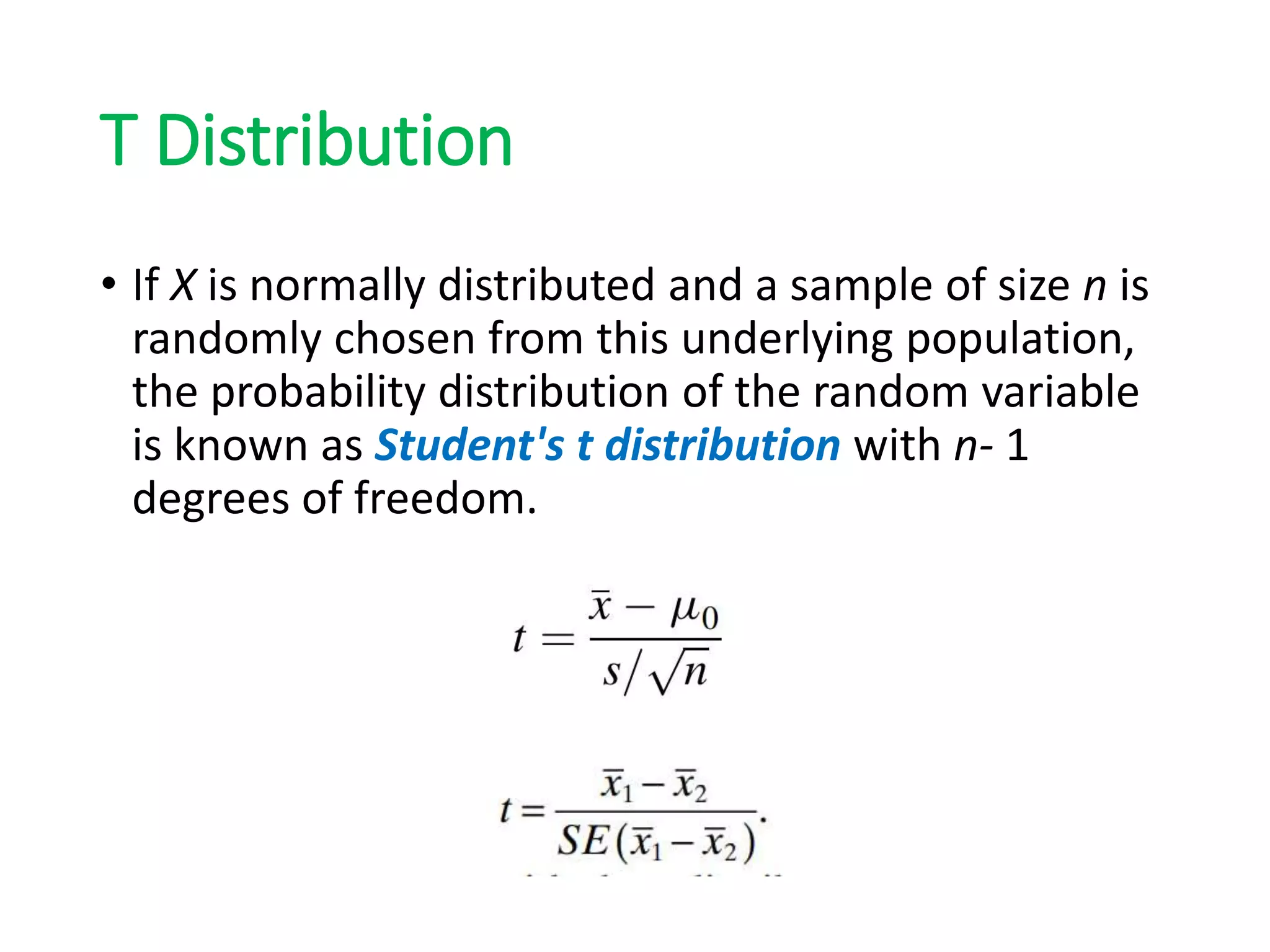
• If X is normally distributed and a sample of size n is
randomly chosen from this underlying population,
the probability distribution of the random variable
is known as Student's t distribution with n- 1
degrees of freedom.
Properties of t Distribution
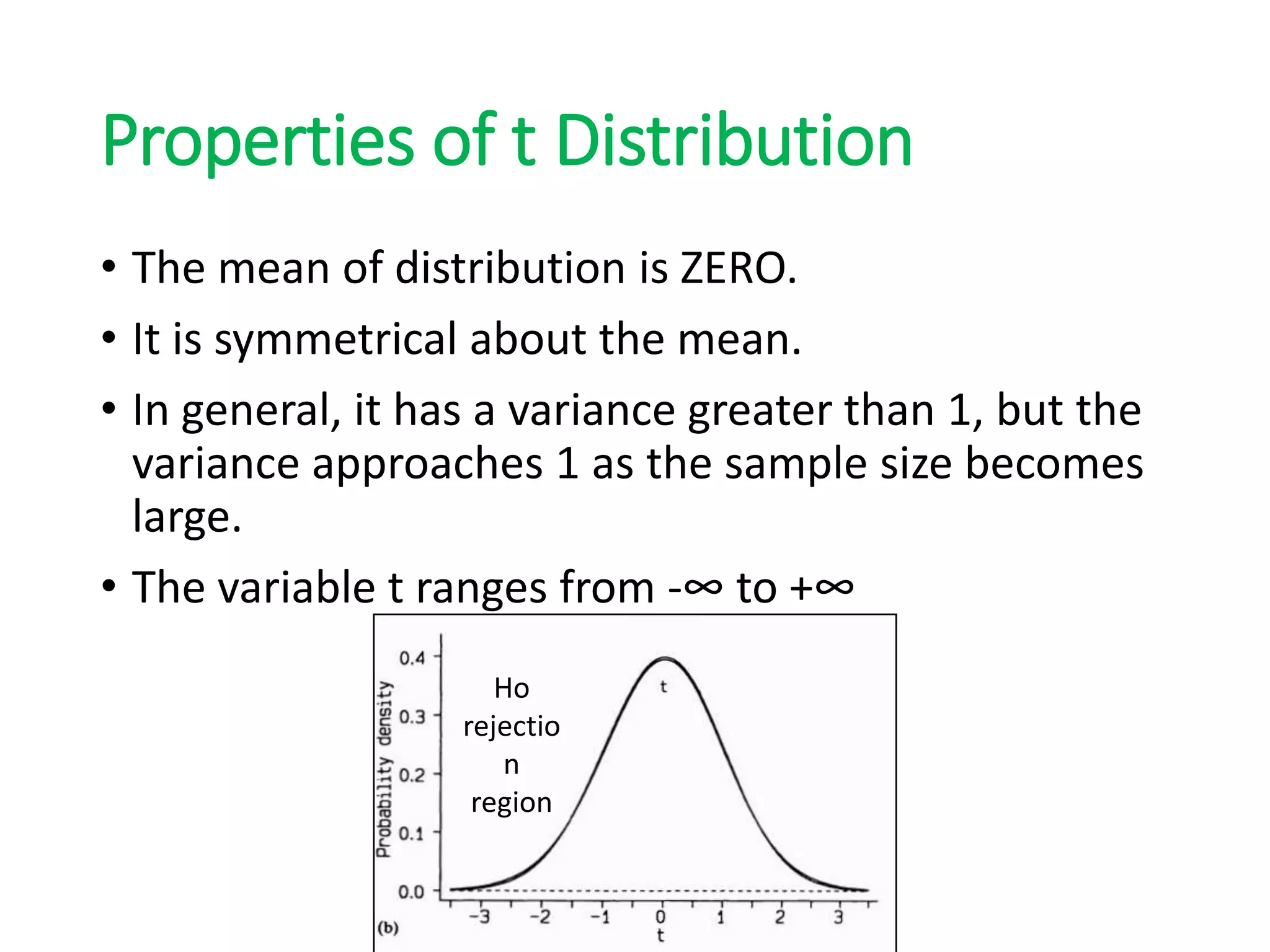
• The mean of distribution is ZERO.
• It is symmetrical about the mean.
• In general, it has a variance greater than 1, but the
variance approaches 1 as the sample size becomes

large.
• The variable t ranges from -∞ to +∞
Ho
rejectio
n
region
Similarities with Normal
Distribution
• Both are uni-modal
• Symmetric around is mean of zero
• Total area of the curve is One.
Difference between t and normal
distribution
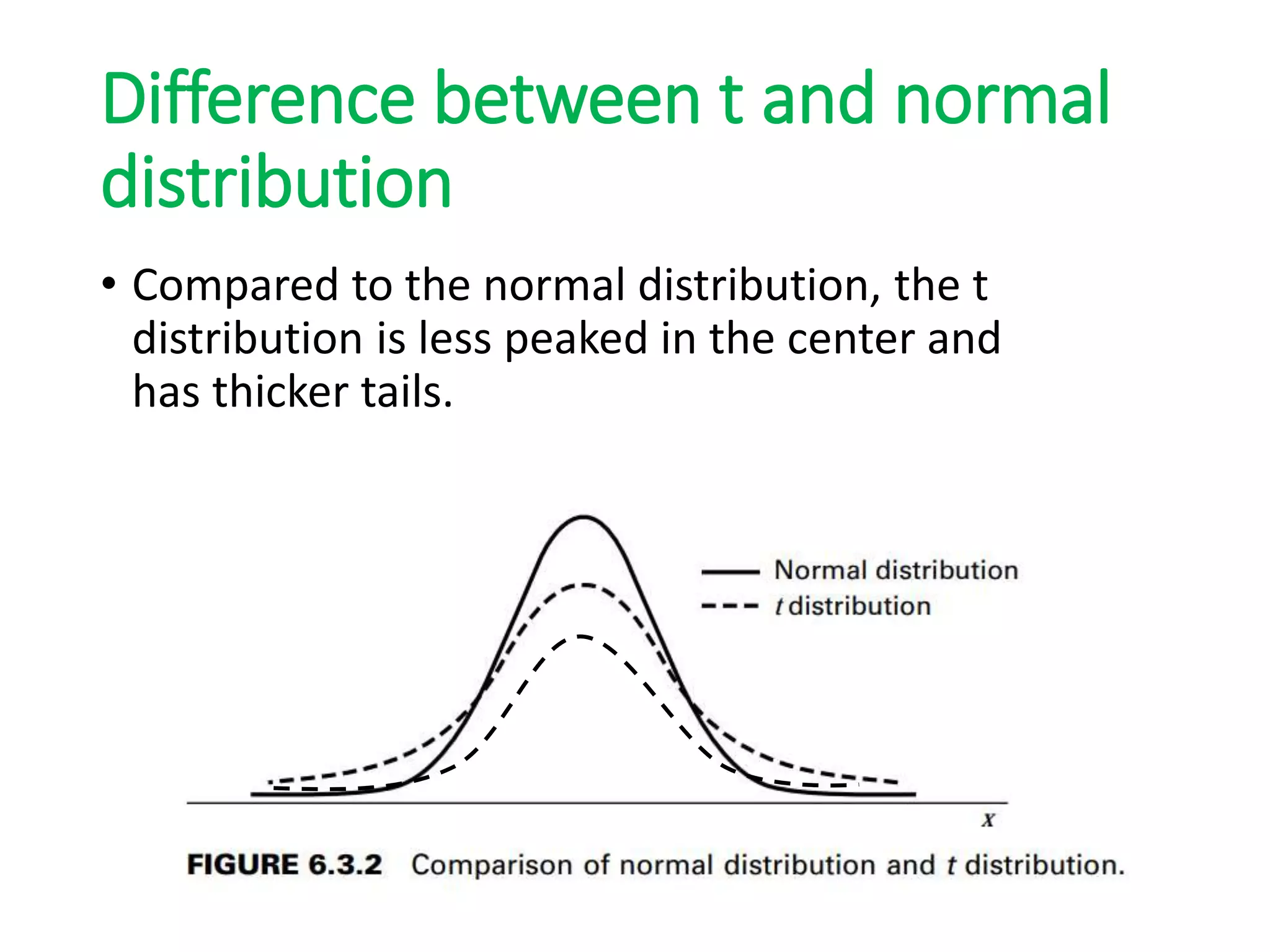
• Compared to the normal distribution, the t
distribution is less peaked in the center and
has thicker tails.
When to Use the t Distribution?
• The t distribution can be used with any statistic
having a bell-shaped distribution
• Quantative data, random samples
• The population distribution is normal.
• The population distribution is symmetric, unimodal,
without outiers, and the sample size is at most 30.
• The population distribution is moderately skewed,
unimodal, without outliers, and the sample size is at
most 40.
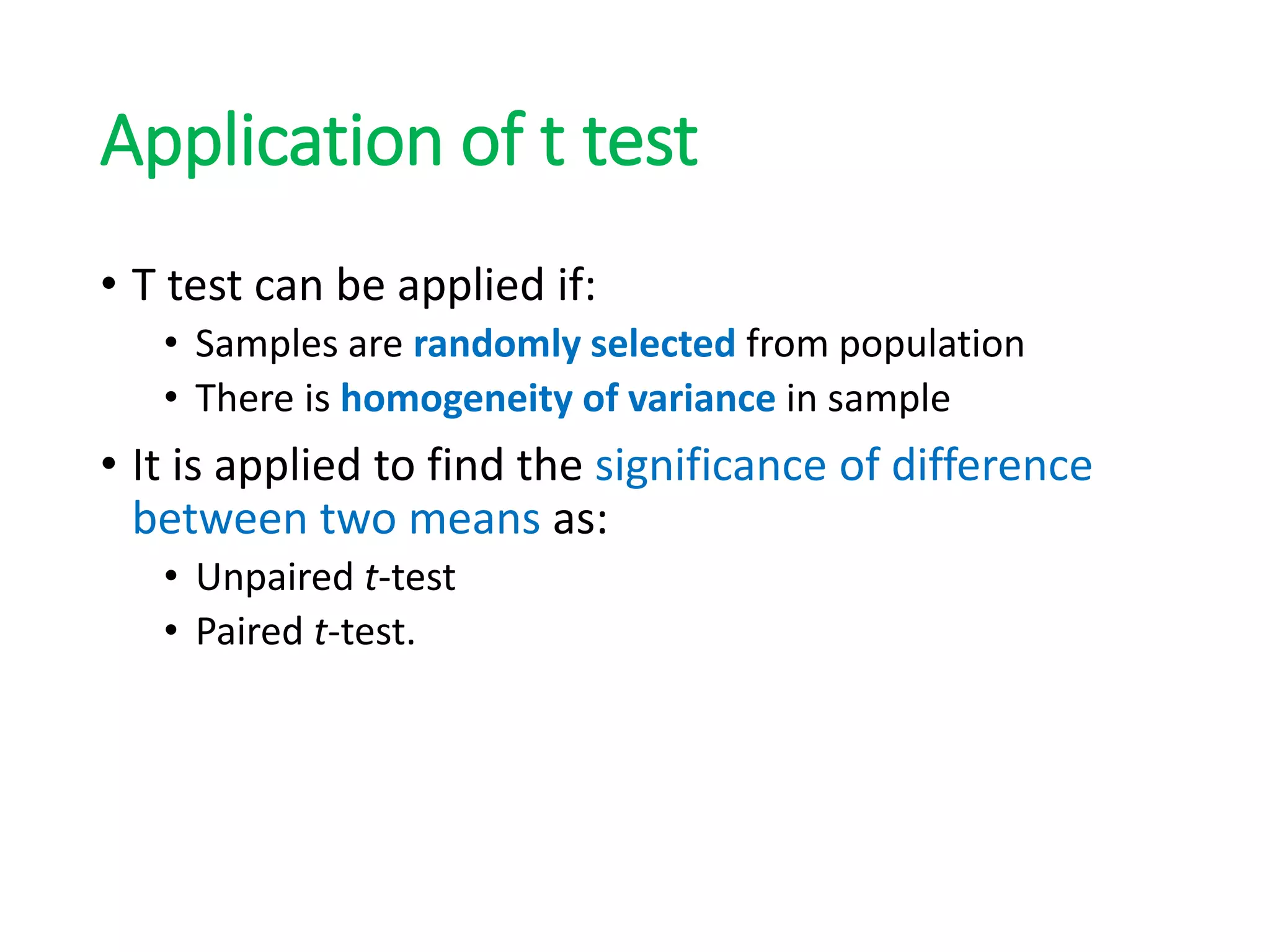
Application of t test
• T test can be applied if:
• Samples are randomly selected from population
• There is homogeneity of variance in sample
• It is applied to find the significance of difference
between two means as:
• Unpaired t-test
• Paired t-test.
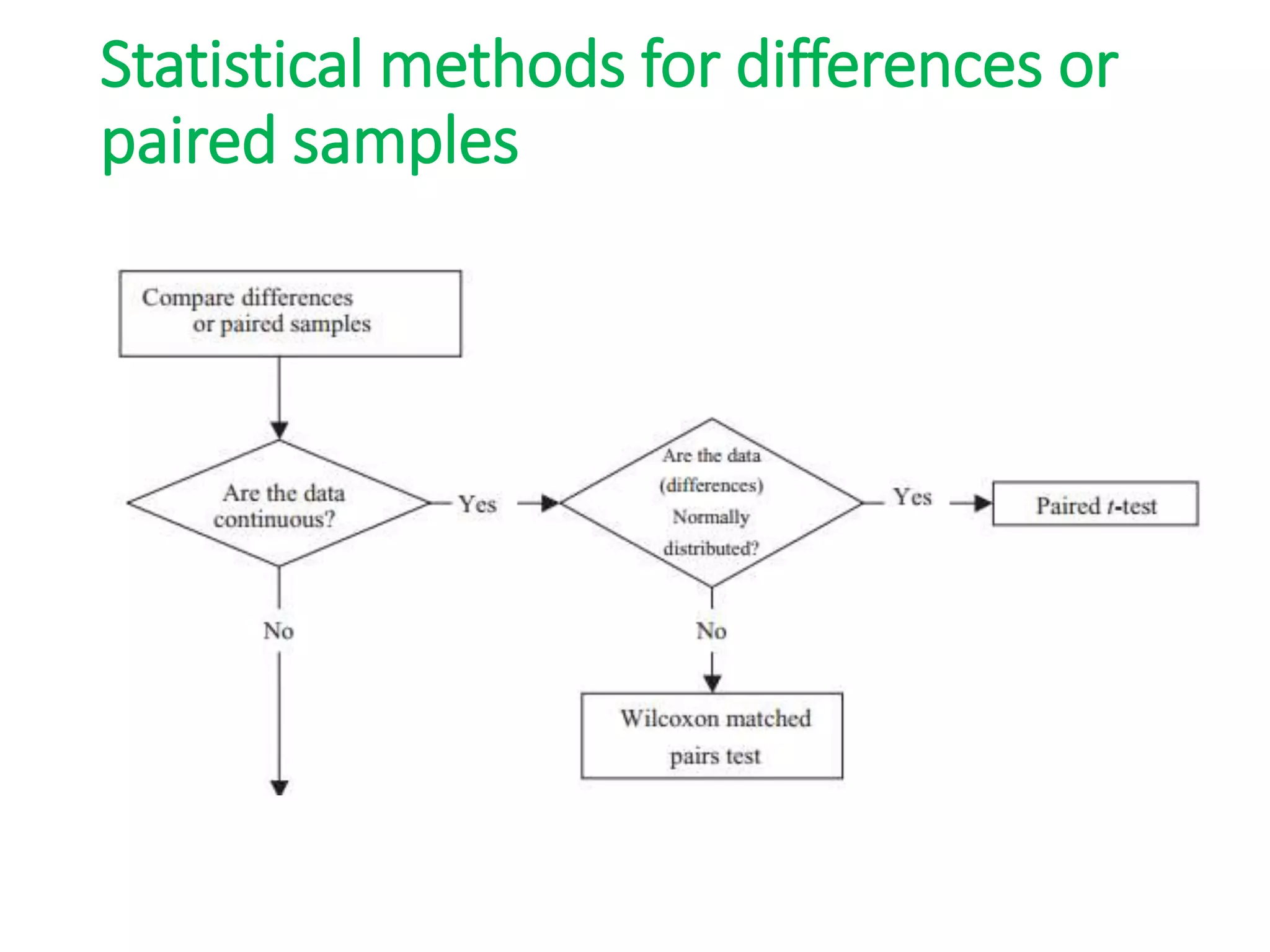
Statistical methods for differences or
paired samples
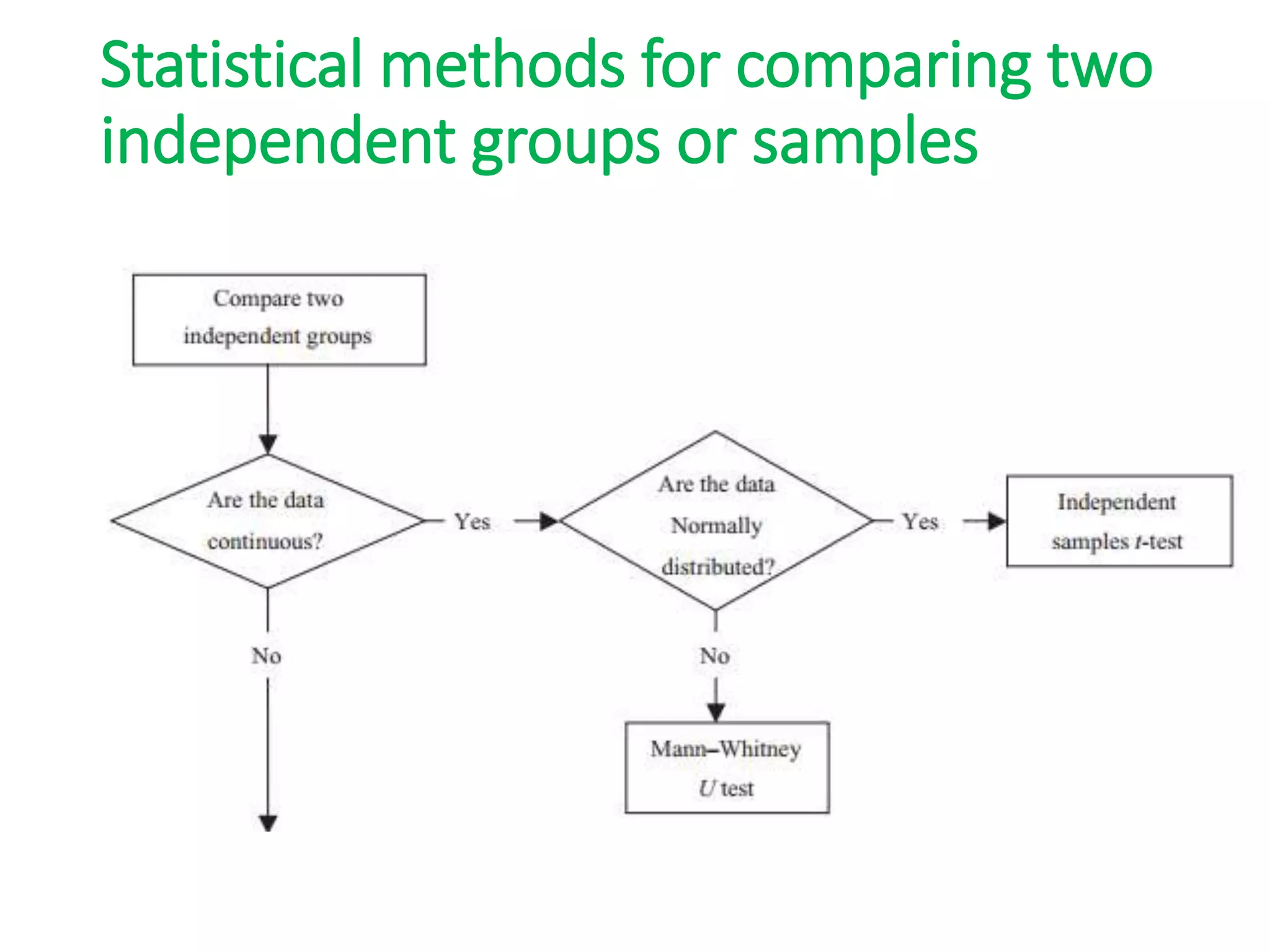
Statistical methods for comparing two
independent groups or samples
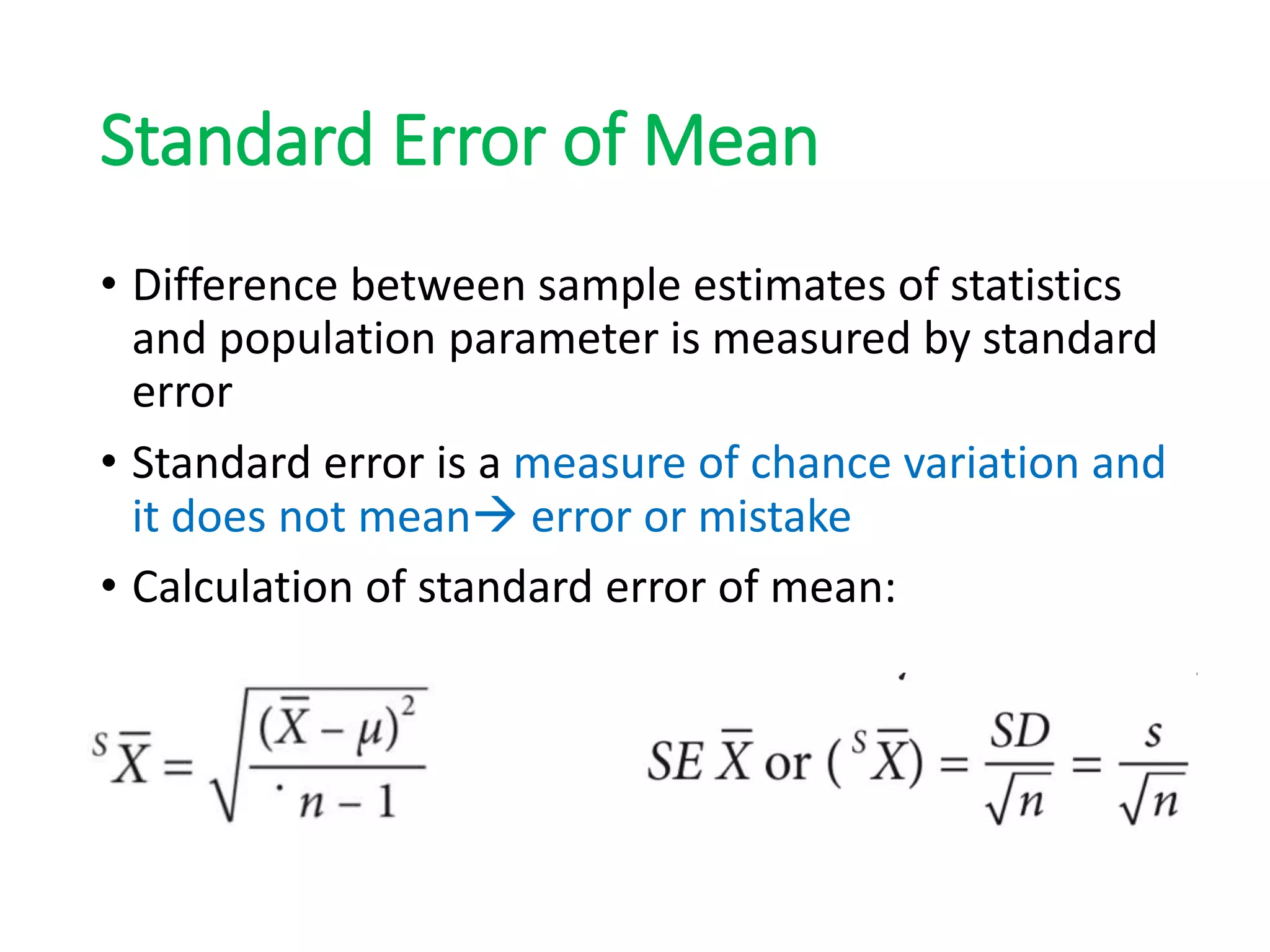
Standard Error of Mean
• Difference between sample estimates of statistics
and population parameter is measured by standard
error
• Standard error is a measure of chance variation and
it does not mean error or mistake
• Calculation of standard error of mean:
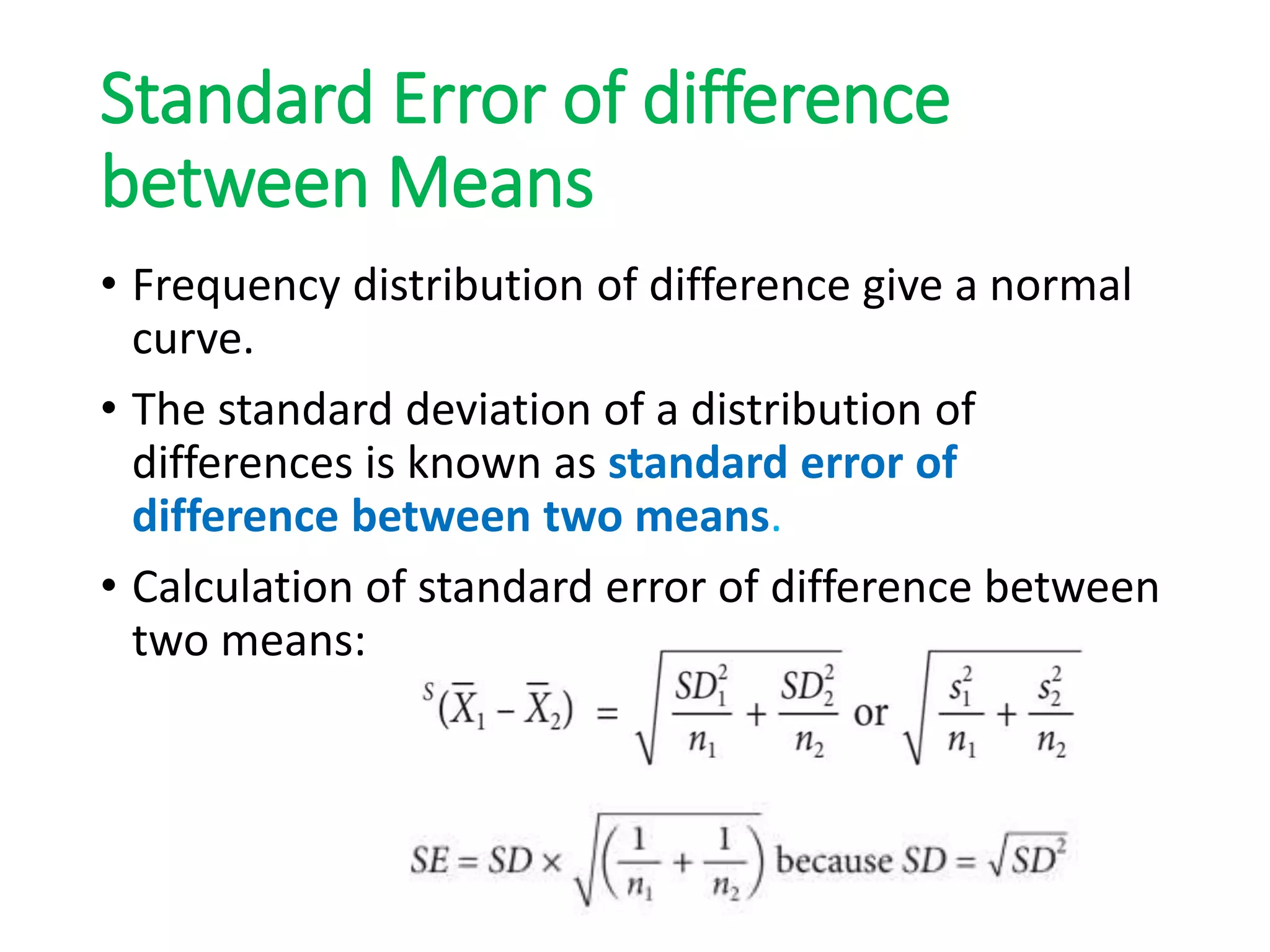
Standard Error of difference
between Means
• Frequency distribution of difference give a normal
curve.
• The standard deviation of a distribution of
differences is known as standard error of
difference between two means.
• Calculation of standard error of difference between
two means:
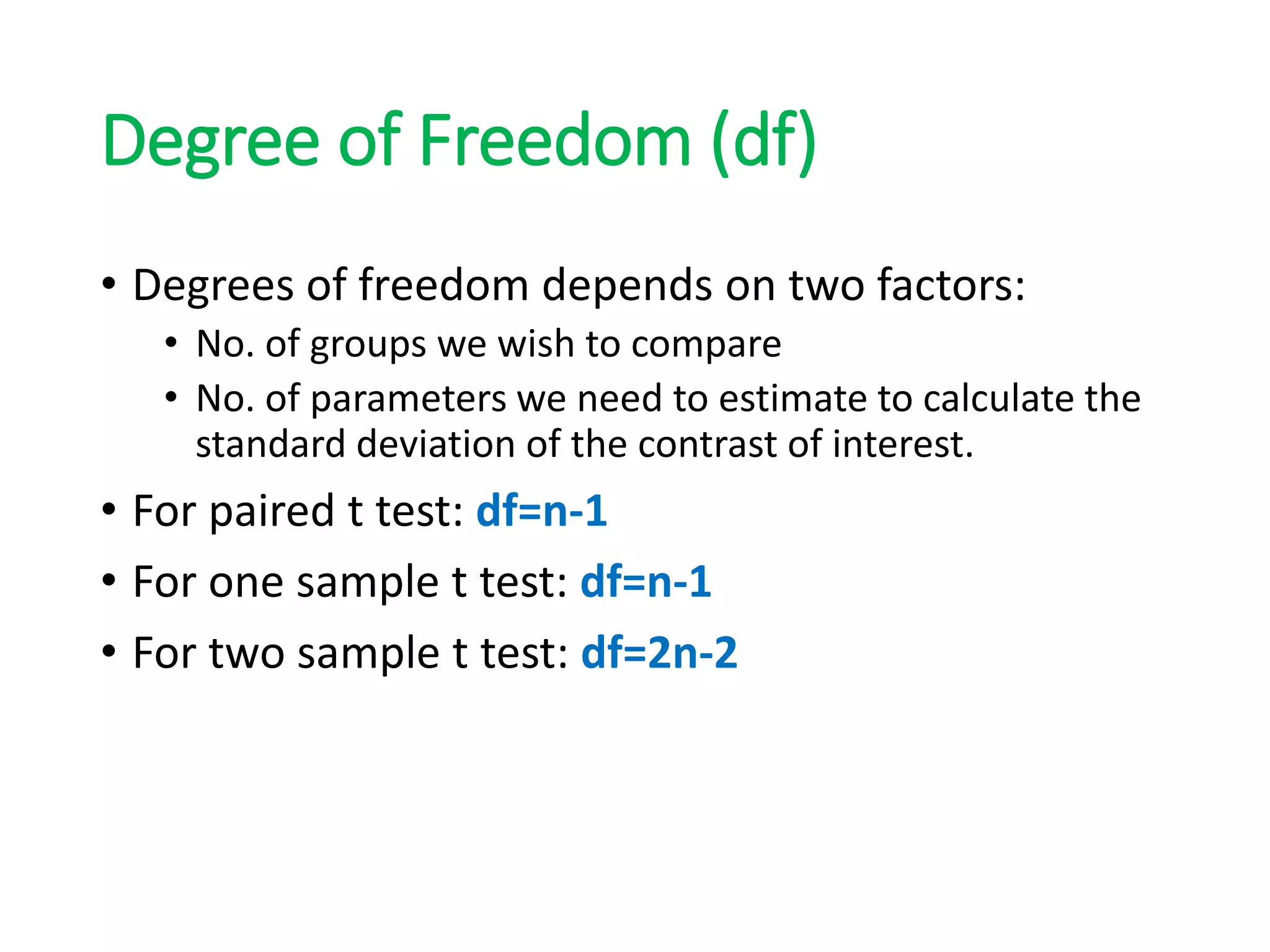
Degree of Freedom (df)
• Degrees of freedom depends on two factors:
• No. of groups we wish to compare
• No. of parameters we need to estimate to calculate the
standard deviation of the contrast of interest.
• For paired t test: df=n-1
• For one sample t test: df=n-1
• For two sample t test: df=2n-2
Paired t test
• Two groups of paired observations, x11, x12, . . . ,
x1n in Group 1 and x21, x22, . . . , x2n in Group 2
such that x1i is paired with x2i and the difference
between them, di = x1i - x2i.
• Assumptions
• The di’s are plausibly Normally distributed. It is not
essential for the original observations to be Normally distributed
• The di’s are independent of each other.
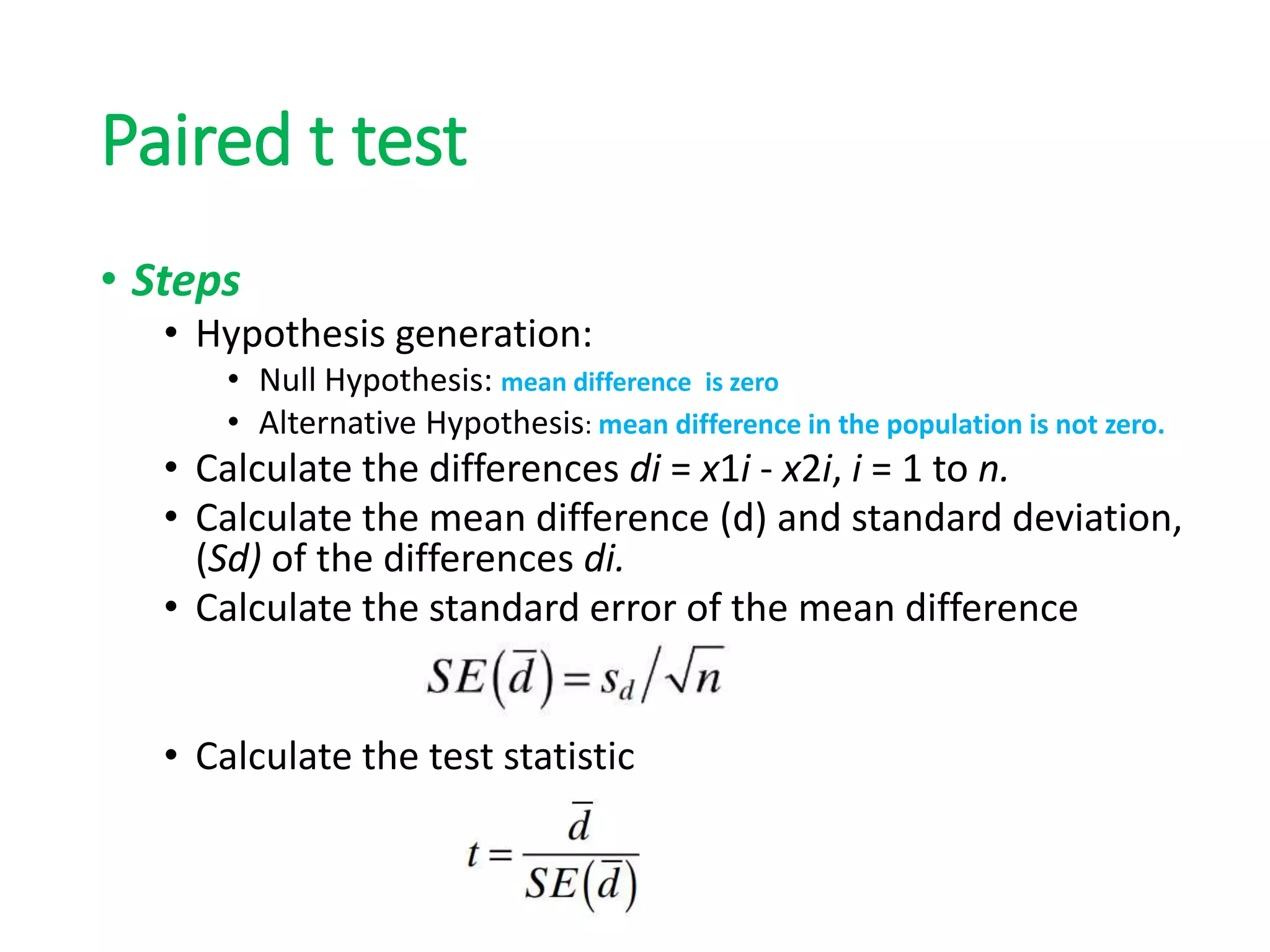
Paired t test
• Steps
• Hypothesis generation:
• Null Hypothesis: mean difference is zero
• Alternative Hypothesis: mean difference in the population is not zero.
• Calculate the differences di = x1i - x2i, i = 1 to n.
• Calculate the mean difference (d) and standard deviation,
(Sd) of the differences di.
• Calculate the standard error of the mean difference
• Calculate the test statistic
Paired t test
• Steps
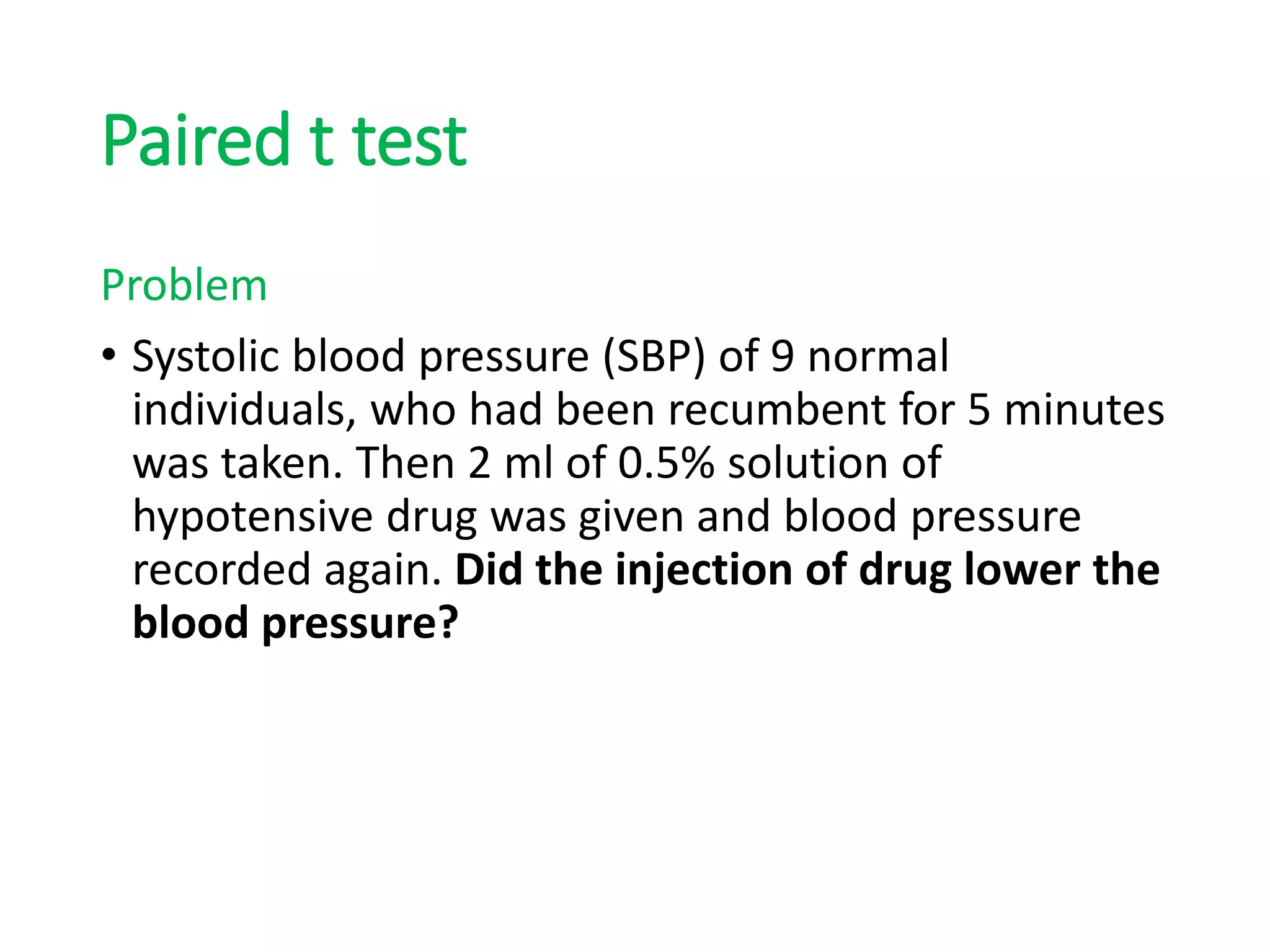
• Find the degrees of freedom.
• df=n-1
• Refer 't' table and find the probability of the
calculated ‘t’ corresponding to n – 1 degrees of
freedom.
• Result
Paired t test
Problem
• Systolic blood pressure (SBP) of 9 normal
individuals, who had been recumbent for 5 minutes
was taken. Then 2 ml of 0.5% solution of
hypotensive drug was given and blood pressure
recorded again. Did the injection of drug lower the
blood pressure?
Paired t test
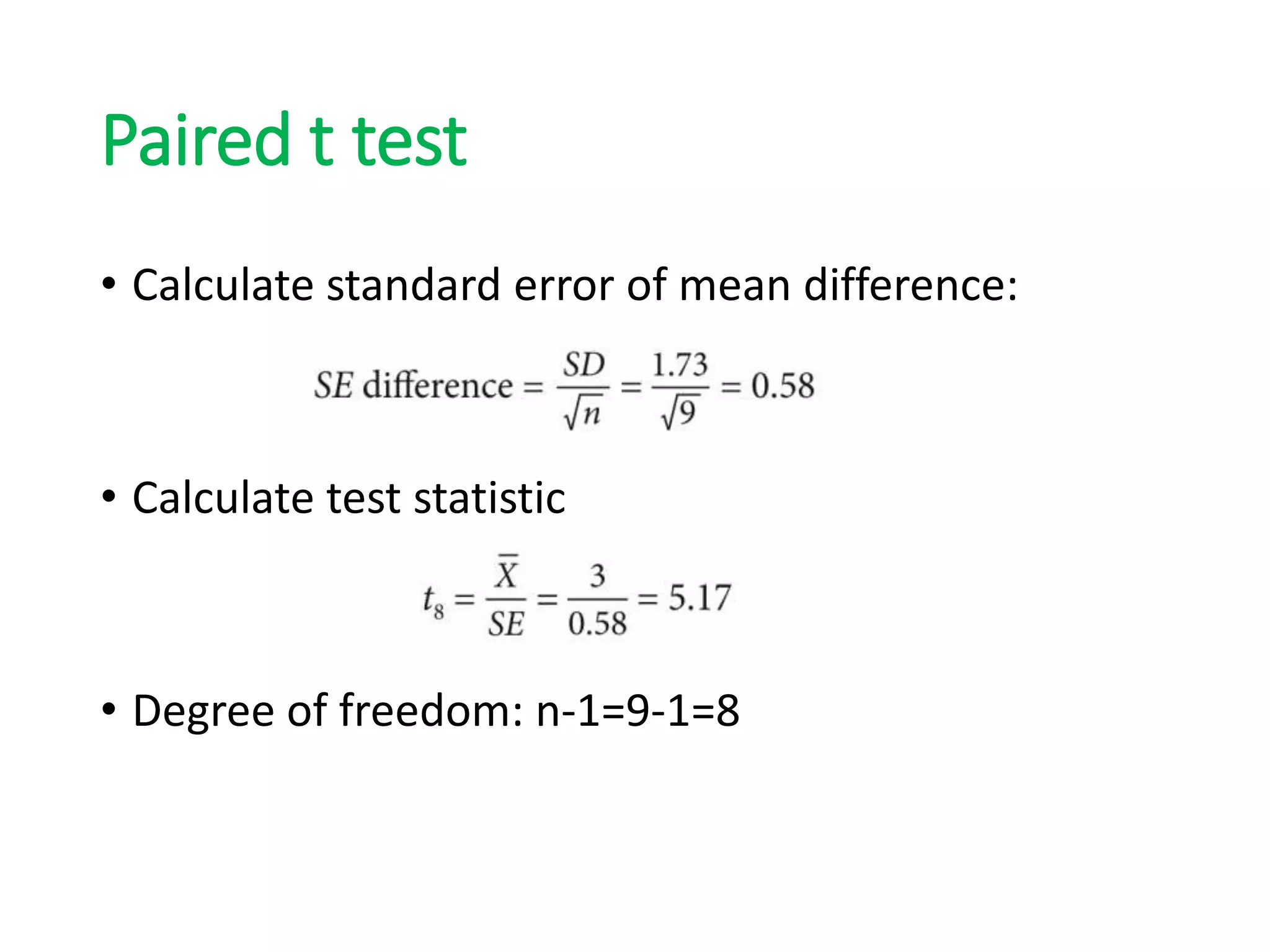
• Hypothesis:
• Ho: no mean difference
• Ha: mean difference
• Calculate differences
• Calculation of mean
difference:
• Calculate Sd of mean
difference:
Paired t test
• Calculate standard error of mean difference:
• Calculate test statistic
• Degree of freedom: n-1=9-1=8
Paired t test
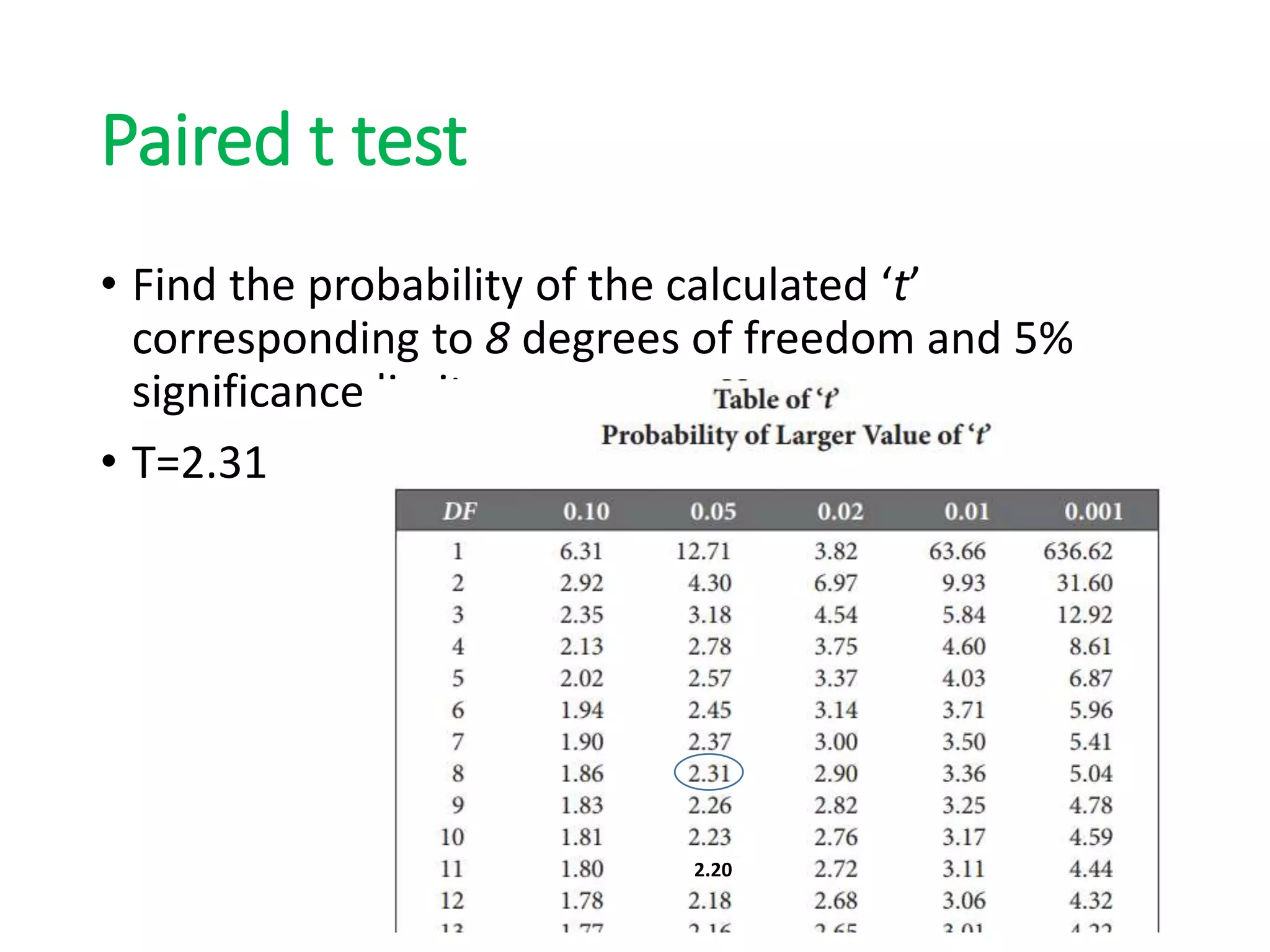
• Find the probability of the calculated ‘t’
corresponding to 8 degrees of freedom and 5%
significance limit.
• T=2.31
2.20
Paired t test
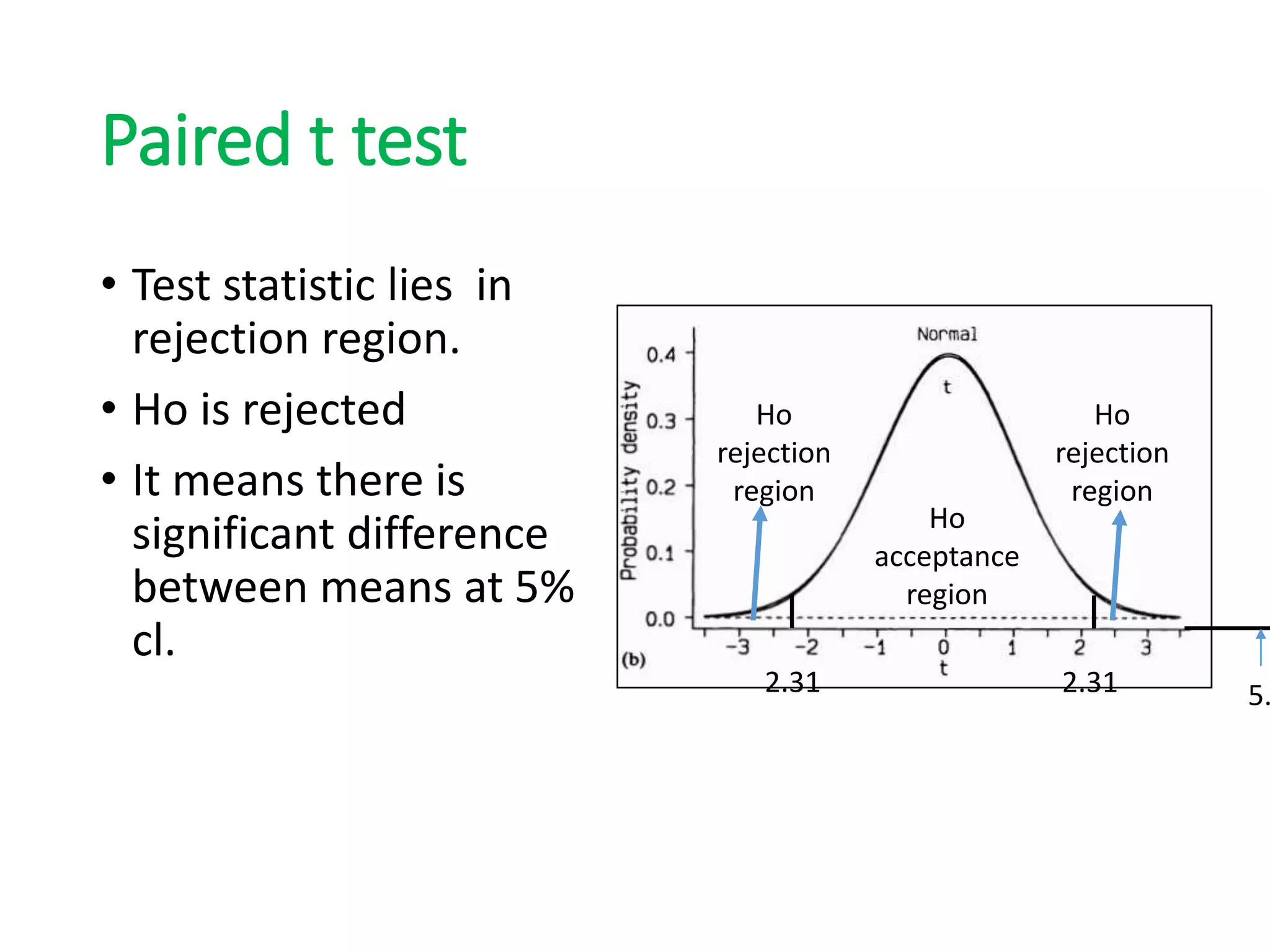
• Test statistic lies in
rejection region.
• Ho is rejected
• It means there is
significant difference
between means at 5%
cl.
Ho
acceptance
region
Ho
rejection
region
Ho
rejection
region
2.31 2.31 5.
Unpaired t test
• One Sample t test
• Independent two Sample t test
Independent sample t test
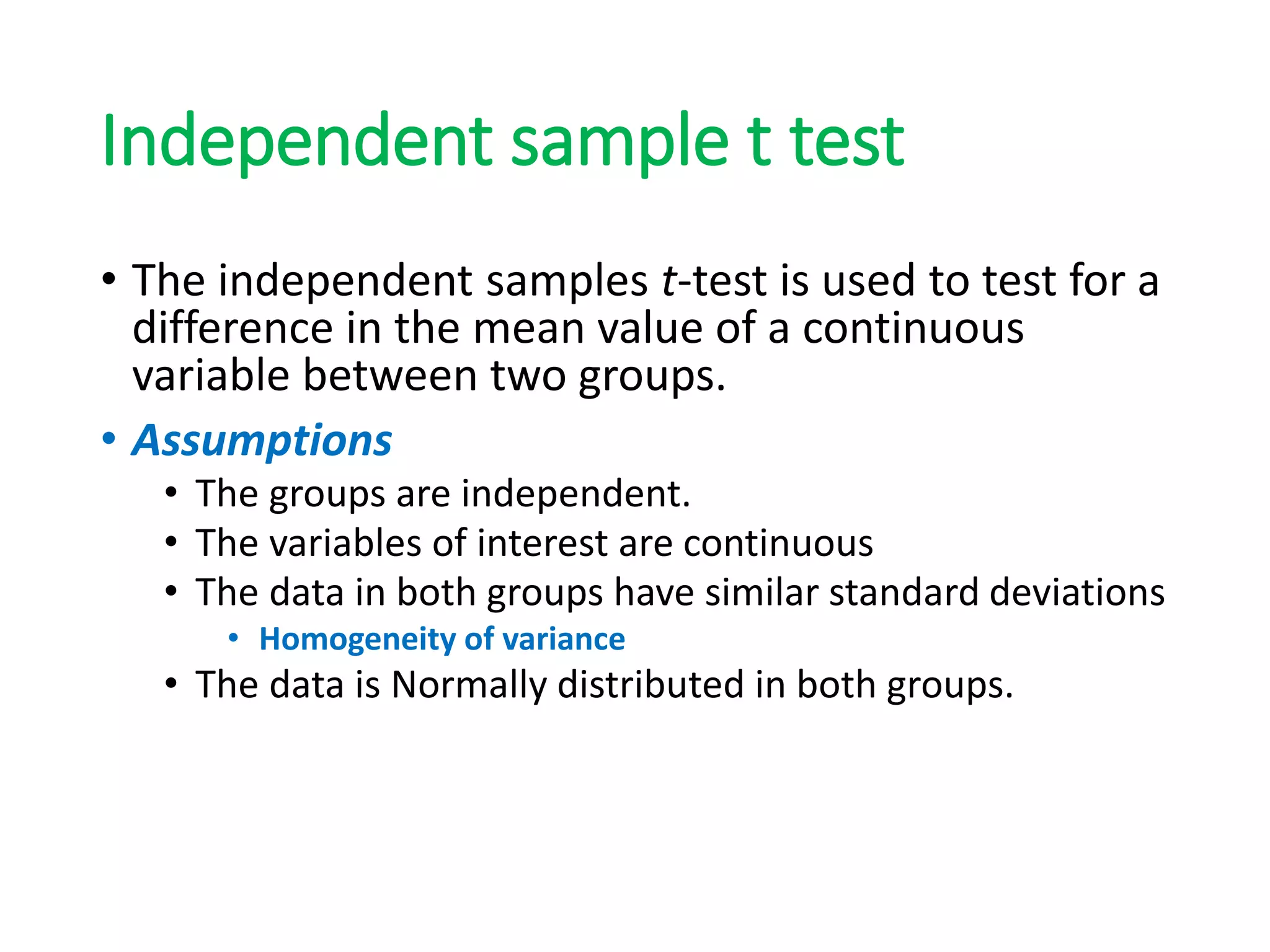
• The independent samples t-test is used to test for a
difference in the mean value of a continuous
variable between two groups.
• Assumptions
• The groups are independent.
• The variables of interest are continuous
• The data in both groups have similar standard deviations
• Homogeneity of variance
• The data is Normally distributed in both groups.
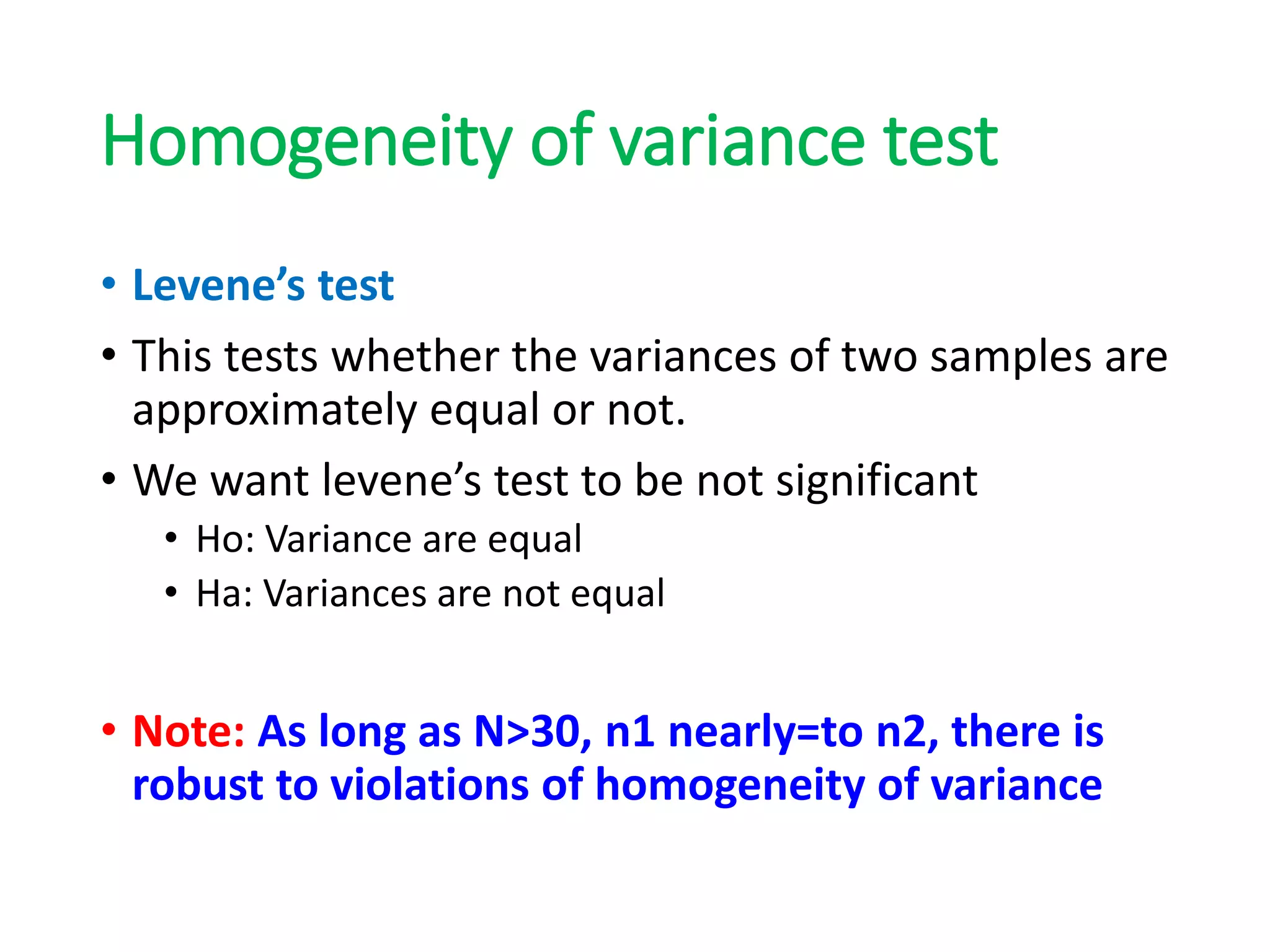
Homogeneity of variance test
• Levene’s test
• This tests whether the variances of two samples are
approximately equal or not.
• We want levene’s test to be not significant
• Ho: Variance are equal
• Ha: Variances are not equal
• Note: As long as N>30, n1 nearly=to n2, there is
robust to violations of homogeneity of variance
Independent sample t test
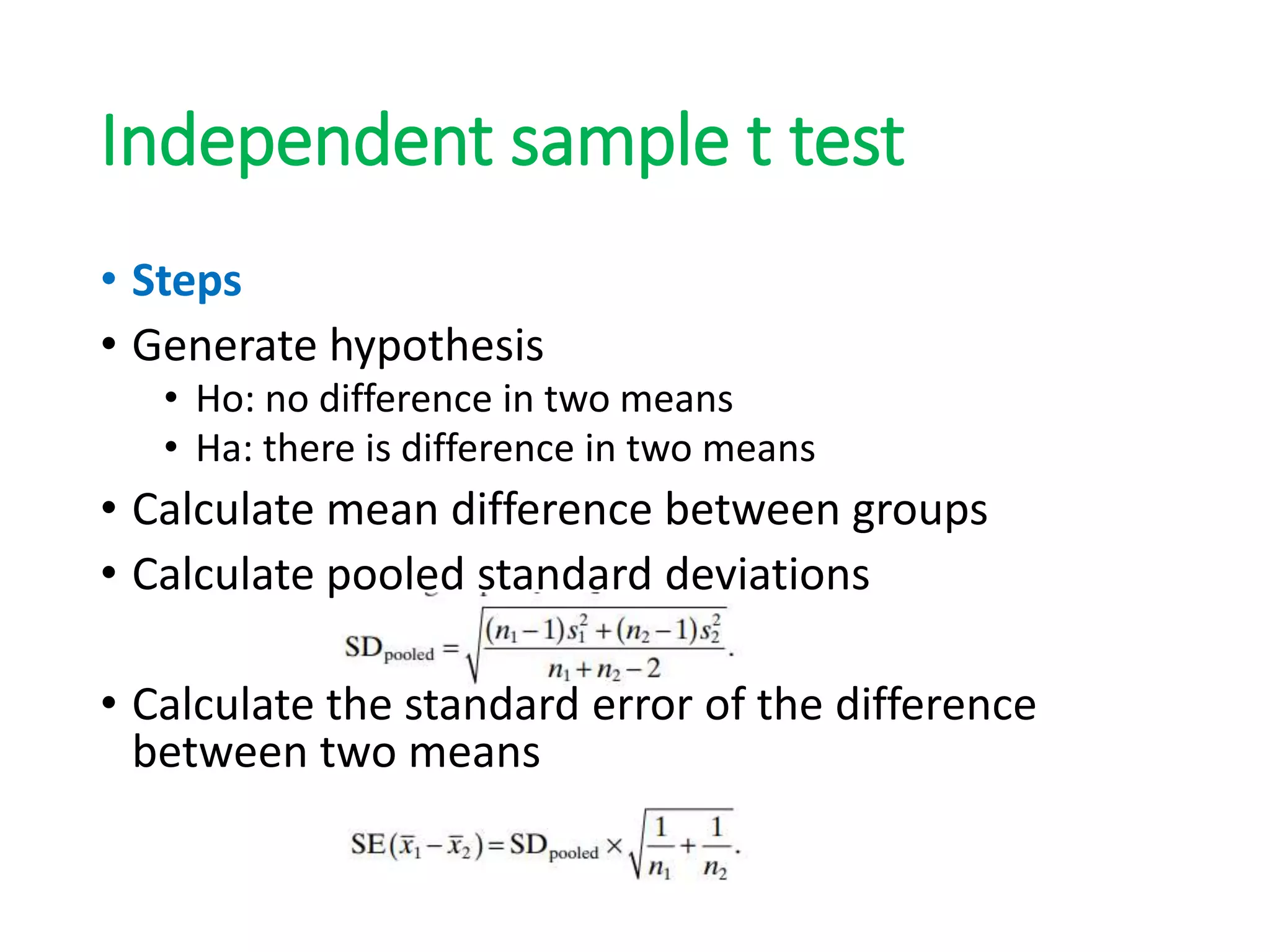
• Steps
• Generate hypothesis
• Ho: no difference in two means
• Ha: there is difference in two means
• Calculate mean difference between groups
• Calculate pooled standard deviations
• Calculate the standard error of the difference
between two means
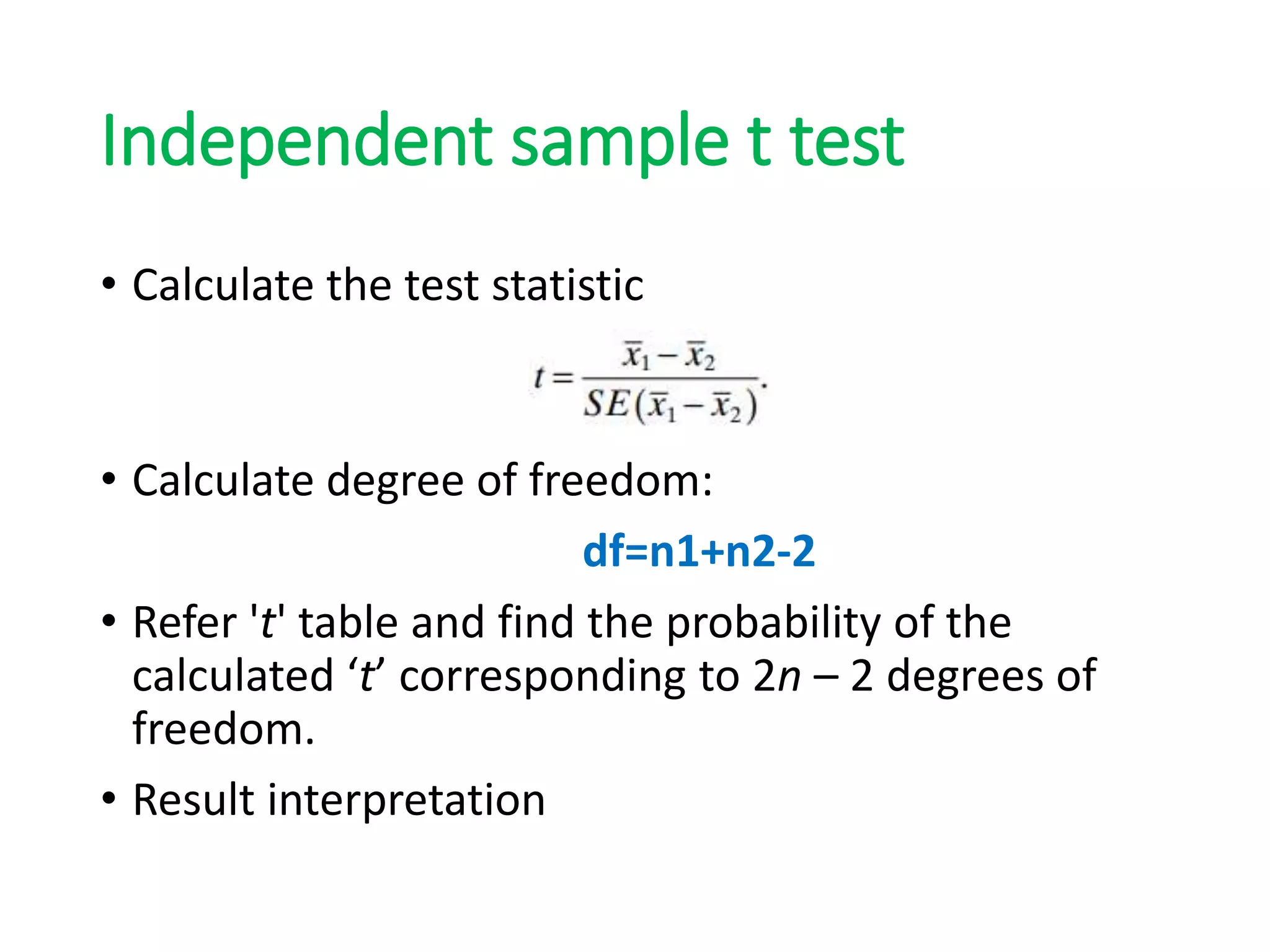
Independent sample t test
• Calculate the test statistic
• Calculate degree of freedom:
df=n1+n2-2
• Refer 't' table and find the probability of the
calculated ‘t’ corresponding to 2n – 2 degrees of
freedom.
• Result interpretation
Independent sample t test
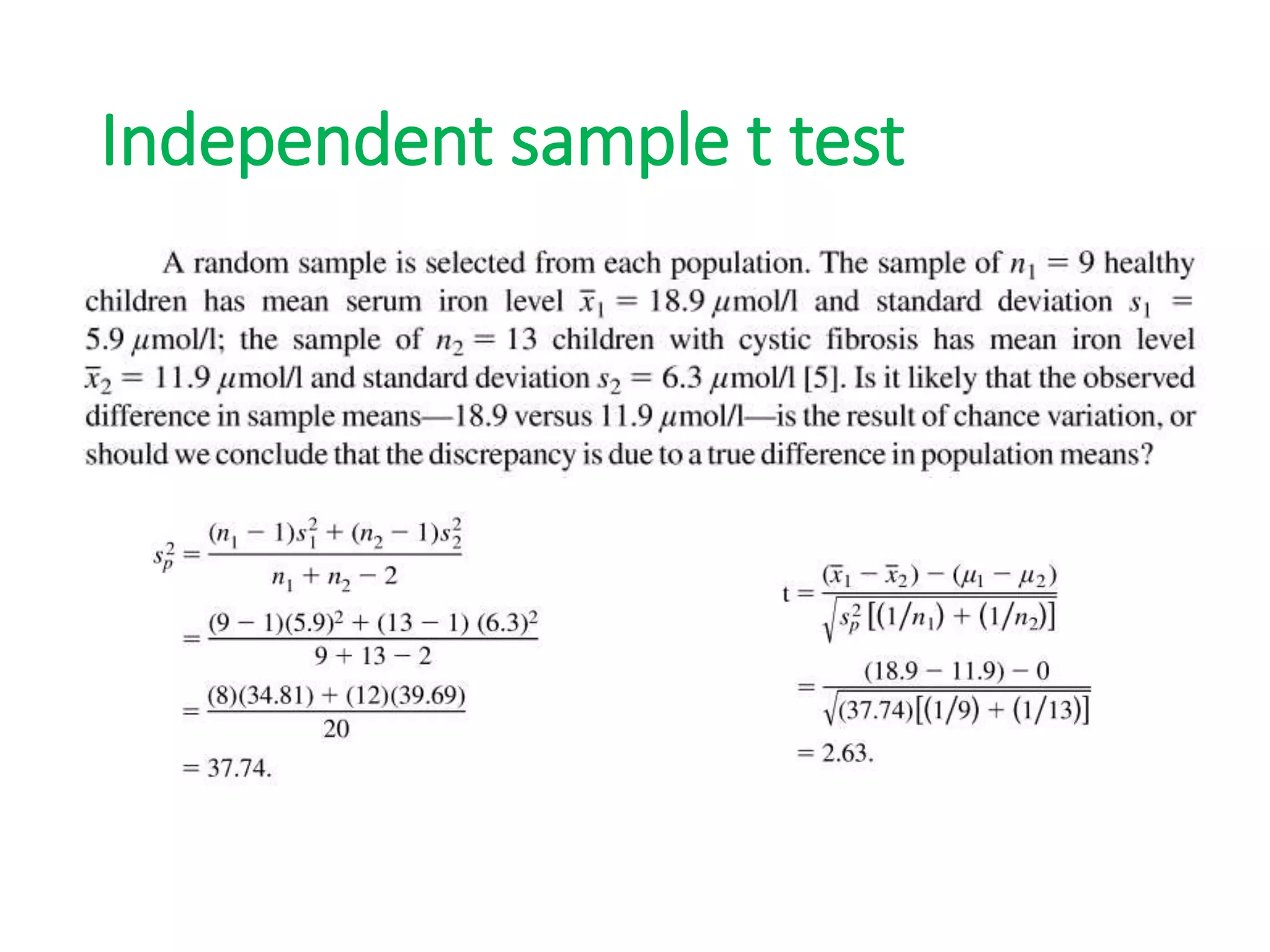
• Degree of freedom =9+13-2 =20
• T20=2.086 (from table)
• Calculated t statistic=2.63
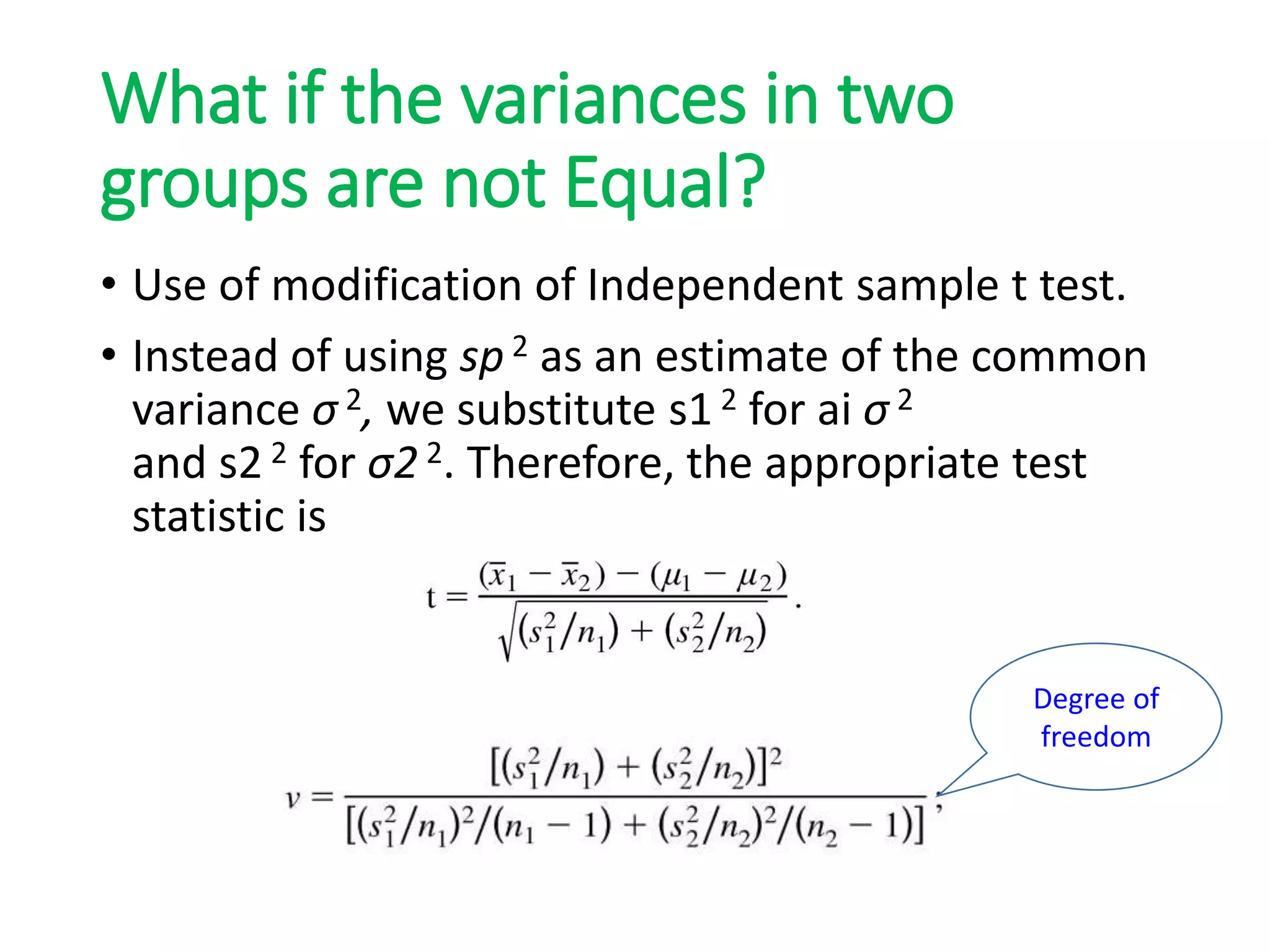
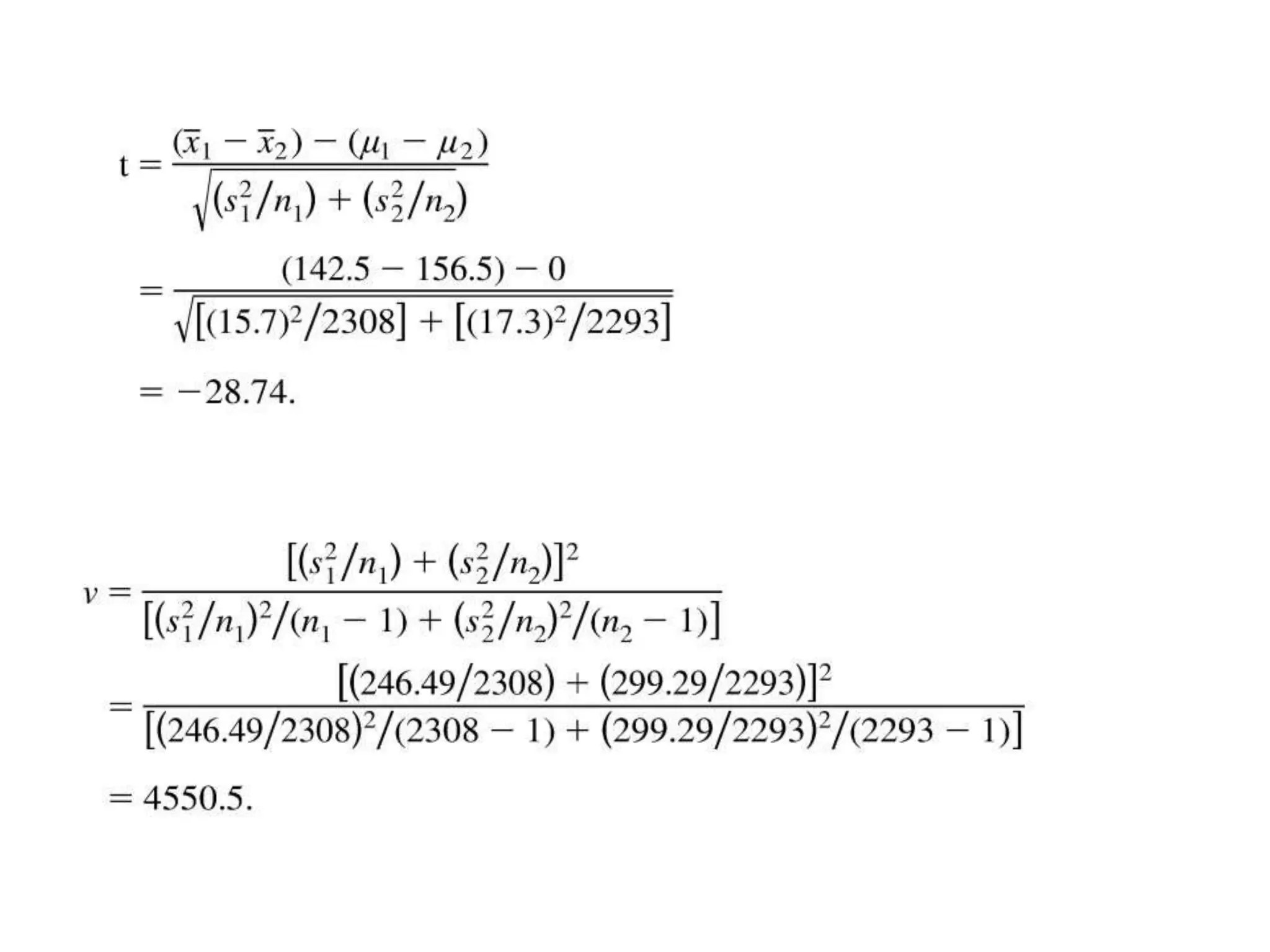
What if the variances in two
groups are not Equal?
• Use of modification of Independent sample t test.
• Instead of using sp 2 as an estimate of the common
variance σ 2, we substitute s1 2 for ai σ 2
and s2 2 for σ2 2. Therefore, the appropriate test
statistic is
Degree of
freedom
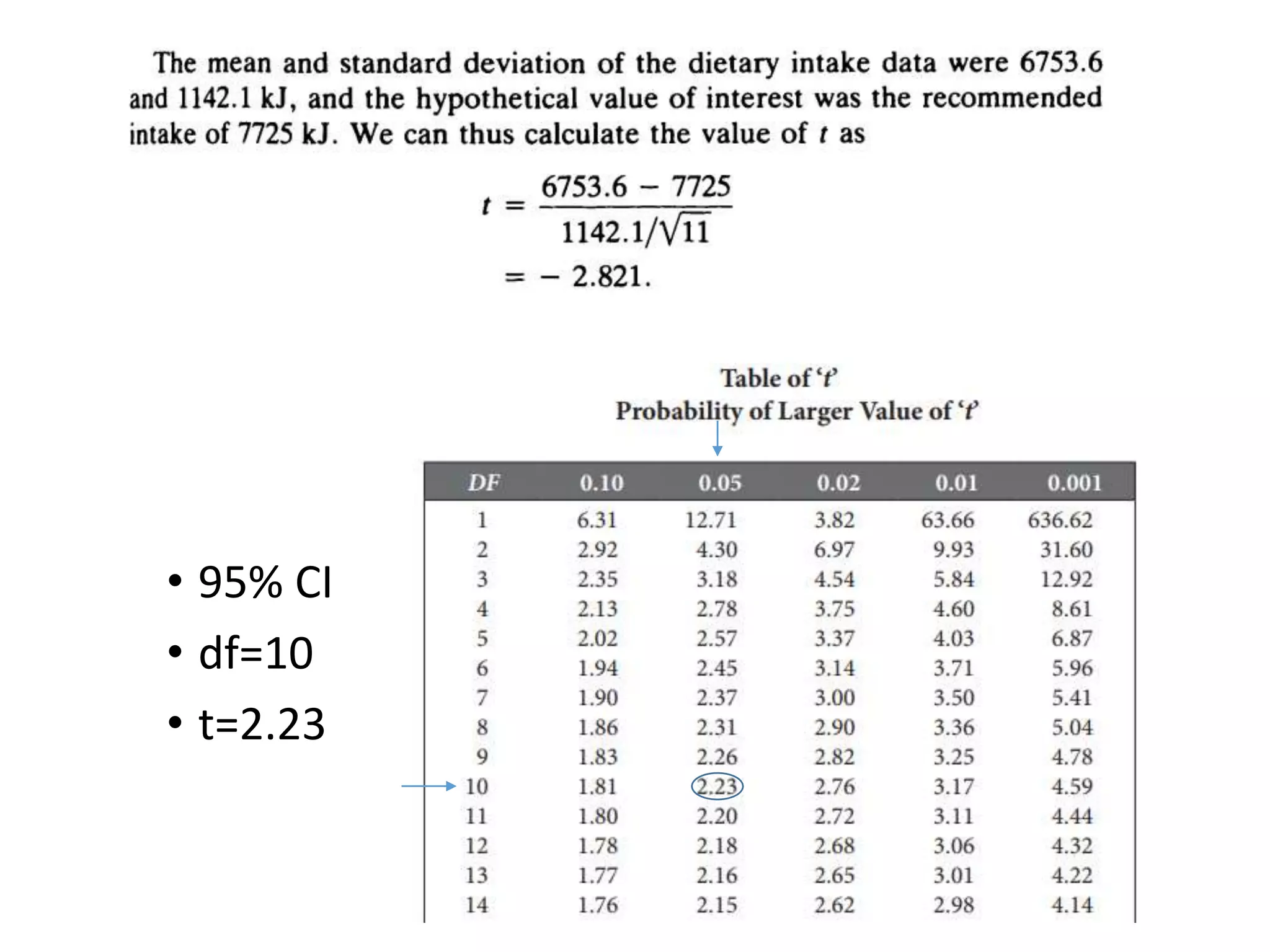
One Sample t test
• It is used for test of the null hypothesis that our
data are a sample from a population with a specific
'hypothesized' mean.
• Test statistic(t):
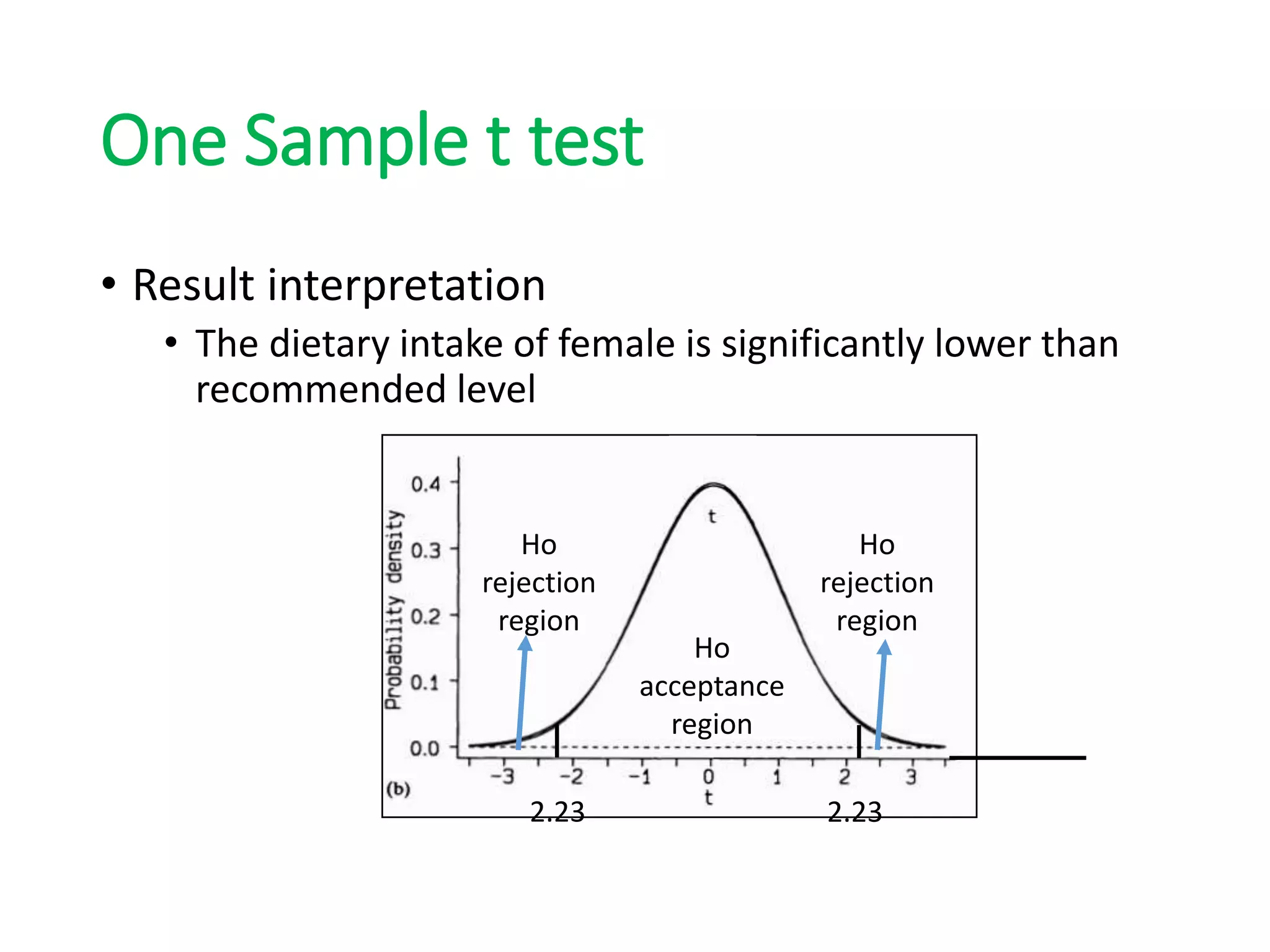
Ho: there is no difference in dietary intake from recommended level.
Ha: there is difference in dietary intake from recommended level.
• 95% CI
• df=10
• t=2.23
One Sample t test
• Result interpretation
• The dietary intake of female is significantly lower than
recommended level
Ho
acceptance
region
Ho
rejection
region
Ho
rejection
region
2.23 2.23
References
• Altman, A practical statistics for medical research,
8th edition, 1999
• Mahajan’s Methods in Biostatistics for medical
students and research works. 8th edition,2016
• Medical statistics-Text book for health sciences, 4th
edition, 2007
• Principles of Biostatistics, Marcello Pagano, 2nd
Edition
• Few internet sites.
Any Queries????
Thank you

t distribution, paired and unpaired t-test

  • 1.
    T Distribution, Paired andUnpaired T test Prepared by: Bikram Adhikari (136) Mean Comparison between 2 groups
  • 2.
    A bit ofHistory • W.A. Gassit (1905) first published a t-test. • He worked at the Guiness Brewery in Dublin and published under the name Student. • The test was called Student Test later shortened to t test
  • 3.
    T Distribution • AkaStudent’s T distribution • A probability distribution that is used to estimate population parameters when the sample size is small and/or when the population variance is unknown.
  • 4.
    T Distribution • IfX is normally distributed and a sample of size n is randomly chosen from this underlying population, the probability distribution of the random variable is known as Student's t distribution with n- 1 degrees of freedom.
  • 5.
    Properties of tDistribution • The mean of distribution is ZERO. • It is symmetrical about the mean. • In general, it has a variance greater than 1, but the variance approaches 1 as the sample size becomes large. • The variable t ranges from -∞ to +∞ Ho rejectio n region
  • 6.
    Similarities with Normal Distribution •Both are uni-modal • Symmetric around is mean of zero • Total area of the curve is One.
  • 7.
    Difference between tand normal distribution • Compared to the normal distribution, the t distribution is less peaked in the center and has thicker tails.
  • 8.
    When to Usethe t Distribution? • The t distribution can be used with any statistic having a bell-shaped distribution • Quantative data, random samples • The population distribution is normal. • The population distribution is symmetric, unimodal, without outiers, and the sample size is at most 30. • The population distribution is moderately skewed, unimodal, without outliers, and the sample size is at most 40.
  • 9.
    Application of ttest • T test can be applied if: • Samples are randomly selected from population • There is homogeneity of variance in sample • It is applied to find the significance of difference between two means as: • Unpaired t-test • Paired t-test.
  • 10.
    Statistical methods fordifferences or paired samples
  • 11.
    Statistical methods forcomparing two independent groups or samples
  • 12.
    Standard Error ofMean • Difference between sample estimates of statistics and population parameter is measured by standard error • Standard error is a measure of chance variation and it does not mean error or mistake • Calculation of standard error of mean:
  • 13.
    Standard Error ofdifference between Means • Frequency distribution of difference give a normal curve. • The standard deviation of a distribution of differences is known as standard error of difference between two means. • Calculation of standard error of difference between two means:
  • 14.
    Degree of Freedom(df) • Degrees of freedom depends on two factors: • No. of groups we wish to compare • No. of parameters we need to estimate to calculate the standard deviation of the contrast of interest. • For paired t test: df=n-1 • For one sample t test: df=n-1 • For two sample t test: df=2n-2
  • 15.
    Paired t test •Two groups of paired observations, x11, x12, . . . , x1n in Group 1 and x21, x22, . . . , x2n in Group 2 such that x1i is paired with x2i and the difference between them, di = x1i - x2i. • Assumptions • The di’s are plausibly Normally distributed. It is not essential for the original observations to be Normally distributed • The di’s are independent of each other.
  • 16.
    Paired t test •Steps • Hypothesis generation: • Null Hypothesis: mean difference is zero • Alternative Hypothesis: mean difference in the population is not zero. • Calculate the differences di = x1i - x2i, i = 1 to n. • Calculate the mean difference (d) and standard deviation, (Sd) of the differences di. • Calculate the standard error of the mean difference • Calculate the test statistic
  • 17.
    Paired t test •Steps • Find the degrees of freedom. • df=n-1 • Refer 't' table and find the probability of the calculated ‘t’ corresponding to n – 1 degrees of freedom. • Result
  • 18.
    Paired t test Problem •Systolic blood pressure (SBP) of 9 normal individuals, who had been recumbent for 5 minutes was taken. Then 2 ml of 0.5% solution of hypotensive drug was given and blood pressure recorded again. Did the injection of drug lower the blood pressure?
  • 19.
    Paired t test •Hypothesis: • Ho: no mean difference • Ha: mean difference • Calculate differences • Calculation of mean difference: • Calculate Sd of mean difference:
  • 20.
    Paired t test •Calculate standard error of mean difference: • Calculate test statistic • Degree of freedom: n-1=9-1=8
  • 21.
    Paired t test •Find the probability of the calculated ‘t’ corresponding to 8 degrees of freedom and 5% significance limit. • T=2.31 2.20
  • 22.
    Paired t test •Test statistic lies in rejection region. • Ho is rejected • It means there is significant difference between means at 5% cl. Ho acceptance region Ho rejection region Ho rejection region 2.31 2.31 5.
  • 23.
    Unpaired t test •One Sample t test • Independent two Sample t test
  • 24.
    Independent sample ttest • The independent samples t-test is used to test for a difference in the mean value of a continuous variable between two groups. • Assumptions • The groups are independent. • The variables of interest are continuous • The data in both groups have similar standard deviations • Homogeneity of variance • The data is Normally distributed in both groups.
  • 25.
    Homogeneity of variancetest • Levene’s test • This tests whether the variances of two samples are approximately equal or not. • We want levene’s test to be not significant • Ho: Variance are equal • Ha: Variances are not equal • Note: As long as N>30, n1 nearly=to n2, there is robust to violations of homogeneity of variance
  • 26.
    Independent sample ttest • Steps • Generate hypothesis • Ho: no difference in two means • Ha: there is difference in two means • Calculate mean difference between groups • Calculate pooled standard deviations • Calculate the standard error of the difference between two means
  • 27.
    Independent sample ttest • Calculate the test statistic • Calculate degree of freedom: df=n1+n2-2 • Refer 't' table and find the probability of the calculated ‘t’ corresponding to 2n – 2 degrees of freedom. • Result interpretation
  • 28.
  • 29.
    Independent sample ttest • Degree of freedom =9+13-2 =20 • T20=2.086 (from table) • Calculated t statistic=2.63
  • 30.
    What if thevariances in two groups are not Equal? • Use of modification of Independent sample t test. • Instead of using sp 2 as an estimate of the common variance σ 2, we substitute s1 2 for ai σ 2 and s2 2 for σ2 2. Therefore, the appropriate test statistic is Degree of freedom
  • 33.
    One Sample ttest • It is used for test of the null hypothesis that our data are a sample from a population with a specific 'hypothesized' mean. • Test statistic(t): Ho: there is no difference in dietary intake from recommended level. Ha: there is difference in dietary intake from recommended level.
  • 34.
    • 95% CI •df=10 • t=2.23
  • 35.
    One Sample ttest • Result interpretation • The dietary intake of female is significantly lower than recommended level Ho acceptance region Ho rejection region Ho rejection region 2.23 2.23
  • 36.
    References • Altman, Apractical statistics for medical research, 8th edition, 1999 • Mahajan’s Methods in Biostatistics for medical students and research works. 8th edition,2016 • Medical statistics-Text book for health sciences, 4th edition, 2007 • Principles of Biostatistics, Marcello Pagano, 2nd Edition • Few internet sites.
  • 37.

Editor's Notes

  • #4 Almost identical to Normal Distribution Curve, but a bit shorter and fatter.
  • #8 The distributions with smaller degrees of freedom are more spread out; as df increases, the t distribution approaches the standard normal. This occurs because as the sample size increases, s becomes a more reliable estimate of a; if n is very large, knowing the value of sis nearly equivalent to knowing a.
  • #10 To test the homogeneity of variances. Fisher’s F-test also called variance ratio test is applied.
  • #11 Normality testing is done before selecting parametric and non parametric tests
  • #13 The difference occurs between sample and population parameter because of chance or biological variability. This difference is measured by SE.
  • #15 (The degrees of freedom are n - 1 rather than n because we lose 1 df by estimating the sample mean. n- 1 is the quantity by which we divided the sum of the squared deviations around the mean, I;=I (x;- x)l, in order to obtain the sample variance . concept of degrees of freedom is one of the more elusive statistical ideas.
  • #16 It is useful to paired data of dependent observation from one sample only when each individual given a pair of observations.
  • #25 Pros and con’s of Independent groups: Pros: mathematically simpler Cons: Group may differ in other ways Matching/Random assign to groups/Use of multivariate analysis
  • #31 Under the null hypothesis, we can approximate the distribution of t by a t distribution with v degrees of freedom. As usual, we compare the value of the statistic to the critical values in Table A.4-or use a computer program-to decide whether or not we should reject H0 .
  • #33 Rejection of null hypothesis