SALES BUDGET ,FORCASTING AND CONTROLBy:-     Jitendra Singh     Roll No. - 19     PGDM IV SEM
Sales BudgetA budget is a plan expressed usually in monetary terms. It is a process of allocating a portion of an organization’s resources for its various activities for a specified period of time.
It helps in planning and coordination of the organization’s activities. Sales budgets are developed for the smooth functioning of the sales function.Cont.Developing sales budgets serve two purposes –
As a mechanism of control and
An instrument of planning.    There are several benefits an organization derives from budgeting.
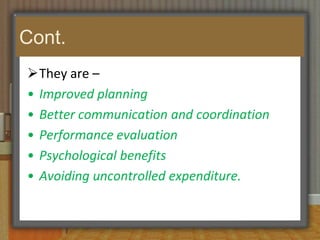
Cont.They are –Improved planningBetter communication and coordinationPerformance evaluationPsychological benefits Avoiding uncontrolled expenditure.
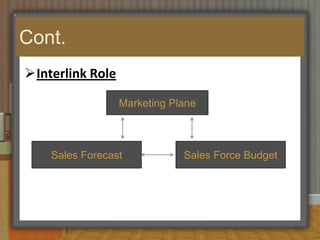
Cont.Interlink RoleMarketing PlaneSales Force BudgetSales Forecast
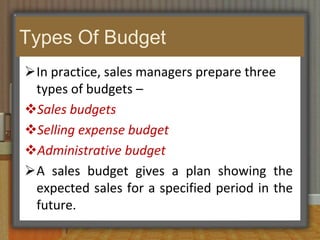
Types Of BudgetIn practice, sales managers prepare three types of budgets –
Sales budgets
Selling expense budget
Administrative budget
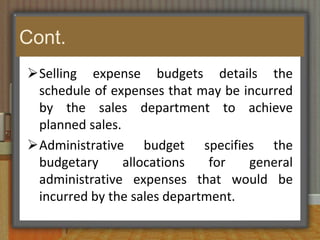
A sales budget gives a plan showing the expected sales for a specified period in the future.Cont.Selling expense budgets details the schedule of expenses that may be incurred by the sales department to achieve planned sales.
Administrative budget specifies the budgetary allocations for general administrative expenses that would be incurred by the sales department.Methods For BudgetingThe different methods for budgeting include the-
Affordability method
Percentage-of-sales method
Competitive parity method
Objective-and-task method
Return-oriented method.Sales ForecastingSales forecasting is a difficult area of management. Most managers believe they are good at forecasting. However, forecasts made usually turn out to be wrong! Marketers argue about whether sales forecasting is a science or an art. The short answer is that it is a bit of both.Cont.Market Forecast refers to the estimates of future sales of a company’s products in the market.
Sales forecasting is very popular in industrially advanced countries where demand conditions are always uncertain than the supply conditions.Reasons for undertaking Sales ForecastBusinesses are forced to look well ahead in order to plan their investments, launch new products, decide when to close or withdraw products and so on.
The sales forecasting process is a critical one for most businesses. Cont.Key decisions that are derived from a sales forecast include:-- Employment levels required- Promotional mix- Investment in production capacity
Types Of ForecastingThere are two major types of forecasting, which can be broadly described as macro and micro:Macro forecasting is concerned with forecasting markets in total. This is about determining the existing level of Market Demand and considering what will happen to market demand in the future.Micro forecasting is concerned with detailed unit sales forecasts. This is about determining a product’s market share in a particular industry and considering what will happen to that market share in the future.
Selection Of Forecasting The selection of which type of forecasting is use depends on the several factors which can be described as:(1) The degree of accuracy required– if the decisions that are to be made on the basis of the sales forecast have high risks attached to them, then it stands to reason that the forecast should be prepared as accurately as possible. However, this involves more cost
Cont.(2) The availability of data and information- in some markets there is a wealth of available sales information (e.g. clothing retail, food retailing, holidays); in others it is hard to find reliable, up-to-date information.(3) The time horizon that the sales forecast is intended to cover. For example, are we forecasting next weeks’ sales, or are we trying to forecast what will happen to the overall size of the market in the next five years?
Cont.(4)The position of the products in its life cycle. For example, for products at the “introductory” stage of the product life cycle, less sales data and information may be available than for products at the “maturity” stage when time series can be a useful forecasting method.
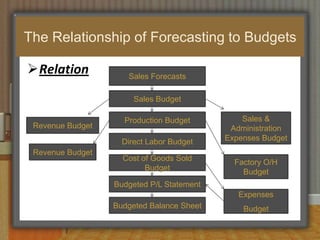
The Relationship of Forecasting to BudgetsRelationSales ForecastsSales BudgetProduction BudgetSales & Administration Expenses BudgetRevenue BudgetDirect Labor BudgetRevenue BudgetCost of Goods Sold BudgetFactory O/H BudgetBudgeted P/L StatementExpensesBudgetBudgeted Balance Sheet
Purposes Of Short term ForecastingAppropriate production schedulingReducing cost of purchasing R/MDetermining appropriate price policySetting sales targets and establishing controls and incentivesEvolving a suitable promotional programForecasting short-term financial requirements
Purposes Of Short term ForecastingPlanning of a new unit or expansion of an existing unitPlanning of long-term financial requirementsPlanning of man-power requirements
A common method of preparing a sales forecast has three stages Prepare a macroeconomic forecast – what will happen to overall economic activity in the relevant economies in which a product is to be sold.Prepare an industry sales forecast – what will happen to overall sales in an industry based on the issues that influence the macroeconomic forecast.Prepare a company sales forecast – based on what management expect to happen to the company’s market share.
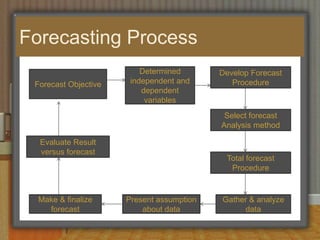
Forecasting ProcessDetermined independent and dependent variablesDevelop Forecast ProcedureForecast ObjectiveSelect forecast Analysis methodEvaluate Result versus forecastTotal forecast ProcedureGather & analyze dataPresent assumption about dataMake & finalize forecast
Cont.Forecasting can be classified into qualitative forecasting and quantitative forecasting. The methods used in qualitative forecasting are:user expectations, sales force composite,jury of executive opinion, Delphi technique and market test.

Sales budget ,forcasting and control

  • 1.
    SALES BUDGET ,FORCASTINGAND CONTROLBy:- Jitendra Singh Roll No. - 19 PGDM IV SEM
  • 2.
    Sales BudgetA budgetis a plan expressed usually in monetary terms. It is a process of allocating a portion of an organization’s resources for its various activities for a specified period of time.
  • 3.
    It helps inplanning and coordination of the organization’s activities. Sales budgets are developed for the smooth functioning of the sales function.Cont.Developing sales budgets serve two purposes –
  • 4.
    As a mechanismof control and
  • 5.
    An instrument ofplanning. There are several benefits an organization derives from budgeting.
  • 6.
    Cont.They are –ImprovedplanningBetter communication and coordinationPerformance evaluationPsychological benefits Avoiding uncontrolled expenditure.
  • 7.
    Cont.Interlink RoleMarketing PlaneSalesForce BudgetSales Forecast
  • 8.
    Types Of BudgetInpractice, sales managers prepare three types of budgets –
  • 9.
  • 10.
  • 11.
  • 12.
    A sales budgetgives a plan showing the expected sales for a specified period in the future.Cont.Selling expense budgets details the schedule of expenses that may be incurred by the sales department to achieve planned sales.
  • 13.
    Administrative budget specifiesthe budgetary allocations for general administrative expenses that would be incurred by the sales department.Methods For BudgetingThe different methods for budgeting include the-
  • 14.
  • 15.
  • 16.
  • 17.
  • 18.
    Return-oriented method.Sales ForecastingSalesforecasting is a difficult area of management. Most managers believe they are good at forecasting. However, forecasts made usually turn out to be wrong! Marketers argue about whether sales forecasting is a science or an art. The short answer is that it is a bit of both.Cont.Market Forecast refers to the estimates of future sales of a company’s products in the market.
  • 19.
    Sales forecasting isvery popular in industrially advanced countries where demand conditions are always uncertain than the supply conditions.Reasons for undertaking Sales ForecastBusinesses are forced to look well ahead in order to plan their investments, launch new products, decide when to close or withdraw products and so on.
  • 20.
    The sales forecastingprocess is a critical one for most businesses. Cont.Key decisions that are derived from a sales forecast include:-- Employment levels required- Promotional mix- Investment in production capacity
  • 21.
    Types Of ForecastingThereare two major types of forecasting, which can be broadly described as macro and micro:Macro forecasting is concerned with forecasting markets in total. This is about determining the existing level of Market Demand and considering what will happen to market demand in the future.Micro forecasting is concerned with detailed unit sales forecasts. This is about determining a product’s market share in a particular industry and considering what will happen to that market share in the future.
  • 22.
    Selection Of ForecastingThe selection of which type of forecasting is use depends on the several factors which can be described as:(1) The degree of accuracy required– if the decisions that are to be made on the basis of the sales forecast have high risks attached to them, then it stands to reason that the forecast should be prepared as accurately as possible. However, this involves more cost
  • 23.
    Cont.(2) The availabilityof data and information- in some markets there is a wealth of available sales information (e.g. clothing retail, food retailing, holidays); in others it is hard to find reliable, up-to-date information.(3) The time horizon that the sales forecast is intended to cover. For example, are we forecasting next weeks’ sales, or are we trying to forecast what will happen to the overall size of the market in the next five years?
  • 24.
    Cont.(4)The position ofthe products in its life cycle. For example, for products at the “introductory” stage of the product life cycle, less sales data and information may be available than for products at the “maturity” stage when time series can be a useful forecasting method.
  • 25.
    The Relationship ofForecasting to BudgetsRelationSales ForecastsSales BudgetProduction BudgetSales & Administration Expenses BudgetRevenue BudgetDirect Labor BudgetRevenue BudgetCost of Goods Sold BudgetFactory O/H BudgetBudgeted P/L StatementExpensesBudgetBudgeted Balance Sheet
  • 26.
    Purposes Of Shortterm ForecastingAppropriate production schedulingReducing cost of purchasing R/MDetermining appropriate price policySetting sales targets and establishing controls and incentivesEvolving a suitable promotional programForecasting short-term financial requirements
  • 27.
    Purposes Of Shortterm ForecastingPlanning of a new unit or expansion of an existing unitPlanning of long-term financial requirementsPlanning of man-power requirements
  • 28.
    A common methodof preparing a sales forecast has three stages Prepare a macroeconomic forecast – what will happen to overall economic activity in the relevant economies in which a product is to be sold.Prepare an industry sales forecast – what will happen to overall sales in an industry based on the issues that influence the macroeconomic forecast.Prepare a company sales forecast – based on what management expect to happen to the company’s market share.
  • 29.
    Forecasting ProcessDetermined independentand dependent variablesDevelop Forecast ProcedureForecast ObjectiveSelect forecast Analysis methodEvaluate Result versus forecastTotal forecast ProcedureGather & analyze dataPresent assumption about dataMake & finalize forecast
  • 30.
    Cont.Forecasting can beclassified into qualitative forecasting and quantitative forecasting. The methods used in qualitative forecasting are:user expectations, sales force composite,jury of executive opinion, Delphi technique and market test.