Metallurgy & Material ScienceDr.S.JoseDept of Mechanical Engg.,TKM College of Engineering, Kollam
2Module IIDiffusion in crystals
Theory of Alloys
Equilibrium Diagram
TTT Diagram
Heat Treatment
Recovery, Recrystallisation & Grain GrowthDiffusionWhat is Diffusion Mechanisms of diffusionVacancyInterstitialSteady-state diffusionNon-steady-state diffusionFick’s laws
What is DiffusionThe phenomenon of material transport by atomic motion.Diffusion couple Cu&Ni is heated to high temperature and cooled.Cu atoms migrated or diffused into Ni and Ni atoms into Cu.The process in which atoms of one metal migrate into another - Inter-diffusion or impurity diffusionDiffusion occurring in  pure metals –atoms exchanging positions- called self diffusion
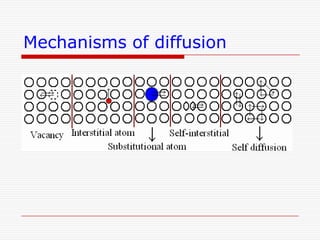
Mechanisms of diffusionDiffusion is a stepwise migration of atoms from lattice site to lattice site.For an atom to make such a move,There must be an empty adjacent site.The atom must have sufficient energy to break bonds with its neighboring atom.Vacancy diffusionInterchange of an atom with an adjacent vacant lattice site. (self- and inter-diffusion)Interstitial diffusionMigration of atoms from an interstitial position to a neighboring empty one.
Mechanisms of diffusion
Diffusion – time function?Steady-state and Non-steady-state diffusion processes are distinguished by the parameter – diffusion flux, J.Flux is defined as number of atoms crossing a unit area perpendicular to a given direction per unit time.Flux has units of atoms/m2.sec or moles/m2.sec.If the flux is independent of time, then the diffusion process is called steady-state diffusion. On the other hand, for non-steady-state diffusion process, flux is dependent on time.
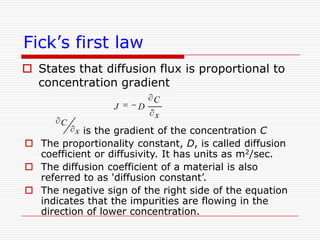
Fick’s first lawStates that diffusion flux is proportional to concentration gradient                 is the gradient of the concentration CThe proportionality constant, D, is called diffusion coefficient or diffusivity. It has units as m2/sec.
The diffusion coefficient of a material is also referred to as 'diffusion constant’. 
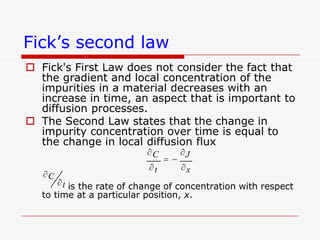
The negative sign of the right side of the equation indicates that the impurities are flowing in the direction of lower concentration.Fick’s second law Fick's First Law does not consider the fact that the gradient and local concentration of the impurities in a material decreases with an increase in time, an aspect that is important to diffusion processes.The Second Law states that the change in impurity concentration over time is equal to the change in local diffusion fluxis the rate of change of concentration with respect to time at a particular position, x.
Theory of alloysWhat is an alloyTypes of alloysSolid solutionSubstitutionalInterstitialIntermetallic compoundsHume – Rothery RulesSuperalloys
AlloysAn alloy is a phase comprising of one or more components.There are three distinguishable types:Substitutional: solute substitutes the solvent in the crystal lattice without structural changes.Interstitial: solute does not occupy the sites in the lattice of the solvent, but resides in crystallographic pores.Transformational: A completely new lattice is formed. Usually occurs as a result of intermetallic compound formation.
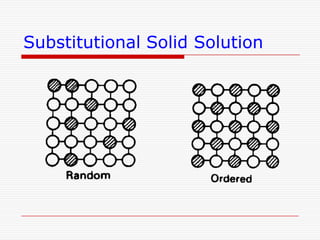
Substitutional Solid SolutionIn substitutional solid solution, the arrangement of the solute atoms may be disordered (random) or ordered.Some alloy systems exhibit complete solid solubility (e.g. Cu-Ni, Cd-Mg), others show only limited solubility at any temperature.Several factors determine the limits of solubility. These are expressed as a series of rules often called Hume-Rothery Rules.
Substitutional Solid Solution
Hume-Rothery RulesThe Hume-Rothery rules are a set of basic rules describing the conditions under which an element could dissolve in a metal, forming a solid solution. There are two sets of rules, one which refers to substitutional solid solutions, and another which refers to interstitial solid solutions.
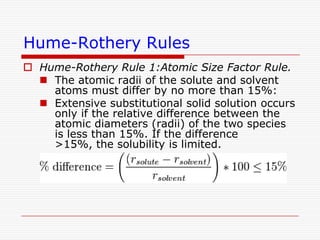
Hume-Rothery RulesHume-Rothery Rule 1:Atomic Size Factor Rule. The atomic radii of the solute and solvent atoms must differ by no more than 15%: Extensive substitutional solid solution occurs only if the relative difference between the atomic diameters (radii) of the two species is less than 15%. If the difference >15%, the solubility is limited.
Hume-Rothery RulesHume-Rothery Rule 2:Crystal Structure Rule .The crystal structures of solute and solvent must match.For appreciable solid solubility, the crystal structures of the two elements must be identical.Hume-Rothery Rule 3: Valency Rule .Maximum solubility occurs when the solvent and solute have the same valency. Metals with lower valency will tend to dissolve metals with higher valency. A metal will dissolve a metal of higher valency to a greater extent than one of lower valency.
Hume-Rothery RulesHume-Rothery Rule 4: The Electronegativity Rule The solute and solvent should have similar electronegativity. If the electronegativity difference is too great, the metals will tend to form intermetallic compounds instead of solid solutions.
Interstitial solid solutionInterstitial solid solutions are formed ifa solute is smaller than the pores in the lattice of a solventa solute has approximately the same electronegativity as a solvent.There are very few elements that create ions, small enough to fit in interstitial positions, therefore, appreciable solubility is rare for interstitial solid solutions.Ions that often may be a solute in solid solutions are: H, Li, Na, B.

Diffusion

  • 1.
    Metallurgy & MaterialScienceDr.S.JoseDept of Mechanical Engg.,TKM College of Engineering, Kollam
  • 2.
  • 3.
  • 4.
  • 5.
  • 6.
  • 7.
    Recovery, Recrystallisation &Grain GrowthDiffusionWhat is Diffusion Mechanisms of diffusionVacancyInterstitialSteady-state diffusionNon-steady-state diffusionFick’s laws
  • 8.
    What is DiffusionThephenomenon of material transport by atomic motion.Diffusion couple Cu&Ni is heated to high temperature and cooled.Cu atoms migrated or diffused into Ni and Ni atoms into Cu.The process in which atoms of one metal migrate into another - Inter-diffusion or impurity diffusionDiffusion occurring in pure metals –atoms exchanging positions- called self diffusion
  • 9.
    Mechanisms of diffusionDiffusionis a stepwise migration of atoms from lattice site to lattice site.For an atom to make such a move,There must be an empty adjacent site.The atom must have sufficient energy to break bonds with its neighboring atom.Vacancy diffusionInterchange of an atom with an adjacent vacant lattice site. (self- and inter-diffusion)Interstitial diffusionMigration of atoms from an interstitial position to a neighboring empty one.
  • 10.
  • 11.
    Diffusion – timefunction?Steady-state and Non-steady-state diffusion processes are distinguished by the parameter – diffusion flux, J.Flux is defined as number of atoms crossing a unit area perpendicular to a given direction per unit time.Flux has units of atoms/m2.sec or moles/m2.sec.If the flux is independent of time, then the diffusion process is called steady-state diffusion. On the other hand, for non-steady-state diffusion process, flux is dependent on time.
  • 12.
    Fick’s first lawStatesthat diffusion flux is proportional to concentration gradient is the gradient of the concentration CThe proportionality constant, D, is called diffusion coefficient or diffusivity. It has units as m2/sec.
  • 13.
    The diffusion coefficientof a material is also referred to as 'diffusion constant’. 
  • 14.
    The negative signof the right side of the equation indicates that the impurities are flowing in the direction of lower concentration.Fick’s second law Fick's First Law does not consider the fact that the gradient and local concentration of the impurities in a material decreases with an increase in time, an aspect that is important to diffusion processes.The Second Law states that the change in impurity concentration over time is equal to the change in local diffusion fluxis the rate of change of concentration with respect to time at a particular position, x.
  • 15.
    Theory of alloysWhatis an alloyTypes of alloysSolid solutionSubstitutionalInterstitialIntermetallic compoundsHume – Rothery RulesSuperalloys
  • 16.
    AlloysAn alloy isa phase comprising of one or more components.There are three distinguishable types:Substitutional: solute substitutes the solvent in the crystal lattice without structural changes.Interstitial: solute does not occupy the sites in the lattice of the solvent, but resides in crystallographic pores.Transformational: A completely new lattice is formed. Usually occurs as a result of intermetallic compound formation.
  • 17.
    Substitutional Solid SolutionInsubstitutional solid solution, the arrangement of the solute atoms may be disordered (random) or ordered.Some alloy systems exhibit complete solid solubility (e.g. Cu-Ni, Cd-Mg), others show only limited solubility at any temperature.Several factors determine the limits of solubility. These are expressed as a series of rules often called Hume-Rothery Rules.
  • 18.
  • 19.
    Hume-Rothery RulesThe Hume-Rotheryrules are a set of basic rules describing the conditions under which an element could dissolve in a metal, forming a solid solution. There are two sets of rules, one which refers to substitutional solid solutions, and another which refers to interstitial solid solutions.
  • 20.
    Hume-Rothery RulesHume-Rothery Rule1:Atomic Size Factor Rule. The atomic radii of the solute and solvent atoms must differ by no more than 15%: Extensive substitutional solid solution occurs only if the relative difference between the atomic diameters (radii) of the two species is less than 15%. If the difference >15%, the solubility is limited.
  • 21.
    Hume-Rothery RulesHume-Rothery Rule2:Crystal Structure Rule .The crystal structures of solute and solvent must match.For appreciable solid solubility, the crystal structures of the two elements must be identical.Hume-Rothery Rule 3: Valency Rule .Maximum solubility occurs when the solvent and solute have the same valency. Metals with lower valency will tend to dissolve metals with higher valency. A metal will dissolve a metal of higher valency to a greater extent than one of lower valency.
  • 22.
    Hume-Rothery RulesHume-Rothery Rule4: The Electronegativity Rule The solute and solvent should have similar electronegativity. If the electronegativity difference is too great, the metals will tend to form intermetallic compounds instead of solid solutions.
  • 23.
    Interstitial solid solutionInterstitialsolid solutions are formed ifa solute is smaller than the pores in the lattice of a solventa solute has approximately the same electronegativity as a solvent.There are very few elements that create ions, small enough to fit in interstitial positions, therefore, appreciable solubility is rare for interstitial solid solutions.Ions that often may be a solute in solid solutions are: H, Li, Na, B.