Advanced Engineering Statistics-IE 5318- Fall 2008-Project1


Report:

Project Proposal:

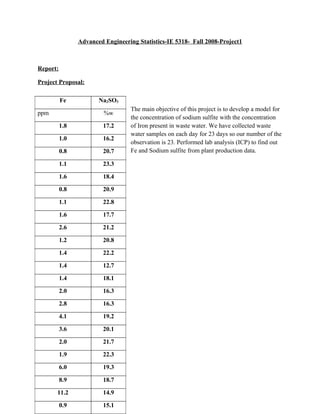
          Fe           Na2SO3
                                  The main objective of this project is to develop a model for
ppm                      %w
                                  the concentration of sodium sulfite with the concentration
          1.8            17.2     of Iron present in waste water. We have collected waste
                                  water samples on each day for 23 days so our number of the
          1.0            16.2
                                  observation is 23. Performed lab analysis (ICP) to find out
          0.8            20.7     Fe and Sodium sulfite from plant production data.

          1.1            23.3

          1.6            18.4

          0.8            20.9

          1.1            22.8

          1.6            17.7

          2.6            21.2

          1.2            20.8

          1.4            22.2

          1.4            12.7

          1.4            18.1

          2.0            16.3

          2.8            16.3

          4.1            19.2

          3.6            20.1

          2.0            21.7

          1.9            22.3

          6.0            19.3

          8.9            18.7

       11.2              14.9

          0.9            15.1
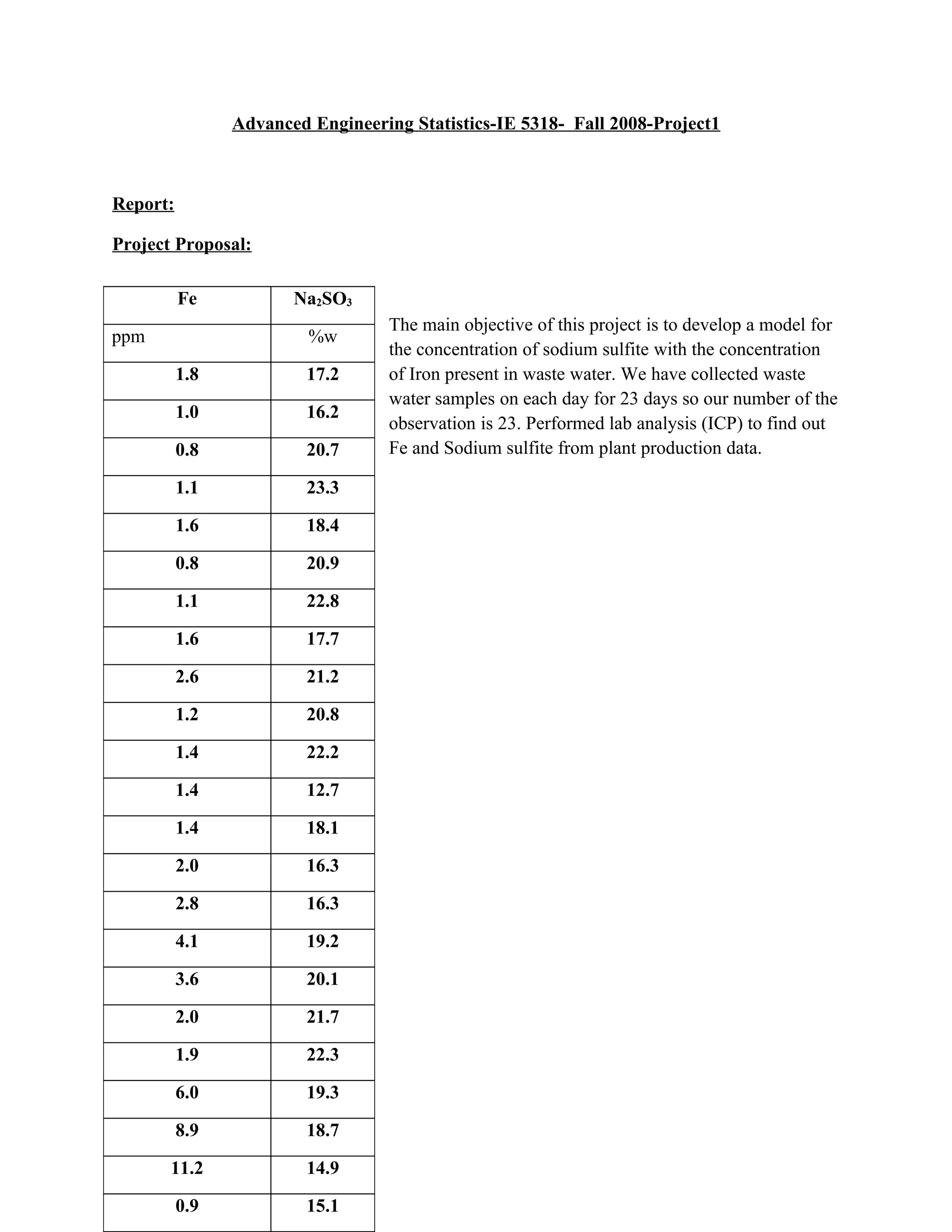
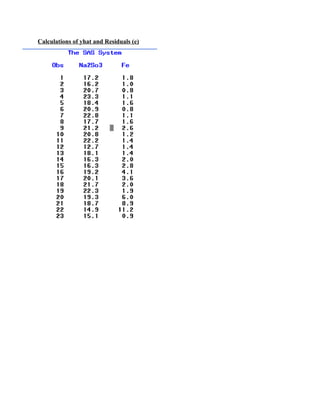
Calculations of yhat and Residuals (e)
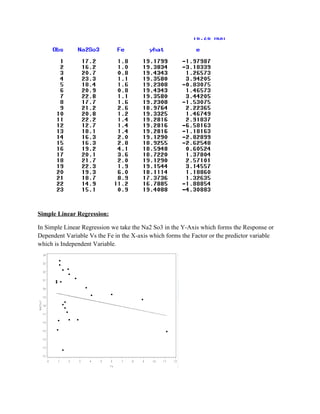
Simple Linear Regression:

In Simple Linear Regression we take the Na2 So3 in the Y-Axis which forms the Response or
Dependent Variable Vs the Fe in the X-axis which forms the Factor or the predictor variable
which is Independent Variable.
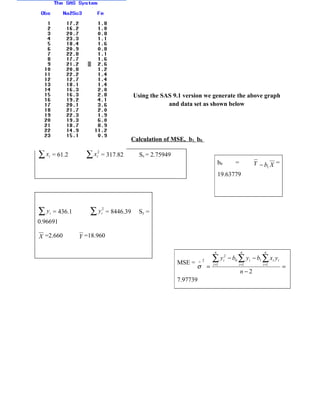
Using the SAS 9.1 version we generate the above graph
                                                          and data set as shown below


                                              Calculation of MSE, b1, b0.

∑x   i   = 61.2      ∑x   2
                          i   = 317.82           Sx = 2.75949
                                                                                     b0          =         Y − b1 X =
                                                                                     19.63779


∑y   i   = 436.1      ∑y      2
                              i   = 8446.39     Sy =
0.96691

X =2.660           Y =18.960

                                                                                 n                   n         n

                                                                MSE =     ∧ 2   ∑y        2
                                                                                          i   − b0 ∑ y i − b1 ∑ xi y i
                                                                        σ =     i =1               i =1       i =1
                                                                                                                         =
                                                                                                     n−2
                                                                7.97739
The Model of SLR:

                          The above equation is explained in as given below.

    Yi = β0 + β1Xi + ξi


 β0 is the y-intercept
 β1 is the slope.
 The random error term ξi = (equation error + measurement error) has a mean E {ξi} = 0
 The constant variance V {ξi} = σ2
 ε is uncorrelated or co-variance Cov(εi, εj) = 0 for all i, j, i ≠ j.
 i = 1, ……, n


Regression Line Fit:

The Regression line fit can be explained as follows:

We find the linearity between the Na2So3 (Response) and Fe (Predictor) by finding the unknown
parameters of β0 and β1 with the values of b0 and b1 respectively.

From our class notes the estimated Regression function is expressed as:
^
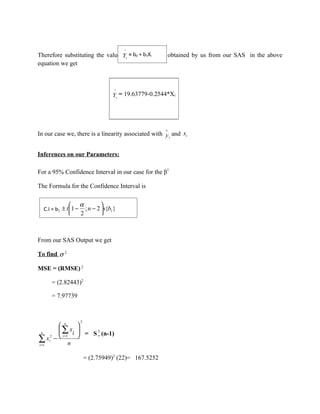
Therefore substituting the valuesYof bb0+andi b1
                                  i
                                    = 0 b1X               obtained by us from our SAS in the above
equation we get


                                       ^
                                      Yi = 19.63779-0.2544*Xi


                                                         ∧
In our case we, there is a linearity associated with y i and xi


Inferences on our Parameters:

For a 95% Confidence Interval in our case for the β1

The Formula for the Confidence Interval is


                     ι         
  C.I = b1 ± t 1 −     ; n − 2  s{b1 }
                     2         


From our SAS Output we get

To find σ 2

MSE = (RMSE) 2

     = (2.82443)2

     = 7.97739


                      2
        n      
       ∑ x          2
        i =1 i  = S x (n-1)
  n

∑ xi − n
i =1
     2


                          = (2.75949)2 (22)= 167.5252
σ2
                               2
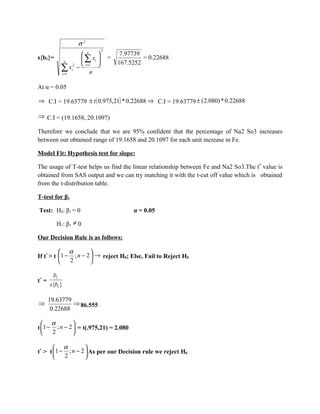
                    n                 7.97739
s{b1}=              ∑ xi         =            = 0.22688
              n                        167.5252
            ∑ xi −  i =1n 
            i =1
                 2


At Îą = 0.05

⇒ C.I = 19.63779 ± t ( 0.975,21) * 0.22688 ⇒ C.I = 19.63779 ± (2.080) * 0.22688

⇒ C.I = (19.1658, 20.1097)

Therefore we conclude that we are 95% confident that the percentage of Na2 So3 increases
between our obtained range of 19.1658 and 20.1097 for each unit increase in Fe.

Model Fit: Hypothesis test for slope:

The usage of T-test helps us find the linear relationship between Fe and Na2 So3.The t* value is
obtained from SAS output and we can try matching it with the t-cut off value which is obtained
from the t-distribution table.

T-test for β1

Test: H0: β1 = 0                            ι = 0.05

          H1: β1 ≠ 0

Our Decision Rule is as follows:

           ι          
If t* > t 1 − ; n − 2  → reject H0; Else, Fail to Reject H0
             2        

        b1
t* =
       s{b1 }

       19.63779
⇒               ⇒ 86.555
        0.22688

   ι          
t 1 − ; n − 2  = t(.975,21) = 2.080
     2        

        ι          
t* > t 1 − ; n − 2  As per our Decision rule we reject H0
          2        
This above decision of ours make us state that we are 95% Confident that our Na2 So3 and
Fe has a Linear Relationship.

Confidence Interval for Y-intercept:

⇒ 100(1-α)% CI for β0.

                                                               _2
Two sided: b0 ± t(1-α/2; n-2) s{b0} ⇒ s {b0}=     MSE{1 / n + X / ∑ () 2

= 0.84339

Applying two sided tests =19.63779Âą t(0.975,21) *0.84339=(17.8835,21.392)

Therefore we conclude that we are 95% confident that the percentage of Na2 So3 increases
between our obtained range of 17.8835 and 21.392 for each unit increase in Fe.

Analysis of Variance:

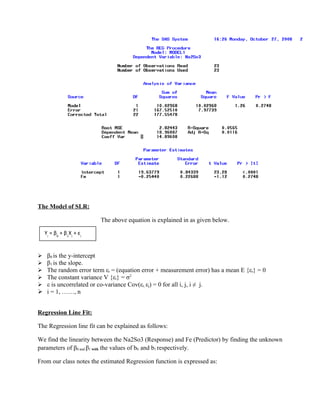
From our SAS OUTPUT,

Regression Sum of Squares (SSR) = 10.02968

Error Sum of Squares (SSE) = 167.5251

Total Sum of Squares (SSTO) =177.55478

Regression Mean square (MSR) = 10.02968

Error Mean Square (MSE) = 7.97739

Coefficient of Determination (R2) = 0.0565

Coefficient of Determination:

R2 = SSR/SSTO = 1-(SSE/SSTO) =0.0565

0 ≤ R2 ≤ 1. It measures the extent to which the regression model fits the data line.

Coefficient of Correlation

r=Âą      R2

     Since the slope ( ) in our model is positive we only consider the positive value of r.

r=     R2

r = 0.2377 ≈ 1
⇒ There is a strong linear relation between the Na2 So3 and the Fe.

ANOVA Table:


Source                 DF             SS                 SS/DF            F           p-value

Regression             1           10.02968           10.02968           1.26             0.2784
Error                  21          167.5251           7.97739
Total                  22          177.55478
Confidence Interval for Mean Response:

1. 95% Confidence Interval for xh= 10


             s{   }    =


                       =    1.76638

            s{    }    = 1.76638

                            ι          
             C.I =     ± t 1 − ; n − 2  * s{    }
                              2        

              = 196.1235 ± (0.975,21)*1.76638 = 196.1235± 2.08*1.76638 ⇒ C.I for xh=10 =
(192.4494, 199.7975)

⇒ We are thus 95% confident that the mean value of the probability distribution of Na2 S03 lies
between 192.4494 and 199.7975 when the xh=10 ppm of Fe.

2.      95% Prediction Interval for xh=10


s{pred} =

                                                                ι          
           = 3.33128                             P.I =     ± t 1 − ; n − 2  * s{pred}
                                                                  2        

                                                      =196.1235 Âą (.975,21)*3.33128
=196.1235 ± 6.929 ⇒ P.I for xh =10 =
(189.1945, 203.0525)

⇒ We predict with 95% confidence that the actual ppm of Fe obtained when the xh=10 ppm of
Fe lies between 189.1235 and 203.0525.

3. 95% Confidence Band for xh= 10

         Âą w s{   }

                  Where       = 2F (1-Îą/2,2,n-2)

                              =2*F (0.95, 2, 21)

                              =2*19.425

                              = 38.85

                              = 6.2329~6.233

                          C.B = 196.1235 Âą 6.233*1.76638

                              = 196.1235 Âą 11.0098

                             =(185.1137,207.1333)

                       ⇒ C.B for xh=10 = (185.1137, 207.1333)


  ⇒ We have 95% confidence that true regression line lies certainly between the upper and
lower band of the CB. So for xh=10 of Fe obtained will lie between 185.1137 and 207.1333


From the above results we infer that CB is wider than CI

     =                        >                      = , which is always true. The Confidence
Band limits for several xh along the range of x:
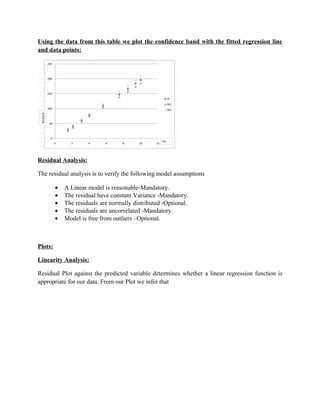
Using the data from this table we plot the confidence band with the fitted regression line
and data points:


Residual Analysis:

The residual analysis is to verify the following model assumptions

         •   A Linear model is reasonable-Mandatory.
         •   The residual have constant Variance -Mandatory.
         •   The residuals are normally distributed -Optional.
         •   The residuals are uncorrelated -Mandatory.
         •   Model is free from outliers –Optional.


Plots:

Linearity Analysis:

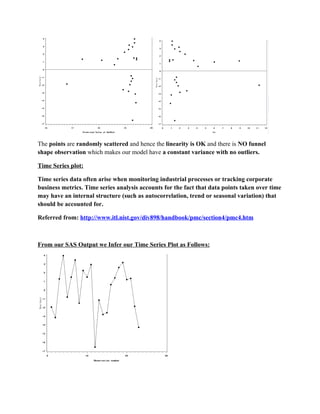
Residual Plot against the predicted variable determines whether a linear regression function is
appropriate for our data. From our Plot we infer that
The points are randomly scattered and hence the linearity is OK and there is NO funnel
shape observation which makes our model have a constant variance with no outliers.

Time Series plot:

Time series data often arise when monitoring industrial processes or tracking corporate
business metrics. Time series analysis accounts for the fact that data points taken over time
may have an internal structure (such as autocorrelation, trend or seasonal variation) that
should be accounted for.

Referred from: http://www.itl.nist.gov/div898/handbook/pmc/section4/pmc4.htm


From our SAS Output we Infer our Time Series Plot as Follows:
The Time Series plot has no Significance in our Analysis, since our data is not based on
time.

Normality Analysis:

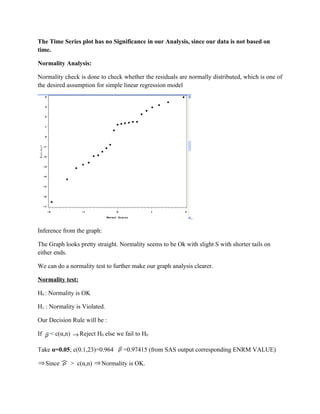
Normality check is done to check whether the residuals are normally distributed, which is one of
the desired assumption for simple linear regression model


                                                             .

Inference from the graph:

The Graph looks pretty straight. Normality seems to be Ok with slight S with shorter tails on
either ends.

We can do a normality test to further make our graph analysis clearer.

Normality test:

H0 : Normality is OK

H1 : Normality is Violated.

Our Decision Rule will be :

If   < c(α,n) → Reject H0 else we fail to H0

Take Îą=0.05; c(0.1,23)=0.964      =0.97415 (from SAS output corresponding ENRM VALUE)

⇒ Since      > c(α,n) ⇒ Normality is OK.
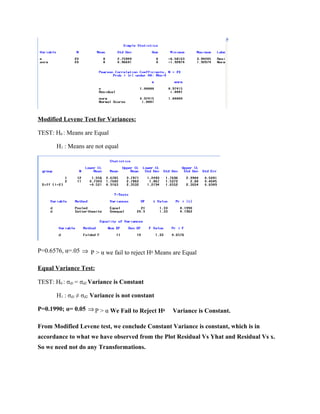
Modified Levene Test for Variances:

TEST: H0 : Means are Equal

       H1 : Means are not equal


P=0.6576, α=.05 ⇒ P > α we fail to reject H0 Means are Equal

Equal Variance Test:

TEST: H0 : σd1 = σd2 Variance is Constant

       H1 : σd1 ≠ σd2 Variance is not constant

P=0.1990; α= 0.05 ⇒ P > α We Fail to Reject H0    Variance is Constant.

From Modified Levene test, we conclude Constant Variance is constant, which is in
accordance to what we have observed from the Plot Residual Vs Yhat and Residual Vs x.
So we need not do any Transformations.
Conclusion:

From all the above tests performed we conclude the following:

There is a linear relation between the Na2So3(Response) and Fe(Predictor).

The fitted regression line in our model is represented by the equation:
         ^
        Y = 19.637739 -0.2544 x
         i


 The T-test further proves that there is a linear regression to relate Na2So3 to Fe. The R value (
   =0.0565) in our model indicates that there is a good fit and it explains everything in estimating
the Na2 So3 considering the Fe as the predictor variable.

We took the significance level as Îą=0.05 to conduct all our tests and our confidence level is
95% for all conclusions.
We calculated the Confidence intervals for the intercept of the regression function and also we
calculated the Confidence interval, Prediction interval and Confidence band for a given
value of ( =10). From the above mentioned calculations, we found that the prediction interval
is wider than the Confidence Interval for the same Confidence level of 95%.We also found that
the Confidence band is wider than the Confidence Interval.

We did Calculate the ANOVA table and found the Degrees of freedom and their corresponding
SSR,SSE,SSTO, MSR,MSE, F*,P-value which gave us the relationship between the Na2So3
and Fe.

We also did find out that the Variances of the error terms were normal and constant and also did
the residual analysis and found that the linearity was Ok with no funnel shape which attributed to
the constant variance. This was further supported by Modified Levene Test which states that
there is a constant Variance with equal means.

We also performed the Normality Test and found out that the Normality is Ok and the plot
suggested that the normality seems to be Ok with slight S with shorter tails on either ends and
got supported with the Normality Test. The plot between the residual and the normal scores
appeared pretty linear.

Statistics Project1

  • 1.
    Advanced Engineering Statistics-IE5318- Fall 2008-Project1 Report: Project Proposal: Fe Na2SO3 The main objective of this project is to develop a model for ppm %w the concentration of sodium sulfite with the concentration 1.8 17.2 of Iron present in waste water. We have collected waste water samples on each day for 23 days so our number of the 1.0 16.2 observation is 23. Performed lab analysis (ICP) to find out 0.8 20.7 Fe and Sodium sulfite from plant production data. 1.1 23.3 1.6 18.4 0.8 20.9 1.1 22.8 1.6 17.7 2.6 21.2 1.2 20.8 1.4 22.2 1.4 12.7 1.4 18.1 2.0 16.3 2.8 16.3 4.1 19.2 3.6 20.1 2.0 21.7 1.9 22.3 6.0 19.3 8.9 18.7 11.2 14.9 0.9 15.1
  • 2.
    Calculations of yhatand Residuals (e)
  • 3.
    Simple Linear Regression: InSimple Linear Regression we take the Na2 So3 in the Y-Axis which forms the Response or Dependent Variable Vs the Fe in the X-axis which forms the Factor or the predictor variable which is Independent Variable.
  • 4.
    Using the SAS9.1 version we generate the above graph and data set as shown below Calculation of MSE, b1, b0. ∑x i = 61.2 ∑x 2 i = 317.82 Sx = 2.75949 b0 = Y − b1 X = 19.63779 ∑y i = 436.1 ∑y 2 i = 8446.39 Sy = 0.96691 X =2.660 Y =18.960 n n n MSE = ∧ 2 ∑y 2 i − b0 ∑ y i − b1 ∑ xi y i σ = i =1 i =1 i =1 = n−2 7.97739
  • 5.
    The Model ofSLR: The above equation is explained in as given below. Yi = β0 + β1Xi + εi  β0 is the y-intercept  β1 is the slope.  The random error term εi = (equation error + measurement error) has a mean E {εi} = 0  The constant variance V {εi} = σ2  ε is uncorrelated or co-variance Cov(εi, εj) = 0 for all i, j, i ≠ j.  i = 1, ……, n Regression Line Fit: The Regression line fit can be explained as follows: We find the linearity between the Na2So3 (Response) and Fe (Predictor) by finding the unknown parameters of β0 and β1 with the values of b0 and b1 respectively. From our class notes the estimated Regression function is expressed as:
  • 6.
    ^ Therefore substituting thevaluesYof bb0+andi b1 i = 0 b1X obtained by us from our SAS in the above equation we get ^ Yi = 19.63779-0.2544*Xi ∧ In our case we, there is a linearity associated with y i and xi Inferences on our Parameters: For a 95% Confidence Interval in our case for the β1 The Formula for the Confidence Interval is  α  C.I = b1 ± t 1 − ; n − 2  s{b1 }  2  From our SAS Output we get To find σ 2 MSE = (RMSE) 2 = (2.82443)2 = 7.97739 2  n  ∑ x  2  i =1 i  = S x (n-1) n ∑ xi − n i =1 2 = (2.75949)2 (22)= 167.5252
  • 7.
    σ2 2  n  7.97739 s{b1}=  ∑ xi  = = 0.22688 n 167.5252 ∑ xi −  i =1n  i =1 2 At α = 0.05 ⇒ C.I = 19.63779 ± t ( 0.975,21) * 0.22688 ⇒ C.I = 19.63779 ± (2.080) * 0.22688 ⇒ C.I = (19.1658, 20.1097) Therefore we conclude that we are 95% confident that the percentage of Na2 So3 increases between our obtained range of 19.1658 and 20.1097 for each unit increase in Fe. Model Fit: Hypothesis test for slope: The usage of T-test helps us find the linear relationship between Fe and Na2 So3.The t* value is obtained from SAS output and we can try matching it with the t-cut off value which is obtained from the t-distribution table. T-test for β1 Test: H0: β1 = 0 α = 0.05 H1: β1 ≠ 0 Our Decision Rule is as follows:  α  If t* > t 1 − ; n − 2  → reject H0; Else, Fail to Reject H0  2  b1 t* = s{b1 } 19.63779 ⇒ ⇒ 86.555 0.22688  α  t 1 − ; n − 2  = t(.975,21) = 2.080  2   α  t* > t 1 − ; n − 2  As per our Decision rule we reject H0  2 
  • 8.
    This above decisionof ours make us state that we are 95% Confident that our Na2 So3 and Fe has a Linear Relationship. Confidence Interval for Y-intercept: ⇒ 100(1-α)% CI for β0. _2 Two sided: b0 ± t(1-α/2; n-2) s{b0} ⇒ s {b0}= MSE{1 / n + X / ∑ () 2 = 0.84339 Applying two sided tests =19.63779± t(0.975,21) *0.84339=(17.8835,21.392) Therefore we conclude that we are 95% confident that the percentage of Na2 So3 increases between our obtained range of 17.8835 and 21.392 for each unit increase in Fe. Analysis of Variance: From our SAS OUTPUT, Regression Sum of Squares (SSR) = 10.02968 Error Sum of Squares (SSE) = 167.5251 Total Sum of Squares (SSTO) =177.55478 Regression Mean square (MSR) = 10.02968 Error Mean Square (MSE) = 7.97739 Coefficient of Determination (R2) = 0.0565 Coefficient of Determination: R2 = SSR/SSTO = 1-(SSE/SSTO) =0.0565 0 ≤ R2 ≤ 1. It measures the extent to which the regression model fits the data line. Coefficient of Correlation r=± R2 Since the slope ( ) in our model is positive we only consider the positive value of r. r= R2 r = 0.2377 ≈ 1
  • 9.
    ⇒ There isa strong linear relation between the Na2 So3 and the Fe. ANOVA Table: Source DF SS SS/DF F p-value Regression 1 10.02968 10.02968 1.26 0.2784 Error 21 167.5251 7.97739 Total 22 177.55478 Confidence Interval for Mean Response: 1. 95% Confidence Interval for xh= 10 s{ } = = 1.76638 s{ } = 1.76638  α  C.I = ± t 1 − ; n − 2  * s{ }  2  = 196.1235 ± (0.975,21)*1.76638 = 196.1235± 2.08*1.76638 ⇒ C.I for xh=10 = (192.4494, 199.7975) ⇒ We are thus 95% confident that the mean value of the probability distribution of Na2 S03 lies between 192.4494 and 199.7975 when the xh=10 ppm of Fe. 2. 95% Prediction Interval for xh=10 s{pred} =  α  = 3.33128 P.I = ± t 1 − ; n − 2  * s{pred}  2  =196.1235 ± (.975,21)*3.33128
  • 10.
    =196.1235 ± 6.929⇒ P.I for xh =10 = (189.1945, 203.0525) ⇒ We predict with 95% confidence that the actual ppm of Fe obtained when the xh=10 ppm of Fe lies between 189.1235 and 203.0525. 3. 95% Confidence Band for xh= 10 ± w s{ } Where = 2F (1-α/2,2,n-2) =2*F (0.95, 2, 21) =2*19.425 = 38.85 = 6.2329~6.233 C.B = 196.1235 ± 6.233*1.76638 = 196.1235 ± 11.0098 =(185.1137,207.1333) ⇒ C.B for xh=10 = (185.1137, 207.1333) ⇒ We have 95% confidence that true regression line lies certainly between the upper and lower band of the CB. So for xh=10 of Fe obtained will lie between 185.1137 and 207.1333 From the above results we infer that CB is wider than CI = > = , which is always true. The Confidence Band limits for several xh along the range of x:
  • 11.
    Using the datafrom this table we plot the confidence band with the fitted regression line and data points: Residual Analysis: The residual analysis is to verify the following model assumptions • A Linear model is reasonable-Mandatory. • The residual have constant Variance -Mandatory. • The residuals are normally distributed -Optional. • The residuals are uncorrelated -Mandatory. • Model is free from outliers –Optional. Plots: Linearity Analysis: Residual Plot against the predicted variable determines whether a linear regression function is appropriate for our data. From our Plot we infer that
  • 12.
    The points arerandomly scattered and hence the linearity is OK and there is NO funnel shape observation which makes our model have a constant variance with no outliers. Time Series plot: Time series data often arise when monitoring industrial processes or tracking corporate business metrics. Time series analysis accounts for the fact that data points taken over time may have an internal structure (such as autocorrelation, trend or seasonal variation) that should be accounted for. Referred from: http://www.itl.nist.gov/div898/handbook/pmc/section4/pmc4.htm From our SAS Output we Infer our Time Series Plot as Follows:
  • 13.
    The Time Seriesplot has no Significance in our Analysis, since our data is not based on time. Normality Analysis: Normality check is done to check whether the residuals are normally distributed, which is one of the desired assumption for simple linear regression model . Inference from the graph: The Graph looks pretty straight. Normality seems to be Ok with slight S with shorter tails on either ends. We can do a normality test to further make our graph analysis clearer. Normality test: H0 : Normality is OK H1 : Normality is Violated. Our Decision Rule will be : If < c(α,n) → Reject H0 else we fail to H0 Take α=0.05; c(0.1,23)=0.964 =0.97415 (from SAS output corresponding ENRM VALUE) ⇒ Since > c(α,n) ⇒ Normality is OK.
  • 14.
    Modified Levene Testfor Variances: TEST: H0 : Means are Equal H1 : Means are not equal P=0.6576, α=.05 ⇒ P > α we fail to reject H0 Means are Equal Equal Variance Test: TEST: H0 : σd1 = σd2 Variance is Constant H1 : σd1 ≠ σd2 Variance is not constant P=0.1990; α= 0.05 ⇒ P > α We Fail to Reject H0 Variance is Constant. From Modified Levene test, we conclude Constant Variance is constant, which is in accordance to what we have observed from the Plot Residual Vs Yhat and Residual Vs x. So we need not do any Transformations.
  • 15.
    Conclusion: From all theabove tests performed we conclude the following: There is a linear relation between the Na2So3(Response) and Fe(Predictor). The fitted regression line in our model is represented by the equation: ^ Y = 19.637739 -0.2544 x i The T-test further proves that there is a linear regression to relate Na2So3 to Fe. The R value ( =0.0565) in our model indicates that there is a good fit and it explains everything in estimating the Na2 So3 considering the Fe as the predictor variable. We took the significance level as Îą=0.05 to conduct all our tests and our confidence level is 95% for all conclusions. We calculated the Confidence intervals for the intercept of the regression function and also we calculated the Confidence interval, Prediction interval and Confidence band for a given value of ( =10). From the above mentioned calculations, we found that the prediction interval is wider than the Confidence Interval for the same Confidence level of 95%.We also found that the Confidence band is wider than the Confidence Interval. We did Calculate the ANOVA table and found the Degrees of freedom and their corresponding SSR,SSE,SSTO, MSR,MSE, F*,P-value which gave us the relationship between the Na2So3 and Fe. We also did find out that the Variances of the error terms were normal and constant and also did the residual analysis and found that the linearity was Ok with no funnel shape which attributed to the constant variance. This was further supported by Modified Levene Test which states that there is a constant Variance with equal means. We also performed the Normality Test and found out that the Normality is Ok and the plot suggested that the normality seems to be Ok with slight S with shorter tails on either ends and got supported with the Normality Test. The plot between the residual and the normal scores appeared pretty linear.