Complex Analysis
( 15UMTC61)
-K.Anitha M.Sc., M.Phil.,
-A.Sujatha M.Sc., M.Phil.,
Department of Mathematics ( SF )
V.V.Vanniaperumal College for Women,
Virudhunagar.
Limits
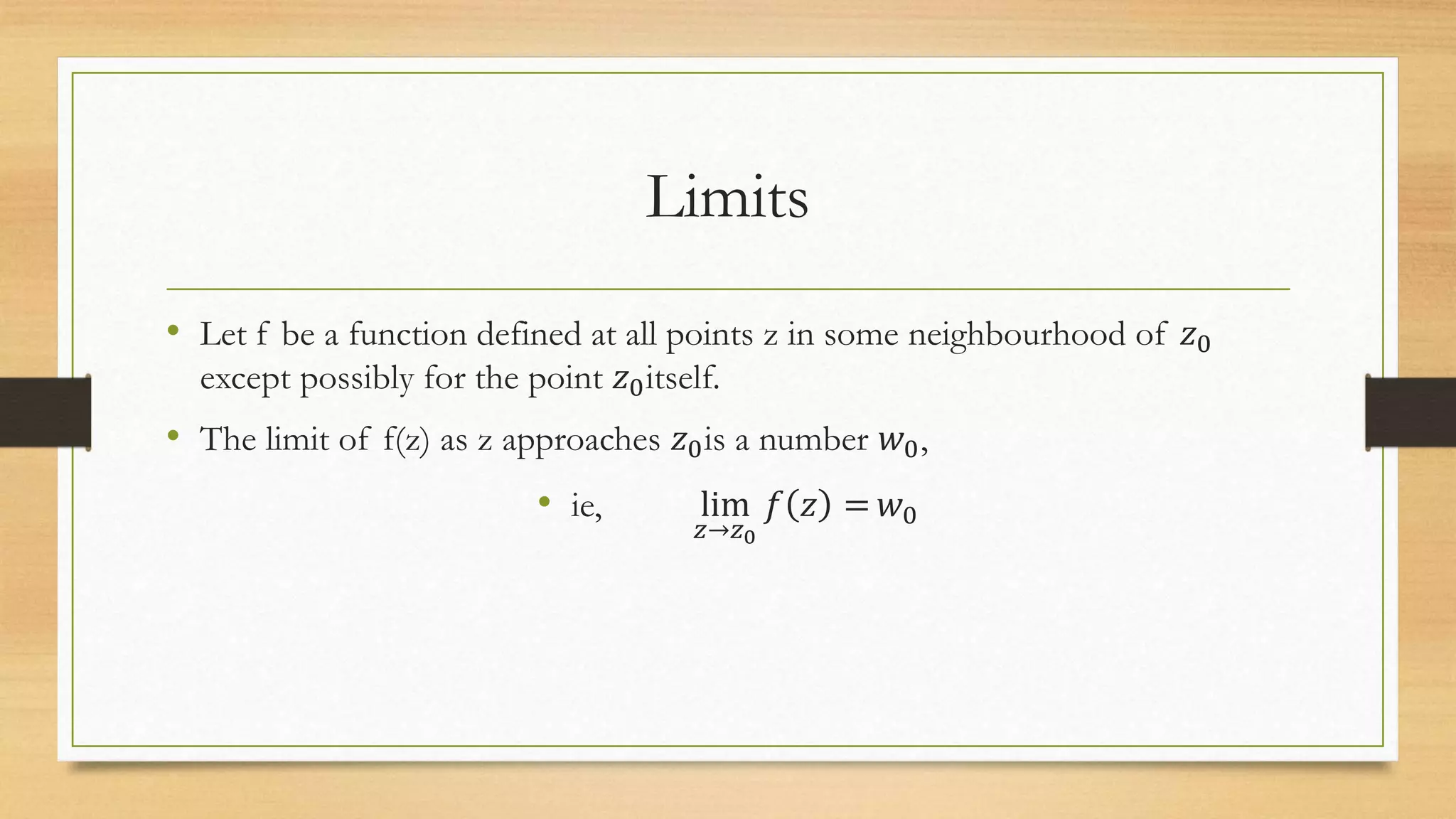
• Let f be a function defined at all points z in some neighbourhood of 𝑧0
except possibly for the point 𝑧0itself.
• The limit of f(z) as z approaches 𝑧0is a number 𝑤0,
• ie, lim
𝑧→𝑧0
𝑓 𝑧 = 𝑤0
Uniqueness of limit
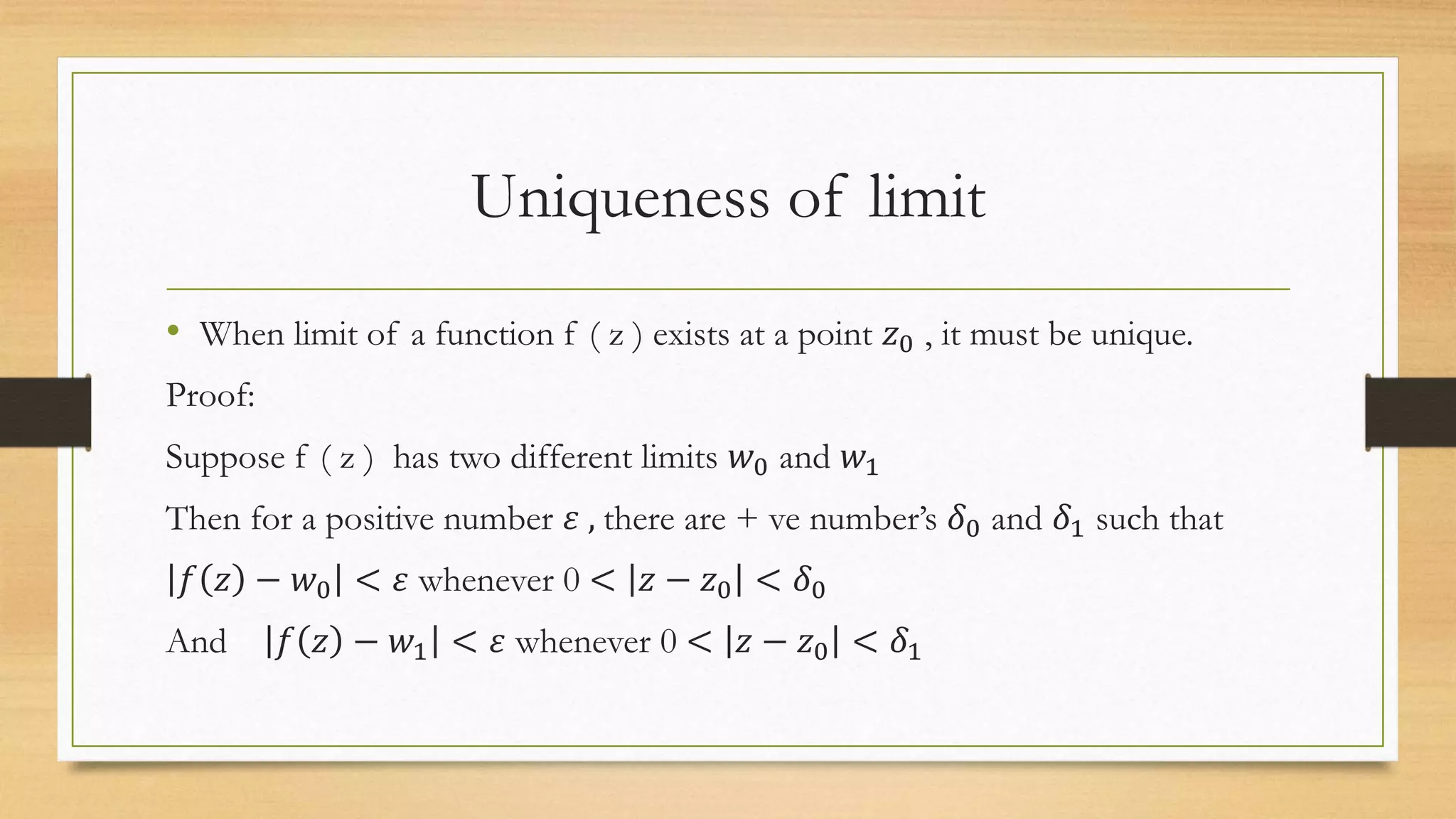
• When limit of a function f ( z ) exists at a point 𝑧0 , it must be unique.
Proof:
Suppose f ( z ) has two different limits 𝑤0 and 𝑤1
Then for a positive number 𝜀 , there are + ve number’s 𝛿0 and 𝛿1 such that
𝑓 𝑧 − 𝑤0 < 𝜀 whenever 0 < 𝑧 − 𝑧0 < 𝛿0
And 𝑓 𝑧 − 𝑤1 < 𝜀 whenever 0 < 𝑧 − 𝑧0 < 𝛿1
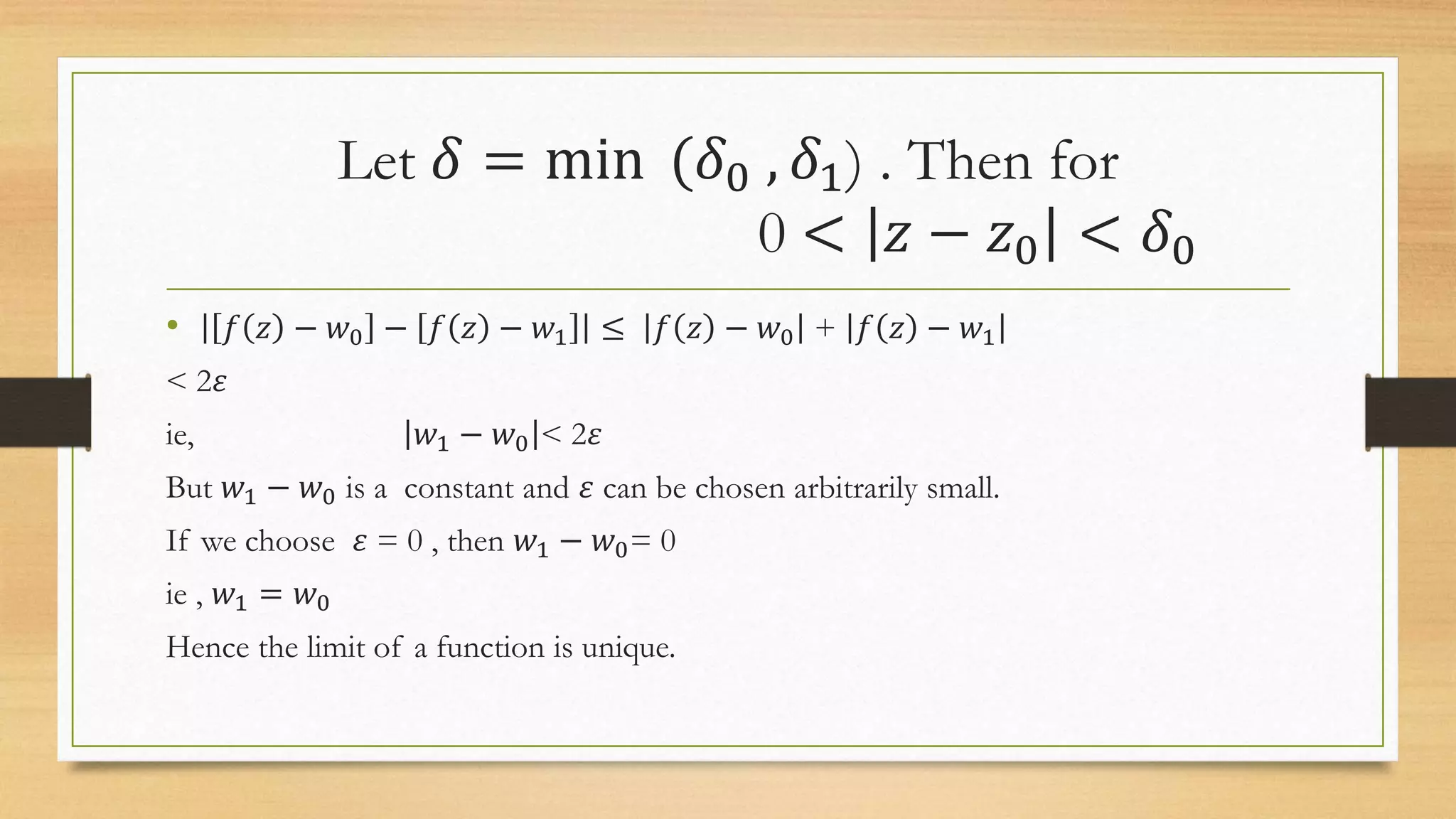
Let 𝛿 = min (𝛿0 , 𝛿1) . Then for
0 < 𝑧 − 𝑧0 < 𝛿0
• 𝑓 𝑧 − 𝑤0 − 𝑓 𝑧 − 𝑤1 ≤ 𝑓 𝑧 − 𝑤0 + 𝑓 𝑧 − 𝑤1
< 2𝜀
ie, 𝑤1 − 𝑤0 < 2𝜀
But 𝑤1 − 𝑤0 is a constant and 𝜀 can be chosen arbitrarily small.
If we choose 𝜀 = 0 , then 𝑤1 − 𝑤0= 0
ie , 𝑤1 = 𝑤0
Hence the limit of a function is unique.
Continuity
• The function f ( z ) is continuous at a point 𝑧0 , if
i) lim
𝑧→𝑧0
𝑓(𝑧) exists
ii) f(𝑧0) exists
iii) lim
𝑧→𝑧0
𝑓(𝑧) = f(𝑧0)
A function of a complex variable is said to be continuous in a region R if it is
continuous at each point in R.
Properties
i) Sum of two continuous functions is a continuous function .
ii) Product of the continuous functions is a continuous function .
iii) Quotient of two continuous functions is continuous where the denominator
not equal to zero.
iv) Polynomial is continuous in the entire plane.
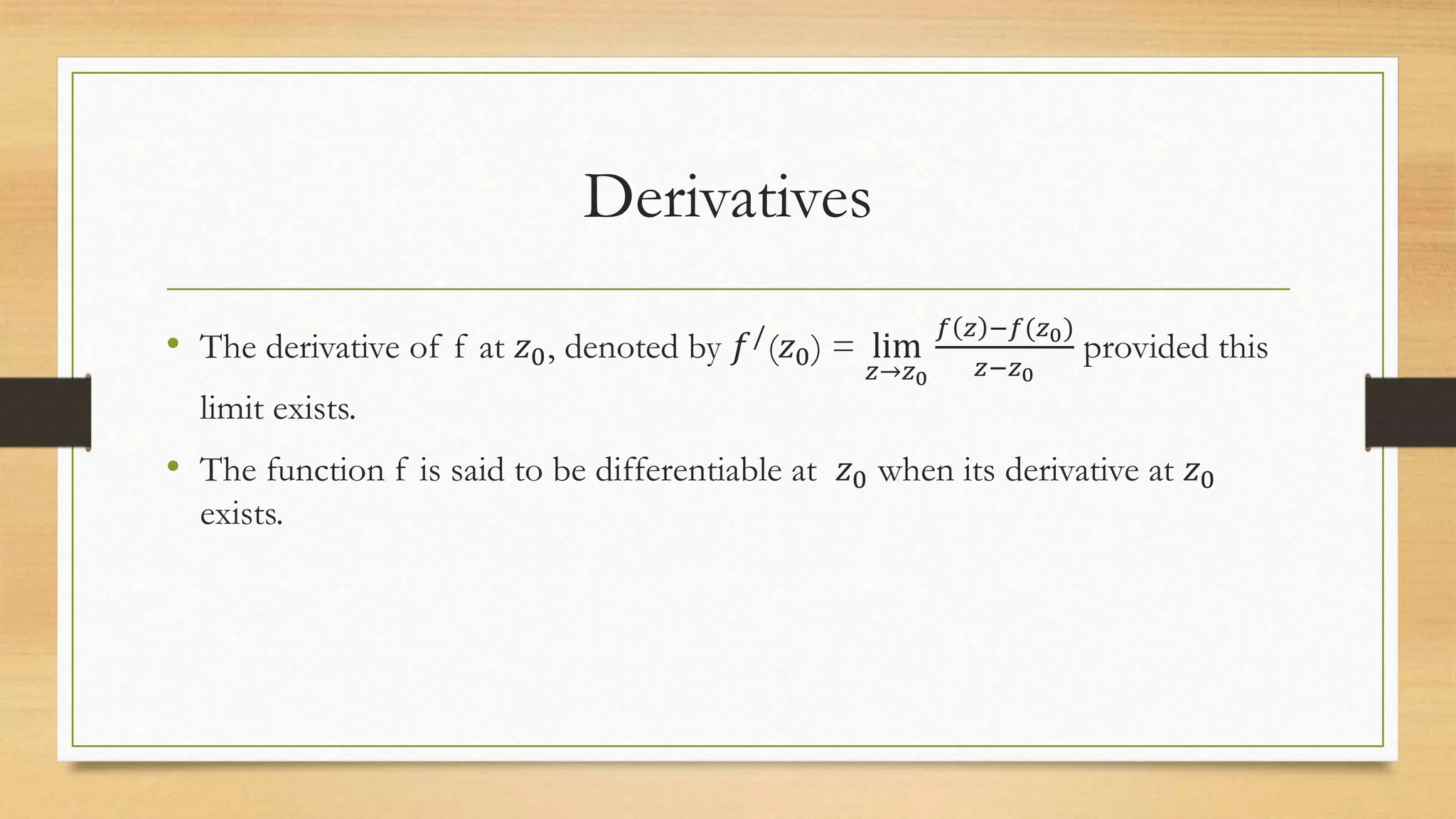
Derivatives
• The derivative of f at 𝑧0, denoted by 𝑓/(𝑧0) = lim
𝑧→𝑧0
𝑓 𝑧 −𝑓(𝑧0)
𝑧−𝑧0
provided this
limit exists.
• The function f is said to be differentiable at 𝑧0 when its derivative at 𝑧0
exists.
Analytic Functions
• A single valued function w = f ( z ) in a domain D is said to be analytic at a
point z = a in a D if there exists a neighbourhood 𝑧 − 𝑎 < 𝛿 at all points
of which the function is differentiable.
Singular Point
The point at which f ( z ) is not differentiable are called singular points of the
function.
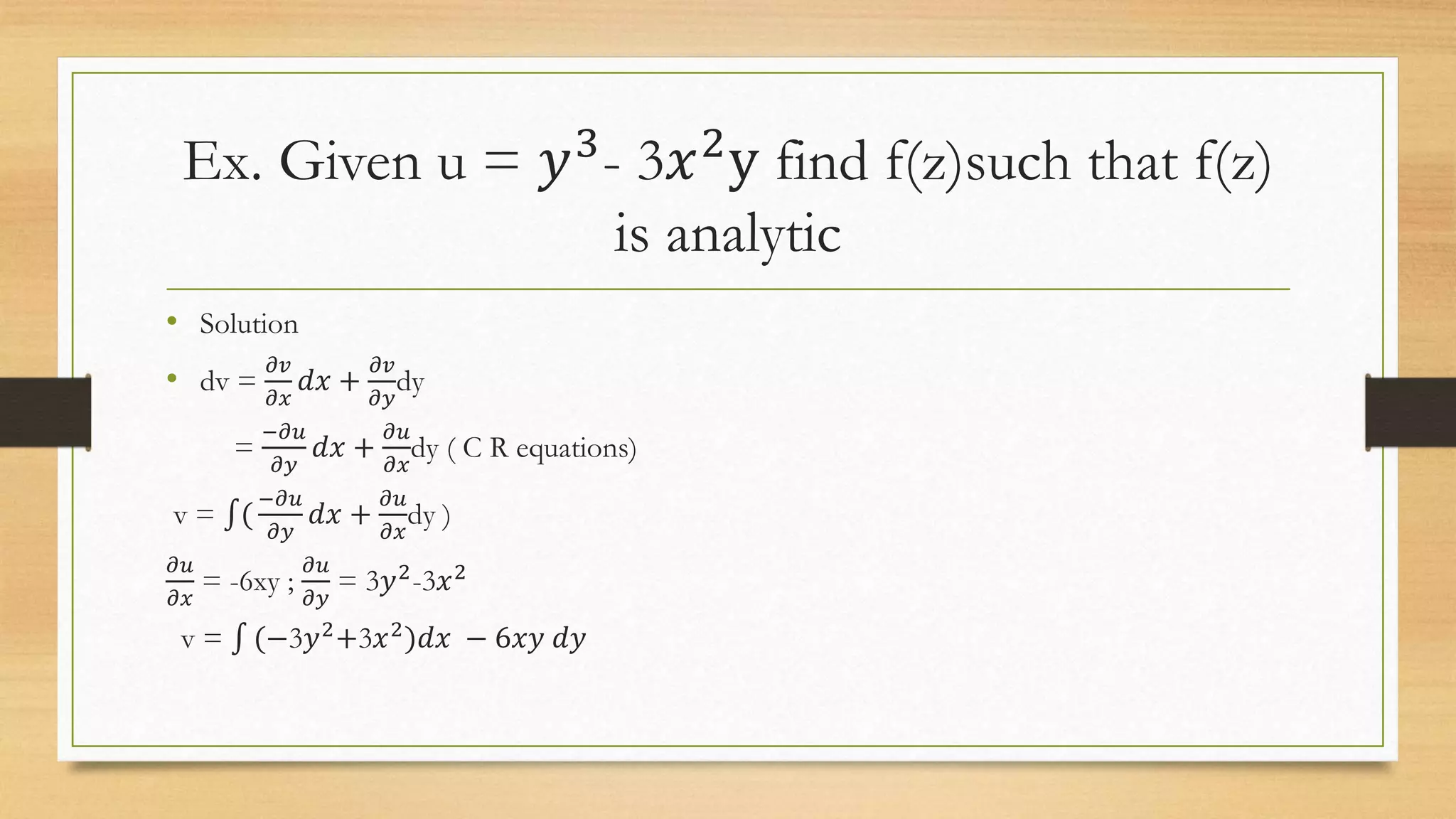
Ex. Given u = 𝑦3
- 3𝑥2
y find f(z)such that f(z)
is analytic
• Solution
• dv =
𝜕𝑣
𝜕𝑥
𝑑𝑥 +
𝜕𝑣
𝜕𝑦
dy
=
−𝜕𝑢
𝜕𝑦
𝑑𝑥 +
𝜕𝑢
𝜕𝑥
dy ( C R equations)
v = (
−𝜕𝑢
𝜕𝑦
𝑑𝑥 +
𝜕𝑢
𝜕𝑥
dy )
𝜕𝑢
𝜕𝑥
= -6xy ;
𝜕𝑢
𝜕𝑦
= 3𝑦2
-3𝑥2
v = (−3𝑦2+3𝑥2)𝑑𝑥 − 6𝑥𝑦 𝑑𝑦
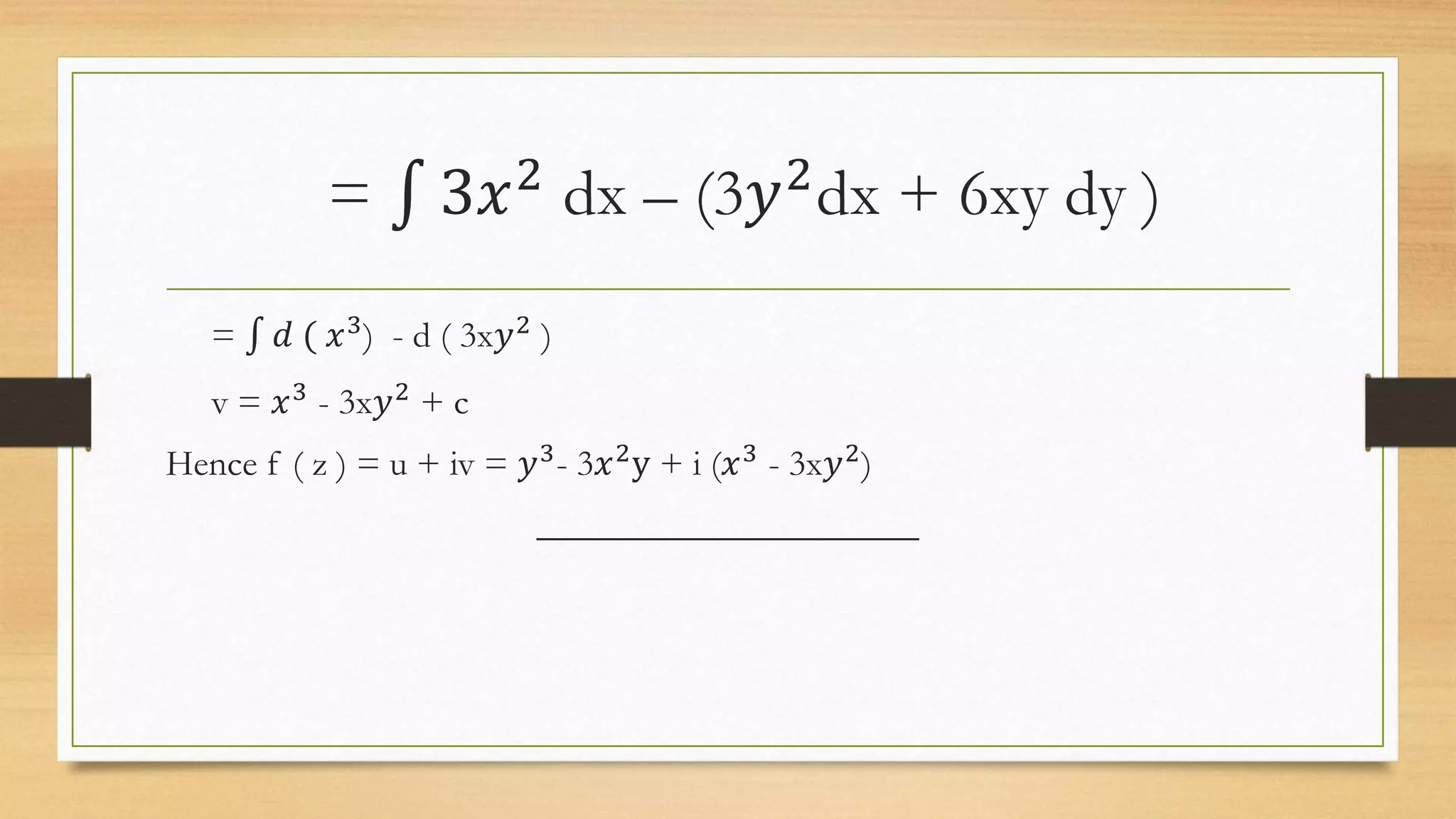
= 3𝑥2
dx – (3𝑦2
dx + 6xy dy )
= 𝑑 ( 𝑥3) - d ( 3x𝑦2 )
v = 𝑥3
- 3x𝑦2
+ c
Hence f ( z ) = u + iv = 𝑦3- 3𝑥2y + i (𝑥3 - 3x𝑦2)
_____________________

Complex analysis

  • 1.
    Complex Analysis ( 15UMTC61) -K.AnithaM.Sc., M.Phil., -A.Sujatha M.Sc., M.Phil., Department of Mathematics ( SF ) V.V.Vanniaperumal College for Women, Virudhunagar.
  • 2.
    Limits • Let fbe a function defined at all points z in some neighbourhood of 𝑧0 except possibly for the point 𝑧0itself. • The limit of f(z) as z approaches 𝑧0is a number 𝑤0, • ie, lim 𝑧→𝑧0 𝑓 𝑧 = 𝑤0
  • 3.
    Uniqueness of limit •When limit of a function f ( z ) exists at a point 𝑧0 , it must be unique. Proof: Suppose f ( z ) has two different limits 𝑤0 and 𝑤1 Then for a positive number 𝜀 , there are + ve number’s 𝛿0 and 𝛿1 such that 𝑓 𝑧 − 𝑤0 < 𝜀 whenever 0 < 𝑧 − 𝑧0 < 𝛿0 And 𝑓 𝑧 − 𝑤1 < 𝜀 whenever 0 < 𝑧 − 𝑧0 < 𝛿1
  • 4.
    Let 𝛿 =min (𝛿0 , 𝛿1) . Then for 0 < 𝑧 − 𝑧0 < 𝛿0 • 𝑓 𝑧 − 𝑤0 − 𝑓 𝑧 − 𝑤1 ≤ 𝑓 𝑧 − 𝑤0 + 𝑓 𝑧 − 𝑤1 < 2𝜀 ie, 𝑤1 − 𝑤0 < 2𝜀 But 𝑤1 − 𝑤0 is a constant and 𝜀 can be chosen arbitrarily small. If we choose 𝜀 = 0 , then 𝑤1 − 𝑤0= 0 ie , 𝑤1 = 𝑤0 Hence the limit of a function is unique.
  • 5.
    Continuity • The functionf ( z ) is continuous at a point 𝑧0 , if i) lim 𝑧→𝑧0 𝑓(𝑧) exists ii) f(𝑧0) exists iii) lim 𝑧→𝑧0 𝑓(𝑧) = f(𝑧0) A function of a complex variable is said to be continuous in a region R if it is continuous at each point in R.
  • 6.
    Properties i) Sum oftwo continuous functions is a continuous function . ii) Product of the continuous functions is a continuous function . iii) Quotient of two continuous functions is continuous where the denominator not equal to zero. iv) Polynomial is continuous in the entire plane.
  • 7.
    Derivatives • The derivativeof f at 𝑧0, denoted by 𝑓/(𝑧0) = lim 𝑧→𝑧0 𝑓 𝑧 −𝑓(𝑧0) 𝑧−𝑧0 provided this limit exists. • The function f is said to be differentiable at 𝑧0 when its derivative at 𝑧0 exists.
  • 8.
    Analytic Functions • Asingle valued function w = f ( z ) in a domain D is said to be analytic at a point z = a in a D if there exists a neighbourhood 𝑧 − 𝑎 < 𝛿 at all points of which the function is differentiable. Singular Point The point at which f ( z ) is not differentiable are called singular points of the function.
  • 9.
    Ex. Given u= 𝑦3 - 3𝑥2 y find f(z)such that f(z) is analytic • Solution • dv = 𝜕𝑣 𝜕𝑥 𝑑𝑥 + 𝜕𝑣 𝜕𝑦 dy = −𝜕𝑢 𝜕𝑦 𝑑𝑥 + 𝜕𝑢 𝜕𝑥 dy ( C R equations) v = ( −𝜕𝑢 𝜕𝑦 𝑑𝑥 + 𝜕𝑢 𝜕𝑥 dy ) 𝜕𝑢 𝜕𝑥 = -6xy ; 𝜕𝑢 𝜕𝑦 = 3𝑦2 -3𝑥2 v = (−3𝑦2+3𝑥2)𝑑𝑥 − 6𝑥𝑦 𝑑𝑦
  • 10.
    = 3𝑥2 dx –(3𝑦2 dx + 6xy dy ) = 𝑑 ( 𝑥3) - d ( 3x𝑦2 ) v = 𝑥3 - 3x𝑦2 + c Hence f ( z ) = u + iv = 𝑦3- 3𝑥2y + i (𝑥3 - 3x𝑦2) _____________________