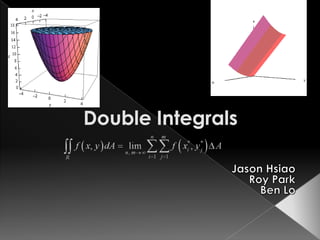
Double IntegralsJason HsiaoRoy ParkBen Lo
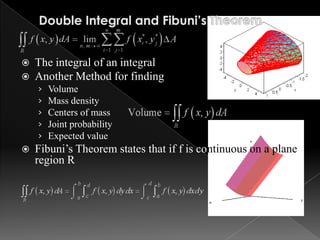
Double Integral and Fibuni’s TheoremThe integral of an integralAnother Method for finding VolumeMass densityCenters of massJoint probabilityExpected valueFibuni’s Theorem states that if f is continuous on a plane region R
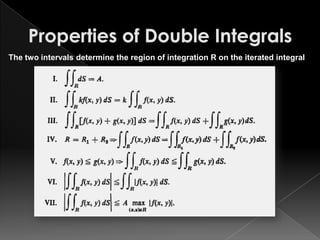
Properties of Double IntegralsThe two intervals determine the region of integration R on the iterated integral
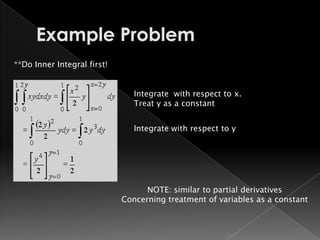
Example Problem**Do Inner Integral first!Integrate  with respect to x. Treat y as a constantIntegrate with respect to yNOTE: similar to partial derivativesConcerning treatment of variables as a constant
Example problem 2∫  ∫  (x2-2y2+1) dxdy∫  [(x3)/3-2y2x+x] |   dy∫  [((64/3)-8y2+4)-(0 -0 +0)] dy[(64y)/3- (8y3)/3+4y] |[(64(2))/3-(8(23)/3+4(2)]-[(64(1))/3-(8(13))/3+4(1)](128-64)/3+(-64+8)/3 +(8-4)64/3-56/3+48/3+420/32140Integrate with respect to x. Treat y as constant214021Integrate with respect to y21
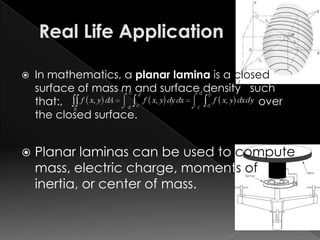
In mathematics, a planar laminais a closed surface of mass m and surface density   such that:,                                                                over the closed surface.Planar laminas can be used to compute mass, electric charge, moments of inertia, or center of mass.Real Life Application
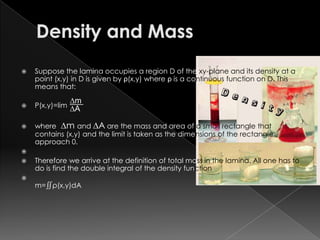
Suppose the lamina occupies a region D of the xy-plane and its density at a point (x,y) in D is given by ρ(x,y) where ρ is a continuous function on D. This means that: Ρ(x,y)=limwhere  ∆m and ∆A are the mass and area of a small rectangle that contains (x,y) and the limit is taken as the dimensions of the rectangle approach 0. Therefore we arrive at the definition of total mass in the lamina. All one has to do is find the double integral of the density function. m=∬ρ(x,y)dADensity and Mass∆m___∆A
Moments of Center of MassThe center of mass of a lamina with density function ρ(x,y) that occupies a region D. To find the center of mass we first have to find the moment of a particle about an axis, which is defined as the product of its mass and its directed distance from the axis. The moment of the entire lamina about the x-axis: Mx=∬yρ(x,y)dA Similarly, the moment about the y-axis: My=∬xρ(x,y)dA You can define the center of mass (α,ŷ) so that  mα=My  and  mŷ=Mx  The physical significance is that the lamina behaves as if its entire mass is concentrated at its center of mass. Thus, the lamina balances horizontally when supported at its center of mass. The coordinates (α,ŷ) of the center of mass of a lamina occupying the region D and having density function ρ(x,y) are: α=  =       ∬xρ(x,y)dA                          ŷ=         =           ∬yρ(x,y)dAMy1__1__My____mmmm
Moment of InertiaThe moment of inertia of a particle of mass m about an axis is defined to be mr^2, where r is the distance from the particle to the axis. We extend this concept to a lamina with density function ρ(x,y) and occupying a region D by proceeding as we did for ordinary moments: we use the double integral:  The moment of inertia of the lamina about the x-axis: Ix =y^2ρ(x,y)dA Similarly the moment about the y-axis is: Iy=x^2ρ(x,y)dA It is also of interest to consider the moment of inertia about the origin, also called the polar moment of inertia: I0=∬(x^2+y^2)ρ(x,y)dA Also notice the following: I0=Ix+Iy

Double Integral Powerpoint

  • 1.
  • 2.
    Double Integral andFibuni’s TheoremThe integral of an integralAnother Method for finding VolumeMass densityCenters of massJoint probabilityExpected valueFibuni’s Theorem states that if f is continuous on a plane region R
  • 3.
    Properties of DoubleIntegralsThe two intervals determine the region of integration R on the iterated integral
  • 4.
    Example Problem**Do InnerIntegral first!Integrate with respect to x. Treat y as a constantIntegrate with respect to yNOTE: similar to partial derivativesConcerning treatment of variables as a constant
  • 5.
    Example problem 2∫ ∫ (x2-2y2+1) dxdy∫ [(x3)/3-2y2x+x] | dy∫ [((64/3)-8y2+4)-(0 -0 +0)] dy[(64y)/3- (8y3)/3+4y] |[(64(2))/3-(8(23)/3+4(2)]-[(64(1))/3-(8(13))/3+4(1)](128-64)/3+(-64+8)/3 +(8-4)64/3-56/3+48/3+420/32140Integrate with respect to x. Treat y as constant214021Integrate with respect to y21
  • 6.
    In mathematics, aplanar laminais a closed surface of mass m and surface density such that:, over the closed surface.Planar laminas can be used to compute mass, electric charge, moments of inertia, or center of mass.Real Life Application
  • 7.
    Suppose the laminaoccupies a region D of the xy-plane and its density at a point (x,y) in D is given by ρ(x,y) where ρ is a continuous function on D. This means that: Ρ(x,y)=limwhere ∆m and ∆A are the mass and area of a small rectangle that contains (x,y) and the limit is taken as the dimensions of the rectangle approach 0. Therefore we arrive at the definition of total mass in the lamina. All one has to do is find the double integral of the density function. m=∬ρ(x,y)dADensity and Mass∆m___∆A
  • 8.
    Moments of Centerof MassThe center of mass of a lamina with density function ρ(x,y) that occupies a region D. To find the center of mass we first have to find the moment of a particle about an axis, which is defined as the product of its mass and its directed distance from the axis. The moment of the entire lamina about the x-axis: Mx=∬yρ(x,y)dA Similarly, the moment about the y-axis: My=∬xρ(x,y)dA You can define the center of mass (α,ŷ) so that mα=My and mŷ=Mx The physical significance is that the lamina behaves as if its entire mass is concentrated at its center of mass. Thus, the lamina balances horizontally when supported at its center of mass. The coordinates (α,ŷ) of the center of mass of a lamina occupying the region D and having density function ρ(x,y) are: α= = ∬xρ(x,y)dA ŷ= = ∬yρ(x,y)dAMy1__1__My____mmmm
  • 9.
    Moment of InertiaThemoment of inertia of a particle of mass m about an axis is defined to be mr^2, where r is the distance from the particle to the axis. We extend this concept to a lamina with density function ρ(x,y) and occupying a region D by proceeding as we did for ordinary moments: we use the double integral:  The moment of inertia of the lamina about the x-axis: Ix =y^2ρ(x,y)dA Similarly the moment about the y-axis is: Iy=x^2ρ(x,y)dA It is also of interest to consider the moment of inertia about the origin, also called the polar moment of inertia: I0=∬(x^2+y^2)ρ(x,y)dA Also notice the following: I0=Ix+Iy