CHAPTER 3
Quantum Mechanics. G. ARULDHAS
Generalized Formalism of
quantum mechanics
Safiya Amer.
Misurata University.
Spring 2010.
Introduction
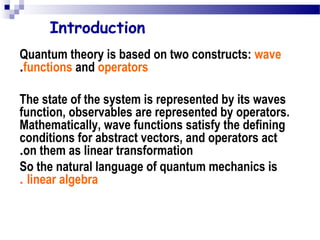
Quantum theory is based on two constructs: wave
functions and operators.
The state of the system is represented by its waves
function, observables are represented by operators.
Mathematically, wave functions satisfy the defining
conditions for abstract vectors, and operators act
on them as linear transformation.
So the natural language of quantum mechanics is
linear algebra.
LINEAR VECTOR SPACE
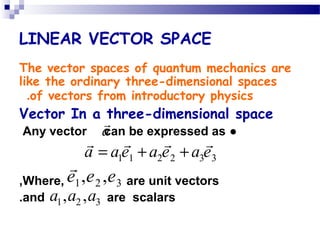
The vector spaces of quantum mechanics are
like the ordinary three-dimensional spaces
of vectors from introductory physics.
Vector In a three-dimensional space
●Any vector can be expressed as
Where, are unit vectors,
and are scalars.
a
r
1 1 2 2 3 3a ae a e a e= + +
r r r r
1 2 3, ,e e e
r
1 2 3, ,a a a
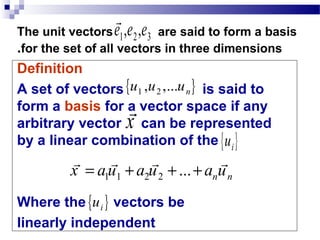
The unit vectors are said to form a basis
for the set of all vectors in three dimensions.
Definition
A set of vectors is said to
form a basis for a vector space if any
arbitrary vector can be represented
by a linear combination of the
Where the vectors be
linearly independent
1 2 3, ,e e e
r
{ }1 2, ,... nu u u
{ }iu
1 1 2 2 ... n nx au a u a u= + + +
r r r r
x
r
{ }iu
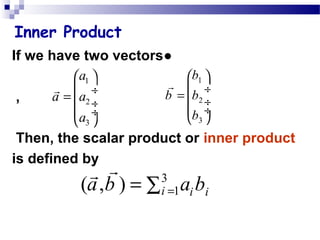
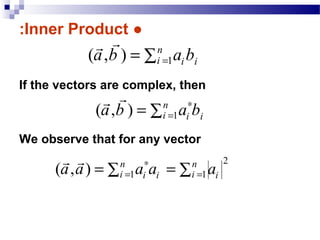
Inner Product
●If we have two vectors
,
Then, the scalar product or inner product
is defined by
1
2
3
a
a a
a
 
 ÷=
 ÷
 ÷
 
r
1
2
3
b
b b
b
 
 ÷=
 ÷
 ÷
 
r
3
1( , ) i i ia b a b== ∑
rr
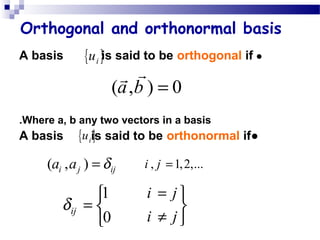
Orthogonal and orthonormal basis
●A basis is said to be orthogonal if
Where a, b any two vectors in a basis.
●A basis is said to be orthonormal if
{ }iu
( , ) 0a b =
rr
{ }iu
( , )i j ija a δ= , 1,2,...i j =
1
0
ijδ

= 

i j
i j
= 

≠ 
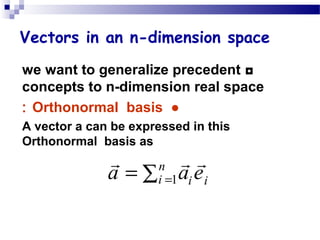
Vectors in an n-dimension space
◘we want to generalize precedent
concepts to n-dimension real space
●Orthonormal basis:
A vector a can be expressed in this
Orthonormal basis as
1
n
i i ia a e== ∑
r r r
●Inner Product:
If the vectors are complex, then
We observe that for any vector
1( , ) n
i i ia b a b∗
== ∑
rr
1( , ) n
i i ia b a b== ∑
rr
2
1 1( , ) n n
i ii i ia a a a a∗
= == =∑ ∑
r r
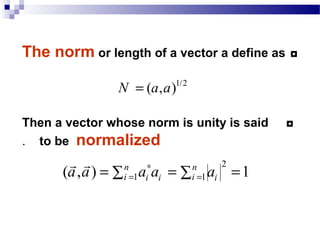
◘The norm or length of a vector a define as
◘Then a vector whose norm is unity is said
to be normalized.
1/2
( , )N a a=
2
1 1( , ) 1n n
i ii i ia a a a a∗
= == = =∑ ∑
r r
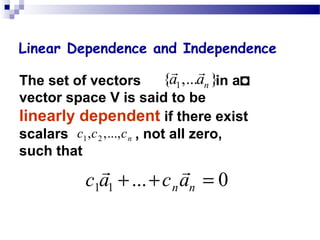
Linear Dependence and Independence
◘The set of vectors in a
vector space V is said to be
linearly dependent if there exist
scalars , not all zero,
such that
1 2, ,..., nc c c
1 1 ... 0n nc a c a+ + =
r r
1{ ,... }na a
r r
◘ The set of vectors is linearly
independent if
can only be satisfied when
1{ ,... }na a
r r
1 1 ... 0n nc a c a+ + =
r r
1 2 ... 0nc c c= = = =
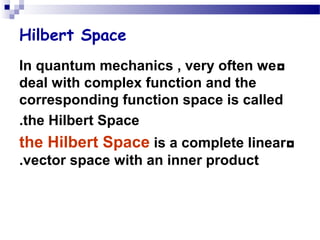
Hilbert Space
◘In quantum mechanics , very often we
deal with complex function and the
corresponding function space is called
the Hilbert Space.
◘the Hilbert Space is a complete linear
vector space with an inner product.
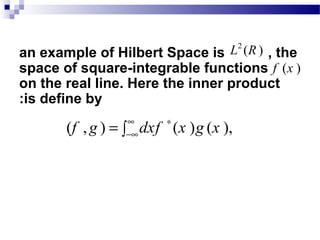
an example of Hilbert Space is , the
space of square-integrable functions
on the real line. Here the inner product
is define by:
2
( )L R
( )f x
( , ) ( ) ( ),f g dxf x g x∞ ∗
−∞
= ∫
Orthogonal functions
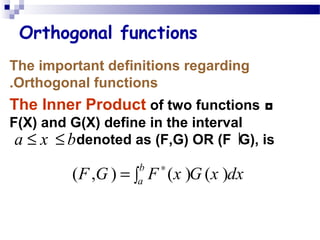
The important definitions regarding
Orthogonal functions.
◘The Inner Product of two functions
F(X) and G(X) define in the interval
denoted as (F,G) OR (F G), is
( , ) ( ) ( )b
a
F G F x G x dx∗
= ∫
a x b≤ ≤
◘These functions are Orthogonal if
◘A function is normalized if its norm is
unity:
( , ) ( ) ( )
b
aF G F x G x dx∗
= ∫
1/221/2
( , ) ( ) 1
b
a
F F F x dx = =∫ 
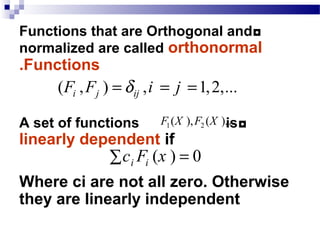
◘Functions that are Orthogonal and
normalized are called orthonormal
Functions.
◘A set of functions is
linearly dependent if
Where ci are not all zero. Otherwise
they are linearly independent
( , ) , 1,2,...i j ijF F i jδ= = =
1 2( ), ( ),...F X F X
( ) 0i ic F x =∑
The expansion theorem
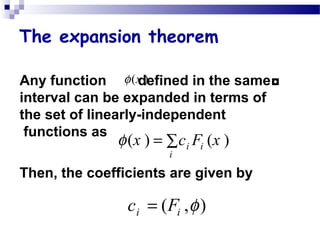
◘Any function defined in the same
interval can be expanded in terms of
the set of linearly-independent
functions as
Then, the coefficients are given by
( ) ( )i i
i
x c F xφ = ∑
( , )i ic F φ=
( )xφ

Linear vector space

  • 1.
    CHAPTER 3 Quantum Mechanics.G. ARULDHAS Generalized Formalism of quantum mechanics Safiya Amer. Misurata University. Spring 2010.
  • 2.
    Introduction Quantum theory isbased on two constructs: wave functions and operators. The state of the system is represented by its waves function, observables are represented by operators. Mathematically, wave functions satisfy the defining conditions for abstract vectors, and operators act on them as linear transformation. So the natural language of quantum mechanics is linear algebra.
  • 3.
    LINEAR VECTOR SPACE Thevector spaces of quantum mechanics are like the ordinary three-dimensional spaces of vectors from introductory physics. Vector In a three-dimensional space ●Any vector can be expressed as Where, are unit vectors, and are scalars. a r 1 1 2 2 3 3a ae a e a e= + + r r r r 1 2 3, ,e e e r 1 2 3, ,a a a
  • 4.
    The unit vectorsare said to form a basis for the set of all vectors in three dimensions. Definition A set of vectors is said to form a basis for a vector space if any arbitrary vector can be represented by a linear combination of the Where the vectors be linearly independent 1 2 3, ,e e e r { }1 2, ,... nu u u { }iu 1 1 2 2 ... n nx au a u a u= + + + r r r r x r { }iu
  • 5.
    Inner Product ●If wehave two vectors , Then, the scalar product or inner product is defined by 1 2 3 a a a a    ÷=  ÷  ÷   r 1 2 3 b b b b    ÷=  ÷  ÷   r 3 1( , ) i i ia b a b== ∑ rr
  • 6.
    Orthogonal and orthonormalbasis ●A basis is said to be orthogonal if Where a, b any two vectors in a basis. ●A basis is said to be orthonormal if { }iu ( , ) 0a b = rr { }iu ( , )i j ija a δ= , 1,2,...i j = 1 0 ijδ  =   i j i j =   ≠ 
  • 7.
    Vectors in ann-dimension space ◘we want to generalize precedent concepts to n-dimension real space ●Orthonormal basis: A vector a can be expressed in this Orthonormal basis as 1 n i i ia a e== ∑ r r r
  • 8.
    ●Inner Product: If thevectors are complex, then We observe that for any vector 1( , ) n i i ia b a b∗ == ∑ rr 1( , ) n i i ia b a b== ∑ rr 2 1 1( , ) n n i ii i ia a a a a∗ = == =∑ ∑ r r
  • 9.
    ◘The norm orlength of a vector a define as ◘Then a vector whose norm is unity is said to be normalized. 1/2 ( , )N a a= 2 1 1( , ) 1n n i ii i ia a a a a∗ = == = =∑ ∑ r r
  • 10.
    Linear Dependence andIndependence ◘The set of vectors in a vector space V is said to be linearly dependent if there exist scalars , not all zero, such that 1 2, ,..., nc c c 1 1 ... 0n nc a c a+ + = r r 1{ ,... }na a r r
  • 11.
    ◘ The setof vectors is linearly independent if can only be satisfied when 1{ ,... }na a r r 1 1 ... 0n nc a c a+ + = r r 1 2 ... 0nc c c= = = =
  • 12.
    Hilbert Space ◘In quantummechanics , very often we deal with complex function and the corresponding function space is called the Hilbert Space. ◘the Hilbert Space is a complete linear vector space with an inner product.
  • 13.
    an example ofHilbert Space is , the space of square-integrable functions on the real line. Here the inner product is define by: 2 ( )L R ( )f x ( , ) ( ) ( ),f g dxf x g x∞ ∗ −∞ = ∫
  • 14.
    Orthogonal functions The importantdefinitions regarding Orthogonal functions. ◘The Inner Product of two functions F(X) and G(X) define in the interval denoted as (F,G) OR (F G), is ( , ) ( ) ( )b a F G F x G x dx∗ = ∫ a x b≤ ≤
  • 15.
    ◘These functions areOrthogonal if ◘A function is normalized if its norm is unity: ( , ) ( ) ( ) b aF G F x G x dx∗ = ∫ 1/221/2 ( , ) ( ) 1 b a F F F x dx = =∫ 
  • 16.
    ◘Functions that areOrthogonal and normalized are called orthonormal Functions. ◘A set of functions is linearly dependent if Where ci are not all zero. Otherwise they are linearly independent ( , ) , 1,2,...i j ijF F i jδ= = = 1 2( ), ( ),...F X F X ( ) 0i ic F x =∑
  • 17.
    The expansion theorem ◘Anyfunction defined in the same interval can be expanded in terms of the set of linearly-independent functions as Then, the coefficients are given by ( ) ( )i i i x c F xφ = ∑ ( , )i ic F φ= ( )xφ