27th ICAS at Nice on 22th September
Session : Supersonic Aircraft Concepts

“Multidisciplinary Design Optimization of Supersonic Transport Wing
                      Using Surrogate Model”


                Naoto Seto (Tokyo Metropolitan University)
Outline

 Background
 Objectives
 Design Approaches
 Design Target and Design Variables
 Objective Functions and Constraints
 Results
 Conclusions
Background 1

 Short time travel is one of the biggest demands.
     SuperSonic Transport (SST) is expected to meet the demand above.

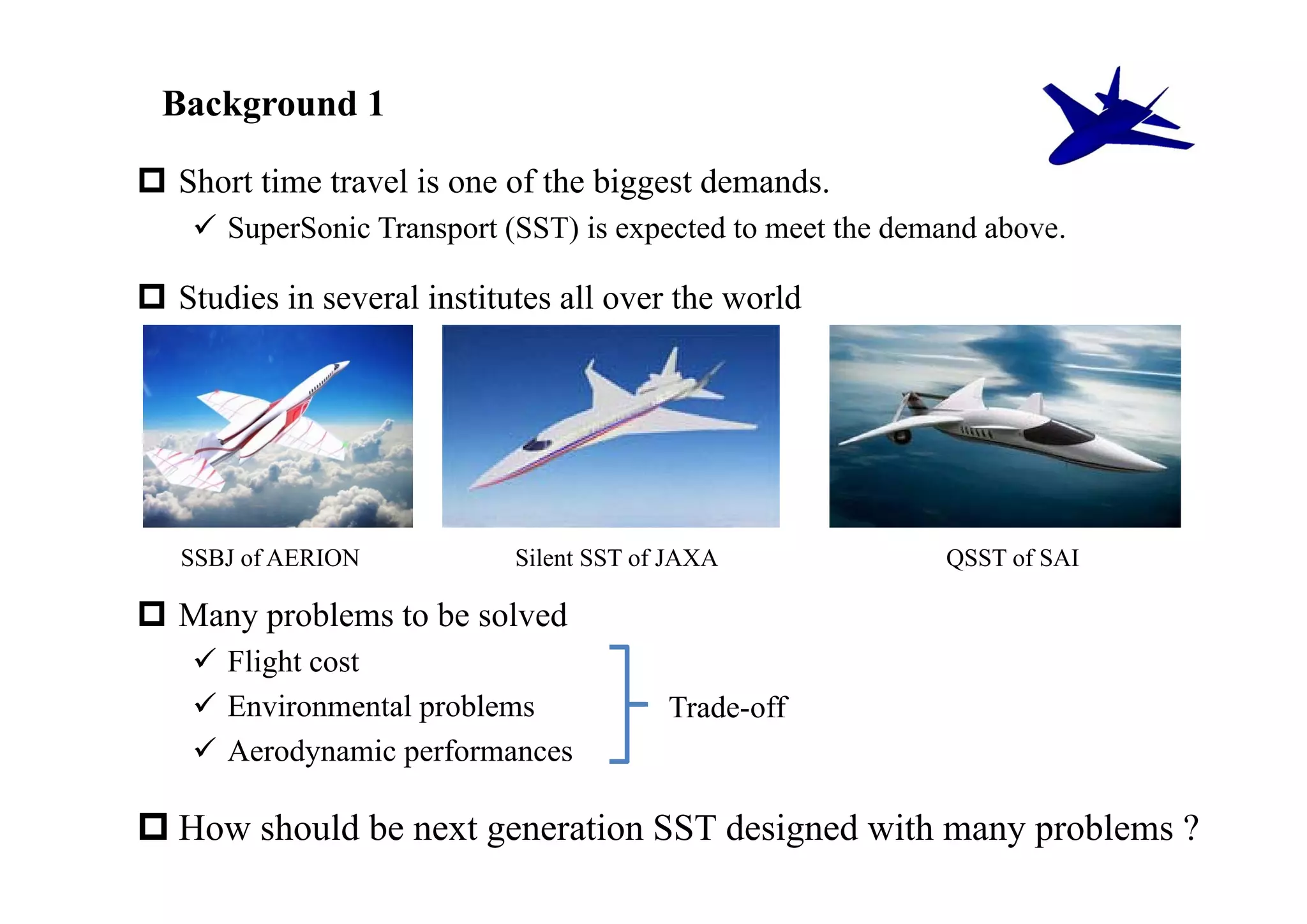
 Studies in several institutes all over the world


   SSBJ of AERION           Silent SST of JAXA              QSST of SAI

 Many problems to be solved
     Flight cost
     Environmental problems             Trade-off
     Aerodynamic performances

 How should be next generation SST designed with many problems ?
Background 2

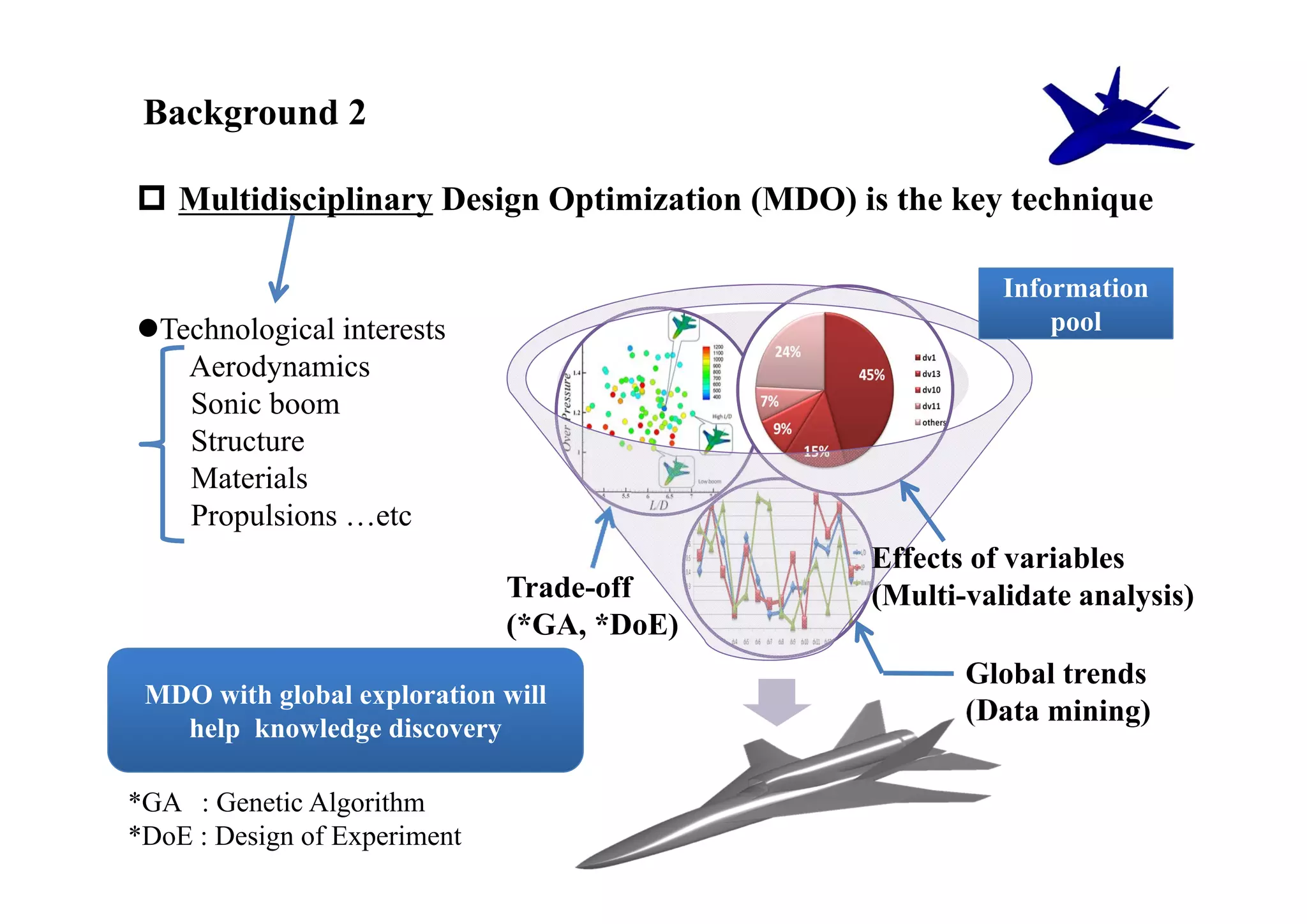
 Multidisciplinary Design Optimization (MDO) is the key technique

                                                         Information
Technological interests                                     pool
   Aerodynamics
   Sonic boom
   Structure
   Materials
   Propulsions …etc
                                               Effects of variables
                              Trade-off        (Multi-validate analysis)
                              (*GA, *DoE)
                                                      Global trends
 MDO with global exploration will
                                                      (Data mining)
   help knowledge discovery

*GA : Genetic Algorithm
*DoE : Design of Experiment
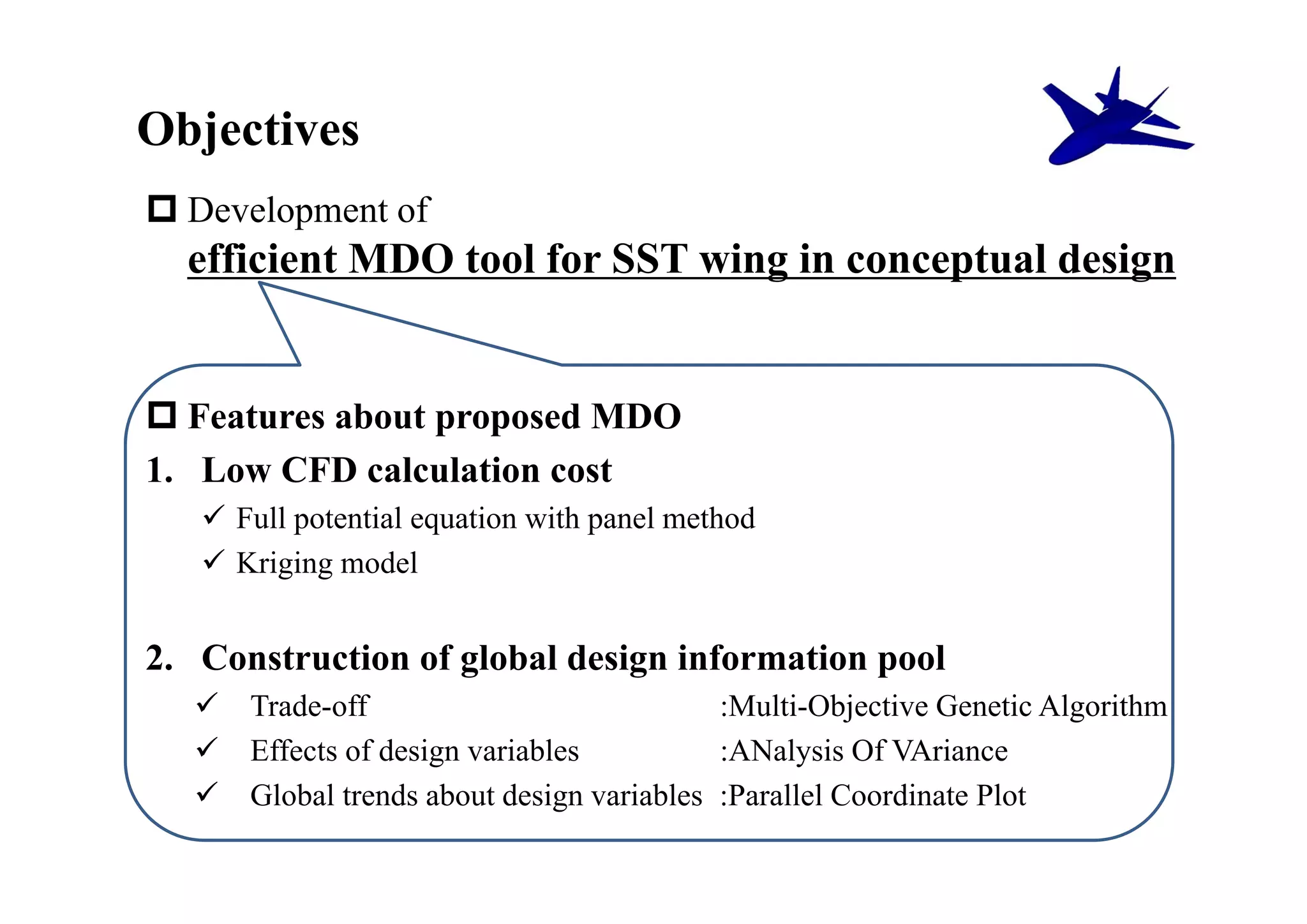
Objectives
 Development of
  efficient MDO tool for SST wing in conceptual design


 Features about proposed MDO
1. Low CFD calculation cost
    Full potential equation with panel method
    Kriging model


2. Construction of global design information pool
     Trade-off                            :Multi-Objective Genetic Algorithm
     Effects of design variables          :ANalysis Of VAriance
     Global trends about design variables :Parallel Coordinate Plot
Design Approaches
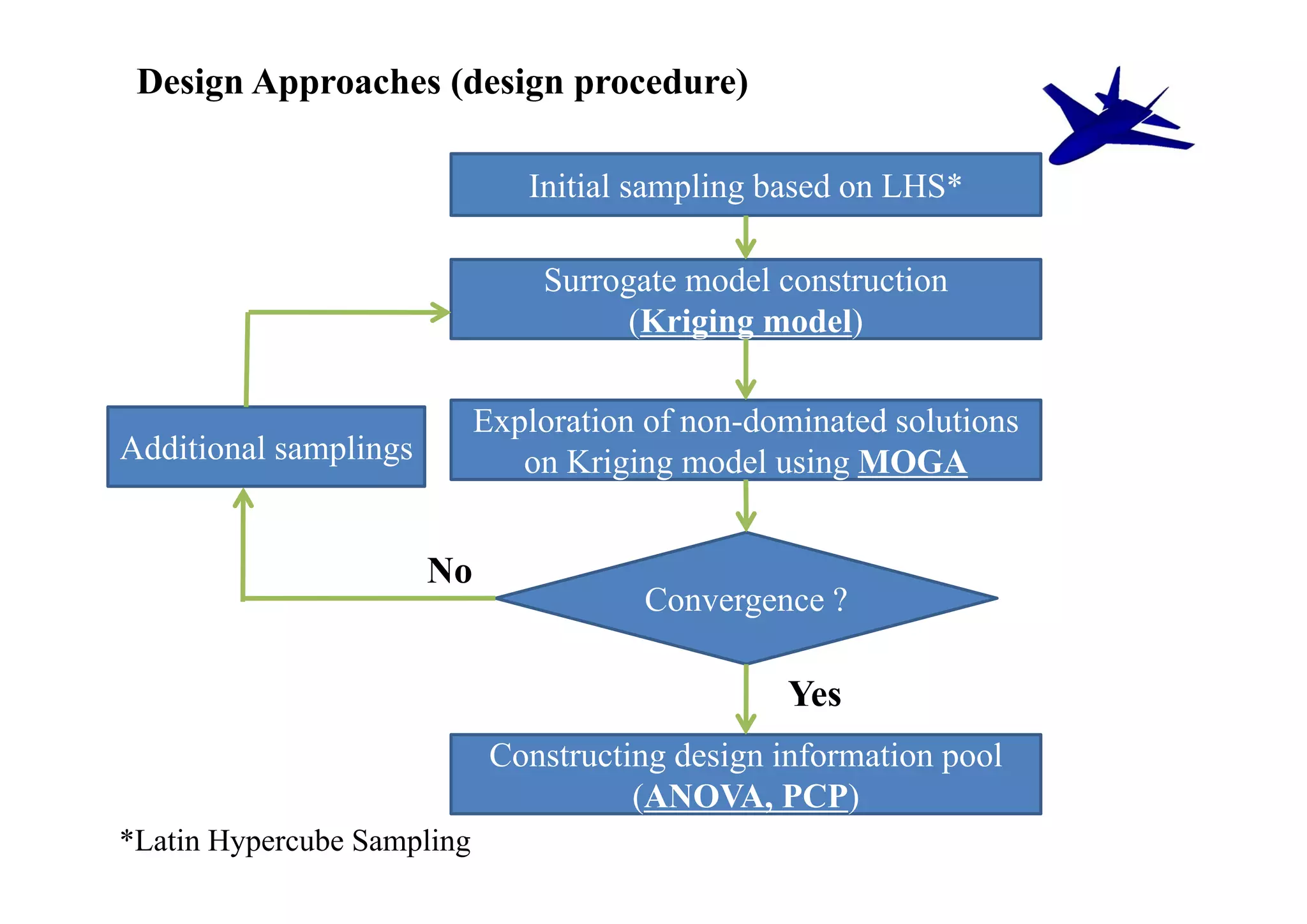
Design Approaches (design procedure)

                               Initial sampling based on LHS*

                                Surrogate model construction
                                      (Kriging model)

                            Exploration of non-dominated solutions
Additional samplings           on Kriging model using MOGA


                       No
                                       Convergence ?

                                                 Yes
                             Constructing design information pool
                                       (ANOVA, PCP)
*Latin Hypercube Sampling
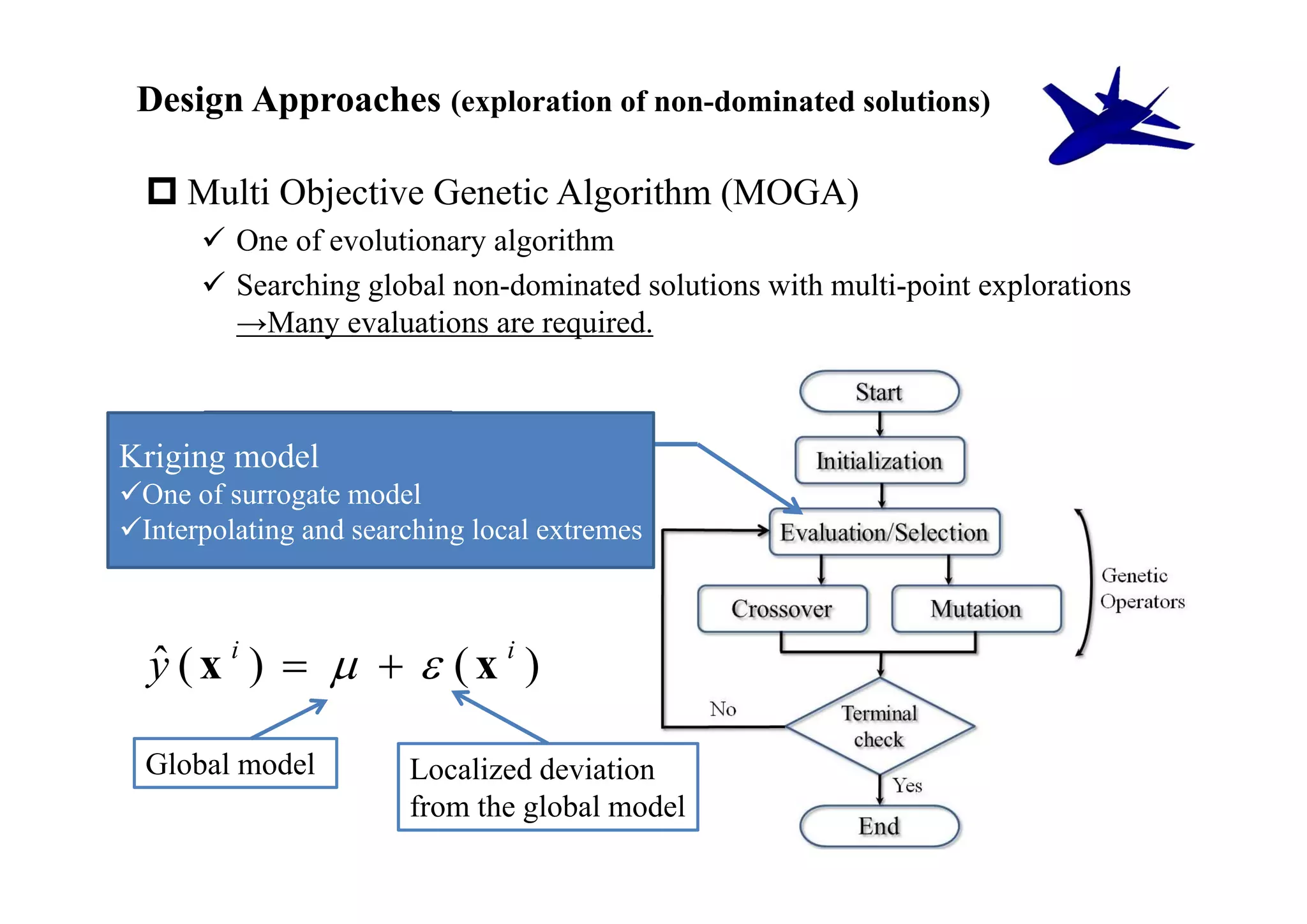
Design Approaches (exploration of non-dominated solutions)

   Multi Objective Genetic Algorithm (MOGA)
       One of evolutionary algorithm
       Searching global non-dominated solutions with multi-point explorations
        →Many evaluations are required.


           CFD
Kriging model
One of surrogate model
Interpolating and searching local extremes


  ˆ (x i )     (x i )
  y

  Global model         Localized deviation
                       from the global model
Design Approaches (exploration of non-dominated solutions)
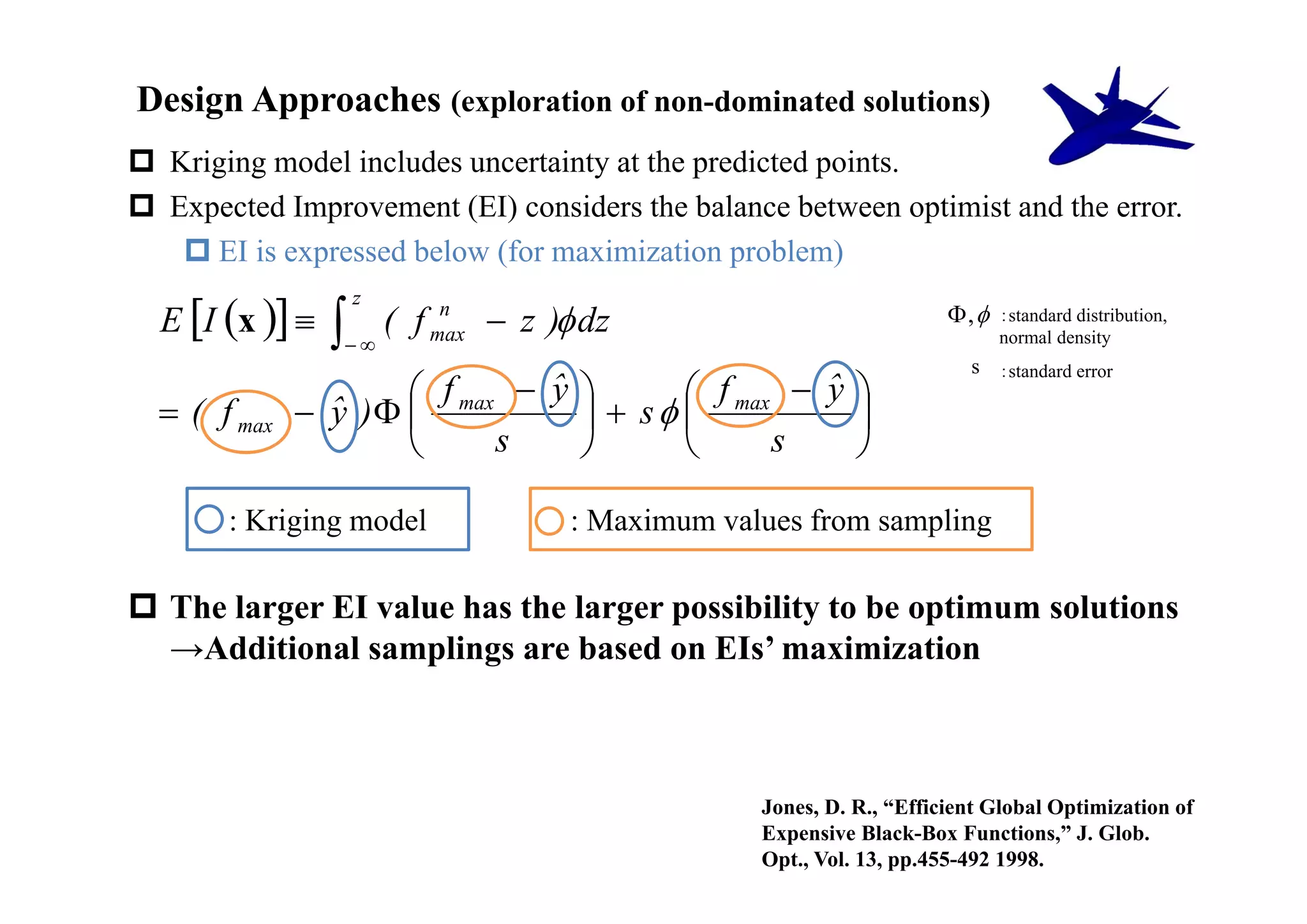
 Kriging model includes uncertainty at the predicted points.
 Expected Improvement (EI) considers the balance between optimist and the error.
    EI is expressed below (for maximization problem)

  E I x  
                     z
                        ( f max  z ) dz                              ,
                              n                                               :standard distribution,
                                                                            normal density
                                                                          s :standard error
                       f      ˆ 
                                y         f max  ˆ 
                                                   y
   ( f max    y
                ˆ )   max         s            
                           s                 s    

       : Kriging model                 : Maximum values from sampling

 The larger EI value has the larger possibility to be optimum solutions
  →Additional samplings are based on EIs’ maximization


                                                    Jones, D. R., “Efficient Global Optimization of
                                                    Expensive Black-Box Functions,” J. Glob.
                                                    Opt., Vol. 13, pp.455-492 1998.
Design Approaches (design information)
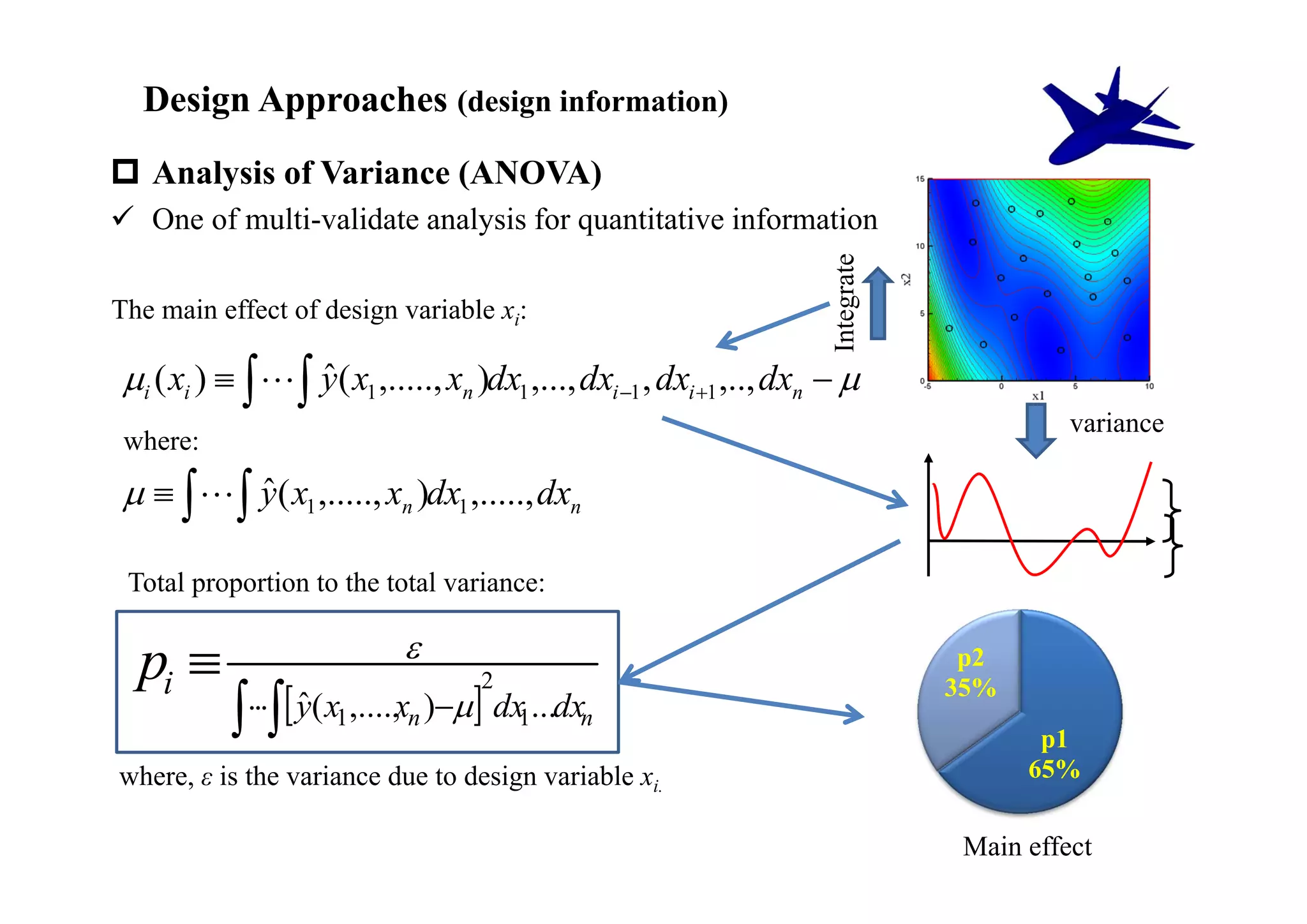
 Analysis of Variance (ANOVA)
 One of multi-validate analysis for quantitative information


                                                                       Integrate
The main effect of design variable xi:

 i ( xi )     y( x1 ,....., xn )dx1 ,..., dxi 1 , dxi 1 ,.., dxn  
                   ˆ
                                                                                             variance
 where:
      y( x1 ,....., xn )dx1 ,....., dxn
           ˆ

 Total proportion to the total variance:


  pi                        
                                     2
                                                                                    p2

            y(x1,....,xn ) dx1...dxn
                                                                                   35%
                  ˆ
                                                                                          p1
where, ε is the variance due to design variable xi.                                      65%

                                                                                    Main effect
Design Approaches (design information)
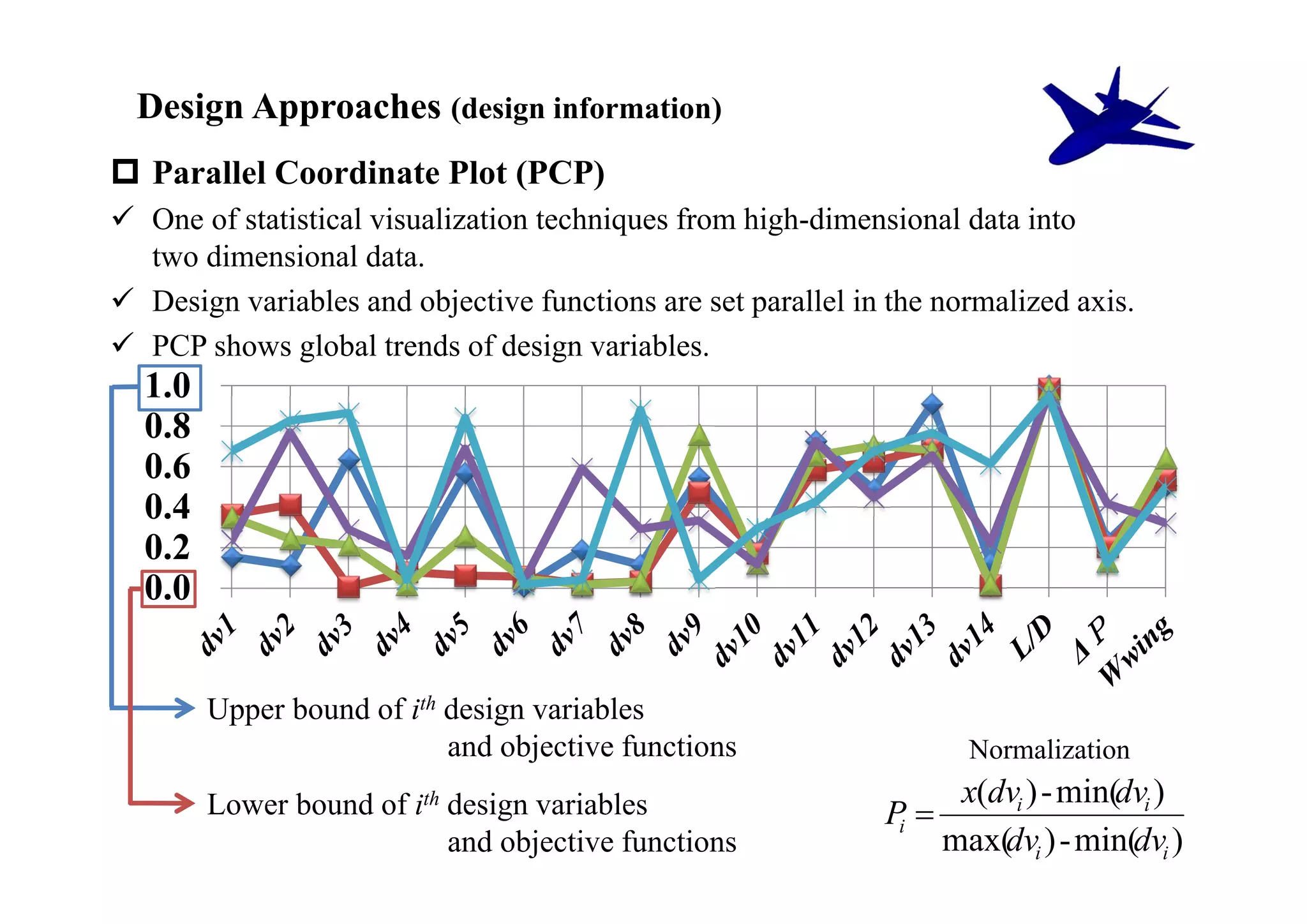
 Parallel Coordinate Plot (PCP)
 One of statistical visualization techniques from high-dimensional data into
  two dimensional data.
 Design variables and objective functions are set parallel in the normalized axis.
 PCP shows global trends of design variables.
  1.0
  0.8
  0.6
  0.4
  0.2
  0.0


        Upper bound of ith design variables
                           and objective functions                   Normalization
        Lower bound of ith design variables                         x(dvi ) - min(dvi )
                                                              P
                                                              i
                           and objective functions                 max(dvi ) - min(dvi )
Design Target and Design Variables
Design Target

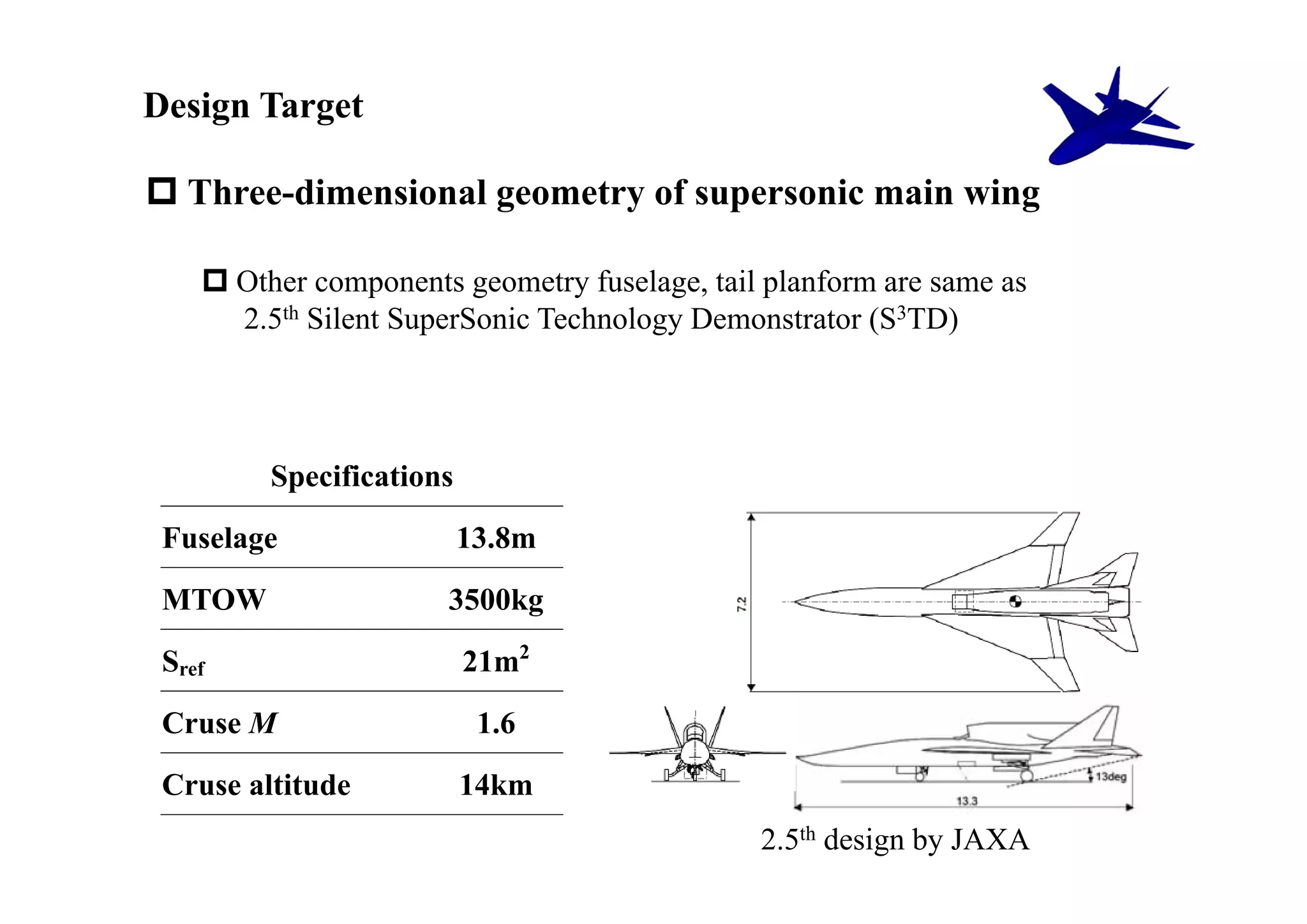
 Three-dimensional geometry of supersonic main wing

     Other components geometry fuselage, tail planform are same as
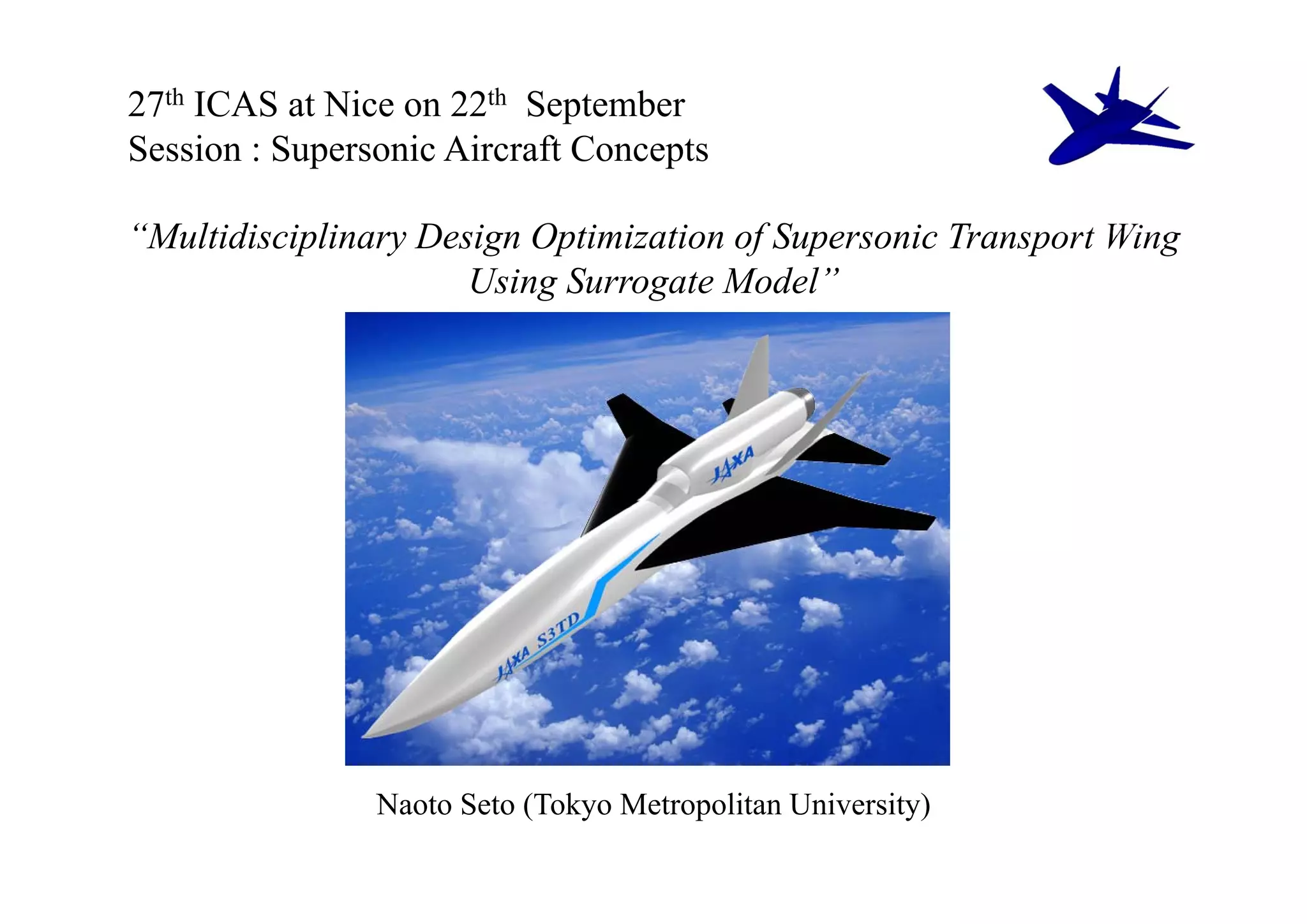
      2.5th Silent SuperSonic Technology Demonstrator (S3TD)


         Specifications
 Fuselage                 13.8m
 MTOW                 3500kg
 Sref                     21m2
 Cruse M                   1.6
 Cruse altitude           14km
                                              2.5th design by JAXA
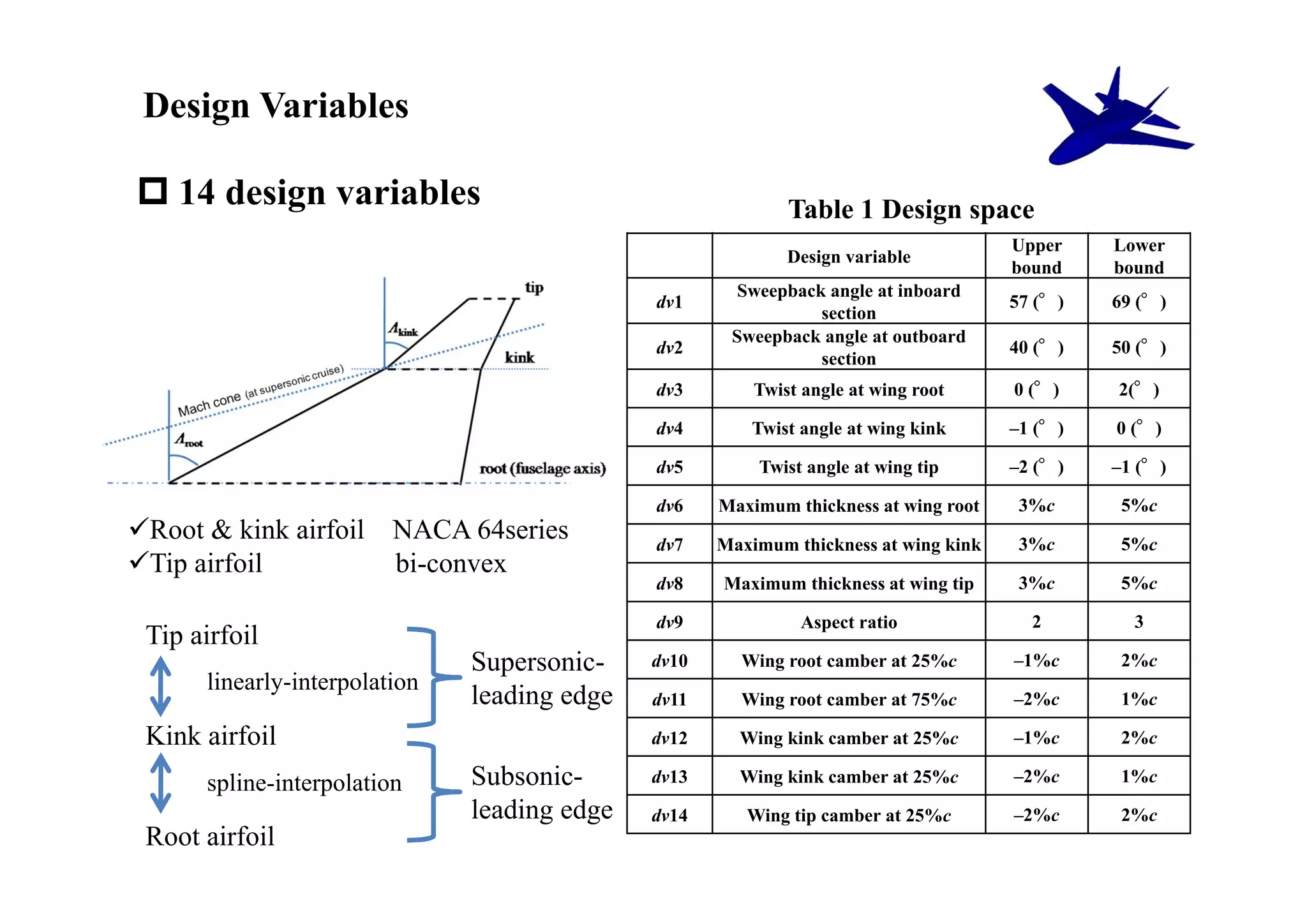
Design Variables

 14 design variables                                        Table 1 Design space
                                                                                      Upper    Lower
                                                             Design variable
                                                                                      bound    bound
                                                       Sweepback angle at inboard
                                              dv1                                     57 (°)   69 (°)
                                                                section
                                                      Sweepback angle at outboard
                                              dv2                                     40 (°)   50 (°)
                                                                section
                                              dv3        Twist angle at wing root     0 (°)    2(°)

                                              dv4       Twist angle at wing kink      –1 (°)   0 (°)

                                              dv5        Twist angle at wing tip      –2 (°)   –1 (°)

                                              dv6    Maximum thickness at wing root    3%c      5%c
Root & kink airfoil     NACA 64series        dv7    Maximum thickness at wing kink    3%c      5%c
Tip airfoil             bi-convex
                                              dv8    Maximum thickness at wing tip     3%c      5%c

                                              dv9             Aspect ratio              2        3
 Tip airfoil
                               Supersonic-    dv10     Wing root camber at 25%c       –1%c      2%c
      linearly-interpolation
                               leading edge   dv11     Wing root camber at 75%c       –2%c      1%c

 Kink airfoil                                 dv12     Wing kink camber at 25%c       –1%c      2%c

      spline-interpolation     Subsonic-      dv13     Wing kink camber at 25%c       –2%c      1%c
                               leading edge   dv14      Wing tip camber at 25%c       –2%c      2%c
 Root airfoil
Objective Functions and Constraints
Objective Functions

 Three objective functions in this study

maximize         L/ D
minimize         ΔP       (On boom carpet)


                                                       ΔP
minimize        Wwing
   subject to Design C L = 0.105
                                                                       Time[ms]
 maximize
                                                                   K-means method
                                ˆ - L / Dmax
                                y                    ˆ - L / Dmax
                                                     y
 • EIL / D = ( ˆ - L / Dmax )Φ(
               y                             ) + sφ(               ) Additional sampling points
                                      s                    s
 maximize
                                                                                       clusters
                            ΔP - ˆ  y        ΔP - ˆ   y


                                                            EI1
 • EIΔP = ( ΔP - y
                 min
                      ˆ )Φ( min ) + sφ( min )
                                s                 s
 maximize
                               Wwingmin ˆy          Wwingmin - ˆ
                                                               y                     EI2
 • EIWwing = (Wwingmin - ˆ )Φ(
                         y                 ) + sφ(               )
                                     s                   s
Evaluations of L/D and ΔP

 CAPAS* developed in JAXA
 Aerodynamic performance                                              Sonic-boom intensity
    Compressible potential equation                                      Correction of shock wave
      with panel method (PANAIR)                                            by Whitham’s theory

              2          2          2                                                            PANAIR data
     2                                                                   F ( x)             CP
  ( M  1)        2
                              2
                                           2
                                                0                                   2
             x           y           z
                                                                        x  
                                                                                   1      r F x 
       : Velocity potential
                                                                                    2   3


                                                                                    Thomas’s waveform parameter
                                                                                    method
                                                                                                    M 2-1
                                                     pressure[psf]

                                                                                                    1.4
Computational               CP distributions                                                      r : propagation distance
geometry

                                                                            Time[ms]
                                                                     *CAPAS (CAD-based Automatic Panel Analysis System)
Evaluation of wing weight
 Inboard wing (multi-frame structure)
     Aluminum material
     Minimum thickness of skin & frame (0<thickness<20mm, every0.1mm)
 Outboard wing (full-depth honeycomb sandwich structure)
     Composite material
     Stack sequence
         Fiber angle θ ; [0/ θ/- θ/90] ns, θ=15, 30, 45, 60, 70deg
         Number of laminations n  n  N  25
 Solver is MSC NASTRAN 2005R (FEM model)
     Strength requirements
         Aluminum material:Mises stress < 200MPa at all FEM nodes
         Composite material: Destruction criteria < 1 at all FEM nodes on each laminate
     Computational conditions
         Symmetrical maneuver +6G, Safety rate: 1.25                 PANAIR data
     Estimated load on the main wing
       (symmetrical maneuver) × (safety rate) × (aerodynamics load)
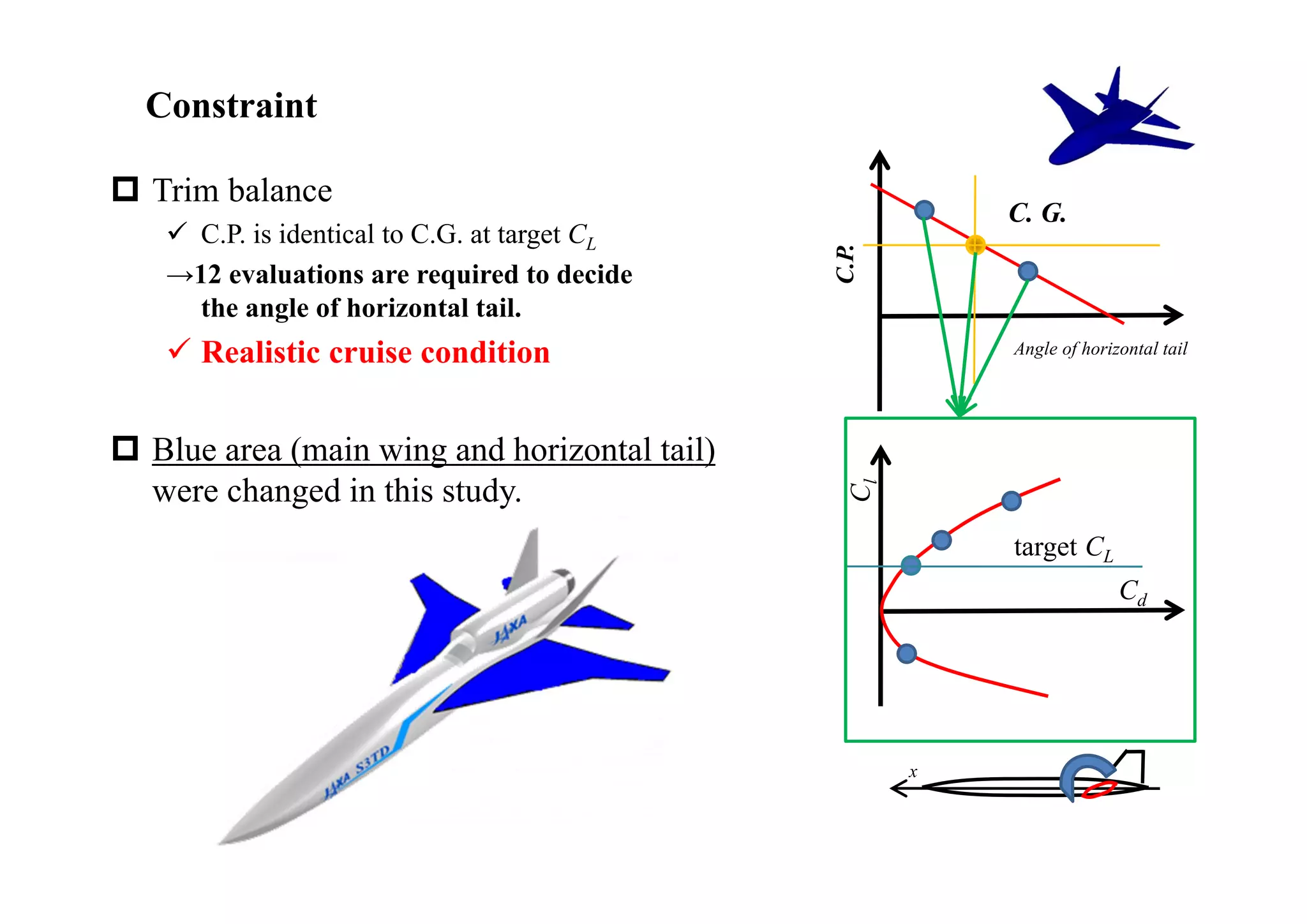
Constraint

 Trim balance
                                                         C. G.
    C.P. is identical to C.G. at target CL


                                              C.P.
   →12 evaluations are required to decide
     the angle of horizontal tail.
    Realistic cruise condition                          Angle of horizontal tail


 Blue area (main wing and horizontal tail)
  were changed in this study.


                                               Cl
                                                         target CL
                                                                       Cd


                                                     x
Results
Results (samplings)

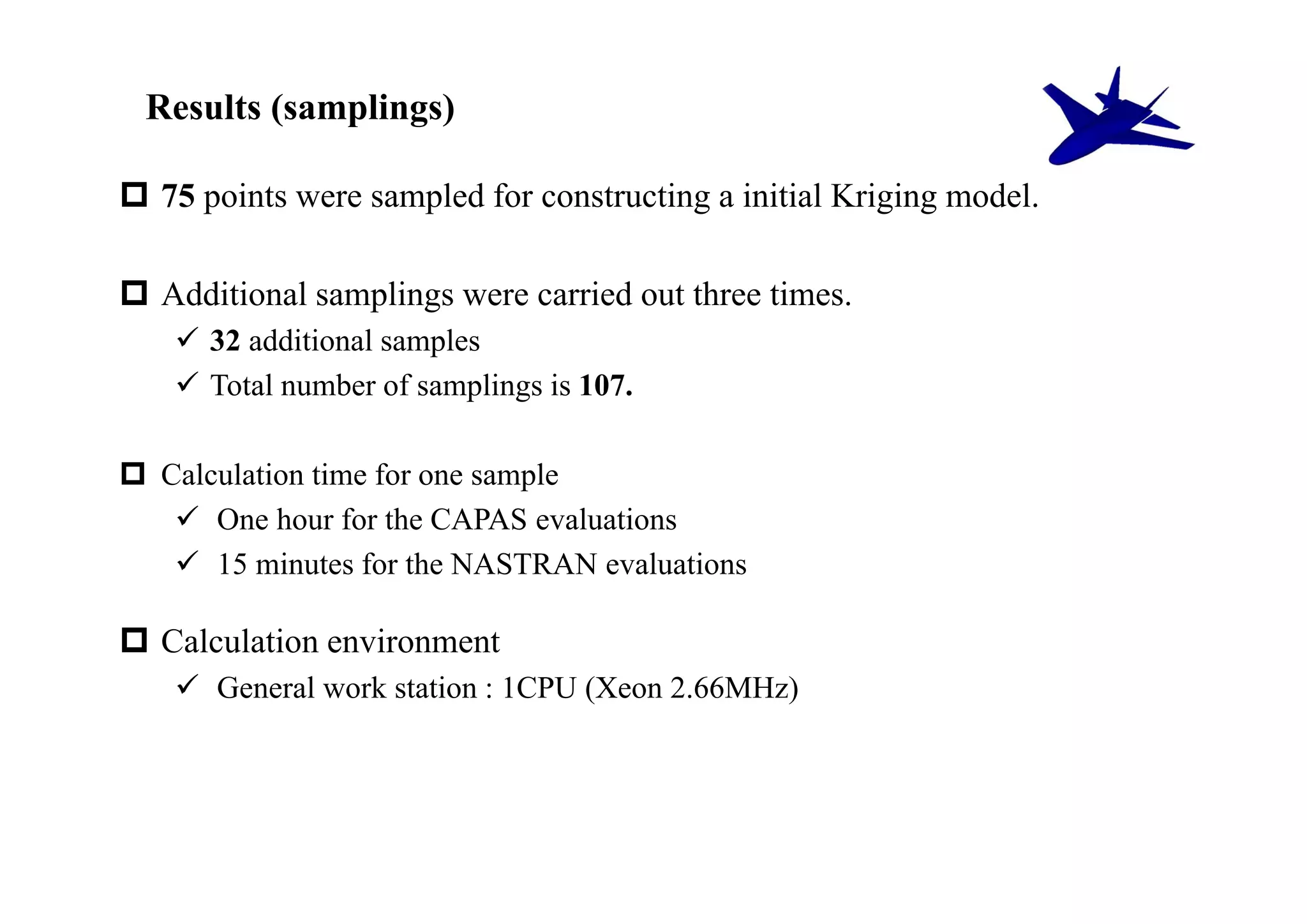
 75 points were sampled for constructing a initial Kriging model.

 Additional samplings were carried out three times.
     32 additional samples
     Total number of samplings is 107.

 Calculation time for one sample
    One hour for the CAPAS evaluations
    15 minutes for the NASTRAN evaluations

 Calculation environment
     General work station : 1CPU (Xeon 2.66MHz)
Results (solution space about objective functions)
                                                                                        Wwing
  24 non-dominated solutions from                                 L/D    ΔP[psf]                  AoA
                                                                                        [kg]
   final data                          Design A                    7.02    1.19          612        2.5
  Most of additional samplings formed Design B                    6.08    0.97          502        2.7
   non-dominated solutions             Design C                    5.60    1.53          276        2.6
                                                    Design D       6.77    1.09          691        2.6
                              Design A (best L/D)         Design B (best ΔP)       Design C (best Wwing)
               Design D (compromised)


                                                       Wwing[kg]
ΔP[psf]


                                             Optimum direction


                             L/D                                                  ΔP[psf]
Results (configuration comparison)
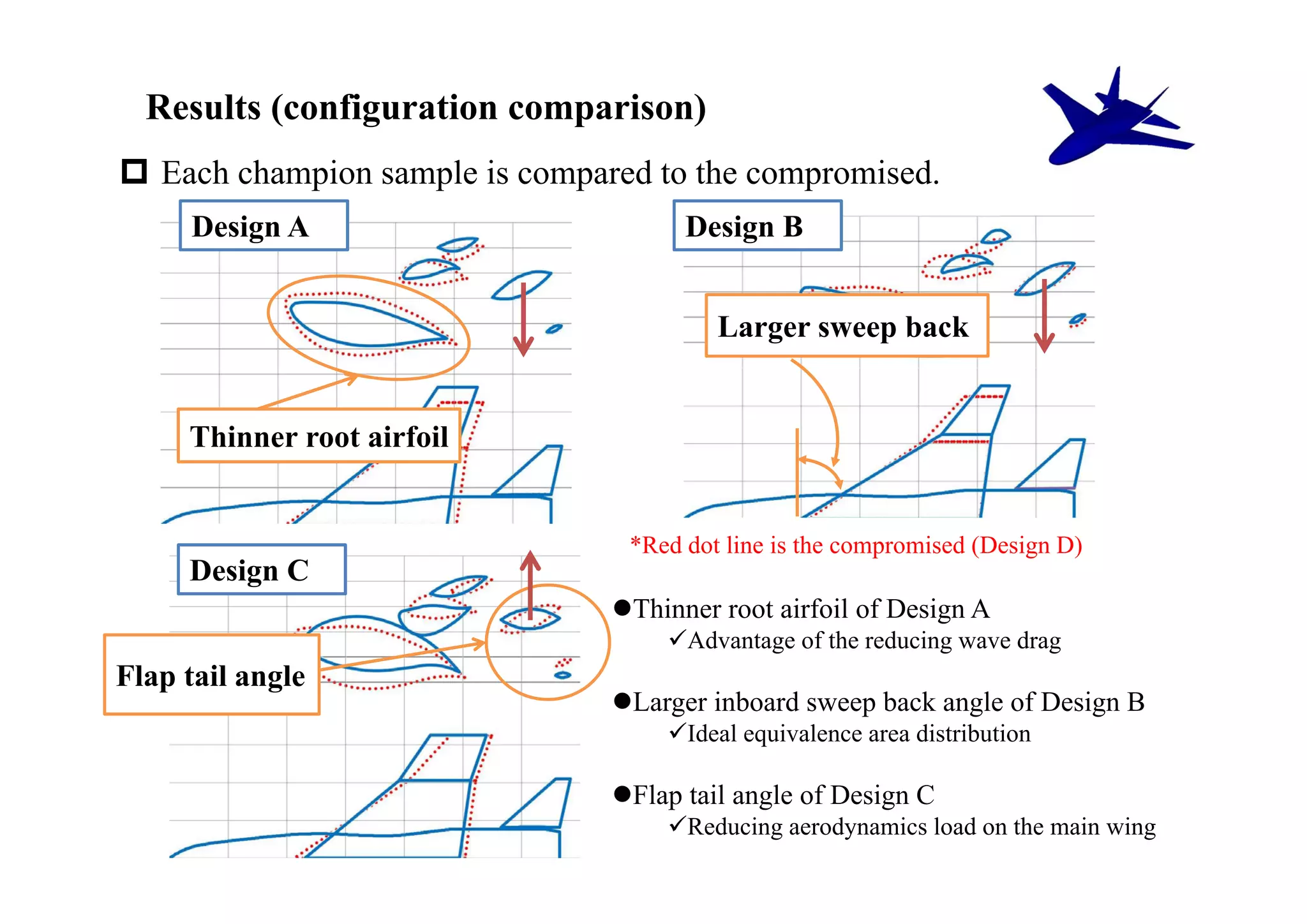
 Each champion sample is compared to the compromised.
     Design A                         Design B


                                         Larger sweep back


     Thinner root airfoil


                                 *Red dot line is the compromised (Design D)
     Design C
                                Thinner root airfoil of Design A
                                    Advantage of the reducing wave drag
Flap tail angle
                                Larger inboard sweep back angle of Design B
                                    Ideal equivalence area distribution

                                Flap tail angle of Design C
                                    Reducing aerodynamics load on the main wing
Evaluation of wing weight evaluations
 Inboard wing (multi-frame structure)
     Aluminum material
     Minimum thickness of skin & frame (0<thickness<20mm, every0.1mm)
 Outboard wing (full-depth honeycomb sandwich structure)
     Composite material
     Stack sequence
         Fiber angle θ ; [0/ θ/- θ/90] ns, θ=15, 30, 45, 60, 70deg
         Number of laminations n  n  N  25
 Solver is MSC NASTRAN 2005R (FEM model)
     Strength requirements
         Aluminum material:Mises stress < 200MPa at all FEM nodes
         Composite material: Destruction criteria < 1 at all FEM nodes on each laminate
     Computational conditions
         Symmetrical maneuver +6G, Safety rate: 1.25                 PANAIR data
     Estimated load on the main wing
      (symmetrical maneuver) × (safety rate) × (aerodynamics load)
Results (waveform on the ground)

  Each champion sample is compared to the compromised.
                                         *Red dot line is the compromised (Design D)
                                              Less different
Design A


                                               among Design A, B, and D

                                              Large different
                                               between Design C and D
                                                           L/D     ΔP[psf]     Wwing[kg]
Design B


                                              Design A    7.02       1.19        612
                                              Design B    6.08       0.97        502
                                              Design C    5.60       1.53        276
                                              Design D    6.77       1.09        691
Design C


                                                        Severe trade-off
                                                      between ΔP & Wwing
Results (Overview about ANOVA)
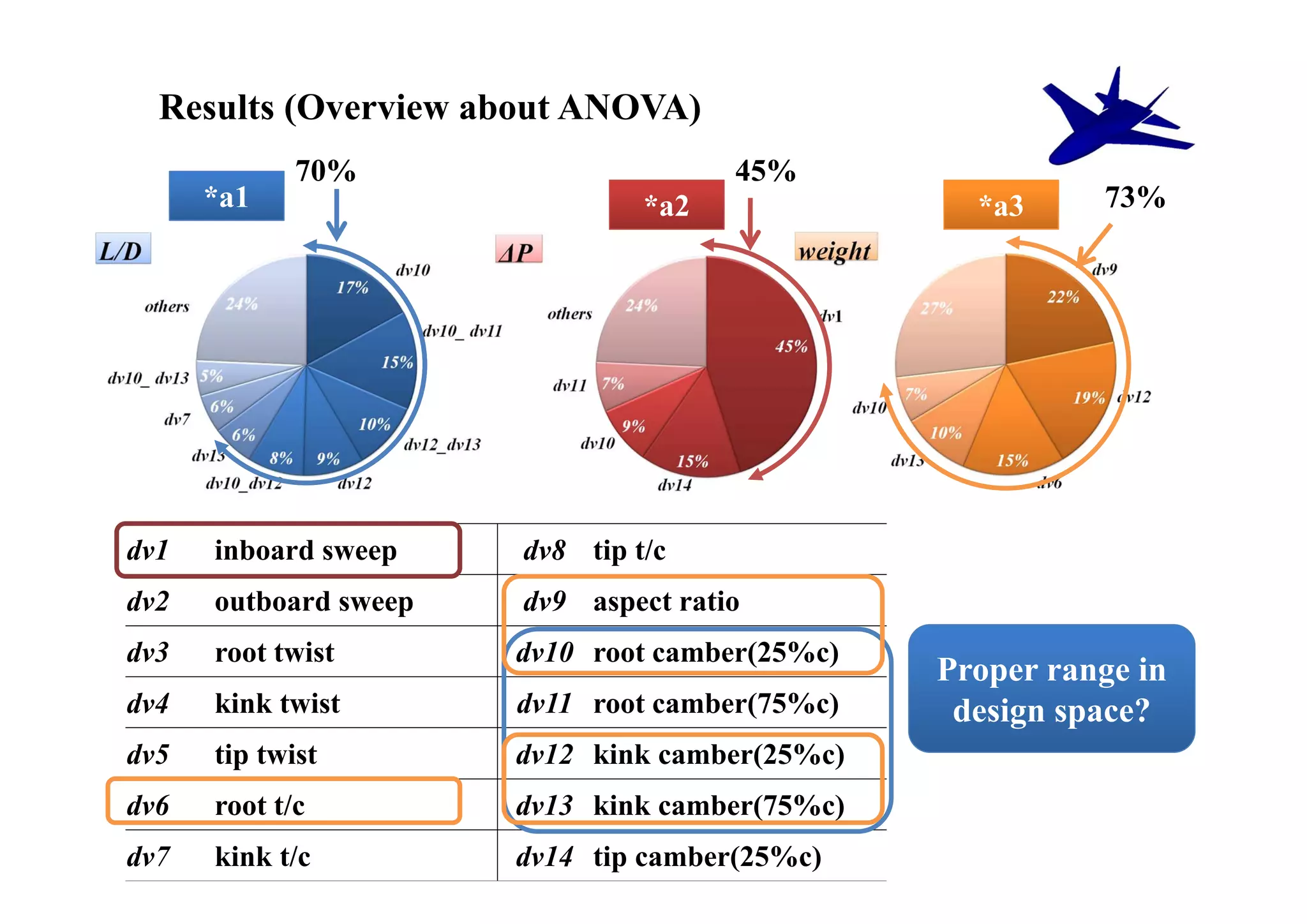
             70%                      45%
      *a1                       *a2               *a3     73%


dv1   inboard sweep    dv8 tip t/c
dv2   outboard sweep   dv9 aspect ratio
dv3   root twist       dv10 root camber(25%c)
                                                Proper range in
dv4   kink twist       dv11 root camber(75%c)    design space?
dv5   tip twist        dv12 kink camber(25%c)
dv6   root t/c         dv13 kink camber(75%c)
dv7   kink t/c         dv14 tip camber(25%c)
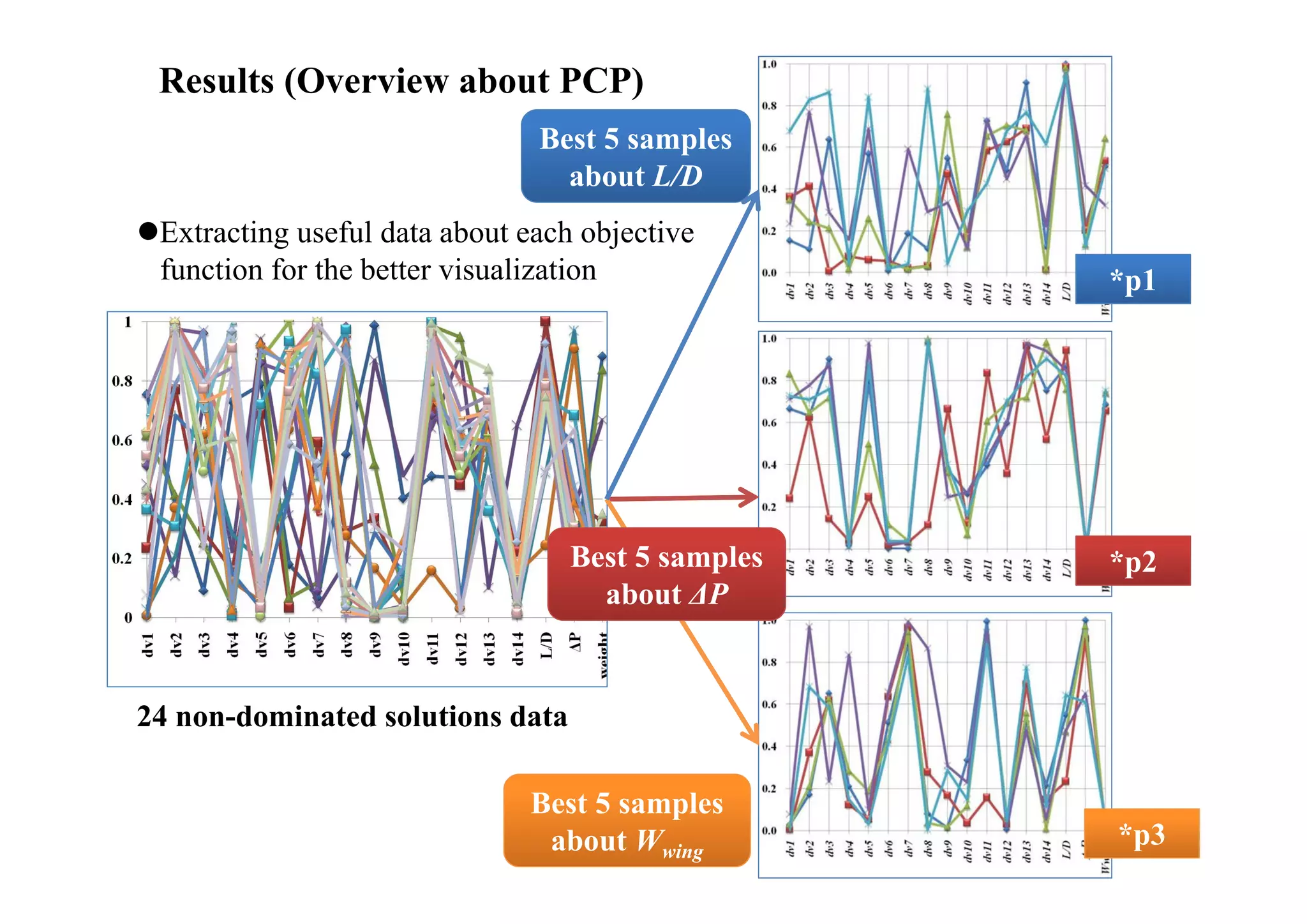
Results (Overview about PCP)
                               Best 5 samples
                                 about L/D
Extracting useful data about each objective
 function for the better visualization             *p1


                                  Best 5 samples   *p2
                                    about ΔP


24 non-dominated solutions data

                               Best 5 samples
                                about Wwing        *p3
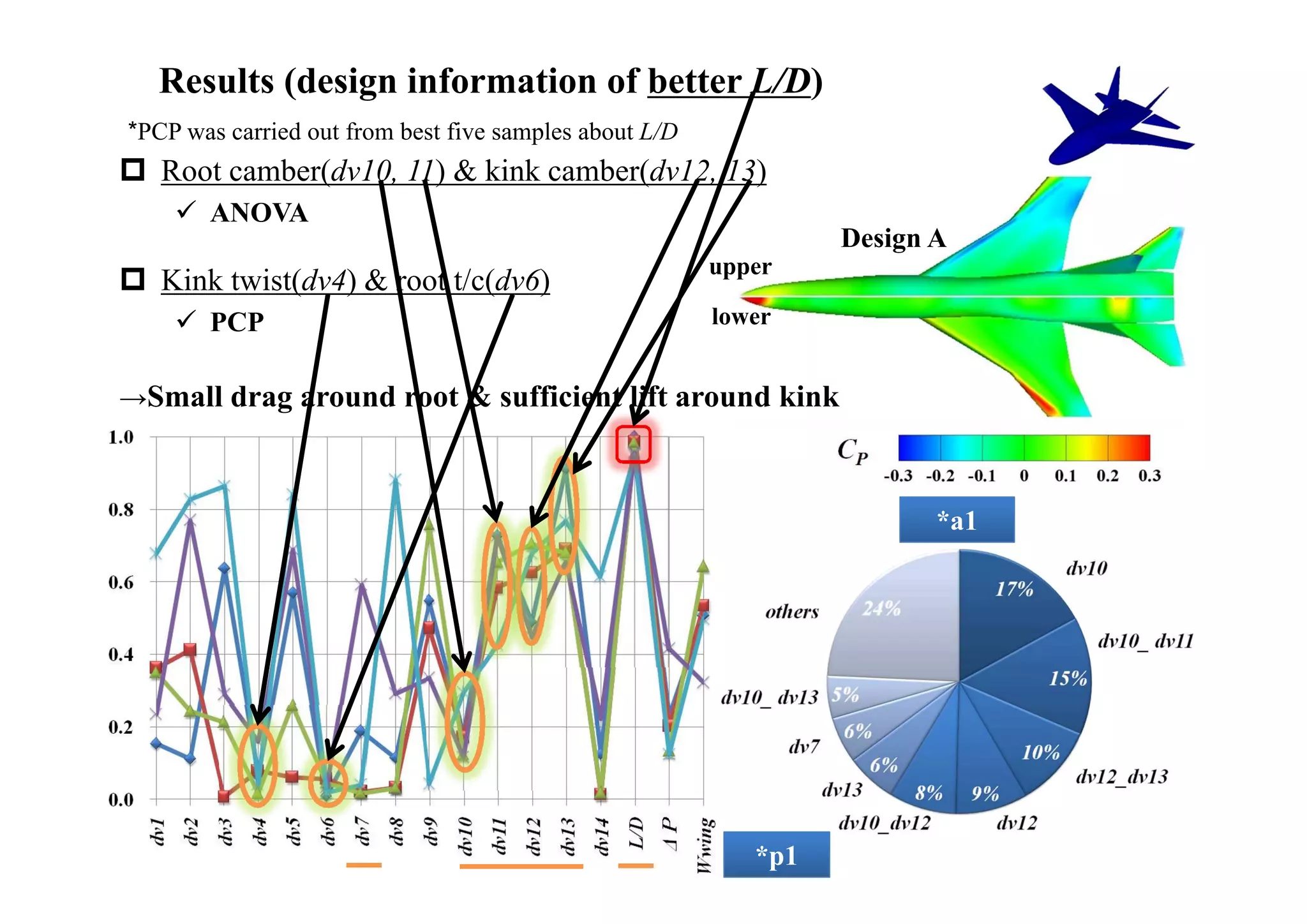
Results (design information of better L/D)
*PCP was carried out from best five samples about L/D
 Root camber(dv10, 11) & kink camber(dv12, 13)
     ANOVA
                                                                 Design A
                                                        upper
 Kink twist(dv4) & root t/c(dv6)
     PCP                                               lower


→Small drag around root & sufficient lift around kink


                                                                        *a1


                                                           *p1
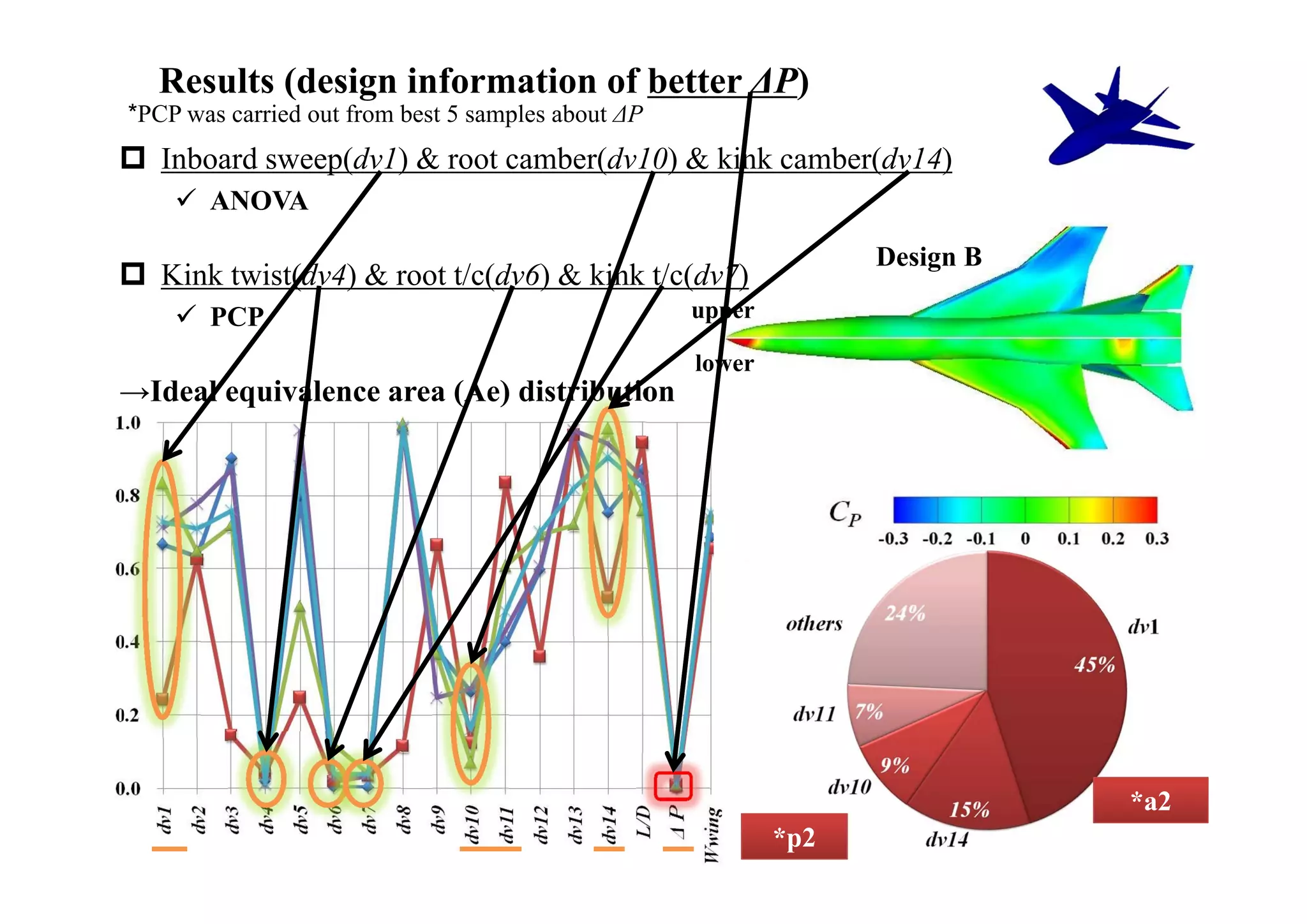
Results (design information of better ΔP)
*PCP was carried out from best 5 samples about ΔP
 Inboard sweep(dv1) & root camber(dv10) & kink camber(dv14)
     ANOVA

                                                                  Design B
 Kink twist(dv4) & root t/c(dv6) & kink t/c(dv7)
     PCP                                           upper

                                                    lower
→Ideal equivalence area (Ae) distribution


                                                                             *a2
                                                            *p2
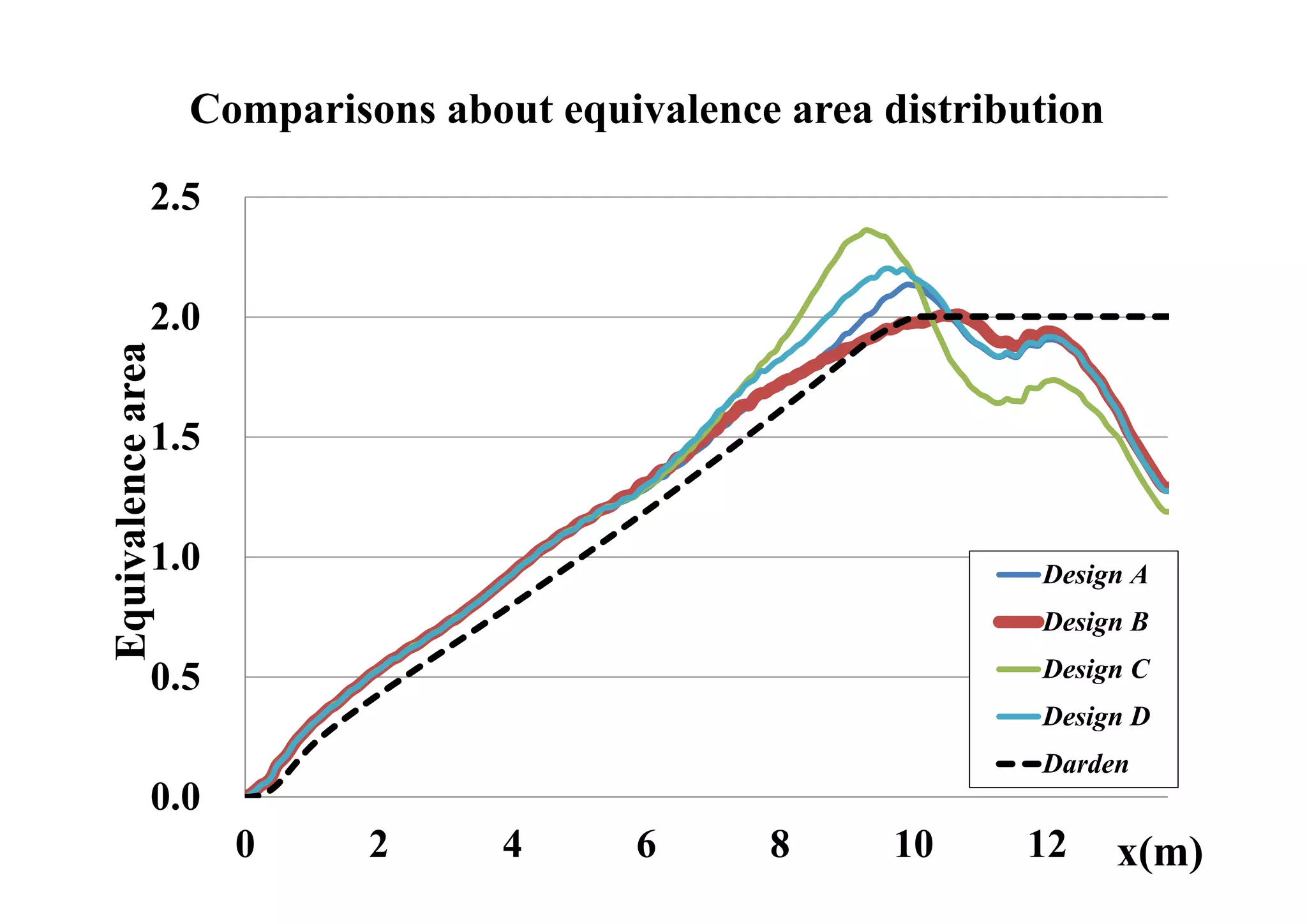
Comparisons about equivalence area distribution
              2.5

              2.0
Equivalence area


              1.5

              1.0                                             Design A
                                                              Design B

              0.5                                             Design C
                                                              Design D
                                                              Darden
              0.0
                     0      2      4     6      8      10     12     x(m)
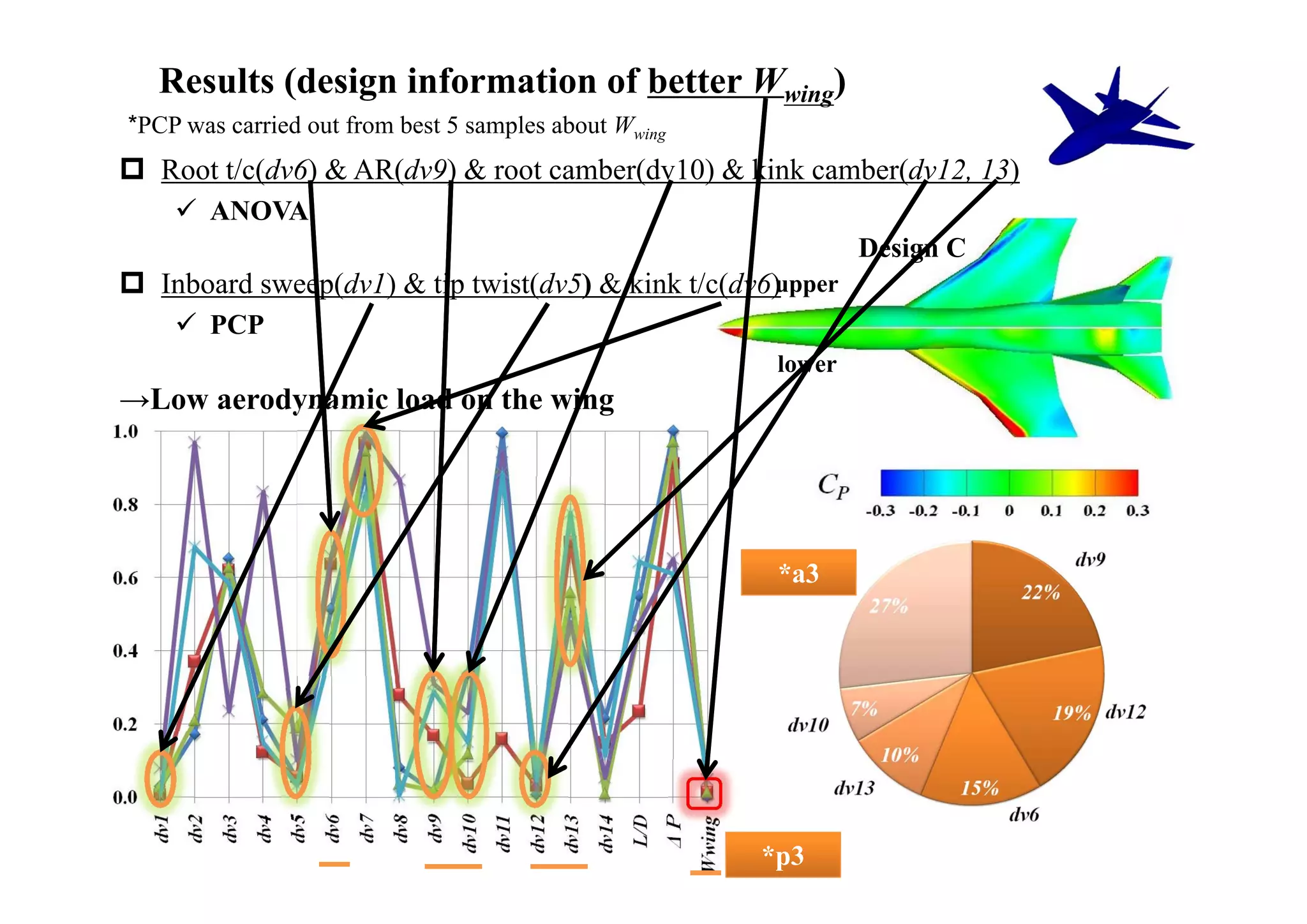
Results (design information of better Wwing)
*PCP was carried out from best 5 samples about Wwing
 Root t/c(dv6) & AR(dv9) & root camber(dv10) & kink camber(dv12, 13)
     ANOVA
                                                                Design C
 Inboard sweep(dv1) & tip twist(dv5) & kink t/c(dv6)upper
     PCP
                                                        lower
→Low aerodynamic load on the wing


                                                        *a3


                                                       *p3
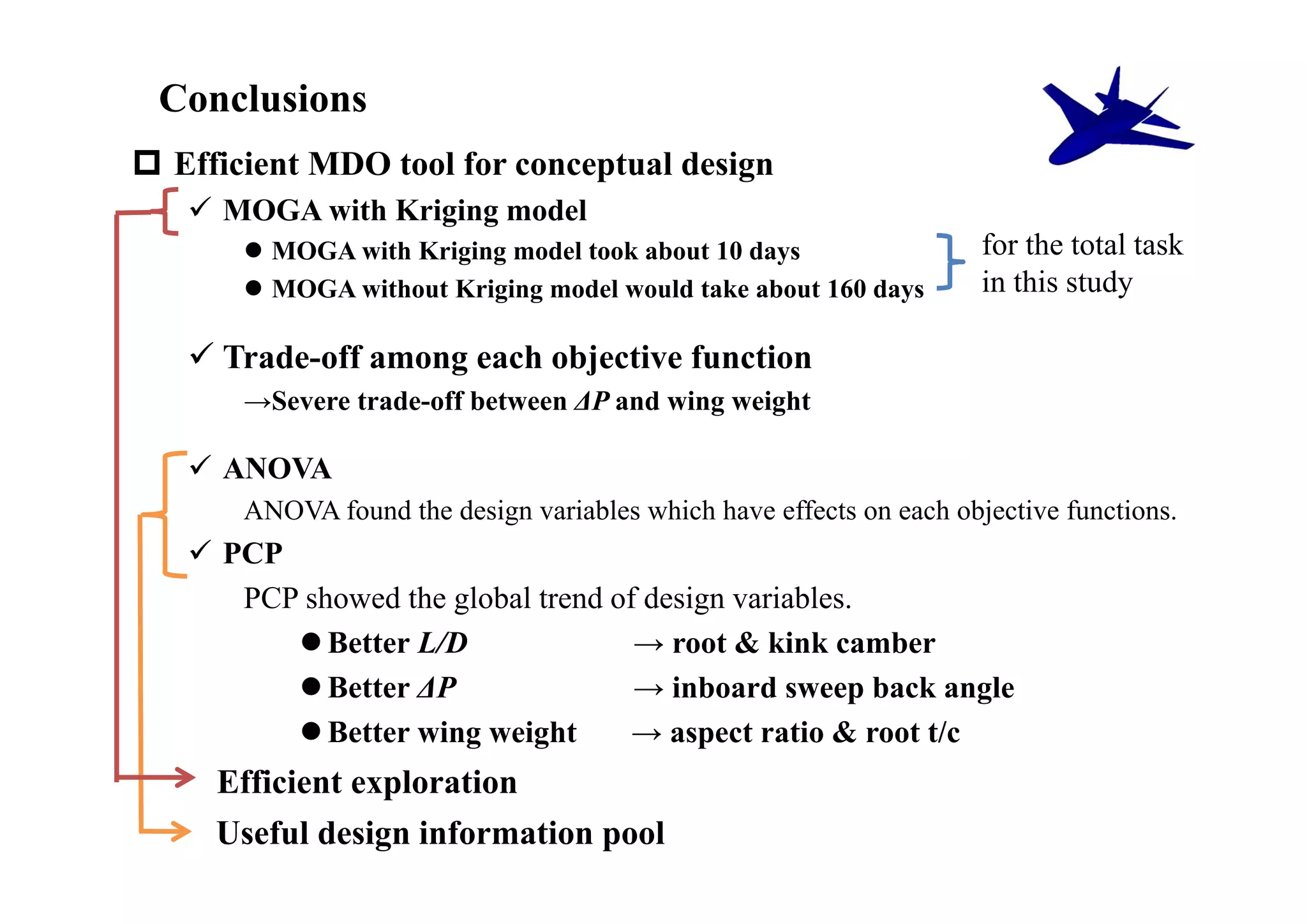
Conclusions
 Efficient MDO tool for conceptual design
    MOGA with Kriging model
        MOGA with Kriging model took about 10 days                   for the total task
        MOGA without Kriging model would take about 160 days         in this study

    Trade-off among each objective function
       →Severe trade-off between ΔP and wing weight

    ANOVA
       ANOVA found the design variables which have effects on each objective functions.
    PCP
      PCP showed the global trend of design variables.
          Better L/D               → root & kink camber
          Better ΔP                → inboard sweep back angle
          Better wing weight       → aspect ratio & root t/c
     Efficient exploration
     Useful design information pool
Acknowledgement

• I wish to thank Dr. Yoshikazu Makino, and Dr. Takeshi
  Takatoya, researchers in Aviation Program Group/Japan
  Aerospace Exploration Agency, for providing their CAE
  program and large support. I would like to thank my paper
  adviser, Prof. Masahiro Kanazaki, for his guidance, and
  support.

• My presentation is supported by the grant from JSASS (Japan
  Society of Aeronautics and Space Science).

Multidisciplinary Design Optimization of Supersonic Transport Wing Using Surrogate Model

  • 1.
    27th ICAS atNice on 22th September Session : Supersonic Aircraft Concepts “Multidisciplinary Design Optimization of Supersonic Transport Wing Using Surrogate Model” Naoto Seto (Tokyo Metropolitan University)
  • 2.
    Outline  Background  Objectives Design Approaches  Design Target and Design Variables  Objective Functions and Constraints  Results  Conclusions
  • 3.
    Background 1  Shorttime travel is one of the biggest demands.  SuperSonic Transport (SST) is expected to meet the demand above.  Studies in several institutes all over the world SSBJ of AERION Silent SST of JAXA QSST of SAI  Many problems to be solved  Flight cost  Environmental problems Trade-off  Aerodynamic performances  How should be next generation SST designed with many problems ?
  • 4.
    Background 2  MultidisciplinaryDesign Optimization (MDO) is the key technique Information Technological interests pool Aerodynamics Sonic boom Structure Materials Propulsions …etc Effects of variables Trade-off (Multi-validate analysis) (*GA, *DoE) Global trends MDO with global exploration will (Data mining) help knowledge discovery *GA : Genetic Algorithm *DoE : Design of Experiment
  • 5.
    Objectives  Development of efficient MDO tool for SST wing in conceptual design  Features about proposed MDO 1. Low CFD calculation cost  Full potential equation with panel method  Kriging model 2. Construction of global design information pool  Trade-off :Multi-Objective Genetic Algorithm  Effects of design variables :ANalysis Of VAriance  Global trends about design variables :Parallel Coordinate Plot
  • 6.
  • 7.
    Design Approaches (designprocedure) Initial sampling based on LHS* Surrogate model construction (Kriging model) Exploration of non-dominated solutions Additional samplings on Kriging model using MOGA No Convergence ? Yes Constructing design information pool (ANOVA, PCP) *Latin Hypercube Sampling
  • 8.
    Design Approaches (explorationof non-dominated solutions)  Multi Objective Genetic Algorithm (MOGA)  One of evolutionary algorithm  Searching global non-dominated solutions with multi-point explorations →Many evaluations are required. CFD Kriging model One of surrogate model Interpolating and searching local extremes ˆ (x i )     (x i ) y Global model Localized deviation from the global model
  • 9.
    Design Approaches (explorationof non-dominated solutions)  Kriging model includes uncertainty at the predicted points.  Expected Improvement (EI) considers the balance between optimist and the error.  EI is expressed below (for maximization problem) E I x   z  ( f max  z ) dz , n :standard distribution,  normal density s :standard error  f  ˆ  y  f max  ˆ  y  ( f max  y ˆ )   max   s    s   s  : Kriging model : Maximum values from sampling  The larger EI value has the larger possibility to be optimum solutions →Additional samplings are based on EIs’ maximization Jones, D. R., “Efficient Global Optimization of Expensive Black-Box Functions,” J. Glob. Opt., Vol. 13, pp.455-492 1998.
  • 10.
    Design Approaches (designinformation)  Analysis of Variance (ANOVA)  One of multi-validate analysis for quantitative information Integrate The main effect of design variable xi: i ( xi )     y( x1 ,....., xn )dx1 ,..., dxi 1 , dxi 1 ,.., dxn   ˆ variance where:      y( x1 ,....., xn )dx1 ,....., dxn ˆ Total proportion to the total variance: pi   2 p2  y(x1,....,xn ) dx1...dxn 35% ˆ p1 where, ε is the variance due to design variable xi. 65% Main effect
  • 11.
    Design Approaches (designinformation)  Parallel Coordinate Plot (PCP)  One of statistical visualization techniques from high-dimensional data into two dimensional data.  Design variables and objective functions are set parallel in the normalized axis.  PCP shows global trends of design variables. 1.0 0.8 0.6 0.4 0.2 0.0 Upper bound of ith design variables and objective functions Normalization Lower bound of ith design variables x(dvi ) - min(dvi ) P i and objective functions max(dvi ) - min(dvi )
  • 12.
    Design Target andDesign Variables
  • 13.
    Design Target  Three-dimensionalgeometry of supersonic main wing  Other components geometry fuselage, tail planform are same as 2.5th Silent SuperSonic Technology Demonstrator (S3TD) Specifications Fuselage 13.8m MTOW 3500kg Sref 21m2 Cruse M 1.6 Cruse altitude 14km 2.5th design by JAXA
  • 14.
    Design Variables  14design variables Table 1 Design space Upper Lower Design variable bound bound Sweepback angle at inboard dv1 57 (°) 69 (°) section Sweepback angle at outboard dv2 40 (°) 50 (°) section dv3 Twist angle at wing root 0 (°) 2(°) dv4 Twist angle at wing kink –1 (°) 0 (°) dv5 Twist angle at wing tip –2 (°) –1 (°) dv6 Maximum thickness at wing root 3%c 5%c Root & kink airfoil NACA 64series dv7 Maximum thickness at wing kink 3%c 5%c Tip airfoil bi-convex dv8 Maximum thickness at wing tip 3%c 5%c dv9 Aspect ratio 2 3 Tip airfoil Supersonic- dv10 Wing root camber at 25%c –1%c 2%c linearly-interpolation leading edge dv11 Wing root camber at 75%c –2%c 1%c Kink airfoil dv12 Wing kink camber at 25%c –1%c 2%c spline-interpolation Subsonic- dv13 Wing kink camber at 25%c –2%c 1%c leading edge dv14 Wing tip camber at 25%c –2%c 2%c Root airfoil
  • 15.
  • 16.
    Objective Functions  Threeobjective functions in this study maximize L/ D minimize ΔP (On boom carpet) ΔP minimize Wwing subject to Design C L = 0.105 Time[ms] maximize K-means method ˆ - L / Dmax y ˆ - L / Dmax y • EIL / D = ( ˆ - L / Dmax )Φ( y ) + sφ( ) Additional sampling points s s maximize clusters ΔP - ˆ y ΔP - ˆ y EI1 • EIΔP = ( ΔP - y min ˆ )Φ( min ) + sφ( min ) s s maximize Wwingmin ˆy Wwingmin - ˆ y EI2 • EIWwing = (Wwingmin - ˆ )Φ( y ) + sφ( ) s s
  • 17.
    Evaluations of L/Dand ΔP  CAPAS* developed in JAXA  Aerodynamic performance  Sonic-boom intensity  Compressible potential equation  Correction of shock wave with panel method (PANAIR) by Whitham’s theory  2  2  2  PANAIR data 2 F ( x)  CP ( M  1) 2  2  2 0 2 x y z x     1 r F x   : Velocity potential 2 3 Thomas’s waveform parameter method   M 2-1 pressure[psf]   1.4 Computational CP distributions r : propagation distance geometry Time[ms] *CAPAS (CAD-based Automatic Panel Analysis System)
  • 18.
    Evaluation of wingweight  Inboard wing (multi-frame structure)  Aluminum material  Minimum thickness of skin & frame (0<thickness<20mm, every0.1mm)  Outboard wing (full-depth honeycomb sandwich structure)  Composite material  Stack sequence  Fiber angle θ ; [0/ θ/- θ/90] ns, θ=15, 30, 45, 60, 70deg  Number of laminations n  n  N  25  Solver is MSC NASTRAN 2005R (FEM model)  Strength requirements  Aluminum material:Mises stress < 200MPa at all FEM nodes  Composite material: Destruction criteria < 1 at all FEM nodes on each laminate  Computational conditions  Symmetrical maneuver +6G, Safety rate: 1.25 PANAIR data  Estimated load on the main wing (symmetrical maneuver) × (safety rate) × (aerodynamics load)
  • 19.
    Constraint  Trim balance C. G.  C.P. is identical to C.G. at target CL C.P. →12 evaluations are required to decide the angle of horizontal tail.  Realistic cruise condition Angle of horizontal tail  Blue area (main wing and horizontal tail) were changed in this study. Cl target CL Cd x
  • 20.
  • 21.
    Results (samplings)  75points were sampled for constructing a initial Kriging model.  Additional samplings were carried out three times.  32 additional samples  Total number of samplings is 107.  Calculation time for one sample  One hour for the CAPAS evaluations  15 minutes for the NASTRAN evaluations  Calculation environment  General work station : 1CPU (Xeon 2.66MHz)
  • 22.
    Results (solution spaceabout objective functions) Wwing  24 non-dominated solutions from L/D ΔP[psf] AoA [kg] final data Design A 7.02 1.19 612 2.5  Most of additional samplings formed Design B 6.08 0.97 502 2.7 non-dominated solutions Design C 5.60 1.53 276 2.6 Design D 6.77 1.09 691 2.6 Design A (best L/D) Design B (best ΔP) Design C (best Wwing) Design D (compromised) Wwing[kg] ΔP[psf] Optimum direction L/D ΔP[psf]
  • 23.
    Results (configuration comparison) Each champion sample is compared to the compromised. Design A Design B Larger sweep back Thinner root airfoil *Red dot line is the compromised (Design D) Design C Thinner root airfoil of Design A Advantage of the reducing wave drag Flap tail angle Larger inboard sweep back angle of Design B Ideal equivalence area distribution Flap tail angle of Design C Reducing aerodynamics load on the main wing
  • 24.
    Evaluation of wingweight evaluations  Inboard wing (multi-frame structure)  Aluminum material  Minimum thickness of skin & frame (0<thickness<20mm, every0.1mm)  Outboard wing (full-depth honeycomb sandwich structure)  Composite material  Stack sequence  Fiber angle θ ; [0/ θ/- θ/90] ns, θ=15, 30, 45, 60, 70deg  Number of laminations n  n  N  25  Solver is MSC NASTRAN 2005R (FEM model)  Strength requirements  Aluminum material:Mises stress < 200MPa at all FEM nodes  Composite material: Destruction criteria < 1 at all FEM nodes on each laminate  Computational conditions  Symmetrical maneuver +6G, Safety rate: 1.25 PANAIR data  Estimated load on the main wing (symmetrical maneuver) × (safety rate) × (aerodynamics load)
  • 25.
    Results (waveform onthe ground)  Each champion sample is compared to the compromised. *Red dot line is the compromised (Design D) Less different Design A among Design A, B, and D Large different between Design C and D L/D ΔP[psf] Wwing[kg] Design B Design A 7.02 1.19 612 Design B 6.08 0.97 502 Design C 5.60 1.53 276 Design D 6.77 1.09 691 Design C Severe trade-off between ΔP & Wwing
  • 26.
    Results (Overview aboutANOVA) 70% 45% *a1 *a2 *a3 73% dv1 inboard sweep dv8 tip t/c dv2 outboard sweep dv9 aspect ratio dv3 root twist dv10 root camber(25%c) Proper range in dv4 kink twist dv11 root camber(75%c) design space? dv5 tip twist dv12 kink camber(25%c) dv6 root t/c dv13 kink camber(75%c) dv7 kink t/c dv14 tip camber(25%c)
  • 27.
    Results (Overview aboutPCP) Best 5 samples about L/D Extracting useful data about each objective function for the better visualization *p1 Best 5 samples *p2 about ΔP 24 non-dominated solutions data Best 5 samples about Wwing *p3
  • 28.
    Results (design informationof better L/D) *PCP was carried out from best five samples about L/D  Root camber(dv10, 11) & kink camber(dv12, 13)  ANOVA Design A upper  Kink twist(dv4) & root t/c(dv6)  PCP lower →Small drag around root & sufficient lift around kink *a1 *p1
  • 29.
    Results (design informationof better ΔP) *PCP was carried out from best 5 samples about ΔP  Inboard sweep(dv1) & root camber(dv10) & kink camber(dv14)  ANOVA Design B  Kink twist(dv4) & root t/c(dv6) & kink t/c(dv7)  PCP upper lower →Ideal equivalence area (Ae) distribution *a2 *p2
  • 30.
    Comparisons about equivalencearea distribution 2.5 2.0 Equivalence area 1.5 1.0 Design A Design B 0.5 Design C Design D Darden 0.0 0 2 4 6 8 10 12 x(m)
  • 31.
    Results (design informationof better Wwing) *PCP was carried out from best 5 samples about Wwing  Root t/c(dv6) & AR(dv9) & root camber(dv10) & kink camber(dv12, 13)  ANOVA Design C  Inboard sweep(dv1) & tip twist(dv5) & kink t/c(dv6)upper  PCP lower →Low aerodynamic load on the wing *a3 *p3
  • 32.
    Conclusions  Efficient MDOtool for conceptual design  MOGA with Kriging model  MOGA with Kriging model took about 10 days for the total task  MOGA without Kriging model would take about 160 days in this study  Trade-off among each objective function →Severe trade-off between ΔP and wing weight  ANOVA ANOVA found the design variables which have effects on each objective functions.  PCP PCP showed the global trend of design variables.  Better L/D → root & kink camber  Better ΔP → inboard sweep back angle  Better wing weight → aspect ratio & root t/c Efficient exploration Useful design information pool
  • 33.
    Acknowledgement • I wishto thank Dr. Yoshikazu Makino, and Dr. Takeshi Takatoya, researchers in Aviation Program Group/Japan Aerospace Exploration Agency, for providing their CAE program and large support. I would like to thank my paper adviser, Prof. Masahiro Kanazaki, for his guidance, and support. • My presentation is supported by the grant from JSASS (Japan Society of Aeronautics and Space Science).