STATISTICAL INFERENCE
(Estimation)
The main objective of sampling is to draw conclusions about
the
unknown population from the information provided by a
sample.
This is called statistical inference.
Statistical inference may be of two kinds: parameter estimation
and Hypothesis testing.
PARAMETER ESTIMATION
Parameter estimation is concerned with obtaining numerical
values of the parameter from a sample.
Example, a company may be interested in estimating the
share of the population who are aware of its product.
HYPOTHESIS TESTING
On the other hand, hypothesis is concerned with passing a
judgment on some assumption which we make( on the basis of
some theory or information) about a true value of a population
parameter.
COMPARISON BETWEEN ESTIMATION AND
HYPOTHESIS TESTING
• Utilises the information of a sample .
• In parameter estimation we use some formula in which we
substitute the observations of a sample in order to obtain
numerical estimate of the population parameter.
• In hypothesis testing we begin with some assumption about
the true value of the population parameter.
• Then we calculate certain test statistic and draw conclusion.
POINT ESTIMATION AND INTERVAL ESTIMATION.
An estimate of the population parameter given
by
a single number is called is called a point
estimate of the parameter.
EX.
A firm wish to estimate amount of time its
salesman spend on each sales call.
INTERVAL ESTIMATION
An estimate of a population parameter given by
two numbers between which the parameter
may
be considered to lie. The interval estimation
consists of lower and upper limits and we
assign
a probability (say 95% confidence) that this
interval contains the true value of the
parameter.
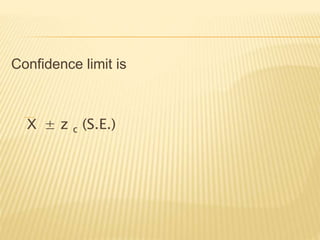
Confidence limit is
X ± z c (S.E.)
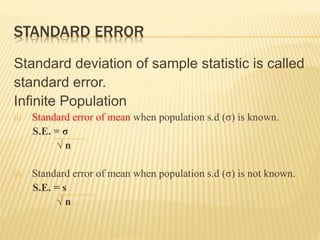
STANDARD ERROR
Standard deviation of sample statistic is called
standard error.
Infinite Population
(i) Standard error of mean when population s.d (σ) is known.
S.E. = σ
√ n
(i) Standard error of mean when population s.d (σ) is not known.
S.E. = s
√ n
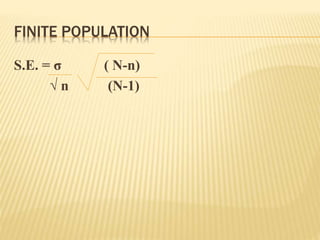
FINITE POPULATION
S.E. = σ ( N-n)
√ n (N-1)
EX 1
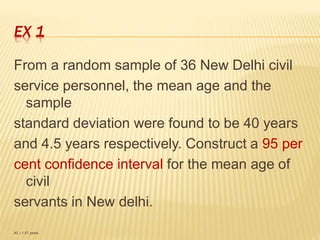
From a random sample of 36 New Delhi civil
service personnel, the mean age and the
sample
standard deviation were found to be 40 years
and 4.5 years respectively. Construct a 95 per
cent confidence interval for the mean age of
civil
servants in New delhi.
40 ±1.47 years.
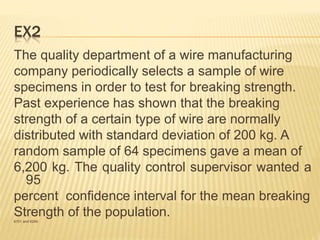
EX2
The quality department of a wire manufacturing
company periodically selects a sample of wire
specimens in order to test for breaking strength.
Past experience has shown that the breaking
strength of a certain type of wire are normally
distributed with standard deviation of 200 kg. A
random sample of 64 specimens gave a mean of
6,200 kg. The quality control supervisor wanted a
95
percent confidence interval for the mean breaking
Strength of the population.6151 and 6249.
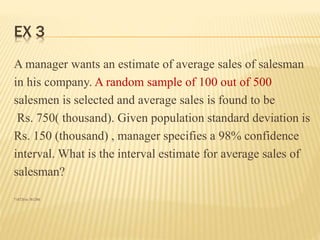
EX 3
A manager wants an estimate of average sales of salesman
in his company. A random sample of 100 out of 500
salesmen is selected and average sales is found to be
Rs. 750( thousand). Given population standard deviation is
Rs. 150 (thousand) , manager specifies a 98% confidence
interval. What is the interval estimate for average sales of
salesman?
718720 to 781280.

Statistical inference

  • 1.
  • 2.
    The main objectiveof sampling is to draw conclusions about the unknown population from the information provided by a sample. This is called statistical inference. Statistical inference may be of two kinds: parameter estimation and Hypothesis testing.
  • 3.
    PARAMETER ESTIMATION Parameter estimationis concerned with obtaining numerical values of the parameter from a sample. Example, a company may be interested in estimating the share of the population who are aware of its product.
  • 4.
    HYPOTHESIS TESTING On theother hand, hypothesis is concerned with passing a judgment on some assumption which we make( on the basis of some theory or information) about a true value of a population parameter.
  • 5.
    COMPARISON BETWEEN ESTIMATIONAND HYPOTHESIS TESTING • Utilises the information of a sample . • In parameter estimation we use some formula in which we substitute the observations of a sample in order to obtain numerical estimate of the population parameter. • In hypothesis testing we begin with some assumption about the true value of the population parameter. • Then we calculate certain test statistic and draw conclusion.
  • 6.
    POINT ESTIMATION ANDINTERVAL ESTIMATION. An estimate of the population parameter given by a single number is called is called a point estimate of the parameter.
  • 7.
    EX. A firm wishto estimate amount of time its salesman spend on each sales call.
  • 8.
    INTERVAL ESTIMATION An estimateof a population parameter given by two numbers between which the parameter may be considered to lie. The interval estimation consists of lower and upper limits and we assign a probability (say 95% confidence) that this interval contains the true value of the parameter.
  • 9.
    Confidence limit is X± z c (S.E.)
  • 10.
    STANDARD ERROR Standard deviationof sample statistic is called standard error. Infinite Population (i) Standard error of mean when population s.d (σ) is known. S.E. = σ √ n (i) Standard error of mean when population s.d (σ) is not known. S.E. = s √ n
  • 11.
    FINITE POPULATION S.E. =σ ( N-n) √ n (N-1)
  • 12.
    EX 1 From arandom sample of 36 New Delhi civil service personnel, the mean age and the sample standard deviation were found to be 40 years and 4.5 years respectively. Construct a 95 per cent confidence interval for the mean age of civil servants in New delhi. 40 ±1.47 years.
  • 13.
    EX2 The quality departmentof a wire manufacturing company periodically selects a sample of wire specimens in order to test for breaking strength. Past experience has shown that the breaking strength of a certain type of wire are normally distributed with standard deviation of 200 kg. A random sample of 64 specimens gave a mean of 6,200 kg. The quality control supervisor wanted a 95 percent confidence interval for the mean breaking Strength of the population.6151 and 6249.
  • 14.
    EX 3 A managerwants an estimate of average sales of salesman in his company. A random sample of 100 out of 500 salesmen is selected and average sales is found to be Rs. 750( thousand). Given population standard deviation is Rs. 150 (thousand) , manager specifies a 98% confidence interval. What is the interval estimate for average sales of salesman? 718720 to 781280.