MBA 901
Subject: Business Analytics for Decision
Making
Subject Code: MBA 201-18
Instructor: Amita
Session: 2020-22
Class: MBA II
Statistical Inference – Tests of
Hypotheses
MBA 901
Introduction
• Statistical inference is that branch of statistics
which is concerned with using probability
concept to deal with uncertainty in decision-
making.
• It refers to the process of selecting and using a
sample statistic to draw inference about a
population parameter based on a subset of it – the
sample drawn from the population.
MBA 901
Statistical inference treats two different classes of
problems:
1. Hypothesis testing, i.e., to test some hypothesis
about parent population from which the sample is
drawn.
2. Estimation, i.e., to use the ‘statistics’ obtained from
the sample as estimate of the unknown ‘parameter’ of
the population from which the sample is drawn.
In both these cases, the particular problem at hand is
structured in such a way that inferences about relevant
population values can be made from sample data.
MBA 901
Hypothesis Testing
• It begins with an assumption, called a
hypothesis, that we make about a population
parameter.
• A hypothesis is a supposition made as a basis
for reasoning.
MBA 901
There can be several types of hypotheses.
For example:
A coin may be tossed 200 times and we may get
heads 80 times and tails 120 times. We may now be
interested in testing the hypothesis that the coin is
unbiased.
We may study the average weight of the 100
students of a particular college and may get the
result as 100 lb. We may now be interested in testing
the hypothesis that the sample has been drawn from
a population with average weight 115 lb.
Similarly, we may be interested in testing the
hypothesis that the variable in the population are
uncorrelated.
MBA 901
Procedure of Testing Hypothesis
Setting up a hypothesis
• Set up a hypothesis about a population parameter.
• Then collect sample data, produce sample
statistics, and use this information to decide how
likely it is that our hypothesized population
parameter is correct.
1)
MBA 901
Say, we assume a certain value for a population
mean.
• To test the validity of our assumption, we gather
sample data and determine the difference between
the hypothesized value and the actual value of the
sample mean.
• Then we judge whether the difference is
significant.
The smaller the difference, the greater the likelihood
that our hypothesized value for the mean is correct.
The larger the value, the smaller the likelihood.
MBA 901
 The conventional approach to hypothesis testing
is not to construct a single hypothesis about the
population parameter, but rather to set up two
different hypotheses.
 These hypothesis must be so constructed that if
one hypothesis is accepted, the other is rejected
and vice versa.
MBA 901
The two hypotheses in a statistical test are
normally referred to as:
i. Null hypothesis, and
ii. Alternative hypothesis
MBA 901
The null hypothesis asserts that there is no real
difference in the sample and the population in the
particular matter under consideration (hence the
word “null” which means invalid, or amounting to
nothing) and the difference found is accidental and
unimportant arising out of fluctuations of
sampling.
MBA 901
For example:
• If we want to find out whether extra coaching has
benefited the students or not, then
null hypothesis “extra coaching has not benefited the students”.
• If we want to find out whether a particular drug is
effective in curing malaria, then
null hypothesis “the drug is not effective in curing malaria”.
MBA 901
 The rejection of the null hypothesis indicates
that the differences have statistical
significance, and
 The acceptance of the null hypothesis
indicates that the differences are due to
chance.
Since many practical problems aim at
establishment of statistical significance of
differences, rejection of the null hypothesis may,
thus, indicate success in statistical project.
MBA 901
 The alternative hypothesis specifies those
values that the researcher believes to hold true,
and of course, he hopes that the sample data
lead to acceptance of this hypothesis as true.
MBA 901
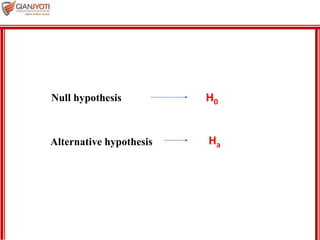
Null hypothesis H0
Alternative hypothesis Ha
MBA 901
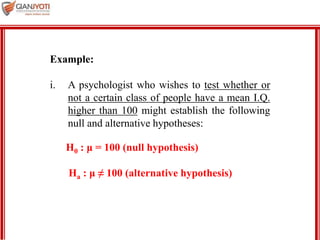
Example:
i. A psychologist who wishes to test whether or
not a certain class of people have a mean I.Q.
higher than 100 might establish the following
null and alternative hypotheses:
H0 : μ = 100 (null hypothesis)
Ha : μ ≠ 100 (alternative hypothesis)
MBA 901
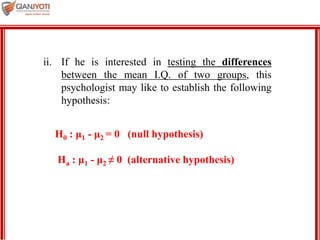
ii. If he is interested in testing the differences
between the mean I.Q. of two groups, this
psychologist may like to establish the following
hypothesis:
H0 : μ1 - μ2 = 0 (null hypothesis)
Ha : μ1 - μ2 ≠ 0 (alternative hypothesis)
MBA 901
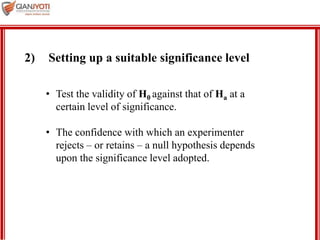
Setting up a suitable significance level
2)
• Test the validity of H0 against that of Ha at a
certain level of significance.
• The confidence with which an experimenter
rejects – or retains – a null hypothesis depends
upon the significance level adopted.
MBA 901
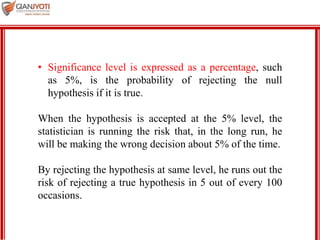
• Significance level is expressed as a percentage, such
as 5%, is the probability of rejecting the null
hypothesis if it is true.
When the hypothesis is accepted at the 5% level, the
statistician is running the risk that, in the long run, he
will be making the wrong decision about 5% of the time.
By rejecting the hypothesis at same level, he runs out the
risk of rejecting a true hypothesis in 5 out of every 100
occasions.
MBA 901
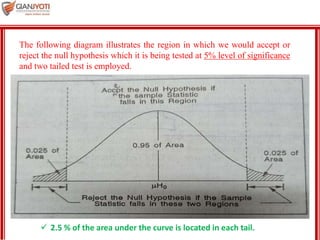
The following diagram illustrates the region in which we would accept or
reject the null hypothesis which it is being tested at 5% level of significance
and two tailed test is employed.
 2.5 % of the area under the curve is located in each tail.
MBA 901
Setting a test criterion
3)
• This involves selecting an appropriate
probability distribution for the particular test.
• Some probability distributions that are
commonly used in testing procedures are t, F
and χ2.
MBA 901
Doing computations
4)
• Perform calculations from a random sample of
size n.
• It includes the testing statistic and the standard
error of the testing statistic.
MBA 901
Making decisions
5)
The decision (whether to accept or reject the null
hypothesis) will depend on whether the computed value
of the test criterion falls in the region of rejection or the
region of acceptance.
MBA 901
 If the hypothesis is being tested at 5% level and the
observed set of results has probabilities less than 5%,
we consider the difference between the sample
statistics and hypothetical parameter significant.
We then decide to reject null hypothesis and state: “the
null hypothesis is false”, or “the sample observations are
not consistent with the null hypothesis” (the rejection of
null hypothesis automatically leads to acceptance of
alternative hypothesis.
MBA 901
 If at 5% level of significance, the observed set of
results has probabilities more than 5%, we give the
reason that the difference between the sample result
and hypothetical parameter can be explained by
chance variations and , therefore, is not significant
statistically.
We then decide not to reject null hypothesis and state:
“the sample observations are not inconsistent with the
null hypothesis”.

Statistical inference concept, procedure of hypothesis testing

  • 1.
    MBA 901 Subject: BusinessAnalytics for Decision Making Subject Code: MBA 201-18 Instructor: Amita Session: 2020-22 Class: MBA II Statistical Inference – Tests of Hypotheses
  • 2.
    MBA 901 Introduction • Statisticalinference is that branch of statistics which is concerned with using probability concept to deal with uncertainty in decision- making. • It refers to the process of selecting and using a sample statistic to draw inference about a population parameter based on a subset of it – the sample drawn from the population.
  • 3.
    MBA 901 Statistical inferencetreats two different classes of problems: 1. Hypothesis testing, i.e., to test some hypothesis about parent population from which the sample is drawn. 2. Estimation, i.e., to use the ‘statistics’ obtained from the sample as estimate of the unknown ‘parameter’ of the population from which the sample is drawn. In both these cases, the particular problem at hand is structured in such a way that inferences about relevant population values can be made from sample data.
  • 4.
    MBA 901 Hypothesis Testing •It begins with an assumption, called a hypothesis, that we make about a population parameter. • A hypothesis is a supposition made as a basis for reasoning.
  • 5.
    MBA 901 There canbe several types of hypotheses. For example: A coin may be tossed 200 times and we may get heads 80 times and tails 120 times. We may now be interested in testing the hypothesis that the coin is unbiased. We may study the average weight of the 100 students of a particular college and may get the result as 100 lb. We may now be interested in testing the hypothesis that the sample has been drawn from a population with average weight 115 lb. Similarly, we may be interested in testing the hypothesis that the variable in the population are uncorrelated.
  • 6.
    MBA 901 Procedure ofTesting Hypothesis Setting up a hypothesis • Set up a hypothesis about a population parameter. • Then collect sample data, produce sample statistics, and use this information to decide how likely it is that our hypothesized population parameter is correct. 1)
  • 7.
    MBA 901 Say, weassume a certain value for a population mean. • To test the validity of our assumption, we gather sample data and determine the difference between the hypothesized value and the actual value of the sample mean. • Then we judge whether the difference is significant. The smaller the difference, the greater the likelihood that our hypothesized value for the mean is correct. The larger the value, the smaller the likelihood.
  • 8.
    MBA 901  Theconventional approach to hypothesis testing is not to construct a single hypothesis about the population parameter, but rather to set up two different hypotheses.  These hypothesis must be so constructed that if one hypothesis is accepted, the other is rejected and vice versa.
  • 9.
    MBA 901 The twohypotheses in a statistical test are normally referred to as: i. Null hypothesis, and ii. Alternative hypothesis
  • 10.
    MBA 901 The nullhypothesis asserts that there is no real difference in the sample and the population in the particular matter under consideration (hence the word “null” which means invalid, or amounting to nothing) and the difference found is accidental and unimportant arising out of fluctuations of sampling.
  • 11.
    MBA 901 For example: •If we want to find out whether extra coaching has benefited the students or not, then null hypothesis “extra coaching has not benefited the students”. • If we want to find out whether a particular drug is effective in curing malaria, then null hypothesis “the drug is not effective in curing malaria”.
  • 12.
    MBA 901  Therejection of the null hypothesis indicates that the differences have statistical significance, and  The acceptance of the null hypothesis indicates that the differences are due to chance. Since many practical problems aim at establishment of statistical significance of differences, rejection of the null hypothesis may, thus, indicate success in statistical project.
  • 13.
    MBA 901  Thealternative hypothesis specifies those values that the researcher believes to hold true, and of course, he hopes that the sample data lead to acceptance of this hypothesis as true.
  • 14.
    MBA 901 Null hypothesisH0 Alternative hypothesis Ha
  • 15.
    MBA 901 Example: i. Apsychologist who wishes to test whether or not a certain class of people have a mean I.Q. higher than 100 might establish the following null and alternative hypotheses: H0 : μ = 100 (null hypothesis) Ha : μ ≠ 100 (alternative hypothesis)
  • 16.
    MBA 901 ii. Ifhe is interested in testing the differences between the mean I.Q. of two groups, this psychologist may like to establish the following hypothesis: H0 : μ1 - μ2 = 0 (null hypothesis) Ha : μ1 - μ2 ≠ 0 (alternative hypothesis)
  • 17.
    MBA 901 Setting upa suitable significance level 2) • Test the validity of H0 against that of Ha at a certain level of significance. • The confidence with which an experimenter rejects – or retains – a null hypothesis depends upon the significance level adopted.
  • 18.
    MBA 901 • Significancelevel is expressed as a percentage, such as 5%, is the probability of rejecting the null hypothesis if it is true. When the hypothesis is accepted at the 5% level, the statistician is running the risk that, in the long run, he will be making the wrong decision about 5% of the time. By rejecting the hypothesis at same level, he runs out the risk of rejecting a true hypothesis in 5 out of every 100 occasions.
  • 19.
    MBA 901 The followingdiagram illustrates the region in which we would accept or reject the null hypothesis which it is being tested at 5% level of significance and two tailed test is employed.  2.5 % of the area under the curve is located in each tail.
  • 20.
    MBA 901 Setting atest criterion 3) • This involves selecting an appropriate probability distribution for the particular test. • Some probability distributions that are commonly used in testing procedures are t, F and χ2.
  • 21.
    MBA 901 Doing computations 4) •Perform calculations from a random sample of size n. • It includes the testing statistic and the standard error of the testing statistic.
  • 22.
    MBA 901 Making decisions 5) Thedecision (whether to accept or reject the null hypothesis) will depend on whether the computed value of the test criterion falls in the region of rejection or the region of acceptance.
  • 23.
    MBA 901  Ifthe hypothesis is being tested at 5% level and the observed set of results has probabilities less than 5%, we consider the difference between the sample statistics and hypothetical parameter significant. We then decide to reject null hypothesis and state: “the null hypothesis is false”, or “the sample observations are not consistent with the null hypothesis” (the rejection of null hypothesis automatically leads to acceptance of alternative hypothesis.
  • 24.
    MBA 901  Ifat 5% level of significance, the observed set of results has probabilities more than 5%, we give the reason that the difference between the sample result and hypothetical parameter can be explained by chance variations and , therefore, is not significant statistically. We then decide not to reject null hypothesis and state: “the sample observations are not inconsistent with the null hypothesis”.