NEW PRODUCT DEVELOPMENT
Factors That Limit New Product Development
• Shortage of ideas
• Fragmented markets
• Social and governmental constraints
• Cost of development
• Capital shortages
• Faster required development time
• Shorter product life cycles
World’s Most Innovative Companies
• Apple
• Google
• Toyota
• General Electric
• Microsoft
• Procter & Gamble
• 3M
• Walt Disney
• IBM
• Sony
• Wal-Mart
• Honda
• Starbucks
• Target
• BMW
• Samsung
Seven Notions of Innovation
• See the future through the eyes of your
customer
• Intellectual property and brand power are key
assets
• Use digital technology to create tools for
customers
• Build a championship team
• Innovation is a state of mind
• Speed is critical, so push your organization
• Partner up if you’re not the best
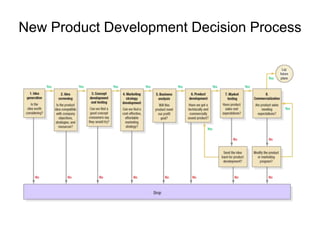
New Product Development Decision Process
Stages in a New Product Development
1) Idea Generation
The new product development process starts
with the search for ideas. New product ideas can
come from many sources- customers, scientists,
competitors, employees, channel members and
top management.
Drawing Ideas
• Observe customers using product
• Ask customers about problems with products
• Ask customers about their dream products
• Use a customer advisory board or a brand
community of enthusiasts to discuss product
• Run informal sessions with customers
• Make customer brainstorming a part of plant
tours
• Taking ideas from employees
2) Idea Screening
Ideas showed be written down and
reviewed, each week by an idea
committee, which sorts them into 3
groups. Promising ideas, marginal ideas
and rejects.
The purpose of screening is to drop poor
ideas as early as possible.
3) Concept development and Testing
A product idea is a possible product the company might
offer to the market. A product concept is an elaborated
version of the idea expressed in meaningful consumer
terms. A product idea can be turned into several
concepts. The first question is:
• Who will use this product? The powder can be aimed at
infants, children, teenagers, young, middle age
• Second question can be, what primary benefit should this
product provide? Taste, nutrition, refreshment, energy
• When will people consume this drink? Breakfast, lunch,
mid afternoon, evening, late evening
CONCEPT TESTING
It involves presenting the product concept to
appropriate target consumers and getting their
reactions. The more the tested concepts
resemble the final product, the more dependable
concept testing is. In the past, creating physical
prototypes was costly and time consuming but
computer aided design and manufacturing
programs have changed that. Today firms
design alternative physical products. (e.g. small
appliances or toys) on a computer and then
produce plastic models of each.
4) Business Analysis
Management needs to estimate whether sales
will be high enough to yield a satisfactory profit.
In estimating a new product’s sales, the
manager’s first task is to estimate first time
purchase of the new product in each period.
After preparing the sales forecast, management
should estimate expected costs and profits.
Marketing Strategy
• Target market’s size, structure, and
behavior
• Planned price, distribution, and promotion
for year one
• Long-run sales and profit goals and
marketing-mix strategy over time
5) Product Development
6) Market Testing
After management is satisfied with functional and
psychological performance, the product is ready to be dressed
up with a brand name and packaging and put to a market test.
Test markets- The company chooses a few representative
cities and the sales force tries to sell the trade on carrying the
product and giving it good shelf exposure. The company puts
on a full advertising and promotion campaign in these markets.
a) How many test cities- between 2 and 6 cities
b) Which cities- one company looks for cities
that have diversified industry, good media
coverage, cooperative chain stores, average
competitive activity, no evidence of being over
tested
c) Length of test- from a few months to a year
d) What information- store audits will show retail
sales and competitors’ market shares but will
not reveal buyer characteristic. Consumer
panel will indicate which people are buying
which brands and their loyalty and switching
rates. Buyer surveys will yield in-depth
information about consumer attitudes, usage
and satisfaction.
e) What action to take- If the test markets show a
high trial rate and a low repurchase rate,
customers are not satisfied and the product
should be redesigned or dropped. If the trial
and repurchase rates are both low, the product
should be abandoned.
7) Commercialization
a) When (timing)
b) Where (geographic strategy)- The company must
decide whether to launch the new product in a single
locality, a region, several regions, national or
international market.
c) To whom (target market prospects)- The company must
target its initial distribution and promotion to the best
prospect groups. The company has already profiled the
prime prospects. They would be early adopters, heavy
users and opinion leaders
d) How (introductory market strategy)

Chapter 13. new product development

  • 1.
  • 2.
    Factors That LimitNew Product Development • Shortage of ideas • Fragmented markets • Social and governmental constraints • Cost of development • Capital shortages • Faster required development time • Shorter product life cycles
  • 3.
    World’s Most InnovativeCompanies • Apple • Google • Toyota • General Electric • Microsoft • Procter & Gamble • 3M • Walt Disney • IBM • Sony • Wal-Mart • Honda • Starbucks • Target • BMW • Samsung
  • 4.
    Seven Notions ofInnovation • See the future through the eyes of your customer • Intellectual property and brand power are key assets • Use digital technology to create tools for customers • Build a championship team • Innovation is a state of mind • Speed is critical, so push your organization • Partner up if you’re not the best
  • 5.
    New Product DevelopmentDecision Process
  • 6.
    Stages in aNew Product Development 1) Idea Generation The new product development process starts with the search for ideas. New product ideas can come from many sources- customers, scientists, competitors, employees, channel members and top management.
  • 7.
    Drawing Ideas • Observecustomers using product • Ask customers about problems with products • Ask customers about their dream products • Use a customer advisory board or a brand community of enthusiasts to discuss product • Run informal sessions with customers • Make customer brainstorming a part of plant tours • Taking ideas from employees
  • 8.
    2) Idea Screening Ideasshowed be written down and reviewed, each week by an idea committee, which sorts them into 3 groups. Promising ideas, marginal ideas and rejects. The purpose of screening is to drop poor ideas as early as possible.
  • 9.
    3) Concept developmentand Testing A product idea is a possible product the company might offer to the market. A product concept is an elaborated version of the idea expressed in meaningful consumer terms. A product idea can be turned into several concepts. The first question is: • Who will use this product? The powder can be aimed at infants, children, teenagers, young, middle age • Second question can be, what primary benefit should this product provide? Taste, nutrition, refreshment, energy • When will people consume this drink? Breakfast, lunch, mid afternoon, evening, late evening
  • 10.
    CONCEPT TESTING It involvespresenting the product concept to appropriate target consumers and getting their reactions. The more the tested concepts resemble the final product, the more dependable concept testing is. In the past, creating physical prototypes was costly and time consuming but computer aided design and manufacturing programs have changed that. Today firms design alternative physical products. (e.g. small appliances or toys) on a computer and then produce plastic models of each.
  • 11.
    4) Business Analysis Managementneeds to estimate whether sales will be high enough to yield a satisfactory profit. In estimating a new product’s sales, the manager’s first task is to estimate first time purchase of the new product in each period. After preparing the sales forecast, management should estimate expected costs and profits.
  • 12.
    Marketing Strategy • Targetmarket’s size, structure, and behavior • Planned price, distribution, and promotion for year one • Long-run sales and profit goals and marketing-mix strategy over time
  • 13.
    5) Product Development 6)Market Testing After management is satisfied with functional and psychological performance, the product is ready to be dressed up with a brand name and packaging and put to a market test. Test markets- The company chooses a few representative cities and the sales force tries to sell the trade on carrying the product and giving it good shelf exposure. The company puts on a full advertising and promotion campaign in these markets.
  • 14.
    a) How manytest cities- between 2 and 6 cities b) Which cities- one company looks for cities that have diversified industry, good media coverage, cooperative chain stores, average competitive activity, no evidence of being over tested c) Length of test- from a few months to a year
  • 15.
    d) What information-store audits will show retail sales and competitors’ market shares but will not reveal buyer characteristic. Consumer panel will indicate which people are buying which brands and their loyalty and switching rates. Buyer surveys will yield in-depth information about consumer attitudes, usage and satisfaction. e) What action to take- If the test markets show a high trial rate and a low repurchase rate, customers are not satisfied and the product should be redesigned or dropped. If the trial and repurchase rates are both low, the product should be abandoned.
  • 16.
    7) Commercialization a) When(timing) b) Where (geographic strategy)- The company must decide whether to launch the new product in a single locality, a region, several regions, national or international market. c) To whom (target market prospects)- The company must target its initial distribution and promotion to the best prospect groups. The company has already profiled the prime prospects. They would be early adopters, heavy users and opinion leaders d) How (introductory market strategy)