Biostatistics
Unit 7
Hypothesis Testing
1
Testing Hypotheses
• Hypothesis testing and estimation are
used to reach conclusions about a
population by examining a sample of that
population.
• Hypothesis testing is widely used in
medicine, dentistry, health care, biology and
other fields as a means to draw conclusions
about the nature of populations.
2
Hypothesis testing
• Hypothesis testing is to provide information
in helping to make decisions.
• The administrative decision usually depends
a test between two hypotheses.
• Decisions are based on the outcome.
3
Definitions
Hypothesis: A hypothesis is a statement about one
or more populations. There are research
hypotheses and statistical hypotheses.
4
Definitions
• Research hypothesis: A research
hypothesis is the supposition or conjecture
that motivates the research.
• It may be proposed after numerous
repeated observation.
• Research hypotheses lead directly to
statistical hypotheses.
5
Definitions
• Statistical hypotheses: Statistical
hypotheses are stated in such a way that
they may be evaluated by appropriate
statistical techniques.
• There are two statistical hypotheses
involved in hypothesis testing.
6
Definitions
• Hypothesis testing is a procedure to support
one of two proposed hypotheses.
• is the null hypothesis or the hypothesis of
no difference.
• (otherwise known as ) is the
alternative hypothesis. It is what we will
believe is true if we reject the null
hypothesis.
7
Rules for testing hypotheses
1. Your expected conclusion, or what you
hope to conclude as a result of the experiment
should be placed in the alternative hypothesis.
2. The null hypothesis should contain an
expression of equality, either =, or .
3. The null hypothesis is the hypothesis that
will be tested.
8
Rules for testing hypotheses
4. The null and alternative hypotheses are
complementary. This means that the two
alternatives together exhaust all possibilities
of the values that the hypothesized parameter
can assume.
Note: Neither hypothesis testing nor
statistical inference proves the hypothesis. It
only indicates whether the hypothesis is
supported by the data or not.
9
Stating statistical hypotheses
10
Test statistic
The general formula for a test statistic is
11
Example of test statistic
sample mean
hypothesized parameter— population mean
standard error of which is the relevant
statistic
This all depends on the assumptions being correct.
12
Level of significance
• The level of significance, a, is a
probability and is, in reality, the probability
of rejecting a true null hypothesis.
• For example, with 95% confidence
intervals, a = .05 meaning that there is a
5% chance that the parameter does not fall
within the 95% confidence region.
• This creates an error and leads to a false
conclusion.
13
Significance and errors
• When the computed value of the test
statistic falls in the rejection region it is said
to be significant.
• We select a small value of a such as .10,
.05 or .01 to make the probability of rejecting
a true null hypothesis small.
14
Types of errors
•When a true null hypothesis is rejected, it
causes a Type I error whose probability is a.
•When a false null hypothesis is not rejected,
it causes a Type II error whose probability is
designated by b.
•A Type I error is considered to be more
serious than a Type II error.
15
Table of error conditions
16
Risk management
• Since rejecting a null hypothesis has a
chance of committing a type I error, we
make a small by selecting an appropriate
confidence interval.
• Generally, we do not control b, even though
it is generally greater than a. However,
when failing to reject a null hypothesis, the
risk of error is unknown.
17
Procedure for hypothesis testing
• In science, as in other disciplines, certain
methods and procedures are used for
performing experiments and reporting
results.
• A research report in the biological sciences
generally has five sections.
18
Procedure for hypothesis testing
I. Introduction
The introduction contains a statement of the
problem to be solved, a summary of what is
being done, a discussion of work done before
and other basic background for the paper.
19
Procedure for hypothesis testing
II. Materials and methods
The biological, chemical and physical
materials used in the experiments are
described. The procedures used are given or
referenced so that the reader may repeat the
experiments if s/he so desires.
20
Procedure for hypothesis testing
III. Results
A section dealing with the outcomes of the
experiments. The results are reported and
sometimes explained in this section. Other
explanations are placed in the discussion
section.
21
Procedure for hypothesis testing
IV. Discussion
The results are explained in terms of their
relationship to the solution of the problem
under study and their meaning.
22
Procedure for hypothesis testing
V. Conclusions
Appropriate conclusions are drawn from the
information obtained as a result of performing
the experiments.
23
Procedure for hypothesis testing
• This method can be modified for use in
biostatistics.
• The materials and procedures used in
biostatistics can be made to fit into these
five categories.
• Alternatively, we will use an approach that is
similar in structure but contains seven
sections.
24
Procedure for hypothesis testing
a. Given
b. Assumptions
c. Hypotheses
d. Statistical test
e. Calculations
f. Discussion
g. Conclusions
25
Explanation of procedure
a. Given
This section contains introductory material
such as the measurements or counts given in
the statement of the problem. It should
contain enough information so as to solve the
problem without further information
26
Explanation of procedure
b. Assumptions
This is another set of introductory material that
is necessary for a correct solution of the
problem. In biostatistics, problems are solved
and conclusions drawn based on certain
assumptions being true. If they are not true
the results may be invalid.
27
Explanation of procedure
c. Hypotheses
The specific hypotheses being tested are
written
H0 : the null hypothesis
HA : the alternative hypothesis
28
Explanation of procedure
d. Test statistic
In this section, several items are necessary.
• First, decide on the test statistic that will be
used. for example z or t. It must be
possible to compute the test statistic from
the data of the sample. How it is set up
depends on how the hypotheses are stated.
29
Explanation of procedure
• Second, the distribution of the test statistic
must be known. For example, the z statistic
is distributed as the standard normal
distribution whereas the t statistic is
distributed following Student's t distribution.
30
Explanation of procedure
• Third, the criteria for making the decision
are required.
• It is best to draw an actual distribution with
rejection and non-rejection regions.
• The values of the test statistic that mark the
regions should be calculated in advance so
that when the problem is solved, the
resulting figure can be compared
immediately.
31
Explanation of procedure
e. Calculations
The test statistic is calculated using the data
given in the problem. The result is compared
with the previously specified rejection and
non-rejection regions.
32
Explanation of procedure
f. Discussion
A statistical decision is made on whether to
reject the null hypothesis or not.
33
Explanation of procedure
g. Conclusion
After the statistical decision is made,
conclusions are drawn. What is reported
depends on the statistical decision made in
the Discussion section.
If H0 is rejected we conclude that HA is true.
This conclusion can be stated as written.
34
Explanation of procedure
• If H0 is not rejected , then we conclude that
H0 may be true. We “fail to reject H0.”
• Caution is required when reporting this
outcome.
• One should not say "H0 is true," because
there is always a chance of making a Type II
error. This would mean that a false null
hypothesis was not rejected. It is better to
say, "H0 may be true." in this case.
35
Purpose of hypothesis testing
• Hypothesis testing is to provide information
in helping to make decisions.
• The administrative decision usually depends
on the null hypothesis.
• If the null hypothesis is rejected, usually the
administrative decision will follow the
alternative hypothesis.
36
Purpose of hypothesis testing
• It is important to remember never to base
any decision solely on the outcome of
only one test.
• Statistical testing can be used to provide
additional support for decisions based on
other relevant information.
37
Topics
Hypothesis Testing of a Single Population Mean
Hypothesis Testing of the Difference Between Two
Population Means
Hypothesis Testing of a Single Population Proportion
Hypothesis Testing of the Difference Between Two
Population Proportions
Hypothesis Testing of a Single Population Variance
Hypothesis Testing of the Ratio of Two Population
Variances
38
A) Hypothesis testing of a single population mean
A hypothesis about a population mean can be
tested when sampling is from any of the
following.
• A normally distributed population--variances
known
39
Hypothesis testing of a single population mean
• A normally distributed population--variances
unknown
40
Hypothesis testing of a single population mean
• A population that is not normally distributed
(assuming n 30; the central limit theorem
applies)
41
p values
• A p value is a probability that the result is as
extreme or more extreme than the observed
value if the null hypothesis is true.
• If the p value is less than or equal to a, we
reject the null hypothesis, otherwise we do
not reject the null hypothesis.
42
One tail and two tail tests
• One tail test. In a one tail test, the rejection
region is at one end of the distribution or the
other.
• Two tail test. In a two tail test, the rejection
region is split between the two tails.
Which one is used depends on the way the
null hypothesis is written.
43
Confidence intervals
• A confidence interval can be used to test
hypotheses.
• For example, if the null hypothesis is: H0:
m = 30, a 95% confidence interval can be
constructed.
• If 30 were within the confidence interval, we
could conclude that the null hypothesis is
not rejected at that level of significance.
44
Procedure
The procedure of seven steps is followed for
hypothesis testing. It is very important to
observe several items.
• Avoid rounding numbers off until the very
end of the problem.
• Pay strict attention to details.
• Be very careful with regard to the way things
are worded.
• Write down all the steps and do not take
short cuts.
45
Sampling from a normally distributed
population--variance known
Example 7.2.1
A simple random sample of 10 people from a
certain population has a mean age of 27. Can
we conclude that the mean age of the
population is not 30? The variance is known
to be 20. Let a = .05.
46
Solution
a. Data
n = 10 = 20
= 27 a = .05
47
Solution
b. Assumptions
• simple random sample
• normally distributed population
48
Solution
c. Hypotheses
H0 : m = 30
HA : m 30
49
Solution
d. Statistical test
• Test statistic
50
Solution
d. Statistical test
• Distribution of test statistic
If the assumptions are correct and H0 is
true, the test statistic follows the standard
normal distribution.
51
Solution
d. Statistical test
• Decision criteria
Reject H0 if the z value falls in the rejection
region. Fail to reject H0 if it falls in the
nonrejection region.
52
Solution
d. Statistical test
• Decision criteria
53
Solution
d. Statistical test
Decision criteria
Because of the structure of H0 it is a two tail
test. Therefore, reject H0 if z -1.96 or
z 1.96.
54
Solution
e. Calculations
55
Solution
f. Discussion
We reject the null hypothesis because
z = -2.12 which is in the rejection
region. The value is significant at
the .05 level.
56
Solution
g. Conclusions
We conclude that m is not 30.
p = .0340
• A z value of -2.12 corresponds to an area of
.0170. Since there are two parts to the
rejection region in a two tail test, the p value
is twice this which is .0340.
57
Confidence interval
58
Solution
Same example as a one tail test.
Example 7.2.1 (reprise)
A simple random sample of 10 people from a
certain population has a mean age of 27. Can
we conclude that the mean age of the
population is less than 30? The variance is
known to be 20. Let a = .05.
59
Solution
a. Given
n = 10 = 20
= 27 a = .05
60
Solution
b. Assumptions
• simple random sample
• normally distributed population
61
Solution
c. Hypotheses
H0: m 30
HA: m < 30
62
Solution
d. Statistical test
• Test statistic
63
Solution
d. Statistical Test
• Distribution of test statistic
If the assumptions are correct and H0 is true, the
test statistic follows the standard normal
distribution. Therefore, we calculate a z score and
use it to test the hypothesis.
64
Solution
d. Statistical Test
• Decision criteria
Reject H0 if the z value falls in the rejection
region. Fail to reject H0 if it falls in the
nonrejection region.
65
Solution
d. Statistical Test
• Decision criteria
66
Solution
d. Statistical Test
• Decision criteria
With a = .05 and the inequality we have the entire
rejection region at the left. The critical value will
be z = -1.645. Reject H0 if z < -1.645.
67
Solution
e. Calculations
68
Solution
f. Discussion
We reject the null hypothesis because
-2.12 < -1.645.
69
Solution
g. Conclusions
We conclude that m < 30.
p = .0170 this time because it is only a one tail test
and not a two tail test.
70
Sampling is from a normally distributed
population--variance unknown.
Example 7.2.3 Body mass index
A simple random sample of 14 people from a certain
population gives body mass indices as shown in
Table 7.2.1. Can we conclude that the BMI is not
35? Let a = .05.
71
72
Solution
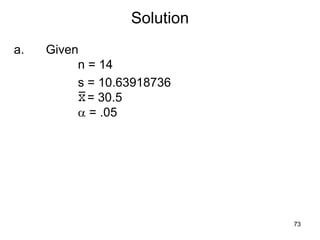
a. Given
n = 14
s = 10.63918736
= 30.5
a = .05
73
Solution
b. Assumptions
• simple random sample
• population of similar subjects
• normally distributed
74
Solution
c. Hypotheses
H0: m = 35
HA: m 35
75
Solution
d. Statistical Test
• Test statistic
76
Solution
d. Statistical Test
• Distribution of test statistic
If the assumptions are correct and H0 is true, the test
statistic follows Student's t distribution with 13
degrees of freedom.
77
Solution
d. Statistical Test
• Decision criteria
We have a two tail test. With a = .05 it means that
each tail is 0.025. The critical t values with 13 df are
-2.1604 and 2.1604.
We reject H0 if the t -2.1604 or t 2.1604.
78
decision criteria
79
Solution
e. Calculation of test statistic
80
Solution
f. Discussion
Do not reject the null hypothesis because -1.58 is
not in the rejection region.
81
Solution
g. Conclusions
Based on the data of the sample, it is possible that
m = 35. The value of p = .1375
82
Sampling is from a population that is not
normally distributed
Example 7.2.4
Maximum oxygen uptake data
Can we conclude that m > 30?
Let a = .05.
83
Solution
a. Given
n = 242 s = 12.14
= 33.3 a = .05
84
Solution
b. Assumptions
• simple random sample
• population is similar to those subjects in the sample
(cannot assume normal distribution)
85
Solution
c. Hypotheses
H0: m 30
HA: m > 30
86
Solution
d. Statistical Test
• Test statistic
87
Solution
d. Statistical Test
• Distribution of test statistic
By virtue of the Central Limit Theorem, the test
statistic is approximately normally distributed
with m = 0 if H0 is true.
88
Solution
d. Statistical Test
• Decision criteria
This is a one tail test with a = .05. The rejection
region is at the right of the value z = 1.645.
89
90
Solution
e. Calculations
91
Solution
f. Discussion
Reject H0 because 4.23 > 1.645.
92
Solution
g. Conclusion
The maximum oxygen uptake for the sampled
population is greater than 30.
The p value < .001 because 4.23 is off the chart
(p(3.89) < .001).
Actual value p=1.17 x 10⁻⁵ (.0000117)
93
B) Hypothesis testing of the difference
between two population means
This is a two sample z test which is used to
determine if two population means are equal or
unequal. There are three possibilities for formulating
hypotheses.
(continued)
94
Possible hypotheses
l. H0: m1 = m2 HA: m1 m2
2. H0: m1 m2 HA: m1 < m2
3. H0: m1 m2 HA: m1 > m2
95
Procedure
The same procedure is used in three different
situations
96
Sampling is from normally distributed populations
with known variances
97
Sampling from normally distributed populations
where population variances are unknown
population variances equal
This is with t distributed as Student's t distribution
with n1 + n2 - 2 degrees of freedom and a pooled
variance.
(continued)
98
Sampling from normally distributed populations
where population variances are unknown
population variances equal--distribution
99
Sampling from normally distributed populations
where population variances are unknown
population variances equal—pooled variance
100
population variances unequal
When population variances are unequal, a
distribution of t' is used in a manner similar to
calculations of confidence intervals in similar
circumstances.
101
Sampling from populations that are not
normally distributed
If both sample sizes are 30 or larger the central limit
theorem is in effect. The test statistic is z. If the
population variances are unknown, the sample
variances are used.
102
Sampling from normally distributed
populations with population variances known
Example 7.3.1
Serum uric acid levels: Is there a difference
between the means between individuals with Down's
syndrome and normal individuals?
103
Solution
a. Given
= 4.5 n1 = 12 s1
2 = 1
= 3.4 n2 = 15 s2
2 = 1.5 a = .05
104
Solution
b. Assumptions
• two independent random samples
• each drawn from a normally distributed population
105
Solution
c. Hypotheses
H0: m1 = m2
HA: m1 m2
106
Solution
d. Statistical test -- This is a two sample z test.
107
Solution
d. Statistical Test
• Distribution of Test Statistic
If the assumptions are correct and H0 is true, the
test statistic is distributed as the normal
distribution.
108
Solution
d. Statistical Test
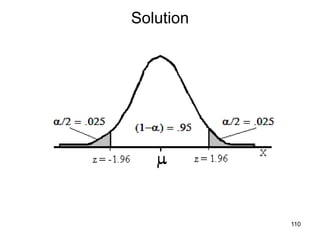
• Decision criteria
With a = .05, the critical values of z are -1.96 and
+1.96. We reject H0 if z < -1.96 or z > +1.96.
109
Solution
110
Solution
e. Calculations
111
Solution
f. Discussion
Reject H0 because 2.57 > 1.96.
112
Solution
g. Conclusion
From these data, it can be concluded that the
population means are not equal. A 95% confidence
interval would give the same conclusion.
p = .0102.
113
Sampling from normally distributed
populations with unknown variances
With equal population variances, we can obtain a
pooled value from the sample variances.
(continued)
114
Example 7.3.2 -- Lung destructive index
We wish to know if we may conclude, at the 95%
confidence level, that smokers, in general, have
greater lung damage than do non-smokers.
115
Solution
a. Given
Smokers: = 17.5 n1 = 16 s1 = 4.4752
Non-Smokers: = 12.4 n2 = 9 s2 = 4.8492
a = .05
116
Calculation of Pooled Variance
117
Solution
b. Assumptions
• independent random samples
• normal distribution of the populations
• population variances are equal
118
Solution
c. Hypotheses
H0: m1 m2
HA: m1 > m2
119
Solution
d. Statistical test -- Test statistic
120
Solution
d. Statistical Test
• Distribution of Test Statistic
If the assumptions are met and H0 is true, the test
statistic is distributed as Student's t distribution with
23 degrees of freedom.
121
Solution
d. Statistical Test
• Decision Criteria
With a = .05 and df = 23, the critical value of t is
1.7139. We reject H0 if t > 1.7139.
122
Solution
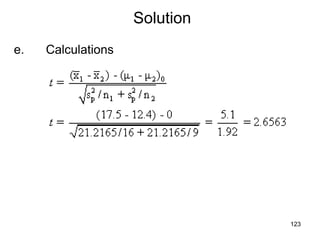
e. Calculations
123
Solution
f. Discussion
Reject H0 because 2.6563 > 1.7139.
124
Solution
g. Conclusions
On the basis of the data, we conclude that
m1 > m2 .
Actual values
t = 2.6558
p = .014
125
Sampling from populations that are not
normally distributed -- Example 7.3.4
These data were obtained in a study comparing
persons with disabilities with persons without
disabilities. A scale known as the Barriers to Health
Promotion Activities for Disabled Persons (BHADP)
Scale gave the data. We wish to know if we may
conclude, at the 99% confidence level, that persons
with disabilities score higher than persons without
disabilities.
126
Solution
a. Given
Disabled: = 31.83 n1 = 132 s1 = 7.93
Nondisabled: = 25.07 n2 = 137 s2 = 4.80
a = .01
127
Solution
b. Assumptions
• independent random samples
128
Solution
c. Hypotheses
H0: m1 m2
HA: m1 > m2
129
Solution
d. Statistical test -- Test statistic
Because of the large samples, the central limit
theorem permits calculation of the z score as
opposed to using t. The z score is calculated using
the given sample standard deviations.
130
Solution
d. Statistical Test
• Distribution of Test Statistic
If the assumptions are correct and H0 is true, the test
statistic is approximately normally distributed
131
Solution
d. Statistical Test
• Decision criteria
With a = .01 and a one tail test, the critical value
of z is 2.33. We reject H0 if z > 2.33.
132
Solution
e. Calculation of test statistic
133
Solution
f. Discussion
Reject H0 because 8.42 > 2.33.
134
C) Hypothesis testing of a single
population proportion
When the assumptions for using a normal curve are
achieved, it is possible to test hypotheses about a
population proportion. When the sample size is
large to permit use of the central limit theorem, the
statistic of choice is z.
(continued)
135
Example 7.5.1
IV drug users and HIV
We wish to know if we may conclude that fewer than
5% of the IV drug users in the sampled population
are HIV positive.
136
Solution
a. Given
n = 423 with 18 possessing the characteristic of
interest
= 18/423 = .0426
p0 = .05
a = .05
137
Solution
b. Assumptions
• because of the central limit theorem, the sampling
distribution of is normally distributed
138
Solution
c. Hypotheses
H0:p .05
HA:p < .05
(continued)
139
Solution
If H0 is true, p = .05 and the standard error is
Note that the standard error is not based on the
value of
140
Solution
d. Statistical test -- Test statistic
The test statistic is z which is calculated as
141
Solution
d. Statistical Test
• Distribution of test statistic
Because the sample is large we can use z
distributed as the normal distribution if H0 is true.
142
Solution
d. Statistical Test
• Decision criteria
With a = .05 the critical z score is -1.645. We
reject H0 if z -1.645.
143
Solution
e. Calculations
144
Solution
f. Discussion
Do not reject H0 because -.6983 > -1.645
145
Solution
g. Conclusions
We conclude that p may be .05 or more.
146
D) Hypothesis testing of the difference
between two population proportions
It is frequently important to test the difference
between two population proportions. Generally we
would test p1 = p2 . This permits the construction of
a pooled estimate which is given by the following
formula.
(continued)
147
D) Hypothesis testing of the difference
between two population proportions
The pooled estimate for calculating the standard
error of the estimator is:
(continued)
148
D) Hypothesis testing of the difference
between two population proportions
The standard error of the estimator is:
149
Two population proportions -- Example 7.6.1
In a study of patients on sodium-restricted diets, 55
patients with hypertension were studied. Among
these, 24 were on sodium-restricted diets. Of 149
patients without hypertension, 36 were on sodium-
restricted diets. We would like to know if we can
conclude that, in the sampled population, the
proportion of patients on sodium-restricted diets is
higher among patients with hypertension than
among patients without hypertension.
150
a. Given
Patients with hypertension:
n1 = 55 x1 = 24 = .4364
Patients without hypertension:
n2 = 149 x2 = 36 = .2416
a = .05
151
Solution
b. Assumptions
independent random samples from the populations
152
Solution
c. Hypotheses
H0: p1 p2
HA: p1 > p2
153
d. Statistical test – Test statistic
The test statistic is z which is calculated as
154
Solution
d. Statistical Test
• Distribution of test statistic
If the null hypothesis is true, the test statistic
approximately follows the standard normal
distribution.
155
Solution
d. Statistical Test
• Decision criteria
With a = .05 the critical z score is 1.645. We
reject H0 if z > 1.645.
156
Solution
e. Calculations
157
Solution
f. Discussion
Reject H0 because 2.71 > 1.645
158
Solution
g. Conclusions
The proportion of patients on sodium restricted diets
among hypertensive patients is higher than in
nonhypertensive patients.
p = .0034
159
Where the data consist of a simple random sample
drawn from a normally distributed population, the
test statistic for testing hypotheses about a single
population variance is
which, when H0 is true, is distributed as c2 with n-1
degrees of freedom.
160
E) Hypothesis testing of a single population variance
Example 7.7.1
Response to allergen inhalation in allergic
primates. In a study of 12 monkeys, the standard
error of the mean for allergen inhalation was found
to be .4 for one of the items studied. We wish to
know if we may conclude that the population
variance is not 4.
161
Solution
a. Given
n = 12
standard error = .4
a = .05
df = 11
162
Solution
b. Assumptions
• simple random sample
• normally distributed population
163
Solution
c. Hypotheses
H0: s2 = 4
HA: s2 4
164
Solution
d. Statistical test -- Test statistic
The test statistic is
165
Solution
d. Statistical Test
• Distribution of test statistic
When the null hypothesis is true, the distribution
is c2 with 11 df.
166
Solution
d. Statistical Test
• Decision criteria
With a = .05 and 11 df, the critical values are
3.816 and 21.920. Reject H0 if c2 < 3.816
or c2 > 21.920.
167
168
Solution
e. Calculations
s2 = .4*12 = 4.8
c2= [11(4.8)]/4=13.2
169
Solution
f. Discussion
Do not reject H0 because 3.816 < 13.2 < 21.920
(calculated value of c2 is not in rejection region)
170
Solution
g. Conclusions
Based on these data, we cannot conclude that the
population variance is not 4.
p > .05 because c2 = 13.2 is not in the rejection
region.
171
F) Hypothesis testing of the ratio of two
population variances
This test is used to determine if there is a significant
difference between two variances. The test statistic
is the variance ratio
The statistic follows the F distribution with
n1-1 numerator degrees of freedom and
n2-1 denominator degrees of freedom.
172
How V. R. is determined
• two tail test
The larger variance is put in the numerator.
173
How V. R. is determined
• one sided test H0: s1
2 s2
2
In a one sided test where H0: s1
2 s2
2 and
HA : s1
2 > s2
2 we put s1
2 /s2
2. The critical value of F
is determined for a using the appropriate degrees of
freedom.
174
How V. R. is determined
• one sided test H0: s1
2 s2
2
In a one sided test where H0: s1
2 s2
2
and HA : s1
2 < s2
2 we put s2
2 /s1
2. The critical
value of F is determined for a using the appropriate
degrees of freedom.
175
Example 7.8.1 – Pituitary adenomas
A study was performed on patients with pituitary
adenomas. The standard deviation of the weights of
12 patients with pituitary adenomas was 21.4 kg. A
control group of 5 patients without pituitary
adenomas had a standard deviation of the weights
of 12.4 kg. We wish to know if the weights of the
patients with pituitary adenomas are more variable
than the weights of the control group.
176
a. Given
Pituitary adenomas:
n1 = 12 s1 = 21.4 kg
Control:
n2 = 5 s2 = 12.4 kg
a = .05
177
Solution
b. Assumptions
• each sample is a simple random sample
• samples are independent
• both populations are normally distributed
178
Solution
c. Hypotheses
H0: s1
2 s2
2
HA : s1
2 > s2
2
179
Solution
d. Statistical test
• Test statistic
The test statistic is
180
Solution
d. Statistical Test
• Distribution of test statistic
When H0 is true, the test statistic is distributed as F
with 11 numerator degrees of freedom and 4
denominator degrees of freedom.
181
Solution
d. Statistical Test
• Decision criteria
The critical value is F11,4 = 5.91. Reject H0 if
V.R. > 5.91
182
From the F.95 table
183
Solution
e. Calculations
184
Solution
f. Discussion
We cannot reject H0 because 2.98 < 5.91. The
calculated value for V.R. falls in the nonrejection
region.
185
Solution
g. Conclusions
The weights of the population of patients may not be
any more variable than the weights of the control
subjects. Since V.R. of 2.98 < 3.10, it gives p > .10
Actual p = .1517
186
fin
187

Hypothesis testing

  • 1.
  • 2.
    Testing Hypotheses • Hypothesistesting and estimation are used to reach conclusions about a population by examining a sample of that population. • Hypothesis testing is widely used in medicine, dentistry, health care, biology and other fields as a means to draw conclusions about the nature of populations. 2
  • 3.
    Hypothesis testing • Hypothesistesting is to provide information in helping to make decisions. • The administrative decision usually depends a test between two hypotheses. • Decisions are based on the outcome. 3
  • 4.
    Definitions Hypothesis: A hypothesisis a statement about one or more populations. There are research hypotheses and statistical hypotheses. 4
  • 5.
    Definitions • Research hypothesis:A research hypothesis is the supposition or conjecture that motivates the research. • It may be proposed after numerous repeated observation. • Research hypotheses lead directly to statistical hypotheses. 5
  • 6.
    Definitions • Statistical hypotheses:Statistical hypotheses are stated in such a way that they may be evaluated by appropriate statistical techniques. • There are two statistical hypotheses involved in hypothesis testing. 6
  • 7.
    Definitions • Hypothesis testingis a procedure to support one of two proposed hypotheses. • is the null hypothesis or the hypothesis of no difference. • (otherwise known as ) is the alternative hypothesis. It is what we will believe is true if we reject the null hypothesis. 7
  • 8.
    Rules for testinghypotheses 1. Your expected conclusion, or what you hope to conclude as a result of the experiment should be placed in the alternative hypothesis. 2. The null hypothesis should contain an expression of equality, either =, or . 3. The null hypothesis is the hypothesis that will be tested. 8
  • 9.
    Rules for testinghypotheses 4. The null and alternative hypotheses are complementary. This means that the two alternatives together exhaust all possibilities of the values that the hypothesized parameter can assume. Note: Neither hypothesis testing nor statistical inference proves the hypothesis. It only indicates whether the hypothesis is supported by the data or not. 9
  • 10.
  • 11.
    Test statistic The generalformula for a test statistic is 11
  • 12.
    Example of teststatistic sample mean hypothesized parameter— population mean standard error of which is the relevant statistic This all depends on the assumptions being correct. 12
  • 13.
    Level of significance •The level of significance, a, is a probability and is, in reality, the probability of rejecting a true null hypothesis. • For example, with 95% confidence intervals, a = .05 meaning that there is a 5% chance that the parameter does not fall within the 95% confidence region. • This creates an error and leads to a false conclusion. 13
  • 14.
    Significance and errors •When the computed value of the test statistic falls in the rejection region it is said to be significant. • We select a small value of a such as .10, .05 or .01 to make the probability of rejecting a true null hypothesis small. 14
  • 15.
    Types of errors •Whena true null hypothesis is rejected, it causes a Type I error whose probability is a. •When a false null hypothesis is not rejected, it causes a Type II error whose probability is designated by b. •A Type I error is considered to be more serious than a Type II error. 15
  • 16.
    Table of errorconditions 16
  • 17.
    Risk management • Sincerejecting a null hypothesis has a chance of committing a type I error, we make a small by selecting an appropriate confidence interval. • Generally, we do not control b, even though it is generally greater than a. However, when failing to reject a null hypothesis, the risk of error is unknown. 17
  • 18.
    Procedure for hypothesistesting • In science, as in other disciplines, certain methods and procedures are used for performing experiments and reporting results. • A research report in the biological sciences generally has five sections. 18
  • 19.
    Procedure for hypothesistesting I. Introduction The introduction contains a statement of the problem to be solved, a summary of what is being done, a discussion of work done before and other basic background for the paper. 19
  • 20.
    Procedure for hypothesistesting II. Materials and methods The biological, chemical and physical materials used in the experiments are described. The procedures used are given or referenced so that the reader may repeat the experiments if s/he so desires. 20
  • 21.
    Procedure for hypothesistesting III. Results A section dealing with the outcomes of the experiments. The results are reported and sometimes explained in this section. Other explanations are placed in the discussion section. 21
  • 22.
    Procedure for hypothesistesting IV. Discussion The results are explained in terms of their relationship to the solution of the problem under study and their meaning. 22
  • 23.
    Procedure for hypothesistesting V. Conclusions Appropriate conclusions are drawn from the information obtained as a result of performing the experiments. 23
  • 24.
    Procedure for hypothesistesting • This method can be modified for use in biostatistics. • The materials and procedures used in biostatistics can be made to fit into these five categories. • Alternatively, we will use an approach that is similar in structure but contains seven sections. 24
  • 25.
    Procedure for hypothesistesting a. Given b. Assumptions c. Hypotheses d. Statistical test e. Calculations f. Discussion g. Conclusions 25
  • 26.
    Explanation of procedure a.Given This section contains introductory material such as the measurements or counts given in the statement of the problem. It should contain enough information so as to solve the problem without further information 26
  • 27.
    Explanation of procedure b.Assumptions This is another set of introductory material that is necessary for a correct solution of the problem. In biostatistics, problems are solved and conclusions drawn based on certain assumptions being true. If they are not true the results may be invalid. 27
  • 28.
    Explanation of procedure c.Hypotheses The specific hypotheses being tested are written H0 : the null hypothesis HA : the alternative hypothesis 28
  • 29.
    Explanation of procedure d.Test statistic In this section, several items are necessary. • First, decide on the test statistic that will be used. for example z or t. It must be possible to compute the test statistic from the data of the sample. How it is set up depends on how the hypotheses are stated. 29
  • 30.
    Explanation of procedure •Second, the distribution of the test statistic must be known. For example, the z statistic is distributed as the standard normal distribution whereas the t statistic is distributed following Student's t distribution. 30
  • 31.
    Explanation of procedure •Third, the criteria for making the decision are required. • It is best to draw an actual distribution with rejection and non-rejection regions. • The values of the test statistic that mark the regions should be calculated in advance so that when the problem is solved, the resulting figure can be compared immediately. 31
  • 32.
    Explanation of procedure e.Calculations The test statistic is calculated using the data given in the problem. The result is compared with the previously specified rejection and non-rejection regions. 32
  • 33.
    Explanation of procedure f.Discussion A statistical decision is made on whether to reject the null hypothesis or not. 33
  • 34.
    Explanation of procedure g.Conclusion After the statistical decision is made, conclusions are drawn. What is reported depends on the statistical decision made in the Discussion section. If H0 is rejected we conclude that HA is true. This conclusion can be stated as written. 34
  • 35.
    Explanation of procedure •If H0 is not rejected , then we conclude that H0 may be true. We “fail to reject H0.” • Caution is required when reporting this outcome. • One should not say "H0 is true," because there is always a chance of making a Type II error. This would mean that a false null hypothesis was not rejected. It is better to say, "H0 may be true." in this case. 35
  • 36.
    Purpose of hypothesistesting • Hypothesis testing is to provide information in helping to make decisions. • The administrative decision usually depends on the null hypothesis. • If the null hypothesis is rejected, usually the administrative decision will follow the alternative hypothesis. 36
  • 37.
    Purpose of hypothesistesting • It is important to remember never to base any decision solely on the outcome of only one test. • Statistical testing can be used to provide additional support for decisions based on other relevant information. 37
  • 38.
    Topics Hypothesis Testing ofa Single Population Mean Hypothesis Testing of the Difference Between Two Population Means Hypothesis Testing of a Single Population Proportion Hypothesis Testing of the Difference Between Two Population Proportions Hypothesis Testing of a Single Population Variance Hypothesis Testing of the Ratio of Two Population Variances 38
  • 39.
    A) Hypothesis testingof a single population mean A hypothesis about a population mean can be tested when sampling is from any of the following. • A normally distributed population--variances known 39
  • 40.
    Hypothesis testing ofa single population mean • A normally distributed population--variances unknown 40
  • 41.
    Hypothesis testing ofa single population mean • A population that is not normally distributed (assuming n 30; the central limit theorem applies) 41
  • 42.
    p values • Ap value is a probability that the result is as extreme or more extreme than the observed value if the null hypothesis is true. • If the p value is less than or equal to a, we reject the null hypothesis, otherwise we do not reject the null hypothesis. 42
  • 43.
    One tail andtwo tail tests • One tail test. In a one tail test, the rejection region is at one end of the distribution or the other. • Two tail test. In a two tail test, the rejection region is split between the two tails. Which one is used depends on the way the null hypothesis is written. 43
  • 44.
    Confidence intervals • Aconfidence interval can be used to test hypotheses. • For example, if the null hypothesis is: H0: m = 30, a 95% confidence interval can be constructed. • If 30 were within the confidence interval, we could conclude that the null hypothesis is not rejected at that level of significance. 44
  • 45.
    Procedure The procedure ofseven steps is followed for hypothesis testing. It is very important to observe several items. • Avoid rounding numbers off until the very end of the problem. • Pay strict attention to details. • Be very careful with regard to the way things are worded. • Write down all the steps and do not take short cuts. 45
  • 46.
    Sampling from anormally distributed population--variance known Example 7.2.1 A simple random sample of 10 people from a certain population has a mean age of 27. Can we conclude that the mean age of the population is not 30? The variance is known to be 20. Let a = .05. 46
  • 47.
    Solution a. Data n =10 = 20 = 27 a = .05 47
  • 48.
    Solution b. Assumptions • simplerandom sample • normally distributed population 48
  • 49.
    Solution c. Hypotheses H0 :m = 30 HA : m 30 49
  • 50.
  • 51.
    Solution d. Statistical test •Distribution of test statistic If the assumptions are correct and H0 is true, the test statistic follows the standard normal distribution. 51
  • 52.
    Solution d. Statistical test •Decision criteria Reject H0 if the z value falls in the rejection region. Fail to reject H0 if it falls in the nonrejection region. 52
  • 53.
  • 54.
    Solution d. Statistical test Decisioncriteria Because of the structure of H0 it is a two tail test. Therefore, reject H0 if z -1.96 or z 1.96. 54
  • 55.
  • 56.
    Solution f. Discussion We rejectthe null hypothesis because z = -2.12 which is in the rejection region. The value is significant at the .05 level. 56
  • 57.
    Solution g. Conclusions We concludethat m is not 30. p = .0340 • A z value of -2.12 corresponds to an area of .0170. Since there are two parts to the rejection region in a two tail test, the p value is twice this which is .0340. 57
  • 58.
  • 59.
    Solution Same example asa one tail test. Example 7.2.1 (reprise) A simple random sample of 10 people from a certain population has a mean age of 27. Can we conclude that the mean age of the population is less than 30? The variance is known to be 20. Let a = .05. 59
  • 60.
    Solution a. Given n =10 = 20 = 27 a = .05 60
  • 61.
    Solution b. Assumptions • simplerandom sample • normally distributed population 61
  • 62.
  • 63.
  • 64.
    Solution d. Statistical Test •Distribution of test statistic If the assumptions are correct and H0 is true, the test statistic follows the standard normal distribution. Therefore, we calculate a z score and use it to test the hypothesis. 64
  • 65.
    Solution d. Statistical Test •Decision criteria Reject H0 if the z value falls in the rejection region. Fail to reject H0 if it falls in the nonrejection region. 65
  • 66.
  • 67.
    Solution d. Statistical Test •Decision criteria With a = .05 and the inequality we have the entire rejection region at the left. The critical value will be z = -1.645. Reject H0 if z < -1.645. 67
  • 68.
  • 69.
    Solution f. Discussion We rejectthe null hypothesis because -2.12 < -1.645. 69
  • 70.
    Solution g. Conclusions We concludethat m < 30. p = .0170 this time because it is only a one tail test and not a two tail test. 70
  • 71.
    Sampling is froma normally distributed population--variance unknown. Example 7.2.3 Body mass index A simple random sample of 14 people from a certain population gives body mass indices as shown in Table 7.2.1. Can we conclude that the BMI is not 35? Let a = .05. 71
  • 72.
  • 73.
    Solution a. Given n =14 s = 10.63918736 = 30.5 a = .05 73
  • 74.
    Solution b. Assumptions • simplerandom sample • population of similar subjects • normally distributed 74
  • 75.
  • 76.
  • 77.
    Solution d. Statistical Test •Distribution of test statistic If the assumptions are correct and H0 is true, the test statistic follows Student's t distribution with 13 degrees of freedom. 77
  • 78.
    Solution d. Statistical Test •Decision criteria We have a two tail test. With a = .05 it means that each tail is 0.025. The critical t values with 13 df are -2.1604 and 2.1604. We reject H0 if the t -2.1604 or t 2.1604. 78
  • 79.
  • 80.
    Solution e. Calculation oftest statistic 80
  • 81.
    Solution f. Discussion Do notreject the null hypothesis because -1.58 is not in the rejection region. 81
  • 82.
    Solution g. Conclusions Based onthe data of the sample, it is possible that m = 35. The value of p = .1375 82
  • 83.
    Sampling is froma population that is not normally distributed Example 7.2.4 Maximum oxygen uptake data Can we conclude that m > 30? Let a = .05. 83
  • 84.
    Solution a. Given n =242 s = 12.14 = 33.3 a = .05 84
  • 85.
    Solution b. Assumptions • simplerandom sample • population is similar to those subjects in the sample (cannot assume normal distribution) 85
  • 86.
  • 87.
  • 88.
    Solution d. Statistical Test •Distribution of test statistic By virtue of the Central Limit Theorem, the test statistic is approximately normally distributed with m = 0 if H0 is true. 88
  • 89.
    Solution d. Statistical Test •Decision criteria This is a one tail test with a = .05. The rejection region is at the right of the value z = 1.645. 89
  • 90.
  • 91.
  • 92.
    Solution f. Discussion Reject H0because 4.23 > 1.645. 92
  • 93.
    Solution g. Conclusion The maximumoxygen uptake for the sampled population is greater than 30. The p value < .001 because 4.23 is off the chart (p(3.89) < .001). Actual value p=1.17 x 10⁻⁵ (.0000117) 93
  • 94.
    B) Hypothesis testingof the difference between two population means This is a two sample z test which is used to determine if two population means are equal or unequal. There are three possibilities for formulating hypotheses. (continued) 94
  • 95.
    Possible hypotheses l. H0:m1 = m2 HA: m1 m2 2. H0: m1 m2 HA: m1 < m2 3. H0: m1 m2 HA: m1 > m2 95
  • 96.
    Procedure The same procedureis used in three different situations 96
  • 97.
    Sampling is fromnormally distributed populations with known variances 97
  • 98.
    Sampling from normallydistributed populations where population variances are unknown population variances equal This is with t distributed as Student's t distribution with n1 + n2 - 2 degrees of freedom and a pooled variance. (continued) 98
  • 99.
    Sampling from normallydistributed populations where population variances are unknown population variances equal--distribution 99
  • 100.
    Sampling from normallydistributed populations where population variances are unknown population variances equal—pooled variance 100
  • 101.
    population variances unequal Whenpopulation variances are unequal, a distribution of t' is used in a manner similar to calculations of confidence intervals in similar circumstances. 101
  • 102.
    Sampling from populationsthat are not normally distributed If both sample sizes are 30 or larger the central limit theorem is in effect. The test statistic is z. If the population variances are unknown, the sample variances are used. 102
  • 103.
    Sampling from normallydistributed populations with population variances known Example 7.3.1 Serum uric acid levels: Is there a difference between the means between individuals with Down's syndrome and normal individuals? 103
  • 104.
    Solution a. Given = 4.5n1 = 12 s1 2 = 1 = 3.4 n2 = 15 s2 2 = 1.5 a = .05 104
  • 105.
    Solution b. Assumptions • twoindependent random samples • each drawn from a normally distributed population 105
  • 106.
  • 107.
    Solution d. Statistical test-- This is a two sample z test. 107
  • 108.
    Solution d. Statistical Test •Distribution of Test Statistic If the assumptions are correct and H0 is true, the test statistic is distributed as the normal distribution. 108
  • 109.
    Solution d. Statistical Test •Decision criteria With a = .05, the critical values of z are -1.96 and +1.96. We reject H0 if z < -1.96 or z > +1.96. 109
  • 110.
  • 111.
  • 112.
    Solution f. Discussion Reject H0because 2.57 > 1.96. 112
  • 113.
    Solution g. Conclusion From thesedata, it can be concluded that the population means are not equal. A 95% confidence interval would give the same conclusion. p = .0102. 113
  • 114.
    Sampling from normallydistributed populations with unknown variances With equal population variances, we can obtain a pooled value from the sample variances. (continued) 114
  • 115.
    Example 7.3.2 --Lung destructive index We wish to know if we may conclude, at the 95% confidence level, that smokers, in general, have greater lung damage than do non-smokers. 115
  • 116.
    Solution a. Given Smokers: =17.5 n1 = 16 s1 = 4.4752 Non-Smokers: = 12.4 n2 = 9 s2 = 4.8492 a = .05 116
  • 117.
  • 118.
    Solution b. Assumptions • independentrandom samples • normal distribution of the populations • population variances are equal 118
  • 119.
  • 120.
    Solution d. Statistical test-- Test statistic 120
  • 121.
    Solution d. Statistical Test •Distribution of Test Statistic If the assumptions are met and H0 is true, the test statistic is distributed as Student's t distribution with 23 degrees of freedom. 121
  • 122.
    Solution d. Statistical Test •Decision Criteria With a = .05 and df = 23, the critical value of t is 1.7139. We reject H0 if t > 1.7139. 122
  • 123.
  • 124.
    Solution f. Discussion Reject H0because 2.6563 > 1.7139. 124
  • 125.
    Solution g. Conclusions On thebasis of the data, we conclude that m1 > m2 . Actual values t = 2.6558 p = .014 125
  • 126.
    Sampling from populationsthat are not normally distributed -- Example 7.3.4 These data were obtained in a study comparing persons with disabilities with persons without disabilities. A scale known as the Barriers to Health Promotion Activities for Disabled Persons (BHADP) Scale gave the data. We wish to know if we may conclude, at the 99% confidence level, that persons with disabilities score higher than persons without disabilities. 126
  • 127.
    Solution a. Given Disabled: =31.83 n1 = 132 s1 = 7.93 Nondisabled: = 25.07 n2 = 137 s2 = 4.80 a = .01 127
  • 128.
  • 129.
  • 130.
    Solution d. Statistical test-- Test statistic Because of the large samples, the central limit theorem permits calculation of the z score as opposed to using t. The z score is calculated using the given sample standard deviations. 130
  • 131.
    Solution d. Statistical Test •Distribution of Test Statistic If the assumptions are correct and H0 is true, the test statistic is approximately normally distributed 131
  • 132.
    Solution d. Statistical Test •Decision criteria With a = .01 and a one tail test, the critical value of z is 2.33. We reject H0 if z > 2.33. 132
  • 133.
    Solution e. Calculation oftest statistic 133
  • 134.
    Solution f. Discussion Reject H0because 8.42 > 2.33. 134
  • 135.
    C) Hypothesis testingof a single population proportion When the assumptions for using a normal curve are achieved, it is possible to test hypotheses about a population proportion. When the sample size is large to permit use of the central limit theorem, the statistic of choice is z. (continued) 135
  • 136.
    Example 7.5.1 IV drugusers and HIV We wish to know if we may conclude that fewer than 5% of the IV drug users in the sampled population are HIV positive. 136
  • 137.
    Solution a. Given n =423 with 18 possessing the characteristic of interest = 18/423 = .0426 p0 = .05 a = .05 137
  • 138.
    Solution b. Assumptions • becauseof the central limit theorem, the sampling distribution of is normally distributed 138
  • 139.
  • 140.
    Solution If H0 istrue, p = .05 and the standard error is Note that the standard error is not based on the value of 140
  • 141.
    Solution d. Statistical test-- Test statistic The test statistic is z which is calculated as 141
  • 142.
    Solution d. Statistical Test •Distribution of test statistic Because the sample is large we can use z distributed as the normal distribution if H0 is true. 142
  • 143.
    Solution d. Statistical Test •Decision criteria With a = .05 the critical z score is -1.645. We reject H0 if z -1.645. 143
  • 144.
  • 145.
    Solution f. Discussion Do notreject H0 because -.6983 > -1.645 145
  • 146.
    Solution g. Conclusions We concludethat p may be .05 or more. 146
  • 147.
    D) Hypothesis testingof the difference between two population proportions It is frequently important to test the difference between two population proportions. Generally we would test p1 = p2 . This permits the construction of a pooled estimate which is given by the following formula. (continued) 147
  • 148.
    D) Hypothesis testingof the difference between two population proportions The pooled estimate for calculating the standard error of the estimator is: (continued) 148
  • 149.
    D) Hypothesis testingof the difference between two population proportions The standard error of the estimator is: 149
  • 150.
    Two population proportions-- Example 7.6.1 In a study of patients on sodium-restricted diets, 55 patients with hypertension were studied. Among these, 24 were on sodium-restricted diets. Of 149 patients without hypertension, 36 were on sodium- restricted diets. We would like to know if we can conclude that, in the sampled population, the proportion of patients on sodium-restricted diets is higher among patients with hypertension than among patients without hypertension. 150
  • 151.
    a. Given Patients withhypertension: n1 = 55 x1 = 24 = .4364 Patients without hypertension: n2 = 149 x2 = 36 = .2416 a = .05 151
  • 152.
    Solution b. Assumptions independent randomsamples from the populations 152
  • 153.
  • 154.
    d. Statistical test– Test statistic The test statistic is z which is calculated as 154
  • 155.
    Solution d. Statistical Test •Distribution of test statistic If the null hypothesis is true, the test statistic approximately follows the standard normal distribution. 155
  • 156.
    Solution d. Statistical Test •Decision criteria With a = .05 the critical z score is 1.645. We reject H0 if z > 1.645. 156
  • 157.
  • 158.
    Solution f. Discussion Reject H0because 2.71 > 1.645 158
  • 159.
    Solution g. Conclusions The proportionof patients on sodium restricted diets among hypertensive patients is higher than in nonhypertensive patients. p = .0034 159
  • 160.
    Where the dataconsist of a simple random sample drawn from a normally distributed population, the test statistic for testing hypotheses about a single population variance is which, when H0 is true, is distributed as c2 with n-1 degrees of freedom. 160 E) Hypothesis testing of a single population variance
  • 161.
    Example 7.7.1 Response toallergen inhalation in allergic primates. In a study of 12 monkeys, the standard error of the mean for allergen inhalation was found to be .4 for one of the items studied. We wish to know if we may conclude that the population variance is not 4. 161
  • 162.
    Solution a. Given n =12 standard error = .4 a = .05 df = 11 162
  • 163.
    Solution b. Assumptions • simplerandom sample • normally distributed population 163
  • 164.
  • 165.
    Solution d. Statistical test-- Test statistic The test statistic is 165
  • 166.
    Solution d. Statistical Test •Distribution of test statistic When the null hypothesis is true, the distribution is c2 with 11 df. 166
  • 167.
    Solution d. Statistical Test •Decision criteria With a = .05 and 11 df, the critical values are 3.816 and 21.920. Reject H0 if c2 < 3.816 or c2 > 21.920. 167
  • 168.
  • 169.
    Solution e. Calculations s2 =.4*12 = 4.8 c2= [11(4.8)]/4=13.2 169
  • 170.
    Solution f. Discussion Do notreject H0 because 3.816 < 13.2 < 21.920 (calculated value of c2 is not in rejection region) 170
  • 171.
    Solution g. Conclusions Based onthese data, we cannot conclude that the population variance is not 4. p > .05 because c2 = 13.2 is not in the rejection region. 171
  • 172.
    F) Hypothesis testingof the ratio of two population variances This test is used to determine if there is a significant difference between two variances. The test statistic is the variance ratio The statistic follows the F distribution with n1-1 numerator degrees of freedom and n2-1 denominator degrees of freedom. 172
  • 173.
    How V. R.is determined • two tail test The larger variance is put in the numerator. 173
  • 174.
    How V. R.is determined • one sided test H0: s1 2 s2 2 In a one sided test where H0: s1 2 s2 2 and HA : s1 2 > s2 2 we put s1 2 /s2 2. The critical value of F is determined for a using the appropriate degrees of freedom. 174
  • 175.
    How V. R.is determined • one sided test H0: s1 2 s2 2 In a one sided test where H0: s1 2 s2 2 and HA : s1 2 < s2 2 we put s2 2 /s1 2. The critical value of F is determined for a using the appropriate degrees of freedom. 175
  • 176.
    Example 7.8.1 –Pituitary adenomas A study was performed on patients with pituitary adenomas. The standard deviation of the weights of 12 patients with pituitary adenomas was 21.4 kg. A control group of 5 patients without pituitary adenomas had a standard deviation of the weights of 12.4 kg. We wish to know if the weights of the patients with pituitary adenomas are more variable than the weights of the control group. 176
  • 177.
    a. Given Pituitary adenomas: n1= 12 s1 = 21.4 kg Control: n2 = 5 s2 = 12.4 kg a = .05 177
  • 178.
    Solution b. Assumptions • eachsample is a simple random sample • samples are independent • both populations are normally distributed 178
  • 179.
    Solution c. Hypotheses H0: s1 2s2 2 HA : s1 2 > s2 2 179
  • 180.
    Solution d. Statistical test •Test statistic The test statistic is 180
  • 181.
    Solution d. Statistical Test •Distribution of test statistic When H0 is true, the test statistic is distributed as F with 11 numerator degrees of freedom and 4 denominator degrees of freedom. 181
  • 182.
    Solution d. Statistical Test •Decision criteria The critical value is F11,4 = 5.91. Reject H0 if V.R. > 5.91 182
  • 183.
    From the F.95table 183
  • 184.
  • 185.
    Solution f. Discussion We cannotreject H0 because 2.98 < 5.91. The calculated value for V.R. falls in the nonrejection region. 185
  • 186.
    Solution g. Conclusions The weightsof the population of patients may not be any more variable than the weights of the control subjects. Since V.R. of 2.98 < 3.10, it gives p > .10 Actual p = .1517 186
  • 187.