STP
Market Segmentation
Market segmentation is the subdividing of
market into homogenous sub sections of
customers, where any sub section may
conceivably be selected as a market target
to be reached with a distinct marketing mix.
Requirements for Effective
Segmentation
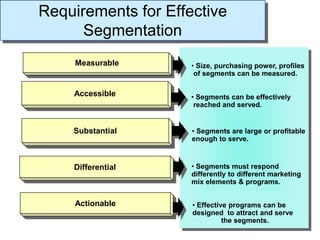
• Size, purchasing power, profiles
of segments can be measured.
• Segments can be effectively
reached and served.
• Segments are large or profitable
enough to serve.
Measurable
Accessible
Substantial
Differential
Actionable
• Segments must respond
differently to different marketing
mix elements & programs.
• Effective programs can be
designed to attract and serve
the segments.
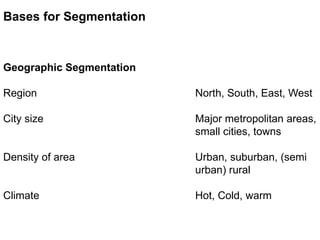
Bases for Segmentation
Geographic Segmentation
Region North, South, East, West
City size Major metropolitan areas,
small cities, towns
Density of area Urban, suburban, (semi
urban) rural
Climate Hot, Cold, warm
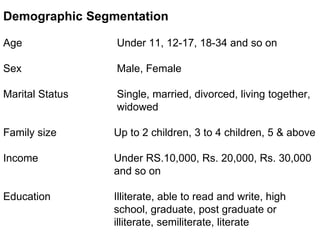
Demographic Segmentation
Age Under 11, 12-17, 18-34 and so on
Sex Male, Female
Marital Status Single, married, divorced, living together,
widowed
Family size Up to 2 children, 3 to 4 children, 5 & above
Income Under RS.10,000, Rs. 20,000, Rs. 30,000
and so on
Education Illiterate, able to read and write, high
school, graduate, post graduate or
illiterate, semiliterate, literate
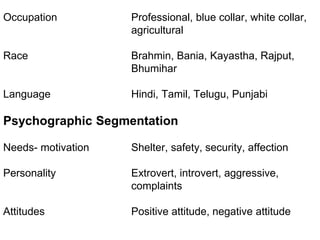
Occupation Professional, blue collar, white collar,
agricultural
Race Brahmin, Bania, Kayastha, Rajput,
Bhumihar
Language Hindi, Tamil, Telugu, Punjabi
Psychographic Segmentation
Needs- motivation Shelter, safety, security, affection
Personality Extrovert, introvert, aggressive,
complaints
Attitudes Positive attitude, negative attitude
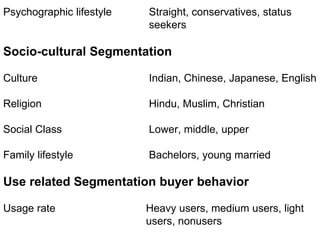
Psychographic lifestyle Straight, conservatives, status
seekers
Socio-cultural Segmentation
Culture Indian, Chinese, Japanese, English
Religion Hindu, Muslim, Christian
Social Class Lower, middle, upper
Family lifestyle Bachelors, young married
Use related Segmentation buyer behavior
Usage rate Heavy users, medium users, light
users, nonusers
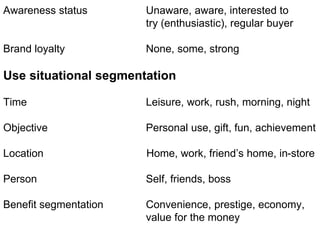
Awareness status Unaware, aware, interested to
try (enthusiastic), regular buyer
Brand loyalty None, some, strong
Use situational segmentation
Time Leisure, work, rush, morning, night
Objective Personal use, gift, fun, achievement
Location Home, work, friend’s home, in-store
Person Self, friends, boss
Benefit segmentation Convenience, prestige, economy,
value for the money
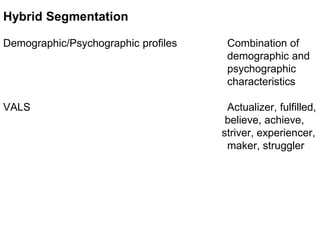
Hybrid Segmentation
Demographic/Psychographic profiles Combination of
demographic and
psychographic
characteristics
VALS Actualizer, fulfilled,
believe, achieve,
striver, experiencer,
maker, struggler
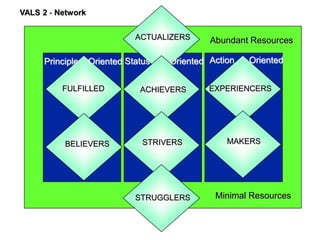
Principle Oriented Status Oriented
FULFILLED
BELIEVERS
ACTUALIZERS
ACHIEVERS
STRIVERS
STRUGGLERS
Abundant Resources
Minimal Resources
Action Oriented
EXPERIENCERS
MAKERS
VALS 2 - Network
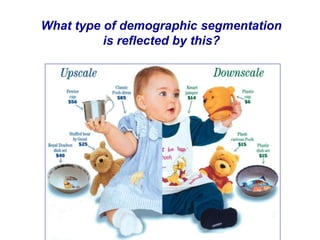
What type of demographic segmentation
is reflected by this?
Refrigerators
The refrigerator market can be segmented on the following basis
of:
i) Geographical
a) North India b) South India c) East India d) West India
ii) Size of refrigerators
a) 65 litres b) 90 litres c) 165 litres d) 286 litres e) 300
litres
iii) Nature of consumers
a) Households b) Industrial
Washing machines
a) Density : Urban and Suburban
b) Economy : Middle and upper income group
c) Benefits : Automatic, Semi automatic
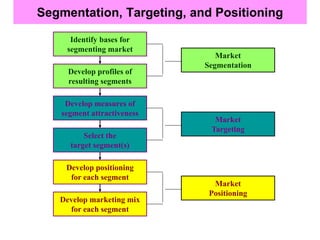
Segmentation, Targeting, and Positioning
Develop profiles of
resulting segments
Market
Segmentation
Develop measures of
segment attractiveness
Select the
target segment(s)
Develop positioning
for each segment
Develop marketing mix
for each segment
Identify bases for
segmenting market
Market
Targeting
Market
Positioning
Targeting
It involves making
decision about which
part of the market an
organization wishes
to focus on.
Evaluating a segment for
targeting
• Has sufficient current and potential sales and
profits
• Has the potential for sufficient future growth
• Is not over-competitive
• Does not have excessive barriers or costs to
entry or exit
• Has some relatively unsatisfied needs that the
company can serve particularly well.
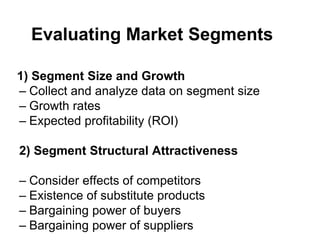
Evaluating Market Segments
1) Segment Size and Growth
– Collect and analyze data on segment size
– Growth rates
– Expected profitability (ROI)
2) Segment Structural Attractiveness
– Consider effects of competitors
– Existence of substitute products
– Bargaining power of buyers
– Bargaining power of suppliers
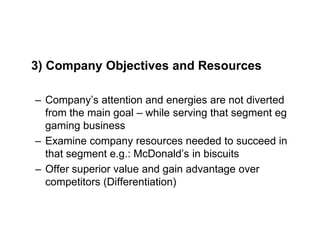
3) Company Objectives and Resources
– Company’s attention and energies are not diverted
from the main goal – while serving that segment eg
gaming business
– Examine company resources needed to succeed in
that segment e.g.: McDonald’s in biscuits
– Offer superior value and gain advantage over
competitors (Differentiation)
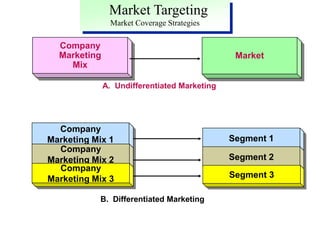
Market Targeting
Market Coverage Strategies
Segment 1
Segment 2
Segment 3
Company
Marketing
Mix
Company
Marketing Mix 1
Company
Marketing Mix 2
Company
Marketing Mix 3
Market
A. Undifferentiated Marketing
B. Differentiated Marketing
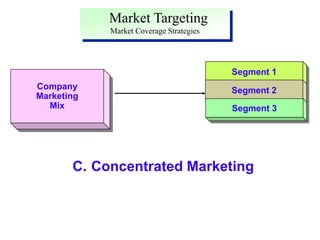
Market Targeting
Market Coverage Strategies
Segment 1
Segment 2
Segment 3
Company
Marketing
Mix
C. Concentrated Marketing
• Undifferentiated marketing: when a firm
produces only one product or product line
and promotes it to all customers with a
single marketing mix
– Sometimes called mass marketing
– Much more common in the past
• Differentiated marketing: when a firm
produces numerous products and
promotes them with a different
marketing mix designed to satisfy
smaller segments
– Tends to raise costs
– Firms may be forced to practice
differentiated marketing to remain
competitive
• Concentrated marketing (niche
marketing): when a firm commits all of its
marketing resources to serve a single
market segment
– Attractive to small firms with limited resources
and to firms offering highly specialized goods
and services
Positioning
Developing a specific marketing mix to
influence potential customers’ overall
perception of a brand, product line, or
organization in general.
The process of creating an image for a product
in the mind of target customers.
The place a product, brand, or group of
products occupies in consumers’ minds relative
to competing offerings.
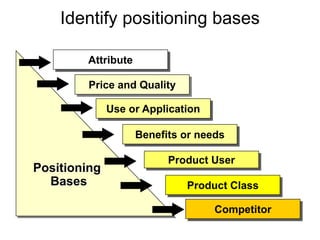
Identify positioning bases
Attribute
Price and Quality
Use or Application
Product User
Product Class
Competitor
Positioning
Bases
Benefits or needs
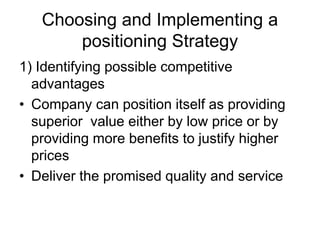
Choosing and Implementing a
positioning Strategy
1) Identifying possible competitive
advantages
• Company can position itself as providing
superior value either by low price or by
providing more benefits to justify higher
prices
• Deliver the promised quality and service
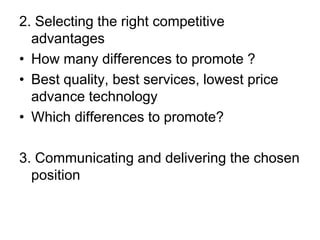
2. Selecting the right competitive
advantages
• How many differences to promote ?
• Best quality, best services, lowest price
advance technology
• Which differences to promote?
3. Communicating and delivering the chosen
position
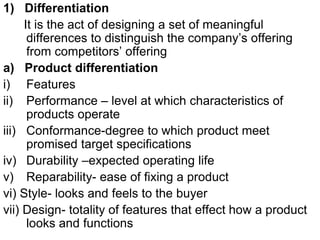
1) Differentiation
It is the act of designing a set of meaningful
differences to distinguish the company’s offering
from competitors’ offering
a) Product differentiation
i) Features
ii) Performance – level at which characteristics of
products operate
iii) Conformance-degree to which product meet
promised target specifications
iv) Durability –expected operating life
v) Reparability- ease of fixing a product
vi) Style- looks and feels to the buyer
vii) Design- totality of features that effect how a product
looks and functions
b) Service differentiation – differentiating in
services.
i) Ordering ease- how easy it is for the cr
customer to place an order
ii) delivery- how well product is delivered.
iii) Installation- work done to make a product
operational.
iv) Customer training
v) Customer consulting- data, information that the
sellers offers free
vi) Maintenance and repair- Company’s service
programme for helping customers.
c) Personnel Differentiation – Competitive
advantage through hiring and training people.
i) Competence- employees possess the required
knowledge and skill
ii) Courtesy- employees are helpful, friendly
iii) Responsiveness - respond to customer
requests and problems
iv) Communication- employees make an effort to
understand customer and communicate
clearly
v) Credibility- employees are trust worthy
vi) Reliability- employees perform the service
consistently and accurately
d) Channel differentiation – Companies can make
differentiation through distribution channel.
Channel’s coverage, expertise and performance .
e) Image differentiation- how companies differentiate
their personnel or brand image
2) Market Segmentation – It can help the
management in achieving following benefits
a) Concentrating on most profitable market
b) Designing product that really match the market
demand
c) Determining promotional mix which will be most
effective.
d) Choosing advertising media effectively and
determining how to allocate better budget among
the various media.
Repositioning
Changing consumers’ perceptions of a brand
in relation to competing brands.

Chapter 4. segmentation, targeting, positioning

  • 1.
  • 2.
    Market Segmentation Market segmentationis the subdividing of market into homogenous sub sections of customers, where any sub section may conceivably be selected as a market target to be reached with a distinct marketing mix.
  • 3.
    Requirements for Effective Segmentation •Size, purchasing power, profiles of segments can be measured. • Segments can be effectively reached and served. • Segments are large or profitable enough to serve. Measurable Accessible Substantial Differential Actionable • Segments must respond differently to different marketing mix elements & programs. • Effective programs can be designed to attract and serve the segments.
  • 4.
    Bases for Segmentation GeographicSegmentation Region North, South, East, West City size Major metropolitan areas, small cities, towns Density of area Urban, suburban, (semi urban) rural Climate Hot, Cold, warm
  • 5.
    Demographic Segmentation Age Under11, 12-17, 18-34 and so on Sex Male, Female Marital Status Single, married, divorced, living together, widowed Family size Up to 2 children, 3 to 4 children, 5 & above Income Under RS.10,000, Rs. 20,000, Rs. 30,000 and so on Education Illiterate, able to read and write, high school, graduate, post graduate or illiterate, semiliterate, literate
  • 6.
    Occupation Professional, bluecollar, white collar, agricultural Race Brahmin, Bania, Kayastha, Rajput, Bhumihar Language Hindi, Tamil, Telugu, Punjabi Psychographic Segmentation Needs- motivation Shelter, safety, security, affection Personality Extrovert, introvert, aggressive, complaints Attitudes Positive attitude, negative attitude
  • 7.
    Psychographic lifestyle Straight,conservatives, status seekers Socio-cultural Segmentation Culture Indian, Chinese, Japanese, English Religion Hindu, Muslim, Christian Social Class Lower, middle, upper Family lifestyle Bachelors, young married Use related Segmentation buyer behavior Usage rate Heavy users, medium users, light users, nonusers
  • 8.
    Awareness status Unaware,aware, interested to try (enthusiastic), regular buyer Brand loyalty None, some, strong Use situational segmentation Time Leisure, work, rush, morning, night Objective Personal use, gift, fun, achievement Location Home, work, friend’s home, in-store Person Self, friends, boss Benefit segmentation Convenience, prestige, economy, value for the money
  • 9.
    Hybrid Segmentation Demographic/Psychographic profilesCombination of demographic and psychographic characteristics VALS Actualizer, fulfilled, believe, achieve, striver, experiencer, maker, struggler
  • 10.
    Principle Oriented StatusOriented FULFILLED BELIEVERS ACTUALIZERS ACHIEVERS STRIVERS STRUGGLERS Abundant Resources Minimal Resources Action Oriented EXPERIENCERS MAKERS VALS 2 - Network
  • 11.
    What type ofdemographic segmentation is reflected by this?
  • 12.
    Refrigerators The refrigerator marketcan be segmented on the following basis of: i) Geographical a) North India b) South India c) East India d) West India ii) Size of refrigerators a) 65 litres b) 90 litres c) 165 litres d) 286 litres e) 300 litres iii) Nature of consumers a) Households b) Industrial Washing machines a) Density : Urban and Suburban b) Economy : Middle and upper income group c) Benefits : Automatic, Semi automatic
  • 13.
    Segmentation, Targeting, andPositioning Develop profiles of resulting segments Market Segmentation Develop measures of segment attractiveness Select the target segment(s) Develop positioning for each segment Develop marketing mix for each segment Identify bases for segmenting market Market Targeting Market Positioning
  • 14.
    Targeting It involves making decisionabout which part of the market an organization wishes to focus on.
  • 15.
    Evaluating a segmentfor targeting • Has sufficient current and potential sales and profits • Has the potential for sufficient future growth • Is not over-competitive • Does not have excessive barriers or costs to entry or exit • Has some relatively unsatisfied needs that the company can serve particularly well.
  • 16.
    Evaluating Market Segments 1)Segment Size and Growth – Collect and analyze data on segment size – Growth rates – Expected profitability (ROI) 2) Segment Structural Attractiveness – Consider effects of competitors – Existence of substitute products – Bargaining power of buyers – Bargaining power of suppliers
  • 17.
    3) Company Objectivesand Resources – Company’s attention and energies are not diverted from the main goal – while serving that segment eg gaming business – Examine company resources needed to succeed in that segment e.g.: McDonald’s in biscuits – Offer superior value and gain advantage over competitors (Differentiation)
  • 18.
    Market Targeting Market CoverageStrategies Segment 1 Segment 2 Segment 3 Company Marketing Mix Company Marketing Mix 1 Company Marketing Mix 2 Company Marketing Mix 3 Market A. Undifferentiated Marketing B. Differentiated Marketing
  • 19.
    Market Targeting Market CoverageStrategies Segment 1 Segment 2 Segment 3 Company Marketing Mix C. Concentrated Marketing
  • 20.
    • Undifferentiated marketing:when a firm produces only one product or product line and promotes it to all customers with a single marketing mix – Sometimes called mass marketing – Much more common in the past
  • 21.
    • Differentiated marketing:when a firm produces numerous products and promotes them with a different marketing mix designed to satisfy smaller segments – Tends to raise costs – Firms may be forced to practice differentiated marketing to remain competitive
  • 22.
    • Concentrated marketing(niche marketing): when a firm commits all of its marketing resources to serve a single market segment – Attractive to small firms with limited resources and to firms offering highly specialized goods and services
  • 23.
    Positioning Developing a specificmarketing mix to influence potential customers’ overall perception of a brand, product line, or organization in general. The process of creating an image for a product in the mind of target customers. The place a product, brand, or group of products occupies in consumers’ minds relative to competing offerings.
  • 24.
    Identify positioning bases Attribute Priceand Quality Use or Application Product User Product Class Competitor Positioning Bases Benefits or needs
  • 25.
    Choosing and Implementinga positioning Strategy 1) Identifying possible competitive advantages • Company can position itself as providing superior value either by low price or by providing more benefits to justify higher prices • Deliver the promised quality and service
  • 26.
    2. Selecting theright competitive advantages • How many differences to promote ? • Best quality, best services, lowest price advance technology • Which differences to promote? 3. Communicating and delivering the chosen position
  • 27.
    1) Differentiation It isthe act of designing a set of meaningful differences to distinguish the company’s offering from competitors’ offering a) Product differentiation i) Features ii) Performance – level at which characteristics of products operate iii) Conformance-degree to which product meet promised target specifications iv) Durability –expected operating life v) Reparability- ease of fixing a product vi) Style- looks and feels to the buyer vii) Design- totality of features that effect how a product looks and functions
  • 28.
    b) Service differentiation– differentiating in services. i) Ordering ease- how easy it is for the cr customer to place an order ii) delivery- how well product is delivered. iii) Installation- work done to make a product operational. iv) Customer training v) Customer consulting- data, information that the sellers offers free vi) Maintenance and repair- Company’s service programme for helping customers.
  • 29.
    c) Personnel Differentiation– Competitive advantage through hiring and training people. i) Competence- employees possess the required knowledge and skill ii) Courtesy- employees are helpful, friendly iii) Responsiveness - respond to customer requests and problems iv) Communication- employees make an effort to understand customer and communicate clearly v) Credibility- employees are trust worthy vi) Reliability- employees perform the service consistently and accurately
  • 30.
    d) Channel differentiation– Companies can make differentiation through distribution channel. Channel’s coverage, expertise and performance . e) Image differentiation- how companies differentiate their personnel or brand image 2) Market Segmentation – It can help the management in achieving following benefits a) Concentrating on most profitable market b) Designing product that really match the market demand c) Determining promotional mix which will be most effective. d) Choosing advertising media effectively and determining how to allocate better budget among the various media.
  • 31.
    Repositioning Changing consumers’ perceptionsof a brand in relation to competing brands.