Statistical Inference
Weeks 1 & 2: Probability and Distribution
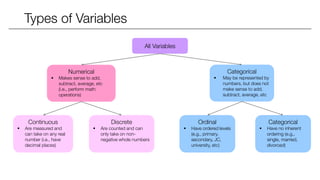
Types of Variables
All Variables
Categorical
 May be represented by
numbers, but does not
make sense to add,
subtract, average, etc
Numerical
 Makes sense to add,
subtract, average, etc
(i.e., perform math
operations)
Discrete
 Are counted and can
only take on non-
negative whole numbers
Continuous
 Are measured and
can take on any real
number (i.e., have
decimal places)
Categorical
 Have no inherent
ordering (e.g.,
single, married,
divorced)
Ordinal
 Have ordered levels
(e.g., primary,
secondary, JC,
university, etc)
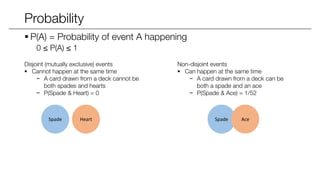
Probability
 P(A) = Probability of event A happening
0 ≤ P(A) ≤ 1
Disjoint (mutually exclusive) events
 Cannot happen at the same time
− A card drawn from a deck cannot be
both spades and hearts
− P(Spade & Heart) = 0
Non-disjoint events
 Can happen at the same time
− A card drawn from a deck can be
both a spade and an ace
− P(Spade & Ace) = 1/52
Spade SpadeHeart Ace
Disjoint and non-disjoint events
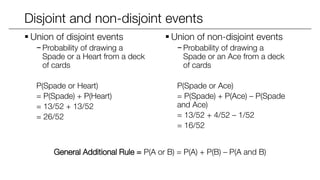
 Union of disjoint events
− Probability of drawing a
Spade or a Heart from a deck
of cards
P(Spade or Heart)
= P(Spade) + P(Heart)
= 13/52 + 13/52
= 26/52
 Union of non-disjoint events
− Probability of drawing a
Spade or an Ace from a deck
of cards
P(Spade or Ace)
= P(Spade) + P(Ace) – P(Spade
and Ace)
= 13/52 + 4/52 – 1/52
= 16/52
General Additional Rule = P(A or B) = P(A) + P(B) – P(A and B)
Marginal, Joint, and Conditional Probability
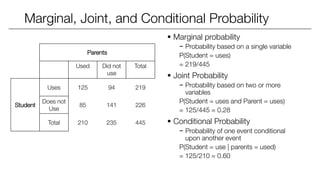
 Marginal probability
− Probability based on a single variable
P(Student = uses)
= 219/445
 Joint Probability
− Probability based on two or more
variables
P(Student = uses and Parent = uses)
= 125/445 = 0.28
 Conditional Probability
− Probability of one event conditional
upon another event
P(Student = use | parents = used)
= 125/210 = 0.60
Parents
Used Did not
use
Total
Student
Uses 125 94 219
Does not
Use
85 141 226
Total 210 235 445
Bayes’ Theorem
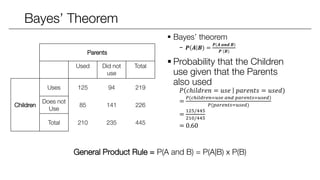
 Bayes’ theorem
− 𝑷 𝑨 𝑩) =
𝑷(𝑨 𝒂𝒏𝒅 𝑩)
𝑷 (𝑩)
 Probability that the Children
use given that the Parents
also used
𝑃 𝑐ℎ𝑖𝑙𝑑𝑟𝑒𝑛 = 𝑢𝑠𝑒 𝑝𝑎𝑟𝑒𝑛𝑡𝑠 = 𝑢𝑠𝑒𝑑)
=
𝑃(𝑐ℎ𝑖𝑙𝑑𝑟𝑒𝑛=𝑢𝑠𝑒 𝑎𝑛𝑑 𝑝𝑎𝑟𝑒𝑛𝑡𝑠=𝑢𝑠𝑒𝑑)
𝑃(𝑝𝑎𝑟𝑒𝑛𝑡𝑠=𝑢𝑠𝑒𝑑)
=
125/445
210/445
= 0.60
Parents
Used Did not
use
Total
Children
Uses 125 94 219
Does not
Use
85 141 226
Total 210 235 445
General Product Rule = P(A and B) = P(A|B) x P(B)
Bayes’ Theorem expanded
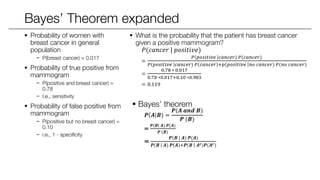
 Probability of women with
breast cancer in general
population
− P(breast cancer) = 0.017
 Probability of true positive from
mammogram
− P(positive | breast cancer) = 0.78
− I.e., sensitivity
 Probability of false positive from
mammogram
− P(positive | no breast cancer) =
0.10
− i.e., 1 - specificity
 What is the probability that the patient has breast cancer
given a positive mammogram?
𝑃(𝑐𝑎𝑛𝑐𝑒𝑟 | 𝑝𝑜𝑠𝑖𝑡𝑖𝑣𝑒)
=
𝑃 𝑝𝑜𝑠𝑖𝑡𝑖𝑣𝑒 𝑐𝑎𝑛𝑐𝑒𝑟) 𝑃(𝑐𝑎𝑛𝑐𝑒𝑟)
𝑃 𝑝𝑜𝑠𝑖𝑡𝑖𝑣𝑒 𝑐𝑎𝑛𝑐𝑒𝑟) 𝑃 𝑐𝑎𝑛𝑐𝑒𝑟 +𝑝 𝑝𝑜𝑠𝑖𝑡𝑖𝑣𝑒 𝑛𝑜 𝑐𝑎𝑛𝑐𝑒𝑟) 𝑃(𝑛𝑜 𝑐𝑎𝑛𝑐𝑒𝑟)
=
0.78 ∗ 0.017
0.78 ∗0.017+0.10 ∗0.983
= 0.119
 Bayes’ theorem
𝑷 𝑨 𝑩) =
𝑷(𝑨 𝒂𝒏𝒅 𝑩)
𝑷 (𝑩)
=
𝑷 𝑩 𝑨) 𝑷(𝑨)
𝑷 (𝑩)
=
𝑷 𝑩 𝑨) 𝑷(𝑨)
𝑷 𝑩 𝑨) 𝑷 𝑨 +𝑷 𝑩 𝑨 𝒄)𝑷(𝑨 𝒄)
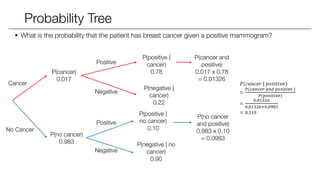
Probability Tree
Cancer
No Cancer
P(cancer)
0.017
P(no cancer)
0.983
 What is the probability that the patient has breast cancer given a positive mammogram?
Positive
Positive
Negative
Negative
P(positive |
cancer)
0.78
P(negative |
cancer)
0.22
P(positive |
no cancer)
0.10
P(negative | no
cancer)
0.90
P(cancer and
positive)
0.017 x 0.78
= 0.01326
P(no cancer
and positive)
0.983 x 0.10
= 0.0983
𝑃(𝑐𝑎𝑛𝑐𝑒𝑟 | 𝑝𝑜𝑠𝑖𝑡𝑖𝑣𝑒)
=
𝑃(𝑐𝑎𝑛𝑐𝑒𝑟 𝑎𝑛𝑑 𝑝𝑜𝑠𝑖𝑡𝑖𝑣𝑒 )
𝑃(𝑝𝑜𝑠𝑖𝑡𝑖𝑣𝑒)
=
0.01326
0.01326+0.0983
= 0.119
Expected Mean
 Expected Mean
𝐸 𝑋
= E[𝑋 × 𝑝 𝑥 ] # sum of all values of x multiplied by its probability
 What is the expected value of a dice roll?
𝐸 𝑋
= 1 ×
1
6
+ 2 ×
1
6
+ 3 ×
1
6
+ 4 ×
1
6
+ 5 ×
1
6
+ 6 ×
1
6
= 3.5
Notation:
𝑥 : sample mean
𝜇 : population mean
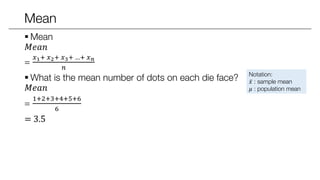
Mean
 Mean
𝑀𝑒𝑎𝑛
=
𝑥1+ 𝑥2+ 𝑥3+ …+ 𝑥 𝑛
𝑛
 What is the mean number of dots on each die face?
𝑀𝑒𝑎𝑛
=
1+2+3+4+5+6
6
= 3.5
Notation:
𝑥 : sample mean
𝜇 : population mean
Expected Variance
 Expected Variance
𝑉𝑎𝑟 𝑋
=E[(𝑋 − 𝜇)2] # sum square of difference between each value and mean
=E 𝑋2 − 𝐸[𝑋]2
 What is the variance of a dice roll?
From previous slide, mean 𝐸 𝑋 = 3.5
𝐸 𝑋2 = 12 ×
1
6
+ 22 ×
1
6
+ 32 ×
1
6
+ 42 ×
1
6
+ 52 ×
1
6
+ 62 ×
1
6
= 15.17
Var(X) = 𝐸 𝑋2 − 𝐸 𝑋 2 = 15.17 − 3.52 ≈ 2.9
Notation:
𝑠2: sample variance
𝜎2
: population variance
𝑠 : sample standard deviation
𝜎 : population standard deviation
Population Variance
 Population Variance
𝜎2
=
1
𝑁
Σ[(𝑥𝑖 − 𝜇)2
]
 What is the variance of dots on die faces?
Given 𝑥 = 3.5
𝜎2 =
1
6
[ 1 − 3.5 2 + 2 − 3.5 2 + … + 6 − 3.5 2]
≈ 2.9
Notation:
𝑠2: sample variance
𝜎2
: population variance
𝑠 : sample standard deviation
𝜎 : population standard deviation
Sample Variance
 Sample Variance
𝑠2
=
1
𝑛−1
Σ[(𝑥𝑖 − 𝑥)2
]
 Why n – 1?
− A sample will always have smaller variance than the population. Thus, we
perform an “adjustment” to get a bigger variance that more closer
approximates the population variance
− i.e., think of it as a “correction” used on samples
Notation:
𝑠2: sample variance
𝜎2
: population variance
𝑠 : sample standard deviation
𝜎 : population standard deviation
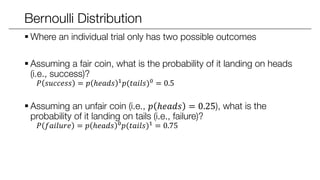
Bernoulli Distribution
 Where an individual trial only has two possible outcomes
 Assuming a fair coin, what is the probability of it landing on heads
(i.e., success)?
𝑃 𝑠𝑢𝑐𝑐𝑒𝑠𝑠 = 𝑝 ℎ𝑒𝑎𝑑𝑠 1
𝑝(𝑡𝑎𝑖𝑙𝑠)0
= 0.5
 Assuming an unfair coin (i.e., 𝑝 ℎ𝑒𝑎𝑑𝑠 = 0.25), what is the
probability of it landing on tails (i.e., failure)?
𝑃 𝑓𝑎𝑖𝑙𝑢𝑟𝑒 = 𝑝 ℎ𝑒𝑎𝑑𝑠 0
𝑝(𝑡𝑎𝑖𝑙𝑠)1
= 0.75
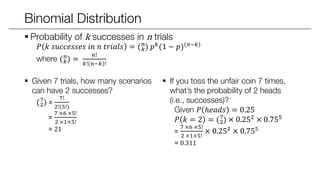
Binomial Distribution
 Probability of k successes in n trials
𝑃 𝑘 𝑠𝑢𝑐𝑐𝑒𝑠𝑠𝑒𝑠 𝑖𝑛 𝑛 𝑡𝑟𝑖𝑎𝑙𝑠 = ( 𝑘
𝑛
) 𝑝 𝑘(1 − 𝑝)(𝑛−𝑘)
where ( 𝑘
𝑛
) =
𝑛!
𝑘! 𝑛−𝑘 !
 Given 7 trials, how many scenarios
can have 2 successes?
(2
7
) =
7!
2!(5!)
=
7 ×6 ×5!
2 ×1×5!
= 21
 If you toss the unfair coin 7 times,
what’s the probability of 2 heads
(i.e., successes)?
Given 𝑃 ℎ𝑒𝑎𝑑𝑠 = 0.25
𝑃 𝑘 = 2 = (2
7
) × 0.252 × 0.755
=
7 ×6 ×5!
2 ×1×5!
× 0.252 × 0.755
= 0.311
Normal Distribution
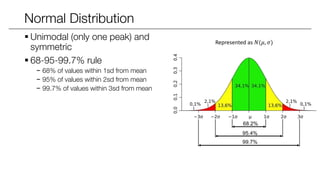
 Unimodal (only one peak) and
symmetric
 68-95-99.7% rule
− 68% of values within 1sd from mean
− 95% of values within 2sd from mean
− 99.7% of values within 3sd from mean
Represented as 𝑁(𝜇, 𝜎)
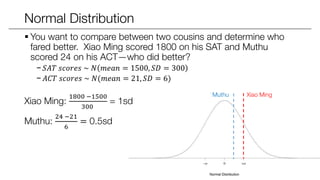
Xiao MingMuthu
Normal Distribution
 You want to compare between two cousins and determine who
fared better. Xiao Ming scored 1800 on his SAT and Muthu
scored 24 on his ACT—who did better?
− 𝑆𝐴𝑇 𝑠𝑐𝑜𝑟𝑒𝑠 ~ 𝑁 𝑚𝑒𝑎𝑛 = 1500, 𝑆𝐷 = 300
− 𝐴𝐶𝑇 𝑠𝑐𝑜𝑟𝑒𝑠 ~ 𝑁(𝑚𝑒𝑎𝑛 = 21, 𝑆𝐷 = 6)
Xiao Ming:
1800 −1500
300
= 1sd
Muthu:
24 −21
6
= 0.5sd
Normal Distribution (Z scores)
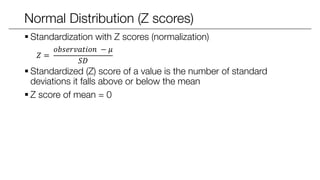
 Standardization with Z scores (normalization)
𝑍 =
𝑜𝑏𝑠𝑒𝑟𝑣𝑎𝑡𝑖𝑜𝑛 − 𝜇
𝑆𝐷
 Standardized (Z) score of a value is the number of standard
deviations it falls above or below the mean
 Z score of mean = 0
Normal Distribution
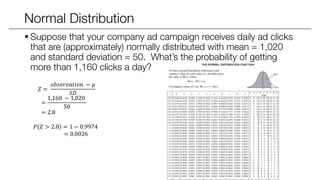
 Suppose that your company ad campaign receives daily ad clicks
that are (approximately) normally distributed with mean = 1,020
and standard deviation = 50. What’s the probability of getting
more than 1,160 clicks a day?
𝑍 =
𝑜𝑏𝑠𝑒𝑟𝑣𝑎𝑡𝑖𝑜𝑛 − 𝜇
𝑆𝐷
=
1,160 − 1,020
50
= 2.8
𝑃 𝑍 > 2.8 = 1 − 0.9974
= 0.0026
Normal Distribution
 Your friend boast that his ad is in the top 25% of the company’s
ad campaign. What is the lowest number of ad clicks his ad
received?
− 𝐴𝑑 𝑐𝑙𝑖𝑐𝑘𝑠 ~ 𝑁(1020, 50)
𝑍 = 0.67 =
𝑥 − 1,020
50
𝑥 = 0.67 × 50 + 1020
= 1053.5
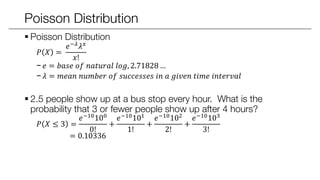
Poisson Distribution
 Poisson Distribution
𝑃 𝑋 =
𝑒−𝜆 𝜆 𝑥
𝑥!
− 𝑒 = 𝑏𝑎𝑠𝑒 𝑜𝑓 𝑛𝑎𝑡𝑢𝑟𝑎𝑙 𝑙𝑜𝑔, 2.71828 …
− 𝜆 = 𝑚𝑒𝑎𝑛 𝑛𝑢𝑚𝑏𝑒𝑟 𝑜𝑓 𝑠𝑢𝑐𝑐𝑒𝑠𝑠𝑒𝑠 𝑖𝑛 𝑎 𝑔𝑖𝑣𝑒𝑛 𝑡𝑖𝑚𝑒 𝑖𝑛𝑡𝑒𝑟𝑣𝑎𝑙
 2.5 people show up at a bus stop every hour. What is the
probability that 3 or fewer people show up after 4 hours?
𝑃 𝑋 ≤ 3 =
𝑒−10100
0!
+
𝑒−10101
1!
+
𝑒−10102
2!
+
𝑒−10103
3!
= 0.10336
Thank you for your attention!
Eugene Yan

Statistical inference: Probability and Distribution

  • 1.
    Statistical Inference Weeks 1& 2: Probability and Distribution
  • 2.
    Types of Variables AllVariables Categorical  May be represented by numbers, but does not make sense to add, subtract, average, etc Numerical  Makes sense to add, subtract, average, etc (i.e., perform math operations) Discrete  Are counted and can only take on non- negative whole numbers Continuous  Are measured and can take on any real number (i.e., have decimal places) Categorical  Have no inherent ordering (e.g., single, married, divorced) Ordinal  Have ordered levels (e.g., primary, secondary, JC, university, etc)
  • 3.
    Probability  P(A) =Probability of event A happening 0 ≤ P(A) ≤ 1 Disjoint (mutually exclusive) events  Cannot happen at the same time − A card drawn from a deck cannot be both spades and hearts − P(Spade & Heart) = 0 Non-disjoint events  Can happen at the same time − A card drawn from a deck can be both a spade and an ace − P(Spade & Ace) = 1/52 Spade SpadeHeart Ace
  • 4.
    Disjoint and non-disjointevents  Union of disjoint events − Probability of drawing a Spade or a Heart from a deck of cards P(Spade or Heart) = P(Spade) + P(Heart) = 13/52 + 13/52 = 26/52  Union of non-disjoint events − Probability of drawing a Spade or an Ace from a deck of cards P(Spade or Ace) = P(Spade) + P(Ace) – P(Spade and Ace) = 13/52 + 4/52 – 1/52 = 16/52 General Additional Rule = P(A or B) = P(A) + P(B) – P(A and B)
  • 5.
    Marginal, Joint, andConditional Probability  Marginal probability − Probability based on a single variable P(Student = uses) = 219/445  Joint Probability − Probability based on two or more variables P(Student = uses and Parent = uses) = 125/445 = 0.28  Conditional Probability − Probability of one event conditional upon another event P(Student = use | parents = used) = 125/210 = 0.60 Parents Used Did not use Total Student Uses 125 94 219 Does not Use 85 141 226 Total 210 235 445
  • 6.
    Bayes’ Theorem  Bayes’theorem − 𝑷 𝑨 𝑩) = 𝑷(𝑨 𝒂𝒏𝒅 𝑩) 𝑷 (𝑩)  Probability that the Children use given that the Parents also used 𝑃 𝑐ℎ𝑖𝑙𝑑𝑟𝑒𝑛 = 𝑢𝑠𝑒 𝑝𝑎𝑟𝑒𝑛𝑡𝑠 = 𝑢𝑠𝑒𝑑) = 𝑃(𝑐ℎ𝑖𝑙𝑑𝑟𝑒𝑛=𝑢𝑠𝑒 𝑎𝑛𝑑 𝑝𝑎𝑟𝑒𝑛𝑡𝑠=𝑢𝑠𝑒𝑑) 𝑃(𝑝𝑎𝑟𝑒𝑛𝑡𝑠=𝑢𝑠𝑒𝑑) = 125/445 210/445 = 0.60 Parents Used Did not use Total Children Uses 125 94 219 Does not Use 85 141 226 Total 210 235 445 General Product Rule = P(A and B) = P(A|B) x P(B)
  • 7.
    Bayes’ Theorem expanded Probability of women with breast cancer in general population − P(breast cancer) = 0.017  Probability of true positive from mammogram − P(positive | breast cancer) = 0.78 − I.e., sensitivity  Probability of false positive from mammogram − P(positive | no breast cancer) = 0.10 − i.e., 1 - specificity  What is the probability that the patient has breast cancer given a positive mammogram? 𝑃(𝑐𝑎𝑛𝑐𝑒𝑟 | 𝑝𝑜𝑠𝑖𝑡𝑖𝑣𝑒) = 𝑃 𝑝𝑜𝑠𝑖𝑡𝑖𝑣𝑒 𝑐𝑎𝑛𝑐𝑒𝑟) 𝑃(𝑐𝑎𝑛𝑐𝑒𝑟) 𝑃 𝑝𝑜𝑠𝑖𝑡𝑖𝑣𝑒 𝑐𝑎𝑛𝑐𝑒𝑟) 𝑃 𝑐𝑎𝑛𝑐𝑒𝑟 +𝑝 𝑝𝑜𝑠𝑖𝑡𝑖𝑣𝑒 𝑛𝑜 𝑐𝑎𝑛𝑐𝑒𝑟) 𝑃(𝑛𝑜 𝑐𝑎𝑛𝑐𝑒𝑟) = 0.78 ∗ 0.017 0.78 ∗0.017+0.10 ∗0.983 = 0.119  Bayes’ theorem 𝑷 𝑨 𝑩) = 𝑷(𝑨 𝒂𝒏𝒅 𝑩) 𝑷 (𝑩) = 𝑷 𝑩 𝑨) 𝑷(𝑨) 𝑷 (𝑩) = 𝑷 𝑩 𝑨) 𝑷(𝑨) 𝑷 𝑩 𝑨) 𝑷 𝑨 +𝑷 𝑩 𝑨 𝒄)𝑷(𝑨 𝒄)
  • 8.
    Probability Tree Cancer No Cancer P(cancer) 0.017 P(nocancer) 0.983  What is the probability that the patient has breast cancer given a positive mammogram? Positive Positive Negative Negative P(positive | cancer) 0.78 P(negative | cancer) 0.22 P(positive | no cancer) 0.10 P(negative | no cancer) 0.90 P(cancer and positive) 0.017 x 0.78 = 0.01326 P(no cancer and positive) 0.983 x 0.10 = 0.0983 𝑃(𝑐𝑎𝑛𝑐𝑒𝑟 | 𝑝𝑜𝑠𝑖𝑡𝑖𝑣𝑒) = 𝑃(𝑐𝑎𝑛𝑐𝑒𝑟 𝑎𝑛𝑑 𝑝𝑜𝑠𝑖𝑡𝑖𝑣𝑒 ) 𝑃(𝑝𝑜𝑠𝑖𝑡𝑖𝑣𝑒) = 0.01326 0.01326+0.0983 = 0.119
  • 9.
    Expected Mean  ExpectedMean 𝐸 𝑋 = E[𝑋 × 𝑝 𝑥 ] # sum of all values of x multiplied by its probability  What is the expected value of a dice roll? 𝐸 𝑋 = 1 × 1 6 + 2 × 1 6 + 3 × 1 6 + 4 × 1 6 + 5 × 1 6 + 6 × 1 6 = 3.5 Notation: 𝑥 : sample mean 𝜇 : population mean
  • 10.
    Mean  Mean 𝑀𝑒𝑎𝑛 = 𝑥1+ 𝑥2+𝑥3+ …+ 𝑥 𝑛 𝑛  What is the mean number of dots on each die face? 𝑀𝑒𝑎𝑛 = 1+2+3+4+5+6 6 = 3.5 Notation: 𝑥 : sample mean 𝜇 : population mean
  • 11.
    Expected Variance  ExpectedVariance 𝑉𝑎𝑟 𝑋 =E[(𝑋 − 𝜇)2] # sum square of difference between each value and mean =E 𝑋2 − 𝐸[𝑋]2  What is the variance of a dice roll? From previous slide, mean 𝐸 𝑋 = 3.5 𝐸 𝑋2 = 12 × 1 6 + 22 × 1 6 + 32 × 1 6 + 42 × 1 6 + 52 × 1 6 + 62 × 1 6 = 15.17 Var(X) = 𝐸 𝑋2 − 𝐸 𝑋 2 = 15.17 − 3.52 ≈ 2.9 Notation: 𝑠2: sample variance 𝜎2 : population variance 𝑠 : sample standard deviation 𝜎 : population standard deviation
  • 12.
    Population Variance  PopulationVariance 𝜎2 = 1 𝑁 Σ[(𝑥𝑖 − 𝜇)2 ]  What is the variance of dots on die faces? Given 𝑥 = 3.5 𝜎2 = 1 6 [ 1 − 3.5 2 + 2 − 3.5 2 + … + 6 − 3.5 2] ≈ 2.9 Notation: 𝑠2: sample variance 𝜎2 : population variance 𝑠 : sample standard deviation 𝜎 : population standard deviation
  • 13.
    Sample Variance  SampleVariance 𝑠2 = 1 𝑛−1 Σ[(𝑥𝑖 − 𝑥)2 ]  Why n – 1? − A sample will always have smaller variance than the population. Thus, we perform an “adjustment” to get a bigger variance that more closer approximates the population variance − i.e., think of it as a “correction” used on samples Notation: 𝑠2: sample variance 𝜎2 : population variance 𝑠 : sample standard deviation 𝜎 : population standard deviation
  • 14.
    Bernoulli Distribution  Wherean individual trial only has two possible outcomes  Assuming a fair coin, what is the probability of it landing on heads (i.e., success)? 𝑃 𝑠𝑢𝑐𝑐𝑒𝑠𝑠 = 𝑝 ℎ𝑒𝑎𝑑𝑠 1 𝑝(𝑡𝑎𝑖𝑙𝑠)0 = 0.5  Assuming an unfair coin (i.e., 𝑝 ℎ𝑒𝑎𝑑𝑠 = 0.25), what is the probability of it landing on tails (i.e., failure)? 𝑃 𝑓𝑎𝑖𝑙𝑢𝑟𝑒 = 𝑝 ℎ𝑒𝑎𝑑𝑠 0 𝑝(𝑡𝑎𝑖𝑙𝑠)1 = 0.75
  • 15.
    Binomial Distribution  Probabilityof k successes in n trials 𝑃 𝑘 𝑠𝑢𝑐𝑐𝑒𝑠𝑠𝑒𝑠 𝑖𝑛 𝑛 𝑡𝑟𝑖𝑎𝑙𝑠 = ( 𝑘 𝑛 ) 𝑝 𝑘(1 − 𝑝)(𝑛−𝑘) where ( 𝑘 𝑛 ) = 𝑛! 𝑘! 𝑛−𝑘 !  Given 7 trials, how many scenarios can have 2 successes? (2 7 ) = 7! 2!(5!) = 7 ×6 ×5! 2 ×1×5! = 21  If you toss the unfair coin 7 times, what’s the probability of 2 heads (i.e., successes)? Given 𝑃 ℎ𝑒𝑎𝑑𝑠 = 0.25 𝑃 𝑘 = 2 = (2 7 ) × 0.252 × 0.755 = 7 ×6 ×5! 2 ×1×5! × 0.252 × 0.755 = 0.311
  • 16.
    Normal Distribution  Unimodal(only one peak) and symmetric  68-95-99.7% rule − 68% of values within 1sd from mean − 95% of values within 2sd from mean − 99.7% of values within 3sd from mean Represented as 𝑁(𝜇, 𝜎)
  • 17.
    Xiao MingMuthu Normal Distribution You want to compare between two cousins and determine who fared better. Xiao Ming scored 1800 on his SAT and Muthu scored 24 on his ACT—who did better? − 𝑆𝐴𝑇 𝑠𝑐𝑜𝑟𝑒𝑠 ~ 𝑁 𝑚𝑒𝑎𝑛 = 1500, 𝑆𝐷 = 300 − 𝐴𝐶𝑇 𝑠𝑐𝑜𝑟𝑒𝑠 ~ 𝑁(𝑚𝑒𝑎𝑛 = 21, 𝑆𝐷 = 6) Xiao Ming: 1800 −1500 300 = 1sd Muthu: 24 −21 6 = 0.5sd
  • 18.
    Normal Distribution (Zscores)  Standardization with Z scores (normalization) 𝑍 = 𝑜𝑏𝑠𝑒𝑟𝑣𝑎𝑡𝑖𝑜𝑛 − 𝜇 𝑆𝐷  Standardized (Z) score of a value is the number of standard deviations it falls above or below the mean  Z score of mean = 0
  • 19.
    Normal Distribution  Supposethat your company ad campaign receives daily ad clicks that are (approximately) normally distributed with mean = 1,020 and standard deviation = 50. What’s the probability of getting more than 1,160 clicks a day? 𝑍 = 𝑜𝑏𝑠𝑒𝑟𝑣𝑎𝑡𝑖𝑜𝑛 − 𝜇 𝑆𝐷 = 1,160 − 1,020 50 = 2.8 𝑃 𝑍 > 2.8 = 1 − 0.9974 = 0.0026
  • 20.
    Normal Distribution  Yourfriend boast that his ad is in the top 25% of the company’s ad campaign. What is the lowest number of ad clicks his ad received? − 𝐴𝑑 𝑐𝑙𝑖𝑐𝑘𝑠 ~ 𝑁(1020, 50) 𝑍 = 0.67 = 𝑥 − 1,020 50 𝑥 = 0.67 × 50 + 1020 = 1053.5
  • 21.
    Poisson Distribution  PoissonDistribution 𝑃 𝑋 = 𝑒−𝜆 𝜆 𝑥 𝑥! − 𝑒 = 𝑏𝑎𝑠𝑒 𝑜𝑓 𝑛𝑎𝑡𝑢𝑟𝑎𝑙 𝑙𝑜𝑔, 2.71828 … − 𝜆 = 𝑚𝑒𝑎𝑛 𝑛𝑢𝑚𝑏𝑒𝑟 𝑜𝑓 𝑠𝑢𝑐𝑐𝑒𝑠𝑠𝑒𝑠 𝑖𝑛 𝑎 𝑔𝑖𝑣𝑒𝑛 𝑡𝑖𝑚𝑒 𝑖𝑛𝑡𝑒𝑟𝑣𝑎𝑙  2.5 people show up at a bus stop every hour. What is the probability that 3 or fewer people show up after 4 hours? 𝑃 𝑋 ≤ 3 = 𝑒−10100 0! + 𝑒−10101 1! + 𝑒−10102 2! + 𝑒−10103 3! = 0.10336
  • 22.
    Thank you foryour attention! Eugene Yan