DISTRIBUTION CHANNEL AND
PHYSICAL DISTRIBUTION
A distribution channel (also known as a
marketing channel) is a set of interdependent
organizations or intermediaries involved in the
process of making a product available for
consumption. A channel directs the flow of
products from producers to customers.
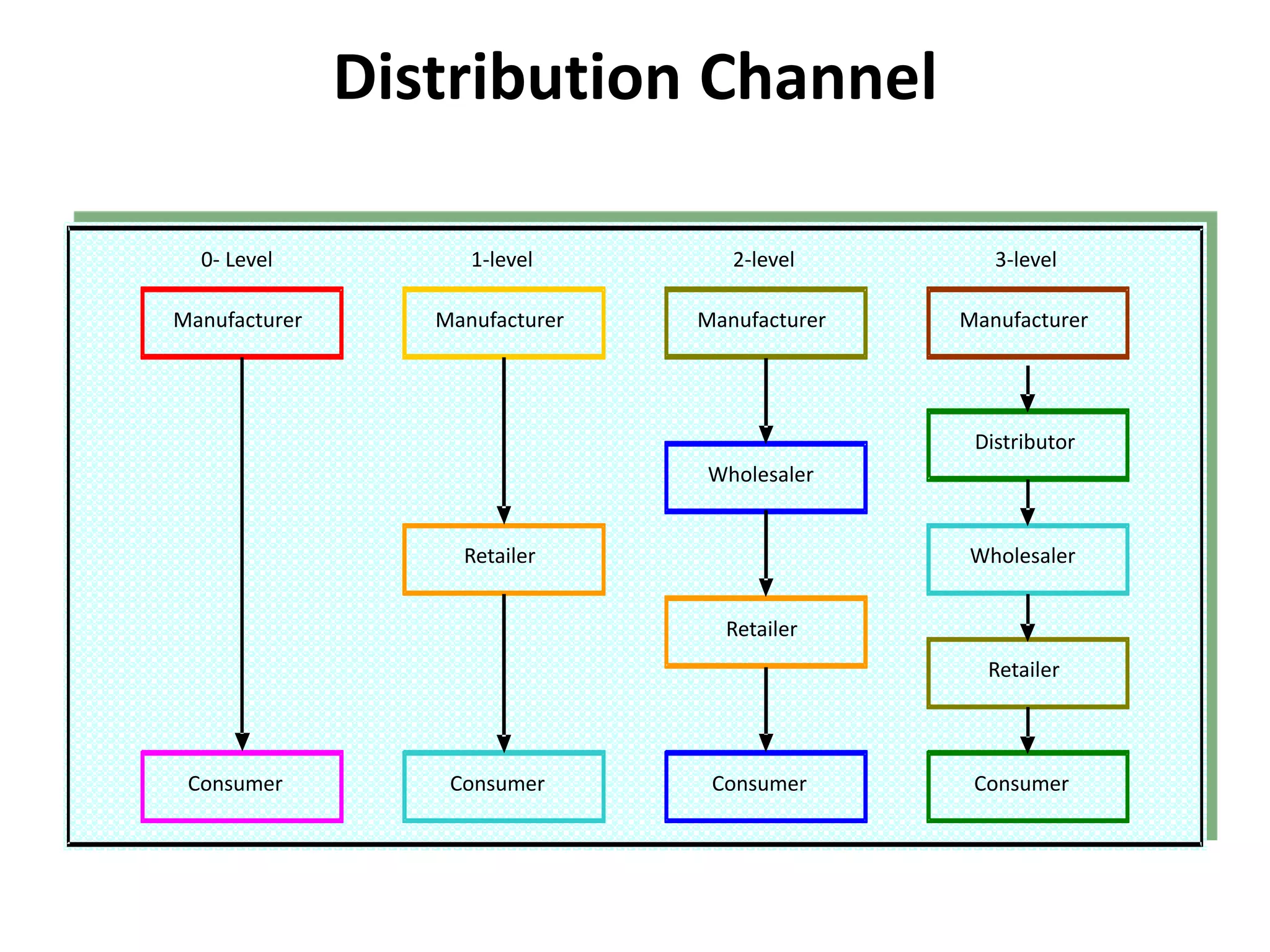
Distribution Channel
0- Level 1-level 2-level 3-level
ManufacturerManufacturer Manufacturer Manufacturer
Distributor
Wholesaler
Retailer
Retailer
Wholesaler
Retailer
ConsumerConsumerConsumer Consumer
PHYSICAL DISTRIBUTION
THE PROBLEM OF SUBOPTIMIZATION
Results when the managers of individual physical
distribution functions attempt to minimize costs, but the
impact of one task on the others leads to less than optimal
results.
CUSTOMER-SERVICE STANDARDS
State goals and define acceptable performance for the
quality of service that a firm expects to deliver to its
customers.
After these standards are defined, designers assemble other
physical distribution components to meet these standards.
PHYSICAL DISTRIBUTION
• A company’s physical distribution system
contains the following elements:
– Warehousing
– Transportation
– Inventory Control
– Order Processing
WAREHOUSING
• Storage warehouse—holds goods for moderate to long
periods in an attempt to balance supply and demand for
producers and purchasers.
• Distribution warehouse—assembles and redistributes
goods, keeping them moving as much as possible.
• Automated warehouse technology can cut distribution
costs and improve customer service.
• Warehouse locations are influenced by warehouse and
materials handling costs and delivery costs from
warehouses to customers.
WAREHOUSING
• Every company stores its goods while they wait to be
sold.
• A company must decide on (1) how many and (2)
what types of warehouses it needs and (3) where
they will be located.
• The company might own private warehouses or rent
space in public warehouses or both.
TRANSPORTATION
• The choice of transportation carriers affects (1) the
pricing of products, (2) delivery performance, (3)
condition of the goods when they arrive - all affect
customer satisfaction.
• In shipping goods, there are five transportation
modes: rail, water, truck, pipeline, and air.
– Rail; is the most cost-effective mode for shipping large
amounts products e.g. coal, farm and forest products over
long distances.
– Road; trucks are very flexible in their routing and time
scheduling. They can move goods door to door, saving
the need to transfer goods from truck to rail and back
again. They are efficient for short hauls of high-value
products. They can offer faster service.
– Water; the cost is very low for shipping bulky, low-
value, nonperishable products e.g. coal, oil, metallic
ores. It is the slowest mode and affected by the
weather.
– Air; costs higher than rail and truck but ideal when
speed is needed and distant markets have to be
reached. Products are perishables (fresh fish, cut
flowers), high-value, low-bulk items (technical
instruments, jewellery).
• In choosing a transportation mode, shippers
consider five criteria; (1) speed - door to door
delivery time, (2) meeting schedules on time, (3)
ability to handle various products, (4) number of
geographic points served, (5) cost per tone-mile.
Inventory
• Inventory decisions involve (1) when to order and (2) how
much to order.
• In deciding when to order, the company must think of the
risks of running out of stock and costs of carrying too much.
• In deciding how much to order, the company must think of
order-processing costs and inventory-carrying costs.
• Just-in-time logistic systems are used by some companies in
which the producers carry only small inventories only enough
for a few days of operations. Such systems result in savings in
inventory carrying and handling costs.
ORDER PROCESSING
• Orders can be submitted in many ways; by
mail, telephone, through salespeople, or via
computer.
• Order processing systems prepare invoices
and order information. The warehouse
receives instructions to pack and ship the
ordered items. And bills send out.

Distribution channel &_physical_distribution.pptx [repaired]

  • 1.
  • 2.
    A distribution channel(also known as a marketing channel) is a set of interdependent organizations or intermediaries involved in the process of making a product available for consumption. A channel directs the flow of products from producers to customers.
  • 3.
    Distribution Channel 0- Level1-level 2-level 3-level ManufacturerManufacturer Manufacturer Manufacturer Distributor Wholesaler Retailer Retailer Wholesaler Retailer ConsumerConsumerConsumer Consumer
  • 4.
    PHYSICAL DISTRIBUTION THE PROBLEMOF SUBOPTIMIZATION Results when the managers of individual physical distribution functions attempt to minimize costs, but the impact of one task on the others leads to less than optimal results. CUSTOMER-SERVICE STANDARDS State goals and define acceptable performance for the quality of service that a firm expects to deliver to its customers. After these standards are defined, designers assemble other physical distribution components to meet these standards.
  • 5.
    PHYSICAL DISTRIBUTION • Acompany’s physical distribution system contains the following elements: – Warehousing – Transportation – Inventory Control – Order Processing
  • 6.
    WAREHOUSING • Storage warehouse—holdsgoods for moderate to long periods in an attempt to balance supply and demand for producers and purchasers. • Distribution warehouse—assembles and redistributes goods, keeping them moving as much as possible. • Automated warehouse technology can cut distribution costs and improve customer service. • Warehouse locations are influenced by warehouse and materials handling costs and delivery costs from warehouses to customers.
  • 7.
    WAREHOUSING • Every companystores its goods while they wait to be sold. • A company must decide on (1) how many and (2) what types of warehouses it needs and (3) where they will be located. • The company might own private warehouses or rent space in public warehouses or both.
  • 8.
    TRANSPORTATION • The choiceof transportation carriers affects (1) the pricing of products, (2) delivery performance, (3) condition of the goods when they arrive - all affect customer satisfaction. • In shipping goods, there are five transportation modes: rail, water, truck, pipeline, and air. – Rail; is the most cost-effective mode for shipping large amounts products e.g. coal, farm and forest products over long distances. – Road; trucks are very flexible in their routing and time scheduling. They can move goods door to door, saving
  • 9.
    the need totransfer goods from truck to rail and back again. They are efficient for short hauls of high-value products. They can offer faster service. – Water; the cost is very low for shipping bulky, low- value, nonperishable products e.g. coal, oil, metallic ores. It is the slowest mode and affected by the weather. – Air; costs higher than rail and truck but ideal when speed is needed and distant markets have to be reached. Products are perishables (fresh fish, cut flowers), high-value, low-bulk items (technical instruments, jewellery).
  • 10.
    • In choosinga transportation mode, shippers consider five criteria; (1) speed - door to door delivery time, (2) meeting schedules on time, (3) ability to handle various products, (4) number of geographic points served, (5) cost per tone-mile.
  • 11.
    Inventory • Inventory decisionsinvolve (1) when to order and (2) how much to order. • In deciding when to order, the company must think of the risks of running out of stock and costs of carrying too much. • In deciding how much to order, the company must think of order-processing costs and inventory-carrying costs. • Just-in-time logistic systems are used by some companies in which the producers carry only small inventories only enough for a few days of operations. Such systems result in savings in inventory carrying and handling costs.
  • 12.
    ORDER PROCESSING • Orderscan be submitted in many ways; by mail, telephone, through salespeople, or via computer. • Order processing systems prepare invoices and order information. The warehouse receives instructions to pack and ship the ordered items. And bills send out.