RETAIL
What is retailing?
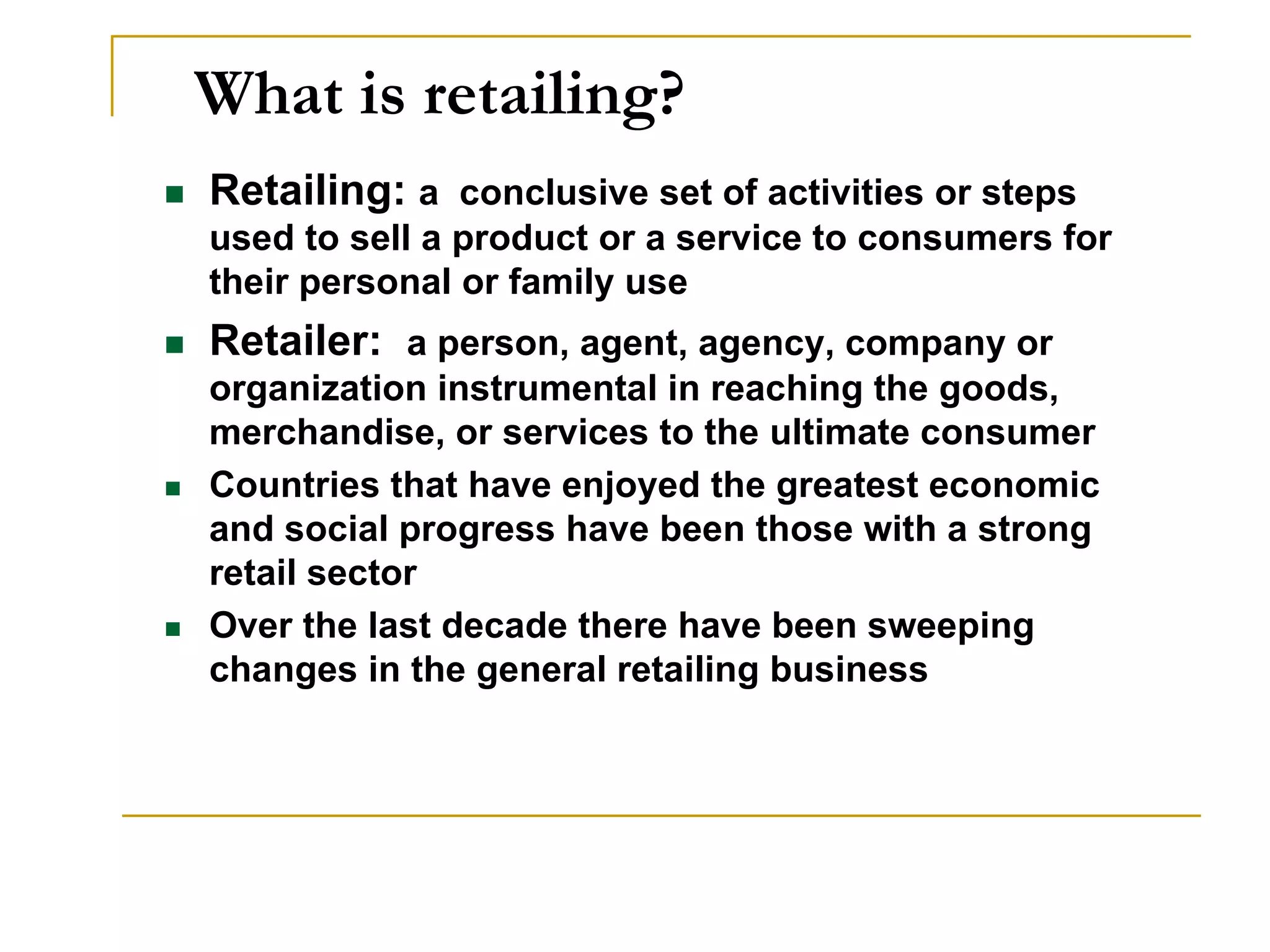
 Retailing: a conclusive set of activities or steps
used to sell a product or a service to consumers for
their personal or family use
 Retailer: a person, agent, agency, company or
organization instrumental in reaching the goods,
merchandise, or services to the ultimate consumer
 Countries that have enjoyed the greatest economic
and social progress have been those with a strong
retail sector
 Over the last decade there have been sweeping
changes in the general retailing business
World Brands
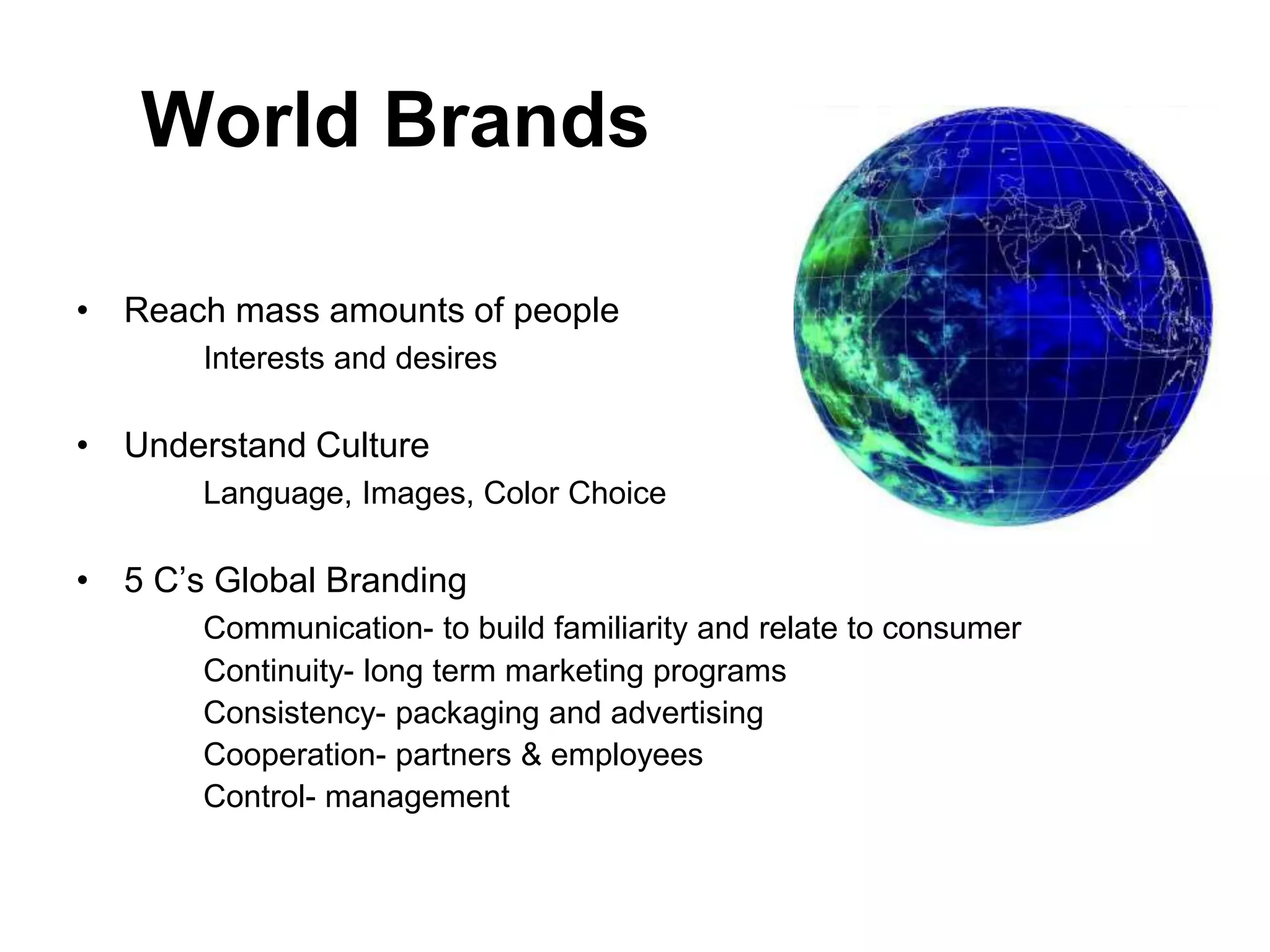
• Reach mass amounts of people
Interests and desires
• Understand Culture
Language, Images, Color Choice
• 5 C’s Global Branding
Communication- to build familiarity and relate to consumer
Continuity- long term marketing programs
Consistency- packaging and advertising
Cooperation- partners & employees
Control- management
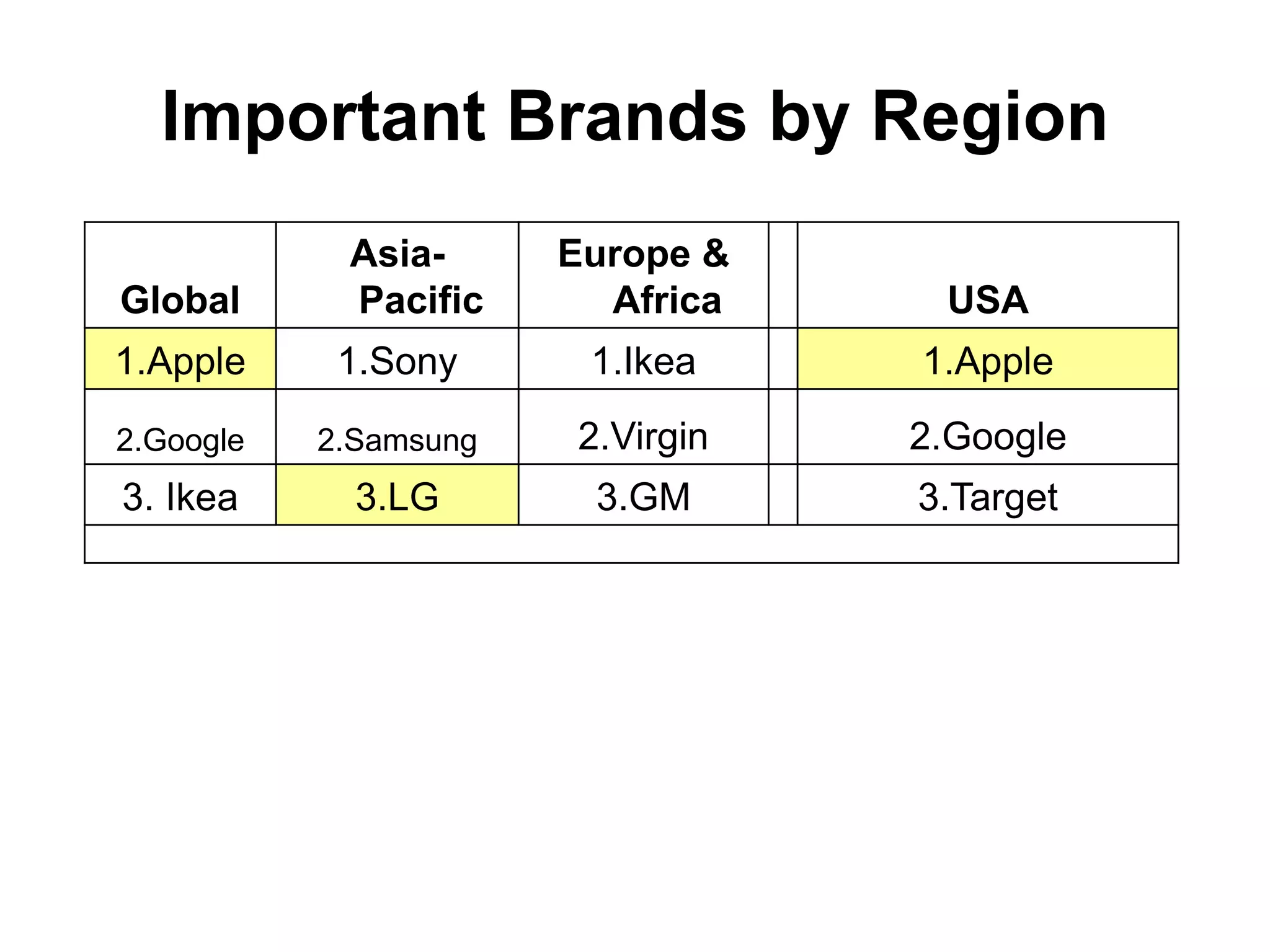
Important Brands by Region
Global
Asia-
Pacific
Europe &
Africa USA
1.Apple 1.Sony 1.Ikea 1.Apple
2.Google 2.Samsung 2.Virgin 2.Google
3. Ikea 3.LG 3.GM 3.Target
RETAIL FORMATS
1) Mom and Pop Stores (traditional
kirana stores)
Mom and pop stores are very small
stores in the city where they buy in few
numbers from whole sellers and sell it to
the consumers. These stores offer few
products that are necessarily required for
daily life. These are so small stores,
where you cannot go inside and select
what ever you want. Customer orders by
standing out side the counter.
2) E-commerce
E-retailing or e-commerce means retail
business being conducted on the internet.
e-commerce is growing every year. Many
major retail organizations and
manufacturers have online retail stores.
eg. Amazon.com, First and second.com
3) Department stores
Large stores ranging from 20,000-50,000 sq.
ft, catering to a variety of consumer needs
having a wide variety of products, organized
into different departments, such as clothing,
house wares, furniture, appliances, toys, etc.
One stop shop catering to varied consumer
needs.
eg. Ebony, Globus, Lifestyle, Pantaloon,
Shoppers Stop, and Westside
4) Discount Stores
As the name suggests, discount stores or factory
outlets, Stores offering discounts on the retail
price through selling high volumes and reaping
the economies of scale. Low prices. The product
category can range from a variety of perishable/
non perishable goods.
e.g.: S Kumar’s S-MART Discount Chain, Margin
Free Market, and Subhiksha
5) Specialty Stores
Chains such as the Bangalore based Kids
Kemp, the Mumbai books retailer Crossword,
RPG's Music World and the Times Group's
music chain Planet M, Body Shop are focusing
on specific market segments and have
established themselves strongly in their sectors.
These stores concentrate on one type of
merchandise and offer it in some manner that
makes it special.
Retail Management Activities
• Selecting the best location
• Sourcing and buying
• Merchandising
• Promotion
• Store Management
• Operational efficiency
FACTORS DETERMINING LOCATION DECISION
1. SELECTION OF CITY
• Size of the city’s trading area
• Population and growth trend
• Purchasing power and its distribution
• Trade potential
• Number, size, quality of competition
2. SELECTION OF AN AREA OR TYPE OF
LOCATION WITHIN A CITY
• Customer attraction of shopping district
• Quantitative and qualitative nature of
competition
• Availability of access route
• Nature of zoning regulation
• Direction of the area expansion
3. Site Decision
• Adequacy and potential traffic
• Complementary nature of adjacent store
• Adequacy of parking
Relationship Management
• Customer base
• Customer service
• Customer satisfaction
• Loyalty programmes
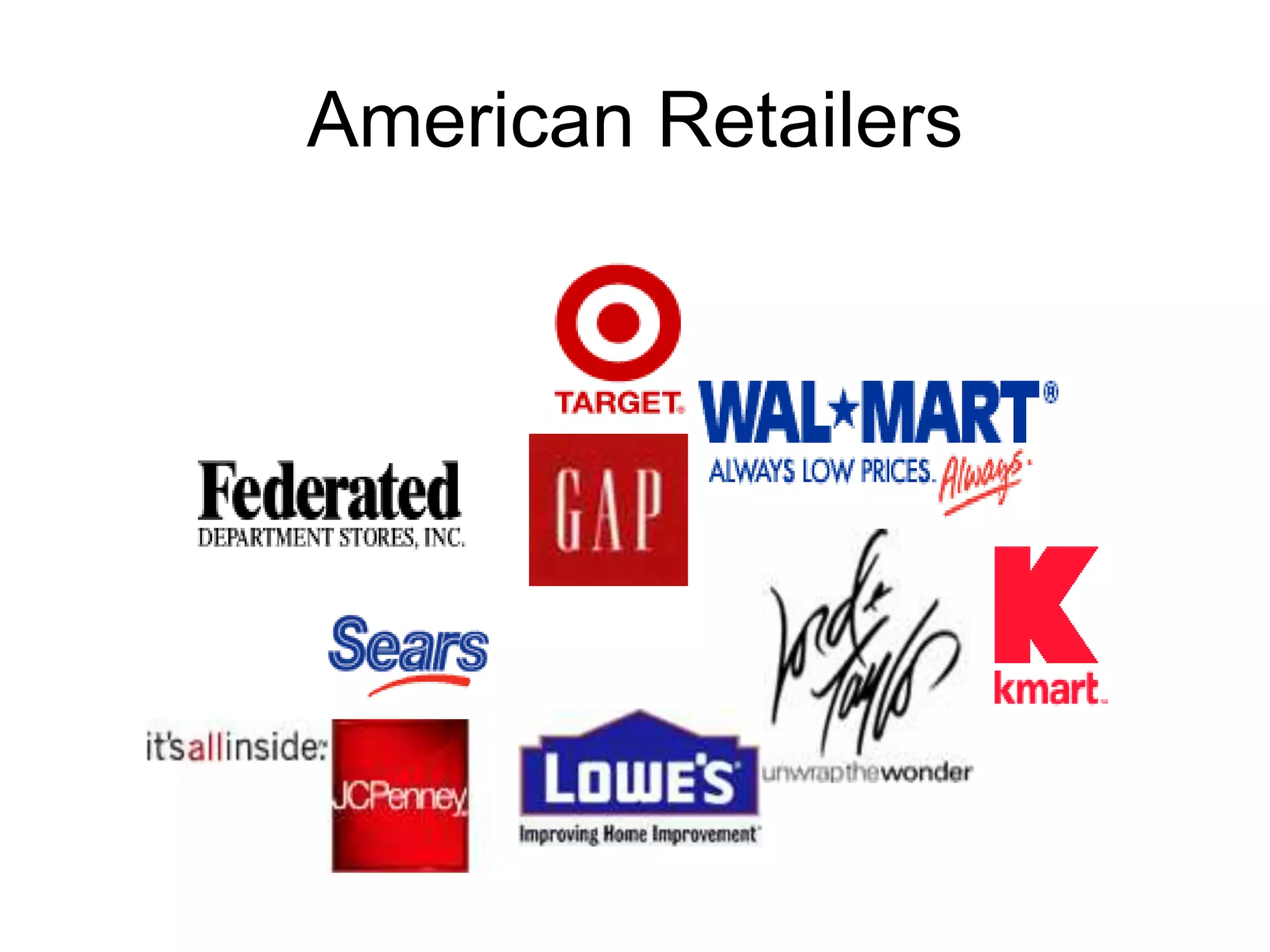
American Retailers
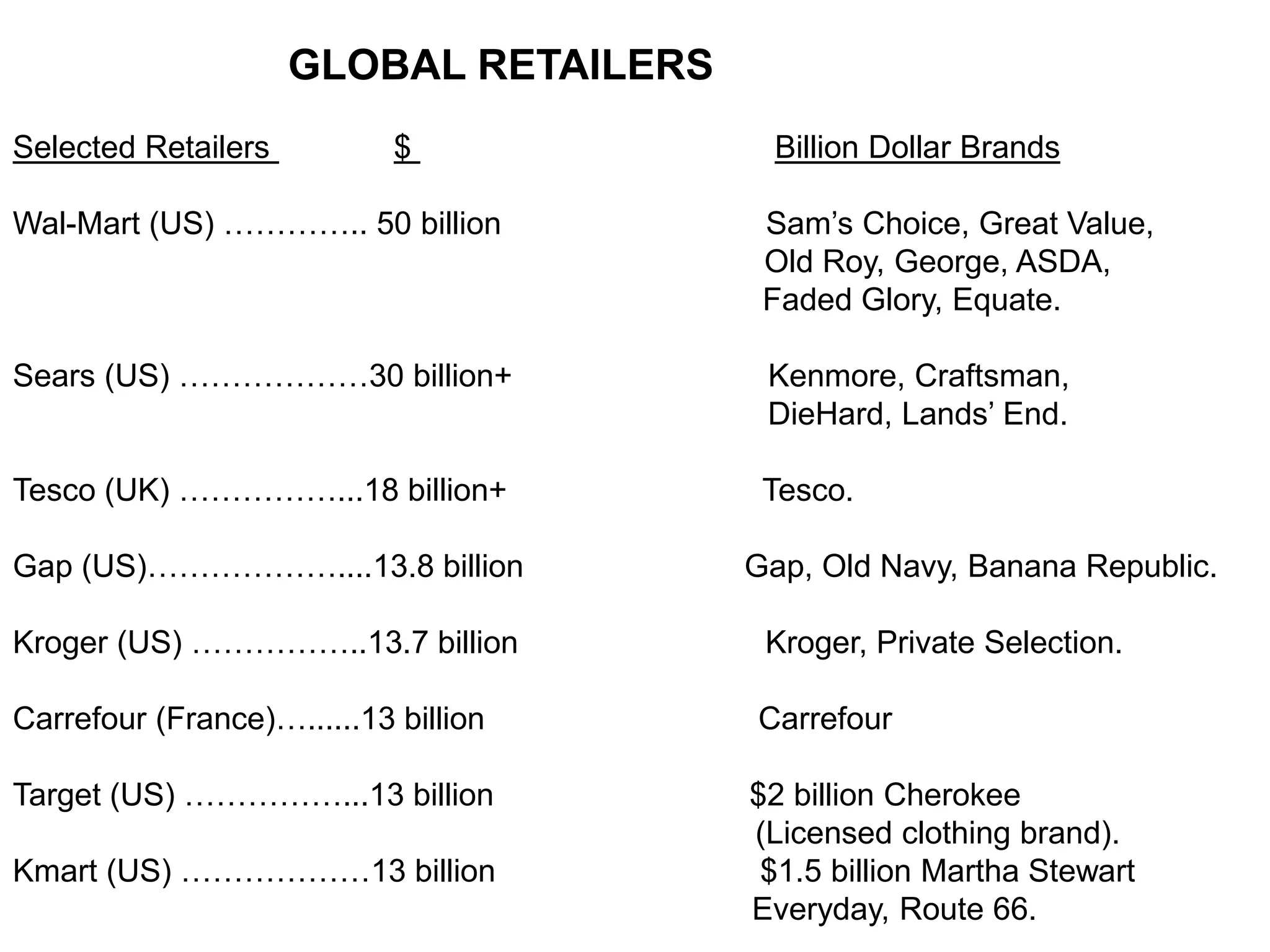
Selected Retailers $ Billion Dollar Brands
Wal-Mart (US) ………….. 50 billion Sam’s Choice, Great Value,
Old Roy, George, ASDA,
Faded Glory, Equate.
Sears (US) ………………30 billion+ Kenmore, Craftsman,
DieHard, Lands’ End.
Tesco (UK) ……………...18 billion+ Tesco.
Gap (US)………………....13.8 billion Gap, Old Navy, Banana Republic.
Kroger (US) ……………..13.7 billion Kroger, Private Selection.
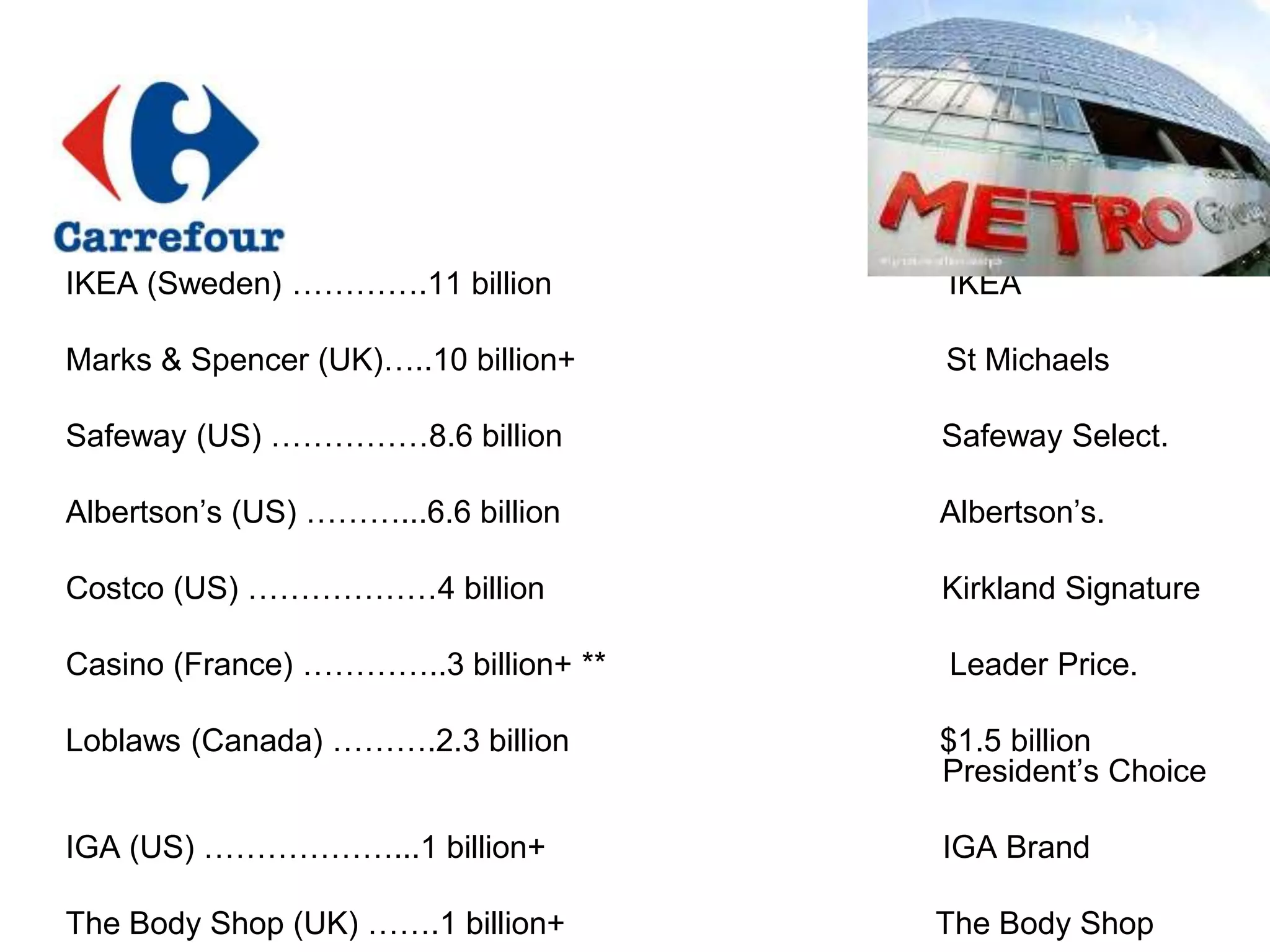
Carrefour (France)…......13 billion Carrefour
Target (US) ……………...13 billion $2 billion Cherokee
(Licensed clothing brand).
Kmart (US) ………………13 billion $1.5 billion Martha Stewart
Everyday, Route 66.
GLOBAL RETAILERS
IKEA (Sweden) ………….11 billion IKEA
Marks & Spencer (UK)…..10 billion+ St Michaels
Safeway (US) ……………8.6 billion Safeway Select.
Albertson’s (US) ………...6.6 billion Albertson’s.
Costco (US) ………………4 billion Kirkland Signature
Casino (France) …………..3 billion+ ** Leader Price.
Loblaws (Canada) ……….2.3 billion $1.5 billion
President’s Choice
IGA (US) ………………...1 billion+ IGA Brand
The Body Shop (UK) …….1 billion+ The Body Shop
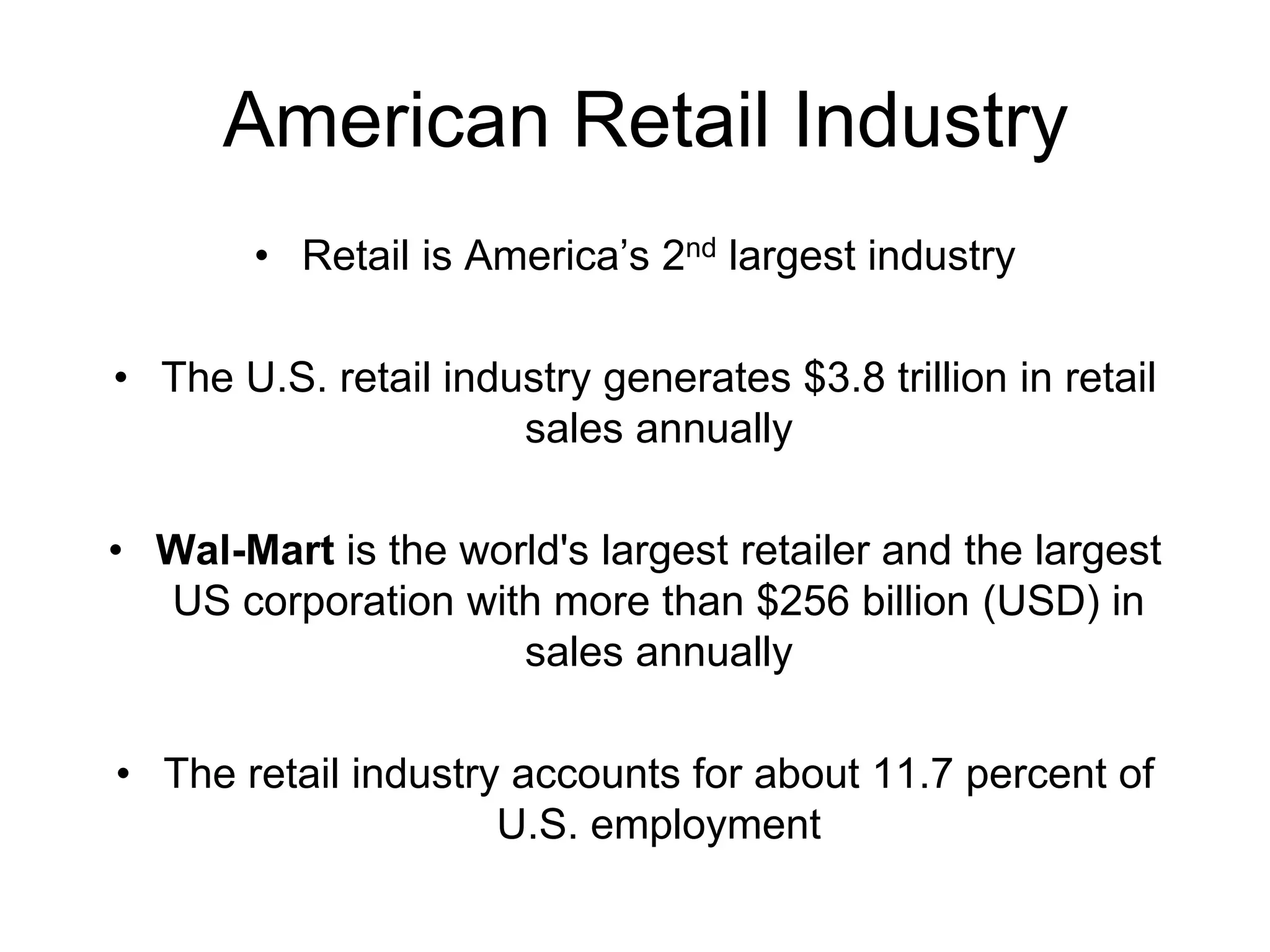
American Retail Industry
• Retail is America’s 2nd largest industry
• The U.S. retail industry generates $3.8 trillion in retail
sales annually
• Wal-Mart is the world's largest retailer and the largest
US corporation with more than $256 billion (USD) in
sales annually
• The retail industry accounts for about 11.7 percent of
U.S. employment
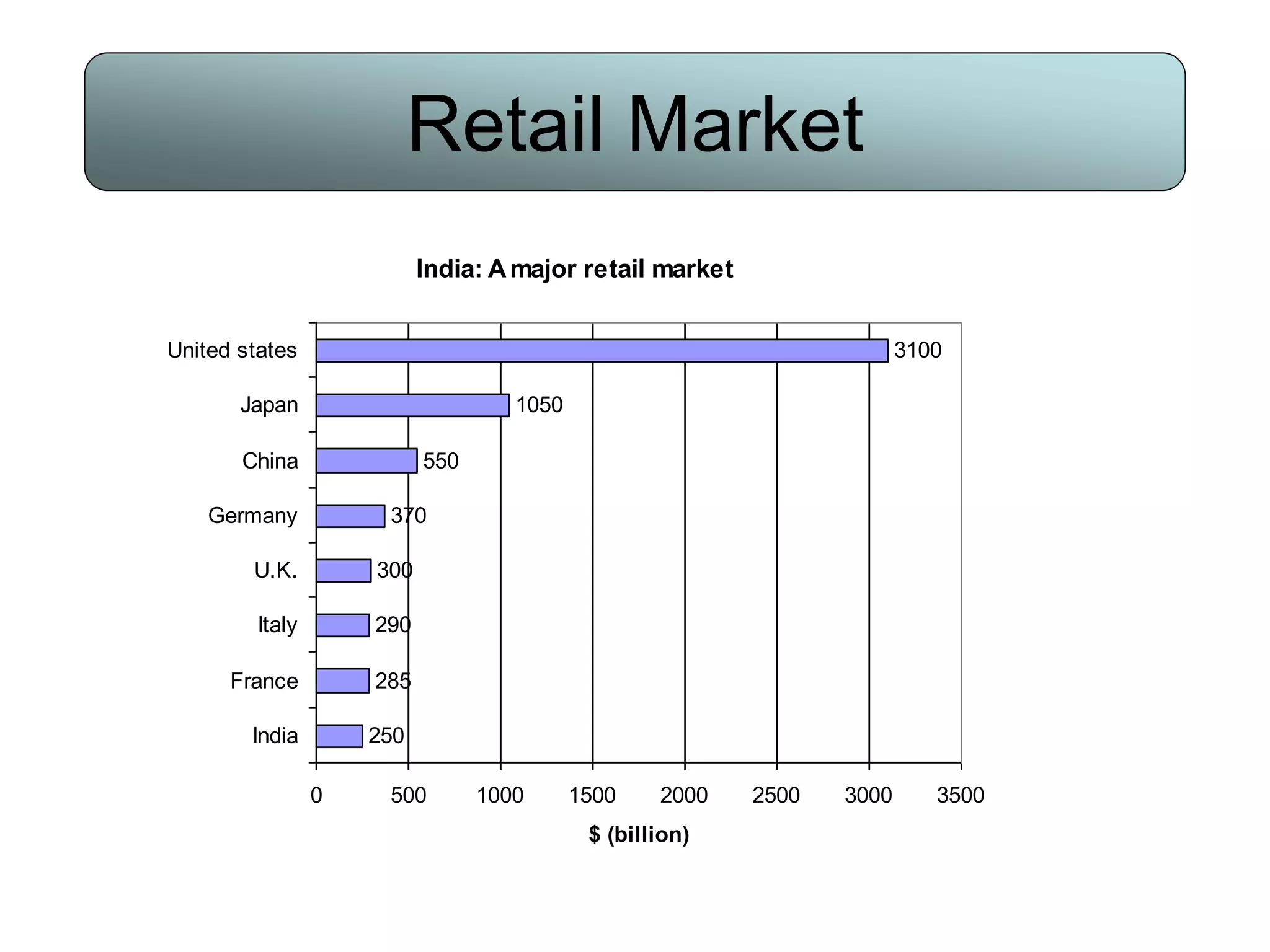
Retail Market
India: Amajor retail market
250
285
290
300
370
550
1050
3100
0 500 1000 1500 2000 2500 3000 3500
India
France
Italy
U.K.
Germany
China
Japan
United states
$ (billion)
What is the key to success?
"The secret of successful retailing is to give your
customers what they want,"
-Wal-Mart founder Sam Walton
• Good service is very essential- customers remember extra
attention
• Have innovative ideas
• The application of advanced technology to improve existing
system
• Automated inventory management
• Precision in demand and sales forecasting
• Effective marketing and communication
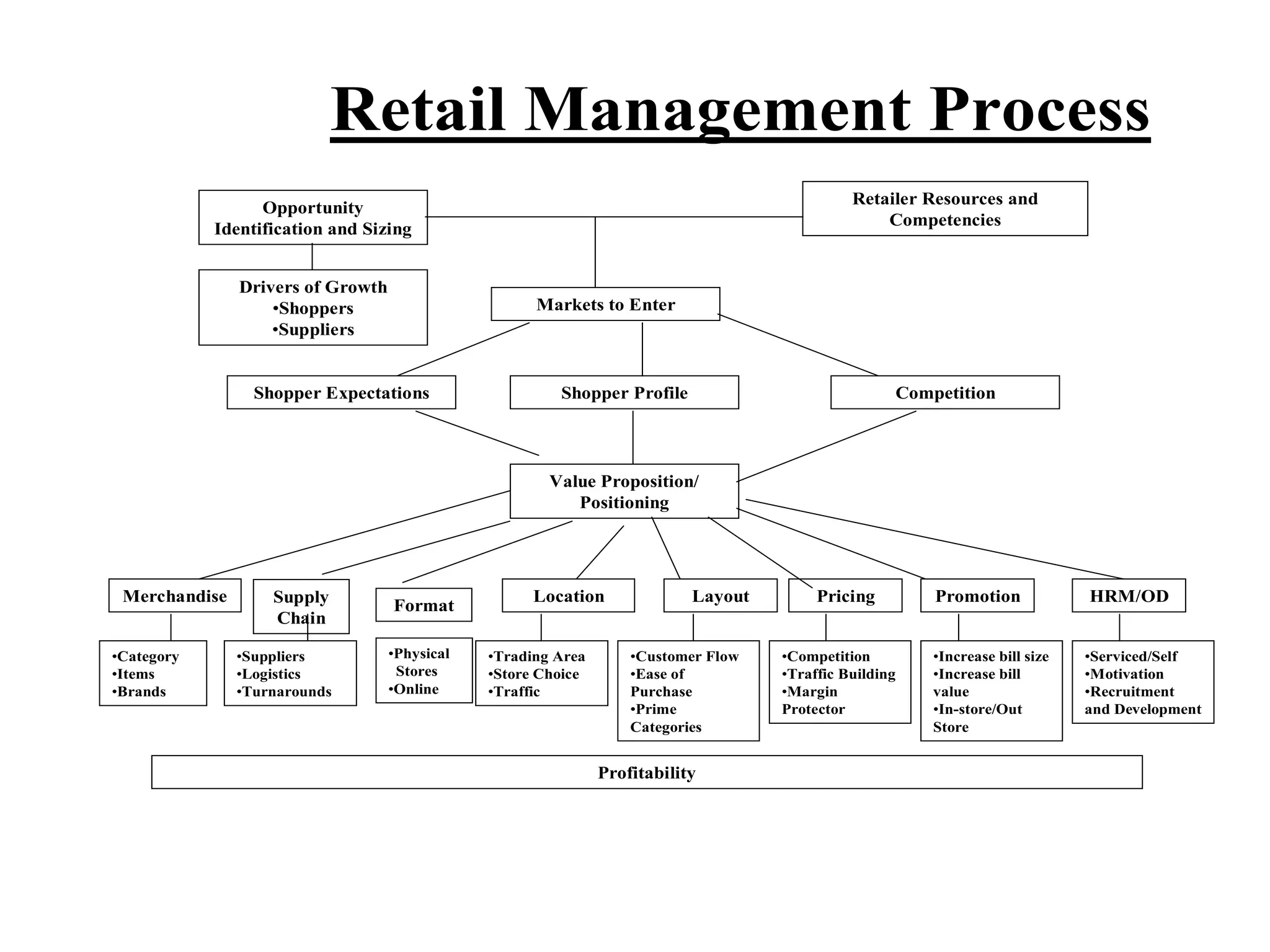
Retail Management Process
Opportunity
Identification and Sizing
Retailer Resources and
Competencies
Markets to Enter
Shopper Expectations Shopper Profile Competition
Value Proposition/
Positioning
Merchandise Supply
Chain
Location Layout Pricing Promotion HRM/OD
•Suppliers
•Logistics
•Turnarounds
•Trading Area
•Store Choice
•Traffic
•Customer Flow
•Ease of
Purchase
•Prime
Categories
•Competition
•Traffic Building
•Margin
Protector
•Increase bill size
•Increase bill
value
•In-store/Out
Store
•Serviced/Self
•Motivation
•Recruitment
and Development
•Category
•Items
•Brands
Drivers of Growth
•Shoppers
•Suppliers
Profitability
Format
•Physical
Stores
•Online
Retail Management Process
• Retailing is a complex business as it involves the detailing and
precision involved in implementing each of the decisions
• The core of the framework is the Retail Value Proposition.
• The proposition is derived keeping in mind the market profile
and expectations, opportunities present in the market,
competitive stances and activities and the retailer’s objectives
and resources
• Based on the proposition, retailers decide the formats,
merchandise, location, supply chain, pricing, promotion and
other aspects of retailing mix.

Chapter 6. retail mgt

  • 1.
  • 2.
    What is retailing? Retailing: a conclusive set of activities or steps used to sell a product or a service to consumers for their personal or family use  Retailer: a person, agent, agency, company or organization instrumental in reaching the goods, merchandise, or services to the ultimate consumer  Countries that have enjoyed the greatest economic and social progress have been those with a strong retail sector  Over the last decade there have been sweeping changes in the general retailing business
  • 3.
    World Brands • Reachmass amounts of people Interests and desires • Understand Culture Language, Images, Color Choice • 5 C’s Global Branding Communication- to build familiarity and relate to consumer Continuity- long term marketing programs Consistency- packaging and advertising Cooperation- partners & employees Control- management
  • 4.
    Important Brands byRegion Global Asia- Pacific Europe & Africa USA 1.Apple 1.Sony 1.Ikea 1.Apple 2.Google 2.Samsung 2.Virgin 2.Google 3. Ikea 3.LG 3.GM 3.Target
  • 5.
    RETAIL FORMATS 1) Momand Pop Stores (traditional kirana stores) Mom and pop stores are very small stores in the city where they buy in few numbers from whole sellers and sell it to the consumers. These stores offer few products that are necessarily required for daily life. These are so small stores, where you cannot go inside and select what ever you want. Customer orders by standing out side the counter.
  • 6.
    2) E-commerce E-retailing ore-commerce means retail business being conducted on the internet. e-commerce is growing every year. Many major retail organizations and manufacturers have online retail stores. eg. Amazon.com, First and second.com
  • 7.
    3) Department stores Largestores ranging from 20,000-50,000 sq. ft, catering to a variety of consumer needs having a wide variety of products, organized into different departments, such as clothing, house wares, furniture, appliances, toys, etc. One stop shop catering to varied consumer needs. eg. Ebony, Globus, Lifestyle, Pantaloon, Shoppers Stop, and Westside
  • 8.
    4) Discount Stores Asthe name suggests, discount stores or factory outlets, Stores offering discounts on the retail price through selling high volumes and reaping the economies of scale. Low prices. The product category can range from a variety of perishable/ non perishable goods. e.g.: S Kumar’s S-MART Discount Chain, Margin Free Market, and Subhiksha
  • 9.
    5) Specialty Stores Chainssuch as the Bangalore based Kids Kemp, the Mumbai books retailer Crossword, RPG's Music World and the Times Group's music chain Planet M, Body Shop are focusing on specific market segments and have established themselves strongly in their sectors. These stores concentrate on one type of merchandise and offer it in some manner that makes it special.
  • 10.
    Retail Management Activities •Selecting the best location • Sourcing and buying • Merchandising • Promotion • Store Management • Operational efficiency
  • 11.
    FACTORS DETERMINING LOCATIONDECISION 1. SELECTION OF CITY • Size of the city’s trading area • Population and growth trend • Purchasing power and its distribution • Trade potential • Number, size, quality of competition
  • 12.
    2. SELECTION OFAN AREA OR TYPE OF LOCATION WITHIN A CITY • Customer attraction of shopping district • Quantitative and qualitative nature of competition • Availability of access route • Nature of zoning regulation • Direction of the area expansion
  • 13.
    3. Site Decision •Adequacy and potential traffic • Complementary nature of adjacent store • Adequacy of parking
  • 14.
    Relationship Management • Customerbase • Customer service • Customer satisfaction • Loyalty programmes
  • 15.
  • 16.
    Selected Retailers $Billion Dollar Brands Wal-Mart (US) ………….. 50 billion Sam’s Choice, Great Value, Old Roy, George, ASDA, Faded Glory, Equate. Sears (US) ………………30 billion+ Kenmore, Craftsman, DieHard, Lands’ End. Tesco (UK) ……………...18 billion+ Tesco. Gap (US)………………....13.8 billion Gap, Old Navy, Banana Republic. Kroger (US) ……………..13.7 billion Kroger, Private Selection. Carrefour (France)…......13 billion Carrefour Target (US) ……………...13 billion $2 billion Cherokee (Licensed clothing brand). Kmart (US) ………………13 billion $1.5 billion Martha Stewart Everyday, Route 66. GLOBAL RETAILERS
  • 17.
    IKEA (Sweden) ………….11billion IKEA Marks & Spencer (UK)…..10 billion+ St Michaels Safeway (US) ……………8.6 billion Safeway Select. Albertson’s (US) ………...6.6 billion Albertson’s. Costco (US) ………………4 billion Kirkland Signature Casino (France) …………..3 billion+ ** Leader Price. Loblaws (Canada) ……….2.3 billion $1.5 billion President’s Choice IGA (US) ………………...1 billion+ IGA Brand The Body Shop (UK) …….1 billion+ The Body Shop
  • 18.
    American Retail Industry •Retail is America’s 2nd largest industry • The U.S. retail industry generates $3.8 trillion in retail sales annually • Wal-Mart is the world's largest retailer and the largest US corporation with more than $256 billion (USD) in sales annually • The retail industry accounts for about 11.7 percent of U.S. employment
  • 19.
    Retail Market India: Amajorretail market 250 285 290 300 370 550 1050 3100 0 500 1000 1500 2000 2500 3000 3500 India France Italy U.K. Germany China Japan United states $ (billion)
  • 20.
    What is thekey to success? "The secret of successful retailing is to give your customers what they want," -Wal-Mart founder Sam Walton • Good service is very essential- customers remember extra attention • Have innovative ideas • The application of advanced technology to improve existing system • Automated inventory management • Precision in demand and sales forecasting • Effective marketing and communication
  • 21.
    Retail Management Process Opportunity Identificationand Sizing Retailer Resources and Competencies Markets to Enter Shopper Expectations Shopper Profile Competition Value Proposition/ Positioning Merchandise Supply Chain Location Layout Pricing Promotion HRM/OD •Suppliers •Logistics •Turnarounds •Trading Area •Store Choice •Traffic •Customer Flow •Ease of Purchase •Prime Categories •Competition •Traffic Building •Margin Protector •Increase bill size •Increase bill value •In-store/Out Store •Serviced/Self •Motivation •Recruitment and Development •Category •Items •Brands Drivers of Growth •Shoppers •Suppliers Profitability Format •Physical Stores •Online
  • 22.
    Retail Management Process •Retailing is a complex business as it involves the detailing and precision involved in implementing each of the decisions • The core of the framework is the Retail Value Proposition. • The proposition is derived keeping in mind the market profile and expectations, opportunities present in the market, competitive stances and activities and the retailer’s objectives and resources • Based on the proposition, retailers decide the formats, merchandise, location, supply chain, pricing, promotion and other aspects of retailing mix.