Lecture Series on
  Biostatistics
                     No. Bio-Stat_11
                    Date – 09.11.2008


         Hypothesis Testing
                           By

           Dr. Bijaya Bhusan Nanda,
       M. Sc (Gold Medalist) Ph. D. (Stat.)
    Topper Orissa Statistics & Economics Services, 1988
            bijayabnanda@yahoo.com


                                                          1
CONTENTS
   Introduction
   Hypothesis Testing : A single population mean
   Hypothesis Testing: The difference between two
    population means
   Paired comparison
   Hypothesis Testing: A single population
    Proportion
   Hypothesis Testing: The difference between two
    population Proportion
   Hypothesis Testing: A single population Variance
   Hypothesis Testing: The ratio of two population
    variance
Learning Objective

 The trainees will be able to take the decision/reach
  a conclusion concerning a population by examining
  a sample from that population.
1. Introduction
 Hypothesis testing- Purpose
   To aid the clinician, researcher , or administrator in
     reaching a conclusion concerning a population by
     examining a representative sample from that
     population.
 Hypothesis Defined:- A statement about one or more
  population.
 Types of Hypothesis:
    Research hypothesis and statistical hypothesis
 Research hypothesis
    It is the conjecture or supposition that motivates the
     research.
    Research project emanates from the desire of such
     health practitioners to validate their supposition by
     rigors of scientific investigation.
Statistical Hypothesis
   That are stated in such a way that they may be
    evaluated by appropriate statistical techniques.
Hypothesis Testing
 Hypothesis testing is the
  Procedures which enable researcher to
  decide whether to accept or reject
  hypothesis or whether observed samples
  differ significantly from expected results.
  The results can’t be attributed to chance
  variation due to sampling
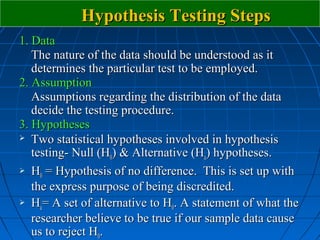
Hypothesis Testing Steps
1. Data
   The nature of the data should be understood as it
   determines the particular test to be employed.
2. Assumption
   Assumptions regarding the distribution of the data
   decide the testing procedure.
3. Hypotheses
 Two statistical hypotheses involved in hypothesis

   testing- Null (H0) & Alternative (Ha) hypotheses.
 H = Hypothesis of no difference. This is set up with
     0
   the express purpose of being discredited.
 H = A set of alternative to H . A statement of what the
     a                          0
   researcher believe to be true if our sample data cause
   us to reject H0.
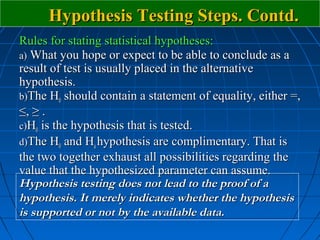
Hypothesis Testing Steps. Contd.
Rules for stating statistical hypotheses:
a) What you hope or expect to be able to conclude as a
result of test is usually placed in the alternative
hypothesis.
b)The H0 should contain a statement of equality, either =,
≤, ≥ .
c)H0 is the hypothesis that is tested.
d)The H0 and Ha hypothesis are complimentary. That is
the two together exhaust all possibilities regarding the
value that the hypothesized parameter can assume.
Hypothesis testing does not lead to the proof of a
hypothesis. It merely indicates whether the hypothesis
is supported or not by the available data.
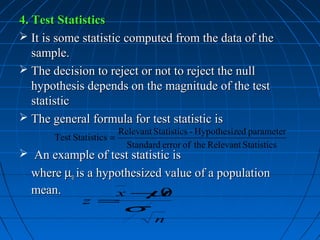
4. Test Statistics
 It is some statistic computed from the data of the
   sample.
 The decision to reject or not to reject the null
   hypothesis depends on the magnitude of the test
   statistic
 The general formula for test statistic is
                           Relevant Statistics - Hypothesized parameter
       Test Statistics =
                             Standard error of the Relevant Statistics
 An example of test statistic is
  where µ0 is a hypothesized value of a population
  mean.            x − 0 µ
              z =
                           σ
                                    n
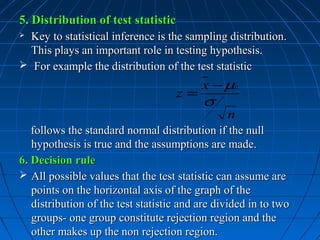
5. Distribution of test statistic
 Key to statistical inference is the sampling distribution.
  This plays an important role in testing hypothesis.
 For example the distribution of the test statistic
                                          x − µ0
                                    z=
                                          σ
                                                n
   follows the standard normal distribution if the null
   hypothesis is true and the assumptions are made.
6. Decision rule
 All possible values that the test statistic can assume are
   points on the horizontal axis of the graph of the
   distribution of the test statistic and are divided in to two
   groups- one group constitute rejection region and the
   other makes up the non rejection region.
 If the test statistic falls in the in the rejection region
 the H0 is rejected and not rejected otherwise.
 Errors in test of hypothesis:
 The error committed when a true null hypothesis is
 rejected is called a type I error and the probability of
 type-I error is designated by α
                      Decision         Decision
    Condition Of    Accept H0          Reject H0
    Null Hypothesis
    H0(true)          Correct decision Type I error
                                       (α error)
    H0(false)         Type II error    Correct decision
                      (β error)
 The type II error is committed when a false null
  hypothesis is not rejected. The probability of type II
  error is designated by β.
 Error is determined in advance as level of
  significance for a given sample size
 If we try to reduce type I error, the probability of
  committing type II error increases
 Both type errors cannot be reduced simultaneously
 Decision maker has to strike a balance / trade off
  examining the costs & penalties of both type errors
Level of significance (α):
 Some percentage (usually 5%) chosen with great
  care, thought & reason so that H0will be rejected
  when the sampling result (observed evidence) has a
  probability of < 0.05 of occurring if H0 is true
 Researcher is willing to take as much as a 5% risk of
  rejecting H0
 Significance level is the maximum value of the
  probability of rejecting H0when it is true
 It is usually determined in advance, i.e., the
  probability of type I error (α) is assigned in advance
  and hence nothing can be done about it.
7. Calculation of test statistic
   From the data we compute a value of the test statistic
   and compare it with the rejection and non rejection
   regions.
8. Statistical decision
   H0 is rejected if the computed value of test statistic falls
   in the rejection region or it is not rejected if it falls in
   the non rejection region.
9. Conclusion
   If H0 is rejected, we conclude that HA is true. If H0 is not
   rejected we conclude that H0 may be true.
10. p values
   The p value is a number that tells us how unusual our
   sample results are, given H0 is true. It is the prob. that
   the test statistic will fall in the rejection region when H 0
   is true. If ‘p’ ≤α, we reject H0. If ‘p’> α, H0 is not
   rejected.
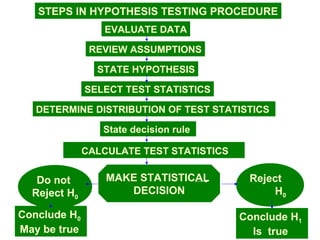
STEPS IN HYPOTHESIS TESTING PROCEDURE
                 EVALUATE DATA

               REVIEW ASSUMPTIONS

                STATE HYPOTHESIS

              SELECT TEST STATISTICS

   DETERMINE DISTRIBUTION OF TEST STATISTICS

                 State decision rule

              CALCULATE TEST STATISTICS


   Do not         MAKE STATISTICAL         Reject
  Reject H0          DECISION                  H0

Conclude H0                               Conclude H1
May be true                                 Is true
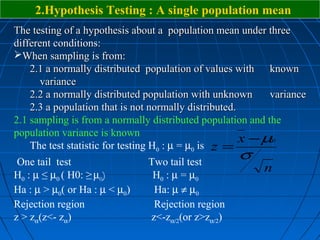
2.Hypothesis Testing : A single population mean
The testing of a hypothesis about a population mean under three
different conditions:
When sampling is from:
    2.1 a normally distributed population of values with known
      variance
    2.2 a normally distributed population with unknown      variance
    2.3 a population that is not normally distributed.
2.1 sampling is from a normally distributed population and the
population variance is known
                                                       x − µ0
    The test statistic for testing H0 : µ = µ0 is z =
 One tail test                 Two tail test
                                                    σ
                                                          n
H0 : µ ≤ µ0 ( H0: ≥ µ0)         H0 : µ = µ0
Ha : µ > µ0( or Ha : µ < µ0)    Ha: µ ≠ µ0
Rejection region                Rejection region
z > zα(z<- zα)                 z<-zα/2(or z>zα/2)
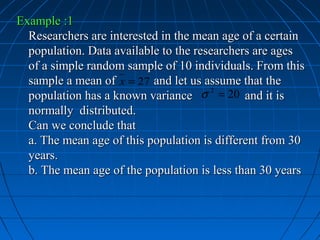
Example :1
  Researchers are interested in the mean age of a certain
  population. Data available to the researchers are ages
  of a simple random sample of 10 individuals. From this
  sample a mean of x = 27 and let us assume that the
  population has a known variance σ = 20 and it is
                                       2


  normally distributed.
  Can we conclude that
  a. The mean age of this population is different from 30
  years.
  b. The mean age of the population is less than 30 years
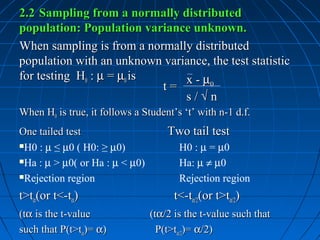
2.2 Sampling from a normally distributed
population: Population variance unknown.
When sampling is from a normally distributed
population with an unknown variance, the test statistic
for testing H0 : µ = µ0 is     x - µ0
                           t=
                               s/√n
When H0 is true, it follows a Student’s ‘t’ with n-1 d.f.
One tailed test                     Two tail test
H0 : µ ≤ µ0 ( H0: ≥ µ0)               H0 : µ = µ0
Ha : µ > µ0( or Ha : µ < µ0)          Ha: µ ≠ µ0
Rejection region                      Rejection region
t>tα(or t<-tα)                        t<-tα/2(or t>tα/2)
(tα is the t-value              (tα/2 is the t-value such that
such that P(t>tα)= α)             P(t>tα/2)= α/2)
Example: 2
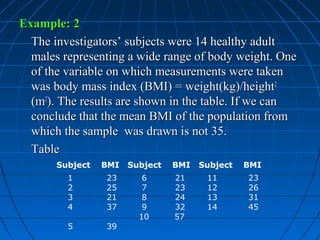
  The investigators’ subjects were 14 healthy adult
  males representing a wide range of body weight. One
  of the variable on which measurements were taken
  was body mass index (BMI) = weight(kg)/height2
  (m2). The results are shown in the table. If we can
  conclude that the mean BMI of the population from
  which the sample was drawn is not 35.
  Table
       Subject   BMI   Subject   BMI   Subject   BMI
         1       23       6      21     11       23
         2       25       7      23     12       26
         3       21       8      24     13       31
         4       37       9      32     14       45
                         10      57
         5       39
2.3 Sampling from a population that is not normally
  distributed.
(How to test the normality of the population? What is central
   Limit Theorem)
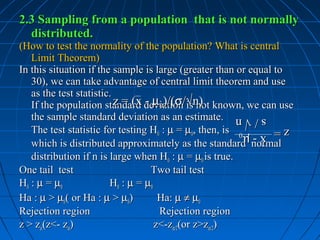
In this situation if the sample is large (greater than or equal to
   30), we can take advantage of central limit theorem and use
   as the test statistic.
   If the population standard deviation/√n) known, we can use
                          z = (x - µ0)/(σ is not
   the sample standard deviation as an estimate.       s/√n
                                                       s/√n
   The test statistic for testing H0 : µ = µ0, then, is
                                                   z=
                                                   z = x - µ0
                                                       x - µ0
   which is distributed approximately as the standard normal
   distribution if n is large when H0 : µ = µ0 is true.
One tail test                      Two tail test
H0 : µ = µ0             H0 : µ = µ0
Ha : µ > µ0( or Ha : µ > µ0)         Ha: µ ≠ µ0
Rejection region                     Rejection region
z > zα(z<- zα)                      z<-zα/2(or z>zα/2)
Example: 3
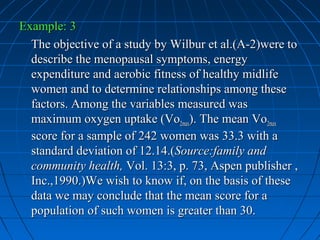
  The objective of a study by Wilbur et al.(A-2)were to
  describe the menopausal symptoms, energy
  expenditure and aerobic fitness of healthy midlife
  women and to determine relationships among these
  factors. Among the variables measured was
  maximum oxygen uptake (Vo2max). The mean Vo2max
  score for a sample of 242 women was 33.3 with a
  standard deviation of 12.14.(Source:family and
  community health, Vol. 13:3, p. 73, Aspen publisher ,
  Inc.,1990.)We wish to know if, on the basis of these
  data we may conclude that the mean score for a
  population of such women is greater than 30.
3.Hypothesis Testing: The difference between two
                   population means
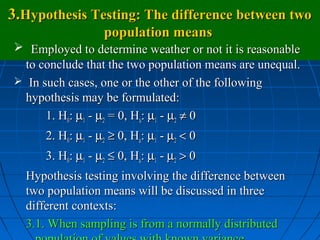
 Employed to determine weather or not it is reasonable
  to conclude that the two population means are unequal.
 In such cases, one or the other of the following
  hypothesis may be formulated:
      1. H0: µ1 - µ2 = 0, Ha: µ1 - µ2 ≠ 0
      2. H0: µ1 - µ2 ≥ 0, Ha: µ1 - µ2 < 0
      3. H0: µ1 - µ2 ≤ 0, Ha: µ1 - µ2 > 0
  Hypothesis testing involving the difference between
  two population means will be discussed in three
  different contexts:
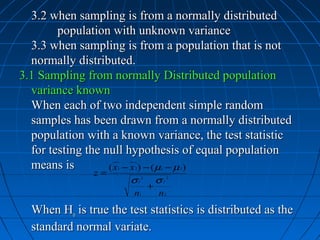
  3.1. When sampling is from a normally distributed
3.2 when sampling is from a normally distributed
        population with unknown variance
  3.3 when sampling is from a population that is not
  normally distributed.
3.1 Sampling from normally Distributed population
  variance known
  When each of two independent simple random
  samples has been drawn from a normally distributed
  population with a known variance, the test statistic
  for testing the null hypothesis of equal population
  means is         ( x − x ) − (µ − µ )
               z=
                    1    2          1     2


                        σ 12       σ 22
                               +
                         n1         n2
  When Ho is true the test statistics is distributed as the
  standard normal variate.
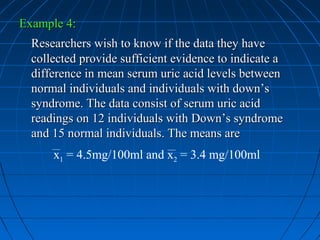
Example 4:
  Researchers wish to know if the data they have
  collected provide sufficient evidence to indicate a
  difference in mean serum uric acid levels between
  normal individuals and individuals with down’s
  syndrome. The data consist of serum uric acid
  readings on 12 individuals with Down’s syndrome
  and 15 normal individuals. The means are
      x1 = 4.5mg/100ml and x2 = 3.4 mg/100ml
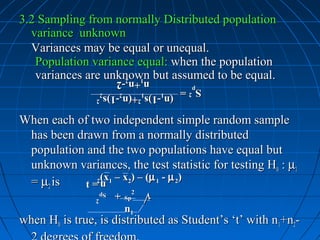
3.2 Sampling from normally Distributed population
  variance unknown
  Variances may be equal or unequal.
   Population variance equal: when the population
   variances are unknown but assumed to be equal.
                           n1+n2-2
                           n +n -2
                 p =
                 p =
                S2
                S2
                     (n1-1)s12+(n2-1)s22
                     (n -1)s 2+(n -1)s 2

When each of two independent simple random sample
 has been drawn from a normally distributed
 population and the two populations have equal but
 unknown variances, the test statistic for testing H0 : µ1
 = µ2 is       (x1 – x2) – (µ 1 - µ 2)
                n2
            t=
                n
                Sp
                Sp     +
                       +      2   √
                                  √
                   2
                   2       Sp
                           n1
when H0 is true, is distributed as Student’s ‘t’ with n1+n2-
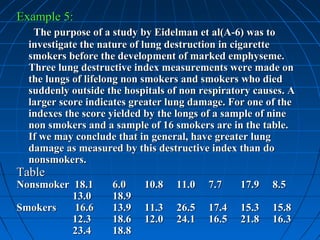
Example 5:
   The purpose of a study by Eidelman et al(A-6) was to
  investigate the nature of lung destruction in cigarette
  smokers before the development of marked emphyseme.
  Three lung destructive index measurements were made on
  the lungs of lifelong non smokers and smokers who died
  suddenly outside the hospitals of non respiratory causes. A
  larger score indicates greater lung damage. For one of the
  indexes the score yielded by the longs of a sample of nine
  non smokers and a sample of 16 smokers are in the table.
  If we may conclude that in general, have greater lung
  damage as measured by this destructive index than do
  nonsmokers.
Table
Nonsmoker 18.1      6.0    10.8   11.0   7.7    17.9   8.5
          13.0      18.9
Smokers   16.6      13.9   11.3   26.5   17.4   15.3   15.8
          12.3      18.6   12.0   24.1   16.5   21.8   16.3
          23.4      18.8
Population variance unequal:
                         (x1 – x2) – (µ 1 - µ 2)
                     t ′=
                        n2
                        n
                        S2
                        S2     +
                               +      2   √
                                          √
                           2
                           2       S1
                                   n1
The critical value of t′ for an α level of significance and
a two sided test is approximately
                                    w1t1+w2t2
                       t ′ 1-α /2 =
                                    w1+w2
Where w1 = s12/n1, w2 = s22/n2, t1 = t1-(α/2) for n1-1 degree of
freedom, and t2 = t1-(α/2) for n2-1 degrees of freedom. The
critical value of t′ for a one sided test is found by computing
 t′1- α using t1= t1- α for n1-1 d.f. & t2 = t1-α for n2 – 1 d.f. For a two
sided test reject H0 if computed value of t′ ≥ to the critical
value given by the above equation or ≤ to negative of that.
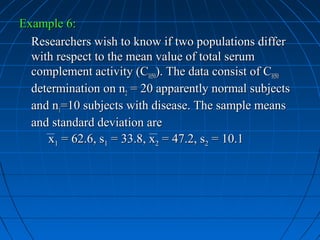
Example 6:
  Researchers wish to know if two populations differ
  with respect to the mean value of total serum
  complement activity (CH50). The data consist of CH50
  determination on n2 = 20 apparently normal subjects
  and n1=10 subjects with disease. The sample means
  and standard deviation are
     x1 = 62.6, s1 = 33.8, x2 = 47.2, s2 = 10.1
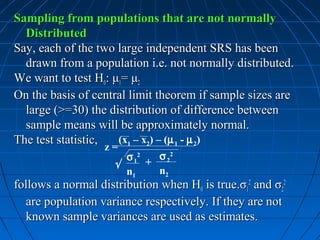
Sampling from populations that are not normally
  Distributed
Say, each of the two large independent SRS has been
  drawn from a population i.e. not normally distributed.
We want to test H0: μ1= μ2
On the basis of central limit theorem if sample sizes are
  large (>=30) the distribution of difference between
  sample means will be approximately normal.
The test statistic,    (x1 – x2) – (µ 1 - µ 2)
                    z=
                      σ 12 + σ 22
                    √
                      n1     n2
follows a normal distribution when H0 is true.σ12 and σ22
  are population variance respectively. If they are not
  known sample variances are used as estimates.
Example 7:
  An article by Becker et al. in the American journal of health
  Health Promotion (A-7) describes the development of a tool to
  measures barriers to health promotion among persons with
  disabilities. The authors state that the issue of barriers is
  especially salient for disabled persons who experience barriers
  in such contexts as employment, transportation, housing,
  education, insurance, architectural access, entitlement
  programs, and society's attitudes. Studies suggest that
  measurement of barriers can enhance health workers’
  understanding of the likelihood of the people engaging in
  various health promoting behaviors and may be a relevant
  construct in assessing the health behaviors of disabled
  persons.Sample            Mean score      Standard
                                         deviation
         D               31.83           7.93
         ND              25.07           4.80
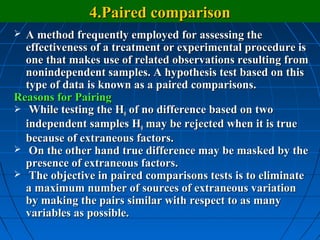
4.Paired comparison
 A method frequently employed for assessing the
  effectiveness of a treatment or experimental procedure is
  one that makes use of related observations resulting from
  nonindependent samples. A hypothesis test based on this
  type of data is known as a paired comparisons.
Reasons for Pairing
 While testing the H0 of no difference based on two
  independent samples H0 may be rejected when it is true
  because of extraneous factors.
 On the other hand true difference may be masked by the
  presence of extraneous factors.
 The objective in paired comparisons tests is to eliminate
  a maximum number of sources of extraneous variation
  by making the pairs similar with respect to as many
  variables as possible.
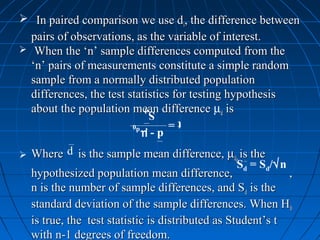
 In paired comparison we use di, the difference between
  pairs of observations, as the variable of interest.
 When the ‘n’ sample differences computed from the
  ‘n’ pairs of measurements constitute a simple random
  sample from a normally distributed population
  differences, the test statistics for testing hypothesis
  about the population mean difference µd is
                              Sd
                                      t=
                           d - µ d0

   Where d is the sample mean difference, µd0 is the
                                                    Sd = Sd/√n
    hypothesized population mean difference,                   ,
    n is the number of sample differences, and Sd is the
    standard deviation of the sample differences. When H 0
    is true, the test statistic is distributed as Student’s t
    with n-1 degrees of freedom.
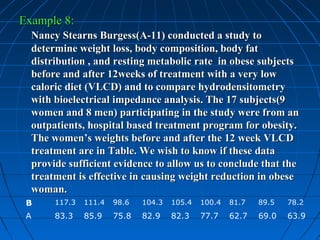
Example 8:
  Nancy Stearns Burgess(A-11) conducted a study to
  determine weight loss, body composition, body fat
  distribution , and resting metabolic rate in obese subjects
  before and after 12weeks of treatment with a very low
  caloric diet (VLCD) and to compare hydrodensitometry
  with bioelectrical impedance analysis. The 17 subjects(9
  women and 8 men) participating in the study were from an
  outpatients, hospital based treatment program for obesity.
  The women’s weights before and after the 12 week VLCD
  treatment are in Table. We wish to know if these data
  provide sufficient evidence to allow us to conclude that the
  treatment is effective in causing weight reduction in obese
  woman.
 B     117.3   111.4   98.6   104.3   105.4   100.4   81.7   89.5   78.2
 A     83.3    85.9    75.8   82.9    82.3    77.7    62.7   69.0   63.9
5. Hypothesis Testing: A single population
                   Proportion
 Testing hypothesis about population proportions is same
  as for means when the condition necessary for using the
  normal curve are met.
 When a sample sufficiently large for application of the
  central limit theorem, the test statistic is
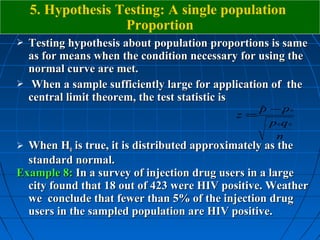
                                              p − p0
                                              ˆ
                                           z=
                                                p0q0
                                                 n
 When H0 is true, it is distributed approximately as the
  standard normal.
Example 8: In a survey of injection drug users in a large
  city found that 18 out of 423 were HIV positive. Weather
  we conclude that fewer than 5% of the injection drug
  users in the sampled population are HIV positive.
6. Hypothesis Testing : The difference between two
               population proportion
 Let p1 and p2 are the population proportions of some
  character under study from two populations.
 When the null hypothesis to be tested is p1 – p2=0, we are
  hypothesizing that the two population proportion are equal.
 This is the justification of combining the result of the two
  samples to come up with a estimate of hypothesized
  common
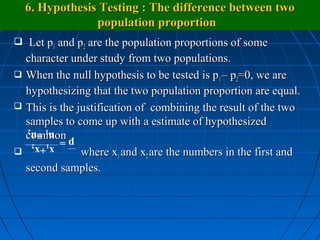
     n1 +n2
   p= 1 2
     x +x
              where x1 and x2 are the numbers in the first and
  second samples.
The estimated standard error of the estimator,
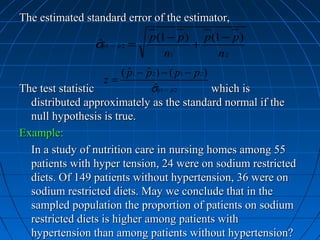
                              p (1 − p ) p (1 − p )
                σp1 − p 2 =
                 ˆˆ ˆ                   +
                                  n1         n2
                        ( p1 − p 2 ) − ( p1 − p 2 )
                          ˆ ˆ
                    z=
The test statistic              σp1 − pˆ 2
                                  ˆˆ                which is
  distributed approximately as the standard normal if the
  null hypothesis is true.
Example:
  In a study of nutrition care in nursing homes among 55
  patients with hyper tension, 24 were on sodium restricted
  diets. Of 149 patients without hypertension, 36 were on
  sodium restricted diets. May we conclude that in the
  sampled population the proportion of patients on sodium
  restricted diets is higher among patients with
  hypertension than among patients without hypertension?
7.Hypothesis Testing: A single population Variance
  When the data available for analysis consists of a simple
   random sample drawn from a normally distributed
   population, the test statistic for testing hypothesis about a
   population variance is
   when H0 is true, is distributed as χ 2 with n-1 degrees of

   freedom.
                           χ = (n-1)s /σ
                           2         2  2

 Example:
   The release of preformed and newly generated mediators in the
   immediate response to allergen inhalation in allegic primates. Subjects
   were 12 wild-caught, adult male cynomolgus monkeys meeting certain
   criteria of the study. Among the data reported by the investigator was a
   standard error of the sample mean of 0.4 for one of the mediator
   received from the subject by bronchoalveolar lavage(BAL). We wish to
   know if we may conclude from these data that the population variance
   is not 4.
For Ha:σ2> σ02(reject H0 if χ2 computed.)
For Ha:σ2< σ02(reject H0 if χ2 computed.)
8. Hypothesis Testing: The ratio of two population
variance
Variance Ratio Test:
 Decision regarding the comparability of two population
  variances are usually based on the variance ratio test.
 When two population variances are equal, testing the
  hypothesis that their ratio is equal to 1.
 If σ12 = σ22 , then the hypothesis is true, and the two variances
  cancel out in the above expression leaving s12/ s22 , which
  follows the same F distribution.
 The ratio s12/ s22 will be designated V.R. for variance ratio.
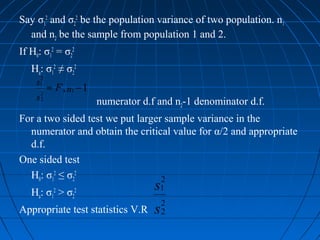
Say σ12 and σ22 be the population variance of two population. n1
  and n2 be the sample from population 1 and 2.
If H0: σ12 = σ22
   Ha: σ12 ≠ σ22
        2
    s1
        2
            ≈ F , n1 − 1
    s   2
                           numerator d.f and n2-1 denominator d.f.
For a two sided test we put larger sample variance in the
  numerator and obtain the critical value for α/2 and appropriate
  d.f.
One sided test
  H0: σ12 ≤ σ22                   2
   Ha: σ > σ2 2     2                   s1
             1
                                            2
Appropriate test statistics V.R         s   2
Fα is obtained for appropriate d.f.
   H0: σ12 ≥ σ22
   Ha: σ12 < σ22      s
                       2
                       1
Test statistic V.R=       2
                      s   2


Fα is obtained for α and appropriate d.f.
Decision rule in all these cases is that reject H0 if computed.
Example:
 To investigate alterations of thermoregulation in patients
 with certain pituitary adenomous (P) the standard
 deviation of the weights of a sample of 12 patients was
 21.4kg. The weights of a sample of five control subjects©
 yielded a standard deviation of 12.4kg. Wheather we
 conclude that the weights of the population represented
 by the sample of patients are more variable than the
 weights of the population represented by the sample of
 control subjects.
9. The Type II Error and The Power of a test
  α is a measure of the acceptable risk of rejecting a true
  null hypothesis.
 But β may assume one of many values.

 To test the null hypothesis for some population

  parameter is equal to some specified value. If H0 is false
  and we fail to reject it then it is a type- II error.
 If the hypothesized value of parameter is not the true

  value, the value of β depends on several factors.
          • the true value of the parameter of interest
          • hypothesized value of the parameter
          • the value of α
          • the sample size n
 For fixed α and n we compute many values of β by
  postulating many values for the parameter.
    If H0 is in fact false , we would like to know probability
    of its rejection. The power of test, designated 1-β this
    information.
    The quantity 1-β is the probability of reject a null
    hypothesis ; it may be computed for any alternative value
    of the parameter .
   For a given test number of possible values of the
    parameter of interest and for each compute the value of 1-
    β. The result is called a power function.
    The graph of a power function is called a power curve,
    helpful device for quickly assessing the nature of the
    power of a given test.
THANK YOU

Hypothesis Testing

  • 1.
    Lecture Series on Biostatistics No. Bio-Stat_11 Date – 09.11.2008 Hypothesis Testing By Dr. Bijaya Bhusan Nanda, M. Sc (Gold Medalist) Ph. D. (Stat.) Topper Orissa Statistics & Economics Services, 1988 bijayabnanda@yahoo.com 1
  • 2.
    CONTENTS  Introduction  Hypothesis Testing : A single population mean  Hypothesis Testing: The difference between two population means  Paired comparison  Hypothesis Testing: A single population Proportion  Hypothesis Testing: The difference between two population Proportion  Hypothesis Testing: A single population Variance  Hypothesis Testing: The ratio of two population variance
  • 3.
    Learning Objective  Thetrainees will be able to take the decision/reach a conclusion concerning a population by examining a sample from that population.
  • 4.
    1. Introduction  Hypothesistesting- Purpose  To aid the clinician, researcher , or administrator in reaching a conclusion concerning a population by examining a representative sample from that population.  Hypothesis Defined:- A statement about one or more population.  Types of Hypothesis:  Research hypothesis and statistical hypothesis  Research hypothesis  It is the conjecture or supposition that motivates the research.  Research project emanates from the desire of such health practitioners to validate their supposition by rigors of scientific investigation.
  • 5.
    Statistical Hypothesis  That are stated in such a way that they may be evaluated by appropriate statistical techniques.
  • 6.
    Hypothesis Testing  Hypothesistesting is the Procedures which enable researcher to decide whether to accept or reject hypothesis or whether observed samples differ significantly from expected results. The results can’t be attributed to chance variation due to sampling
  • 7.
    Hypothesis Testing Steps 1.Data The nature of the data should be understood as it determines the particular test to be employed. 2. Assumption Assumptions regarding the distribution of the data decide the testing procedure. 3. Hypotheses  Two statistical hypotheses involved in hypothesis testing- Null (H0) & Alternative (Ha) hypotheses.  H = Hypothesis of no difference. This is set up with 0 the express purpose of being discredited.  H = A set of alternative to H . A statement of what the a 0 researcher believe to be true if our sample data cause us to reject H0.
  • 8.
    Hypothesis Testing Steps.Contd. Rules for stating statistical hypotheses: a) What you hope or expect to be able to conclude as a result of test is usually placed in the alternative hypothesis. b)The H0 should contain a statement of equality, either =, ≤, ≥ . c)H0 is the hypothesis that is tested. d)The H0 and Ha hypothesis are complimentary. That is the two together exhaust all possibilities regarding the value that the hypothesized parameter can assume. Hypothesis testing does not lead to the proof of a hypothesis. It merely indicates whether the hypothesis is supported or not by the available data.
  • 9.
    4. Test Statistics It is some statistic computed from the data of the sample.  The decision to reject or not to reject the null hypothesis depends on the magnitude of the test statistic  The general formula for test statistic is Relevant Statistics - Hypothesized parameter Test Statistics = Standard error of the Relevant Statistics  An example of test statistic is where µ0 is a hypothesized value of a population mean. x − 0 µ z = σ n
  • 10.
    5. Distribution oftest statistic  Key to statistical inference is the sampling distribution. This plays an important role in testing hypothesis.  For example the distribution of the test statistic x − µ0 z= σ n follows the standard normal distribution if the null hypothesis is true and the assumptions are made. 6. Decision rule  All possible values that the test statistic can assume are points on the horizontal axis of the graph of the distribution of the test statistic and are divided in to two groups- one group constitute rejection region and the other makes up the non rejection region.
  • 11.
     If thetest statistic falls in the in the rejection region the H0 is rejected and not rejected otherwise. Errors in test of hypothesis:  The error committed when a true null hypothesis is rejected is called a type I error and the probability of type-I error is designated by α Decision Decision Condition Of Accept H0 Reject H0 Null Hypothesis H0(true) Correct decision Type I error (α error) H0(false) Type II error Correct decision (β error)
  • 12.
     The typeII error is committed when a false null hypothesis is not rejected. The probability of type II error is designated by β.  Error is determined in advance as level of significance for a given sample size  If we try to reduce type I error, the probability of committing type II error increases  Both type errors cannot be reduced simultaneously  Decision maker has to strike a balance / trade off examining the costs & penalties of both type errors
  • 13.
    Level of significance(α):  Some percentage (usually 5%) chosen with great care, thought & reason so that H0will be rejected when the sampling result (observed evidence) has a probability of < 0.05 of occurring if H0 is true  Researcher is willing to take as much as a 5% risk of rejecting H0  Significance level is the maximum value of the probability of rejecting H0when it is true  It is usually determined in advance, i.e., the probability of type I error (α) is assigned in advance and hence nothing can be done about it.
  • 14.
    7. Calculation oftest statistic From the data we compute a value of the test statistic and compare it with the rejection and non rejection regions. 8. Statistical decision H0 is rejected if the computed value of test statistic falls in the rejection region or it is not rejected if it falls in the non rejection region. 9. Conclusion If H0 is rejected, we conclude that HA is true. If H0 is not rejected we conclude that H0 may be true. 10. p values The p value is a number that tells us how unusual our sample results are, given H0 is true. It is the prob. that the test statistic will fall in the rejection region when H 0 is true. If ‘p’ ≤α, we reject H0. If ‘p’> α, H0 is not rejected.
  • 15.
    STEPS IN HYPOTHESISTESTING PROCEDURE EVALUATE DATA REVIEW ASSUMPTIONS STATE HYPOTHESIS SELECT TEST STATISTICS DETERMINE DISTRIBUTION OF TEST STATISTICS State decision rule CALCULATE TEST STATISTICS Do not MAKE STATISTICAL Reject Reject H0 DECISION H0 Conclude H0 Conclude H1 May be true Is true
  • 16.
    2.Hypothesis Testing :A single population mean The testing of a hypothesis about a population mean under three different conditions: When sampling is from: 2.1 a normally distributed population of values with known variance 2.2 a normally distributed population with unknown variance 2.3 a population that is not normally distributed. 2.1 sampling is from a normally distributed population and the population variance is known x − µ0 The test statistic for testing H0 : µ = µ0 is z = One tail test Two tail test σ n H0 : µ ≤ µ0 ( H0: ≥ µ0) H0 : µ = µ0 Ha : µ > µ0( or Ha : µ < µ0) Ha: µ ≠ µ0 Rejection region Rejection region z > zα(z<- zα) z<-zα/2(or z>zα/2)
  • 17.
    Example :1 Researchers are interested in the mean age of a certain population. Data available to the researchers are ages of a simple random sample of 10 individuals. From this sample a mean of x = 27 and let us assume that the population has a known variance σ = 20 and it is 2 normally distributed. Can we conclude that a. The mean age of this population is different from 30 years. b. The mean age of the population is less than 30 years
  • 18.
    2.2 Sampling froma normally distributed population: Population variance unknown. When sampling is from a normally distributed population with an unknown variance, the test statistic for testing H0 : µ = µ0 is x - µ0 t= s/√n When H0 is true, it follows a Student’s ‘t’ with n-1 d.f. One tailed test Two tail test H0 : µ ≤ µ0 ( H0: ≥ µ0) H0 : µ = µ0 Ha : µ > µ0( or Ha : µ < µ0) Ha: µ ≠ µ0 Rejection region Rejection region t>tα(or t<-tα) t<-tα/2(or t>tα/2) (tα is the t-value (tα/2 is the t-value such that such that P(t>tα)= α) P(t>tα/2)= α/2)
  • 19.
    Example: 2 The investigators’ subjects were 14 healthy adult males representing a wide range of body weight. One of the variable on which measurements were taken was body mass index (BMI) = weight(kg)/height2 (m2). The results are shown in the table. If we can conclude that the mean BMI of the population from which the sample was drawn is not 35. Table Subject BMI Subject BMI Subject BMI 1 23 6 21 11 23 2 25 7 23 12 26 3 21 8 24 13 31 4 37 9 32 14 45 10 57 5 39
  • 20.
    2.3 Sampling froma population that is not normally distributed. (How to test the normality of the population? What is central Limit Theorem) In this situation if the sample is large (greater than or equal to 30), we can take advantage of central limit theorem and use as the test statistic. If the population standard deviation/√n) known, we can use z = (x - µ0)/(σ is not the sample standard deviation as an estimate. s/√n s/√n The test statistic for testing H0 : µ = µ0, then, is z= z = x - µ0 x - µ0 which is distributed approximately as the standard normal distribution if n is large when H0 : µ = µ0 is true. One tail test Two tail test H0 : µ = µ0 H0 : µ = µ0 Ha : µ > µ0( or Ha : µ > µ0) Ha: µ ≠ µ0 Rejection region Rejection region z > zα(z<- zα) z<-zα/2(or z>zα/2)
  • 21.
    Example: 3 The objective of a study by Wilbur et al.(A-2)were to describe the menopausal symptoms, energy expenditure and aerobic fitness of healthy midlife women and to determine relationships among these factors. Among the variables measured was maximum oxygen uptake (Vo2max). The mean Vo2max score for a sample of 242 women was 33.3 with a standard deviation of 12.14.(Source:family and community health, Vol. 13:3, p. 73, Aspen publisher , Inc.,1990.)We wish to know if, on the basis of these data we may conclude that the mean score for a population of such women is greater than 30.
  • 22.
    3.Hypothesis Testing: Thedifference between two population means  Employed to determine weather or not it is reasonable to conclude that the two population means are unequal.  In such cases, one or the other of the following hypothesis may be formulated: 1. H0: µ1 - µ2 = 0, Ha: µ1 - µ2 ≠ 0 2. H0: µ1 - µ2 ≥ 0, Ha: µ1 - µ2 < 0 3. H0: µ1 - µ2 ≤ 0, Ha: µ1 - µ2 > 0 Hypothesis testing involving the difference between two population means will be discussed in three different contexts: 3.1. When sampling is from a normally distributed
  • 23.
    3.2 when samplingis from a normally distributed population with unknown variance 3.3 when sampling is from a population that is not normally distributed. 3.1 Sampling from normally Distributed population variance known When each of two independent simple random samples has been drawn from a normally distributed population with a known variance, the test statistic for testing the null hypothesis of equal population means is ( x − x ) − (µ − µ ) z= 1 2 1 2 σ 12 σ 22 + n1 n2 When Ho is true the test statistics is distributed as the standard normal variate.
  • 24.
    Example 4: Researchers wish to know if the data they have collected provide sufficient evidence to indicate a difference in mean serum uric acid levels between normal individuals and individuals with down’s syndrome. The data consist of serum uric acid readings on 12 individuals with Down’s syndrome and 15 normal individuals. The means are x1 = 4.5mg/100ml and x2 = 3.4 mg/100ml
  • 25.
    3.2 Sampling fromnormally Distributed population variance unknown Variances may be equal or unequal. Population variance equal: when the population variances are unknown but assumed to be equal. n1+n2-2 n +n -2 p = p = S2 S2 (n1-1)s12+(n2-1)s22 (n -1)s 2+(n -1)s 2 When each of two independent simple random sample has been drawn from a normally distributed population and the two populations have equal but unknown variances, the test statistic for testing H0 : µ1 = µ2 is (x1 – x2) – (µ 1 - µ 2) n2 t= n Sp Sp + + 2 √ √ 2 2 Sp n1 when H0 is true, is distributed as Student’s ‘t’ with n1+n2-
  • 26.
    Example 5: The purpose of a study by Eidelman et al(A-6) was to investigate the nature of lung destruction in cigarette smokers before the development of marked emphyseme. Three lung destructive index measurements were made on the lungs of lifelong non smokers and smokers who died suddenly outside the hospitals of non respiratory causes. A larger score indicates greater lung damage. For one of the indexes the score yielded by the longs of a sample of nine non smokers and a sample of 16 smokers are in the table. If we may conclude that in general, have greater lung damage as measured by this destructive index than do nonsmokers. Table Nonsmoker 18.1 6.0 10.8 11.0 7.7 17.9 8.5 13.0 18.9 Smokers 16.6 13.9 11.3 26.5 17.4 15.3 15.8 12.3 18.6 12.0 24.1 16.5 21.8 16.3 23.4 18.8
  • 27.
    Population variance unequal: (x1 – x2) – (µ 1 - µ 2) t ′= n2 n S2 S2 + + 2 √ √ 2 2 S1 n1 The critical value of t′ for an α level of significance and a two sided test is approximately w1t1+w2t2 t ′ 1-α /2 = w1+w2 Where w1 = s12/n1, w2 = s22/n2, t1 = t1-(α/2) for n1-1 degree of freedom, and t2 = t1-(α/2) for n2-1 degrees of freedom. The critical value of t′ for a one sided test is found by computing t′1- α using t1= t1- α for n1-1 d.f. & t2 = t1-α for n2 – 1 d.f. For a two sided test reject H0 if computed value of t′ ≥ to the critical value given by the above equation or ≤ to negative of that.
  • 28.
    Example 6: Researchers wish to know if two populations differ with respect to the mean value of total serum complement activity (CH50). The data consist of CH50 determination on n2 = 20 apparently normal subjects and n1=10 subjects with disease. The sample means and standard deviation are x1 = 62.6, s1 = 33.8, x2 = 47.2, s2 = 10.1
  • 29.
    Sampling from populationsthat are not normally Distributed Say, each of the two large independent SRS has been drawn from a population i.e. not normally distributed. We want to test H0: μ1= μ2 On the basis of central limit theorem if sample sizes are large (>=30) the distribution of difference between sample means will be approximately normal. The test statistic, (x1 – x2) – (µ 1 - µ 2) z= σ 12 + σ 22 √ n1 n2 follows a normal distribution when H0 is true.σ12 and σ22 are population variance respectively. If they are not known sample variances are used as estimates.
  • 30.
    Example 7: An article by Becker et al. in the American journal of health Health Promotion (A-7) describes the development of a tool to measures barriers to health promotion among persons with disabilities. The authors state that the issue of barriers is especially salient for disabled persons who experience barriers in such contexts as employment, transportation, housing, education, insurance, architectural access, entitlement programs, and society's attitudes. Studies suggest that measurement of barriers can enhance health workers’ understanding of the likelihood of the people engaging in various health promoting behaviors and may be a relevant construct in assessing the health behaviors of disabled persons.Sample Mean score Standard deviation D 31.83 7.93 ND 25.07 4.80
  • 31.
    4.Paired comparison  Amethod frequently employed for assessing the effectiveness of a treatment or experimental procedure is one that makes use of related observations resulting from nonindependent samples. A hypothesis test based on this type of data is known as a paired comparisons. Reasons for Pairing  While testing the H0 of no difference based on two independent samples H0 may be rejected when it is true because of extraneous factors.  On the other hand true difference may be masked by the presence of extraneous factors.  The objective in paired comparisons tests is to eliminate a maximum number of sources of extraneous variation by making the pairs similar with respect to as many variables as possible.
  • 32.
     In pairedcomparison we use di, the difference between pairs of observations, as the variable of interest.  When the ‘n’ sample differences computed from the ‘n’ pairs of measurements constitute a simple random sample from a normally distributed population differences, the test statistics for testing hypothesis about the population mean difference µd is Sd t= d - µ d0  Where d is the sample mean difference, µd0 is the Sd = Sd/√n hypothesized population mean difference, , n is the number of sample differences, and Sd is the standard deviation of the sample differences. When H 0 is true, the test statistic is distributed as Student’s t with n-1 degrees of freedom.
  • 33.
    Example 8: Nancy Stearns Burgess(A-11) conducted a study to determine weight loss, body composition, body fat distribution , and resting metabolic rate in obese subjects before and after 12weeks of treatment with a very low caloric diet (VLCD) and to compare hydrodensitometry with bioelectrical impedance analysis. The 17 subjects(9 women and 8 men) participating in the study were from an outpatients, hospital based treatment program for obesity. The women’s weights before and after the 12 week VLCD treatment are in Table. We wish to know if these data provide sufficient evidence to allow us to conclude that the treatment is effective in causing weight reduction in obese woman. B 117.3 111.4 98.6 104.3 105.4 100.4 81.7 89.5 78.2 A 83.3 85.9 75.8 82.9 82.3 77.7 62.7 69.0 63.9
  • 34.
    5. Hypothesis Testing:A single population Proportion  Testing hypothesis about population proportions is same as for means when the condition necessary for using the normal curve are met.  When a sample sufficiently large for application of the central limit theorem, the test statistic is p − p0 ˆ z= p0q0 n  When H0 is true, it is distributed approximately as the standard normal. Example 8: In a survey of injection drug users in a large city found that 18 out of 423 were HIV positive. Weather we conclude that fewer than 5% of the injection drug users in the sampled population are HIV positive.
  • 35.
    6. Hypothesis Testing: The difference between two population proportion  Let p1 and p2 are the population proportions of some character under study from two populations.  When the null hypothesis to be tested is p1 – p2=0, we are hypothesizing that the two population proportion are equal.  This is the justification of combining the result of the two samples to come up with a estimate of hypothesized common n1 +n2 p= 1 2 x +x  where x1 and x2 are the numbers in the first and second samples.
  • 36.
    The estimated standarderror of the estimator, p (1 − p ) p (1 − p ) σp1 − p 2 = ˆˆ ˆ + n1 n2 ( p1 − p 2 ) − ( p1 − p 2 ) ˆ ˆ z= The test statistic σp1 − pˆ 2 ˆˆ which is distributed approximately as the standard normal if the null hypothesis is true. Example: In a study of nutrition care in nursing homes among 55 patients with hyper tension, 24 were on sodium restricted diets. Of 149 patients without hypertension, 36 were on sodium restricted diets. May we conclude that in the sampled population the proportion of patients on sodium restricted diets is higher among patients with hypertension than among patients without hypertension?
  • 37.
    7.Hypothesis Testing: Asingle population Variance  When the data available for analysis consists of a simple random sample drawn from a normally distributed population, the test statistic for testing hypothesis about a population variance is when H0 is true, is distributed as χ 2 with n-1 degrees of freedom. χ = (n-1)s /σ 2 2 2 Example: The release of preformed and newly generated mediators in the immediate response to allergen inhalation in allegic primates. Subjects were 12 wild-caught, adult male cynomolgus monkeys meeting certain criteria of the study. Among the data reported by the investigator was a standard error of the sample mean of 0.4 for one of the mediator received from the subject by bronchoalveolar lavage(BAL). We wish to know if we may conclude from these data that the population variance is not 4.
  • 38.
    For Ha:σ2> σ02(rejectH0 if χ2 computed.) For Ha:σ2< σ02(reject H0 if χ2 computed.)
  • 39.
    8. Hypothesis Testing:The ratio of two population variance Variance Ratio Test:  Decision regarding the comparability of two population variances are usually based on the variance ratio test.  When two population variances are equal, testing the hypothesis that their ratio is equal to 1.  If σ12 = σ22 , then the hypothesis is true, and the two variances cancel out in the above expression leaving s12/ s22 , which follows the same F distribution.  The ratio s12/ s22 will be designated V.R. for variance ratio.
  • 40.
    Say σ12 andσ22 be the population variance of two population. n1 and n2 be the sample from population 1 and 2. If H0: σ12 = σ22 Ha: σ12 ≠ σ22 2 s1 2 ≈ F , n1 − 1 s 2 numerator d.f and n2-1 denominator d.f. For a two sided test we put larger sample variance in the numerator and obtain the critical value for α/2 and appropriate d.f. One sided test H0: σ12 ≤ σ22 2 Ha: σ > σ2 2 2 s1 1 2 Appropriate test statistics V.R s 2
  • 41.
    Fα is obtainedfor appropriate d.f. H0: σ12 ≥ σ22 Ha: σ12 < σ22 s 2 1 Test statistic V.R= 2 s 2 Fα is obtained for α and appropriate d.f. Decision rule in all these cases is that reject H0 if computed.
  • 42.
    Example: To investigatealterations of thermoregulation in patients with certain pituitary adenomous (P) the standard deviation of the weights of a sample of 12 patients was 21.4kg. The weights of a sample of five control subjects© yielded a standard deviation of 12.4kg. Wheather we conclude that the weights of the population represented by the sample of patients are more variable than the weights of the population represented by the sample of control subjects.
  • 43.
    9. The TypeII Error and The Power of a test  α is a measure of the acceptable risk of rejecting a true null hypothesis.  But β may assume one of many values.  To test the null hypothesis for some population parameter is equal to some specified value. If H0 is false and we fail to reject it then it is a type- II error.  If the hypothesized value of parameter is not the true value, the value of β depends on several factors. • the true value of the parameter of interest • hypothesized value of the parameter • the value of α • the sample size n  For fixed α and n we compute many values of β by postulating many values for the parameter.
  • 44.
    If H0 is in fact false , we would like to know probability of its rejection. The power of test, designated 1-β this information.  The quantity 1-β is the probability of reject a null hypothesis ; it may be computed for any alternative value of the parameter .  For a given test number of possible values of the parameter of interest and for each compute the value of 1- β. The result is called a power function.  The graph of a power function is called a power curve, helpful device for quickly assessing the nature of the power of a given test.
  • 45.