Dr.Manish Tiwari
SMC (unnao)
Department of microbiology
1. HISTORY
2. CLASSIFICATION
3. MORPHOLOGY
4. LOCATION
5. CULTURE CHARACTERISTIC
6. BIOCHEMICAL REACTION
7. RESISTANCE
8. VIRULENCE FACTOR
9. PATHOGENISIS
10. DISEASE
11. LABORATORY DIAGNOSIS
12. TREATMENT
History:
Von Recklinghausen first observed Staphylococci
in 1871 in human pyogenic lesions.
1884 Rosenbach named S. aureus and S. Albus
1885 passet described third variety , S. citreus
producing lemon yellow colonies
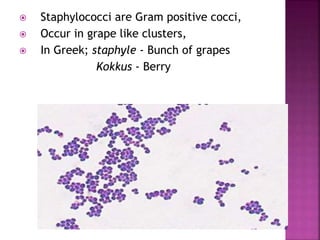
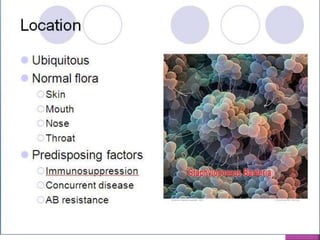
 Staphylococci are Gram positive cocci,
 Occur in grape like clusters,
 In Greek; staphyle - Bunch of grapes
Kokkus - Berry
 Family:- Microccaceae
 Genus:- Micrococcus and Staphylococcus
 Species:- S, aureus, S. saprophytics,
S. epidermidis, S. luteus
CLASSIFICATION:
A) Based on coagulase production:
1. Coagulase positive: Eg- S. aureus
2. Coagulase negative: Eg- S. epidermidis
S. saprophyticus
B) Based on pathogenicity:
1. Common pathogen: Eg- S. aureus
2. Opportunistic pathogens: Eg- S. epidermidis
S.
saprophyticus
3. Non pathogen: Eg- S. hominis
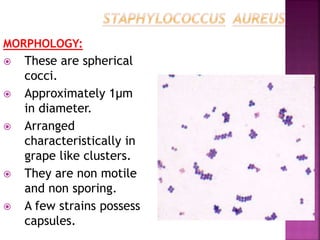
MORPHOLOGY:
 These are spherical
cocci.
 Approximately 1μm
in diameter.
 Arranged
characteristically in
grape like clusters.
 They are non motile
and non sporing.
 A few strains possess
capsules.
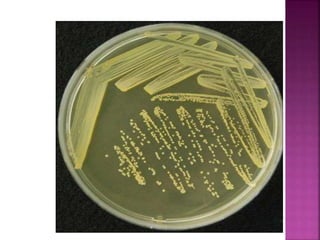
CULTURE:
Media used :-
i) Non selective media: Nutrient agar,
Blood agar,
MacConkey’s agar.
ii) Selective media: Salt-milk agar,
Ludlam’s medium
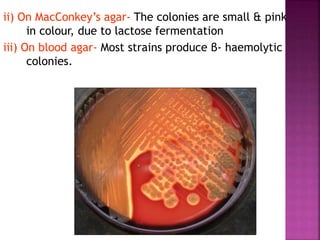
ii) On MacConkey’s agar- The colonies are small & pink
in colour, due to lactose fermentation
iii) On blood agar- Most strains produce β- haemolytic
colonies.
Biochemical
reactions:
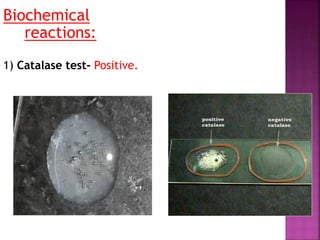
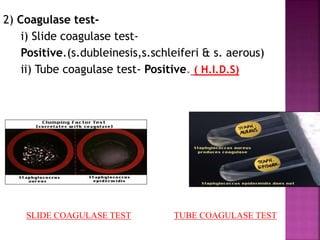
1) Catalase test- Positive.
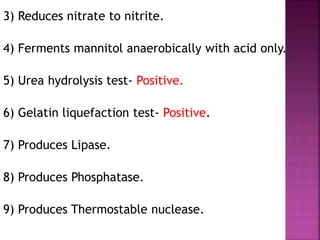
2) Coagulase test-
i) Slide coagulase test-
Positive.(s.dubleinesis,s.schleiferi & s. aerous)
ii) Tube coagulase test- Positive. ( H.I.D.S)
SLIDE COAGULASE TEST TUBE COAGULASE TEST
3) Reduces nitrate to nitrite.
4) Ferments mannitol anaerobically with acid only.
5) Urea hydrolysis test- Positive.
6) Gelatin liquefaction test- Positive.
7) Produces Lipase.
8) Produces Phosphatase.
9) Produces Thermostable nuclease.
PATHOGENICITY:
Source of infection:
A) Exogenous: patients or carriers
B) Endogenous: From colonized site
Mode of transmission:
A) Contact: direct or indirect( through fomites)
B) Inhalation of air borne droplets
Resistance
Remain vaible in dried state for 3-6 months.
Can with stand temperature 60ºc for 30 minutes.
Ability to grow in presence of 10% Nacl.
Resist 1% phenol for 15 min.
Penicillin resistance-
Staph. Produce of β lactmases.
Alternation of penicillin binding protein PBP2a.
Changes in bacterial surface receptors tolerance to
penicillin.
Virulence factors:
These include:-
A) Cell associated factors
B) Extracellular factors
A) CELL ASSOCIATED FACTORS:
a) Cell associated polymers
b) Cell surface proteins
a) CELL ASSOCIATED POLYMERS
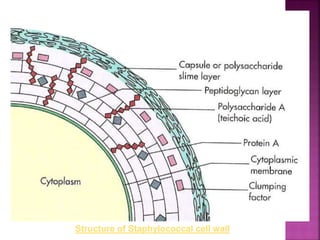
1. Cell wall polysaccharide peptidoglycan:- it
provide rigidity & structural integrity to the
bacterial cell wall & activate the complement &
induce release the inflammatory cytokines.
2. Teichoic acid:- antigenic component of bacterial
cell wall. act as adhesion of cocci to the host cell
surface & protect from complement mediated
opsonisation.
3. Capsular polysaccharide:- it occurs into
surrounding the cell wall that inhibit the
opsonisation.
b) CELL SURFACE PROTEINS:-
1. Protein A:- it present in most strains of s.aureus.
It has many biological property such as
chemotactic, anti phagocytic & anti
complementary effect.
It also induce the platelet damage &
hypersensitivity.
2. Clumping factor:- it is another surface protein is
called bound protein that responsible for the
slide coagulase test.
Structure of Staphylococcal cell wall
B) EXTRACELLULAR FACTORS
a) Enzymes
b) Toxins
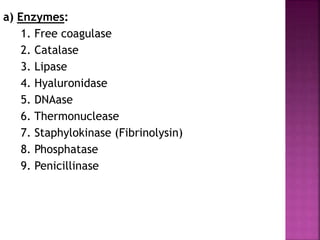
a) Enzymes:
1. Free coagulase
2. Catalase
3. Lipase
4. Hyaluronidase
5. DNAase
6. Thermonuclease
7. Staphylokinase (Fibrinolysin)
8. Phosphatase
9. Penicillinase
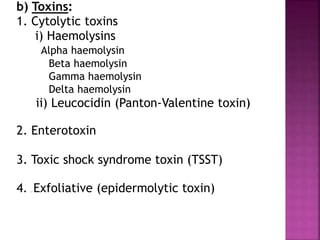
b) Toxins:
1. Cytolytic toxins
i) Haemolysins
Alpha haemolysin
Beta haemolysin
Gamma haemolysin
Delta haemolysin
ii) Leucocidin (Panton-Valentine toxin)
2. Enterotoxin
3. Toxic shock syndrome toxin (TSST)
4. . Exfoliative (epidermolytic toxin)
Disease:
Diseases produced by Staphylococcus aureus
is studied under 2 groups:
A) Infections
B) Intoxications
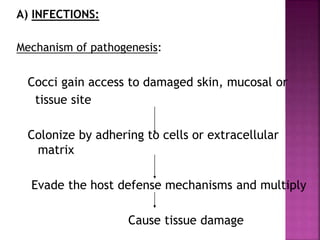
A) INFECTIONS:
Mechanism of pathogenesis:
Cocci gain access to damaged skin, mucosal or
tissue site
Colonize by adhering to cells or extracellular
matrix
Evade the host defense mechanisms and multiply
Cause tissue damage
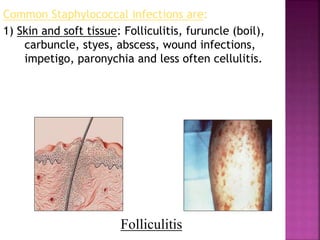
Common Staphylococcal infections are:
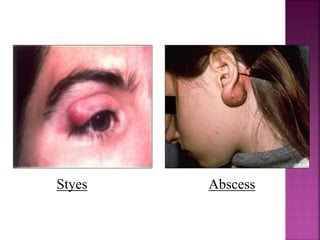
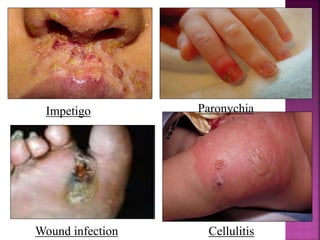
1) Skin and soft tissue: Folliculitis, furuncle (boil),
carbuncle, styes, abscess, wound infections,
impetigo, paronychia and less often cellulitis.
Folliculitis
Folliculitis
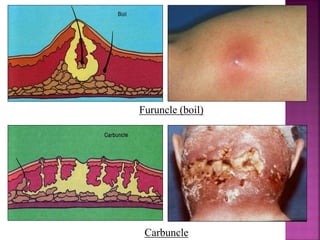
Furuncle (boil)
Carbuncle
Styes Abscess
Impetigo Paronychia
CellulitisWound infection
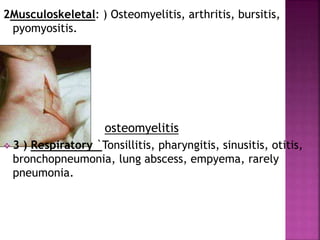
2Musculoskeletal: ) Osteomyelitis, arthritis, bursitis,
pyomyositis.
osteomyelitis
 3 ) Respiratory `Tonsillitis, pharyngitis, sinusitis, otitis,
bronchopneumonia, lung abscess, empyema, rarely
pneumonia.
4) Central nervous system: Abscess, meningitis,
intracranial thrombophlebitis.
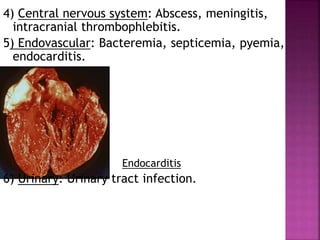
5) Endovascular: Bacteremia, septicemia, pyemia,
endocarditis.
Endocarditis
6) Urinary: Urinary tract infection.
B) INTOXICATIOINS:
The disease is caused by the bacterial exotoxins,
which are produced either in the infected host
or preformed in vitro.
There are 3 types-
1. Food poisoning
2. Toxic shock syndrome
3. Staphylococcal scalded skin syndrome
1) Food poisoning:
 Enterotoxin is responsible for manifestations of
staphylococcal food poisoning.
 Eight types of enterotoxin are currently known,
named A, B, C1-3, D, E, and H.
 It usually occurs when preformed toxin is ingested
with contaminated food.
 The toxin acts directly on the autonomic nervous
system to cause the illness, rather than gut
mucosa.
 The common food items responsible are - milk and milk
products, meat, fish and ice cream.
 Source of infection- food handler who is a carrier.
 Incubation period- 2 to 6 hours.
 Clinical symptoms- nausea, vomiting and diarrhoea.
 The illness is usually self limited, with recovery in a day
or so.
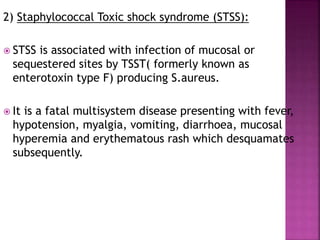
2) Staphylococcal Toxic shock syndrome (STSS):
 STSS is associated with infection of mucosal or
sequestered sites by TSST( formerly known as
enterotoxin type F) producing S.aureus.
 It is a fatal multisystem disease presenting with fever,
hypotension, myalgia, vomiting, diarrhoea, mucosal
hyperemia and erythematous rash which desquamates
subsequently.
2 types of STSS known:
i) Menstrual associated STSS: Here colonization of
S.aureus occurs in the vagina of menstruating woman
who uses highly absorbent vaginal tampons.
ii) Non menstrual associated STSS: Here colonization of
S.aureus occurs in other sites like surgical wound.
3) Staphylococcal scalded skin syndrome
(SSSS):
 Exfoliative toxin produced by S.aureus is responsible for
this.
 It is a skin disease in which outer layer of epidermis
gets separated from the underlying tissues.
Types of SSSS:
Severe form Milder form
In new born - Ritter’s disease - Pemphigus
neonatorum
In older patients - Toxic epidermal - Bullous
necrolysis impetigo
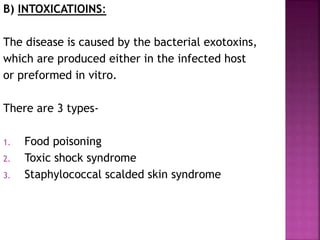
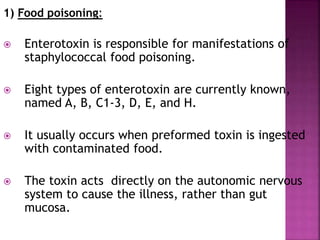
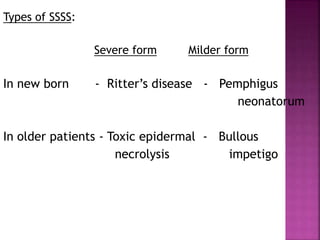
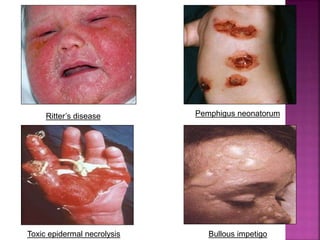
Toxic epidermal necrolysis
Ritter’s disease
Bullous impetigo
Pemphigus neonatorum
LAB DIAGNOSIS:
Specimens collected: Depends on the type of
infection.
• Suppurative lesion- Pus,
• Respiratory infection- Sputum,
• Bacteremia & septicemia- Blood,
• Food poisoning- Feces, vomit & the remains of
suspected food,
• For the detection of carriers- Nasal swab.
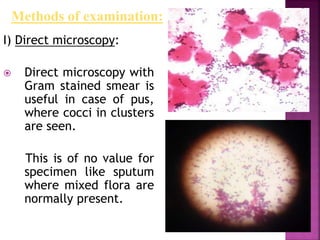
I) Direct microscopy:
 Direct microscopy with
Gram stained smear is
useful in case of pus,
where cocci in clusters
are seen.
This is of no value for
specimen like sputum
where mixed flora are
normally present.
Methods of examination:
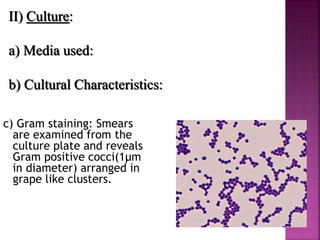
c) Gram staining: Smears
are examined from the
culture plate and reveals
Gram positive cocci(1μm
in diameter) arranged in
grape like clusters.
II) Culture:
a) Media used:
b) Cultural Characteristics:
d) Biochemical reactions:
III) Antibiotic sensitivity tests done as a guide to
treatment.
IV) Bacteriophage typing is done for epidemiological
purposes.
V) Serological tests are not useful.
“ These may sometimes help in diagnosis of hidden deep
infections”
TREATMENT:
 Drug resistance is common.
 Benzyl penicillin is the most effective antibiotic, if the
strain is sensitive.
 Cloxacillin or Methicillin is used against
beta-lactamase producing strains.
 Methicillin Resistant Staphylococcus aureus (MRSA)
strains have become common.
 Vancomycin is used in treatment of infections with
MRSA strains.
MRSA
 Methicillin-resistant S. aureus
 Resistant to all penicillins, cephalosporins, and
penems
 Usually multiply-resistant
 Vancomycin resistance is very rare – so far
 Hospital-acquired
 Community-acquired cases now (CA MRSA)
PREVENTION:
 Isolation & treatment of MRSA patients.
 Detection of carriers among hospital staff, their
isolation & treatment.
 Avoid indiscriminate usage of antibiotics.
1. Phenotypic
• Agar dilution
• Broth dilution (microbroth dilution)
• Disk diffusion and variations
• Gradient diffusion
• Enzymatic detection
• Mutation or other DNA change detection by
PCR (+ microarray)
• Mutation or DNA change detection by line
probe
• Sequencing
3. Others
• Growth and MALDI-TOF facilitated
• Growth and Image analysis
 Chromogenic cephalosporin disk
 Staphylococcus aureus
• Do not trust automated systems – they fail to
detect VISA Some VISA = 2 by Etest and 1 by broth
MIC
• Use Vanco disk & Vanco screen plate, incubate 24hr
• Growth on Vanco plate & no zone = VRSA
• Growth on Vanco plate & zone ≥7 mm = possible
VISA/VRSA Perform Etest or send isolate to
reference lab
• BHI plate with 6 mg/ml Vanco
• Inoculate with swab from 0.5 McFarland
suspension 30 mcg Vanco disk
 Disk diffusion susceptibility testing (Bauer-
Kirby method) For staphylococci,
Enterobacteriaceae, Pseudomonas
aeruginosa, enterococci, and other organisms
that grow well on Mueller-Hinton agar in air
at 35°C
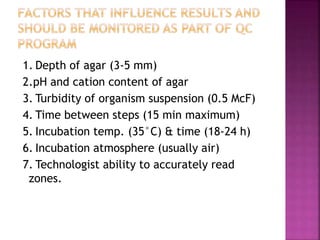
1. Depth of agar (3-5 mm)
2.pH and cation content of agar
3. Turbidity of organism suspension (0.5 McF)
4. Time between steps (15 min maximum)
5. Incubation temp. (35°C) & time (18-24 h)
6. Incubation atmosphere (usually air)
7. Technologist ability to accurately read
zones.
 Conventional identification methods for
MRSA detection including disk diffusion
method with oxacillin, latex agglutination
test and oxacillin-salt agar screening test
and etc.
 According to the recommendation of
Clinical and Laboratory Standards
Institute (CLSI), disk diffusion method
with cefoxitin [27] was applied on MRSA
detection massively.
 Bacterial inoculum of each sample strain is made and adjusting
the turbidity to 0.5 McFarland.
 One drop of this suspension was inoculated on Mueller–Hinton
agar containing NaCl (40 g/L) and oxacillin (6 μg/mL) [32].
 Plates are incubated at 35 °C for 24 h then.
 Observed by naked eye, any strains growth on the plate
containing oxacillin should be recognized as MRSA.
 The sensitivity is 100% when screened by this method [33].
 In oxacillin screen agar test, several different strains can be
cultivated and tested on one plate..
 A simple and rapid method, MRSA screen
latex agglutination assay for the detection of
methicillin resistance using a specific
monoclonal antibody directed toward the
PBP2a antigen has been developed [38]
 Aimed at membrane protein extraction,
monoclonal antibody reacts and then
produces macroscopic particle aggregate to
identify MRSA.
 Also, some other latex reagents react with
PBP2a existing in cell membrane.
S.saprophyticus:
 It causes urinary tract infections, mostly in sexually
active young women.
 The infection is symptomatic and may involve the upper
urinary tract also.
 Men are infected much less often.
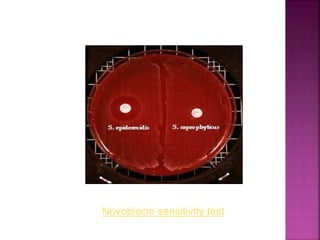
 It is one of the few frequently isolated CoNS that is
resistant to Novobiocin.
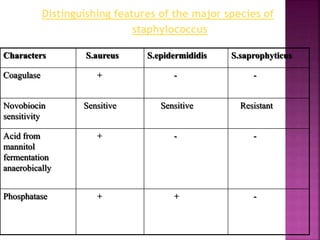
Characters S.aureus S.epidermididis S.saprophyticus
Coagulase + - -
Novobiocin
sensitivity
Sensitive Sensitive Resistant
Acid from
mannitol
fermentation
anaerobically
+ - -
Phosphatase + + -
Distinguishing features of the major species of
staphylococcus
Novobiocin sensitivity test
Staphylococcus

Staphylococcus

  • 1.
  • 2.
    1. HISTORY 2. CLASSIFICATION 3.MORPHOLOGY 4. LOCATION 5. CULTURE CHARACTERISTIC 6. BIOCHEMICAL REACTION 7. RESISTANCE 8. VIRULENCE FACTOR 9. PATHOGENISIS 10. DISEASE 11. LABORATORY DIAGNOSIS 12. TREATMENT
  • 3.
    History: Von Recklinghausen firstobserved Staphylococci in 1871 in human pyogenic lesions. 1884 Rosenbach named S. aureus and S. Albus 1885 passet described third variety , S. citreus producing lemon yellow colonies
  • 4.
     Staphylococci areGram positive cocci,  Occur in grape like clusters,  In Greek; staphyle - Bunch of grapes Kokkus - Berry
  • 5.
     Family:- Microccaceae Genus:- Micrococcus and Staphylococcus  Species:- S, aureus, S. saprophytics, S. epidermidis, S. luteus
  • 6.
    CLASSIFICATION: A) Based oncoagulase production: 1. Coagulase positive: Eg- S. aureus 2. Coagulase negative: Eg- S. epidermidis S. saprophyticus B) Based on pathogenicity: 1. Common pathogen: Eg- S. aureus 2. Opportunistic pathogens: Eg- S. epidermidis S. saprophyticus 3. Non pathogen: Eg- S. hominis
  • 7.
    MORPHOLOGY:  These arespherical cocci.  Approximately 1μm in diameter.  Arranged characteristically in grape like clusters.  They are non motile and non sporing.  A few strains possess capsules.
  • 9.
    CULTURE: Media used :- i)Non selective media: Nutrient agar, Blood agar, MacConkey’s agar. ii) Selective media: Salt-milk agar, Ludlam’s medium
  • 11.
    ii) On MacConkey’sagar- The colonies are small & pink in colour, due to lactose fermentation iii) On blood agar- Most strains produce β- haemolytic colonies.
  • 12.
  • 13.
    2) Coagulase test- i)Slide coagulase test- Positive.(s.dubleinesis,s.schleiferi & s. aerous) ii) Tube coagulase test- Positive. ( H.I.D.S) SLIDE COAGULASE TEST TUBE COAGULASE TEST
  • 14.
    3) Reduces nitrateto nitrite. 4) Ferments mannitol anaerobically with acid only. 5) Urea hydrolysis test- Positive. 6) Gelatin liquefaction test- Positive. 7) Produces Lipase. 8) Produces Phosphatase. 9) Produces Thermostable nuclease.
  • 15.
    PATHOGENICITY: Source of infection: A)Exogenous: patients or carriers B) Endogenous: From colonized site Mode of transmission: A) Contact: direct or indirect( through fomites) B) Inhalation of air borne droplets
  • 16.
    Resistance Remain vaible indried state for 3-6 months. Can with stand temperature 60ºc for 30 minutes. Ability to grow in presence of 10% Nacl. Resist 1% phenol for 15 min. Penicillin resistance- Staph. Produce of β lactmases. Alternation of penicillin binding protein PBP2a. Changes in bacterial surface receptors tolerance to penicillin.
  • 17.
    Virulence factors: These include:- A)Cell associated factors B) Extracellular factors
  • 18.
    A) CELL ASSOCIATEDFACTORS: a) Cell associated polymers b) Cell surface proteins a) CELL ASSOCIATED POLYMERS 1. Cell wall polysaccharide peptidoglycan:- it provide rigidity & structural integrity to the bacterial cell wall & activate the complement & induce release the inflammatory cytokines. 2. Teichoic acid:- antigenic component of bacterial cell wall. act as adhesion of cocci to the host cell surface & protect from complement mediated opsonisation. 3. Capsular polysaccharide:- it occurs into surrounding the cell wall that inhibit the opsonisation.
  • 19.
    b) CELL SURFACEPROTEINS:- 1. Protein A:- it present in most strains of s.aureus. It has many biological property such as chemotactic, anti phagocytic & anti complementary effect. It also induce the platelet damage & hypersensitivity. 2. Clumping factor:- it is another surface protein is called bound protein that responsible for the slide coagulase test.
  • 20.
  • 21.
    B) EXTRACELLULAR FACTORS a)Enzymes b) Toxins
  • 22.
    a) Enzymes: 1. Freecoagulase 2. Catalase 3. Lipase 4. Hyaluronidase 5. DNAase 6. Thermonuclease 7. Staphylokinase (Fibrinolysin) 8. Phosphatase 9. Penicillinase
  • 23.
    b) Toxins: 1. Cytolytictoxins i) Haemolysins Alpha haemolysin Beta haemolysin Gamma haemolysin Delta haemolysin ii) Leucocidin (Panton-Valentine toxin) 2. Enterotoxin 3. Toxic shock syndrome toxin (TSST) 4. . Exfoliative (epidermolytic toxin)
  • 24.
    Disease: Diseases produced byStaphylococcus aureus is studied under 2 groups: A) Infections B) Intoxications
  • 25.
    A) INFECTIONS: Mechanism ofpathogenesis: Cocci gain access to damaged skin, mucosal or tissue site Colonize by adhering to cells or extracellular matrix Evade the host defense mechanisms and multiply Cause tissue damage
  • 26.
    Common Staphylococcal infectionsare: 1) Skin and soft tissue: Folliculitis, furuncle (boil), carbuncle, styes, abscess, wound infections, impetigo, paronychia and less often cellulitis. Folliculitis Folliculitis
  • 27.
  • 28.
  • 29.
  • 30.
    2Musculoskeletal: ) Osteomyelitis,arthritis, bursitis, pyomyositis. osteomyelitis  3 ) Respiratory `Tonsillitis, pharyngitis, sinusitis, otitis, bronchopneumonia, lung abscess, empyema, rarely pneumonia.
  • 31.
    4) Central nervoussystem: Abscess, meningitis, intracranial thrombophlebitis. 5) Endovascular: Bacteremia, septicemia, pyemia, endocarditis. Endocarditis 6) Urinary: Urinary tract infection.
  • 32.
    B) INTOXICATIOINS: The diseaseis caused by the bacterial exotoxins, which are produced either in the infected host or preformed in vitro. There are 3 types- 1. Food poisoning 2. Toxic shock syndrome 3. Staphylococcal scalded skin syndrome
  • 33.
    1) Food poisoning: Enterotoxin is responsible for manifestations of staphylococcal food poisoning.  Eight types of enterotoxin are currently known, named A, B, C1-3, D, E, and H.  It usually occurs when preformed toxin is ingested with contaminated food.  The toxin acts directly on the autonomic nervous system to cause the illness, rather than gut mucosa.
  • 34.
     The commonfood items responsible are - milk and milk products, meat, fish and ice cream.  Source of infection- food handler who is a carrier.  Incubation period- 2 to 6 hours.  Clinical symptoms- nausea, vomiting and diarrhoea.  The illness is usually self limited, with recovery in a day or so.
  • 35.
    2) Staphylococcal Toxicshock syndrome (STSS):  STSS is associated with infection of mucosal or sequestered sites by TSST( formerly known as enterotoxin type F) producing S.aureus.  It is a fatal multisystem disease presenting with fever, hypotension, myalgia, vomiting, diarrhoea, mucosal hyperemia and erythematous rash which desquamates subsequently.
  • 37.
    2 types ofSTSS known: i) Menstrual associated STSS: Here colonization of S.aureus occurs in the vagina of menstruating woman who uses highly absorbent vaginal tampons. ii) Non menstrual associated STSS: Here colonization of S.aureus occurs in other sites like surgical wound.
  • 38.
    3) Staphylococcal scaldedskin syndrome (SSSS):  Exfoliative toxin produced by S.aureus is responsible for this.  It is a skin disease in which outer layer of epidermis gets separated from the underlying tissues.
  • 39.
    Types of SSSS: Severeform Milder form In new born - Ritter’s disease - Pemphigus neonatorum In older patients - Toxic epidermal - Bullous necrolysis impetigo
  • 40.
    Toxic epidermal necrolysis Ritter’sdisease Bullous impetigo Pemphigus neonatorum
  • 41.
    LAB DIAGNOSIS: Specimens collected:Depends on the type of infection. • Suppurative lesion- Pus, • Respiratory infection- Sputum, • Bacteremia & septicemia- Blood, • Food poisoning- Feces, vomit & the remains of suspected food, • For the detection of carriers- Nasal swab.
  • 42.
    I) Direct microscopy: Direct microscopy with Gram stained smear is useful in case of pus, where cocci in clusters are seen. This is of no value for specimen like sputum where mixed flora are normally present. Methods of examination:
  • 43.
    c) Gram staining:Smears are examined from the culture plate and reveals Gram positive cocci(1μm in diameter) arranged in grape like clusters. II) Culture: a) Media used: b) Cultural Characteristics:
  • 44.
    d) Biochemical reactions: III)Antibiotic sensitivity tests done as a guide to treatment. IV) Bacteriophage typing is done for epidemiological purposes. V) Serological tests are not useful. “ These may sometimes help in diagnosis of hidden deep infections”
  • 45.
    TREATMENT:  Drug resistanceis common.  Benzyl penicillin is the most effective antibiotic, if the strain is sensitive.  Cloxacillin or Methicillin is used against beta-lactamase producing strains.  Methicillin Resistant Staphylococcus aureus (MRSA) strains have become common.  Vancomycin is used in treatment of infections with MRSA strains.
  • 46.
    MRSA  Methicillin-resistant S.aureus  Resistant to all penicillins, cephalosporins, and penems  Usually multiply-resistant  Vancomycin resistance is very rare – so far  Hospital-acquired  Community-acquired cases now (CA MRSA)
  • 47.
    PREVENTION:  Isolation &treatment of MRSA patients.  Detection of carriers among hospital staff, their isolation & treatment.  Avoid indiscriminate usage of antibiotics.
  • 48.
    1. Phenotypic • Agardilution • Broth dilution (microbroth dilution) • Disk diffusion and variations • Gradient diffusion • Enzymatic detection
  • 49.
    • Mutation orother DNA change detection by PCR (+ microarray) • Mutation or DNA change detection by line probe • Sequencing
  • 50.
    3. Others • Growthand MALDI-TOF facilitated • Growth and Image analysis  Chromogenic cephalosporin disk
  • 51.
     Staphylococcus aureus •Do not trust automated systems – they fail to detect VISA Some VISA = 2 by Etest and 1 by broth MIC • Use Vanco disk & Vanco screen plate, incubate 24hr • Growth on Vanco plate & no zone = VRSA • Growth on Vanco plate & zone ≥7 mm = possible VISA/VRSA Perform Etest or send isolate to reference lab • BHI plate with 6 mg/ml Vanco • Inoculate with swab from 0.5 McFarland suspension 30 mcg Vanco disk
  • 52.
     Disk diffusionsusceptibility testing (Bauer- Kirby method) For staphylococci, Enterobacteriaceae, Pseudomonas aeruginosa, enterococci, and other organisms that grow well on Mueller-Hinton agar in air at 35°C
  • 53.
    1. Depth ofagar (3-5 mm) 2.pH and cation content of agar 3. Turbidity of organism suspension (0.5 McF) 4. Time between steps (15 min maximum) 5. Incubation temp. (35°C) & time (18-24 h) 6. Incubation atmosphere (usually air) 7. Technologist ability to accurately read zones.
  • 54.
     Conventional identificationmethods for MRSA detection including disk diffusion method with oxacillin, latex agglutination test and oxacillin-salt agar screening test and etc.  According to the recommendation of Clinical and Laboratory Standards Institute (CLSI), disk diffusion method with cefoxitin [27] was applied on MRSA detection massively.
  • 55.
     Bacterial inoculumof each sample strain is made and adjusting the turbidity to 0.5 McFarland.  One drop of this suspension was inoculated on Mueller–Hinton agar containing NaCl (40 g/L) and oxacillin (6 μg/mL) [32].  Plates are incubated at 35 °C for 24 h then.  Observed by naked eye, any strains growth on the plate containing oxacillin should be recognized as MRSA.  The sensitivity is 100% when screened by this method [33].  In oxacillin screen agar test, several different strains can be cultivated and tested on one plate..
  • 56.
     A simpleand rapid method, MRSA screen latex agglutination assay for the detection of methicillin resistance using a specific monoclonal antibody directed toward the PBP2a antigen has been developed [38]  Aimed at membrane protein extraction, monoclonal antibody reacts and then produces macroscopic particle aggregate to identify MRSA.  Also, some other latex reagents react with PBP2a existing in cell membrane.
  • 57.
    S.saprophyticus:  It causesurinary tract infections, mostly in sexually active young women.  The infection is symptomatic and may involve the upper urinary tract also.  Men are infected much less often.  It is one of the few frequently isolated CoNS that is resistant to Novobiocin.
  • 58.
    Characters S.aureus S.epidermididisS.saprophyticus Coagulase + - - Novobiocin sensitivity Sensitive Sensitive Resistant Acid from mannitol fermentation anaerobically + - - Phosphatase + + - Distinguishing features of the major species of staphylococcus
  • 59.