Standing Waves A guide to what they are and where they are used
To summarise so far: Waves superpose when they meet They can interfere constructively when ‘In-Phase’ and destructively when ‘anti-phase’ Waves interfere in a stable manner when they are coherent – they have a constant phase difference Waves can be represented by a phasor that rotates anticlockwise The angular movement can be represented in Radians, where 2π Radians is the equivalent to 360 o  and 1 wavelength (λ)
This lesson we will See how a standing wave in a string is set up Understand how a standing wave is formed in terms of wavelengths Find out what a fundamental frequency of a standing wave is Understand the term resonance, harmonic, node and antinode
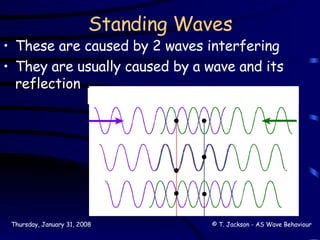
Standing Waves These are caused by 2 waves interfering They are usually caused by a wave and its reflection
Let’s see one in action...
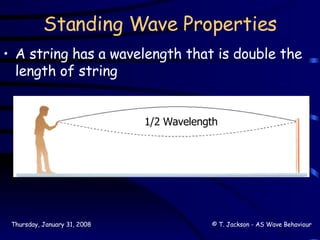
Standing Wave Properties A string has a wavelength that is double the length of string 1/2 Wavelength
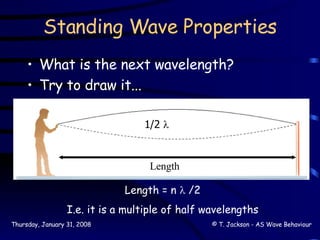
Standing Wave Properties What is the next wavelength? Try to draw it... 1/2   Length = n    /2 I.e. it is a multiple of half wavelengths Length
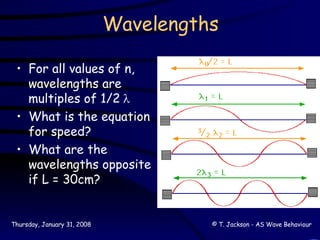
Wavelengths For all values of n, wavelengths are multiples of 1/2  What is the equation for speed? What are the wavelengths opposite if L = 30cm?
Fundamental Frequency This is the lowest frequency that a system can resonate at - it is the lowest frequency that a standing wave can form at on a string Using; Speed = Frequency x Wavelength Therefore Fundamental Frequency = speed / 2L What is the fundamental frequency the previous string (30cm) assuming the speed is 60ms -1 ?
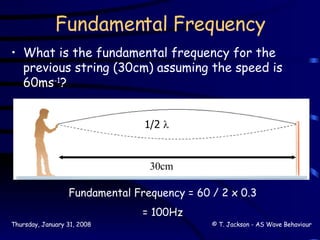
Fundamental Frequency What is the fundamental frequency for the previous string (30cm) assuming the speed is 60ms -1 ? 1/2   30cm Fundamental Frequency = 60 / 2 x 0.3 = 100Hz
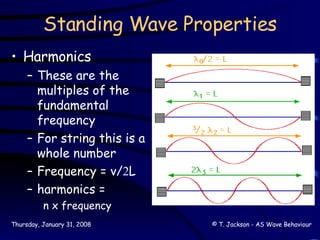
Standing Wave Properties Harmonics These are the multiples of the fundamental frequency For string this is a whole number Frequency = v/  L harmonics = n x frequency
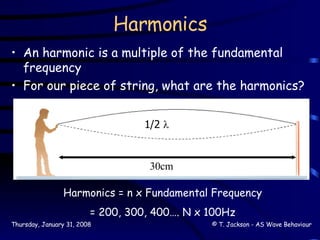
Harmonics An harmonic is a multiple of the fundamental frequency For our piece of string, what are the harmonics? 1/2   30cm Harmonics = n x Fundamental Frequency = 200, 300, 400…. N x 100Hz
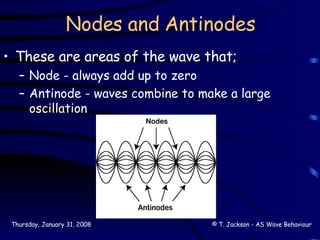
Nodes and Antinodes These are areas of the wave that; Node - always add up to zero Antinode - waves combine to make a large oscillation
Some Questions 1.A source of sound waves of frequency 570Hz emits a note of wavelength 0.6m in air at 20 o C.  What is the speed of sound at this temperature? 2.A stationary wave is formed in a string with antinodes every 150mm.  What is the wavelength of the standing wave? 3.A loudspeaker points directly at a wall 3m away and emits a note of frequency 680Hz.  A standing wave is formed.  If the speed is 340m/s what will be the separation between minimum intensities (nodes)?
Some Questions 1.A source of sound waves of frequency 570Hz emits a note of wavelength 0.6m in air at 20 o C.  What is the speed of sound at this temperature?  342m/s 2.A stationary wave is formed in a string with antinodes every 150mm.  What is the wavelength of the standing wave?  300mm 3.A loudspeaker points directly at a wall 3m away and emits a note of frequency 680Hz.  A standing wave is formed.  If the speed is 340m/s what will be the separation between minimum intensities (nodes)?  0.25m

Standing Waves

  • 1.
    Standing Waves Aguide to what they are and where they are used
  • 2.
    To summarise sofar: Waves superpose when they meet They can interfere constructively when ‘In-Phase’ and destructively when ‘anti-phase’ Waves interfere in a stable manner when they are coherent – they have a constant phase difference Waves can be represented by a phasor that rotates anticlockwise The angular movement can be represented in Radians, where 2π Radians is the equivalent to 360 o and 1 wavelength (λ)
  • 3.
    This lesson wewill See how a standing wave in a string is set up Understand how a standing wave is formed in terms of wavelengths Find out what a fundamental frequency of a standing wave is Understand the term resonance, harmonic, node and antinode
  • 4.
    Standing Waves Theseare caused by 2 waves interfering They are usually caused by a wave and its reflection
  • 5.
    Let’s see onein action...
  • 6.
    Standing Wave PropertiesA string has a wavelength that is double the length of string 1/2 Wavelength
  • 7.
    Standing Wave PropertiesWhat is the next wavelength? Try to draw it... 1/2  Length = n  /2 I.e. it is a multiple of half wavelengths Length
  • 8.
    Wavelengths For allvalues of n, wavelengths are multiples of 1/2  What is the equation for speed? What are the wavelengths opposite if L = 30cm?
  • 9.
    Fundamental Frequency Thisis the lowest frequency that a system can resonate at - it is the lowest frequency that a standing wave can form at on a string Using; Speed = Frequency x Wavelength Therefore Fundamental Frequency = speed / 2L What is the fundamental frequency the previous string (30cm) assuming the speed is 60ms -1 ?
  • 10.
    Fundamental Frequency Whatis the fundamental frequency for the previous string (30cm) assuming the speed is 60ms -1 ? 1/2  30cm Fundamental Frequency = 60 / 2 x 0.3 = 100Hz
  • 11.
    Standing Wave PropertiesHarmonics These are the multiples of the fundamental frequency For string this is a whole number Frequency = v/  L harmonics = n x frequency
  • 12.
    Harmonics An harmonicis a multiple of the fundamental frequency For our piece of string, what are the harmonics? 1/2  30cm Harmonics = n x Fundamental Frequency = 200, 300, 400…. N x 100Hz
  • 13.
    Nodes and AntinodesThese are areas of the wave that; Node - always add up to zero Antinode - waves combine to make a large oscillation
  • 14.
    Some Questions 1.Asource of sound waves of frequency 570Hz emits a note of wavelength 0.6m in air at 20 o C. What is the speed of sound at this temperature? 2.A stationary wave is formed in a string with antinodes every 150mm. What is the wavelength of the standing wave? 3.A loudspeaker points directly at a wall 3m away and emits a note of frequency 680Hz. A standing wave is formed. If the speed is 340m/s what will be the separation between minimum intensities (nodes)?
  • 15.
    Some Questions 1.Asource of sound waves of frequency 570Hz emits a note of wavelength 0.6m in air at 20 o C. What is the speed of sound at this temperature? 342m/s 2.A stationary wave is formed in a string with antinodes every 150mm. What is the wavelength of the standing wave? 300mm 3.A loudspeaker points directly at a wall 3m away and emits a note of frequency 680Hz. A standing wave is formed. If the speed is 340m/s what will be the separation between minimum intensities (nodes)? 0.25m