1.4 DIFFRACTION


  www.myfunphysicsworld.blogspot.com
By the end of today’s lesson you
         should be able to…
• Describe diffraction of waves in
  terms of wavelength,
  frequency, speed, direction
  of propagation, and shape of
  waves
• Draw a diagram to show
  diffraction of waves   www.myfunphysicsworld.blogspot.com
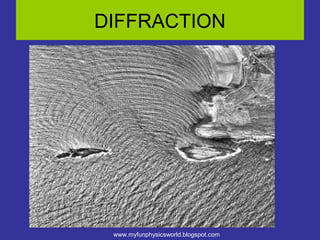
DIFFRACTION


 www.myfunphysicsworld.blogspot.com
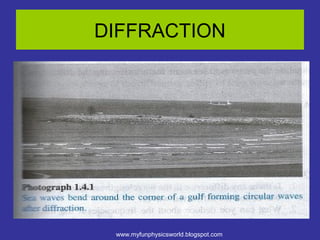
DIFFRACTION


 www.myfunphysicsworld.blogspot.com
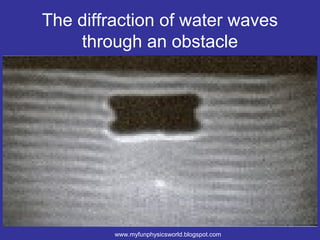
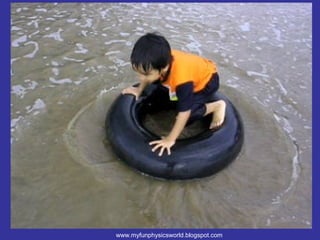
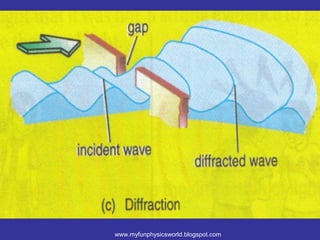
The diffraction of water waves
    through an obstacle


         www.myfunphysicsworld.blogspot.com
Diffraction
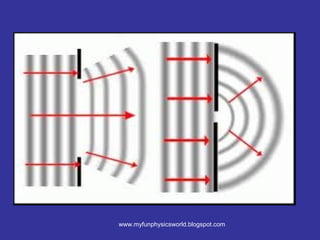
The property of waves that bend/spread
out after a gap, or an obstacles


            www.myfunphysicsworld.blogspot.
                        com
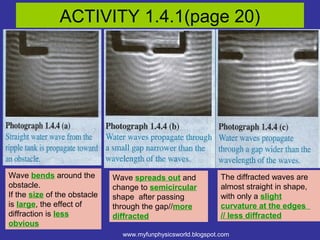
ACTIVITY 1.4.1(page 20)


Wave bends around the         Wave spreads out and             The diffracted waves are
obstacle.                     change to semicircular           almost straight in shape,
If the size of the obstacle   shape after passing              with only a slight
is large, the effect of       through the gap//more            curvature at the edges
diffraction is less           diffracted                       // less diffracted
obvious
                                www.myfunphysicsworld.blogspot.com
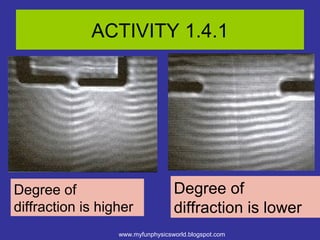
ACTIVITY 1.4.1


Degree of                          Degree of
diffraction is higher              diffraction is lower
                  www.myfunphysicsworld.blogspot.com
www.myfunphysicsworld.blogspot.com
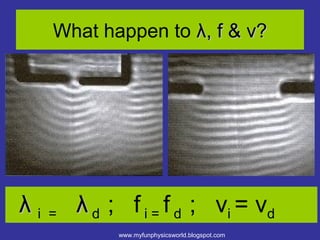
What happen to λ, f & v?


λi   =   λ d ; f i = f d ; vi = vd
              www.myfunphysicsworld.blogspot.com
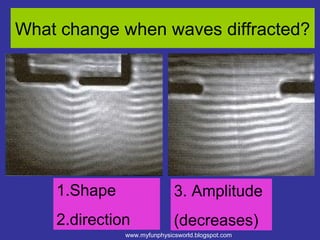
What change when waves diffracted?


    1.Shape                  3. Amplitude
    2.direction              (decreases)
              www.myfunphysicsworld.blogspot.com
Exercise
 Practical Text Book
Page 18, Question 1-6


     www.myfunphysicsworld.blogspot.com
Question..(practical book-page 18)
1) How does the size of a barrier affect the
  diffraction of waves???

The smaller the size of the barrier,
 the higher the degree of the diffraction of
the waves //more diffracted


                 www.myfunphysicsworld.blogspot.com
Question..(practical book-page 18)
 2) What is the shape of the diffracted waves when
   straight waves enter a gap bigger than the
   wavelength?


The diffracted waves are almost straight in
shape with only a slight curvature at the edges

 *Gap smaller or equal to the wavelength will
 produce semicircular diffracted waves
 (more diffracted//higher degree of diffraction)
                  www.myfunphysicsworld.blogspot.com
Question..(practical book-page 18)
3) Is there any difference in the wavelength
  of the incidence wavefronts and the
  diffracted wavefronts?

No


                www.myfunphysicsworld.blogspot.com
Question..(practical book-page 18)
4) What can you predict the frequency of the
  incident waves and diffracted waves?

No change.
Frequency of the incident waves and diffracted
waves are the same


               www.myfunphysicsworld.blogspot.com
Question..(practical book-page 18)
5) A radio waves passes through an
  opening of 20 cm. What do you expect the
  shape of the diffracted wave to be?
  (the wavelength of radio wave is longer
  than 20 cm : x 103 m)

Semi circular diffracted wave
because the radio waves’ wavelength is
larger than the gap
               www.myfunphysicsworld.blogspot.com
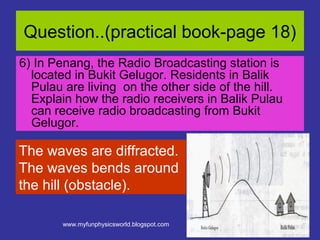
Question..(practical book-page 18)
6) In Penang, the Radio Broadcasting station is
  located in Bukit Gelugor. Residents in Balik
  Pulau are living on the other side of the hill.
  Explain how the radio receivers in Balik Pulau
  can receive radio broadcasting from Bukit
  Gelugor.

The waves are diffracted.
The waves bends around
the hill (obstacle).

        www.myfunphysicsworld.blogspot.com
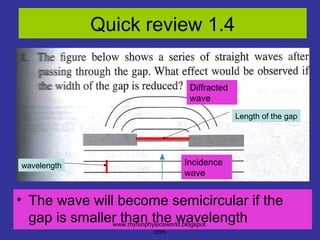
Quick review 1.4


                              Diffracted
                              wave
                                           Length of the gap


wavelength                   Incidence
                             wave


• The wave will become semicircular if the
  gap is smaller than the wavelength
               www.myfunphysicsworld.blogspot.
                       com
www.myfunphysicsworld.blogspot.com
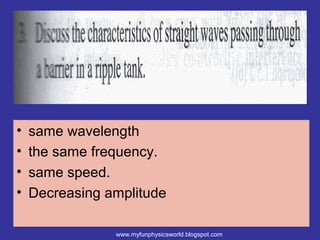
•   same wavelength
•   the same frequency.
•   same speed.
•   Decreasing amplitude

                www.myfunphysicsworld.blogspot.com
www.myfunphysicsworld.blogspot.com
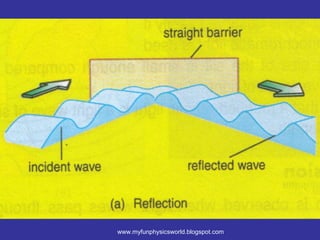
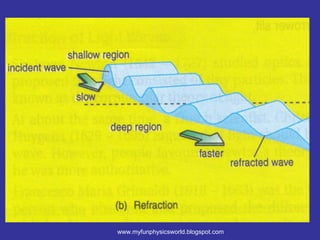
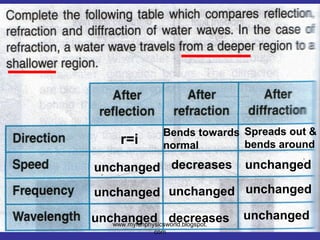
Bends towards Spreads out &
       r=i       normal        bends around

unchanged decreases                  unchanged

unchanged unchanged unchanged

unchanged decreases                  unchanged
   www.myfunphysicsworld.blogspot.
               com
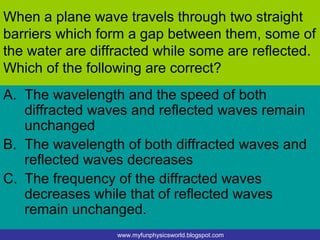
When a plane wave travels through two straight
barriers which form a gap between them, some of
the water are diffracted while some are reflected.
Which of the following are correct?
A. The wavelength and the speed of both
   diffracted waves and reflected waves remain
   unchanged
B. The wavelength of both diffracted waves and
   reflected waves decreases
C. The frequency of the diffracted waves
   decreases while that of reflected waves
   remain unchanged.
                  www.myfunphysicsworld.blogspot.com
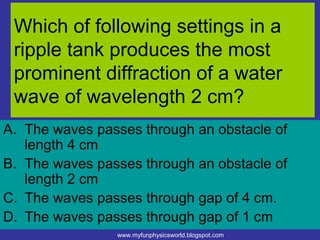
Which of following settings in a
 ripple tank produces the most
 prominent diffraction of a water
 wave of wavelength 2 cm?
A. The waves passes through an obstacle of
   length 4 cm
B. The waves passes through an obstacle of
   length 2 cm
C. The waves passes through gap of 4 cm.
D. The waves passes through gap of 1 cm
                www.myfunphysicsworld.blogspot.com

1.4 Diffraction Of Waves

  • 1.
    1.4 DIFFRACTION www.myfunphysicsworld.blogspot.com
  • 2.
    By the endof today’s lesson you should be able to… • Describe diffraction of waves in terms of wavelength, frequency, speed, direction of propagation, and shape of waves • Draw a diagram to show diffraction of waves www.myfunphysicsworld.blogspot.com
  • 3.
  • 4.
  • 5.
    The diffraction ofwater waves through an obstacle www.myfunphysicsworld.blogspot.com
  • 6.
    Diffraction The property ofwaves that bend/spread out after a gap, or an obstacles www.myfunphysicsworld.blogspot. com
  • 7.
    ACTIVITY 1.4.1(page 20) Wavebends around the Wave spreads out and The diffracted waves are obstacle. change to semicircular almost straight in shape, If the size of the obstacle shape after passing with only a slight is large, the effect of through the gap//more curvature at the edges diffraction is less diffracted // less diffracted obvious www.myfunphysicsworld.blogspot.com
  • 8.
    ACTIVITY 1.4.1 Degree of Degree of diffraction is higher diffraction is lower www.myfunphysicsworld.blogspot.com
  • 9.
  • 10.
    What happen toλ, f & v? λi = λ d ; f i = f d ; vi = vd www.myfunphysicsworld.blogspot.com
  • 11.
    What change whenwaves diffracted? 1.Shape 3. Amplitude 2.direction (decreases) www.myfunphysicsworld.blogspot.com
  • 12.
    Exercise Practical TextBook Page 18, Question 1-6 www.myfunphysicsworld.blogspot.com
  • 13.
    Question..(practical book-page 18) 1)How does the size of a barrier affect the diffraction of waves??? The smaller the size of the barrier, the higher the degree of the diffraction of the waves //more diffracted www.myfunphysicsworld.blogspot.com
  • 14.
    Question..(practical book-page 18) 2) What is the shape of the diffracted waves when straight waves enter a gap bigger than the wavelength? The diffracted waves are almost straight in shape with only a slight curvature at the edges *Gap smaller or equal to the wavelength will produce semicircular diffracted waves (more diffracted//higher degree of diffraction) www.myfunphysicsworld.blogspot.com
  • 15.
    Question..(practical book-page 18) 3)Is there any difference in the wavelength of the incidence wavefronts and the diffracted wavefronts? No www.myfunphysicsworld.blogspot.com
  • 16.
    Question..(practical book-page 18) 4)What can you predict the frequency of the incident waves and diffracted waves? No change. Frequency of the incident waves and diffracted waves are the same www.myfunphysicsworld.blogspot.com
  • 17.
    Question..(practical book-page 18) 5)A radio waves passes through an opening of 20 cm. What do you expect the shape of the diffracted wave to be? (the wavelength of radio wave is longer than 20 cm : x 103 m) Semi circular diffracted wave because the radio waves’ wavelength is larger than the gap www.myfunphysicsworld.blogspot.com
  • 18.
    Question..(practical book-page 18) 6)In Penang, the Radio Broadcasting station is located in Bukit Gelugor. Residents in Balik Pulau are living on the other side of the hill. Explain how the radio receivers in Balik Pulau can receive radio broadcasting from Bukit Gelugor. The waves are diffracted. The waves bends around the hill (obstacle). www.myfunphysicsworld.blogspot.com
  • 19.
    Quick review 1.4 Diffracted wave Length of the gap wavelength Incidence wave • The wave will become semicircular if the gap is smaller than the wavelength www.myfunphysicsworld.blogspot. com
  • 20.
  • 21.
    same wavelength • the same frequency. • same speed. • Decreasing amplitude www.myfunphysicsworld.blogspot.com
  • 22.
  • 23.
  • 24.
  • 25.
  • 26.
    Bends towards Spreadsout & r=i normal bends around unchanged decreases unchanged unchanged unchanged unchanged unchanged decreases unchanged www.myfunphysicsworld.blogspot. com
  • 27.
    When a planewave travels through two straight barriers which form a gap between them, some of the water are diffracted while some are reflected. Which of the following are correct? A. The wavelength and the speed of both diffracted waves and reflected waves remain unchanged B. The wavelength of both diffracted waves and reflected waves decreases C. The frequency of the diffracted waves decreases while that of reflected waves remain unchanged. www.myfunphysicsworld.blogspot.com
  • 28.
    Which of followingsettings in a ripple tank produces the most prominent diffraction of a water wave of wavelength 2 cm? A. The waves passes through an obstacle of length 4 cm B. The waves passes through an obstacle of length 2 cm C. The waves passes through gap of 4 cm. D. The waves passes through gap of 1 cm www.myfunphysicsworld.blogspot.com