Electric Charges,
Forces, and
Fields
Electric Charges
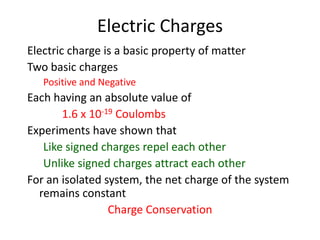
Electric charge is a basic property of matter
Two basic charges
Positive and Negative
Each having an absolute value of
1.6 x 10⁻¹⁹ Coulombs
Experiments have shown that
Like signed charges repel each other
Unlike signed charges attract each other
For an isolated system, the net charge of the system
remains constant
Charge Conservation
Two basics type of materials
Conductors
Materials, such as metals, that allow the free
movement of charges
Insulators
Materials, such as rubber and glass, that don’t
allow the free movement of charges
Coulomb’s Law
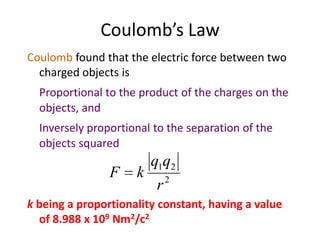
Coulomb found that the electric force between two
charged objects is
Proportional to the product of the charges on the
objects, and
Inversely proportional to the separation of the
objects squared
2
21
r
qq
kF
k being a proportionality constant, having a value
of 8.988 x 10⁹ Nm2/c2
Electric Force
122
21
12 ˆr
r
qq
kF

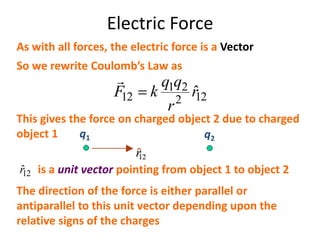
This gives the force on charged object 2 due to charged
object 1
The direction of the force is either parallel or
antiparallel to this unit vector depending upon the
relative signs of the charges
12ˆr is a unit vector pointing from object 1 to object 2
As with all forces, the electric force is a Vector
So we rewrite Coulomb’s Law as
q2q1
Electric Force
The force acting on each charged object has the
same magnitude - but acting in opposite directions
(Newton’s Third Law)2112 FF

More Than Two Charges
q
q1
q2
qqF
1

qqF
2

netF

If q1 were the only other charge, we would
know the force on q due to q1 -
qqF
1

If q2 were the only other charge, we would
know the force on q due to q2 -
qqF
2

Given charges q, q1, and q2
What is the net force if both charges are present?
The net force is given by the Superposition Principle
21 FFFnet

Superposition of Forces
If there are more than two charged objects
interacting with each other
The net force on any one of the charged
objects is
The vector sum of the individual Coulomb
forces on that charged object
ji
r
r
q
kqF ij
ij
i
jj ˆ2

Note on constants
k is in reality defined in terms of a more
fundamental constant, known as the
permittivity of free space.
2
2
12
0
0
C
10854.8
4
1
Nm
xwith
k
Electric Field
The Electric Force is like the Gravitational Force
Action at a Distance
The electric force can be thought of as being
mediated by an electric field.
What is a Field?
A Field is something that can be defined anywhere
in space
A field represents some physical quantity
(e.g., temperature, wind speed, force)
It can be a scalar field (e.g., Temperature field)
It can be a vector field (e.g., Electric field)
It can be a “tensor” field (e.g., Space-time curvature)
77
82
83
68
55
66
83
75 80
90
91
75
71
80
72
84
73
82
88
92
77
88
88
73
64
A Scalar Field
A scalar field is a map of a quantity that has only
a magnitude, such as temperature
77
82
83
68
55
66
83
75 80
90
91
75
71
80
72
84
73
57
88
92
77
56
88
7364
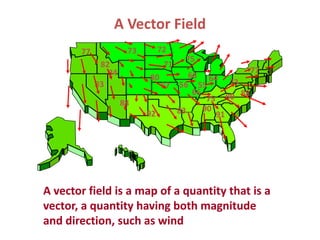
A Vector Field
A vector field is a map of a quantity that is a
vector, a quantity having both magnitude
and direction, such as wind
Electric Field
We say that when a charged object is put at a
point in space,
The charged object sets up an Electric Field
throughout the space surrounding the
charged object
It is this field that then exerts a force on
another charged object
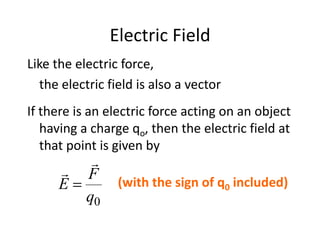
Electric Field
Like the electric force,
the electric field is also a vector
If there is an electric force acting on an object
having a charge qo, then the electric field at
that point is given by
0q
F
E


(with the sign of q0 included)
Electric Field
The force on a positively
charged object is in the same
direction as the electric field at
that point,
While the force on a negative
test charge is in the opposite
direction as the electric field
at the point
Electric Field
A positive charge sets up
an electric field pointing
away from the charge
A negative charge sets up an
electric field pointing towards
the charge
Electric Field
r
r
q
kE ˆ2

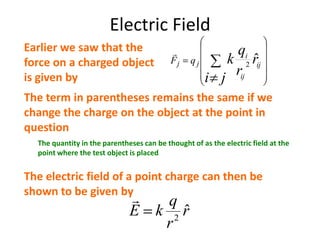
The electric field of a point charge can then be
shown to be given by
ji
r
r
q
k ij
ij
i
jj qF ˆ2
Earlier we saw that the
force on a charged object
is given by
The term in parentheses remains the same if we
change the charge on the object at the point in
question
The quantity in the parentheses can be thought of as the electric field at the
point where the test object is placed
Electric Field
As with the electric force, if there are several
charged objects, the net electric field at a
given point is given by the vector sum of the
individual electric fields
i
iEE

Electric Field
r
r
dq
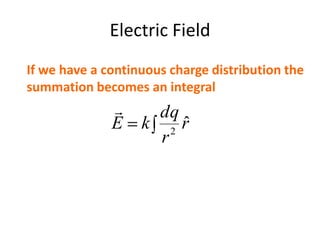
kE ˆ2

If we have a continuous charge distribution the
summation becomes an integral
Hints
1) Look for and exploit symmetries in the
problem.
2) Choose variables for integration carefully.
3) Check limiting conditions for appropriate
result
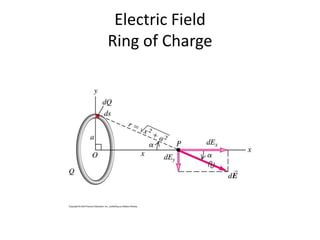
Electric Field
Ring of Charge
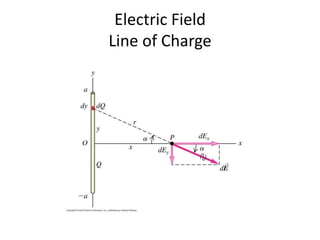
Electric Field
Line of Charge
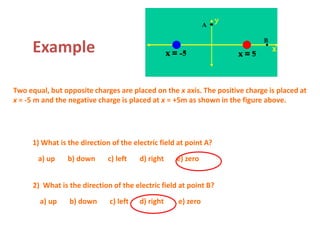
Two equal, but opposite charges are placed on the x axis. The positive charge is placed at
x = -5 m and the negative charge is placed at x = +5m as shown in the figure above.
1) What is the direction of the electric field at point A?
a) up b) down c) left d) right e) zero
2) What is the direction of the electric field at point B?
a) up b) down c) left d) right e) zero
Example
Example
Two charges, Q1 and Q2, fixed along the x-axis as
shown produce an electric field, E, at a point
(x,y) = (0,d) which is directed along the negative
y-axis.
Which of the following is true?
Q2
Q1
(c) E
Q2
Q1
(b)
E
Q2
Q1 x
y
Ed
(a) Both charges Q1 and Q2 are positive
(b) Both charges Q1 and Q2 are negative
(c) The charges Q1 and Q2 have opposite signs
E
Q2
Q1
(a)
Electric Field Lines
Possible to map out the electric field in a region
of space
An imaginary line that at any given point has
its tangent being in the direction of the electric
field at that point
The spacing, density, of lines is related to the
magnitude of the electric field at that point
Electric Field Lines
At any given point, there can be only one field
line
The electric field has a unique direction at any
given point
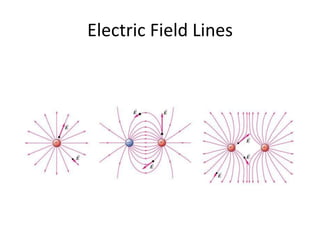
Electric Field Lines
Begin on Positive Charges
End on Negative Charges
Electric Field Lines
Electric Dipole
An electric dipole is a pair of point charges having equal
magnitude but opposite sign that are separated by a
distance d.
Two questions concerning dipoles:
1) What are the forces and torques acting on a dipole
when placed in an external electric field?
2) What does the electric field of a dipole look like?
Force on a Dipole
Given a uniform external field
Then since the charges are of equal
magnitude, the force on each charge has
the same value
However the forces are in opposite directions!
Therefore the net force on the dipole is
Fnet = 0
Potential Energy of a Dipole
Given a dipole in an external field:
Dipole will rotate due to torque
Electric field will do work
The work done is the negative of the
change in potential energy of the dipole
The potential energy can be shown to be
EdqU

Electric Field of a Dipole

Electric Charges, Forces and Fields

  • 1.
  • 2.
    Electric Charges Electric chargeis a basic property of matter Two basic charges Positive and Negative Each having an absolute value of 1.6 x 10⁻¹⁹ Coulombs Experiments have shown that Like signed charges repel each other Unlike signed charges attract each other For an isolated system, the net charge of the system remains constant Charge Conservation
  • 3.
    Two basics typeof materials Conductors Materials, such as metals, that allow the free movement of charges Insulators Materials, such as rubber and glass, that don’t allow the free movement of charges
  • 4.
    Coulomb’s Law Coulomb foundthat the electric force between two charged objects is Proportional to the product of the charges on the objects, and Inversely proportional to the separation of the objects squared 2 21 r qq kF k being a proportionality constant, having a value of 8.988 x 10⁹ Nm2/c2
  • 5.
    Electric Force 122 21 12 ˆr r qq kF  Thisgives the force on charged object 2 due to charged object 1 The direction of the force is either parallel or antiparallel to this unit vector depending upon the relative signs of the charges 12ˆr is a unit vector pointing from object 1 to object 2 As with all forces, the electric force is a Vector So we rewrite Coulomb’s Law as q2q1
  • 6.
    Electric Force The forceacting on each charged object has the same magnitude - but acting in opposite directions (Newton’s Third Law)2112 FF 
  • 7.
    More Than TwoCharges q q1 q2 qqF 1  qqF 2  netF  If q1 were the only other charge, we would know the force on q due to q1 - qqF 1  If q2 were the only other charge, we would know the force on q due to q2 - qqF 2  Given charges q, q1, and q2 What is the net force if both charges are present? The net force is given by the Superposition Principle 21 FFFnet 
  • 8.
    Superposition of Forces Ifthere are more than two charged objects interacting with each other The net force on any one of the charged objects is The vector sum of the individual Coulomb forces on that charged object ji r r q kqF ij ij i jj ˆ2 
  • 9.
    Note on constants kis in reality defined in terms of a more fundamental constant, known as the permittivity of free space. 2 2 12 0 0 C 10854.8 4 1 Nm xwith k
  • 10.
    Electric Field The ElectricForce is like the Gravitational Force Action at a Distance The electric force can be thought of as being mediated by an electric field.
  • 11.
    What is aField? A Field is something that can be defined anywhere in space A field represents some physical quantity (e.g., temperature, wind speed, force) It can be a scalar field (e.g., Temperature field) It can be a vector field (e.g., Electric field) It can be a “tensor” field (e.g., Space-time curvature)
  • 12.
    77 82 83 68 55 66 83 75 80 90 91 75 71 80 72 84 73 82 88 92 77 88 88 73 64 A ScalarField A scalar field is a map of a quantity that has only a magnitude, such as temperature
  • 13.
    77 82 83 68 55 66 83 75 80 90 91 75 71 80 72 84 73 57 88 92 77 56 88 7364 A VectorField A vector field is a map of a quantity that is a vector, a quantity having both magnitude and direction, such as wind
  • 14.
    Electric Field We saythat when a charged object is put at a point in space, The charged object sets up an Electric Field throughout the space surrounding the charged object It is this field that then exerts a force on another charged object
  • 15.
    Electric Field Like theelectric force, the electric field is also a vector If there is an electric force acting on an object having a charge qo, then the electric field at that point is given by 0q F E   (with the sign of q0 included)
  • 16.
    Electric Field The forceon a positively charged object is in the same direction as the electric field at that point, While the force on a negative test charge is in the opposite direction as the electric field at the point
  • 17.
    Electric Field A positivecharge sets up an electric field pointing away from the charge A negative charge sets up an electric field pointing towards the charge
  • 18.
    Electric Field r r q kE ˆ2  Theelectric field of a point charge can then be shown to be given by ji r r q k ij ij i jj qF ˆ2 Earlier we saw that the force on a charged object is given by The term in parentheses remains the same if we change the charge on the object at the point in question The quantity in the parentheses can be thought of as the electric field at the point where the test object is placed
  • 19.
    Electric Field As withthe electric force, if there are several charged objects, the net electric field at a given point is given by the vector sum of the individual electric fields i iEE 
  • 20.
    Electric Field r r dq kE ˆ2  Ifwe have a continuous charge distribution the summation becomes an integral
  • 21.
    Hints 1) Look forand exploit symmetries in the problem. 2) Choose variables for integration carefully. 3) Check limiting conditions for appropriate result
  • 22.
  • 23.
  • 24.
    Two equal, butopposite charges are placed on the x axis. The positive charge is placed at x = -5 m and the negative charge is placed at x = +5m as shown in the figure above. 1) What is the direction of the electric field at point A? a) up b) down c) left d) right e) zero 2) What is the direction of the electric field at point B? a) up b) down c) left d) right e) zero Example
  • 25.
    Example Two charges, Q1and Q2, fixed along the x-axis as shown produce an electric field, E, at a point (x,y) = (0,d) which is directed along the negative y-axis. Which of the following is true? Q2 Q1 (c) E Q2 Q1 (b) E Q2 Q1 x y Ed (a) Both charges Q1 and Q2 are positive (b) Both charges Q1 and Q2 are negative (c) The charges Q1 and Q2 have opposite signs E Q2 Q1 (a)
  • 26.
    Electric Field Lines Possibleto map out the electric field in a region of space An imaginary line that at any given point has its tangent being in the direction of the electric field at that point The spacing, density, of lines is related to the magnitude of the electric field at that point
  • 27.
    Electric Field Lines Atany given point, there can be only one field line The electric field has a unique direction at any given point Electric Field Lines Begin on Positive Charges End on Negative Charges
  • 28.
  • 29.
    Electric Dipole An electricdipole is a pair of point charges having equal magnitude but opposite sign that are separated by a distance d. Two questions concerning dipoles: 1) What are the forces and torques acting on a dipole when placed in an external electric field? 2) What does the electric field of a dipole look like?
  • 30.
    Force on aDipole Given a uniform external field Then since the charges are of equal magnitude, the force on each charge has the same value However the forces are in opposite directions! Therefore the net force on the dipole is Fnet = 0
  • 31.
    Potential Energy ofa Dipole Given a dipole in an external field: Dipole will rotate due to torque Electric field will do work The work done is the negative of the change in potential energy of the dipole The potential energy can be shown to be EdqU 
  • 32.