Standing Waves on
Strings
BY ALYKHAN DEVSI
Introduction to standing waves on
strings
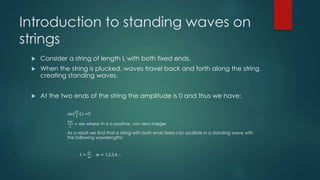
 Consider a string of length L with both fixed ends.
 When the string is plucked, waves travel back and forth along the string
creating standing waves.
 At the two ends of the string the amplitude is 0 and thus we have:
sin(
2𝜋
𝜆
𝐿) =0
2𝜋𝐿
𝜆
= 𝑚𝜋 where m is a positive, non zero integer
As a result we find that a string with both ends fixed can oscillate in a standing wave with
the following wavelengths:
𝜆 =
2𝐿
𝑚
, m = 1,2,3,4 …
Normal Modes
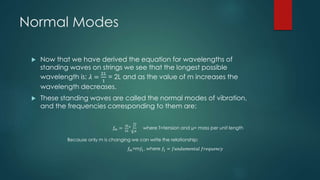
 Now that we have derived the equation for wavelengths of
standing waves on strings we see that the longest possible
wavelength is: 𝜆 =
2𝐿
1
= 2L and as the value of m increases the
wavelength decreases.
 These standing waves are called the normal modes of vibration,
and the frequencies corresponding to them are:
𝑓𝑚 =
𝑚
2𝐿
*
𝑇
𝜇
where T=tension and µ= mass per unit length
Because only m is changing we can write the relationship:
𝑓𝑚=m𝑓1, where 𝑓1 = 𝑓𝑢𝑛𝑑𝑎𝑚𝑒𝑛𝑡𝑎𝑙 𝑓𝑟𝑒𝑞𝑢𝑒𝑛𝑐𝑦
Harmonics or Resonant
Frequencies
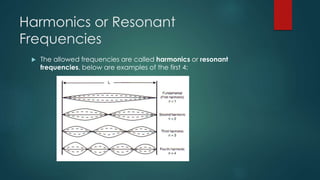
 The allowed frequencies are called harmonics or resonant
frequencies, below are examples of the first 4:
Time for Some Practice!
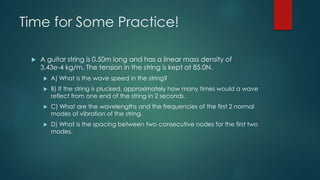
 A guitar string is 0.50m long and has a linear mass density of
3.43e-4 kg/m. The tension in the string is kept at 85.0N.
 A) What is the wave speed in the string?
 B) If the string is plucked, approximately how many times would a wave
reflect from one end of the string in 2 seconds.
 C) What are the wavelengths and the frequencies of the first 2 normal
modes of vibration of the string.
 D) What is the spacing between two consecutive nodes for the first two
modes.
Solutions
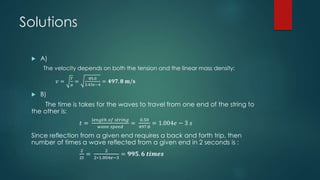
 A)
The velocity depends on both the tension and the linear mass density:
𝑣 =
𝑇
𝜇
=
85.0
3.43𝑒−4
= 𝟒𝟗𝟕. 𝟖 𝐦/𝐬
 B)
The time is takes for the waves to travel from one end of the string to
the other is:
𝑡 =
𝑙𝑒𝑛𝑔𝑡ℎ 𝑜𝑓 𝑠𝑡𝑟𝑖𝑛𝑔
𝑤𝑎𝑣𝑒 𝑠𝑝𝑒𝑒𝑑
=
0.50
497.8
= 1.004𝑒 − 3 𝑠
Since reflection from a given end requires a back and forth trip, then
number of times a wave reflected from a given end in 2 seconds is :
2
2𝑡
=
2
2∗1.004𝑒−3
= 𝟗𝟗𝟓. 𝟔 𝒕𝒊𝒎𝒆𝒔
Solutions
 C)
For the first harmonic: 𝜆 =
2𝐿
1
= 2 ∗ 0.50 = 𝟏 𝒎
𝑓𝑚 =
𝑚
2𝐿
*
𝑇
𝜇
=
85.0
3.43𝑒−4
= 𝟒𝟗𝟕. 𝟖 𝑯𝒛
For the second harmonic: 𝜆 =
2𝐿
2
= 𝟎. 𝟓𝟎 m
𝑓𝑚= m𝑓1 = 2 ∗ 497.8 = 𝟗𝟗𝟓. 𝟔 𝑯𝒛
Solutions
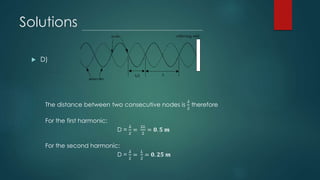
 D)
The distance between two consecutive nodes is
𝜆
2
therefore
For the first harmonic:
D =
𝜆
2
=
2𝐿
2
= 𝟎. 𝟓 𝒎
For the second harmonic:
D =
𝜆
2
=
𝐿
2
= 𝟎. 𝟐𝟓 𝒎
Thank You!

Standing Waves on a String

  • 1.
  • 2.
    Introduction to standingwaves on strings  Consider a string of length L with both fixed ends.  When the string is plucked, waves travel back and forth along the string creating standing waves.  At the two ends of the string the amplitude is 0 and thus we have: sin( 2𝜋 𝜆 𝐿) =0 2𝜋𝐿 𝜆 = 𝑚𝜋 where m is a positive, non zero integer As a result we find that a string with both ends fixed can oscillate in a standing wave with the following wavelengths: 𝜆 = 2𝐿 𝑚 , m = 1,2,3,4 …
  • 3.
    Normal Modes  Nowthat we have derived the equation for wavelengths of standing waves on strings we see that the longest possible wavelength is: 𝜆 = 2𝐿 1 = 2L and as the value of m increases the wavelength decreases.  These standing waves are called the normal modes of vibration, and the frequencies corresponding to them are: 𝑓𝑚 = 𝑚 2𝐿 * 𝑇 𝜇 where T=tension and µ= mass per unit length Because only m is changing we can write the relationship: 𝑓𝑚=m𝑓1, where 𝑓1 = 𝑓𝑢𝑛𝑑𝑎𝑚𝑒𝑛𝑡𝑎𝑙 𝑓𝑟𝑒𝑞𝑢𝑒𝑛𝑐𝑦
  • 4.
    Harmonics or Resonant Frequencies The allowed frequencies are called harmonics or resonant frequencies, below are examples of the first 4:
  • 5.
    Time for SomePractice!  A guitar string is 0.50m long and has a linear mass density of 3.43e-4 kg/m. The tension in the string is kept at 85.0N.  A) What is the wave speed in the string?  B) If the string is plucked, approximately how many times would a wave reflect from one end of the string in 2 seconds.  C) What are the wavelengths and the frequencies of the first 2 normal modes of vibration of the string.  D) What is the spacing between two consecutive nodes for the first two modes.
  • 6.
    Solutions  A) The velocitydepends on both the tension and the linear mass density: 𝑣 = 𝑇 𝜇 = 85.0 3.43𝑒−4 = 𝟒𝟗𝟕. 𝟖 𝐦/𝐬  B) The time is takes for the waves to travel from one end of the string to the other is: 𝑡 = 𝑙𝑒𝑛𝑔𝑡ℎ 𝑜𝑓 𝑠𝑡𝑟𝑖𝑛𝑔 𝑤𝑎𝑣𝑒 𝑠𝑝𝑒𝑒𝑑 = 0.50 497.8 = 1.004𝑒 − 3 𝑠 Since reflection from a given end requires a back and forth trip, then number of times a wave reflected from a given end in 2 seconds is : 2 2𝑡 = 2 2∗1.004𝑒−3 = 𝟗𝟗𝟓. 𝟔 𝒕𝒊𝒎𝒆𝒔
  • 7.
    Solutions  C) For thefirst harmonic: 𝜆 = 2𝐿 1 = 2 ∗ 0.50 = 𝟏 𝒎 𝑓𝑚 = 𝑚 2𝐿 * 𝑇 𝜇 = 85.0 3.43𝑒−4 = 𝟒𝟗𝟕. 𝟖 𝑯𝒛 For the second harmonic: 𝜆 = 2𝐿 2 = 𝟎. 𝟓𝟎 m 𝑓𝑚= m𝑓1 = 2 ∗ 497.8 = 𝟗𝟗𝟓. 𝟔 𝑯𝒛
  • 8.
    Solutions  D) The distancebetween two consecutive nodes is 𝜆 2 therefore For the first harmonic: D = 𝜆 2 = 2𝐿 2 = 𝟎. 𝟓 𝒎 For the second harmonic: D = 𝜆 2 = 𝐿 2 = 𝟎. 𝟐𝟓 𝒎
  • 9.