Atomic Structure and Properties Today we will discuss: The structure of metals, insulators and semi-conductors and how this affects: Electrical properties Appearance Mechanical properties 29 May 2009
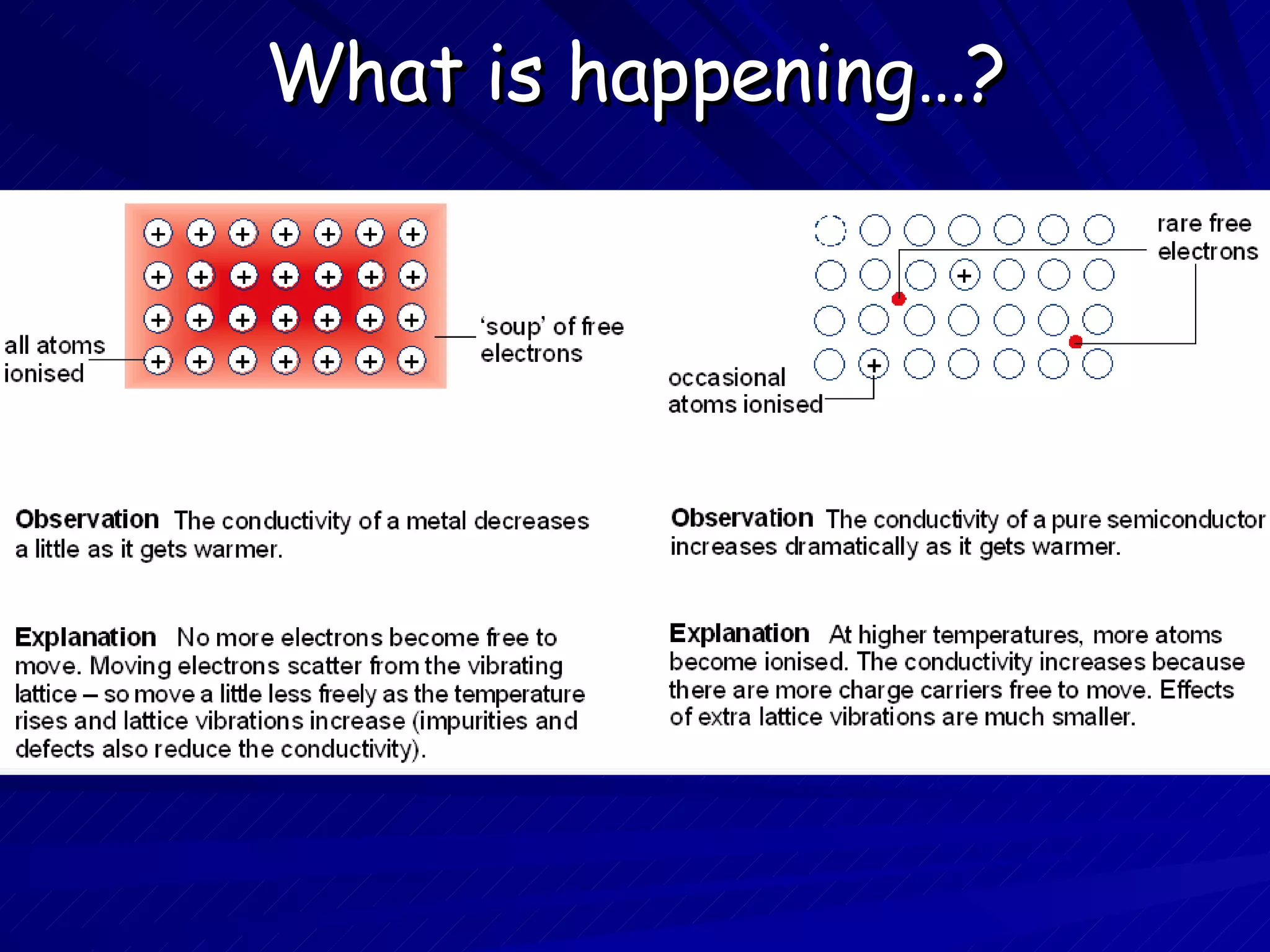
Metals Metals - Because the free electrons in metals: conduct well - are mobile and carry current are shiny - oscillate in light, scattering light photons are stiff - ‘glue’ ions together strongly are ductile - provide non-directional glue, letting ions slip All atoms are ionised and the electrons are free to move…
Insulators - Ceramics Ceramics - Because the ionic bonds holding them together: are insulators - lock electrons to ions or atoms, so none are free to move are stiff - are hard to stretch strong bonds are brittle - are directional bonds, so that atoms or ions cannot slip Electrons lock to ions so none are free to move…
Insulators - Polymers Polymers - Because the covalent bonds stringing  monomers in long chains: are insulators - lock electrons to atoms, with none free to move are often flexible- can rotate, letting chains stretch or fold are often plastic – make chains which can slip past one another The covalent bonds, stringing monomers into long chains…
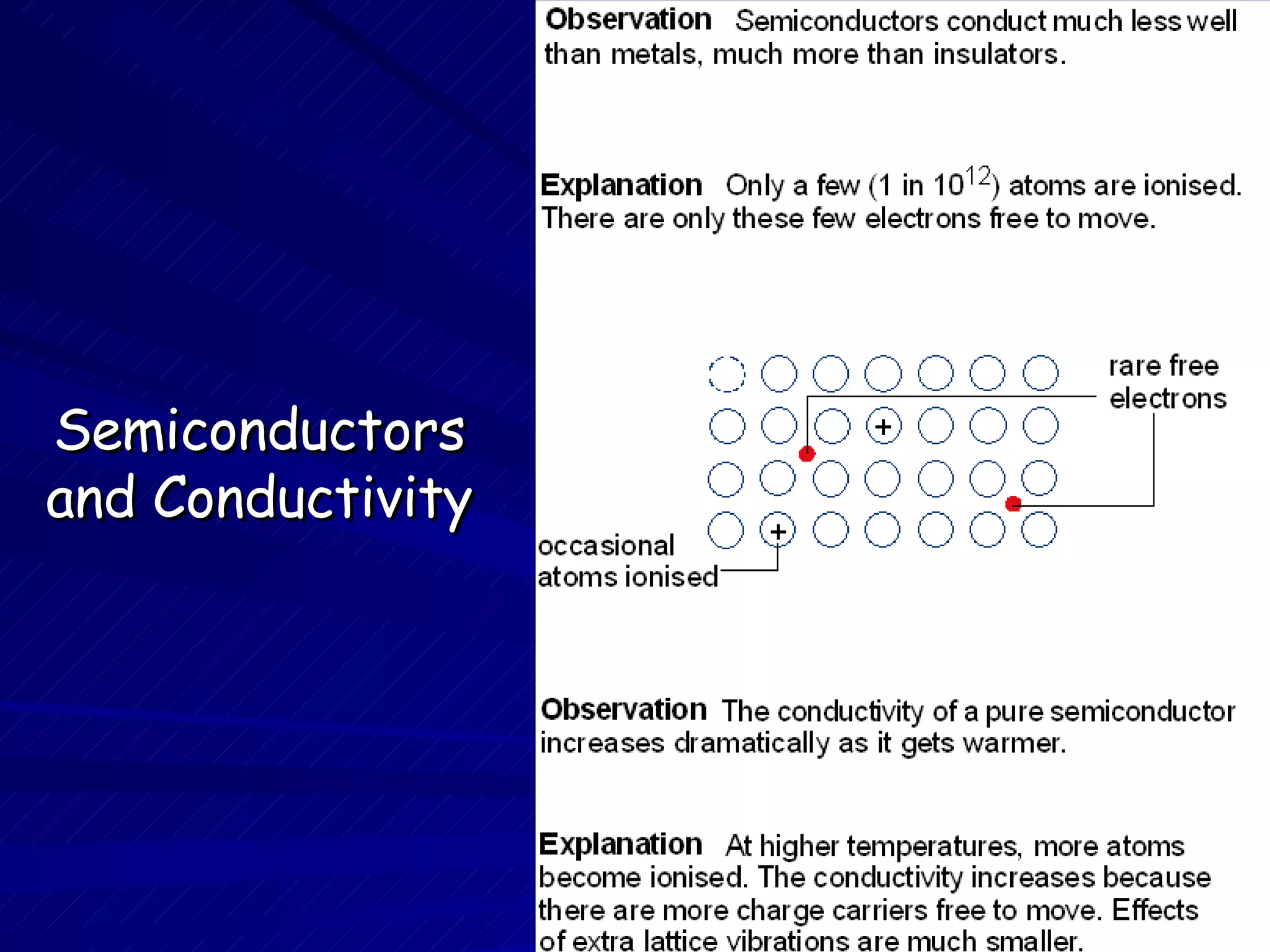
Semi-Conductors These have properties in-between: Metals and Insulators These have far fewer ionised atoms (and hence fee electrons)
Semiconductors and Conductivity
But what happens… When things get hot!!!?!?!?!? Using a beaker, tripod, multimeter, a piece of wire and a semiconductor sample (thermistor), test: The effect of temperature on conductivity  (measure resistance) of metals and semiconductors…
What is happening…?
Doping Obviously it is not practical to heat up semiconductors – to increase conductivity we ‘dope’ them with other atoms. Using page 124 summarise, with pictures, the 2 types of doping

5

  • 1.
    Atomic Structure andProperties Today we will discuss: The structure of metals, insulators and semi-conductors and how this affects: Electrical properties Appearance Mechanical properties 29 May 2009
  • 2.
    Metals Metals -Because the free electrons in metals: conduct well - are mobile and carry current are shiny - oscillate in light, scattering light photons are stiff - ‘glue’ ions together strongly are ductile - provide non-directional glue, letting ions slip All atoms are ionised and the electrons are free to move…
  • 3.
    Insulators - CeramicsCeramics - Because the ionic bonds holding them together: are insulators - lock electrons to ions or atoms, so none are free to move are stiff - are hard to stretch strong bonds are brittle - are directional bonds, so that atoms or ions cannot slip Electrons lock to ions so none are free to move…
  • 4.
    Insulators - PolymersPolymers - Because the covalent bonds stringing monomers in long chains: are insulators - lock electrons to atoms, with none free to move are often flexible- can rotate, letting chains stretch or fold are often plastic – make chains which can slip past one another The covalent bonds, stringing monomers into long chains…
  • 5.
    Semi-Conductors These haveproperties in-between: Metals and Insulators These have far fewer ionised atoms (and hence fee electrons)
  • 6.
  • 7.
    But what happens…When things get hot!!!?!?!?!? Using a beaker, tripod, multimeter, a piece of wire and a semiconductor sample (thermistor), test: The effect of temperature on conductivity (measure resistance) of metals and semiconductors…
  • 8.
  • 9.
    Doping Obviously itis not practical to heat up semiconductors – to increase conductivity we ‘dope’ them with other atoms. Using page 124 summarise, with pictures, the 2 types of doping