Standing Waves on
Strings
Physics 101
What is a Standing Wave?
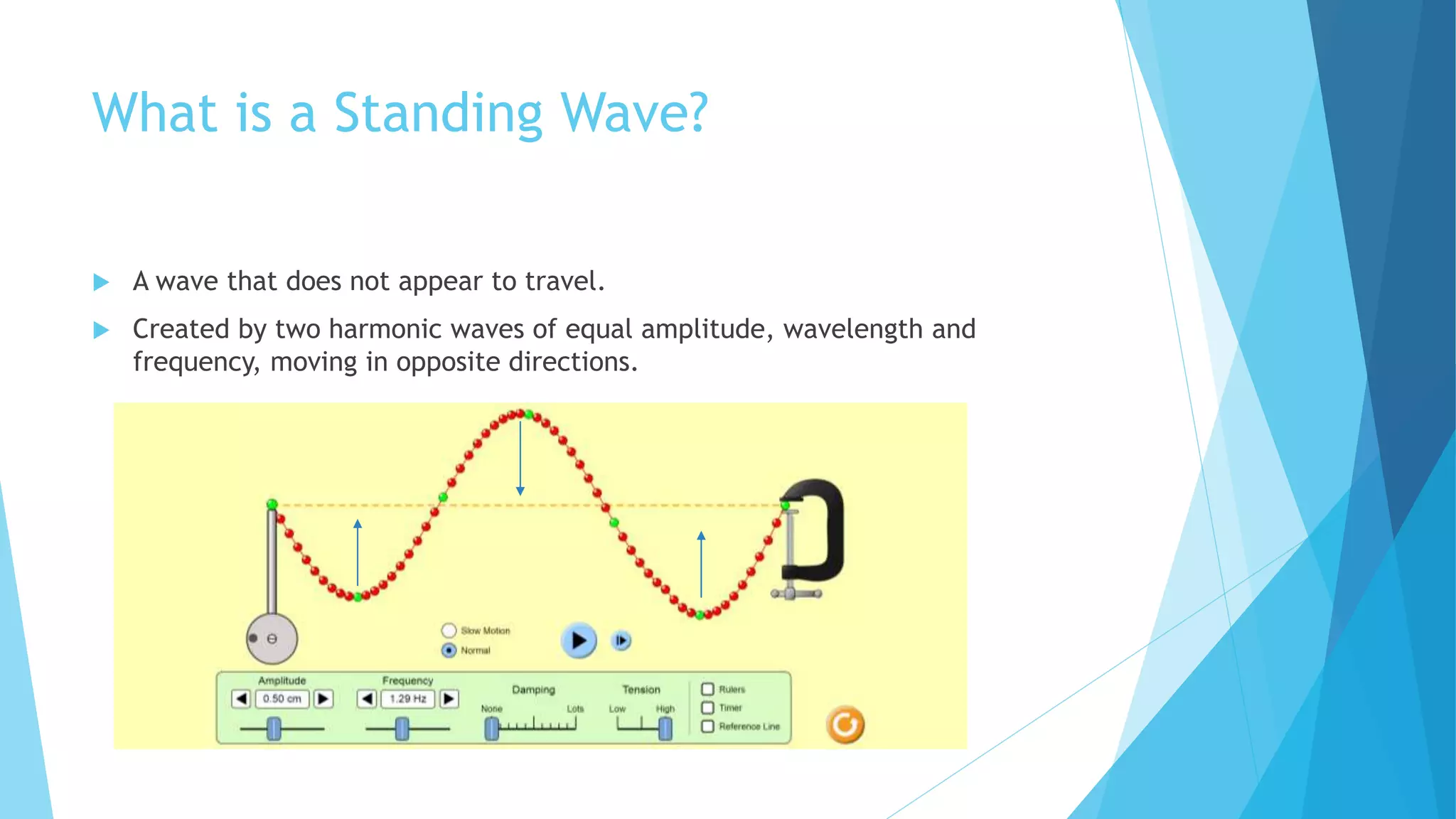
 A wave that does not appear to travel.
 Created by two harmonic waves of equal amplitude, wavelength and
frequency, moving in opposite directions.
Nodes and Antinodes
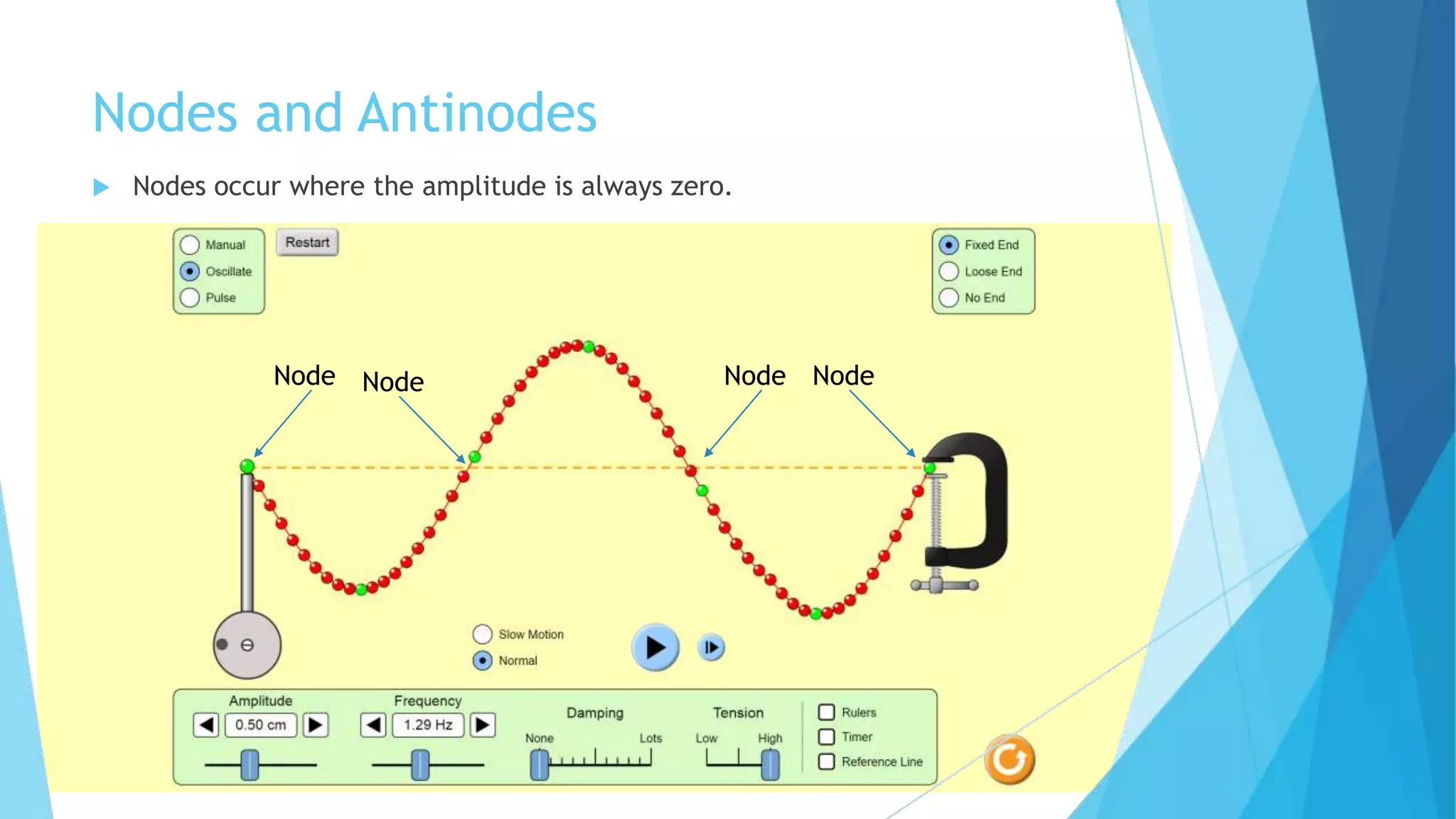
 Nodes occur where the amplitude is always zero.
Node Node NodeNode
Nodes and Antinodes
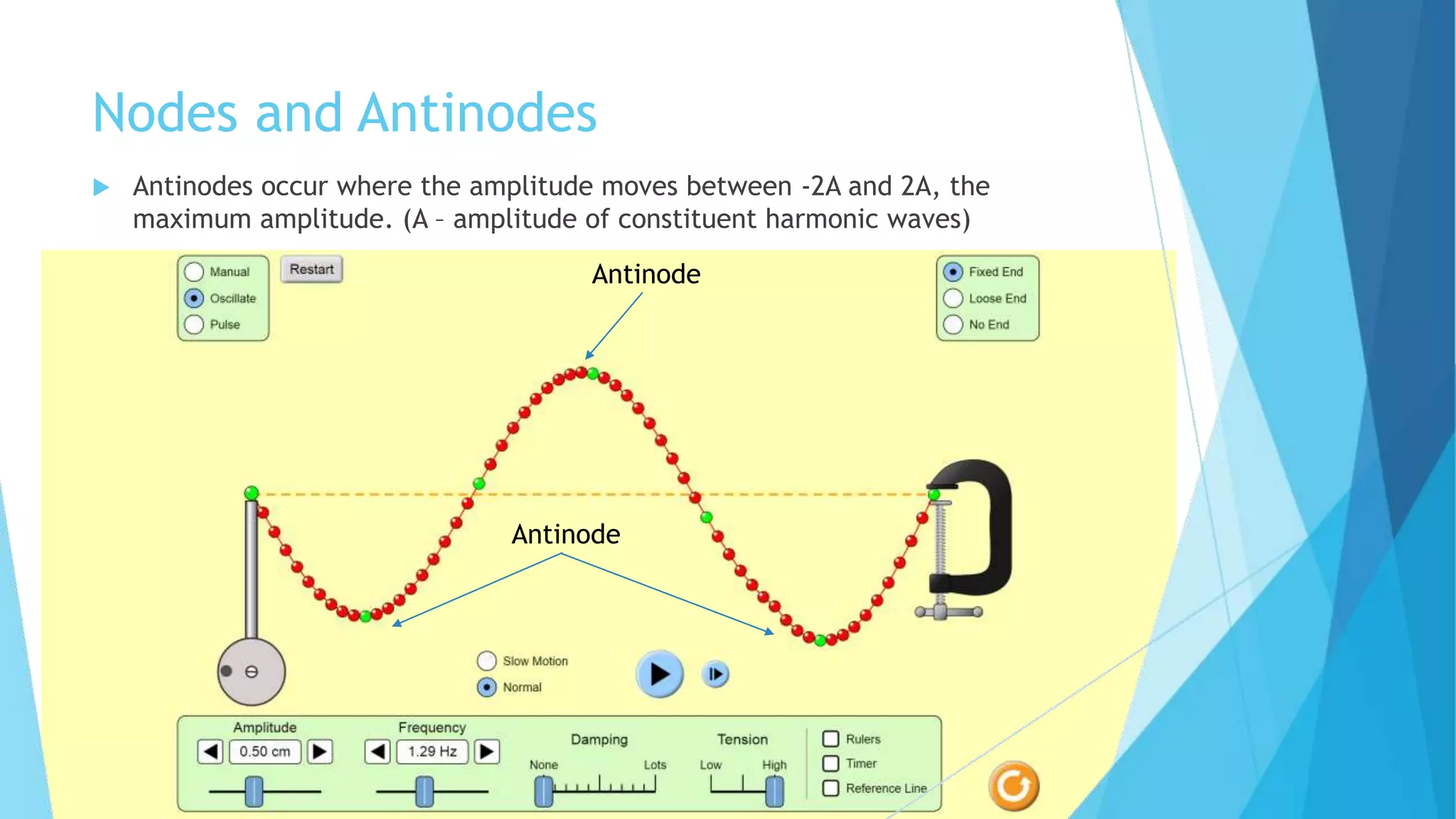
 Antinodes occur where the amplitude moves between -2A and 2A, the
maximum amplitude. (A – amplitude of constituent harmonic waves)
Antinode
Antinode
λ
4
λ
2
3λ
4
λ 5λ
4
λ
2
λ
2
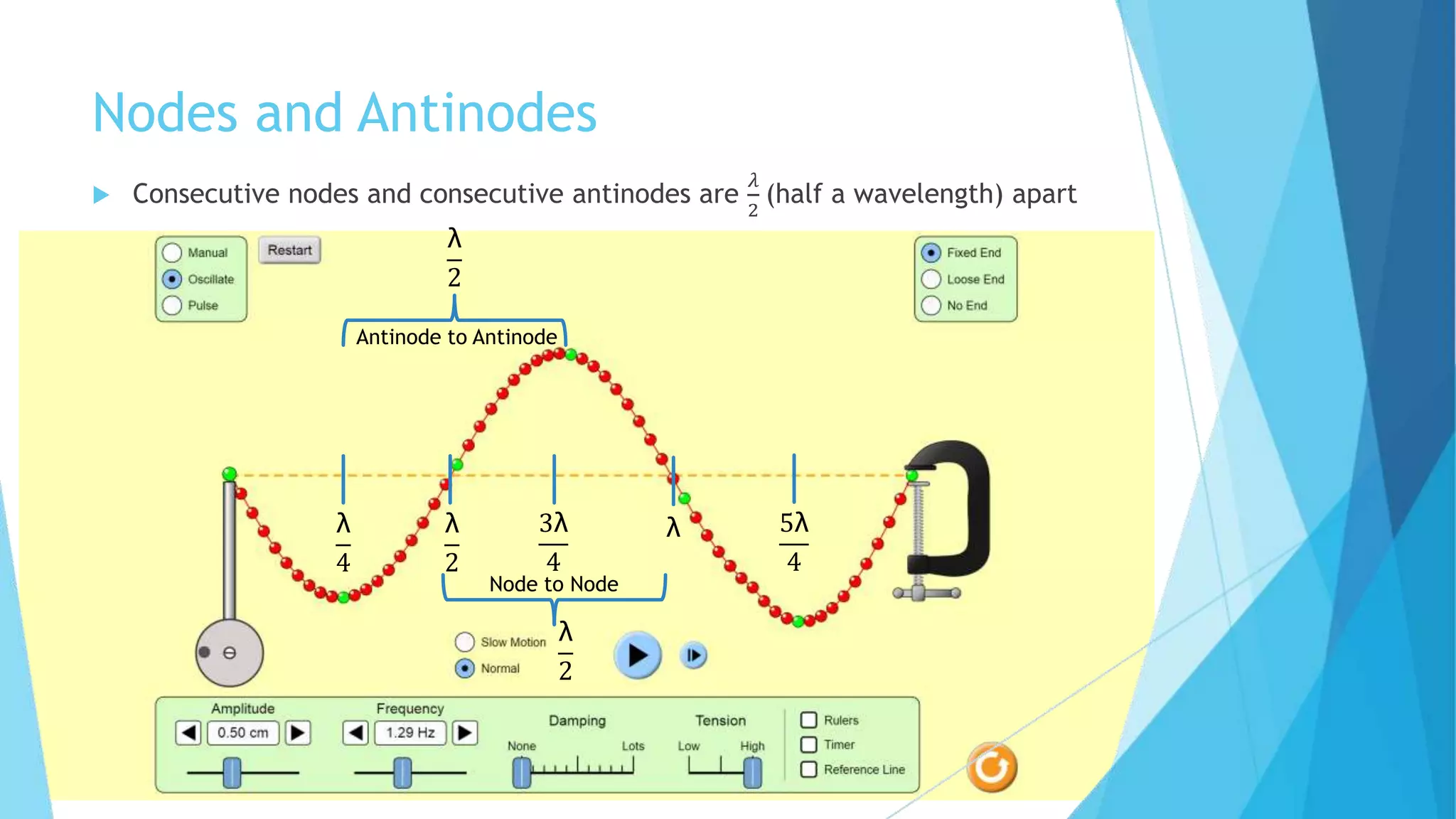
Node to Node
Antinode to Antinode
Nodes and Antinodes
 Consecutive nodes and consecutive antinodes are
𝜆
2
(half a wavelength) apart
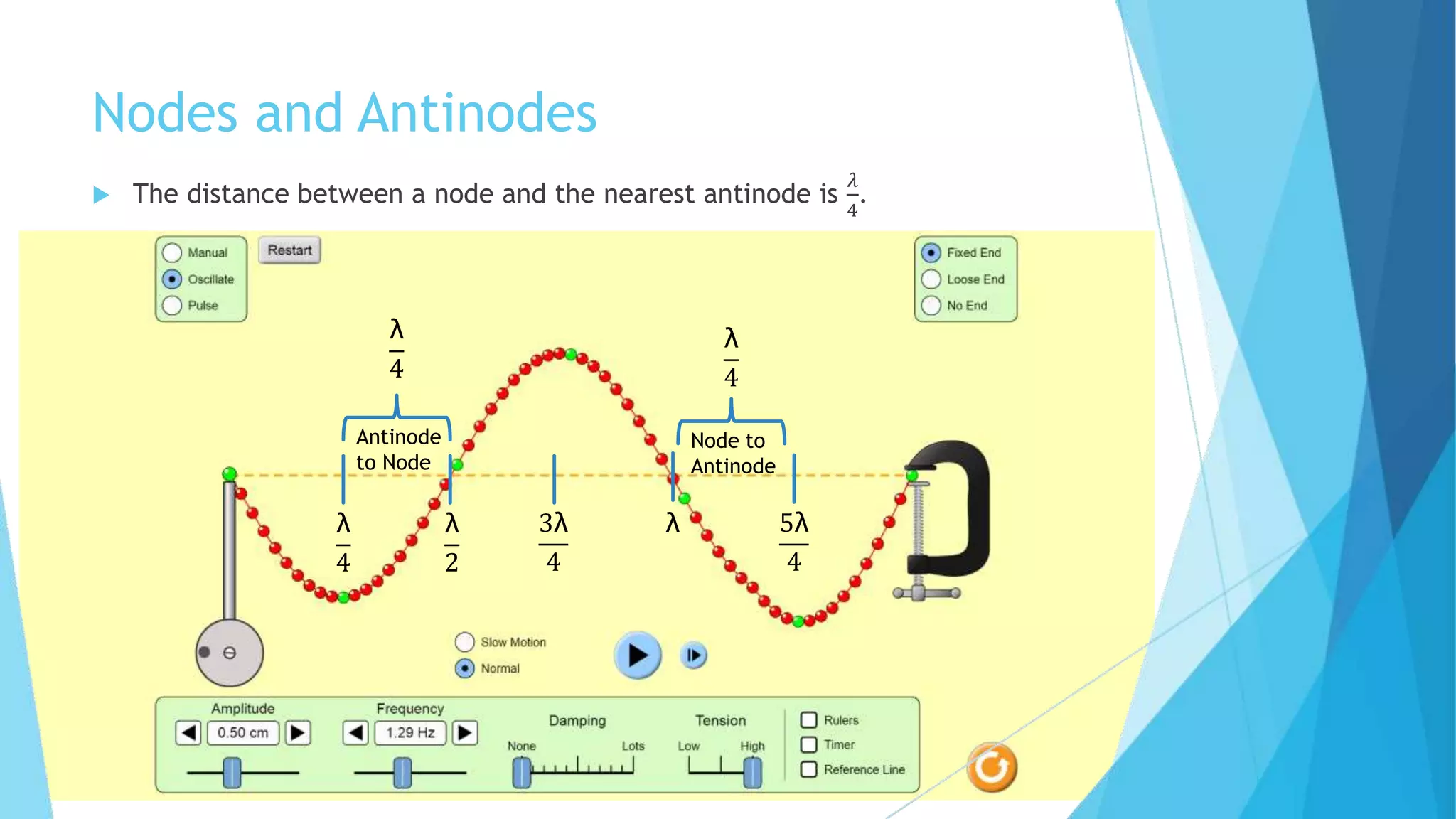
 The distance between a node and the nearest antinode is
𝜆
4
.
Nodes and Antinodes
λ
4
λ
2
3λ
4
λ 5λ
4
λ
4
Antinode
to Node
λ
4
Node to
Antinode
Frequency of Standing Waves on Strings
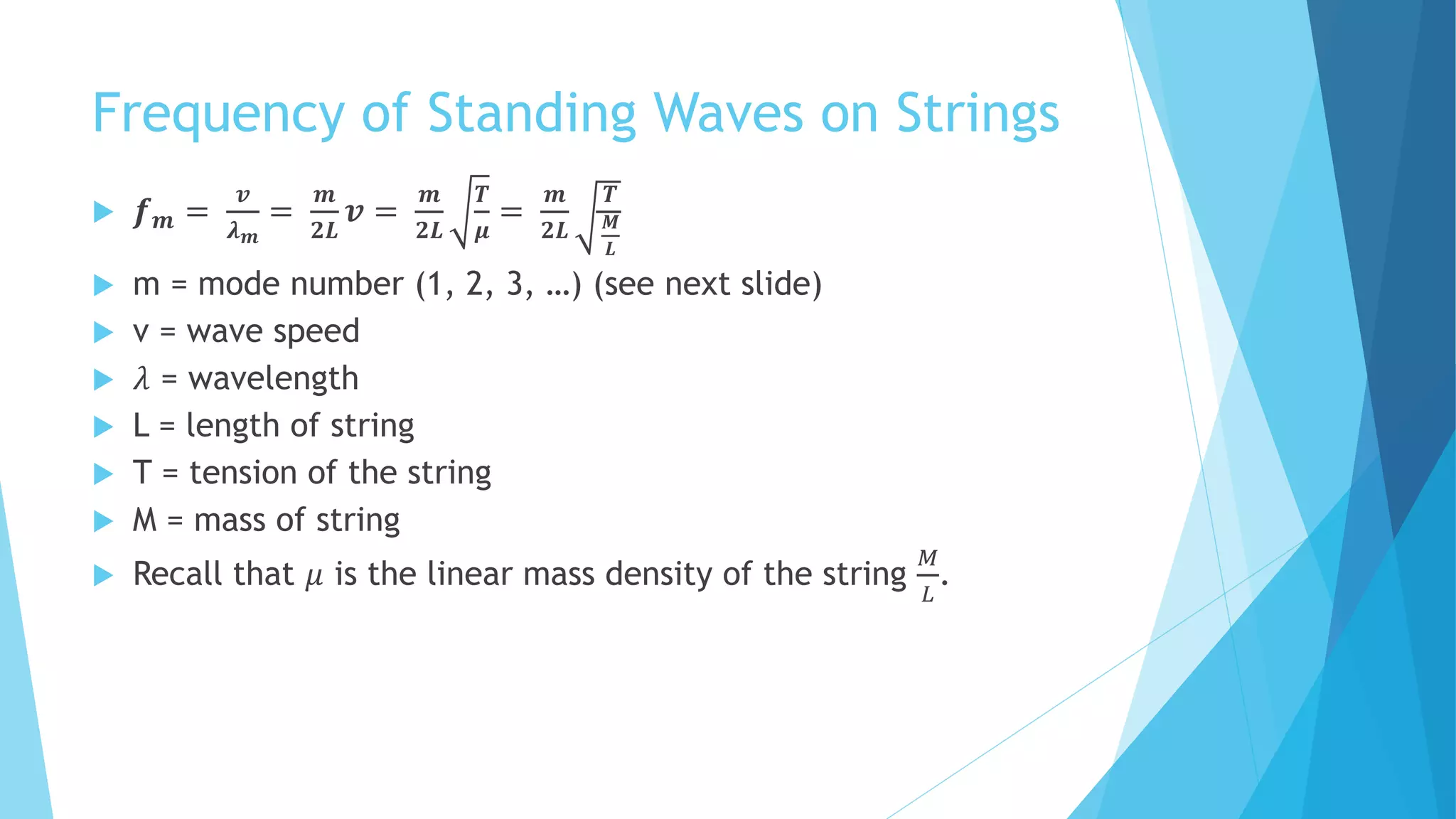
 𝒇 𝒎 =
𝒗
𝝀 𝒎
=
𝒎
𝟐𝑳
𝒗 =
𝒎
𝟐𝑳
𝑻
𝝁
=
𝒎
𝟐𝑳
𝑻
𝑴
𝑳
 m = mode number (1, 2, 3, …) (see next slide)
 v = wave speed
 𝜆 = wavelength
 L = length of string
 T = tension of the string
 M = mass of string
 Recall that 𝜇 is the linear mass density of the string
𝑀
𝐿
.
Normal Modes
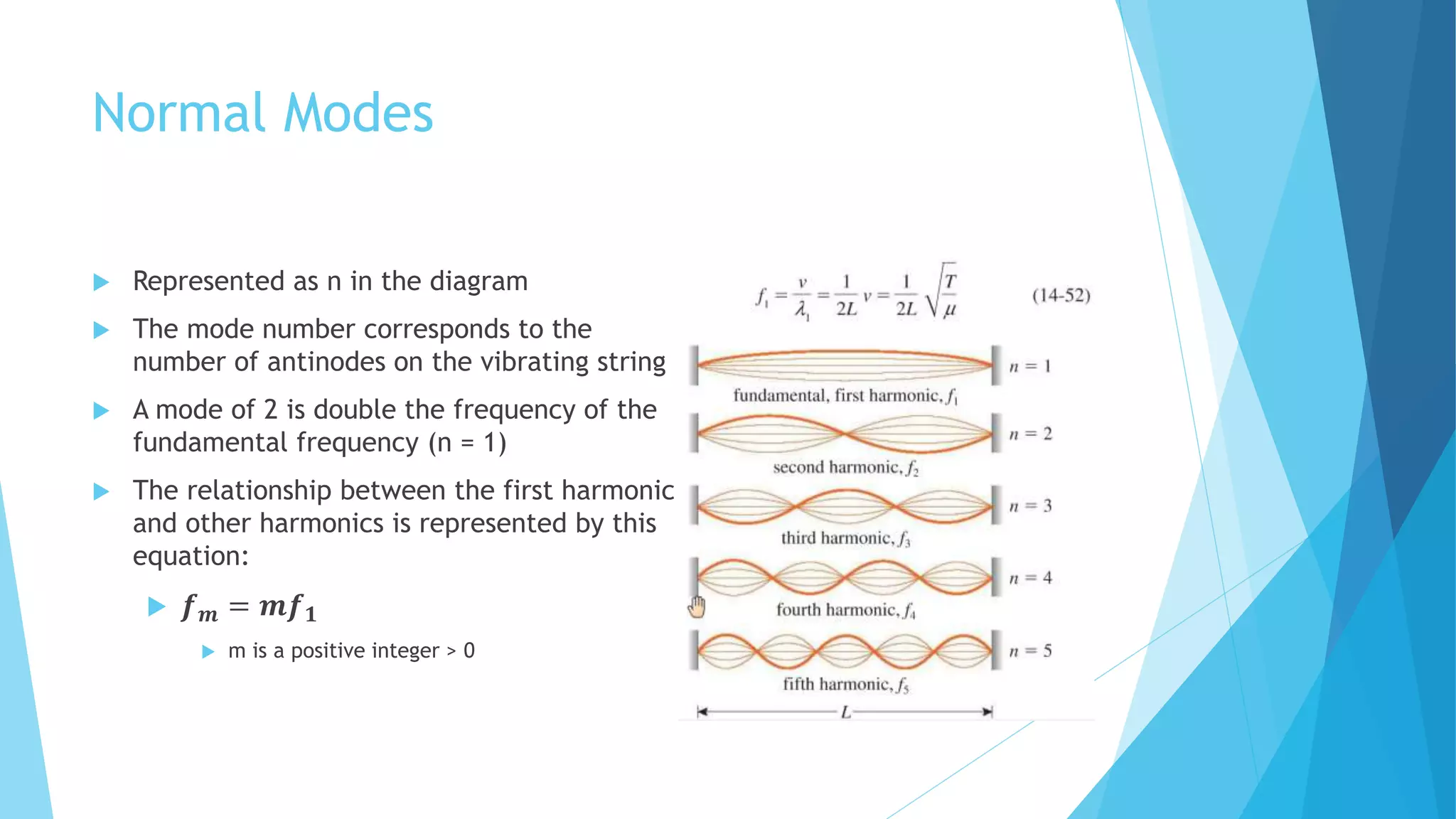
 Represented as n in the diagram
 The mode number corresponds to the
number of antinodes on the vibrating string
 A mode of 2 is double the frequency of the
fundamental frequency (n = 1)
 The relationship between the first harmonic
and other harmonics is represented by this
equation:
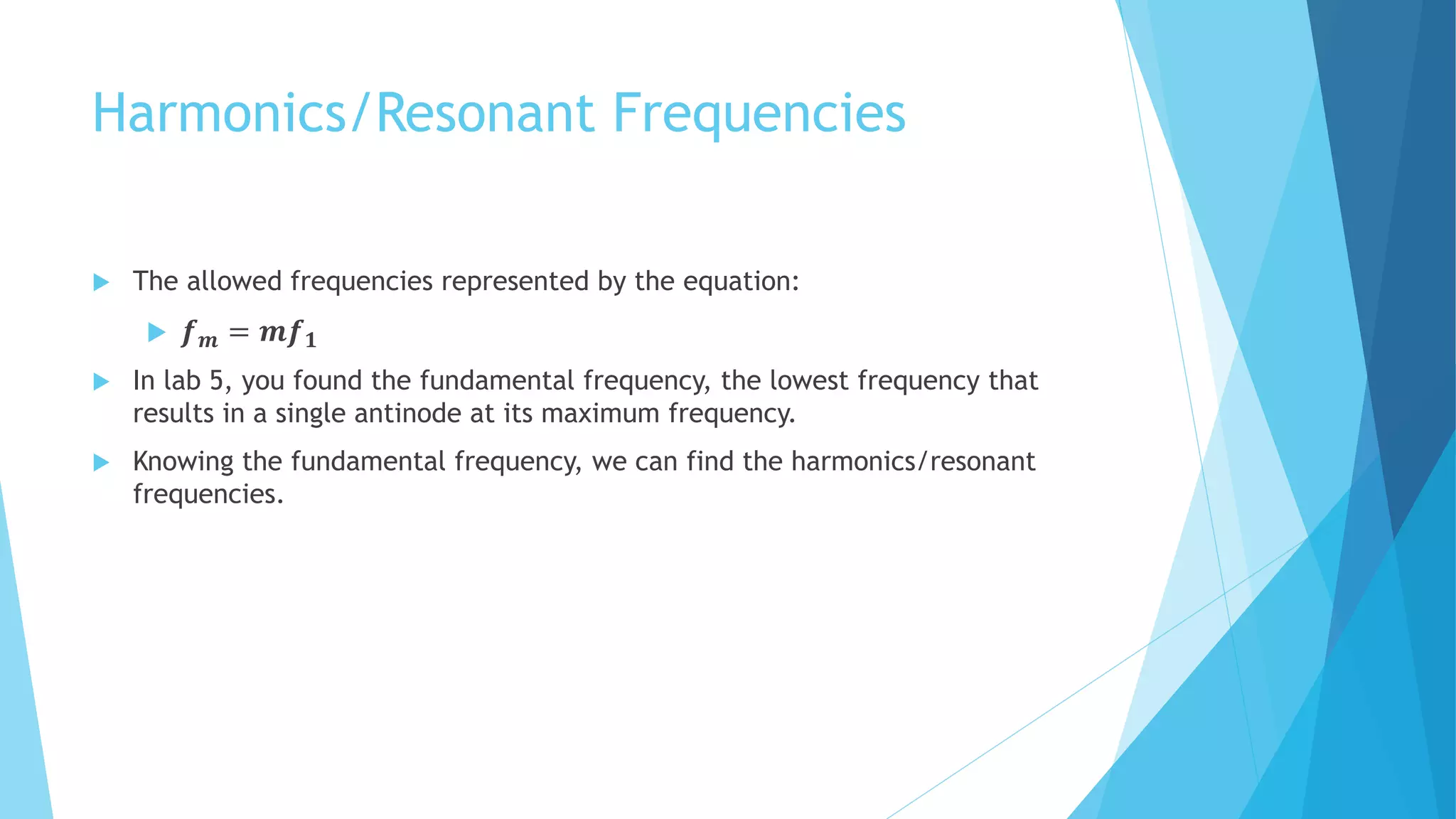
 𝒇 𝒎 = 𝒎𝒇 𝟏
 m is a positive integer > 0
Harmonics/Resonant Frequencies
 The allowed frequencies represented by the equation:
 𝒇 𝒎 = 𝒎𝒇 𝟏
 In lab 5, you found the fundamental frequency, the lowest frequency that
results in a single antinode at its maximum frequency.
 Knowing the fundamental frequency, we can find the harmonics/resonant
frequencies.
Questions
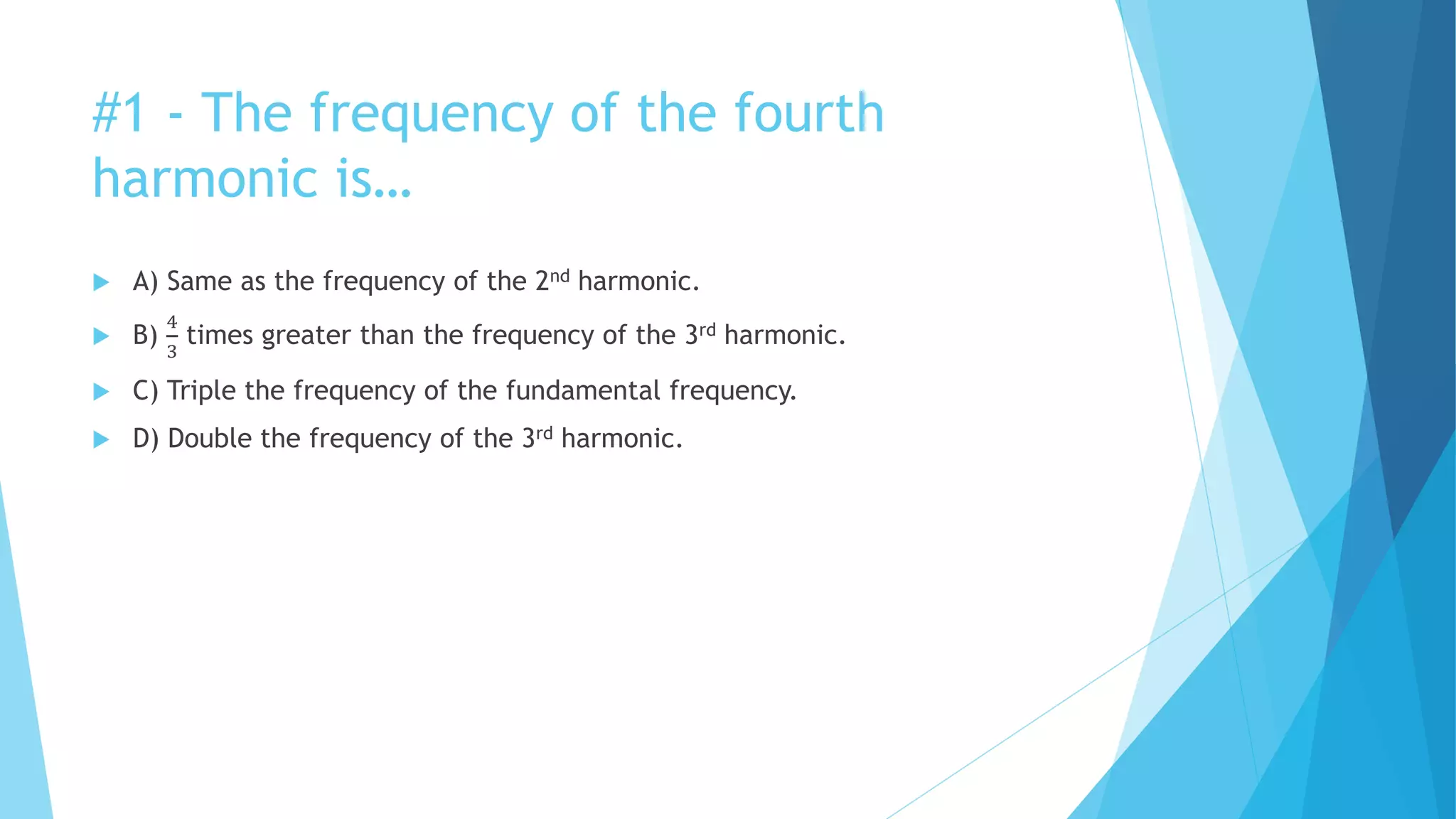
#1 - The frequency of the fourth
harmonic is…
 A) Same as the frequency of the 2nd harmonic.
 B)
4
3
times greater than the frequency of the 3rd harmonic.
 C) Triple the frequency of the fundamental frequency.
 D) Double the frequency of the 3rd harmonic.
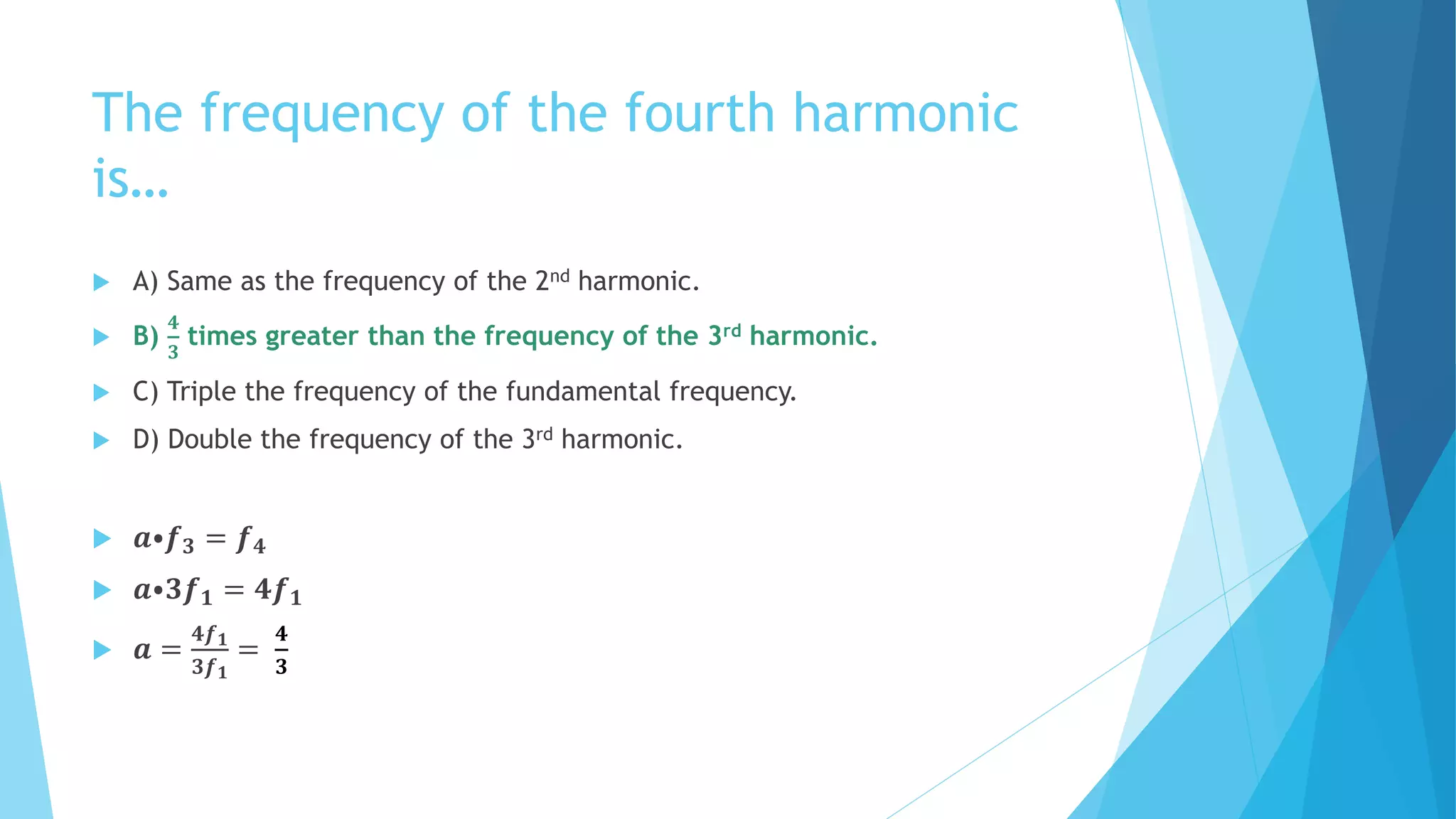
The frequency of the fourth harmonic
is…
 A) Same as the frequency of the 2nd harmonic.
 B)
𝟒
𝟑
times greater than the frequency of the 3rd harmonic.
 C) Triple the frequency of the fundamental frequency.
 D) Double the frequency of the 3rd harmonic.
 𝒂⦁𝒇 𝟑 = 𝒇 𝟒
 𝒂⦁𝟑𝒇 𝟏 = 𝟒𝒇 𝟏
 𝒂 =
𝟒𝒇 𝟏
𝟑𝒇 𝟏
=
𝟒
𝟑
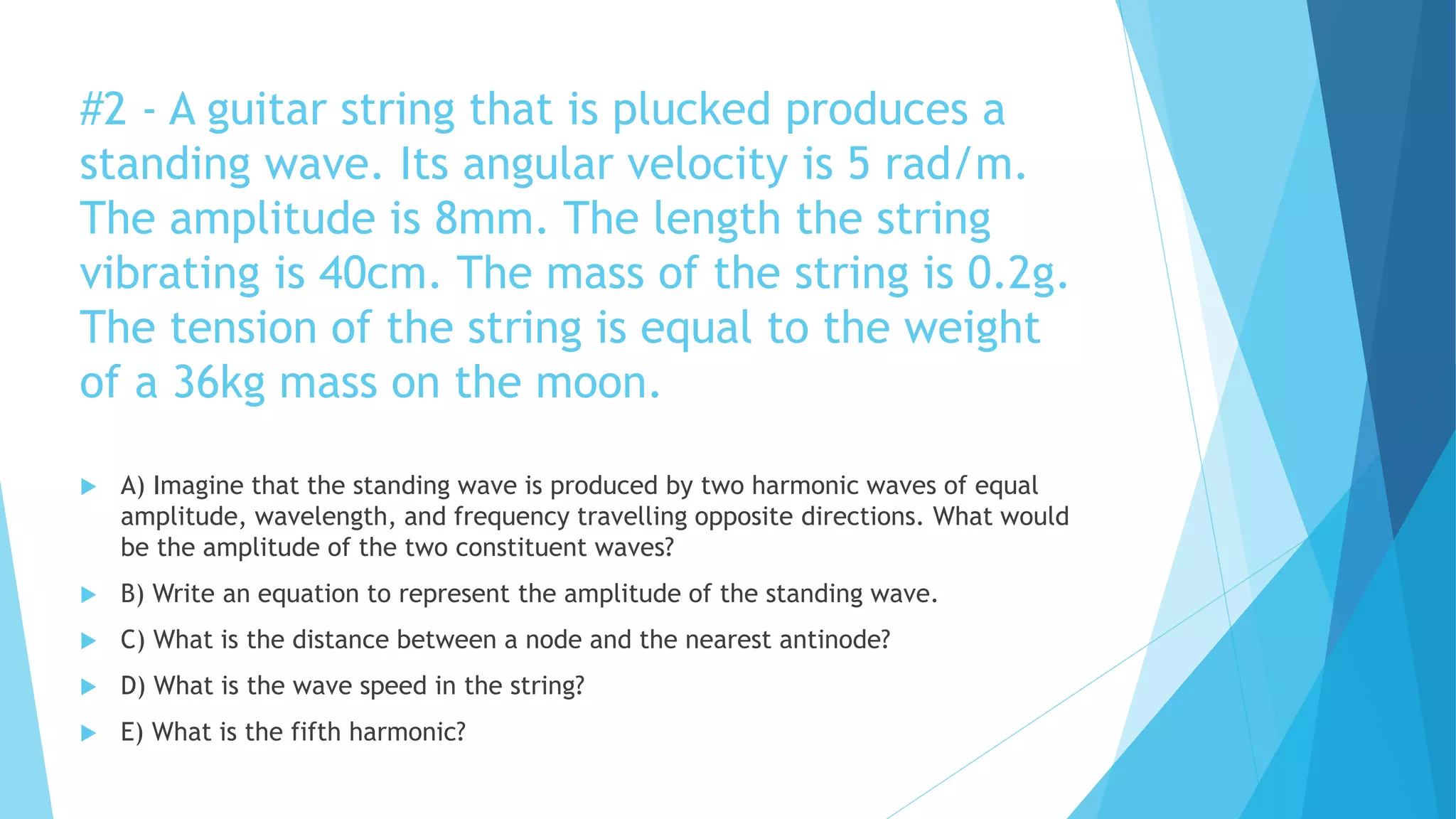
#2 - A guitar string that is plucked produces a
standing wave. Its angular velocity is 5 rad/m.
The amplitude is 8mm. The length the string
vibrating is 40cm. The mass of the string is 0.2g.
The tension of the string is equal to the weight
of a 36kg mass on the moon.
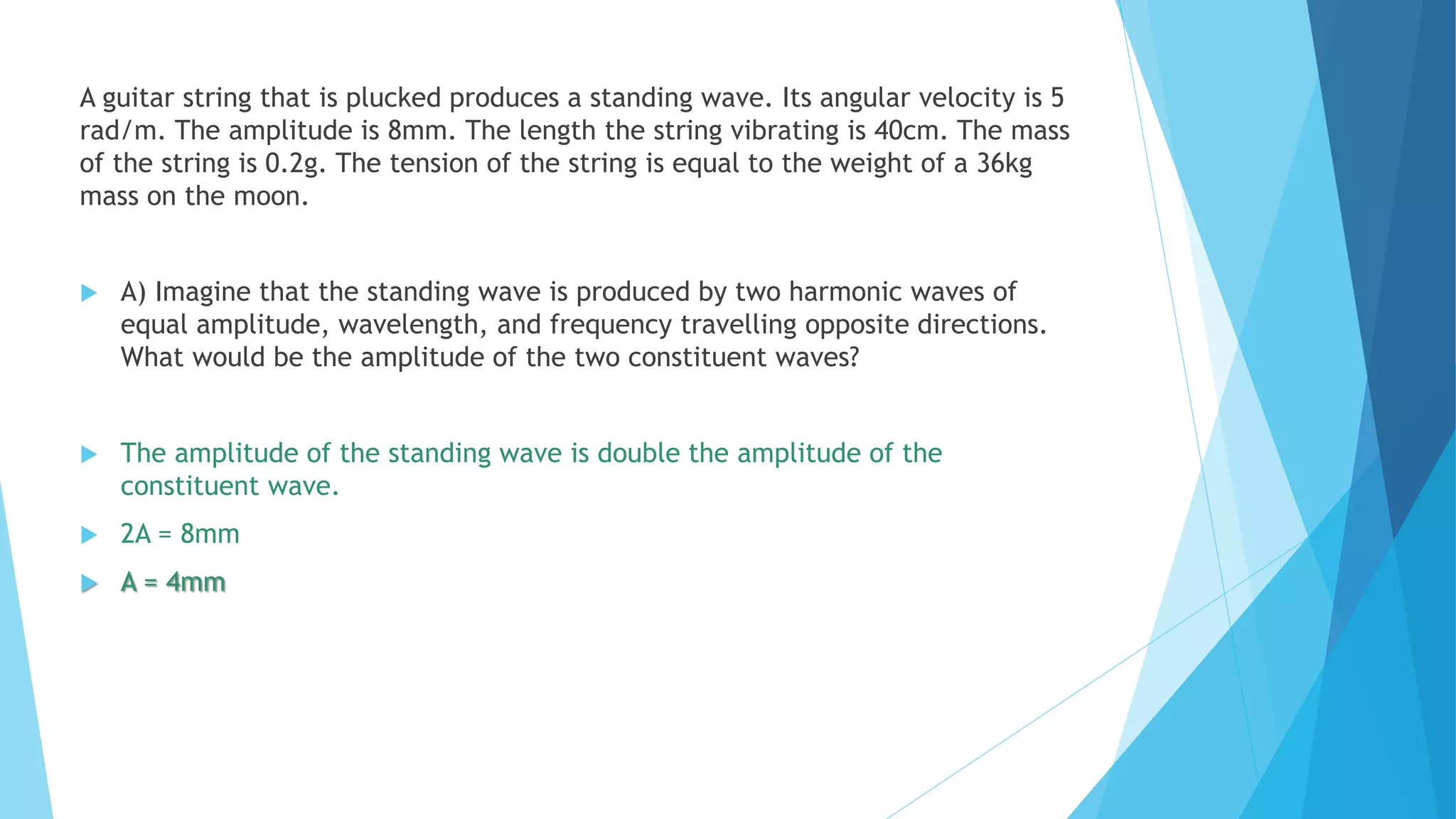
 A) Imagine that the standing wave is produced by two harmonic waves of equal
amplitude, wavelength, and frequency travelling opposite directions. What would
be the amplitude of the two constituent waves?
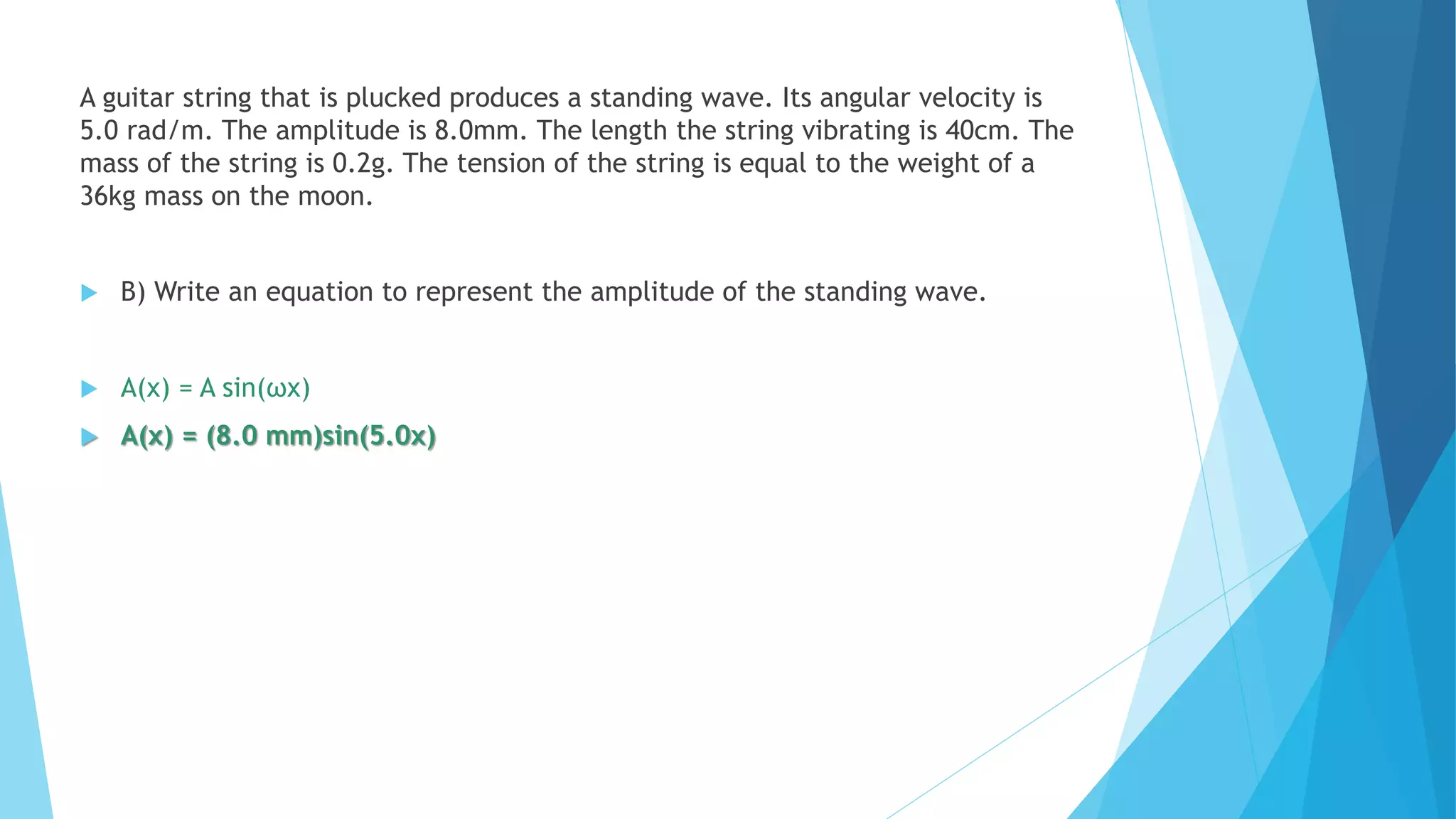
 B) Write an equation to represent the amplitude of the standing wave.
 C) What is the distance between a node and the nearest antinode?
 D) What is the wave speed in the string?
 E) What is the fifth harmonic?
A guitar string that is plucked produces a standing wave. Its angular velocity is 5
rad/m. The amplitude is 8mm. The length the string vibrating is 40cm. The mass
of the string is 0.2g. The tension of the string is equal to the weight of a 36kg
mass on the moon.
 A) Imagine that the standing wave is produced by two harmonic waves of
equal amplitude, wavelength, and frequency travelling opposite directions.
What would be the amplitude of the two constituent waves?
 The amplitude of the standing wave is double the amplitude of the
constituent wave.
 2A = 8mm
 A = 4mm
A guitar string that is plucked produces a standing wave. Its angular velocity is
5.0 rad/m. The amplitude is 8.0mm. The length the string vibrating is 40cm. The
mass of the string is 0.2g. The tension of the string is equal to the weight of a
36kg mass on the moon.
 B) Write an equation to represent the amplitude of the standing wave.
 A(x) = A sin(ωx)
 A(x) = (8.0 mm)sin(5.0x)
A guitar string that is plucked produces a standing wave. Its angular velocity is 5
rad/m. The amplitude is 8mm. The length the string vibrating is 40cm. The mass
of the string is 0.2g. The tension of the string is equal to the weight of a 36kg
mass on the moon.
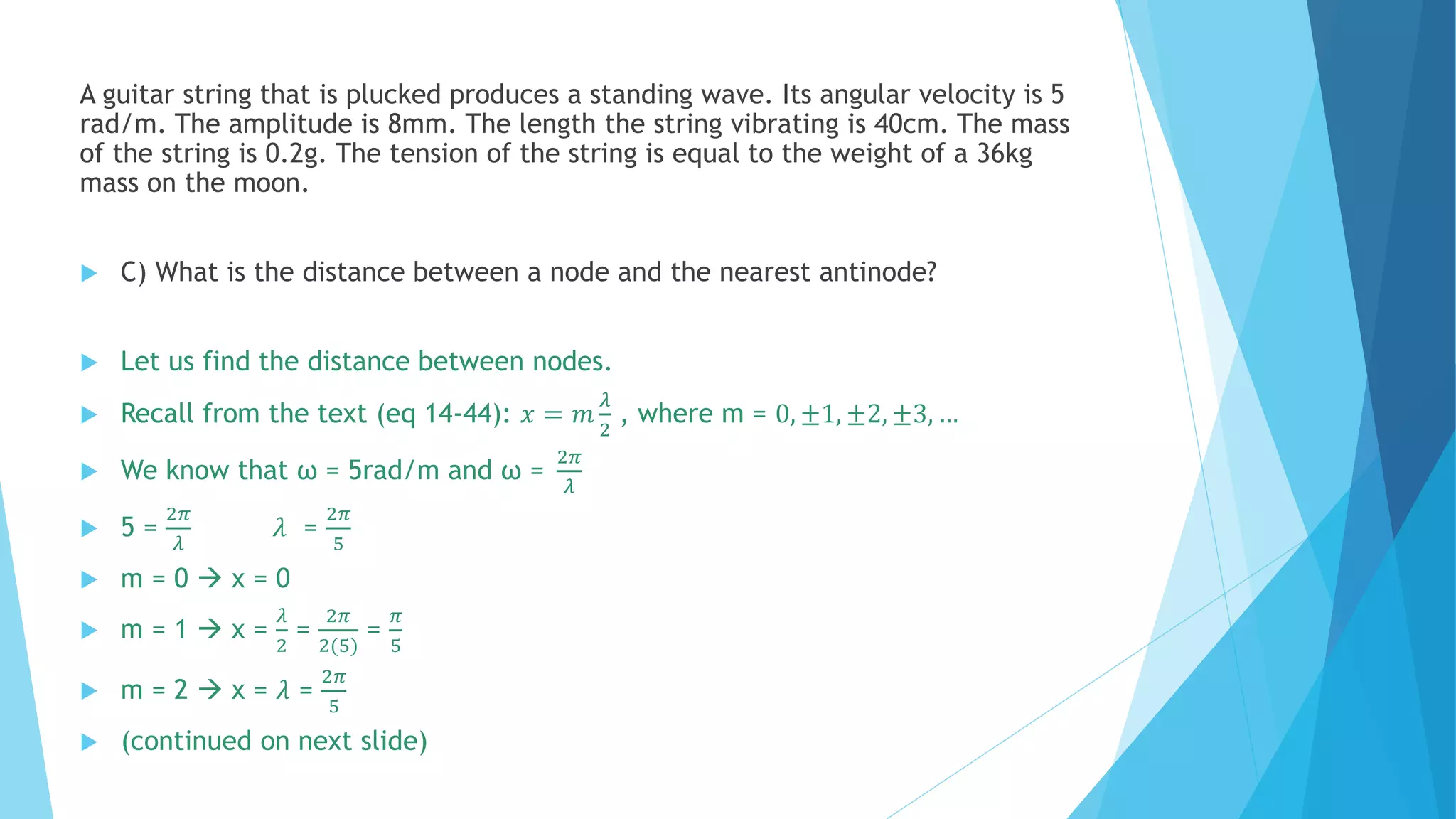
 C) What is the distance between a node and the nearest antinode?
 Let us find the distance between nodes.
 Recall from the text (eq 14-44): 𝑥 = 𝑚
𝜆
2
, where m = 0, ±1, ±2, ±3, …
 We know that ω = 5rad/m and ω =
2𝜋
𝜆
 5 =
2𝜋
𝜆
𝜆 =
2𝜋
5
 m = 0  x = 0
 m = 1  x =
𝜆
2
=
2𝜋
2(5)
=
𝜋
5
 m = 2  x = 𝜆 =
2𝜋
5
 (continued on next slide)
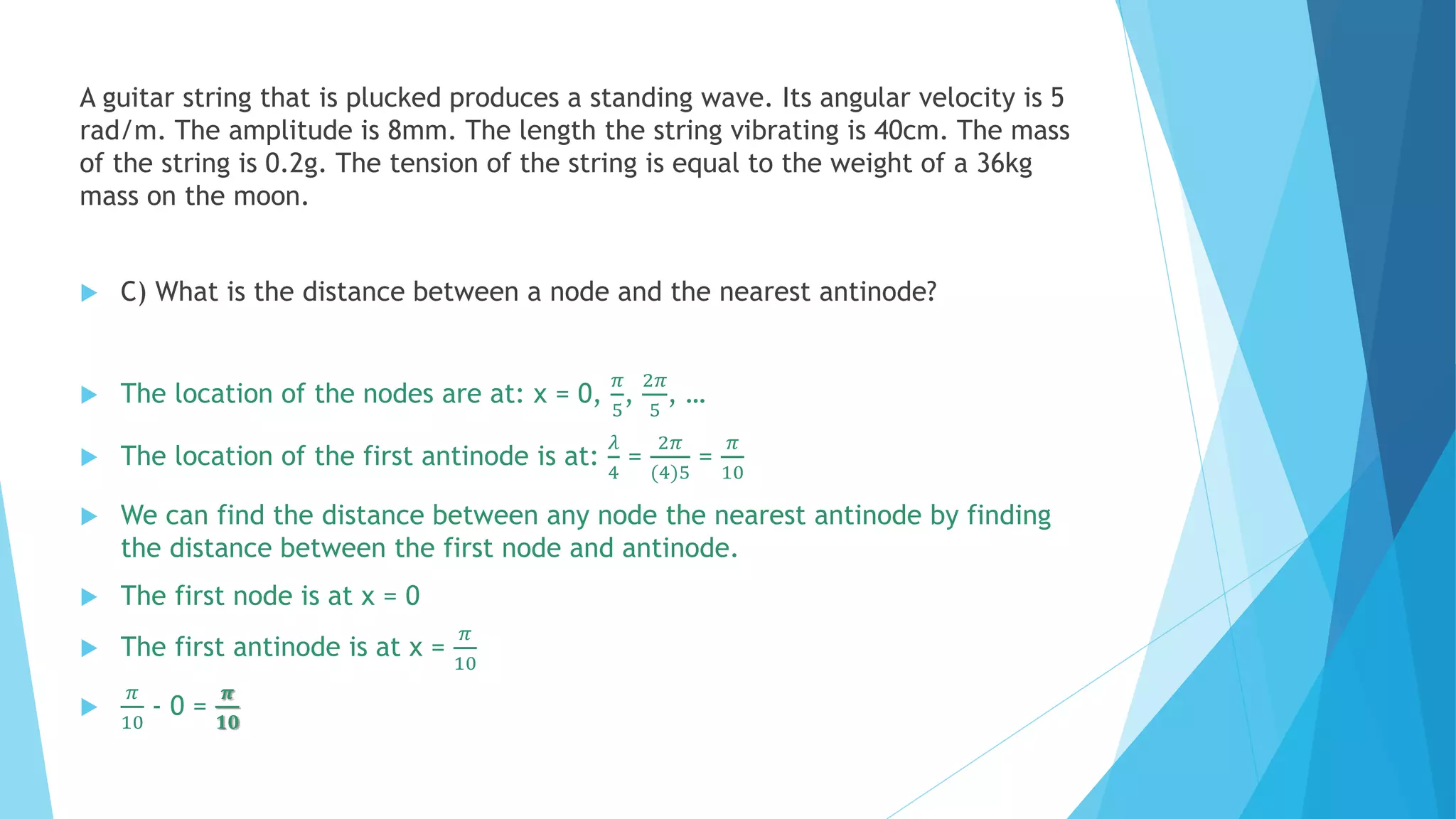
A guitar string that is plucked produces a standing wave. Its angular velocity is 5
rad/m. The amplitude is 8mm. The length the string vibrating is 40cm. The mass
of the string is 0.2g. The tension of the string is equal to the weight of a 36kg
mass on the moon.
 C) What is the distance between a node and the nearest antinode?
 The location of the nodes are at: x = 0,
𝜋
5
,
2𝜋
5
, …
 The location of the first antinode is at:
𝜆
4
=
2𝜋
(4)5
=
𝜋
10
 We can find the distance between any node the nearest antinode by finding
the distance between the first node and antinode.
 The first node is at x = 0
 The first antinode is at x =
𝜋
10

𝜋
10
- 0 =
𝝅
𝟏𝟎
A guitar string that is plucked produces a standing wave. Its angular velocity is 5
rad/m. The amplitude is 8mm. The length the string vibrating is 40cm. The mass of
the string is 0.2g. The tension of the string is equal to the weight of a 36kg mass on
the moon.
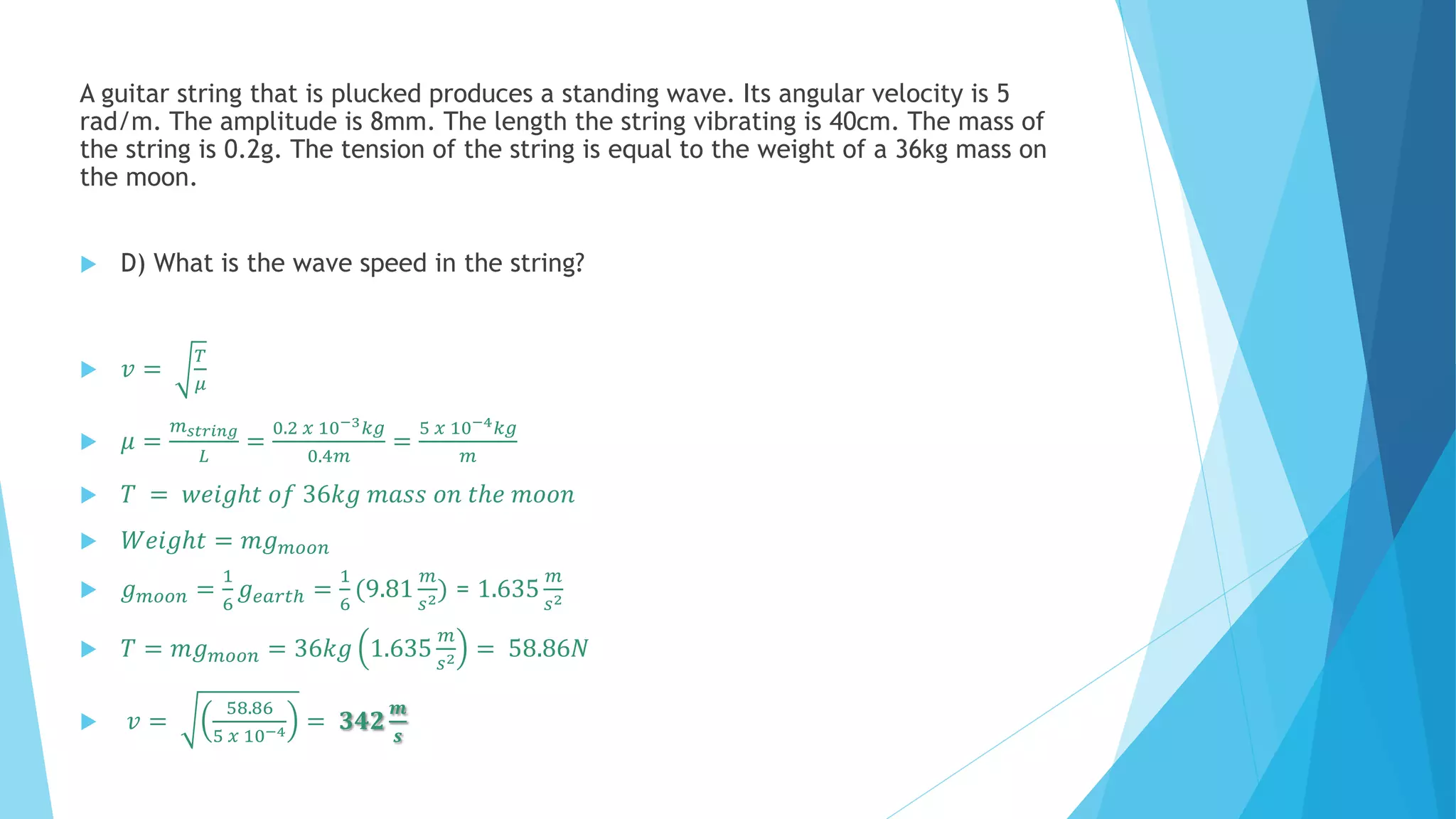
 D) What is the wave speed in the string?
 𝑣 =
𝑇
𝜇
 𝜇 =
𝑚 𝑠𝑡𝑟𝑖𝑛𝑔
𝐿
=
0.2 𝑥 10−3 𝑘𝑔
0.4𝑚
=
5 𝑥 10−4 𝑘𝑔
𝑚
 𝑇 = 𝑤𝑒𝑖𝑔ℎ𝑡 𝑜𝑓 36𝑘𝑔 𝑚𝑎𝑠𝑠 𝑜𝑛 𝑡ℎ𝑒 𝑚𝑜𝑜𝑛
 𝑊𝑒𝑖𝑔ℎ𝑡 = 𝑚𝑔 𝑚𝑜𝑜𝑛
 𝑔 𝑚𝑜𝑜𝑛 =
1
6
𝑔 𝑒𝑎𝑟𝑡ℎ =
1
6
(9.81
𝑚
𝑠2) = 1.635
𝑚
𝑠2
 𝑇 = 𝑚𝑔 𝑚𝑜𝑜𝑛 = 36𝑘𝑔 1.635
𝑚
𝑠2 = 58.86𝑁
 𝑣 =
58.86
5 𝑥 10−4 = 𝟑𝟒𝟐
𝒎
𝒔
A guitar string that is plucked produces a standing wave. Its angular velocity is 5
rad/m. The amplitude is 8mm. The length the string vibrating is 40cm. The mass of
the string is 0.2g. The tension of the string is equal to the weight of a 36kg mass on
the moon.
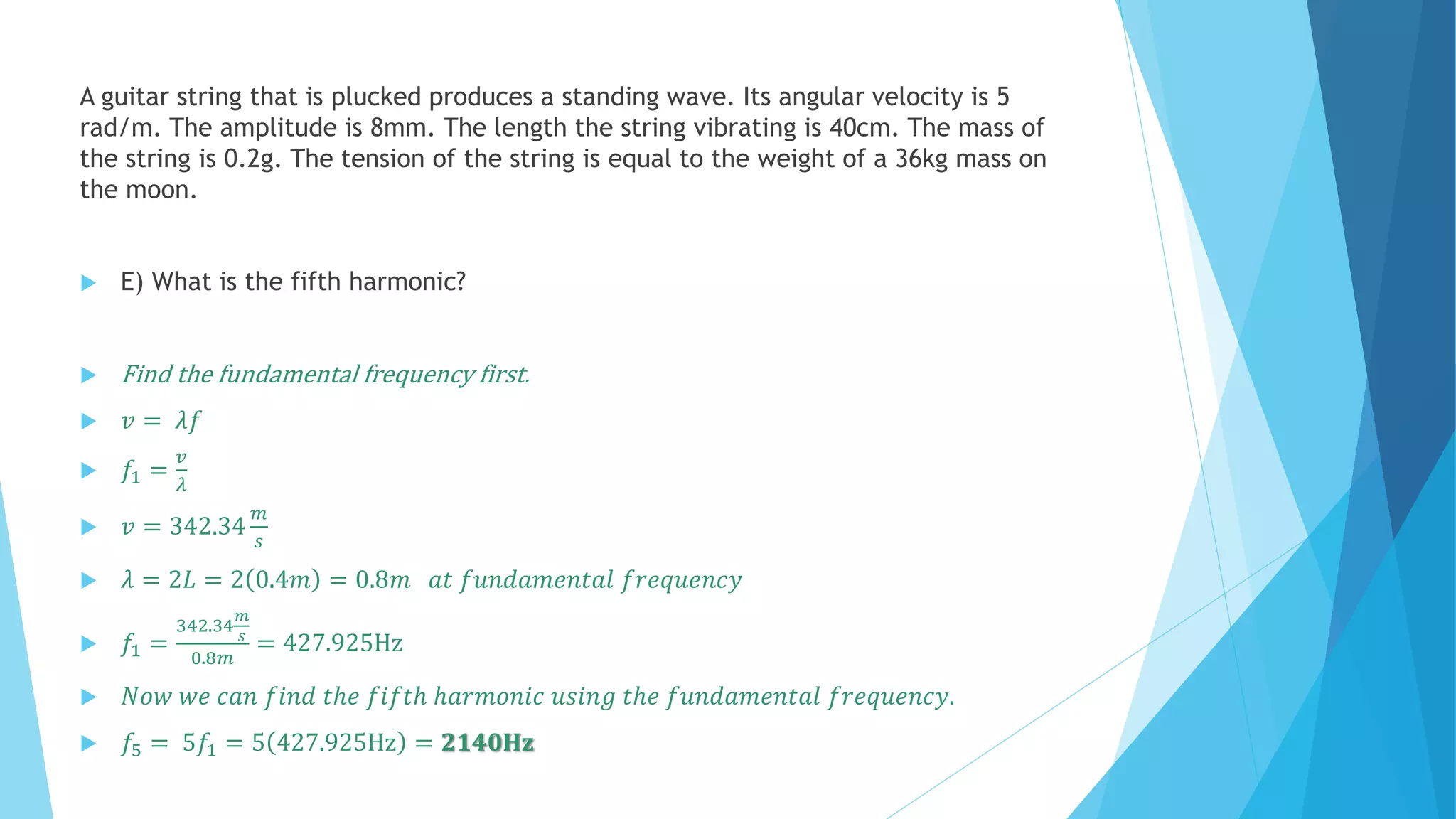
 E) What is the fifth harmonic?
 Find the fundamental frequency first.
 𝑣 = 𝜆𝑓
 𝑓1 =
𝑣
𝜆
 𝑣 = 342.34
𝑚
𝑠
 𝜆 = 2𝐿 = 2 0.4𝑚 = 0.8𝑚 𝑎𝑡 𝑓𝑢𝑛𝑑𝑎𝑚𝑒𝑛𝑡𝑎𝑙 𝑓𝑟𝑒𝑞𝑢𝑒𝑛𝑐𝑦
 𝑓1 =
342.34
𝑚
𝑠
0.8𝑚
= 427.925Hz
 𝑁𝑜𝑤 𝑤𝑒 𝑐𝑎𝑛 𝑓𝑖𝑛𝑑 𝑡ℎ𝑒 𝑓𝑖𝑓𝑡ℎ ℎ𝑎𝑟𝑚𝑜𝑛𝑖𝑐 𝑢𝑠𝑖𝑛𝑔 𝑡ℎ𝑒 𝑓𝑢𝑛𝑑𝑎𝑚𝑒𝑛𝑡𝑎𝑙 𝑓𝑟𝑒𝑞𝑢𝑒𝑛𝑐𝑦.
 𝑓5 = 5𝑓1 = 5 427.925Hz = 𝟐𝟏𝟒𝟎𝐇𝐳
Works Cited
 Wave on a String PhET simulation (wave diagrams)
 https://phet.colorado.edu/en/simulation/wave-on-a-string
 Physics 101 Textbook (definitions and equations)
 Physics for Scientists and Engineers: An Interactive Approach, 1st
Edition
 Robert Hawkes, Javed Iqbal, Firas Mansour, Marina Milner-Bolotin,
and Peter Williams

Standing Waves on Strings

  • 1.
  • 2.
    What is aStanding Wave?  A wave that does not appear to travel.  Created by two harmonic waves of equal amplitude, wavelength and frequency, moving in opposite directions.
  • 3.
    Nodes and Antinodes Nodes occur where the amplitude is always zero. Node Node NodeNode
  • 4.
    Nodes and Antinodes Antinodes occur where the amplitude moves between -2A and 2A, the maximum amplitude. (A – amplitude of constituent harmonic waves) Antinode Antinode
  • 5.
    λ 4 λ 2 3λ 4 λ 5λ 4 λ 2 λ 2 Node toNode Antinode to Antinode Nodes and Antinodes  Consecutive nodes and consecutive antinodes are 𝜆 2 (half a wavelength) apart
  • 6.
     The distancebetween a node and the nearest antinode is 𝜆 4 . Nodes and Antinodes λ 4 λ 2 3λ 4 λ 5λ 4 λ 4 Antinode to Node λ 4 Node to Antinode
  • 7.
    Frequency of StandingWaves on Strings  𝒇 𝒎 = 𝒗 𝝀 𝒎 = 𝒎 𝟐𝑳 𝒗 = 𝒎 𝟐𝑳 𝑻 𝝁 = 𝒎 𝟐𝑳 𝑻 𝑴 𝑳  m = mode number (1, 2, 3, …) (see next slide)  v = wave speed  𝜆 = wavelength  L = length of string  T = tension of the string  M = mass of string  Recall that 𝜇 is the linear mass density of the string 𝑀 𝐿 .
  • 8.
    Normal Modes  Representedas n in the diagram  The mode number corresponds to the number of antinodes on the vibrating string  A mode of 2 is double the frequency of the fundamental frequency (n = 1)  The relationship between the first harmonic and other harmonics is represented by this equation:  𝒇 𝒎 = 𝒎𝒇 𝟏  m is a positive integer > 0
  • 9.
    Harmonics/Resonant Frequencies  Theallowed frequencies represented by the equation:  𝒇 𝒎 = 𝒎𝒇 𝟏  In lab 5, you found the fundamental frequency, the lowest frequency that results in a single antinode at its maximum frequency.  Knowing the fundamental frequency, we can find the harmonics/resonant frequencies.
  • 10.
  • 11.
    #1 - Thefrequency of the fourth harmonic is…  A) Same as the frequency of the 2nd harmonic.  B) 4 3 times greater than the frequency of the 3rd harmonic.  C) Triple the frequency of the fundamental frequency.  D) Double the frequency of the 3rd harmonic.
  • 12.
    The frequency ofthe fourth harmonic is…  A) Same as the frequency of the 2nd harmonic.  B) 𝟒 𝟑 times greater than the frequency of the 3rd harmonic.  C) Triple the frequency of the fundamental frequency.  D) Double the frequency of the 3rd harmonic.  𝒂⦁𝒇 𝟑 = 𝒇 𝟒  𝒂⦁𝟑𝒇 𝟏 = 𝟒𝒇 𝟏  𝒂 = 𝟒𝒇 𝟏 𝟑𝒇 𝟏 = 𝟒 𝟑
  • 13.
    #2 - Aguitar string that is plucked produces a standing wave. Its angular velocity is 5 rad/m. The amplitude is 8mm. The length the string vibrating is 40cm. The mass of the string is 0.2g. The tension of the string is equal to the weight of a 36kg mass on the moon.  A) Imagine that the standing wave is produced by two harmonic waves of equal amplitude, wavelength, and frequency travelling opposite directions. What would be the amplitude of the two constituent waves?  B) Write an equation to represent the amplitude of the standing wave.  C) What is the distance between a node and the nearest antinode?  D) What is the wave speed in the string?  E) What is the fifth harmonic?
  • 14.
    A guitar stringthat is plucked produces a standing wave. Its angular velocity is 5 rad/m. The amplitude is 8mm. The length the string vibrating is 40cm. The mass of the string is 0.2g. The tension of the string is equal to the weight of a 36kg mass on the moon.  A) Imagine that the standing wave is produced by two harmonic waves of equal amplitude, wavelength, and frequency travelling opposite directions. What would be the amplitude of the two constituent waves?  The amplitude of the standing wave is double the amplitude of the constituent wave.  2A = 8mm  A = 4mm
  • 15.
    A guitar stringthat is plucked produces a standing wave. Its angular velocity is 5.0 rad/m. The amplitude is 8.0mm. The length the string vibrating is 40cm. The mass of the string is 0.2g. The tension of the string is equal to the weight of a 36kg mass on the moon.  B) Write an equation to represent the amplitude of the standing wave.  A(x) = A sin(ωx)  A(x) = (8.0 mm)sin(5.0x)
  • 16.
    A guitar stringthat is plucked produces a standing wave. Its angular velocity is 5 rad/m. The amplitude is 8mm. The length the string vibrating is 40cm. The mass of the string is 0.2g. The tension of the string is equal to the weight of a 36kg mass on the moon.  C) What is the distance between a node and the nearest antinode?  Let us find the distance between nodes.  Recall from the text (eq 14-44): 𝑥 = 𝑚 𝜆 2 , where m = 0, ±1, ±2, ±3, …  We know that ω = 5rad/m and ω = 2𝜋 𝜆  5 = 2𝜋 𝜆 𝜆 = 2𝜋 5  m = 0  x = 0  m = 1  x = 𝜆 2 = 2𝜋 2(5) = 𝜋 5  m = 2  x = 𝜆 = 2𝜋 5  (continued on next slide)
  • 17.
    A guitar stringthat is plucked produces a standing wave. Its angular velocity is 5 rad/m. The amplitude is 8mm. The length the string vibrating is 40cm. The mass of the string is 0.2g. The tension of the string is equal to the weight of a 36kg mass on the moon.  C) What is the distance between a node and the nearest antinode?  The location of the nodes are at: x = 0, 𝜋 5 , 2𝜋 5 , …  The location of the first antinode is at: 𝜆 4 = 2𝜋 (4)5 = 𝜋 10  We can find the distance between any node the nearest antinode by finding the distance between the first node and antinode.  The first node is at x = 0  The first antinode is at x = 𝜋 10  𝜋 10 - 0 = 𝝅 𝟏𝟎
  • 18.
    A guitar stringthat is plucked produces a standing wave. Its angular velocity is 5 rad/m. The amplitude is 8mm. The length the string vibrating is 40cm. The mass of the string is 0.2g. The tension of the string is equal to the weight of a 36kg mass on the moon.  D) What is the wave speed in the string?  𝑣 = 𝑇 𝜇  𝜇 = 𝑚 𝑠𝑡𝑟𝑖𝑛𝑔 𝐿 = 0.2 𝑥 10−3 𝑘𝑔 0.4𝑚 = 5 𝑥 10−4 𝑘𝑔 𝑚  𝑇 = 𝑤𝑒𝑖𝑔ℎ𝑡 𝑜𝑓 36𝑘𝑔 𝑚𝑎𝑠𝑠 𝑜𝑛 𝑡ℎ𝑒 𝑚𝑜𝑜𝑛  𝑊𝑒𝑖𝑔ℎ𝑡 = 𝑚𝑔 𝑚𝑜𝑜𝑛  𝑔 𝑚𝑜𝑜𝑛 = 1 6 𝑔 𝑒𝑎𝑟𝑡ℎ = 1 6 (9.81 𝑚 𝑠2) = 1.635 𝑚 𝑠2  𝑇 = 𝑚𝑔 𝑚𝑜𝑜𝑛 = 36𝑘𝑔 1.635 𝑚 𝑠2 = 58.86𝑁  𝑣 = 58.86 5 𝑥 10−4 = 𝟑𝟒𝟐 𝒎 𝒔
  • 19.
    A guitar stringthat is plucked produces a standing wave. Its angular velocity is 5 rad/m. The amplitude is 8mm. The length the string vibrating is 40cm. The mass of the string is 0.2g. The tension of the string is equal to the weight of a 36kg mass on the moon.  E) What is the fifth harmonic?  Find the fundamental frequency first.  𝑣 = 𝜆𝑓  𝑓1 = 𝑣 𝜆  𝑣 = 342.34 𝑚 𝑠  𝜆 = 2𝐿 = 2 0.4𝑚 = 0.8𝑚 𝑎𝑡 𝑓𝑢𝑛𝑑𝑎𝑚𝑒𝑛𝑡𝑎𝑙 𝑓𝑟𝑒𝑞𝑢𝑒𝑛𝑐𝑦  𝑓1 = 342.34 𝑚 𝑠 0.8𝑚 = 427.925Hz  𝑁𝑜𝑤 𝑤𝑒 𝑐𝑎𝑛 𝑓𝑖𝑛𝑑 𝑡ℎ𝑒 𝑓𝑖𝑓𝑡ℎ ℎ𝑎𝑟𝑚𝑜𝑛𝑖𝑐 𝑢𝑠𝑖𝑛𝑔 𝑡ℎ𝑒 𝑓𝑢𝑛𝑑𝑎𝑚𝑒𝑛𝑡𝑎𝑙 𝑓𝑟𝑒𝑞𝑢𝑒𝑛𝑐𝑦.  𝑓5 = 5𝑓1 = 5 427.925Hz = 𝟐𝟏𝟒𝟎𝐇𝐳
  • 20.
    Works Cited  Waveon a String PhET simulation (wave diagrams)  https://phet.colorado.edu/en/simulation/wave-on-a-string  Physics 101 Textbook (definitions and equations)  Physics for Scientists and Engineers: An Interactive Approach, 1st Edition  Robert Hawkes, Javed Iqbal, Firas Mansour, Marina Milner-Bolotin, and Peter Williams