Physics 101 Learning Object (LO6)
By: James Kurniawan
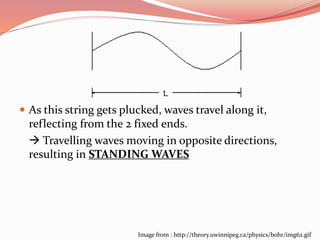
 As this string gets plucked, waves travel along it,
reflecting from the 2 fixed ends.
 Travelling waves moving in opposite directions,
resulting in STANDING WAVES
Image from : http://theory.uwinnipeg.ca/physics/bohr/img62.gif
Wavelength?
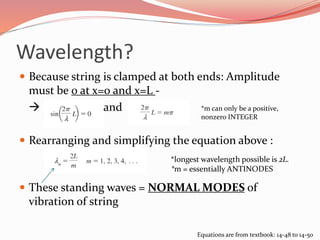
 Because string is clamped at both ends: Amplitude
must be 0 at x=0 and x=L -
 and
 Rearranging and simplifying the equation above :
 These standing waves = NORMAL MODES of
vibration of string
*longest wavelength possible is 2L.
*m = essentially ANTINODES
Equations are from textbook: 14-48 to 14-50
*m can only be a positive,
nonzero INTEGER
Frequency?
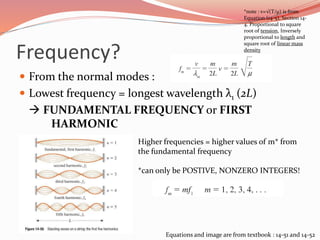
 From the normal modes :
 Lowest frequency = longest wavelength λ1 (2L)
 FUNDAMENTAL FREQUENCY or FIRST
HARMONIC
*note : v=√(T/µ) is from
Equation (14-5), Section 14-
4. Proportional to square
root of tension, Inversely
proportional to length and
square root of linear mass
density
Higher frequencies = higher values of m* from
the fundamental frequency
*can only be POSTIVE, NONZERO INTEGERS!
Equations and image are from textbook : 14-51 and 14-52
Harmonics
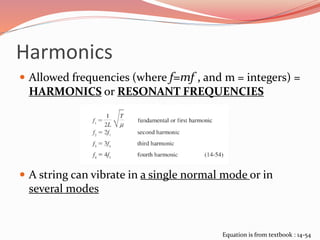
 Allowed frequencies (where f=mf , and m = integers) =
HARMONICS or RESONANT FREQUENCIES
 A string can vibrate in a single normal mode or in
several modes
Equation is from textbook : 14-54
Question
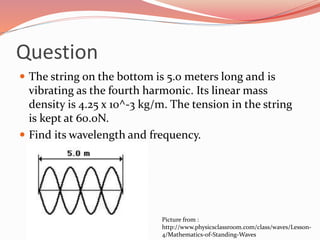
 The string on the bottom is 5.0 meters long and is
vibrating as the fourth harmonic. Its linear mass
density is 4.25 x 10^-3 kg/m. The tension in the string
is kept at 60.0N.
 Find its wavelength and frequency.
Picture from :
http://www.physicsclassroom.com/class/waves/Lesson-
4/Mathematics-of-Standing-Waves
Answer (Part 1)
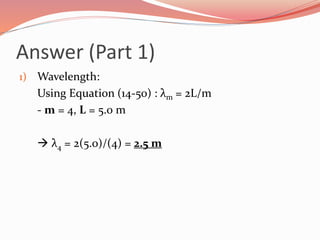
1) Wavelength:
Using Equation (14-50) : λm = 2L/m
- m = 4, L = 5.0 m
 λ4 = 2(5.0)/(4) = 2.5 m
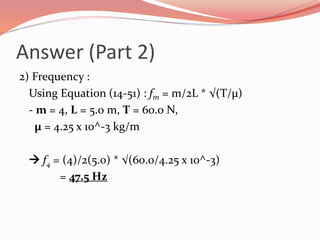
Answer (Part 2)
2) Frequency :
Using Equation (14-51) : fm = m/2L * √(T/µ)
- m = 4, L = 5.0 m, T = 60.0 N,
µ = 4.25 x 10^-3 kg/m
 f4 = (4)/2(5.0) * √(60.0/4.25 x 10^-3)
= 47.5 Hz

PHYS101 Learning Object (LO6)

  • 1.
    Physics 101 LearningObject (LO6) By: James Kurniawan
  • 2.
     As thisstring gets plucked, waves travel along it, reflecting from the 2 fixed ends.  Travelling waves moving in opposite directions, resulting in STANDING WAVES Image from : http://theory.uwinnipeg.ca/physics/bohr/img62.gif
  • 3.
    Wavelength?  Because stringis clamped at both ends: Amplitude must be 0 at x=0 and x=L -  and  Rearranging and simplifying the equation above :  These standing waves = NORMAL MODES of vibration of string *longest wavelength possible is 2L. *m = essentially ANTINODES Equations are from textbook: 14-48 to 14-50 *m can only be a positive, nonzero INTEGER
  • 4.
    Frequency?  From thenormal modes :  Lowest frequency = longest wavelength λ1 (2L)  FUNDAMENTAL FREQUENCY or FIRST HARMONIC *note : v=√(T/µ) is from Equation (14-5), Section 14- 4. Proportional to square root of tension, Inversely proportional to length and square root of linear mass density Higher frequencies = higher values of m* from the fundamental frequency *can only be POSTIVE, NONZERO INTEGERS! Equations and image are from textbook : 14-51 and 14-52
  • 5.
    Harmonics  Allowed frequencies(where f=mf , and m = integers) = HARMONICS or RESONANT FREQUENCIES  A string can vibrate in a single normal mode or in several modes Equation is from textbook : 14-54
  • 6.
    Question  The stringon the bottom is 5.0 meters long and is vibrating as the fourth harmonic. Its linear mass density is 4.25 x 10^-3 kg/m. The tension in the string is kept at 60.0N.  Find its wavelength and frequency. Picture from : http://www.physicsclassroom.com/class/waves/Lesson- 4/Mathematics-of-Standing-Waves
  • 7.
    Answer (Part 1) 1)Wavelength: Using Equation (14-50) : λm = 2L/m - m = 4, L = 5.0 m  λ4 = 2(5.0)/(4) = 2.5 m
  • 8.
    Answer (Part 2) 2)Frequency : Using Equation (14-51) : fm = m/2L * √(T/µ) - m = 4, L = 5.0 m, T = 60.0 N, µ = 4.25 x 10^-3 kg/m  f4 = (4)/2(5.0) * √(60.0/4.25 x 10^-3) = 47.5 Hz