Chapter 3 – Signalling with Electromagnetic Waves How Signals are Sent…
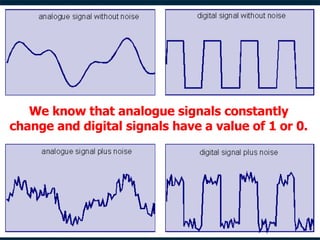
We know that analogue signals constantly change and digital signals have a value of 1 or 0.
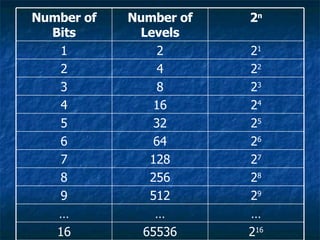
2 1 6 65536 16 … … … 2 9 512 9 2 8 256 8 2 7 128 7 2 6 64 6 2 5 32 5 2 4 16 4 2 3 8 3 2 2 4 2 2 1 2 1 2 n Number of Levels Number of Bits
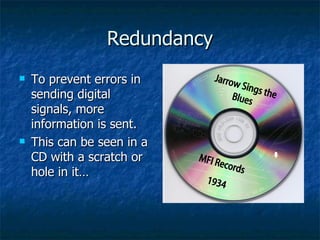
Redundancy To prevent errors in sending digital signals, more information is sent. This can be seen in a CD with a scratch or hole in it… Jarrow Sings the Blues MFI Records 1934
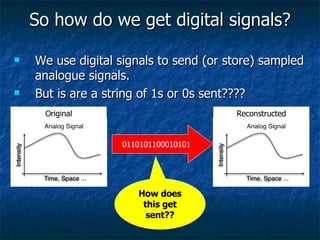
So how do we get digital signals? We use digital signals to send (or store) sampled analogue signals. But is are a string of 1s or 0s sent???? Original Reconstructed 0110101100010101 How does this get sent??
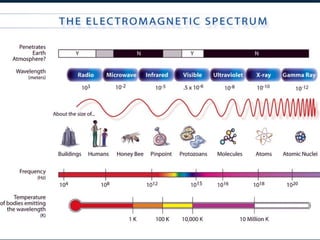
Electromagnetic Radiation From GCSE you should remember the EM Spectrum. An easy way to remember it is: Real Men Invariably Visit Ugly eX Girlfriends
 
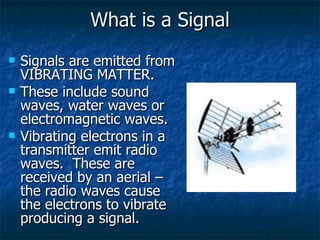
What is a Signal Signals are emitted from VIBRATING MATTER. These include sound waves, water waves or electromagnetic waves. Vibrating electrons in a transmitter emit radio waves.  These are received by an aerial – the radio waves cause the electrons to vibrate producing a signal.
Signal Properties A signal has several characteristics: Amplitude – the maximum displacement Period – time taken for 1 oscillation Frequency – the number of oscillations per second Frequency may not be limited to one – it can be made up of a range of different frequencies…
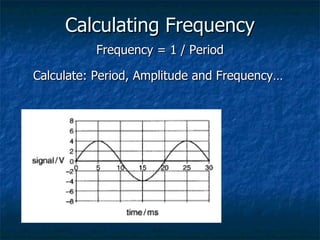
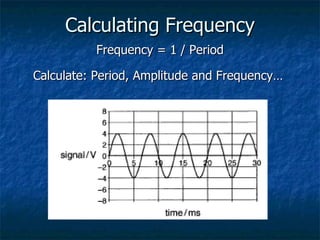
Calculating Frequency Frequency = 1 / Period Calculate: Period, Amplitude and Frequency…
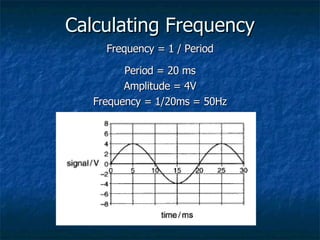
Calculating Frequency Frequency = 1 / Period Period = 20 ms Amplitude = 4V Frequency = 1/20ms = 50Hz
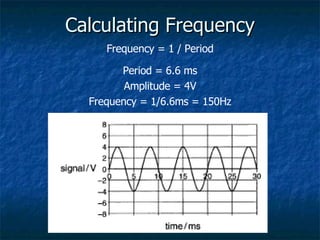
Calculating Frequency Frequency = 1 / Period Calculate: Period, Amplitude and Frequency…
Calculating Frequency Frequency = 1 / Period Period = 6.6 ms Amplitude = 4V Frequency = 1/6.6ms = 150Hz
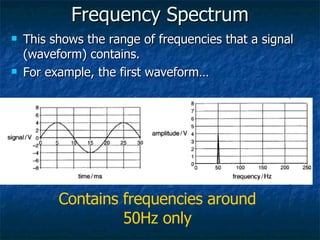
Frequency Spectrum This shows the range of frequencies that a signal (waveform) contains. For example, the first waveform… Contains frequencies around 50Hz only
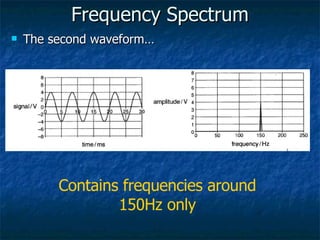
Frequency Spectrum The second waveform… Contains frequencies around 150Hz only
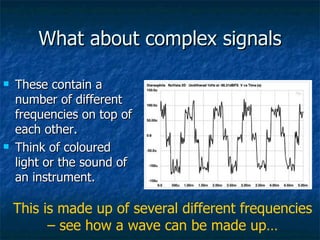
What about complex signals These contain a number of different frequencies on top of each other. Think of coloured light or the sound of an instrument. This is made up of several different frequencies – see how a wave can be made up…
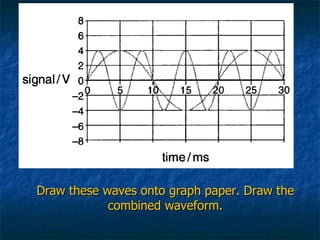
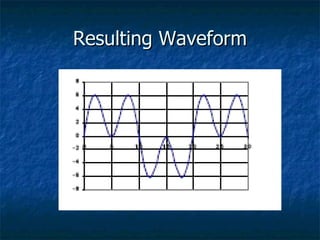
Draw these waves onto graph paper. Draw the combined waveform.
Resulting Waveform

Chapter 3

  • 1.
    Chapter 3 –Signalling with Electromagnetic Waves How Signals are Sent…
  • 2.
    We know thatanalogue signals constantly change and digital signals have a value of 1 or 0.
  • 3.
    2 1 665536 16 … … … 2 9 512 9 2 8 256 8 2 7 128 7 2 6 64 6 2 5 32 5 2 4 16 4 2 3 8 3 2 2 4 2 2 1 2 1 2 n Number of Levels Number of Bits
  • 4.
    Redundancy To preventerrors in sending digital signals, more information is sent. This can be seen in a CD with a scratch or hole in it… Jarrow Sings the Blues MFI Records 1934
  • 5.
    So how dowe get digital signals? We use digital signals to send (or store) sampled analogue signals. But is are a string of 1s or 0s sent???? Original Reconstructed 0110101100010101 How does this get sent??
  • 6.
    Electromagnetic Radiation FromGCSE you should remember the EM Spectrum. An easy way to remember it is: Real Men Invariably Visit Ugly eX Girlfriends
  • 7.
  • 8.
    What is aSignal Signals are emitted from VIBRATING MATTER. These include sound waves, water waves or electromagnetic waves. Vibrating electrons in a transmitter emit radio waves. These are received by an aerial – the radio waves cause the electrons to vibrate producing a signal.
  • 9.
    Signal Properties Asignal has several characteristics: Amplitude – the maximum displacement Period – time taken for 1 oscillation Frequency – the number of oscillations per second Frequency may not be limited to one – it can be made up of a range of different frequencies…
  • 10.
    Calculating Frequency Frequency= 1 / Period Calculate: Period, Amplitude and Frequency…
  • 11.
    Calculating Frequency Frequency= 1 / Period Period = 20 ms Amplitude = 4V Frequency = 1/20ms = 50Hz
  • 12.
    Calculating Frequency Frequency= 1 / Period Calculate: Period, Amplitude and Frequency…
  • 13.
    Calculating Frequency Frequency= 1 / Period Period = 6.6 ms Amplitude = 4V Frequency = 1/6.6ms = 150Hz
  • 14.
    Frequency Spectrum Thisshows the range of frequencies that a signal (waveform) contains. For example, the first waveform… Contains frequencies around 50Hz only
  • 15.
    Frequency Spectrum Thesecond waveform… Contains frequencies around 150Hz only
  • 16.
    What about complexsignals These contain a number of different frequencies on top of each other. Think of coloured light or the sound of an instrument. This is made up of several different frequencies – see how a wave can be made up…
  • 17.
    Draw these wavesonto graph paper. Draw the combined waveform.
  • 18.