WHAT IS A STANDING WAVE?
• The vibration modes associated with strings
, for example, have patterns called standing
waves.
• Standing waves are combinations of two
waves moving in opposite directions to
each other.
• They have particular points that are fixed
(frequency for e.g.), whereas other points
between them vibrate with a maximum
amplitude.
NODES & ANTI-NODES
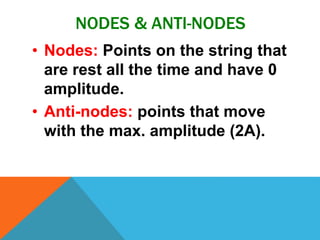
• Nodes: Points on the string that
are rest all the time and have 0
amplitude.
• Anti-nodes: points that move
with the max. amplitude (2A).
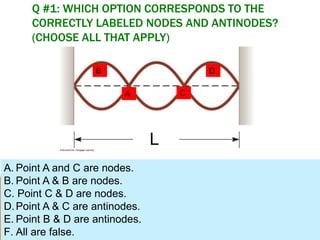
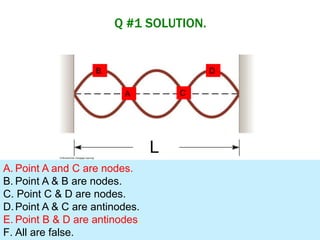
Q #1: WHICH OPTION CORRESPONDS TO THE
CORRECTLY LABELED NODES AND ANTINODES?
(CHOOSE ALL THAT APPLY)
A. Point A and C are nodes.
B. Point A & B are nodes.
C. Point C & D are nodes.
D.Point A & C are antinodes.
E. Point B & D are antinodes.
F. All are false.
A C
DB
Q #1 SOLUTION.
A. Point A and C are nodes.
B. Point A & B are nodes.
C. Point C & D are nodes.
D.Point A & C are antinodes.
E. Point B & D are antinodes.
F. All are false.
A C
DB
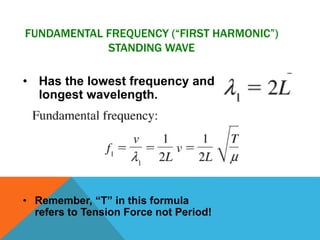
FUNDAMENTAL FREQUENCY (“FIRST HARMONIC”)
STANDING WAVE
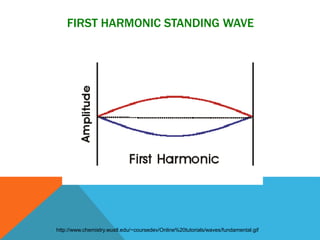
• Has the lowest frequency and
longest wavelength.
• Remember, “T” in this formula
refers to Tension Force not Period!
FIRST HARMONIC STANDING WAVE
http://www.chemistry.wustl.edu/~coursedev/Online%20tutorials/waves/fundamental.gif
Q#2: TRUE OR FALSE? IF THE LENGTH OF THE
STRING IS INCREASED, THE FUNDAMENTAL
FREQUENCY WILL DECREASE.
A)True
B)False
Q#2 SOLUTION.
A) True
B) False
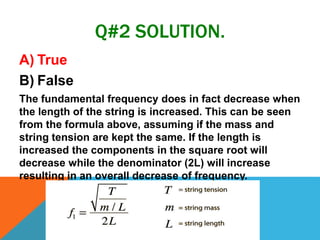
The fundamental frequency does in fact decrease when
the length of the string is increased. This can be seen
from the formula above, assuming if the mass and
string tension are kept the same. If the length is
increased the components in the square root will
decrease while the denominator (2L) will increase
resulting in an overall decrease of frequency.
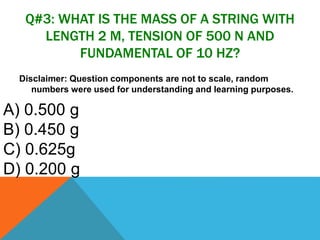
Q#3: WHAT IS THE MASS OF A STRING WITH
LENGTH 2 M, TENSION OF 500 N AND
FUNDAMENTAL OF 10 HZ?
Disclaimer: Question components are not to scale, random
numbers were used for understanding and learning purposes.
A) 0.500 g
B) 0.450 g
C) 0.625g
D) 0.200 g
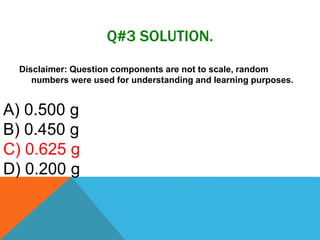
Q#3 SOLUTION.
Disclaimer: Question components are not to scale, random
numbers were used for understanding and learning purposes.
A) 0.500 g
B) 0.450 g
C) 0.625 g
D) 0.200 g
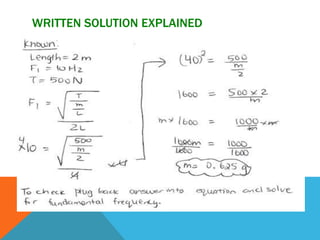
WRITTEN SOLUTION EXPLAINED
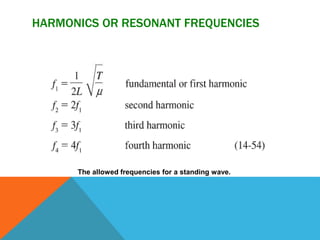
HARMONICS OR RESONANT FREQUENCIES
The allowed frequencies for a standing wave.
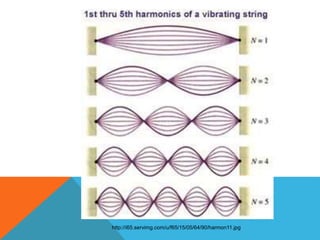
http://i65.servimg.com/u/f65/15/05/64/90/harmon11.jpg
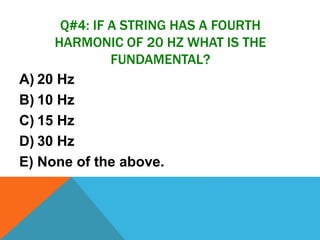
Q#4: IF A STRING HAS A FOURTH
HARMONIC OF 20 HZ WHAT IS THE
FUNDAMENTAL?
A) 20 Hz
B) 10 Hz
C) 15 Hz
D) 30 Hz
E) None of the above.
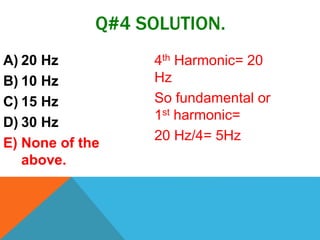
Q#4 SOLUTION.
A) 20 Hz
B) 10 Hz
C) 15 Hz
D) 30 Hz
E) None of the
above.
4th Harmonic= 20
Hz
So fundamental or
1st harmonic=
20 Hz/4= 5Hz
THANK
YOU!

Standing waves final ppt

  • 2.
    WHAT IS ASTANDING WAVE? • The vibration modes associated with strings , for example, have patterns called standing waves. • Standing waves are combinations of two waves moving in opposite directions to each other. • They have particular points that are fixed (frequency for e.g.), whereas other points between them vibrate with a maximum amplitude.
  • 3.
    NODES & ANTI-NODES •Nodes: Points on the string that are rest all the time and have 0 amplitude. • Anti-nodes: points that move with the max. amplitude (2A).
  • 4.
    Q #1: WHICHOPTION CORRESPONDS TO THE CORRECTLY LABELED NODES AND ANTINODES? (CHOOSE ALL THAT APPLY) A. Point A and C are nodes. B. Point A & B are nodes. C. Point C & D are nodes. D.Point A & C are antinodes. E. Point B & D are antinodes. F. All are false. A C DB
  • 5.
    Q #1 SOLUTION. A.Point A and C are nodes. B. Point A & B are nodes. C. Point C & D are nodes. D.Point A & C are antinodes. E. Point B & D are antinodes. F. All are false. A C DB
  • 6.
    FUNDAMENTAL FREQUENCY (“FIRSTHARMONIC”) STANDING WAVE • Has the lowest frequency and longest wavelength. • Remember, “T” in this formula refers to Tension Force not Period!
  • 7.
    FIRST HARMONIC STANDINGWAVE http://www.chemistry.wustl.edu/~coursedev/Online%20tutorials/waves/fundamental.gif
  • 8.
    Q#2: TRUE ORFALSE? IF THE LENGTH OF THE STRING IS INCREASED, THE FUNDAMENTAL FREQUENCY WILL DECREASE. A)True B)False
  • 9.
    Q#2 SOLUTION. A) True B)False The fundamental frequency does in fact decrease when the length of the string is increased. This can be seen from the formula above, assuming if the mass and string tension are kept the same. If the length is increased the components in the square root will decrease while the denominator (2L) will increase resulting in an overall decrease of frequency.
  • 10.
    Q#3: WHAT ISTHE MASS OF A STRING WITH LENGTH 2 M, TENSION OF 500 N AND FUNDAMENTAL OF 10 HZ? Disclaimer: Question components are not to scale, random numbers were used for understanding and learning purposes. A) 0.500 g B) 0.450 g C) 0.625g D) 0.200 g
  • 11.
    Q#3 SOLUTION. Disclaimer: Questioncomponents are not to scale, random numbers were used for understanding and learning purposes. A) 0.500 g B) 0.450 g C) 0.625 g D) 0.200 g
  • 12.
  • 13.
    HARMONICS OR RESONANTFREQUENCIES The allowed frequencies for a standing wave.
  • 14.
  • 15.
    Q#4: IF ASTRING HAS A FOURTH HARMONIC OF 20 HZ WHAT IS THE FUNDAMENTAL? A) 20 Hz B) 10 Hz C) 15 Hz D) 30 Hz E) None of the above.
  • 16.
    Q#4 SOLUTION. A) 20Hz B) 10 Hz C) 15 Hz D) 30 Hz E) None of the above. 4th Harmonic= 20 Hz So fundamental or 1st harmonic= 20 Hz/4= 5Hz
  • 17.