CIRCULAR MOTION
CONTENTS
• CIRCULAR MOTION
• ANGULAR DISPLACEMENT
• ANGULAR SPEED
• ANGULAR VELOCITY
• CENTRIPETAL FORCES &
ACCELERATION
CIRCULAR MOTION
• If an object/ body is moving along a
circular path it is said to be in circular
motion.
• Uniform circular motion : If the object
move with uniform speed along the
circular path, it is said to have uniform
circular motion.
• http://www.animations.physics.unsw.edu.a
u/mechanics/chapter3_circularmotion.html
#3.1
Angular displacement
• The angle through which the radius
vector representing the position of a
particle rotates is called angular
displacement
• The change in position of the particle in
a circular path with respect to its centre
is called angular displacement.
• The angular displacement of a body
with respect to a reference line is
denoted as θ.
Angular Displacement Units
• The angular displacement can be
measured in degree.
• But the S.I. Unit for angular displacement
is Radians.
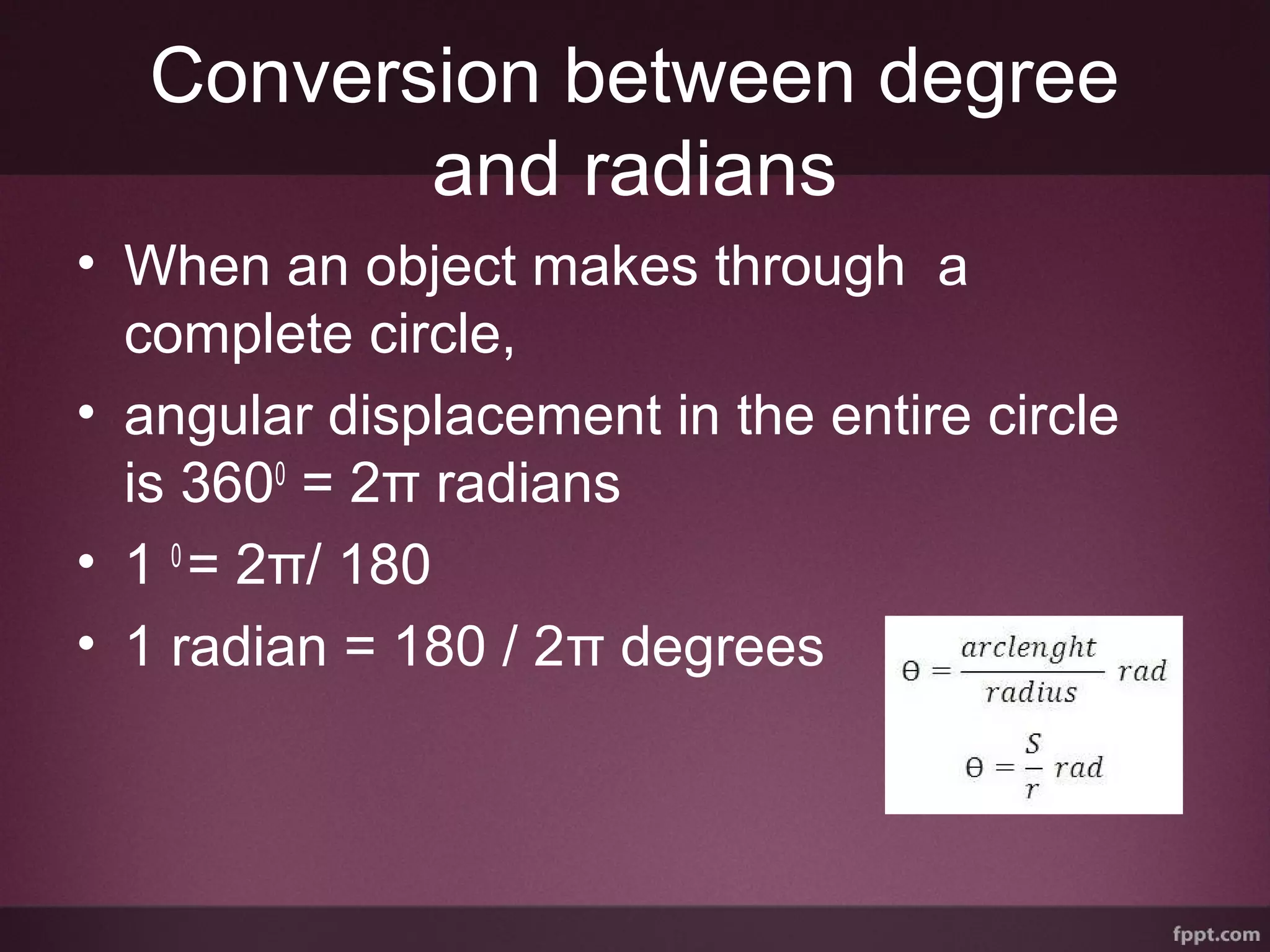
• One radian is defined as the angle
subtended at the centre of a circle by
an arc which is equal to length of the
arc divided by the radius of the circle.
Conversion between degree
and radians
• When an object makes through a
complete circle,
• angular displacement in the entire circle
is 3600
= 2π radians
• 1 0
= 2π/ 180
• 1 radian = 180 / 2π degrees
Question to check how far you
understood
• By how many degrees does the angular
displacement of the hour hand of a clock
change each hour ?
Speed steady , but velocity ?
• An object moving in uniform circular motion is
moving in a circle with a uniform or constant
speed.
• Is it accelerating ?
• Yes, because, it is changing the velocity.
• Since velocity is a vector which has both
magnitude and direction, a change in either the
magnitude or the direction constitutes a change
in the velocity.
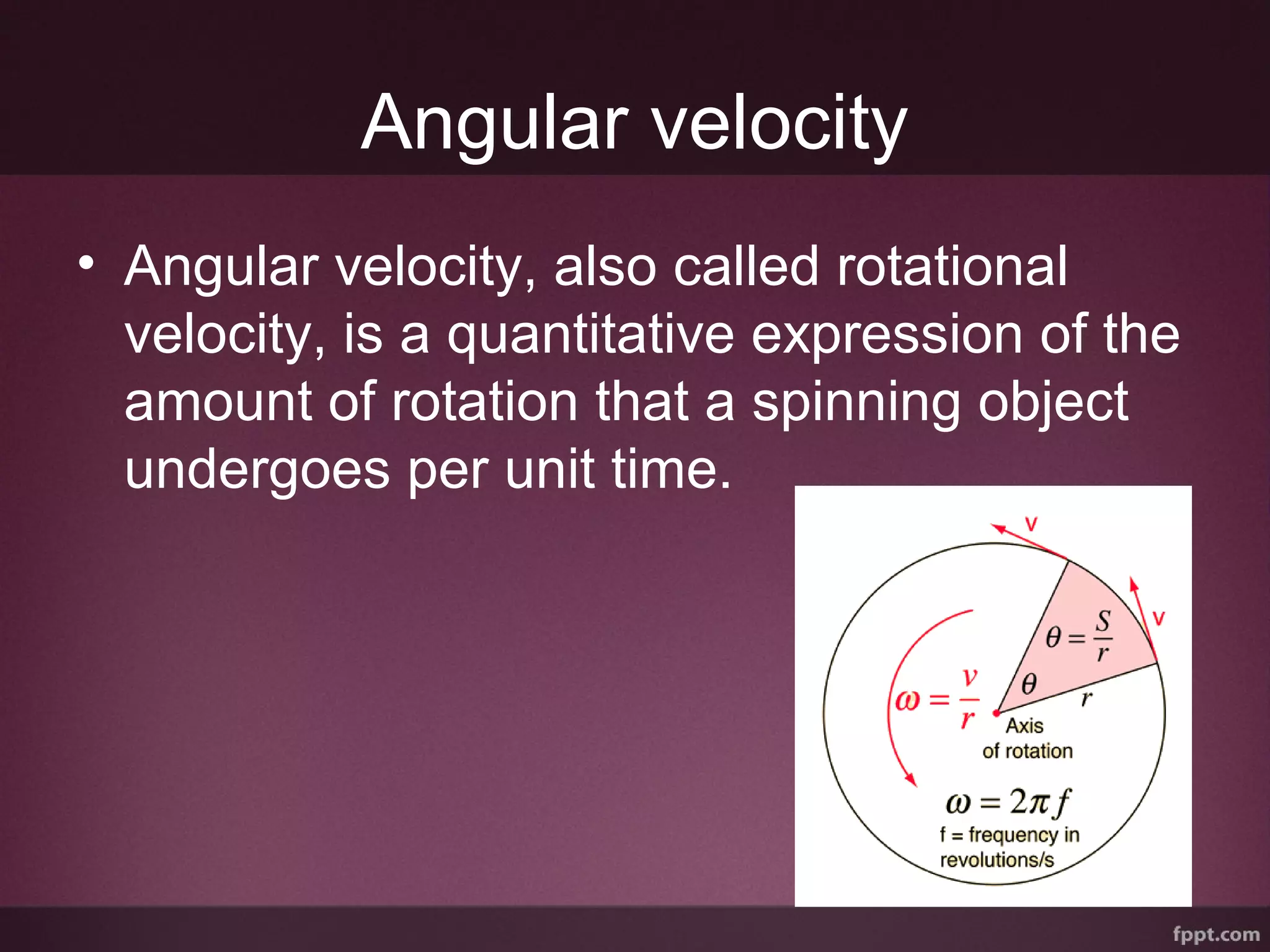
Angular velocity
• Angular velocity, also called rotational
velocity, is a quantitative expression of the
amount of rotation that a spinning object
undergoes per unit time.
Vector – angular velocity
Centripetal acceleration
• An object moving in a circle is
experiencing acceleration. Even if moving
around the perimeter of the circle with a
constant speed, there is still a change in
velocity and subsequently an acceleration.
This acceleration is directed TOWARDS
THE CENTER of the circle.
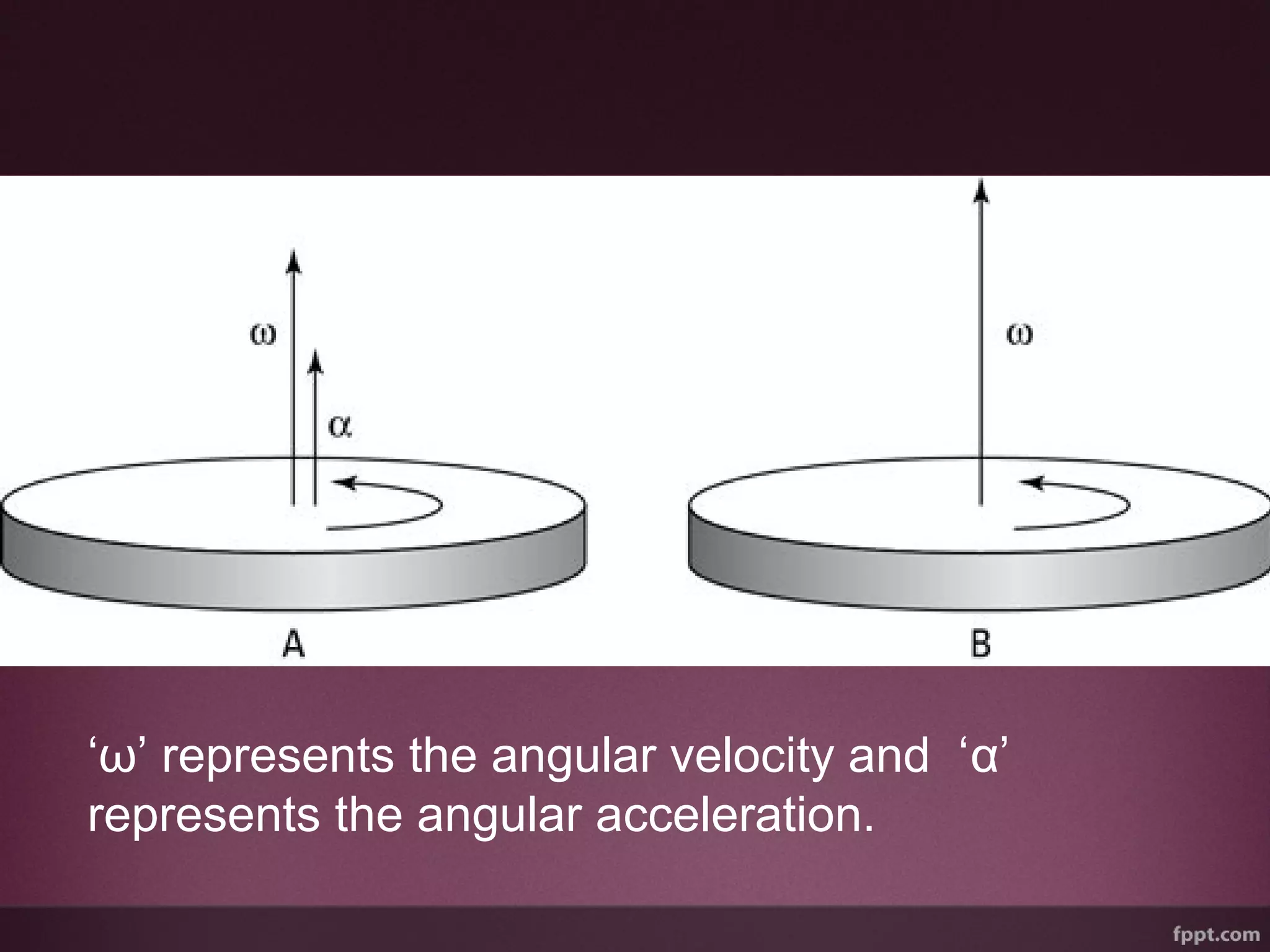
‘ω’ represents the angular velocity and ‘α’
represents the angular acceleration.
Centripetal force
• According to Newton’s second
law of motion, every object which
has an acceleration will
experience a net force in the
direction of acceleration.
Centripetal force
http://w3.shorecrest.org/~Lisa_Peck/Physics/syllabus/mechanics/circularmotion/Images/
wi1.gif
So for an object moving in a circle, there
must be an inward force acting upon it
in order to cause its inward acceleration
which is called centripetal force.
The word "centripetal" means CENTER-
SEEKING. For objects moving in circular
motion, there is a net force acting
towards the center which causes the
object to seek the center.
Centripetal force
http://www.regentsprep.org/regents/physics/phys06/bcentrif/default.htm
http://phet.colorado.edu/en/simulation/legacy/gravity-and-orbits
Questions.
End of the chapter questions.

Circular motion

  • 1.
  • 2.
    CONTENTS • CIRCULAR MOTION •ANGULAR DISPLACEMENT • ANGULAR SPEED • ANGULAR VELOCITY • CENTRIPETAL FORCES & ACCELERATION
  • 3.
    CIRCULAR MOTION • Ifan object/ body is moving along a circular path it is said to be in circular motion. • Uniform circular motion : If the object move with uniform speed along the circular path, it is said to have uniform circular motion. • http://www.animations.physics.unsw.edu.a u/mechanics/chapter3_circularmotion.html #3.1
  • 4.
    Angular displacement • Theangle through which the radius vector representing the position of a particle rotates is called angular displacement • The change in position of the particle in a circular path with respect to its centre is called angular displacement. • The angular displacement of a body with respect to a reference line is denoted as θ.
  • 5.
    Angular Displacement Units •The angular displacement can be measured in degree. • But the S.I. Unit for angular displacement is Radians. • One radian is defined as the angle subtended at the centre of a circle by an arc which is equal to length of the arc divided by the radius of the circle.
  • 6.
    Conversion between degree andradians • When an object makes through a complete circle, • angular displacement in the entire circle is 3600 = 2π radians • 1 0 = 2π/ 180 • 1 radian = 180 / 2π degrees
  • 7.
    Question to checkhow far you understood • By how many degrees does the angular displacement of the hour hand of a clock change each hour ?
  • 8.
    Speed steady ,but velocity ? • An object moving in uniform circular motion is moving in a circle with a uniform or constant speed. • Is it accelerating ? • Yes, because, it is changing the velocity. • Since velocity is a vector which has both magnitude and direction, a change in either the magnitude or the direction constitutes a change in the velocity.
  • 9.
    Angular velocity • Angularvelocity, also called rotational velocity, is a quantitative expression of the amount of rotation that a spinning object undergoes per unit time.
  • 10.
  • 11.
    Centripetal acceleration • Anobject moving in a circle is experiencing acceleration. Even if moving around the perimeter of the circle with a constant speed, there is still a change in velocity and subsequently an acceleration. This acceleration is directed TOWARDS THE CENTER of the circle.
  • 13.
    ‘ω’ represents theangular velocity and ‘α’ represents the angular acceleration.
  • 14.
    Centripetal force • Accordingto Newton’s second law of motion, every object which has an acceleration will experience a net force in the direction of acceleration.
  • 15.
    Centripetal force http://w3.shorecrest.org/~Lisa_Peck/Physics/syllabus/mechanics/circularmotion/Images/ wi1.gif So foran object moving in a circle, there must be an inward force acting upon it in order to cause its inward acceleration which is called centripetal force. The word "centripetal" means CENTER- SEEKING. For objects moving in circular motion, there is a net force acting towards the center which causes the object to seek the center.
  • 16.
  • 17.
    Questions. End of thechapter questions.