PROJECTILE MOTION


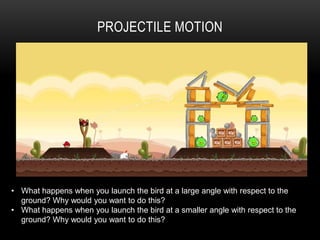
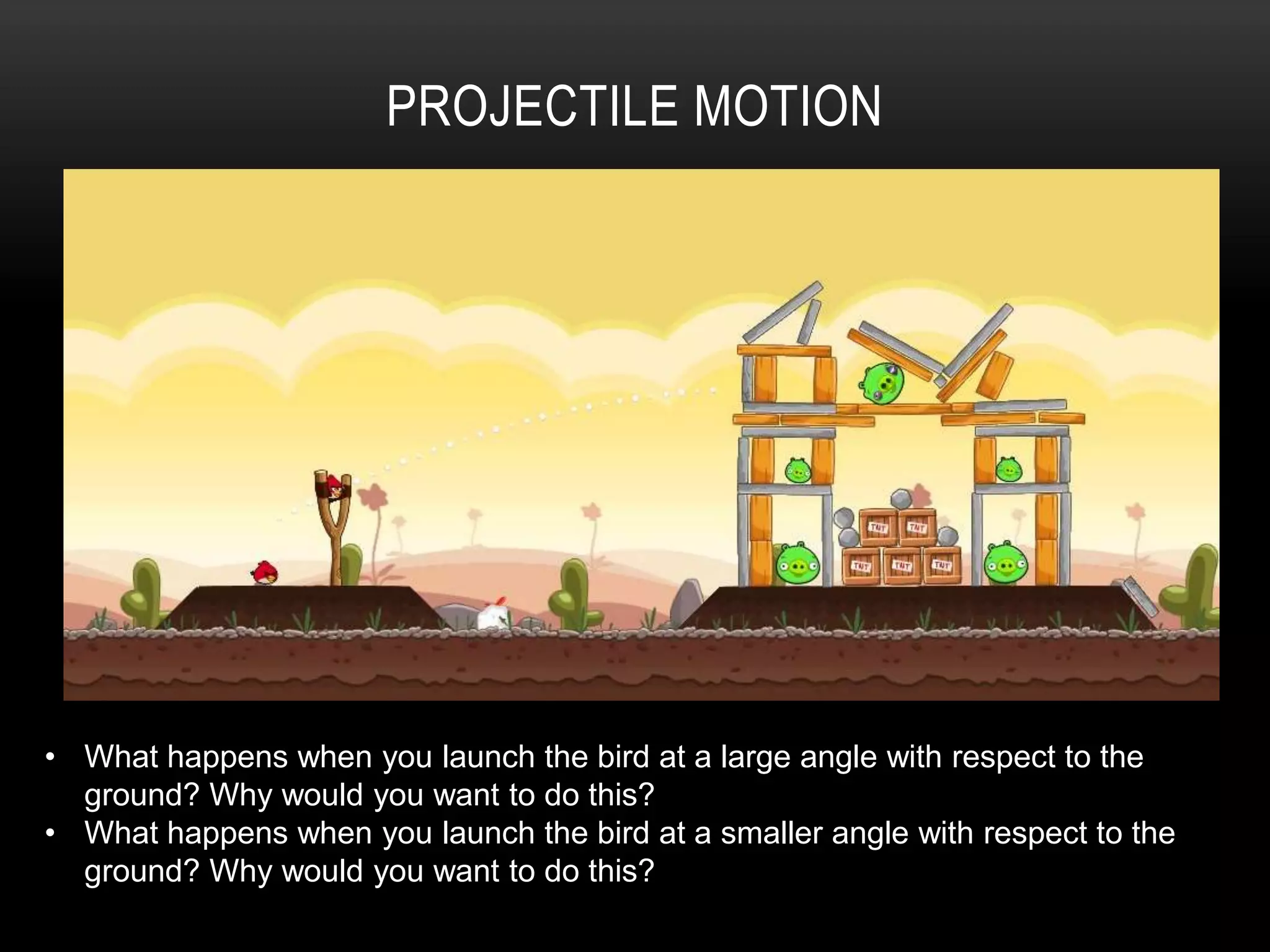
• What happens when you launch the bird at a large angle with respect to the
  ground? Why would you want to do this?
• What happens when you launch the bird at a smaller angle with respect to the
  ground? Why would you want to do this?
PROJECTILE MOTION
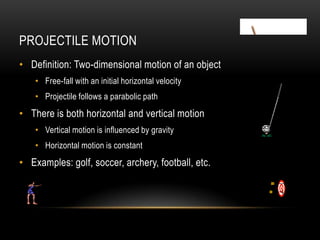
• Definition: Two-dimensional motion of an object
    • Free-fall with an initial horizontal velocity
    • Projectile follows a parabolic path
• There is both horizontal and vertical motion
    • Vertical motion is influenced by gravity
    • Horizontal motion is constant
• Examples: golf, soccer, archery, football, etc.
PROJECTILE MOTION
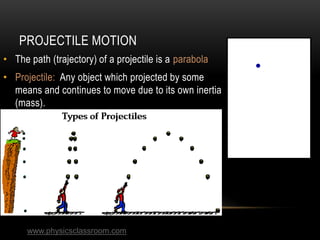
• The path (trajectory) of a projectile is a parabola
• Projectile: Any object which projected by some
  means and continues to move due to its own inertia
  (mass).


      www.physicsclassroom.com
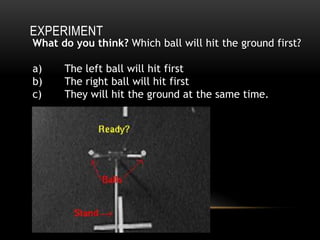
EXPERIMENT
What do you think? Which ball will hit the ground first?

a)    The left ball will hit first
b)    The right ball will hit first
c)    They will hit the ground at the same time.
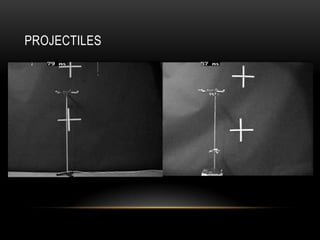
PROJECTILES
PROJECTILE MOTION
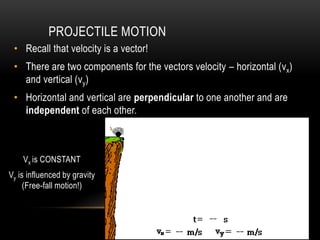
 • Recall that velocity is a vector!
 • There are two components for the vectors velocity – horizontal (vx)
   and vertical (vy)
 • Horizontal and vertical are perpendicular to one another and are
   independent of each other.


    Vx is CONSTANT
Vy is influenced by gravity
     (Free-fall motion!)
PROJECTILE MOTION


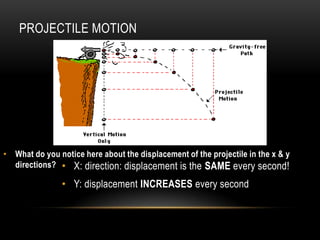
• What do you notice here about the displacement of the projectile in the x & y
  directions? • X: direction: displacement is the SAME every second!

                • Y: displacement INCREASES every second
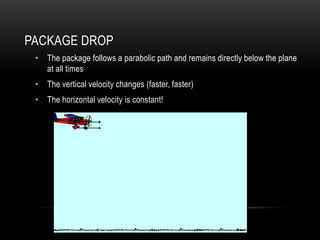
PACKAGE DROP
 • The package follows a parabolic path and remains directly below the plane
   at all times
 • The vertical velocity changes (faster, faster)
 • The horizontal velocity is constant!
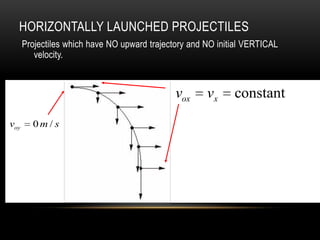
HORIZONTALLY LAUNCHED PROJECTILES
      Projectiles which have NO upward trajectory and NO initial VERTICAL
         velocity.


                                              vox     vx     constant
voy     0m/ s
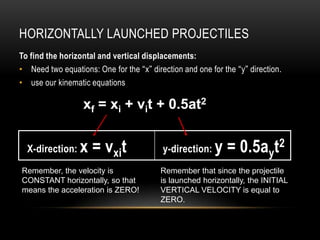
HORIZONTALLY LAUNCHED PROJECTILES
To find the horizontal and vertical displacements:
• Need two equations: One for the “x” direction and one for the “y” direction.
• use our kinematic equations

                   xf = xi + vit + 0.5at2

             x
  X-direction:    x =oxtxit
                    vv                    y-direction:    y = 0.5ayt2
Remember, the velocity is                 Remember that since the projectile
CONSTANT horizontally, so that            is launched horizontally, the INITIAL
means the acceleration is ZERO!           VERTICAL VELOCITY is equal to
                                          ZERO.
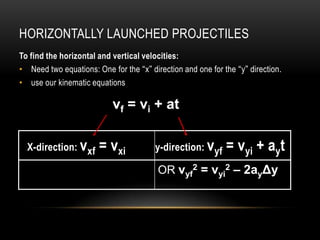
HORIZONTALLY LAUNCHED PROJECTILES
To find the horizontal and vertical velocities:
• Need two equations: One for the “x” direction and one for the “y” direction.
• use our kinematic equations

                           vf = vi + at

  X-direction: vxfv= t xi
             x ox v                     y-direction: vyf     = vyi + ayt
                                         OR vyf2 = vyi2 – 2ayΔy
HORIZONTALLY LAUNCHED PROJECTILES
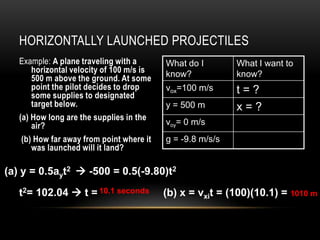
   Example: A plane traveling with a       What do I        What I want to
       horizontal velocity of 100 m/s is   know?            know?
       500 m above the ground. At some
       point the pilot decides to drop     vox=100 m/s      t=?
       some supplies to designated
       target below.                       y = 500 m        x=?
   (a) How long are the supplies in the
       air?                                voy= 0 m/s
    (b) How far away from point where it   g = -9.8 m/s/s
       was launched will it land?

(a) y = 0.5ayt2  -500 = 0.5(-9.80)t2

   t2= 102.04  t = 10.1 seconds           (b) x = vxit = (100)(10.1) = 1010 m
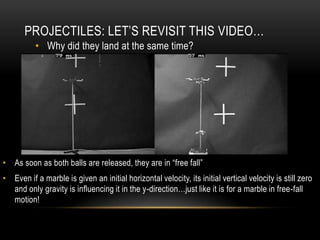
PROJECTILES: LET’S REVISIT THIS VIDEO…
          • Why did they land at the same time?


• As soon as both balls are released, they are in “free fall”
• Even if a marble is given an initial horizontal velocity, its initial vertical velocity is still zero
  and only gravity is influencing it in the y-direction…just like it is for a marble in free-fall
  motion!

Physics -vectors-projectile motion

  • 1.
    PROJECTILE MOTION • Whathappens when you launch the bird at a large angle with respect to the ground? Why would you want to do this? • What happens when you launch the bird at a smaller angle with respect to the ground? Why would you want to do this?
  • 2.
    PROJECTILE MOTION • Definition:Two-dimensional motion of an object • Free-fall with an initial horizontal velocity • Projectile follows a parabolic path • There is both horizontal and vertical motion • Vertical motion is influenced by gravity • Horizontal motion is constant • Examples: golf, soccer, archery, football, etc.
  • 3.
    PROJECTILE MOTION • Thepath (trajectory) of a projectile is a parabola • Projectile: Any object which projected by some means and continues to move due to its own inertia (mass). www.physicsclassroom.com
  • 4.
    EXPERIMENT What do youthink? Which ball will hit the ground first? a) The left ball will hit first b) The right ball will hit first c) They will hit the ground at the same time.
  • 5.
  • 6.
    PROJECTILE MOTION •Recall that velocity is a vector! • There are two components for the vectors velocity – horizontal (vx) and vertical (vy) • Horizontal and vertical are perpendicular to one another and are independent of each other. Vx is CONSTANT Vy is influenced by gravity (Free-fall motion!)
  • 7.
    PROJECTILE MOTION • Whatdo you notice here about the displacement of the projectile in the x & y directions? • X: direction: displacement is the SAME every second! • Y: displacement INCREASES every second
  • 8.
    PACKAGE DROP •The package follows a parabolic path and remains directly below the plane at all times • The vertical velocity changes (faster, faster) • The horizontal velocity is constant!
  • 9.
    HORIZONTALLY LAUNCHED PROJECTILES Projectiles which have NO upward trajectory and NO initial VERTICAL velocity. vox vx constant voy 0m/ s
  • 10.
    HORIZONTALLY LAUNCHED PROJECTILES Tofind the horizontal and vertical displacements: • Need two equations: One for the “x” direction and one for the “y” direction. • use our kinematic equations xf = xi + vit + 0.5at2 x X-direction: x =oxtxit vv y-direction: y = 0.5ayt2 Remember, the velocity is Remember that since the projectile CONSTANT horizontally, so that is launched horizontally, the INITIAL means the acceleration is ZERO! VERTICAL VELOCITY is equal to ZERO.
  • 11.
    HORIZONTALLY LAUNCHED PROJECTILES Tofind the horizontal and vertical velocities: • Need two equations: One for the “x” direction and one for the “y” direction. • use our kinematic equations vf = vi + at X-direction: vxfv= t xi x ox v y-direction: vyf = vyi + ayt OR vyf2 = vyi2 – 2ayΔy
  • 12.
    HORIZONTALLY LAUNCHED PROJECTILES Example: A plane traveling with a What do I What I want to horizontal velocity of 100 m/s is know? know? 500 m above the ground. At some point the pilot decides to drop vox=100 m/s t=? some supplies to designated target below. y = 500 m x=? (a) How long are the supplies in the air? voy= 0 m/s (b) How far away from point where it g = -9.8 m/s/s was launched will it land? (a) y = 0.5ayt2  -500 = 0.5(-9.80)t2 t2= 102.04  t = 10.1 seconds (b) x = vxit = (100)(10.1) = 1010 m
  • 13.
    PROJECTILES: LET’S REVISITTHIS VIDEO… • Why did they land at the same time? • As soon as both balls are released, they are in “free fall” • Even if a marble is given an initial horizontal velocity, its initial vertical velocity is still zero and only gravity is influencing it in the y-direction…just like it is for a marble in free-fall motion!