A wave is a vibratory disturbance 
through a material (medium) or 
space. 
Waves transfer energy without 
transferring mass.
No medium required. 
Travel at the speed of light . 
c = 3 x 10⁸ m/s 
Examples: visible light, x-rays, infrared rays
MECHANICHAL WAVES 
Require a medium ex. Sound, water, waves in 
springs. 
• Longitudinal waves 
Examples - sound, seismic s-waves 
• Transverse waves 
Examples: light, seismic p-waves, water
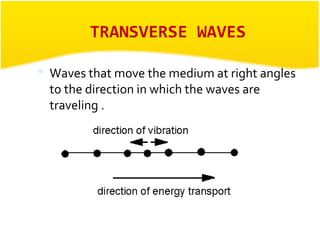
TRANSVERSE WAVES 
 Waves that move the medium at right angles 
to the direction in which the waves are 
traveling .
CREST AND TROUGH 
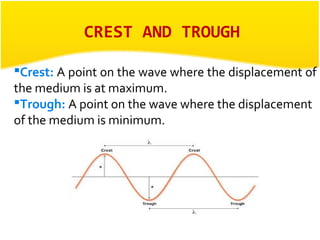
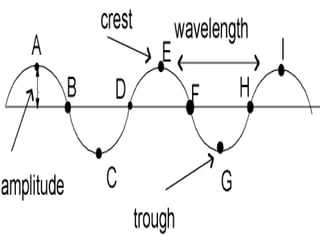
Crest: A point on the wave where the displacement of 
the medium is at maximum. 
Trough: A point on the wave where the displacement 
of the medium is minimum.
LONGITUDINAL WAVES 
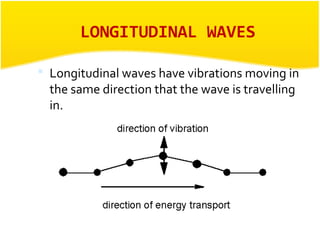
 Longitudinal waves have vibrations moving in 
the same direction that the wave is travelling 
in.
COMPRESSSION AND 
RAREFRACTION 
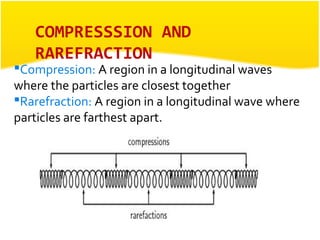
Compression: A region in a longitudinal waves 
where the particles are closest together. 
Rarefraction: A region in a longitudinal wave where 
particles are farthest apart.
PROPERTIES OF WAVES 
 Amplitude 
 Frequency 
 Speed 
 wavelength
AMPLITUDE 
 Maximum distance the particles of the 
medium carrying the wave move away from 
their rest positions. 
 Amplitude of a transverse wave is the 
maximum distance the medium moves up or 
down from its rest position. 
 Amplitude of a longitudinal wave is a 
measure of how compressed or rarefied the 
medium becomes.
WAVELENGTH 
 A wave travels a certain distance before it 
starts to repeat. The distance between two 
corresponding parts of a wave is its 
wavelength. 
 Transverse measure from crest to crest or 
trough to trough. 
 Longitudinal measure from one compression 
to the next.
The number of complete waves that pass a given 
point in a certain amount of time. 
Frequency measured in hertz
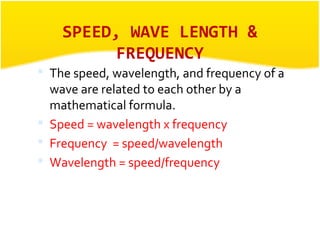
SPEED, WAVE LENGTH & 
FREQUENCY 
 The speed, wavelength, and frequency of a 
wave are related to each other by a 
mathematical formula. 
 Speed = wavelength x frequency 
 Frequency = speed/wavelength 
 Wavelength = speed/frequency
wave motion

wave motion

  • 2.
    A wave isa vibratory disturbance through a material (medium) or space. Waves transfer energy without transferring mass.
  • 3.
    No medium required. Travel at the speed of light . c = 3 x 10⁸ m/s Examples: visible light, x-rays, infrared rays
  • 4.
    MECHANICHAL WAVES Requirea medium ex. Sound, water, waves in springs. • Longitudinal waves Examples - sound, seismic s-waves • Transverse waves Examples: light, seismic p-waves, water
  • 5.
    TRANSVERSE WAVES Waves that move the medium at right angles to the direction in which the waves are traveling .
  • 6.
    CREST AND TROUGH Crest: A point on the wave where the displacement of the medium is at maximum. Trough: A point on the wave where the displacement of the medium is minimum.
  • 7.
    LONGITUDINAL WAVES Longitudinal waves have vibrations moving in the same direction that the wave is travelling in.
  • 8.
    COMPRESSSION AND RAREFRACTION Compression: A region in a longitudinal waves where the particles are closest together. Rarefraction: A region in a longitudinal wave where particles are farthest apart.
  • 9.
    PROPERTIES OF WAVES  Amplitude  Frequency  Speed  wavelength
  • 10.
    AMPLITUDE  Maximumdistance the particles of the medium carrying the wave move away from their rest positions.  Amplitude of a transverse wave is the maximum distance the medium moves up or down from its rest position.  Amplitude of a longitudinal wave is a measure of how compressed or rarefied the medium becomes.
  • 11.
    WAVELENGTH  Awave travels a certain distance before it starts to repeat. The distance between two corresponding parts of a wave is its wavelength.  Transverse measure from crest to crest or trough to trough.  Longitudinal measure from one compression to the next.
  • 13.
    The number ofcomplete waves that pass a given point in a certain amount of time. Frequency measured in hertz
  • 14.
    SPEED, WAVE LENGTH& FREQUENCY  The speed, wavelength, and frequency of a wave are related to each other by a mathematical formula.  Speed = wavelength x frequency  Frequency = speed/wavelength  Wavelength = speed/frequency