Refraction
Refraction Although light travels in straight lines, it  bends  when it passes from one  medium  to another Medium (plural “media”) - the material that is being used or undergoing a process
Refraction Refraction  = the bending of light rays as they pass between two different media
Refraction Refraction occurs due to changes in the  speed of light  in different mediums Different media  slow down  light by different amounts The more that light slows down, the more the light is  refracted
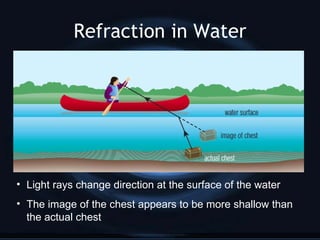
Refraction in Water Light rays change direction at the surface of the water The image of the chest appears to be more shallow than the actual chest
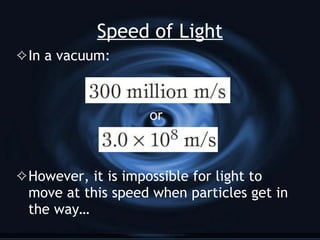
Speed of Light In a vacuum: However, it is impossible for light to move at this speed when particles get in the way… or
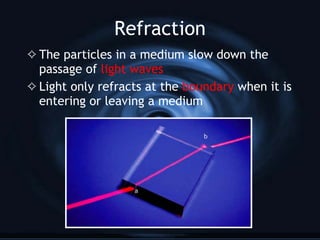
Refraction The particles in a medium slow down the passage of  light waves Light only refracts at the  boundary  when it is entering or leaving a medium
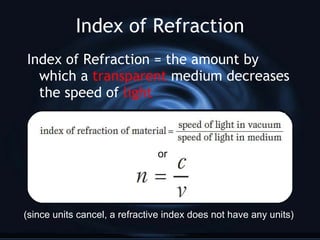
Index of Refraction Index of Refraction = the amount by which a  transparent  medium decreases the speed of  light (since units cancel, a refractive index does not have any units) or
 
Given : Speed of light in glass = 1.91 x 10 8  m/s Speed of light in vacuum = 3.00 x 10 8  m/s =  1.57 The refractive index is 1.57 = 3.00 x 10 8  m/s   1.91 x 10 8  m/s
Given : Refractive index in water = 1.33 Speed of light in a vacuum = 3.00 x 10 8  m/s v  = 2.26 x 10 8  m/s The speed of light in water is 2.26 x 10 8  m/s 1.33 = 3.00 x 10 8  m/s   v
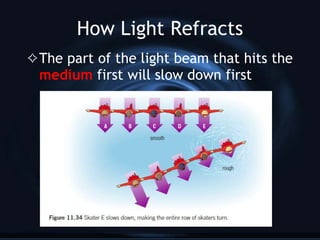
How Light Refracts The part of the light beam that hits the  medium  first will slow down first
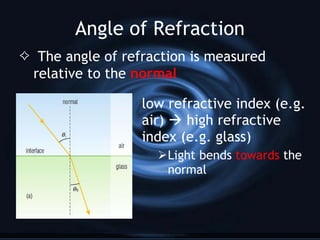
Angle of Refraction low refractive index (e.g. air)    high refractive index (e.g. glass) Light bends  towards  the normal The angle of refraction is measured relative to the  normal
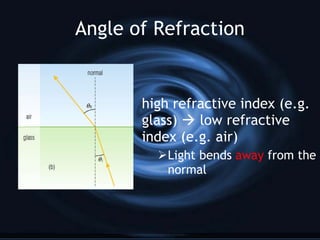
Angle of Refraction high refractive index (e.g. glass)    low refractive index (e.g. air) Light bends  away  from the normal
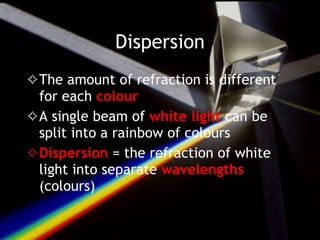
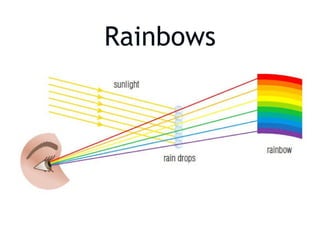
Dispersion The amount of refraction is different for each  colour A single beam of  white   light  can be split into a rainbow of colours Dispersion  = the refraction of white light into separate  wavelengths  (colours)
 
 
Rainbows
Rainbows

Refraction

  • 1.
  • 2.
    Refraction Although lighttravels in straight lines, it bends when it passes from one medium to another Medium (plural “media”) - the material that is being used or undergoing a process
  • 3.
    Refraction Refraction = the bending of light rays as they pass between two different media
  • 4.
    Refraction Refraction occursdue to changes in the speed of light in different mediums Different media slow down light by different amounts The more that light slows down, the more the light is refracted
  • 5.
    Refraction in WaterLight rays change direction at the surface of the water The image of the chest appears to be more shallow than the actual chest
  • 6.
    Speed of LightIn a vacuum: However, it is impossible for light to move at this speed when particles get in the way… or
  • 7.
    Refraction The particlesin a medium slow down the passage of light waves Light only refracts at the boundary when it is entering or leaving a medium
  • 8.
    Index of RefractionIndex of Refraction = the amount by which a transparent medium decreases the speed of light (since units cancel, a refractive index does not have any units) or
  • 9.
  • 10.
    Given : Speedof light in glass = 1.91 x 10 8 m/s Speed of light in vacuum = 3.00 x 10 8 m/s = 1.57 The refractive index is 1.57 = 3.00 x 10 8 m/s 1.91 x 10 8 m/s
  • 11.
    Given : Refractiveindex in water = 1.33 Speed of light in a vacuum = 3.00 x 10 8 m/s v = 2.26 x 10 8 m/s The speed of light in water is 2.26 x 10 8 m/s 1.33 = 3.00 x 10 8 m/s v
  • 12.
    How Light RefractsThe part of the light beam that hits the medium first will slow down first
  • 13.
    Angle of Refractionlow refractive index (e.g. air)  high refractive index (e.g. glass) Light bends towards the normal The angle of refraction is measured relative to the normal
  • 14.
    Angle of Refractionhigh refractive index (e.g. glass)  low refractive index (e.g. air) Light bends away from the normal
  • 15.
    Dispersion The amountof refraction is different for each colour A single beam of white light can be split into a rainbow of colours Dispersion = the refraction of white light into separate wavelengths (colours)
  • 16.
  • 17.
  • 18.
  • 19.