L E A R N I N G O B J E C T V I
J E N N Y H E
STANDING WAVES
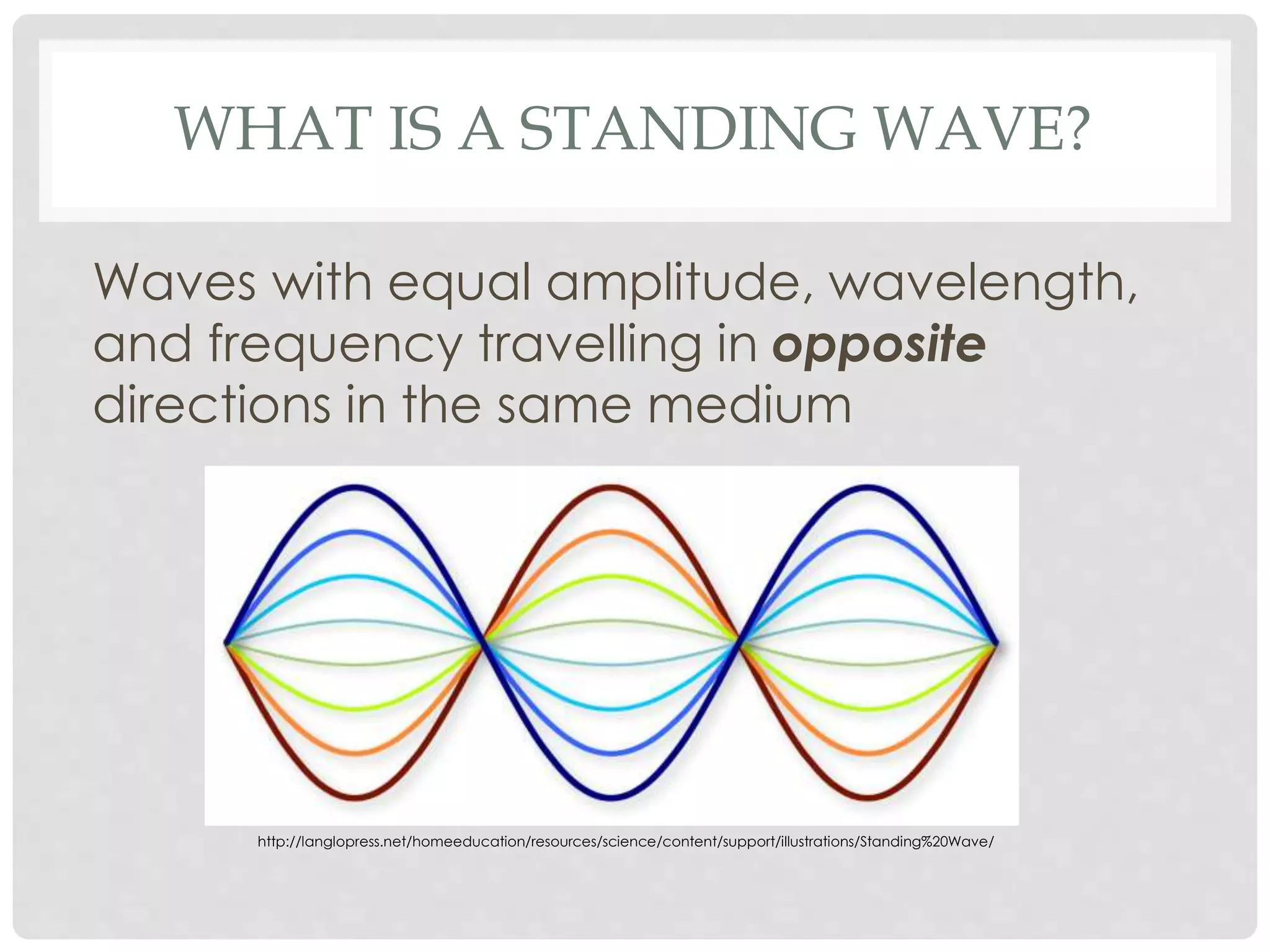
WHAT IS A STANDING WAVE?
Waves with equal amplitude, wavelength,
and frequency travelling in opposite
directions in the same medium
http://langlopress.net/homeeducation/resources/science/content/support/illustrations/Standing%20Wave/
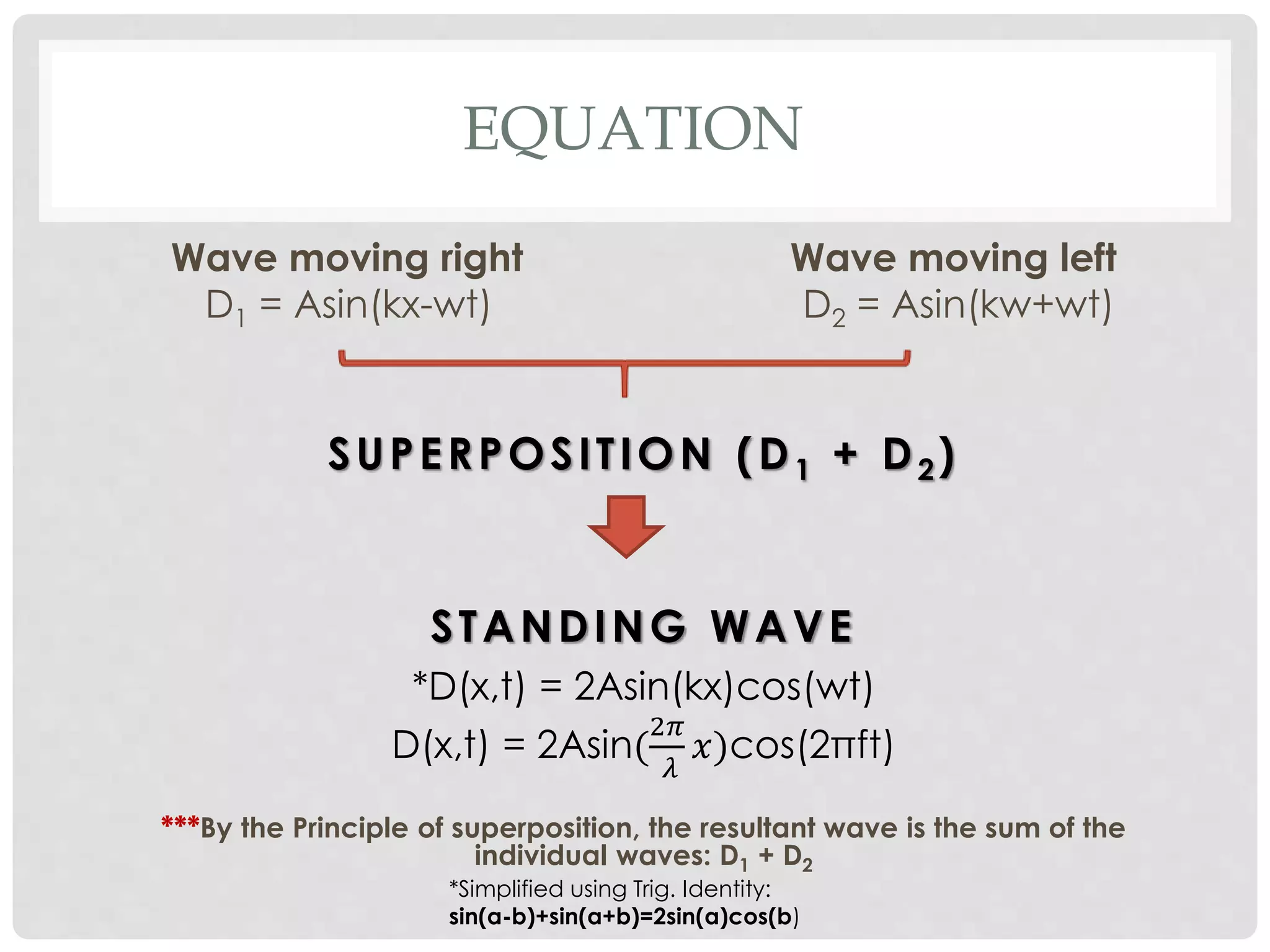
Wave moving right Wave moving left
D1 = Asin(kx-wt) D2 = Asin(kw+wt)
SUPERPOSITION (D1 + D2)
STANDING WAVE
*D(x,t) = 2Asin(kx)cos(wt)
D(x,t) = 2Asin(
2𝜋
𝜆
𝑥)cos(2πft)
***By the Principle of superposition, the resultant wave is the sum of the
individual waves: D1 + D2
EQUATION
*Simplified using Trig. Identity:
sin(a-b)+sin(a+b)=2sin(a)cos(b)
EQUATION APPLICATION
• According to the standing wave equation, there is a
position dependent amplitude:
A(x) = 2Asin(kx) = 2Asin(
2𝜋
𝜆
𝑥)
• So, we can simplify the standing wave equation to:
D(x,t) = A(x)cos(wt)
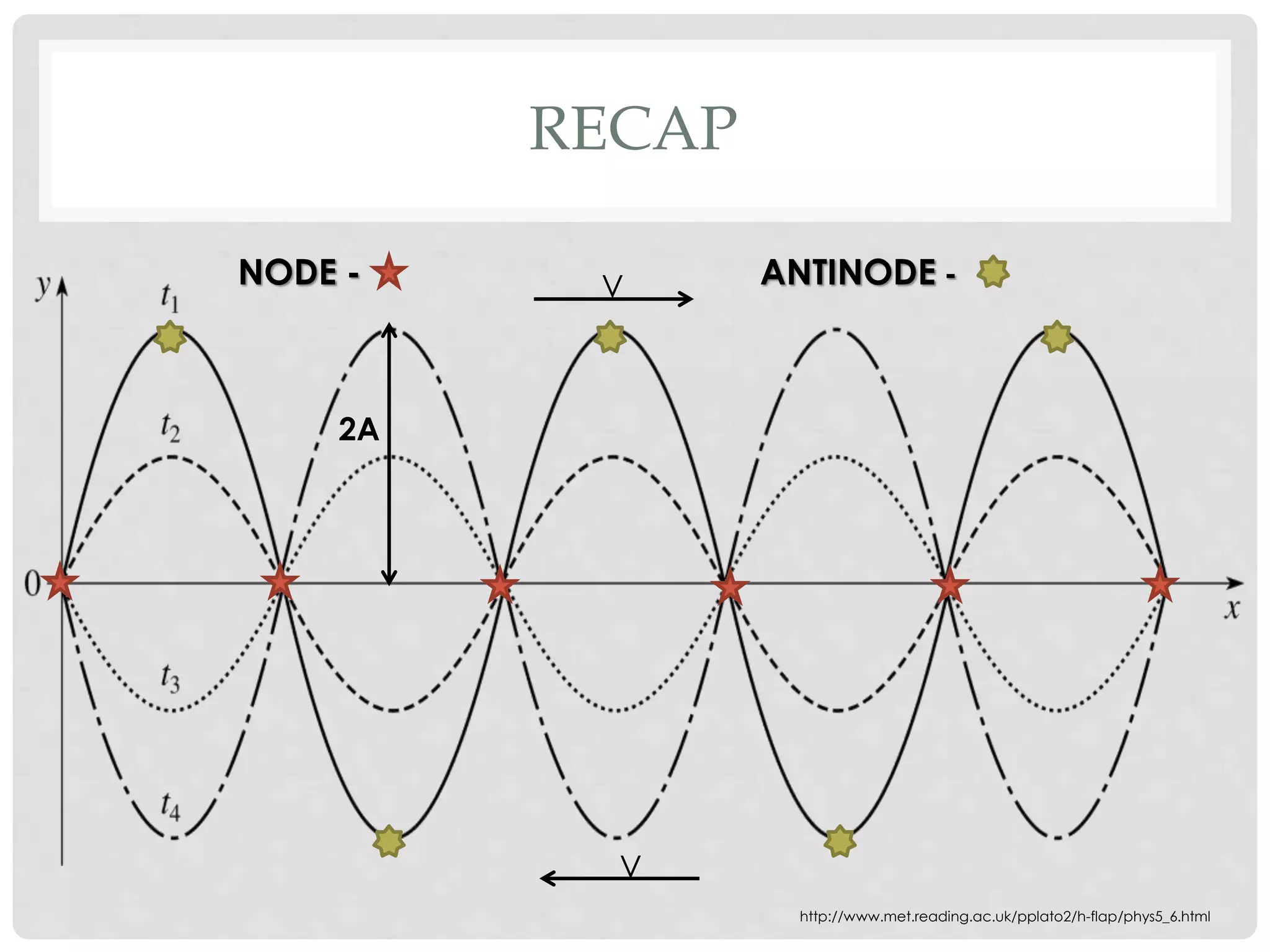
• When D(x,t) = 0 , there is zero amplitude and therefore
exists a NODE
• Similarly, when D(x,t) = 2A, this denotes maximum
amplitude and therefore exists an ANTINODE
WHERE ARE THEY LOCATED?
NODES
Occur at A(X)= 2Asin(
𝟐𝝅
𝝀
𝒙)= 0
Solving for x, we get
2𝜋
𝜆
x = 𝜋m, where m=0, ±1, ±2…
Simplify to get: x=m
𝜆
2
,
m=0, ±1, ±2…
So, nodes are found at
x= 0, ±
𝝀
𝟐
, ± 𝝀, ±
𝟑𝝀
𝟐
…
ANTINODES
Occur at A(X)= 2Asin(
𝟐𝝅
𝝀
𝐱)=2A
 Solving for x, we get
2𝜋
𝜆
x = (m+
1
2
)𝜋, m=0, ±1, ±2…
Simplify to get: x=(m+
1
2
)
𝝀
𝟐
m=0, ±1, ±2…
So, antinodes are found at
X= ±
𝝀
𝟒
, ±
𝟑𝝀
𝟒
, ±
𝟓𝝀
𝟒
…
RECAP
NODE - ANTINODE -
2A
V
V
http://www.met.reading.ac.uk/pplato2/h-flap/phys5_6.html
STANDING WAVES ON STRINGS
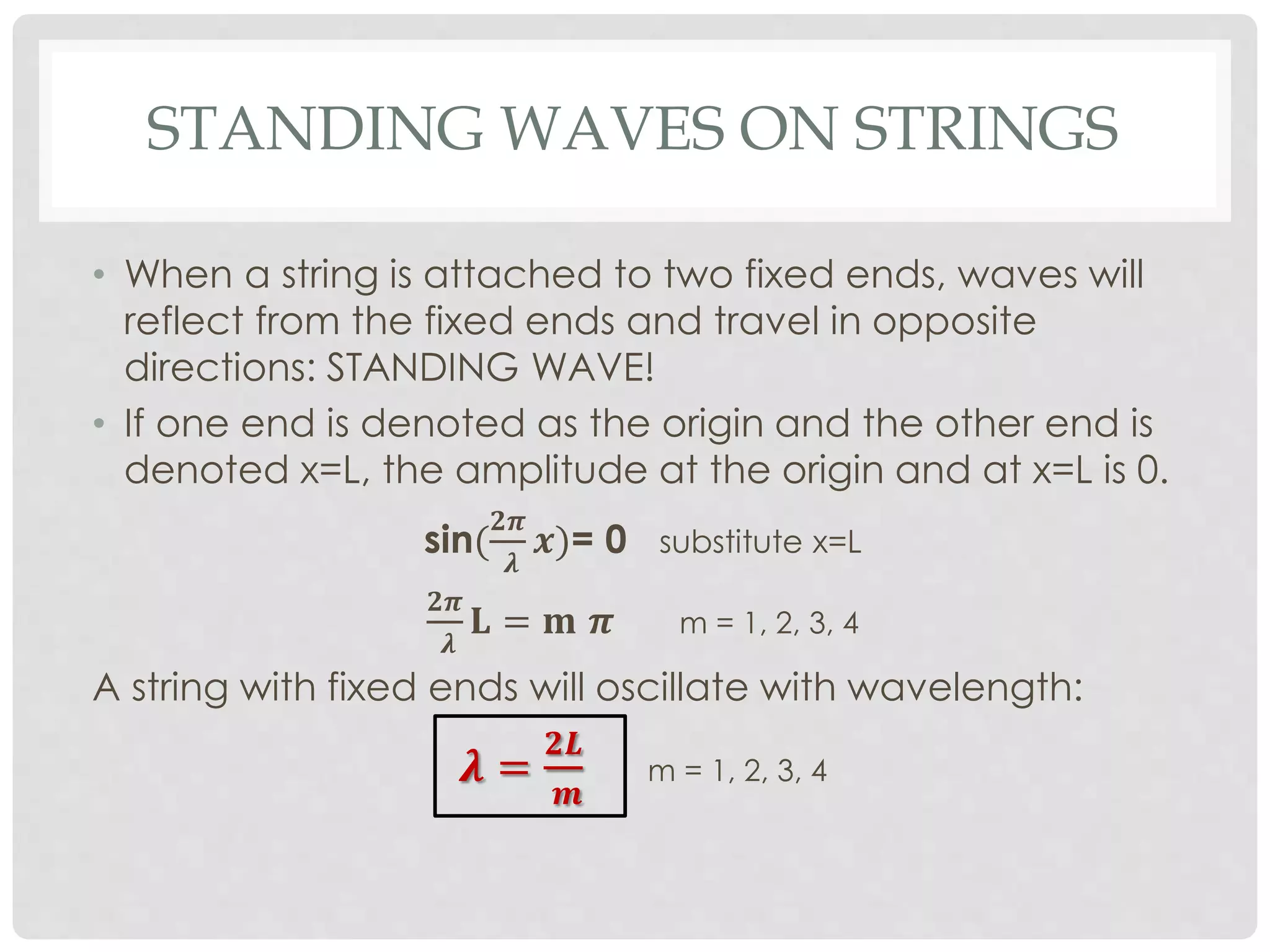
• When a string is attached to two fixed ends, waves will
reflect from the fixed ends and travel in opposite
directions: STANDING WAVE!
• If one end is denoted as the origin and the other end is
denoted x=L, the amplitude at the origin and at x=L is 0.
sin(
𝟐𝝅
𝝀
𝒙)= 0 substitute x=L
𝟐𝝅
𝝀
𝐋 = 𝐦 𝝅 m = 1, 2, 3, 4
A string with fixed ends will oscillate with wavelength:
𝝀 =
𝟐𝑳
𝒎
m = 1, 2, 3, 4
FUNDAMENTAL FREQUENCY
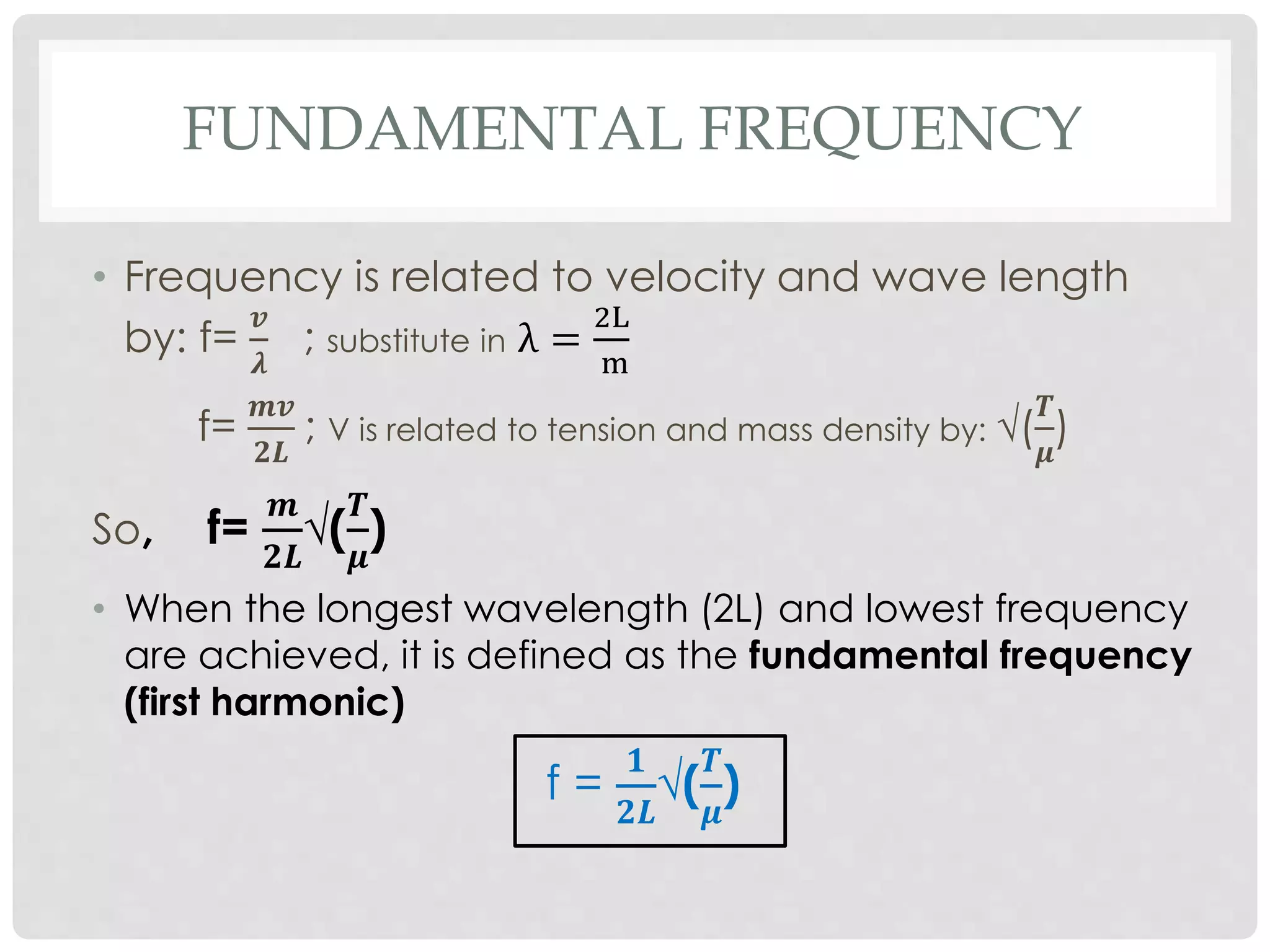
• Frequency is related to velocity and wave length
by: f=
𝒗
𝝀
; substitute in λ =
2L
m
f=
𝒎𝒗
𝟐𝑳
; V is related to tension and mass density by: √(
𝑻
𝝁
)
So, f=
𝒎
𝟐𝑳
√(
𝑻
𝝁
)
• When the longest wavelength (2L) and lowest frequency
are achieved, it is defined as the fundamental frequency
(first harmonic)
f =
𝟏
𝟐𝑳
√(
𝑻
𝝁
)
HARMONICS
• These standing waves are referred
as normal modes of vibration of a
string
• Higher frequencies are often
multiples of fundamental
frequency: fm = mf1 m=1, 2, 3,4…
• These frequencies are known as
harmonics or resonant
frequencies
Fundamental harmonic: f1
Second harmonic: 2f1
Third harmonic: 3f1
Fourth harmonic: 4f1
𝝀 1= 2L
𝝀2= L
𝝀3 =
𝟐𝑳
𝟑
http://hyperphysics.phy-astr.gsu.edu/hbase/waves/string.html
PRACTICE PROBLEMS
Q1:
A 65.0 cm long, 7.0 g string
harp string is strummed by
a harpist. It oscillates in its
m=4 mode of vibration with
a frequency of 200 Hz and
an amplitude of 5 cm.
Determine a) wavelength
of the wave and b) tension
in the string.
http://galleryhip.com/harpist-clipart.html
SOLUTION TO Q1
• First of all, we know that the
mode is m=4. Which equation will
allow us to determine the
wavelength?
 𝝀 =
𝟐𝑳
𝒎
 𝝀 =
𝟐𝑳
𝟒
=
𝐿
2
• We are given that the length of
string is 65.0 cm
 So 𝝀 =
𝐿
2
=
65.0𝑐𝑚
2
= 32.5 cm =
0.325 m
• Now we are asked to determine
the tension of the string. Which
equations will be useful to use?
 1. V= √(
𝑻
𝝁
) and 2. v= 𝝀f
• By rearranging the 1st equation,
we get T= V2 𝝁. Do we know
what v and 𝜇 are?
• Since we are given the mass
and length of string, we can
first determine 𝜇
• 𝜇 =
𝑚
𝐿
=
0.007 𝑘𝑔
0.65 𝑚
= 0.0108 kg/m
• Now we are only missing V.
What other information are we
given? We are given the
frequency, and we calculated
the wavelength in a. Therefore,
we can use v= 𝝀f relationship
SOLUTION TO Q1 (CONT.)
• v= 𝝀f = (0.325 m) (200 Hz) = 65.0 m/s
• Now we have all the required information to solve
for T= V2 𝝁
T = (65.0 m/s) 2 (0.0108 kg/m)
T = 45.6 N
PRACTICE PROBLEMS
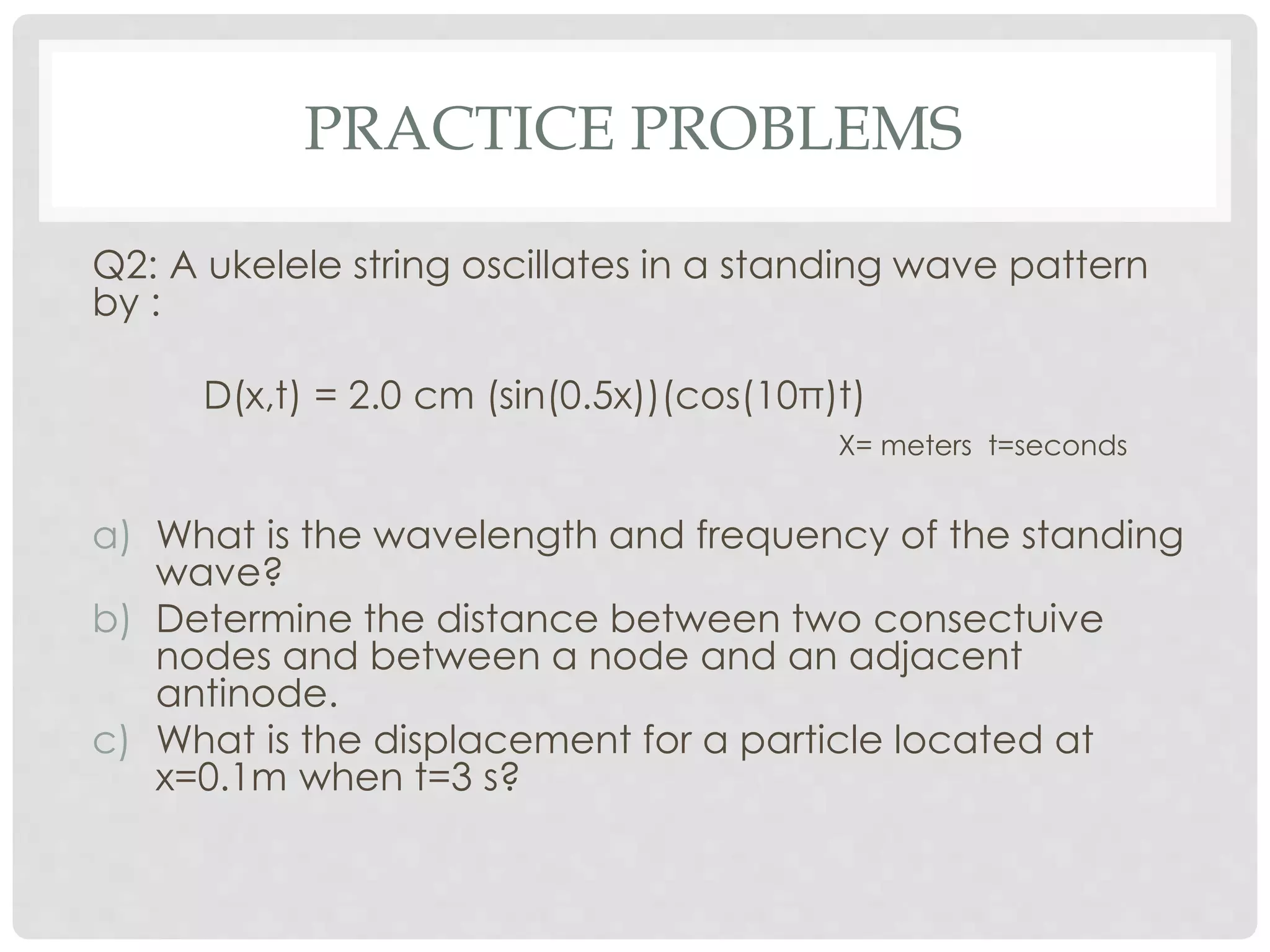
Q2: A ukelele string oscillates in a standing wave pattern
by :
D(x,t) = 2.0 cm (sin(0.5x))(cos(10π)t)
X= meters t=seconds
a) What is the wavelength and frequency of the standing
wave?
b) Determine the distance between two consectuive
nodes and between a node and an adjacent
antinode.
c) What is the displacement for a particle located at
x=0.1m when t=3 s?
SOLUTION TO Q2
a) To determine the wavelength,
we can use the relationship: k=
2𝜋
𝝀
From the given equation, we
know k=0.5 rad/m
So, 𝝀=
2𝜋
0.5
= 4πm
Next, we know the value of w
from the equation, so we can use
w= 2 𝜋 f to solve for frequency.
f=
𝑤
2𝜋
=
10𝜋
2𝜋
= 5.0 Hz
b) The distance between two
consecutive nodes is half a
wavelength. Knowing this, we
can divide the wavelength
calculated in part a by two
4𝜋
2
= 2π m
The distance between two
consecutive antinodes is quarter
of a wavelength. Therefore, we
can multiply ¼ to 4 𝜋 and we get
𝜋 m.
SOLUTION TO Q2 (CONT.)
c) The given equations is:
D(x,t) = 2.0 cm (sin(0.5x))(cos(10π)t)
To evaluate the displacement at x=0.1m and t=3.0 s,
we simply plug in the values into the given equation.
D(0.1m, 3.0s) = 0.02 m[sin(0.5(0.1m))][cos(10π(3s))]
= 0.00099958…
= 0.001 m or 1 mm

Standing waves

  • 1.
    L E AR N I N G O B J E C T V I J E N N Y H E STANDING WAVES
  • 2.
    WHAT IS ASTANDING WAVE? Waves with equal amplitude, wavelength, and frequency travelling in opposite directions in the same medium http://langlopress.net/homeeducation/resources/science/content/support/illustrations/Standing%20Wave/
  • 3.
    Wave moving rightWave moving left D1 = Asin(kx-wt) D2 = Asin(kw+wt) SUPERPOSITION (D1 + D2) STANDING WAVE *D(x,t) = 2Asin(kx)cos(wt) D(x,t) = 2Asin( 2𝜋 𝜆 𝑥)cos(2πft) ***By the Principle of superposition, the resultant wave is the sum of the individual waves: D1 + D2 EQUATION *Simplified using Trig. Identity: sin(a-b)+sin(a+b)=2sin(a)cos(b)
  • 4.
    EQUATION APPLICATION • Accordingto the standing wave equation, there is a position dependent amplitude: A(x) = 2Asin(kx) = 2Asin( 2𝜋 𝜆 𝑥) • So, we can simplify the standing wave equation to: D(x,t) = A(x)cos(wt) • When D(x,t) = 0 , there is zero amplitude and therefore exists a NODE • Similarly, when D(x,t) = 2A, this denotes maximum amplitude and therefore exists an ANTINODE
  • 5.
    WHERE ARE THEYLOCATED? NODES Occur at A(X)= 2Asin( 𝟐𝝅 𝝀 𝒙)= 0 Solving for x, we get 2𝜋 𝜆 x = 𝜋m, where m=0, ±1, ±2… Simplify to get: x=m 𝜆 2 , m=0, ±1, ±2… So, nodes are found at x= 0, ± 𝝀 𝟐 , ± 𝝀, ± 𝟑𝝀 𝟐 … ANTINODES Occur at A(X)= 2Asin( 𝟐𝝅 𝝀 𝐱)=2A  Solving for x, we get 2𝜋 𝜆 x = (m+ 1 2 )𝜋, m=0, ±1, ±2… Simplify to get: x=(m+ 1 2 ) 𝝀 𝟐 m=0, ±1, ±2… So, antinodes are found at X= ± 𝝀 𝟒 , ± 𝟑𝝀 𝟒 , ± 𝟓𝝀 𝟒 …
  • 6.
    RECAP NODE - ANTINODE- 2A V V http://www.met.reading.ac.uk/pplato2/h-flap/phys5_6.html
  • 7.
    STANDING WAVES ONSTRINGS • When a string is attached to two fixed ends, waves will reflect from the fixed ends and travel in opposite directions: STANDING WAVE! • If one end is denoted as the origin and the other end is denoted x=L, the amplitude at the origin and at x=L is 0. sin( 𝟐𝝅 𝝀 𝒙)= 0 substitute x=L 𝟐𝝅 𝝀 𝐋 = 𝐦 𝝅 m = 1, 2, 3, 4 A string with fixed ends will oscillate with wavelength: 𝝀 = 𝟐𝑳 𝒎 m = 1, 2, 3, 4
  • 8.
    FUNDAMENTAL FREQUENCY • Frequencyis related to velocity and wave length by: f= 𝒗 𝝀 ; substitute in λ = 2L m f= 𝒎𝒗 𝟐𝑳 ; V is related to tension and mass density by: √( 𝑻 𝝁 ) So, f= 𝒎 𝟐𝑳 √( 𝑻 𝝁 ) • When the longest wavelength (2L) and lowest frequency are achieved, it is defined as the fundamental frequency (first harmonic) f = 𝟏 𝟐𝑳 √( 𝑻 𝝁 )
  • 9.
    HARMONICS • These standingwaves are referred as normal modes of vibration of a string • Higher frequencies are often multiples of fundamental frequency: fm = mf1 m=1, 2, 3,4… • These frequencies are known as harmonics or resonant frequencies Fundamental harmonic: f1 Second harmonic: 2f1 Third harmonic: 3f1 Fourth harmonic: 4f1 𝝀 1= 2L 𝝀2= L 𝝀3 = 𝟐𝑳 𝟑 http://hyperphysics.phy-astr.gsu.edu/hbase/waves/string.html
  • 10.
    PRACTICE PROBLEMS Q1: A 65.0cm long, 7.0 g string harp string is strummed by a harpist. It oscillates in its m=4 mode of vibration with a frequency of 200 Hz and an amplitude of 5 cm. Determine a) wavelength of the wave and b) tension in the string. http://galleryhip.com/harpist-clipart.html
  • 11.
    SOLUTION TO Q1 •First of all, we know that the mode is m=4. Which equation will allow us to determine the wavelength?  𝝀 = 𝟐𝑳 𝒎  𝝀 = 𝟐𝑳 𝟒 = 𝐿 2 • We are given that the length of string is 65.0 cm  So 𝝀 = 𝐿 2 = 65.0𝑐𝑚 2 = 32.5 cm = 0.325 m • Now we are asked to determine the tension of the string. Which equations will be useful to use?  1. V= √( 𝑻 𝝁 ) and 2. v= 𝝀f • By rearranging the 1st equation, we get T= V2 𝝁. Do we know what v and 𝜇 are? • Since we are given the mass and length of string, we can first determine 𝜇 • 𝜇 = 𝑚 𝐿 = 0.007 𝑘𝑔 0.65 𝑚 = 0.0108 kg/m • Now we are only missing V. What other information are we given? We are given the frequency, and we calculated the wavelength in a. Therefore, we can use v= 𝝀f relationship
  • 12.
    SOLUTION TO Q1(CONT.) • v= 𝝀f = (0.325 m) (200 Hz) = 65.0 m/s • Now we have all the required information to solve for T= V2 𝝁 T = (65.0 m/s) 2 (0.0108 kg/m) T = 45.6 N
  • 13.
    PRACTICE PROBLEMS Q2: Aukelele string oscillates in a standing wave pattern by : D(x,t) = 2.0 cm (sin(0.5x))(cos(10π)t) X= meters t=seconds a) What is the wavelength and frequency of the standing wave? b) Determine the distance between two consectuive nodes and between a node and an adjacent antinode. c) What is the displacement for a particle located at x=0.1m when t=3 s?
  • 14.
    SOLUTION TO Q2 a)To determine the wavelength, we can use the relationship: k= 2𝜋 𝝀 From the given equation, we know k=0.5 rad/m So, 𝝀= 2𝜋 0.5 = 4πm Next, we know the value of w from the equation, so we can use w= 2 𝜋 f to solve for frequency. f= 𝑤 2𝜋 = 10𝜋 2𝜋 = 5.0 Hz b) The distance between two consecutive nodes is half a wavelength. Knowing this, we can divide the wavelength calculated in part a by two 4𝜋 2 = 2π m The distance between two consecutive antinodes is quarter of a wavelength. Therefore, we can multiply ¼ to 4 𝜋 and we get 𝜋 m.
  • 15.
    SOLUTION TO Q2(CONT.) c) The given equations is: D(x,t) = 2.0 cm (sin(0.5x))(cos(10π)t) To evaluate the displacement at x=0.1m and t=3.0 s, we simply plug in the values into the given equation. D(0.1m, 3.0s) = 0.02 m[sin(0.5(0.1m))][cos(10π(3s))] = 0.00099958… = 0.001 m or 1 mm

Editor's Notes

  • #14 Wavelength: 2pi/lambda = k = 0.5rad/m so labmda = 2pi/0.5 = 4pi Frequency: w=2pif From equ, w=10pi=2pif, so f=5HZ