STANDING WAVES ON STRINGS
PHYSICS 101
SECTION 226
MARCH.8/2015
Learning Object 6
What is a Standing Wave?
 A standing wave is when you combine two harmonic waves that have the same
amplitude, frequency, and wavelength as each other but they need to be
traveling in opposite directions than each other.
 The two waves have the wave function:
D(x,t) = A sin(kx±ωt)
 + ωt is when the wave is moving in the negative x direction
 - ωt is when the wave is moving in the positive x direction
The resulting wave function of the 2 waves moving in opposite directions is:
D(x,t) = D1 (x,t) + = D2 (x,t)
= A sin [sin(kx-ωt)+sin(kx+ωt)]
Using trigonometry, the wave function becomes:
D(x,t) = 2A sin(kx) cos (ωt)
Note: This wave function equation describes a standing wave.
What is a Node and Antinode?
 A node is a point on a standing wave on a string that
has an amplitude of zero and is therefore at rest.
Nodes have these characteristics at all times.
 An antinode is a point on a standing wave on a
string that has the maximum amplitude that it can.
The maximum amplitude is ±2A (as shown in the
wave function on the previous slide).
What is a Harmonic and Harmonic Number of a
Standing Wave on a String?
 A harmonic refers to the allowed frequency of a
wave that is a whole number multiple of the
fundamental (reference) frequency of a wave.
 The fundamental frequency is the frequency that
gives the longest wavelength of 2L. It is also called
the first harmonic.
 A harmonic is also called a resonant frequency.
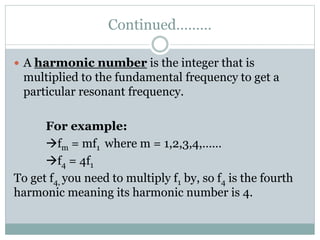
Continued………
 A harmonic number is the integer that is
multiplied to the fundamental frequency to get a
particular resonant frequency.
For example:
fm = mf1 where m = 1,2,3,4,……
f4 = 4f1
To get f4, you need to multiply f1 by, so f4 is the fourth
harmonic meaning its harmonic number is 4.
Wavelengths of a Standing Wave on a String
With Both Ends Fixed
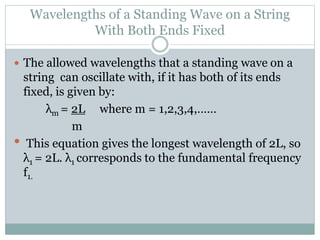
 The allowed wavelengths that a standing wave on a
string can oscillate with, if it has both of its ends
fixed, is given by:
λm = 2L where m = 1,2,3,4,……
m
• This equation gives the longest wavelength of 2L, so
λ1 = 2L. λ1 corresponds to the fundamental frequency
f1.
How is the number of antinodes in a standing wave on a string
with fixed ends equal to the harmonic number of that standing
wave?
Note: To explain this, I am going to use an example.
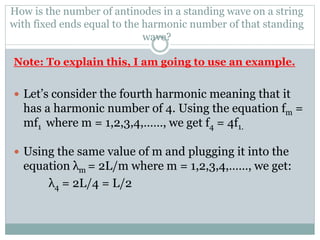
 Let’s consider the fourth harmonic meaning that it
has a harmonic number of 4. Using the equation fm =
mf1 where m = 1,2,3,4,……, we get f4 = 4f1.
 Using the same value of m and plugging it into the
equation λm = 2L/m where m = 1,2,3,4,……, we get:
λ4 = 2L/4 = L/2
Continued……
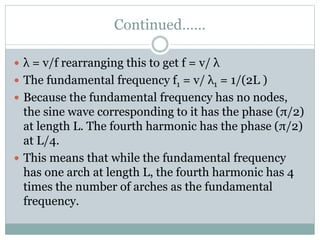
 λ = v/f rearranging this to get f = v/ λ
 The fundamental frequency f1 = v/ λ1 = 1/(2L )
 Because the fundamental frequency has no nodes,
the sine wave corresponding to it has the phase (π/2)
at length L. The fourth harmonic has the phase (π/2)
at L/4.
 This means that while the fundamental frequency
has one arch at length L, the fourth harmonic has 4
times the number of arches as the fundamental
frequency.
Continued……
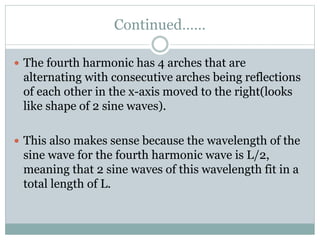
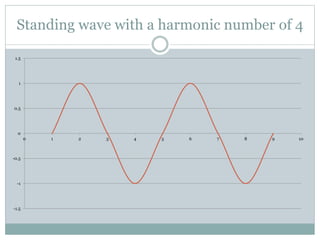
 The fourth harmonic has 4 arches that are
alternating with consecutive arches being reflections
of each other in the x-axis moved to the right(looks
like shape of 2 sine waves).
 This also makes sense because the wavelength of the
sine wave for the fourth harmonic wave is L/2,
meaning that 2 sine waves of this wavelength fit in a
total length of L.
Continued……
 Since each sine wave has an amplitude at (π/2), each sine
wave reaches its amplitude at 2 points (π/2) and (3π/2).
Therefore, 2 sine waves reach the amplitude at 4 points.
 These four points are written in terms of the length L and
in radians:
1) L/8 = (π/2)
2) 3L/8 = (3π/2)
3) 5L/8 = (5π/2)
4) 7L/8 = (7π/2)
Continued……
 4 arches = 4 antinodes because the antinodes are
located at the point of greatest displacement of each
arch so there are 4 such points for 4 arches.
 Because an antinode is a point on a standing wave on
a string that has the maximum
amplitude(greatest displacement on an arch),
there are 4 antinodes.
Standing wave with a harmonic number of 4
-1.5
-1
-0.5
0
0.5
1
1.5
0 1 2 3 4 5 6 7 8 9 10
Description of Graph
• The points at 2, 4, 6, and 8 on the x-axis correspond
to the amplitudes at L/8 = (π/2), 3L/8 = (3π/2),
5L/8 = (5π/2), and 7L/8 = (7π/2) respectively. This
is where the antinodes are located.

Learning Object 6

  • 1.
    STANDING WAVES ONSTRINGS PHYSICS 101 SECTION 226 MARCH.8/2015 Learning Object 6
  • 2.
    What is aStanding Wave?  A standing wave is when you combine two harmonic waves that have the same amplitude, frequency, and wavelength as each other but they need to be traveling in opposite directions than each other.  The two waves have the wave function: D(x,t) = A sin(kx±ωt)  + ωt is when the wave is moving in the negative x direction  - ωt is when the wave is moving in the positive x direction The resulting wave function of the 2 waves moving in opposite directions is: D(x,t) = D1 (x,t) + = D2 (x,t) = A sin [sin(kx-ωt)+sin(kx+ωt)] Using trigonometry, the wave function becomes: D(x,t) = 2A sin(kx) cos (ωt) Note: This wave function equation describes a standing wave.
  • 3.
    What is aNode and Antinode?  A node is a point on a standing wave on a string that has an amplitude of zero and is therefore at rest. Nodes have these characteristics at all times.  An antinode is a point on a standing wave on a string that has the maximum amplitude that it can. The maximum amplitude is ±2A (as shown in the wave function on the previous slide).
  • 4.
    What is aHarmonic and Harmonic Number of a Standing Wave on a String?  A harmonic refers to the allowed frequency of a wave that is a whole number multiple of the fundamental (reference) frequency of a wave.  The fundamental frequency is the frequency that gives the longest wavelength of 2L. It is also called the first harmonic.  A harmonic is also called a resonant frequency.
  • 5.
    Continued………  A harmonicnumber is the integer that is multiplied to the fundamental frequency to get a particular resonant frequency. For example: fm = mf1 where m = 1,2,3,4,…… f4 = 4f1 To get f4, you need to multiply f1 by, so f4 is the fourth harmonic meaning its harmonic number is 4.
  • 6.
    Wavelengths of aStanding Wave on a String With Both Ends Fixed  The allowed wavelengths that a standing wave on a string can oscillate with, if it has both of its ends fixed, is given by: λm = 2L where m = 1,2,3,4,…… m • This equation gives the longest wavelength of 2L, so λ1 = 2L. λ1 corresponds to the fundamental frequency f1.
  • 7.
    How is thenumber of antinodes in a standing wave on a string with fixed ends equal to the harmonic number of that standing wave? Note: To explain this, I am going to use an example.  Let’s consider the fourth harmonic meaning that it has a harmonic number of 4. Using the equation fm = mf1 where m = 1,2,3,4,……, we get f4 = 4f1.  Using the same value of m and plugging it into the equation λm = 2L/m where m = 1,2,3,4,……, we get: λ4 = 2L/4 = L/2
  • 8.
    Continued……  λ =v/f rearranging this to get f = v/ λ  The fundamental frequency f1 = v/ λ1 = 1/(2L )  Because the fundamental frequency has no nodes, the sine wave corresponding to it has the phase (π/2) at length L. The fourth harmonic has the phase (π/2) at L/4.  This means that while the fundamental frequency has one arch at length L, the fourth harmonic has 4 times the number of arches as the fundamental frequency.
  • 9.
    Continued……  The fourthharmonic has 4 arches that are alternating with consecutive arches being reflections of each other in the x-axis moved to the right(looks like shape of 2 sine waves).  This also makes sense because the wavelength of the sine wave for the fourth harmonic wave is L/2, meaning that 2 sine waves of this wavelength fit in a total length of L.
  • 10.
    Continued……  Since eachsine wave has an amplitude at (π/2), each sine wave reaches its amplitude at 2 points (π/2) and (3π/2). Therefore, 2 sine waves reach the amplitude at 4 points.  These four points are written in terms of the length L and in radians: 1) L/8 = (π/2) 2) 3L/8 = (3π/2) 3) 5L/8 = (5π/2) 4) 7L/8 = (7π/2)
  • 11.
    Continued……  4 arches= 4 antinodes because the antinodes are located at the point of greatest displacement of each arch so there are 4 such points for 4 arches.  Because an antinode is a point on a standing wave on a string that has the maximum amplitude(greatest displacement on an arch), there are 4 antinodes.
  • 12.
    Standing wave witha harmonic number of 4 -1.5 -1 -0.5 0 0.5 1 1.5 0 1 2 3 4 5 6 7 8 9 10
  • 13.
    Description of Graph •The points at 2, 4, 6, and 8 on the x-axis correspond to the amplitudes at L/8 = (π/2), 3L/8 = (3π/2), 5L/8 = (5π/2), and 7L/8 = (7π/2) respectively. This is where the antinodes are located.